[T]he elections on November 7th will have enormous consequences for this nation, one way or the other. In all the decisions that will come in the next two years, it's going to matter a great deal which party has the majority on the floor and the gavel in committee. And I don't need to tell you what kind of legislation would come to us by way of committee chairmen like Joe Biden, Ted Kennedy, John Conyers, Henry Waxman, Barney Frank, or Jay Rockefeller.
—Vice President Dick Cheney at fundraiser for Jim Ryun (R-KS) Topeka, Kansas (October 12, 2006)
During the 2006 campaign, many on the political right expressed anxiety about the slate of Democratic representatives and senators poised to become committee chairs in the event of a Democratic victory. After the election, despite post-election promises of “unity” and “bipartisanship” among congressional Democrats, the question remained: How well would this progressive group of “old bulls” work with the new majority, the existence of which was due in part to the 61 Democrats representing House districts that President George W. Bush won in 2004? (Greenblatt 2007, 524) In this paper, we investigate the claim that Democratic committee leaders in the 110th Congress are out of step with their party caucus by comparing the ideological leadership profiles of chairs in the 110th Congress with those of their Republican predecessors in the 109th, as well as those of Democratic chairs from the “Textbook,” “Reform,” and early “Post-reform” eras. We show that Democratic chairs in the 110th Congress are primarily drawn from the most liberal ranks of the Democratic Caucus, particularly in the House. Furthermore, this pattern of committee leadership selection is not the result of aggressive party leaders attempting to “grease the skids” for their favored legislation. Instead, the liberal cohort of committee chairs reflects the changing ideological face of seniority among congressional Democrats.
In his classic piece, “The Changing Textbook Congress,” Kenneth Shepsle (1989) argues that in the “Textbook Congress” of the 1950s, conservative Southern Democrats were disproportionately powerful within the Congress because a disproportionate number of them had risen to the ranks of committee chairmanships. Conservative Southerners were advantaged in the Textbook Congress, of course, because the norm of seniority was the path to the chairmanship of committees and Southern Democrats were more electorally secure than their non-Southern counterparts. As Shepsle argues, the disjunction between the policy preferences of these powerful committee barons and the policy preferences of the majority of the Democratic Caucus ultimately led to a wave of institutional reform that saw significant power shift from committee leaders down to subcommittees and rank-and-file members and from committee leaders up to party leaders (see also Rohde 1991). But, in the wake of these reforms, the norm of seniority that guides the selection of committee chairs, at least within the Democratic Caucus, was left largely unchanged. Upon assuming majority status in the 104th Congress, Republican leaders violated the norm of seniority in a number of cases but, assuming power for the first time in 12 years, Democratic leaders in the 110th Congress have not followed their lead. Republican leaders also instituted term limits for chairs and congressional Democrats have followed suit. However, term limits further cement incentives for members: longevity of service on individual committees, combined with the electoral security necessary for continual service, eventually leads patient committee members to a full committee chairmanship.
While Richard Cohen (1999) correctly points out that committees are no longer the key center of action that they once were, committee chairs in both chambers remain key players in the policymaking process because of the jurisdictional rights and markup authority committees retain, the agenda setting and resource allocation powers chairs command in their committees, and the power chairs still have on the floor and in conference committees. Furthermore, the personal policy and political goals of committee chairs emerge as important factors in understanding the organization and operation of committees (Reeves 1993) and the outcomes they produce (Strahan 1990; Evans 1991). Finally, as the longstanding legislative collaboration of Judiciary Committee colleagues and ideological polar opposites Orrin Hatch (R-UT) and Edward Kennedy (D-MA) illustrates, committees may foster bipartisan cooperation in ways the broader political milieu does not. As CQ Weekly's Rebecca Kimitch (2007, 1080) argues, “Although tense debates sometimes erupt, committees are still the venues for at least occasionally productive conversations across party lines.” To paraphrase Vice President Cheney, committee chairs matter, and it matters who the committee chairs are.
Our central argument is that because the norm of seniority remains the primary path to committee chairmanships and because the ideological face of seniority in the Democratic Party has changed since the heyday of the Textbook Congress, those most likely to acquire the power of full committee chairmanships are more likely than ever to be drawn from the more liberal wing of the Democratic Caucus. Below, we document a long-term power shift within committees from the Textbook Congress, where moderate and conservative Democrats disproportionately held committee chairmanships, to the 110th Congress, where those drawn from the more liberal wing of the Democratic Caucus hold the reins of committee power. Importantly, we frame this transition within the Democratic Party as a result of the greater electoral security of those from this more “extreme” wing of the party rather than being the result of the enhanced power of more ideologically extreme party leaders.
Who Are the Chairs in the 110th Congress?
Unlike the Republican takeover in the 104th Congress (1995–1996), the Democratic takeover in the 110th Congress was not marked by several moves by the party leadership to hand significant committee chairmanships to less-senior ideologues instead of ranking members. The only violation of the norm of seniority in the selection of full committee chairs was the elevation to chairman of Rep. Silvestre Reyes (D-TX), the third-most-senior member on the House Intelligence Committee. However, the circumstances on Intelligence in 2007—Speaker Nancy Pelosi's (CA) well-documented personal conflict with the panel's ranking Democrat, Rep. Jane Harman (D-CA), and the potential political costs of naming the committee's number two Democrat, impeached federal judge Alcee Hastings (D-FL), as chair—suggest that Intelligence might best be treated as the exception that proves the rule in 2007.
As a group, the Democratic House chairs in the 110th Congress were noticeably more diverse than their Republican counterparts in the 109th. While all 20 of the Republican House chairs in the 109th Congress were white males, the 20 chairs named at the beginning of the 110th Congress included four African Americans and two Hispanics, and three of the 20 were female.1
The four African-American House committee chairs at the beginning of the 110th Congress were John Conyers (D-MI) of Judiciary, Charles Rangel (D-NY) of Ways and Means, Bennie Thompson (D-MS) of Homeland Security, and Juanita Millender-McDonald (D-CA) of House Administration. Millender-McDonald died on April 22, 2007, at which point her chairmanship fell to the next most-senior member of the committee, Robert Brady (D-PA). The two Hispanic chairs are Silvestre Reyes (D-TX) of Intelligence and Nydia Velasquez (D-NY) of Small Business. In addition to Millender-McDonald and Velasquez, the other female committee chair was Louise Slaughter (D-NY) of Rules. We exclude the Ethics Committee, chaired by Stephanie Tubbs Jones (D-OH), from all of our calculations.
Susan Collins (R-ME) of Homeland Security and Governmental Affairs and Olympia Snowe (R-ME) of Small Business were replaced by Barbara Boxer (D-CA) of Environment and Public Works and Dianne Feinstein (D-CA) of Rules.
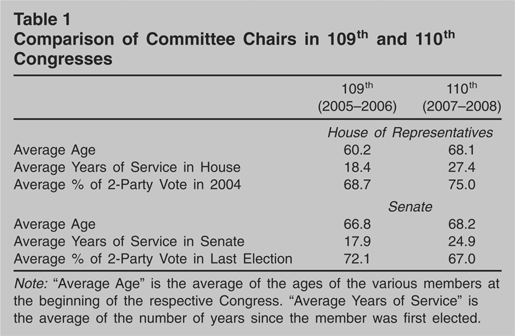
Comparison of Committee Chairs in 109th and 110th Congresses

In order to make an “apples-to-apples”3
We could have used 2006 numbers for the new House Democratic chairs in the 110th Congress (and 1994 numbers for new GOP chairs in the 104th Congress) but the various factors that made 2006 (and 1994) an unusual election year weighed heavily against doing so. Not surprisingly, the average percentage of the two-party vote in the 2006 election for Democratic House chairs was much higher (79.3%).
While Democratic chairs in the 110th Congress received, on average, only a slightly larger percentage of the two-party vote in 2004 than others in their caucus (74.9% vs. 73.0%), this small difference radically understates the difference between chairs and all other members of the caucus, as it excludes those who retired, resigned, or were defeated in the primary or general elections in either 2004 or 2006. Additionally, just one of the 20 Democrats who would become chairs in the 110th Congress received less than 60% of the two-party vote in 2004, and that was Bennie Thompson (D-MS), who received 59%. In contrast, a full 15% of the Democratic Caucus received less than 60% of the two-party vote in that election. Democratic committee chairs were not characterized by electoral vulnerability.
Partisan Middlemen, Extremists, and Committee Leadership Selection
In 1963, Samuel Patterson investigated the ideological postures of party and committee leaders in the 80th (1947–1948) and 87th (1961–1962) Senates, the 1957 Wisconsin Assembly, and the 1959 Oklahoma House of Representatives, pitting Truman's (1959) “partisan middleman” hypothesis against MacRae's (1956) “extremity” hypothesis. While Patterson concedes that his data yield “no generally uniform relationship between leadership status and ideological position” (410), he did find that the modal profile assumed by committee leaders in these legislatures was that of “partisan middleman” (1963, 403–5, 409). Twenty years later, taking advantage of newly-available data on committee voting, Joseph Unekis and Leroy Rieselbach (1983) extended Patterson's study into the Post-reform era, investigating the ideological profiles of committee chairs in the House and Senate. Noting that the coalition building strategy employed by Truman's “partisan middleman” is still fundamentally partisan in nature, Unekis and Rieselbach identify a third potential profile derived from Fenno's (1973) work on congressional committees—that of the “bipartisan consensual leader” (253). In contrast with the “partisan middleman,” who attempts to build support for his proposals among the various members of his party caucus, the bipartisan consensual leader relies on members of the other party to build majorities: “[h]ere, the chairperson will try to build general support for committee positions, drawing votes from wherever they are available” (253). Like Patterson, Unekis and Rieselbach find that the modal profile assumed by chairs in the Congresses they analyze was that of “partisan middleman” (1983, 258).
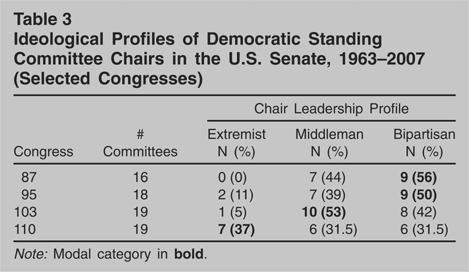
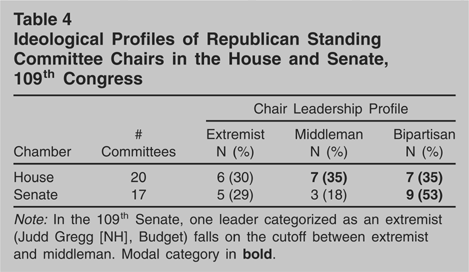
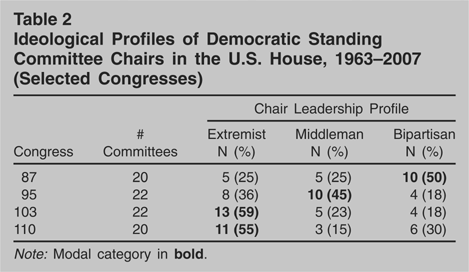
In this section, we update these two studies, categorizing committee chairs in the 110th Congress using Unekis and Rieselbach's three-part scheme as a guide. We categorized all House and Senate committee chairs in the 87th, 95th (1977–1978), 103rd, and 110th Congresses using Keith Poole's common space estimates (Poole 1998; 2004).4
Common space estimates (Poole 1998; 2004) “place the members of the House and Senate in the same space,” thus allowing “members to be compared across Chambers and across Congresses” (2004). Chairs who fell in the outer-most third of their party caucus (left for Democrats and right for Republicans) were categorized as “extremists”; chairs who fell in the middle third of their party caucus were categorized as “partisan middlemen”; and, chairs who fell in the inner-most third of the caucus were categorized as having a “bipartisan consensual” leadership profile. Some of the data on committee chairs in the 87th, 95th, and 103rd Congresses were taken from Nelson (N.d.) and Stewart and Woon (2005).
House difference significant at p < .0001 (t = 7.84). Senate difference significant at p < .05 (one-tailed test; t = 1.73).
Ideological Profiles of Democratic Standing Committee Chairs in the U.S. House, 1963–2007 (Selected Congresses)
Ideological Profiles of Democratic Standing Committee Chairs in the U.S. Senate, 1963–2007 (Selected Congresses)

Ideological Profiles of Republican Standing Committee Chairs in the House and Senate, 109th Congress

One pattern some may find surprising is that Republican House committee chairs in the 109th Congress were drawn almost equally from each wing of the legislative party, and Republican Senate committee chairs were drawn disproportionately from the “bipartisan consensualist” wing. This is particularly surprising given that Republican Party leaders have been far more active in hand-picking committee leaders than their Democratic counterparts. Current debates over partisan polarization have not investigated the potential impact of growing polarization among committee leaders in the House and Senate. However, our results suggest that, to the degree such polarization exists, it is being driven to a large extent by leadership selection dynamics in the Democratic Caucus. It is Democratic committee leaders in the House, not their Republican counterparts, who are being drawn disproportionately from the extreme wing of their party caucus.
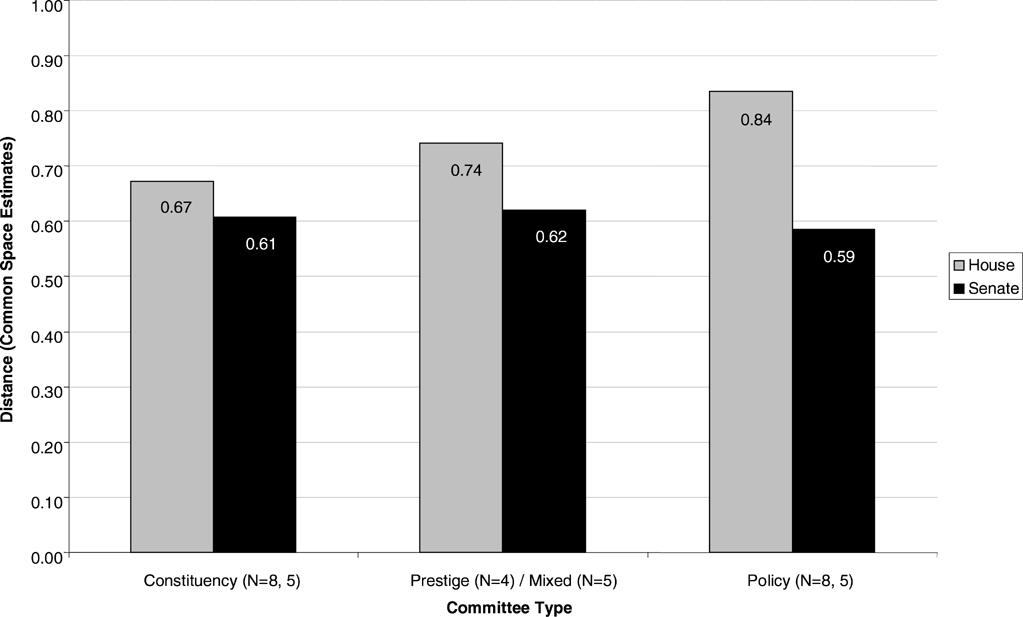
Two additional points merit discussion. First, the degree to which the policy preferences of Democratic and Republican committee leaders diverge varies by chamber. Using common space estimates, we calculated the spatial distance between Republican chairs in the 109th and their Democratic successors in the 110th Congresses. As might be expected, the ideological distances covered in House committee leader transitions were statistically significantly larger, on average, than transition distances in the Senate.6
The mean ideological distance between Republican chairs in the 109th and Democratic chairs in the 110th House was 0.7433 (N = 20); the mean distance in comparable Senate transitions was 0.618 (N = 19). This difference is statistically significant at p < .05 (t = 2.04).
Second, Figure 1 shows that the degree to which the policy preferences of Democratic and Republican committee leaders diverge also varies by type of committee, but only in the House. On average, constituency committees in the House experienced the least dramatic shifts in leader ideology, and policy committees in the House underwent the most dramatic leadership transitions. The Bob Goodlatte (R-VA) to Collin Peterson (D-MN) transition on the constituency-oriented Agriculture Committee and the James Sensenbrenner (R-WI) to John Conyers (D-MI) transition on the policy-oriented Judiciary panel were among the smallest and largest swings in leader ideology, respectively. But despite the clear trend that emerges in the House, Figure 1 also illustrates that swings in leader ideology in the Senate between the 109th and 110th Congresses did not vary by committee type.

Ideological Distances in Chair Transitions by Committee Type, 109th–110th Congresses
Note: Distances calculated using Poole's (1998) common space estimates. Committee type taken from Smith and Deering (1997) for the 17 House and 15 Senate committees they categorized. Based on interviews with committee members, Smith and Deering categorize eight House committees as constituency, five as policy, and four as prestige. In the Senate, they identify five constituency committees, five policy committees, and five mixed-policy/constituency committees. We categorized two new House committees, Homeland Security and Intelligence, as policy committees. The Committee on House Administration was excluded from the analysis. N of cases (House, Senate) = 20, 15.
Electoral Security and the New Ideological Face of Seniority
From the Textbook Congress through the Reform era and into the era of the Post-reform Congress, one constant was that, with few exceptions, senior committee members of the majority party were rewarded with committee chairmanships in the Democratic Caucus. Electoral security and seniority go hand in hand because members would not have seniority without some measure of electoral security over the years and their seniority (and the influence that comes with seniority) can be used to enhance their electoral security. For our purposes, the causal relationship is not all that relevant. It is enough to say that these variables are correlated and committee chairmanships flowed to those who were both senior and electorally-secure. However, two things have changed in the transition from the Textbook Congress to the Post-reform Congress: among Democrats, the ideological face of seniority changed; among Republicans, the value of seniority in securing committee leadership positions changed. We discuss each below.
Because of a lack of significant partisan competition in the South, Democratic chairmen in the Textbook Congress were drawn disproportionately from the South where these conservative Democratic members were largely shielded from variations in the electoral weather. This aspect of the Textbook Congress proved both one of its distinctive characteristics—and its undoing. As the disjunction between the more liberal majority in the caucus and the more conservative preferences of many of the chairs grew, the institution erupted in a fit of reform. Congressional reforms of the 1960s and 1970s did plenty to change the distribution of power within the Congress, but it did very little to change the method by which the committee chairs in Congress were selected by Democratic Caucuses. Committee chairmanships continued to flow to those with seniority and electoral security even as the ideological identity of those with seniority and electoral security changed radically. As greater partisan competition emerged in the South and as more and more Democratic districts elsewhere became “deep blue,” non-Southern liberals replaced Southern conservatives as the most electorally-secure and the most senior Democrats. By the time the 103rd Congress (1993–1994) convened, as evidenced in Table 2, the new Democratic committee chairs were disproportionately drawn from the most liberal wing of the party caucus. Importantly, and in contrast with actions of Republican House leaders between 1995 and 2006, this change was not because of the newly enhanced power of Democratic Party leaders or their willingness to buck seniority, but rather because of this new ideological face of seniority.
Among Republicans, seniority is no longer sacrosanct. Republican leaders who took over in the 104th Congress passed over senior committee members to appoint more conservative ideologues as chairs in four committees, and beginning with the first round of term-limited chair replacements occurring in 2001, violations of seniority in choosing committee leaders became commonplace. In fact, between 2001 and 2006, the Republican Steering Committee violated seniority in exactly half of the 18 instances in which term-limited chairs of legislative committees were replaced (Deering and Wahlbeck 2006; see also Renka and Ponder 2005). Focusing primarily on the 2001 round of “musical chairs,” Deering and Wahlbeck find that while seniority was a significant predictor of who received Steering Committee interviews in the 107th Congress, once prospective chairs reached this stage, seniority no longer provided a statistically significant boost to their chances of becoming chairs. Instead, campaign contributions to fellow Republicans and party loyalty in floor votes emerged as the lone predictors of which of the interviewees received leadership positions (2006, 234). At least initially, however, House Democrats have not replicated these trends. Committee longevity, and the electoral security required for it, has remained the path to Democratic chairmanships despite the changed norm during the 12-year Republican interlude.
In the Senate, both Democrats and Republicans have almost exclusively adhered to seniority as the guiding principle in committee leadership selection. In part, this is simply a nod to the realities of a smaller institution where 49 Democrats plus the two independents that caucus with them have to fill just about 20 committee chairs without handing two chairmanships to any individual (Kimitch 2007).
So, among House and Senate Democrats, adherence to the norm of seniority in choosing committee chairs has yielded a team of policy leaders who are drawn disproportionately from the liberal wing of the party. Among Republicans, violations of seniority have been commonplace in the House, and continued to be so as Republicans in the 110th Congress handed five Ranking Minority Member positions to less-senior members (Kimitch 2007). But interestingly, these Republican moves have not, on average, yielded a slate of committee leaders as ideologically extreme within their caucus as the committee leaders on the other side of the aisle. In short, while much of the literature on party polarization in the Post-reform era has focused on the enhanced power of party leaders and party caucuses to enforce greater ideological cohesion, these data suggest that the more polarized relationship between Democratic committee chairs and Republican ranking members is in no small part the result of a lack of interference in committee leadership decisions by party leaders on the Democratic side.
Implications
So what are the implications of a disjunction between an “extremist” more liberal group of chairs and a caucus that is already somewhat liberal? We might begin to answer that question by remembering that arguably the most important way chairs can influence the legislative process is through their negative agenda-setting power. By serving as gatekeepers, at least within a set jurisdictional realm, committee chairs have more power to stop legislation that is out of step with their own policy preferences than they have to positively impose their policy preferences on the rest of the majority caucus and the rest of the Congress.
Within this context, the revolt against the power of committee chairs that ultimately led to the fall of the Textbook Congress can be understood not as a reaction to gridlock generally, but rather as a reaction to the consistent bottling up or blocking of particular policies (most notably, Civil Rights legislation) that the majority of the caucus viewed as desirable. The ideological positioning of committee chairs in the 110th Congress presents a different kind of challenge to the majority of the majority caucus. The rise of a group of “extremist” committee chairs in a Congress already polarized to a significant degree could make the bipartisan cooperation necessary to enact any significant piece of legislation all the more difficult to come by. Where the “bipartisan” moderates who dominated the ranks of committee chairs in the Textbook Congress could look across the aisle for help in building coalitions, the “extremist” chairs of the 110th Congress will not have that option. Thus, gridlock and a lack of legislative production may be one implication of the findings here. A related point is that if polarization among committee leaders contributes to gridlock and a lack of legislative productivity, then the Senate, due to the smaller average ideological distances between chairs and Ranking Minority Members, will be the most likely source of bipartisan cooperation in the 110th Congress and beyond.
A second set of potential implications has to do with legislative organization. The ideological disjunction between the policy preferences of the majority of the chairs and the majority of the caucus in the Textbook Congress ultimately led to a fit of institutional reform that re-shaped power dynamics within the institution, moving power from committee chairs down to the rank-and-file and up to party leaders. That history begs the question of whether the current disjunction between the policy preferences of the majority of the institution's chairs and the policy preferences of the majority of the Democratic Caucus will lead to a similar fit of institutional reform at some point in the future. We suspect not for several reasons. First, the reforms of the 1970s were the result of decades of pent-up frustration among liberal Democrats; talk of institutional reform less than one election cycle after the Democratic takeover is obviously premature. Second, and relatedly, even though committee chairs have considerable authority, they are no longer the only (or even the most important) power structure standing in the way of a potentially frustrated rank-and-file in the caucus today. Third, the Democrats have, at least for now, retained the Republican rule change limiting terms of service for chairs to six years, so the caucus may well have the opportunity to turn chairs out of their positions and choose others in a relatively short timeframe. Finally, moderates may make for good legislators but they don't make for good “revolutionaries,” and they have seldom been the driving force behind revolts. It is probably more likely that a caucus potentially frustrated by the lack of legislative production we suggest as a possibility above would seek to replace a few extremist chairs than it is that they would seek to make fundamental changes in the organization of the institution as was the case in the Reform era.
Conclusion
Committee chairs remain important leaders within the Post-reform Congress, and the committee chairs in the 110th Congress are no exception. We have shown that, while seniority rather than selection by party leaders remains the path to a chairmanship in the Democratic Party, the ideological face of seniority has changed radically. The chairs in the 110th Congress are drawn disproportionately from the liberal wing of an already far more ideologically cohesive and liberal caucus than Democratic Caucuses of the Textbook Congress era. For scholars of Congress, these findings have important implications in explaining the causes and consequences of the well-documented trend toward a more polarized legislative institution. If seniority remains the primary route to committee leadership, and electorally-secure senior members represent increasingly deep red and deep blue constituencies, then the prospects for cooperation would seem slim. If committees remain an important forum for policymaking—and Richard Hall's (1998) work on participation and power gives us no reason to believe that they will not—and the ideological distances between chairs and ranking minority members and chairs and their party caucuses continue to grow, opportunities for the sorts of bipartisan cooperation observed by Fenno (1973) will continue to evaporate.