Introduction
Internationally, self-report studies of mental health conditions in community settings have found a high prevalence (Demyttenaere et al. Reference Demyttenaere, Bruffaerts, Posada-Villa, Gasquet, Kovess, Lepine, Angermeyer, Bernert, de Girolamo, Morosini, Polidori, Kikkawa, Kawakami, Ono, Takeshima, Uda, Karam, Fayyad, Karam, Mneimneh, Medina-Mora, Borges, Lara, de Graaf, Ormel, Gureje, Shen, Huang, Zhang, Alonso, Haro, Vilagut, Bromet, Gluzman, Webb, Kessler, Merikangas, Anthony, Von Korff, Wang, Brugha, Aguilar-Gaxiola, Lee, Heeringa, Pennell, Zaslavsky, Ustun and Chatterji2004; Kessler et al. Reference Kessler, Aguilar-Gaxiola, Alonso, Chatterji, Lee, Ormel, Ustün and Wang2009), with anxiety and depressive disorders being the most common (Haftgoli et al. Reference Haftgoli, Favrat, Verdon, Vaucher, Bischoff, Burnand and Herzig2010; Connolly et al. Reference Connolly, Leahy, Bury, Gavin, McNicholas, Meagher, O’Kelly, Wiehe and Cullen2012; Bunevicius et al. Reference Bunevicius, Liaugaudaite, Peceliuniene, Raskauskiene, Bunevicius and Mickuviene2014). It is estimated that 16% of all adults in the UK have clinical depression or anxiety (Layard et al. Reference Layard, Clarke, Knapp and Mayraz2007). Dementia, bipolar disorder and schizophrenia are also often encountered in this setting (Alexander & Fraser, Reference Alexander and Fraser2008; Koka et al. Reference Koka, Deane, Lyons and Lambert2014; Patel et al. Reference Patel, Shetty, Jackson, Broadbent, Stewart, Boydell, McGuire and Taylor2016). The Health Research Board National Psychological Wellbeing and Distress Survey (NPWDS), involving 2,711 participants in Ireland, found that almost 60% had discussed mental health conditions with a general practitioner (GP) in the previous year (Tedstone Doherty et al. Reference Tedstone Doherty, Moran and Walsh2007). In Ireland, in 2015, the rate of suicide was 11.7 per 100,000 of the population; ranking Ireland 29 out of 50 European countries (World Health Organization, 2016).
GPs are often the first point of contact for people with mental health conditions (Wittchen et al. Reference Wittchen, Mühlig and Beesdo2003; Health Service Executive, 2017a), and their role has developed to incorporate diagnosis and management of patients, gatekeeper to services and liaison with other primary care professionals and patient groups (Department of Health and Children, 2006). Having assessed the patient with a mental health condition, a GP can decide to manage with medication, monitor the situation, refer to other services, or a combination of these options. GPs manage the majority of mental health conditions without referral to secondary care agencies (Department of Health and Children, 2006) but pharmacological treatment is common. Research from Australia reports that between 60% and 70% of people who are diagnosed with a mental health condition in primary care receive drug therapy as an initial treatment (Department of Health & Human Services, 2017). There is a some evidence which supports the use of brief low intensity psychological interventions in patients with physical co-morbidities and depression presenting in primary care (Coventry et al. Reference Coventry, Lovell, Dickens, Bower, Chew-Graham, McElvenny, Hann, Cherrington, Garrett, Gibbons, Baguley, Roughley, Adeyemi, Reeves, Waheed and Gask2015). However, there is some disagreement on whether it is possible to translate brief interventions into everyday clinical care (Garland et al. Reference Garland, Haine-Schlagel, Brookman-Frazee, Baker-Ericzen, Trask and Fawley-King2013; Warren et al. Reference Warren, Nelson, Mondragon, Baldwin and Burlingame2010). A brief intervention has been defined as an interaction that the physician has with a patient, whereby the physician screens for a certain health behaviour and in a short space of time communicates advice in a structured way about how the behaviour can be changed in order to improve health outcomes (Brown et al. Reference Brown, West, Angus, Beard, Brennan, Drummond, Hickman, Holmes, Kaner and Michie2016). Other interventions which have proven effective in treating those with anxiety and depression in primary care include brief cognitive behavioural therapy (CBT), counselling and problem-solving therapy (McNaughton, Reference McNaughton2009; Serafy et al. Reference Cullen, O’Brien, O’Carroll, O’Kelly and Bury2009; Cape et al. Reference Cape, Whittington, Buszewicz, Wallace and Underwood2010). Of these brief therapies, the evidence is strongest for brief CBT in the management of anxiety (Cape et al. Reference Cape, Whittington, Buszewicz, Wallace and Underwood2010) but the effect sizes were low compared with long-term treatments and the therapies were delivered by a professional other than a GP.
Research on prevalence and treatment of adult mental health conditions, using clinical records in general practice, is sparse in Ireland. The objective of this study, therefore, was to estimate prevalence and describe treatment of mental health conditions for all adults (18 years and over) attending Irish general practice.
Specific objectives of this study were to:
∙ determine the prevalence of psychological problems among adults attending general practice in a representative sample of general practices in Ireland,
∙ identify which psychological conditions in adults present most frequently in general practice,
∙ explore patient characteristics that are more likely to be associated with mental health conditions and
∙ describe management of psychological conditions in general practice, including treatment and referral pathways.
Methods
Participants
The methodology for this study has been previously described (Hickey et al. Reference Hickey, Hannigan, O’Regan, Khalil, Meagher and Cullen2015). All general practices affiliated with the University of Limerick Graduate Entry Medical School with a senior medical student on clinical placement in 2013/14 (n=56 practices) were invited to participate. The practices were located in three of Ireland’s four health regions. They were considered a representative sample of all practices by size, urban/rural location and patient eligibility for free care (Irish College of General Practitioners, 2011). Forty general practices agreed to take part in this study while 16 declined. Practices that declined were a mix of urban and rural practices, also located in three of Ireland’s four health regions. A random number function on the practice software data was used to select 100 patients from each of the 40 participating practices for analysis in the study. Inclusion criteria included being aged 18 years and over and having consulted with the practice in the previous 2 years. Clinical records of selected patients were examined using a standardized reporting tool to extract information on demographics, diagnoses and treatments for psychological problems.
Measures
Clinical records including consultation entries, referral letters and prescriptions for the previous 2 years (2011–2013) were reviewed for any evidence of attending the practice with a mental health condition, including evidence of symptoms documented in consultation notes, pharmacological treatment, psychological intervention, brief intervention (Brown et al. Reference Brown, West, Angus, Beard, Brennan, Drummond, Hickman, Holmes, Kaner and Michie2016), referral to another agency, diagnostic coding of a mental health condition. The search terms anxiety, depression, stress and panic disorder were used to determine what problems a patient might have. These terms would be commonly used in general practice (Irish College of General Practitioners, 2006).
Using a validated instrument (Cullen et al. Reference Cullen, O’Brien, O’Carroll, O’Kelly and Bury2009), the following data were recorded on all patients:
∙ Demographics: age, gender.
∙ Eligibility for free medical care: Ireland operates a mixed private–public system. Forty-three percent of the population have a means-tested (which at the time of this study was provided on the basis of low income and medical need) general medical services (GMS) card or ‘doctor-visit’-only card and do not pay directly for general practice consultations. Non-GMS eligible patients paid an average of €50 per consultation at the time of the study (House of the Oireachtas, 2014).
∙ Health service utilisation: total number of visits to the GP for any reason in the past year; any referral to or attendance at a specialist mental health service in secondary care in the past year.
∙ Whether a mental health condition had been documented in the clinical records over the previous 2 years and if yes.
∙ The number of occasions a mental health condition had been documented.
- The type of condition; stress and anxiety including anxiety attacks, post-traumatic stress disorder, acute stress reaction to family issues (e.g. bereavement, divorce, work-related stress), social phobias, obsessive–compulsive disorder; depression (including post-natal depression, depression or low mood, major depression), seasonal affective disorder; psychosis including mania and schizophrenia/schizoaffective disorder; problem alcohol use; problem substance use or other.
- Whether a psychological intervention was received and the type of intervention.
- Whether a referral to another agency was made.
- Whether a pharmacological treatment was received and the drug prescribed; benzodiazepines, antidepressants, opiates, antipsychotics, ‘Z drugs’ (including zopiclone and zolpidem), anticonvulsants or other.
Data were entered to an Excel file in each practice and anonymised data sets from all practices were merged together with practice characteristics (urban or rural, number of patients, number of staff).
Statistical analysis
Demographic and healthcare utilisation variables were summarised using graphical and numeric descriptive statistics. The proportion of patients with a documented psychological condition in the previous 2 years was estimated together with a 95% confidence interval for the proportion (accounting for the structure of the data with patients clustered within practices). For those patients with mental health issues documented, information on the type and treatment of the condition was summarised using graphical and numeric descriptive statistics. The association between categorical variables was tested using chi-square tests and median consultations rates were compared across groups using non-parametric tests. A 5% level of significance was used for all tests. SPSS Statistics Version 21 for Windows and SAS software Version 9.2 for Windows (SAS Institute, Inc.) were used to carry out the analysis.
Results
Forty (71%) of the 56 practices participated in the study. Practice size ranged from less than 1000 to over 30 000 registered patients. Of the 40 participating practices, 22 (55%) were based in an urban location, 13 (33%) were rural practices and 5 (13%) indicated they were mixed urban/rural practices.
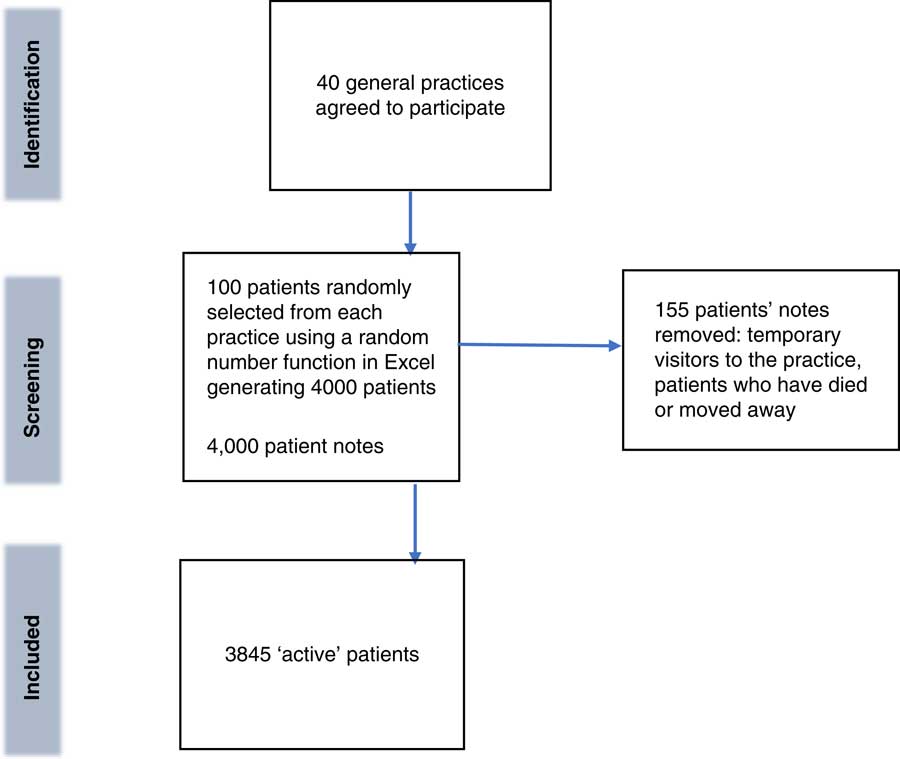
A total of 4000 records of eligible patient notes from 40 practices were included and analysed. From this number there were 155 (4%) patients who were temporary visitors to the practice or who were known to have died or moved away and they were excluded, giving a sample of 3845 ‘active’ patients. Figure 1 represents a flowchart of the inclusion and exclusion of patients. The median age of the patients was 46 years and ages ranged from 18 to 99 years; 53% were female and 51% were fee-paying patients. The median number of GP consultations over a 12-month period was two, with a quarter of patients attending more than six times a year.
Flowchart of inclusion and exclusion of patients.

From the sample of 3845 ‘active’ patients, 620 (16%, 95% confidence interval 15–17%) had a documented mental health condition in the previous year. Mental health symptoms including stress, anxiety and depression were found in 84% or patient records that were examined. Diagnostic coding of a mental health condition was rare (8%). Some patients with mental health condition were identified through referral letters (4%) or prescriptions (4%). Those identified through prescriptions had their clinical notes screened for reference to mental illness to confirm that a mental health condition was present.
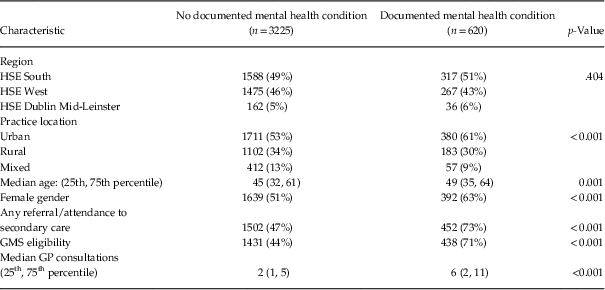
Having a documented mental health condition was more likely in patients who were: female; older; had a higher consultation rate with the GP; had a GMS card and attended any secondary care service in the previous year (see Table 1). People with a documented mental health condition were most commonly diagnosed with depression (n=332, 54%) or stress and anxiety (n=294, 47%).
Demographics and healthcare utilisation by psychological status (n=3,845)

HSE, health service executive; GMS, general medical services; GP, general practitioner.
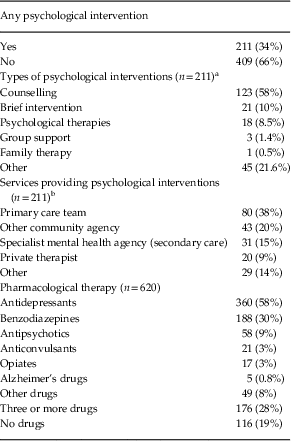
Of the 620 patients diagnosed with a mental health condition in the 2-year study period, 211 (34%) received a psychological intervention. Table 2 describes the psychological interventions: 123 (58%) were referred to counselling, 21 (10%) received a brief intervention from their GP and 18 (8.5%) were referred to psychological therapies. We included CBT, psychodynamic approaches and interpersonal psychotherapy in this category. The number of sessions a patient attended was not measured as part of this study. Of those receiving psychological interventions, most received them from primary care teams (n=80, 38%) or other community-based agencies (n=43, 20%) (see Table 2). Of the 620 patients with a mental health condition, 504 (81%) were prescribed pharmacological treatments. More than half of those with a mental health condition were prescribed antidepressants (n=360, 58%) and 188 (30%) were prescribed benzodiazepines. One hundred and seventy-six (28%) patients were prescribed three or more drugs.
Management of mental health conditions (n=620)

a Type of intervention was not documented for five patients.
b Provider of intervention was not documented for eight patients.
Discussion
One in six of the patients attending their GP had a documented mental health condition in the previous 2 years with depression, stress and anxiety being the most common. Attendance with a mental health condition was associated with the following characteristics: female gender, older age group (by 4 years median), eligibility for free GP care, having higher attendance rates to the GP or secondary care. Four out of five people with a documented mental health condition were prescribed medications and more than one in four were prescribed multiple medications. Kukraja et al. found the prevalence of polypharmacy in psychiatry varies between 13% and 90% and our figures are towards the lower end of this spectrum (Kukreja et al. Reference Kukreja, Kalra, Shah and Shrivastava2013).
The prevalence of mental health conditions in our study is lower than has been reported in an earlier Irish study (Cullinan et al. Reference Cullinan, Veale and Vitale2016). Data for this trial were based on GPs’ recall, which was measured using a 21-item questionnaire. Participants estimated that the prevalence of mental health conditions in their practices was 22%. Our methodology was based on actual patient data which were collected by medical students from patients’ records rather than simple recall which is subjective. Also, Cullinan et al.’s study involved only one county in Ireland, while our study involved GP practices from counties in three of the country’s four health regions. In a literature review and discussion paper of mental health and substance use disorders in general practice in Europe, the prevalence of mental health conditions in the general population was found to range from 10.4% in Luxembourg to 53.6% in Spain (Klimas et al. Reference Klimas, Neary, McNicholas, Meagher and Cullen2014). The studies reviewed used data from patient records to record prevalence of mental health conditions. They stated that in order to improve the management of common mental health conditions, further research is needed to develop strategies that would help improve GPs’ recognition of mental health conditions (Klimas et al. Reference Klimas, Neary, McNicholas, Meagher and Cullen2014).
In Northern Ireland, Bunting et al. conducted semi-structured interviews with 4,340 participants from 2004 to 2008 (Bunting et al. Reference Bunting, O’Neill, Murphy and Ferry2012). The aim was to gain insights into prevalence, severity and co-morbidities of people diagnosed with a mental health condition. This study found that 14% of respondents had sought some kind of treatment for mental health problems in the 12-month period prior to the interview. This is comparable with the findings of our study which found that 16% of participants had a documented psychological condition in the previous 2 years. Bunting et al. emphasised a need for early recognition by GPs and early interventions to improve the health of people with mental health conditions (Bunting et al. Reference Bunting, O’Neill, Murphy and Ferry2012).
Similarly, a review of reviews and meta-analyses conducted by Craven & Bland (Reference Craven and Bland2013) found that rates of detection and treatment of major depression in primary care were low. Furthermore, coding deficiencies (Ford et al. Reference Ford, Campion, Chamles, Hasbash-Bailey and Cooper2016) and the lack of recognition of minor mental health symptoms (Health Service Executive, 2006) may account in part for some the low detection rate we reported. However, given the strong international reporting of low detection rates, it is very likely that under-detection is the main factor in the low detection rate. The reasons for this may include training, resources and time constraints but they are beyond the scope of this study.
Another study set in Germany and Holland also found that female gender was a risk factor for mental health conditions (Linden et al. Reference Linden, Gothe and Ormel2003). Data from the WHO international collaborative study on psychological problems in general healthcare were analysed with respect to pathways to care, treatment and health status. This study provides us with detailed data on the healthcare utilization of women in primary care in both countries (Linden et al. Reference Linden, Gothe and Ormel2003). Sixty-three percent (n=392) of participants in our cross-sectional study who had a documented mental health condition were women. In Ireland one in four women will require treatment for depression at some point in their lives compared to one in ten men (Health Service Executive, 2017b). Our study gives us an insight into the healthcare utilization of women with mental health conditions in Ireland.
In our study, 71% of people with a diagnosed mental health condition were eligible for free GP care. This may reflect the relationship between social disadvantage and unemployment with poorer mental health (World Health Organisation, 2008). Alternatively, it may reflect access to GPs whereby those who are not eligible for free GP care either organise private services themselves or do not present at all.
Our findings suggest poor use or availability of primary care services, as only a third of the patients with a documented mental health condition in this study had a psychological intervention including counselling. Our figures show that 123 (58%) patients who received a psychological intervention were referred for counselling, and this figure makes up only 19% of those who were identified as having mental health issues in the study. National guidelines for counselling state that those who are experiencing mild stress-related conditions such as depression, anxiety, panic disorders, loss issues and stress, should be referred for counselling in primary care (Health Service Executive, 2017c; Health Service Executive, 2006).
The relatively modest referral rates to counselling in our study could be explained by the early stage of the ‘Counselling in Primary Care’ service at the time of the study, which was launched in May 2013, the relatively poor availability of the service to people living outside of population centres, the complex referral process (requiring patients to ‘opt in’ having read the information leaflet and phone the counselling service for an appointment after the GP’s referral letter had been received by the counselling service) and the limitation of the service to psychological issues that could be dealt with in eight counselling sessions. In such circumstances, many GPs would have found it easier to treat the patient symptomatically with medication such as hypnotics, anxiolytics and antidepressants as an alternative to counselling. The authors of this study note the lack of referral for CBT and strongly recommend improved access to primary care CBT, given the strong evidence base for its efficacy in this setting (Cape et al. Reference Cape, Whittington, Buszewicz, Wallace and Underwood2010).
Strengths and limitations
The strengths of this study included the large sample size of clinical records of patients reviewed across a large number of practices and the scope of the examination of clinical records including prescriptions, referral letters and consultation notes. A limitation of this study was that because mild illness and brief interventions are less likely to be recorded, and because the study can only include what is recorded, it is likely that many cases have been omitted. In terms of sampling bias, only prescriptions, clinical entries and letters that were recorded in the 2-year study period were analysed and it is possible that earlier entries recording mental health problems would have been missed as they may not have been recorded on the patient past medical history. The study was limited to Ireland which may affect external validity.
Recommendations for future research and practice
Future research should involve qualitative analysis of how GPs and other primary healthcare professionals manage depression and anxiety and what health systems factors affect the de facto management pathways. Implications for future practice include the need to improve adherence to coding of illnesses and management especially non-pharmacological management.
Conclusion
Mental health conditions were recorded in 16% of patients from a large general practice-based sample. Most patients with a documented mental health condition are managed by medication and the low rate of psychological interventions is concerning. Resourcing and developing mental health management pathways in primary care to meet the needs of all adults with psychological conditions should be a priority for health service planning.
Financial Support Statement
This research received no specific grant from any funding agency, commercial or not-for-profit sectors.
Conflict of Interest Statement
The authors have no conflict of interest to disclose.
Ethical Standards
Ethical approval for the study was granted by the University Hospital Limerick Research Ethics Committee.