The field of sociolinguistics has witnessed a resurgence of interest in the social meaning of variation, what Eckert (Reference Eckert2012) has called the “third wave of variation studies.” While first wave studies (Labov, Reference Labov2006 [1966]; Trudgill, Reference Trudgill1974; Wolfram, Reference Wolfram1969) examine correlations between linguistic practice and membership in demographic categories (such as female, African American, or middle-class), second wave studies (Eckert, Reference Eckert2000; Milroy, Reference Milroy1987 [1980]; Rickford, Reference Rickford1986) shift their attention to locally meaningful social groups (like townies, church ladies, and jocks). Studies comprising both of the first two waves hold that correlations between linguistic practice and social group membership are crucial for understanding the trajectory of linguistic change. On the other hand, third wave studies (Agha, Reference Agha2003; Campbell-Kibler, Reference Campbell-Kibler2007, Reference Campbell-Kibler2008, Reference Campbell-Kibler2009, Reference Campbell-Kibler2011; Johnstone & Kiesling, Reference Johnstone and Kiesling2008; Labov, Reference Labov1963; Levon, Reference Levon2011; Moore, Reference Moore2004; Moore & Podesva, Reference Moore and Podesva2009; Podesva, Reference Podesva2007, Reference Podesva2011a, Reference Podesva2011b; Zhang, Reference Zhang2005, Reference Zhang and McElhinny2007, Reference Zhang2008) shift their focus from linguistic change to the social meanings that motivate speakers to use one linguistic variant over another.Footnote 1 For example, rather than comparing the frequencies with which two social groups use the alveolar variant of (ING), as in talkin', a study focusing on social meaning might ask what saying talkin' enables its user to accomplish, or viewed another way, it might investigate what social characteristics are attributed to a speaker when she uses the alveolar variant. The present study examines the use of the released variant of /t/ by U.S. politicians, as well as listener perceptions of the variant. This work advances scholarship on the social meaning of variation by identifying linguistic and social constraints on the range of meanings attributed to linguistic features.
The released variant of word-final /t/ has been a staple of third wave variation research. In her work on female nerds, Bucholtz (Reference Bucholtz2001, Reference Bucholtz2011) noted the frequent use of released stops as a resource for constructing nerd identity. She argued that stop releases and hyperarticulate reading pronunciations (e.g., pronouncing [g] in the ng digraph) signal a proliteracy stance that associates those who produce such features with learnedness, a fundamental component of nerd identity. Benor (Reference Benor2001, Reference Benor2004) also observed high rates of released /t/ among Orthodox Jewish men. She argued, similar to Bucholtz, that stop releases index learnedness, but that in this particular cultural context, learnedness indirectly indexes masculinity. Released /t/ is most common in the speech of those who have attended yeshiva (an institution for learning Hebrew texts), the majority of whom are men. Levon's (Reference Levon2006) study of style-shifting among two Reform American Jews also draws a connection between Jewish identity and the prevalence of released stops.
Stop releases have also been linked to sounding gay. Podesva, Roberts, and Campbell-Kibler (Reference Podesva, Roberts, Campbell-Kibler, Campbell-Kibler, Podesva, Roberts and Wong2001, Reference Podesva, Cameron and Kulick2006) compared the speech of two opponents in a radio debate on the issue of whether the Boy Scouts of America should be allowed to discriminate on the basis of sexual orientation. They find that a lawyer representing Lambda Legal produces higher rates of released word-final stops than his opponent, who does not publicly identify as gay. They argue that stop releases enable the attorney to put forth a public image that is gay but not flamboyant, drawing on the “learned” meaning potential of released stops to construct a persona that is professional and competent in addition to being gay. In a study on style-shifting among gay professionals, Podesva (Reference Podesva2006) reported that while most speakers released coronal stops more often in professional speaking situations, one particular speaker produces phonetically stronger releases at an informal barbecue with friends. Podesva contended that amplified phonetic content, achieved through longer duration and higher intensity, serves to amplify the clear and precise meanings traditionally associated with the variable, yielding an exaggerated version of clarity and precision—prissiness. The prissy character of stop releases, he argues, partly constitutes a “diva” persona.
Sclafani (Reference Sclafani2009) further expanded the range of indexical meanings associated with released /t/ in her work on parodies of Martha Stewart. She found that actors portraying the popular television personality typically produce hyperstandard speech while engaged in violent, often aggressive acts. In the face of such undeniably bad behavior—the kind of behavior that led the real Martha Stewart to prison for insider trading—categorically released /t/s enable an actor playing her to portray a “good woman” image on the surface.
Collectively, these previous studies have enabled variationists to theorize the indexical relationships among the various social meanings associated with released /t/. Drawing on Silverstein's (Reference Silverstein2003) argument that a linguistic feature may have multiple, related indexical meanings at the same time, Eckert (Reference Eckert2008) located a variant's social meanings in an indexical field, where the relationships between meanings are depicted. Meanings at any given order of indexicality can be recruited to index other, related meanings, and ultimately social types or personas. For example, released /t/s might be used when taking clear or emphatic stances, which when taken often enough might be associated with more enduring qualities such as articulateness, which in some contexts could in turn come to partly represent a nerd identity. Thus, the body of work on released /t/ has led to the development of a theoretical framework that draws explicit connections between stances, enduring qualities, and social types.
In spite of the many recent advances in exploring the meaning of released /t/, a number of gaps remain; three of which we attempt to address here. First, previous work has focused almost exclusively on the production of released /t/. Although this work has provided invaluable insight, the interpretation or perception of released /t/ has gone virtually unexplored. Recent work by Campbell-Kibler (Reference Campbell-Kibler2007, Reference Campbell-Kibler2008, Reference Campbell-Kibler2009) and Labov, Ash, Ravindranath, Weldon, Baranowski, and Nagy (Reference Labov, Ash, Ravindranath, Weldon, Baranowski and Nagy2011) has fruitfully used perceptual methodologies to uncover the social meanings associated with (ING) variation, suggesting that adopting a similar approach for released /t/ would likely prove worthwhile. Second, previous work on released /t/ has not considered the extent to which linguistic factors may influence the social meaning of the feature. While prior studies have either examined one narrowly defined prosodic context or conflated contexts in which released /t/s occur, we investigate whether the social meaning of released /t/ depends on whether it appears word-finally (We need to suppor[t h] the troops) or word-medially (It's a national securi[t h]y issue), where it varies with flapped [ɾ]. Finally, we explore the connection between patterns of production and the social interpretation of a feature. The majority of work on the social meaning of linguistic variants focuses on either production or perception to the exclusion of the other. As Johnstone and Kiesling (Reference Johnstone and Kiesling2008) illustrated, however, the two can be connected. Their study revealed that the monophthongization of /aw/, as in dahntahn for ‘downtown’, is associated with a Pittsburgher identity, but only by subjects who do not produce the feature often themselves. Fridland (Reference Fridland2008) additionally reported that the perception of a Southern accent depends on whether the linguistic variants in question are represented in the speech of the listener. Although listeners from Reno rate many features of the Southern Vowel Shift as sounding Southern, they rate fronting of the high back vowel—the one component of the shift well represented in their own Western speech variety—as sounding less Southern. Given the potential for feedback between the production and perception systems, the present paper examines both the production of and listener impressions about released /t/.
ARTICULATENESS AND POLITICIANS
Because released /t/ has been linked to “articulateness” in previous work, the current study examines the speech of U.S. politicians. We further restrict the study to the genre of political speeches, given the strong likelihood that released /t/ can be interpreted differently from one communicative context to another. Recall that learnedness had very different local significance among the female nerds Bucholtz (Reference Bucholtz2001, Reference Bucholtz2011) studied than it did among the Orthodox Jews in Benor's (Reference Benor2001, Reference Benor2004) study. Focusing on a single genre in one narrowly defined context minimizes divergences in interpretation.
Finally, our decision to examine the speech of politicians in particular stems from the prevalence of articulateness in circulating discourses about prominent political figures. The relationship between articulateness in discourses about political figures and its use in the sociolinguistic literature specifically describing released /t/ is not a simple one, in part because sociolinguists have not always been specific as to the content of labels such as clear, articulate, etc., as they apply to socially meaningful variation. Unpacking this relationship is a project in ethnographic lexicography that is perhaps beyond the scope of this paper, but as we will see, sociolinguists, politicians, journalists, focus group participants, and experimental participants have all proven willing to associate “articulate” to instances of political speech. We recognize that articulateness could in principle be encoded in a host of linguistic features such as vowel quality, rhythm, lexical choice, and syntactic complexity, but we are limiting the investigation to released /t/ only.
The articulate label has followed Barack Obama more closely than it has perhaps any other politician, particularly in the months running up to the 2008 presidential election. Obama's eventual running mate for the presidency, Joe Biden, most infamously referred to him as articulate in March 2007 when he called him “the first mainstream African American who is articulate and bright and clean and a nice-looking guy.” Two months prior, then-president George W. Bush also characterized Obama as articulate, when he said, “He's an attractive guy, he's articulate, I've been impressed with him, I've seen him in person, but he's got a long way to go to be president” (Cavuto, Reference Cavuto2007). Around the same time, Karl Rove described him in similar terms: “He's charismatic, he's articulate, he's a very strong figure on the national stage” (Roberts, Reference Roberts2007).
Statements about the articulateness of Obama and other prominent African American political figures, such as Condoleezza Rice, are controversial because they are rooted in racist, antiblack stereotypes of linguistic ineptitude and lack of intelligence, as chronicled in depth by Alim and Smitherman (Reference Alim and Smitherman2012). The term articulate also perpetuates similar sexist assumptions about women in politics who are not necessarily African American. Hillary Clinton, for example, has been described as “direct, methodical, thoughtful, and articulate” (Ackman & Povich, Reference Ackman and Povich2006). John Edwards,Footnote 2 belonging to neither a racial nor gender minority group, has also been called articulate on numerous occasions. Here again, it is possible that the articulate label comes counter to expectations for members of marginalized groups (in this case, people from the South). Nonetheless, it is evident that the articulate label circulates widely in the realm of U.S. politics to refer to a number of different political figures.
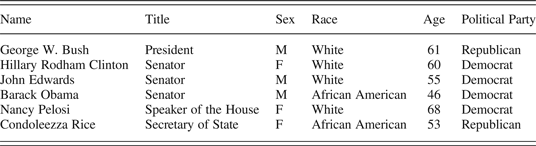
The current study, therefore, takes a more controlled look at six political figures prominent at the time of data collection, as summarized in Table 1. Data were collected in the months leading up to the primaries for the Democratic nomination for the 2008 U.S. presidential election. Thus, even though Barack Obama is, at the time of this writing, the president of the United States, he was (along with Hillary Clinton and John Edwards) a U.S. senator and presidential hopeful when data were collected. We would like to emphasize that our primary concern lies in individual production patterns and how these political figures are perceived as individuals. We avoid making claims about how classes of speakers speak or are perceived, because such claims cannot be substantiated on the basis of six speakers. Nevertheless, given that both production and perception may be mediated by identity factors, we made an effort to select six people diverse in terms of sex, race, age, regional accent, and political party affiliation.Footnote 3
Political figures under investigation and personal characteristics

PRODUCTION STUDY
The production component of the study aims primarily to determine the social constraints on the release of both word-medial and word-final /t/ in the speech of the six politicians under investigation, by identifying differences among these politicians in the rate of stop release in the two prosodic environments. Given that the social meaning of released /t/ varies from one social context to another, as previously discussed, we examine political speeches centering primarily on two topics: U.S. foreign policy and health care. We also seek to shed light on the linguistic factors conditioning the occurrence of the linguistic variable, because previous work (excepting Benor, Reference Benor2001) has focused nearly exclusively on its social meaning.
METHODS
Sixty minutes of speech were analyzed for each of the six politicians. All speeches were transcribed in Transcriber (Barras, Geoffrois, Wu, & Liberman, Reference Barras, Geoffrois, Wu and Liberman2001); Transcriber files were converted into Praat (Boersma, Reference Boersma2001) TextGrids; and tokens were identified in two prosodic positions: word-finally (n = 3,969) and word-medially (n = 1,475). For the word-medial variable, only those tokens occurring in a flapping environment (i.e., following a vowel or a rhotic approximant and preceding a vowel) were considered. Using this environment may eliminate some divergence of phonological behavior for onsets versus codas and consonant clusters versus singletons (Raymond, Dautricourt, & Hume, Reference Raymond, Dautricourt and Hume2006). Tokens occurring in disfluencies (i.e., filled pauses and repeated or truncated words) were excluded from the analysis, since disfluencies are associated with stronger phonetic forms (Jurafsky, Bell, Fosler-Lussier, Girand, & Raymond, Reference Jurafsky, Bell, Fosler-Lussier, Girand and Raymond1998; Shriberg, Reference Shriberg2001).
Each token of word-final and word-medial /t/ was coded for its realization by auditory analysis supplemented by spectrographic analysis. Coding work was distributed among the authors and each coder's work was checked in its entirety by another coder. Tokens were categorized as released, flapped, glottalized, deleted, or other (e.g., palatalized). Spectrographic cues for release included transients and following aspiration, whereas cues for glottalization included between-pulse dampening and aperiodicity (associated with creaky voice), as well as abrupt amplitude falloff in the preceding sound (when /t/ followed sonorants). Deletion was diagnosed by a lack of other cues for the presence of /t/, most notably the silence indicative of a complete occlusion, but also including more gentle amplitude falloff than when /t/ followed a sonorant. Flapping corresponded to a brief and gentle reduction of amplitude that still retained formant structure from the adjacent sonorants. Each token was coded for a number of independent variables, including linguistic factors such as the preceding and following environment, the morphological affiliation of the /t/, stress, and lexical frequency. Lexical frequency was calculated based on frequency in our corpus, as we deemed it important to determine frequency within the semantic domain of politics.Footnote 4 Words were given binary categorizations as either high or low frequency, with high frequency thresholds set at 50 occurrences in the corpus for word-final /t/ and 20 occurrences for word-medial /t/. These cutoffs were in part chosen to ensure a degree of lexical type diversity among high frequency words; the final /t/ dataset has 14 high frequency lexical types and the medial /t/ dataset, 12 high frequency types.
We also considered the effect of one social factor, namely the identity of the politician. Our primary objective with such a small and demographically diverse sample is to establish which speakers use more and less released /t/, factoring out linguistic constraints that might otherwise confound such comparisons. Though these speakers presumably learned how to use released and other variants of /t/ in their own, different communities, their social backgrounds are only relevant to our concerns in the rest of this paper inasmuch as they are part of the speakers' circulating public personae. Some intriguing demographic patterns surface in the analysis; however, we make no strong claims about whether certain social groups represented by the speakers are more or less likely to use certain variants of /t/.
We report two regression analyses with all of the abovementioned factors, conducted using GoldVarb (Sankoff, Tagliamonte, & Smith Reference Sankoff, Tagliamonte and Smith2005). The released variant was the application value in both analyses because, as the strongest possible realization of /t/, we were concerned with contrasting its behavior with all other possible realizations, all of which are phonetically weaker.
RESULTS
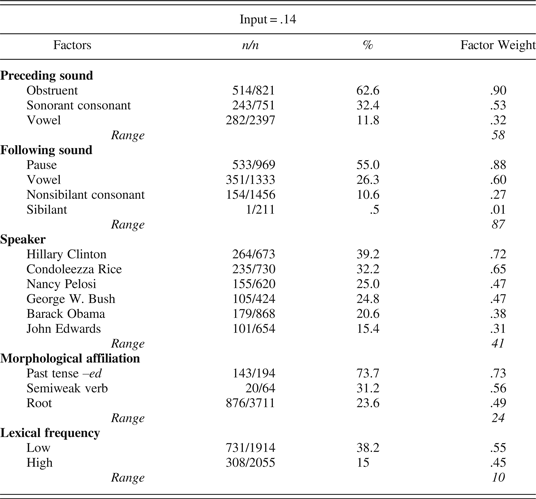
Table 2 summarizes the linguistic factors that significantly affect rates of word-final /t/ release in the politicians' data, beginning with the factor with the strongest effect (by selection order). We discuss only those factors exhibiting a significant effect on the realization of word-final /t/.Footnote 5 The preceding sound exerts the strongest effect on whether word-final /t/ is released. As indicated by their factor weights, preceding obstruents highly favor the released variant and preceding vowels disfavor it, with preceding sonorant consonants neither favoring nor disfavoring released /t/. This pattern is consistent with patterns reported by Benor (Reference Benor2001) for released /t/ and Podesva (Reference Podesva2006) for released /t, d/, according to which released variants are more likely to occur following consonants than vowels. The tendency for preceding obstruents to favor released /t/ is an expected finding because compared with sonorant consonants and vowels, which exhibit perceptually rich cues to the identity of the following consonant, obstruents carry relatively fewer cues for the /t/ (see also Wright, Reference Wright, Hayes, Kirchner and Steriade2004). In the absence of cues leading into to the word-final stop, the release burst following the stop closure provides strong cues to the presence and identity of the word-final /t/.
Factors influencing rates of word-final released /t/
Note: Stress is not included here as it was not selected as significant.
The following sound (i.e., the first sound of the word following /t/) also strongly affects rates of word-final released /t/. Following pauses strongly promote /t/ release, meaning that releases are common utterance-finally, as has been previously found by Byrd (Reference Byrd1992a) and Podesva (Reference Podesva2006). This finding runs counter to Benor's (Reference Benor2001) study, in which /t/ was marginally more likely to be released internal to the intonational phrase (versus intonational phrase-finally). Following vowels also encourage /t/ releases, likely due to the resyllabification of word-final /t/ as the onset of the following syllable. Finally, following consonants strongly disfavor stop releases, particularly sibilants.
Speaker identity has the third strongest effect on rates of released /t/. As is evident in Table 2, the six politicians exhibit a considerable range of release rates, from 15% to 39%. Hillary Clinton and Condoleezza Rice strongly favor released /t/, and Barack Obama and John Edwards strongly disfavor the variant. Although we avoid reading very far into the sex-based patterning of released /t/ given the sample size, it is worth noting that the three female politicians exhibit the highest release rates. A similar sex-based pattern was also found by Byrd (Reference Byrd1992b), who reports that women release utterance-final stops more frequently than men do in the Texas Instruments and Massachusetts Institute of Technology, or TIMIT, corpus.
The morphological affiliation of word-final /t/ also influences rates of word-final release, with /t/ most likely to be released when it represents the past tense marker. This stronger phonetic realization is attributable to the fact that the /t/ itself carries semantic meaning; rendering the phonological /t/ with a release burst maximizes the likelihood that the listener will perceive the past tense marker. When /t/ constituted the final sound of a semiweak verb, as in kept, it was also somewhat likely to be released, though less so than regular past tense markers, presumably because in semiweak verbs tense is also cued by a change in vowel quality in the stem. Finally, when /t/ was tautomorphemic with the root, it was somewhat less likely to be released, since word recovery is possible even in cases when the word-final /t/ is deleted (or cannot be heard). The rankings of these morphological factors are the reverse of those for coronal stop deletion in American varieties of English (e.g., Guy, Reference Guy and Labov1980, Reference Guy, Guy, Feagin, Schiffrin and Baugh1996; Guy & Boyd, Reference Guy and Boyd1990), revealing a direct mapping between semantic content and consonant strength. That is, as the amount of semantic content encoded in word-final /t/ increases, so too does the sound's phonetic strength. In other words, lenited forms (deletions) are favored in morphological contexts in which /t/ carries little meaning (cf. Cohen Priva, Reference Cohen Priva, Abner and Bishop2008), while stronger forms (released /t/) are more likely to occur in semantically rich contexts (when /t/ encodes the regular past tense).
Finally, lexical frequency has a significant effect on rates of released /t/, with low frequency words more likely to contain releases. Low frequency words are less predictable, thus putting more of the perceptual burden on bottom-up processing information, such as place and manner cues offered by stop releases, for lexical retrieval. This finding, taken together with previous work reporting that deleted word-final /t/ is more common in high frequency words, suggests that there is an inverse relationship between word frequency and the strength of realization for word-final /t/ (Jurafsky, Bell, Gregory, & Raymond, Reference Jurafsky, Bell, Gregory, Raymond, Bybee and Hopper2001): the more frequent the word, the weaker its realization (with the deleted variant as the weakest possible realization, and the released variant as the strongest).
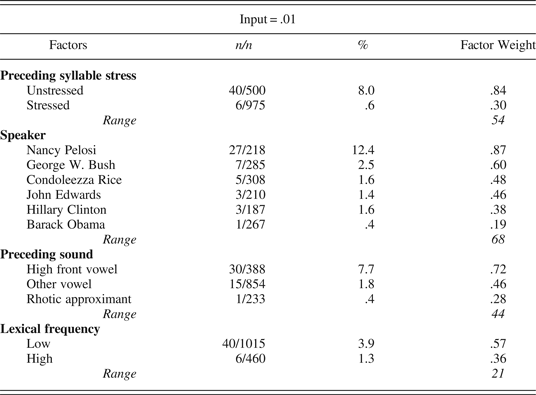
Factors influencing the occurrence of word-medial released /t/ are summarized in Table 3, with factor groups appearing in order of how strongly they affect the occurrence of the released variant. Here again, only those factors significantly affecting rates of release are discussed.Footnote 6 Before discussing the effects of individual factor groups, it should be noted that the frequency with which the released variant occurs is drastically lower in word-medial position than in word-final position, with an input value (or corrected mean) of only .007. By contrast, the input value for word-final releases was .141. Nevertheless, the range of rates of application across factor categories is generally quite large; so while /t/ release may be rare word-medially, there are still clear linguistic constraints on its use, as well as interspeaker differences.
Factors influencing rates of word-medial released /t/
Note: The factors following sound and morphological affiliation are not included here as they were not selected as significant.
The stress of the preceding syllable has the strongest influence on rates of medial /t/ release, with preceding unstressed syllables more likely to occasion releases than (primarily or secondarily) stressed syllables. This finding is expected, given that we considered only those environments of word-medial /t/ in which flapping is permitted. A preceding stressed syllable creates the canonical environment for flapping (Kahn, Reference Kahn1976), as opposed to released /t/. The stress effect is also compatible with Raymond et al.'s (Reference Raymond, Dautricourt and Hume2006) results on word-medial deletion, which revealed that onset /t/s were more likely to be deleted in nonprominent syllables (where presumably the preceding syllable is often stressed).
As was the case for word-final released /t/, speaker identity strongly affects rates of medial /t/ release. Nancy Pelosi in particular releases medial /t/ far more frequently than the other politicians. Of the remaining politicians, Barack Obama releases medial stops least frequently, though it should be noted that none of the politicians besides Pelosi release stops particularly frequently in this environment.
Third, preceding high front vowels encourage medial /t/ release, while other vowels and /r/ disfavor the released variant. Raymond et al. (Reference Raymond, Dautricourt and Hume2006) essentially found the converse of this effect: word-medial /t, d/ deletion was less likely following vowels with high off-glides. Although this pattern has not been explained in previous work, the effect of high front vowels can be explained on the basis of aerodynamic factors. The oral channel through which air passes in high front vowels is narrow and located directly behind the alveolar ridge (Stevens, Reference Stevens1998). Air pressure within this narrow channel is relatively greater than in channels associated with oral configurations needed to produce other vowel qualities. Higher air pressure results in stronger release bursts, thus increasing the likelihood that /t/ releases will be perceived.
Finally, lexical frequency has a significant effect on rates of released word-medial /t/, with low frequency words promoting release. Under the assumption that low frequency words are less predictable, the word-medial /t/s they contain are more likely to be released, with this phonetically strong articulation compensating for lesser predictability. The greater tendency for medial /t/ to be released in low frequency words is also consistent with Raymond et al.'s (Reference Raymond, Dautricourt and Hume2006) findings for word-internal /t, d/ deletion. They report that word-internal /t/ appearing in flapping environments (i.e., the environment investigated in the current study) is more likely to be deleted in more predictable (higher frequency) words. Thus, as was the case for word-final /t/, word frequency appears to be inversely correlated with the strength of the /t/ realization.
Summary
To summarize the results of the production study, it was found that final /t/ releases are much more common than medial releases are in our corpus, and a number of linguistic factors were found to affect rates of word-final and word-medial released /t/. These linguistic factors will inform the construction of stimuli in the perception study. Perhaps even more relevant to the perception component of the study are the social factors revealed to influence the frequency with which /t/ is released in the two prosodic environments. With respect to favoring releases, Hillary Clinton and Condoleezza Rice produce higher rates of final releases, while Nancy Pelosi does so in medial environments. Finally, Barack Obama and John Edwards infrequently release /t/ in word-final position, and Obama has the lowest rate of medial releases. The significance of these findings will be revisited in the discussion of the perception study.
PERCEPTION STUDY
In this section, we report on a perception study designed to determine the range of meanings listeners attribute to the released variant of word-final and word-medial /t/. Specifically, we investigate whether the meaning of released /t/ is relatively stable, such that its social meaning is the same from one politician to another; whether listener interpretations of released /t/ depend on who produces them; and whether the social meaning of the feature depends on the linguistic environment—word-final or word-medial—in which it appears. To address these questions, we employ a matched guise perception test, comparing listener responses to guises containing a released variant of /t/ to identical utterances containing an unreleased (word-final) or flapped (word-medial) variant.
Stimuli
To ensure that stimuli were identical apart from the realization of /t/, we used a digital splicing technique similar to that used by Campbell-Kibler (Reference Campbell-Kibler2007, Reference Campbell-Kibler2008, Reference Campbell-Kibler2009) and Labov et al. (Reference Labov, Ash, Ravindranath, Weldon, Baranowski and Nagy2011) to study responses toward the realization of (ING). In both studies, alveolar variants of (ING) including the vowel preceding the word-final nasal are used to replace velar variants elsewhere. With stimulus pairs differing in one sound only, it is possible to elicit listener impressions of one stimulus in the pair and compare these impressions to those elicited from another, comparable group of listeners presented with the other stimulus in the pair. Any difference in listener responses can be assumed to have been triggered by the manipulated sound, since the stimuli are identical in every way apart from the realization of the target sound.
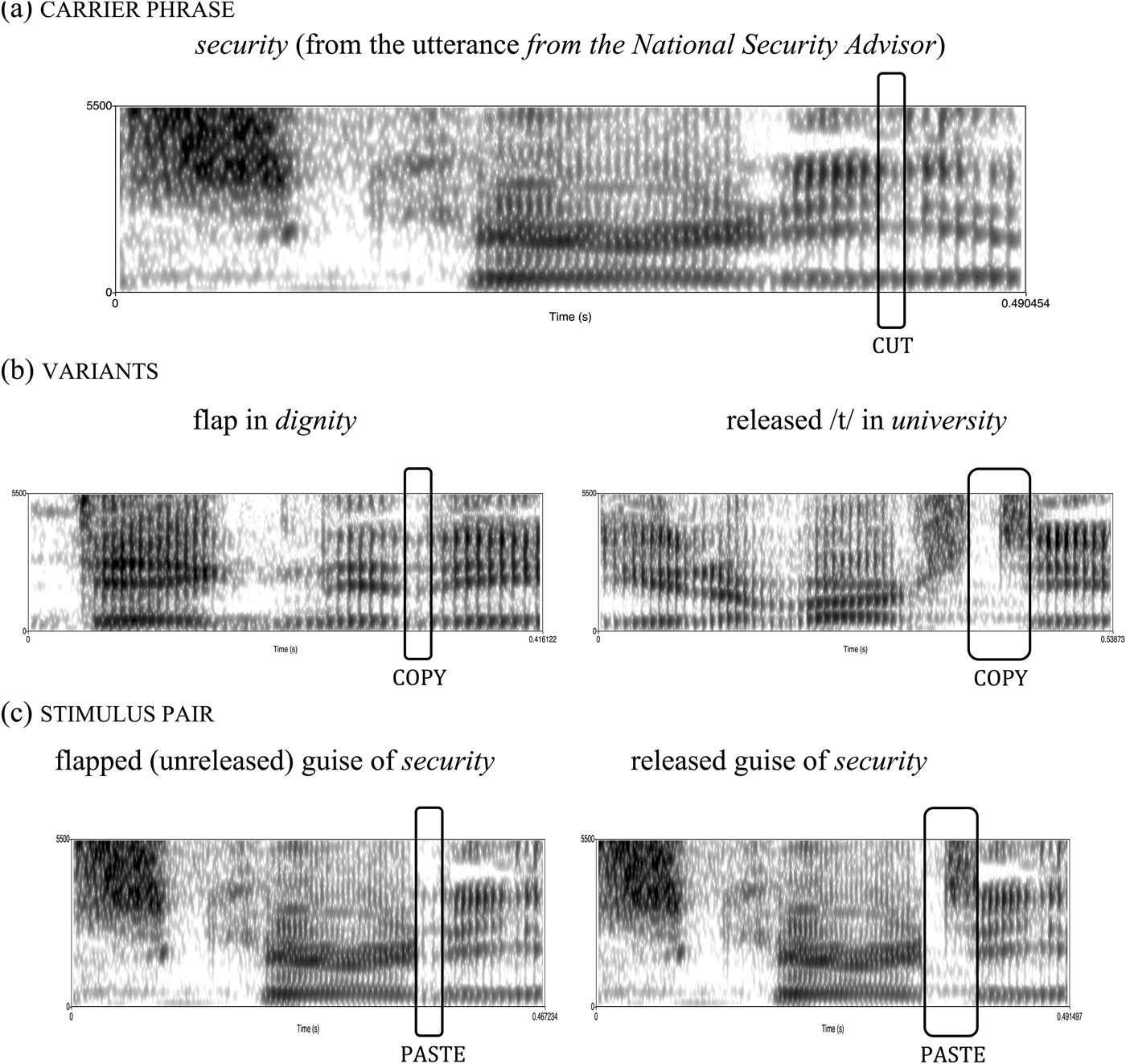
Our procedure for constructing stimuli is illustrated in Figure 1. We first identified a carrier phrase that contained a single instance of either word-final or word-medial /t/. We used carrier phrases containing /t/ in linguistic environments for which /t/ was most variable in the production study. For example, words containing medial /t/ did not carry stress in the syllable preceding /t/, and /t/ was preceded by a high front vowel. Lexical frequency was not strictly controlled for. We used only brief phrases (shorter than full sentences) as carrier phrases, which lasted only a few seconds. This marks a departure from previous work on (ING). Campbell-Kibler's (Reference Campbell-Kibler2007, Reference Campbell-Kibler2008, Reference Campbell-Kibler2009) stimuli contain several sentences each and range in duration from 11 sec to 19 sec, while stimuli in Labov et al. (Reference Labov, Ash, Ravindranath, Weldon, Baranowski and Nagy2011) are longer yet, with seven sentences each. We have opted to use short phrases because, even though they do not eliminate the effects of utterance content on listener responses, they minimize content effects. We also wish to point out that, as was the case for previous studies, even though what is said in the carrier phrase itself may affect ratings, this effect will be the same on the released and unreleased guises of /t/. The use of short phrases also keeps the potential effects of rhythm, which may be especially relevant to the perception of articulateness, to a minimum. Once carrier phrases were identified and the phonetic realization of /t/ isolated, we excised the phonetic realization of /t/. For flaps and unreleased stops (i.e., stops without audible release burst or visible release burst in the spectrographic representation), we cut out the closure; for released /t/, we removed the closure and the following release burst. Both the left and right cursors were placed at zero crossings (in the waveform) prior to cutting in order to avoid abrupt discontinuities in the acoustic signal. Figure 1A exemplifies this step of the procedure. In the carrier phrase from the National Security Advisor, spoken in this case by John Edwards, the target word is security. The word-medial /t/ in this particular example is originally realized as a flap, which was cut.
Procedure for creating a stimulus pair.
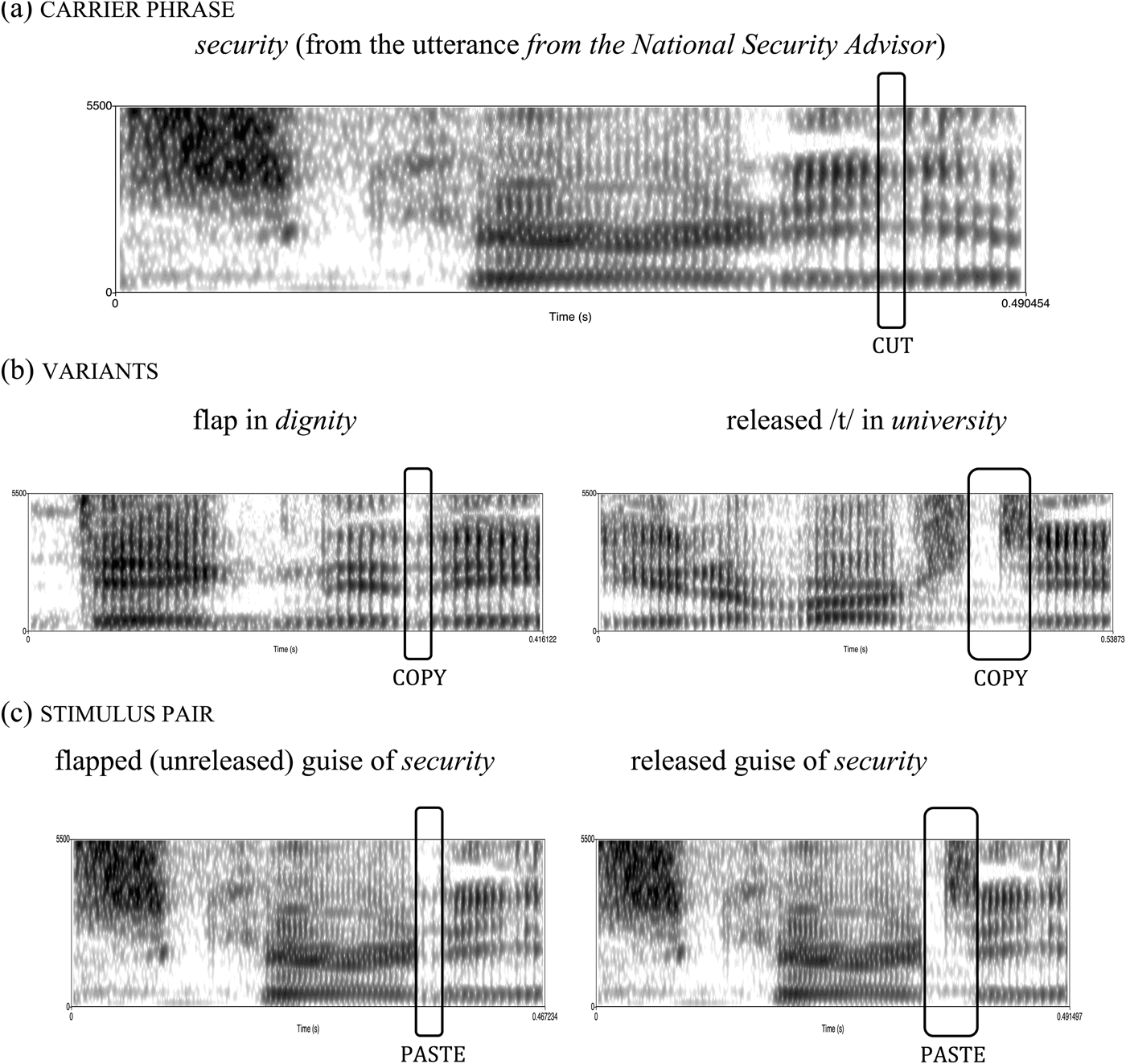
Next, a different unreleased stop (or flap, in the case of word-medial /t/) and a different released /t/ were found elsewhere in the recording, copied (ensuring that left and right markers were located at zero crossings), and reserved as replacements for the realization of /t/ excised in the previous step. These replacement variants were taken from similar linguistic environments to ensure naturalness. In the example in Figure 1B, a flap was taken from the word dignity, and a released /t/ from the word university. We elected to find replacement variants for splicing even when the realization in the carrier was the same as in the target, so that all stimuli were manipulated.
Finally, the variants copied in the previous step were pasted into the original carrier phrase at the original position from which /t/ was removed, yielding the two test stimuli. It is important to notice that the test stimuli are identical apart from the phonetic realization of the word-medial /t/. An example of a test stimulus pair appears in Figure 1C. The replacement variant flap from dignity has been pasted into the carrier phrase, in which the target word is security, resulting in the unreleased guise of the short phrase from the National Security Advisor. Likewise, the replacement variant released /t/ from university has been pasted into the carrier phrase, resulting in a released guise of the same phrase. No additional phonetic modifications were made.
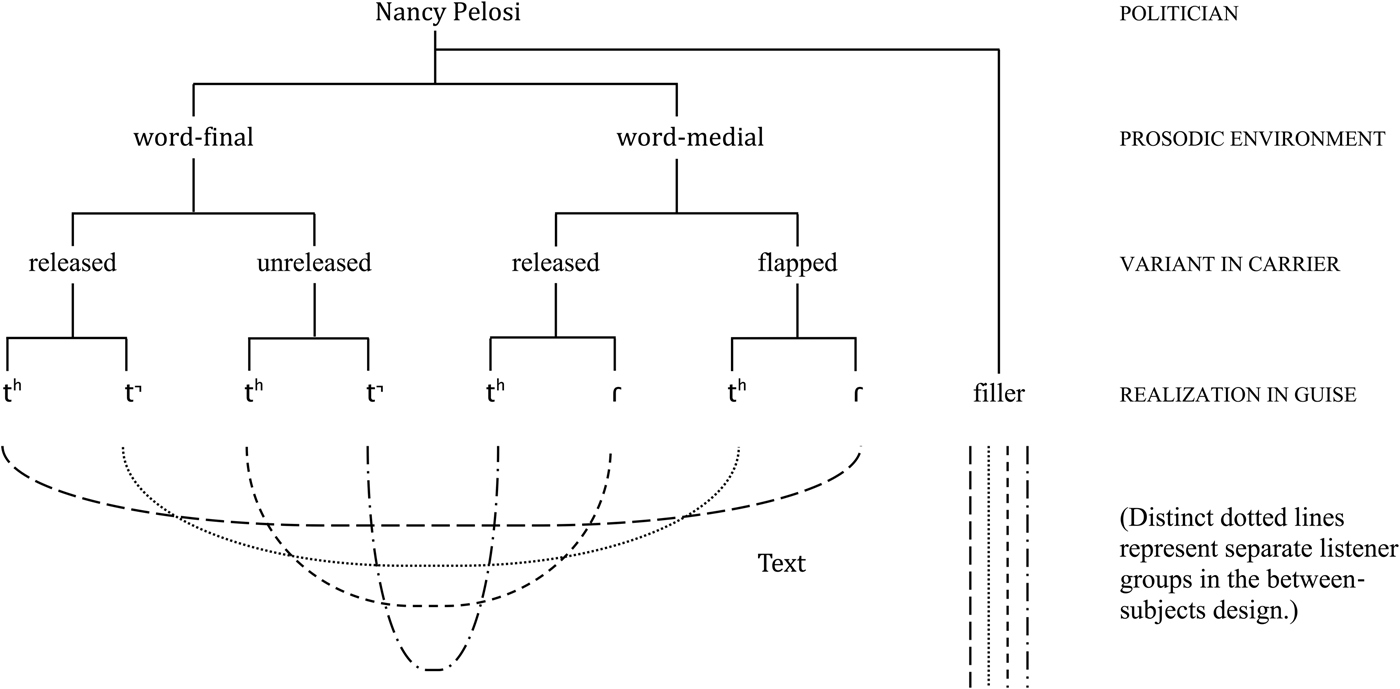
Nine stimuli (2 prosodic positions × 2 carrier variants × 2 guise realizations + 1 filler) were constructed for each politician, as shown in Figure 2. As mentioned, we considered /t/ in two prosodic positions, word-finally and word-medially. In addition, we constructed stimuli from two different carrier phrases, one in which the variant was released in the original and one in which it was unreleased (in word-final position) or flapped (in word-medial position). For each carrier phrase, we constructed both a released guise and an unreleased or flapped guise. This approach was followed to guard against inequitable naturalness for guise realizations of /t/ that matched /t/ variants in the original carrier. In other words, for each prosodic position, a released guise was constructed from a carrier containing a released variant (a match in realization) and from a carrier containing an unreleased variant (a mismatch in realization); likewise, an unreleased guise was constructed from a carrier containing an unreleased variant (match) and from one containing a released variant (mismatch). A filler item, with no environments for word-final or word-medial /t/, was also used for each politician, so that listeners would not focus too heavily on /t/.
Stimuli for each politician.
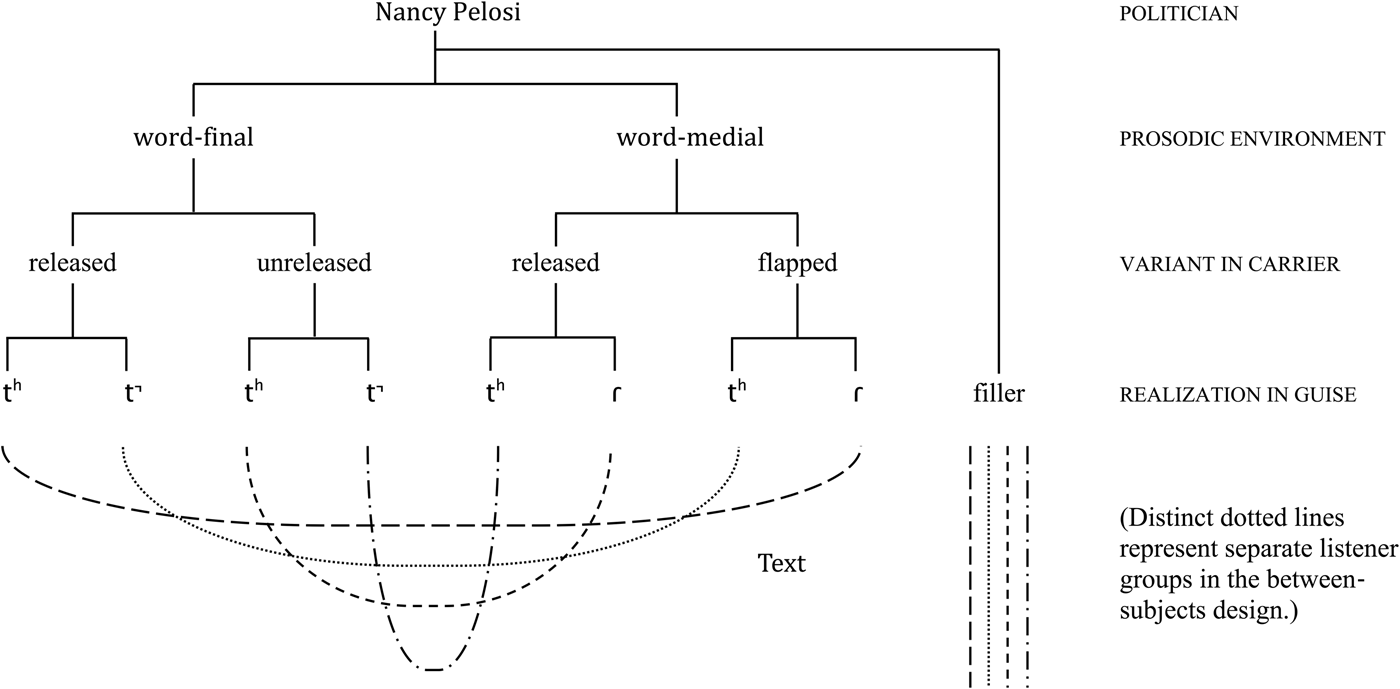
A between-subjects design (cf. Campbell-Kibler, Reference Campbell-Kibler2007) was employed to ensure that respondents would hear only one variant of each clip and to keep the length of the experimental task manageable. Listeners heard three stimuli per politician: a released form (either in word-final or word-medial position), an unreleased form (in whichever position was not used for the released form), and a filler item. We used four groups of listeners, as depicted at the bottom of Figure 2, to cover all the possibilities. Thus each group of listeners heard and rated 18 stimuli, 3 for each of the six politician speakers. While distinct test stimuli were presented to each of the four groups of listeners, the same filler stimulus was played to all listeners.
Adjective scales
Once stimuli were constructed, it was necessary to choose the set of adjectives on which listeners would rate the stimuli. In an attempt to avoid being biased by preconceptions about the social meaning of released /t/, we conducted focus groups (as, for example, in Campell-Kibler, Reference Campbell-Kibler2007, Reference Campbell-Kibler2008, Reference Campbell-Kibler2009) with Georgetown University undergraduate students (18 participants, 7 male and 11 female, mostly politically liberal or independent and mostly white, across eight focus groups of varying sizes, with each session lasting 25 to 40 min). During these focus groups, we played clips of politicians' speech, in no particular order, in order to elicit their impressions. We were not trying to associate adjectives with released /t/ specifically at this stage. Rather, we wanted to observe which descriptors listeners used when describing “political speech” more generally. It was assumed that the subsequent perception study would tell us which of these descriptors, if any, were associated with released /t/. Participants were asked open-ended questions such as, “How does Edwards sound to you here?” without drawing their attention to particular variants of /t/.
In the analysis of focus group audio recordings, each adjective used to describe a politician was logged, along with information about which politician was described. We then condensed this long list into a set of adjective scales to use in the perception study.Footnote 7 We picked the most frequently mentioned attributes used to describe the greatest number of politicians. When possible, similar descriptors were collapsed into a single adjective scale. For example, descriptors such as friendly, warm, welcoming, and relatable all fall under the friendly–unfriendly adjective scale. We also chose adjective scales that focus group participants used to describe the greatest number of politicians. The word articulate, for example, was used eight times, to refer to four different politicians, which we took as an indication of this particular adjective's robustness. Similarly, authoritative was used seven times, to refer to five different politicians.
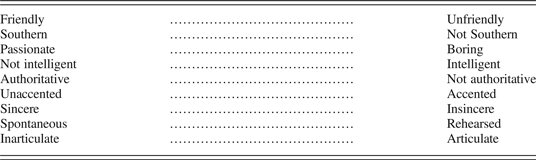
Nine adjective scales, listed in Table 4, were included in the survey. Although the adjective scales were always presented in the same order, we made an effort to include some grammatically negative forms (e.g., not intelligent and unaccented) on the left side of the scale to discourage participants from providing the same rating for each adjective when evaluating politicians about whom they had extreme positive or negative opinions.
Adjective scales included in perception study
Focus groups provided an additional and unforeseen benefit in that they offered a means of testing whether the artificially constructed stimuli sounded natural. No participants commented on irregularities in the sound files, and nearly all expressed surprise when they learned upon the conclusion of the focus group that they were listening to some digitally constructed audio clips. One participant in the subsequent perception study indicated that a stimulus sounded artificial, but the stimulus to which he was referring was actually one of the filler stimuli, which were not altered in any way.
Experimental procedure
The perception study was administered via a web survey. An example of the survey instrument appears in the Appendix. Each politician was identified by name, title, and political party affiliation, and a photograph from the politician's webpage was also displayed at the top of the webpage. A transcript was shown along with an audio controller, and participants could listen to the clip as often as they wanted to. In addition to rating each adjective on a six-point scale (ratings on each scale were required to move on to the next stimulus), respondents were given the option of providing additional comments in a text box appearing immediately below the adjective scales.
We recognize that knowing information about speakers biases listeners; it is precisely this bias that we were interested in uncovering through the perception study. Our decision to include identifying information for each speaker also served to ensure that all survey respondents were as equally biased as possible; if listeners had not been presented with identifying information, some may have recognized speakers' voices and been biased by their previously held views of the speaker, while others who did not recognize the identity of the speaker would be approaching the experimental task with greater neutrality. Disclosing speakers' identities also places respondents in a situation that more closely approximates the evaluation of speech in nonexperimental contexts, given that at least some rudimentary–and often much more–information about speakers is typically available to listeners when evaluating speech. Moreover, Campbell-Kibler's (Reference Campbell-Kibler2007, Reference Campbell-Kibler2008, Reference Campbell-Kibler2009) work illustrates that even when no information about speakers is presented, listeners classify speakers into social types (e.g., Southerner, gay male, or not working class), and their interpretations of linguistic features are developed with reference to these social types. Thus even when speaker identity is not disclosed, bias remains.
Participants
Survey participants were recruited primarily through online networking websites, mostly via Yelp discussion boards and a Facebook page dedicated to recruiting participants that circulated through the researchers' friend networks. This gave rise to intersubject uniformity with respect to the participants' demographic profiles, reviewed briefly here. In all, 70 subjects participated in the survey, on a volunteer basis. They were evenly balanced in terms of sex (36 female, 34 male), and they had lived or currently lived in a wide range of U.S. states (participants grew up or currently live in 31 states, with California, Colorado, and the District of Columbia best represented). More than half the participants identify as white (48 subjects), a significant minority identify as Asian American (15 subjects), and the rest represent a variety of other racial or ethnic minorities. The great majority of respondents were in their early 20s (38 subjects), with the remainder evenly distributed across the other age brackets, up to age 65. Given the study's focus on politicians, information about participants' political views and interest was also collected. Nearly 70% of participants identify as Democrats (48 subjects), 16% as Independents (11 subjects), 4% as Republicans (3 subjects), and the remaining 8 subjects as “other.” Finally, most participants indicated that they follow politics rather closely. Nearly half of the participants (32 subjects) follow politics every day, not just during a presidential election season, and nearly as many follow politics a few times a week (27 subjects), again not just during an election season. Going into the study, subjects knew that the survey pertained to the way politicians speak. It follows, then, that the survey would attract participants with a particularly strong interest in politics.
Previous work in perceptual dialectology (Fridland, Reference Fridland2008; Plichta & Preston, Reference Plichta and Preston2005) has found that the identification of and attitudes toward regional speech varieties varies according to social characteristics of listeners. In the current study, however, ratings for guises containing released versus unreleased stimuli did not vary according to respondent characteristics.Footnote 8 We attribute this fact to the intersubject uniformity in our listener population and hypothesize that, were the study to be conducted again with a more diverse listener population, results might vary along with listener characteristics, potentially obscuring response patterns within groups of respondents who share political orientations. The great majority of the participants in this study were white, early 20s Democrats who follow politics daily, and our results may therefore be less influenced by political differences than they would be with a more politically diverse sample. Nevertheless, some listener characteristics will prove relevant to the discussion of results.
RESULTS
In this section, we report only on the adjective scales for which the released guise was rated significantly differently than the unreleased guise. An alpha level of .05 was used for all statistical tests. Because multiple comparisons are being made at once for each speaker, it would be appropriate to compensate for experiment-wise error, for example by lowering the alpha level in each individual test. Given that previous studies have not adopted this practice, we report here on all effects that are significant at an unadjusted alpha level of .05. Nevertheless, we specially mark all effects that are significant at an alpha level adjusted using a Bonferroni correction for nine concurrent comparisons (α = .0056), the number of descriptor pairs used in the survey.
Table 5 summarizes the results for the word-final /t/ guise, for which there were two effects significant at an unadjusted alpha level. All scales have been adjusted from how they were presented to participants; here, unnegated (“positive”) items are on the right side of the scale (higher-valued) from negated ones.
Significant differences between released and unreleased guises for word-final /t/
As shown in Table 5, Nancy Pelosi was rated as sounding friendlier in her unreleased guise (4.4 of 6). Pelosi's friendliness ratings were high relative to the other politicians, ranking second among the six politicians in terms of overall friendliness values. Barack Obama's word-final /t/ releases also triggered different ratings than his word-final unreleased /t/ variants. He was rated as sounding more intelligent in the unreleased guise.
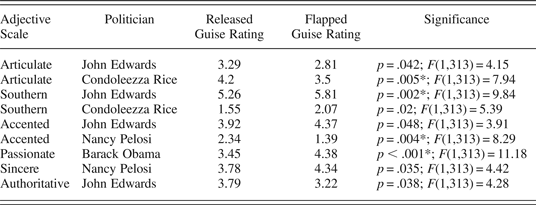
The results for word-medial /t/ appear in Table 6. We note that many more significant effects emerge for /t/ releases in this position. For some adjective scales, the guise for medial /t/ had the same effect on listener interpretations for more than one politician. For example, both John Edwards and Condoleezza Rice were rated as more articulate in the released guise; for Rice this effect is significant at the adjusted alpha level. The same two speakers were also rated as sounding more Southern in their flapped guises. It should be noted, though, that while Edwards is rated as sounding very Southern (reaching 5.81 of 6 in his flapped guise)—and this effect was significant at the adjusted alpha value—Rice's Southernness ratings were the lowest of the six politicians (reaching only 2.07 in her flapped guise).
Significant differences between released and flapped guises for word-medial /t/
Note: Effects that are significant with multiple-comparisons adjustment are marked with an asterisk.
Although we have observed two patterns illustrating that ratings for different politicians are affected in the same way by varying the realization of medial /t/, there is no significant difference in ratings for the four other politicians across the released and unreleased guises for these attributes. While some social meanings emerge across politicians, which is perhaps indicative of more conventionalized meanings, attributing a social meaning to a linguistic variant depends on the identity of the speaker, in this case which politician is speaking. This point can be seen most clearly by examining the effects on ratings of accentedness. The guise of medial /t/ affects accentedness ratings for both John Edwards and Nancy Pelosi, but in the opposite direction. While Edwards is rated as sounding more accented in the flapped guise (likely because he was perceived to have a strong Southern accent, perceptions of which were boosted in the flapped guise), Pelosi's accented ratings are higher in her released guise. For Pelosi, the effect is significant at an alpha level adjusted for multiple comparisons.
Three additional, and somewhat disparate, significant effects were observed for the medial /t/ variable. Barack Obama is rated as more passionate when he flaps (with a between-guise difference of .93, one of the largest among the significant effects; this effect is significant at an alpha adjusted for multiple comparisons); Pelosi has higher sincerity ratings when she flaps; and Edwards is rated as sounding more authoritative in his released guise. This latter finding recalls similar claims by Benor (Reference Benor2004), who argued that the Orthodox Jews in her study employ released /t/s to take stances of adamancy.
DISCUSSION
The results of the perception study indicate that the meanings listeners associate with released /t/ are quite variable from one politician to the next, as no single pattern emerged for more than two speakers. Although studies on the social meaning of linguistic features often explore single social meanings, listeners appear to associate several meanings with a given variant. Social meaning is in fact highly indeterminate once patterns are viewed across a speaker population, even in a narrowly defined social context such as political speeches. Because social meaning is mediated by speaker identity, we suggest that a clearer understanding of the social meaning of released /t/ can be obtained by considering frames of interpretation for each politician separately.
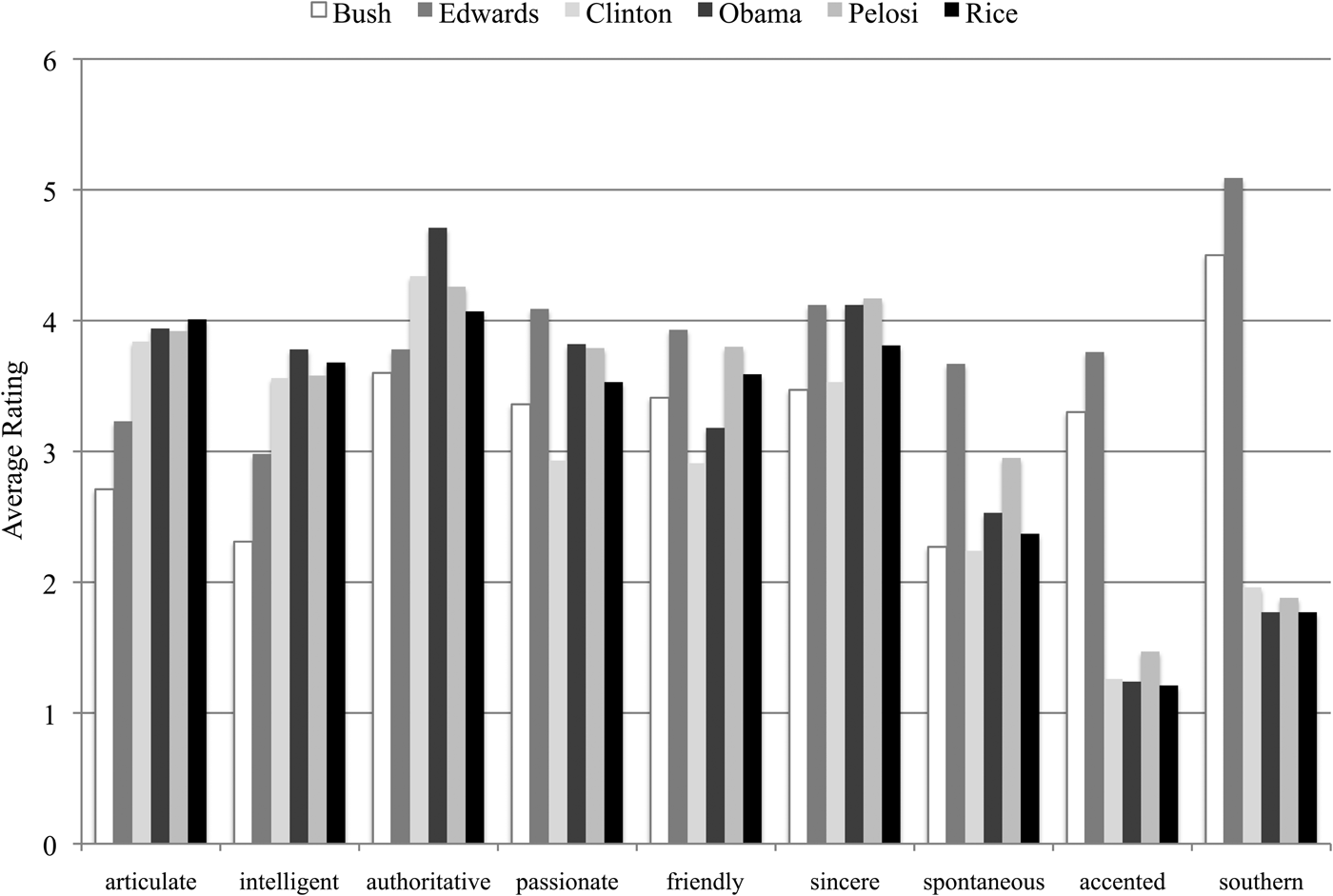
Figure 3 depicts average ratings for each adjective for each politician, facilitating a preliminary comparison of different politicians' ratings. Ratings for the released and unreleased guises are pooled, along with those for the filler items, which in effect erases any effects associated with varying the realization of /t/. We emphasize that comparing across politicians must be done with caution, as the content of utterances differed from one politician to the next. We will discuss Edwards, Rice, Pelosi, and Obama—the four politicians whose speech was interpreted differently based on /t/ guise—and then offer some views on why no significant patterns emerged for Hillary Clinton and George W. Bush. In our discussion of perception patterns, we reference the results of the production component of the study, which provide a backdrop for the interpretation of several findings.
Overall ratings per adjective by politician.
Edwards and Rice
We begin by discussing patterns for John Edwards and Condoleezza Rice, for whom the interpretation of the results is most straightforward. Both were rated as sounding more articulate when medial /t/ is released, which is in line with previous work on the social meaning of final released /t/ (Benor, Reference Benor2001; Bucholtz, Reference Bucholtz2001, Reference Bucholtz2011; Eckert, Reference Eckert2008; Podesva et al., Reference Podesva, Roberts, Campbell-Kibler, Campbell-Kibler, Podesva, Roberts and Wong2001, Reference Podesva, Cameron and Kulick2006). Both Edwards and Rice were also rated as sounding more Southern with medial flaps, though it should be noted that the released variant does not appear to make the difference between sounding Southern and not sounding Southern. Instead, it makes Edwards and Rice sound more or less Southern within their respective perceived accents.Footnote 9 Recall that Edwards was regarded as the most Southern of the politicians and Rice as least Southern. Edwards was additionally rated as sounding more authoritative and unaccented when medial /t/ was released, indicating that his production of released /t/s activates a more expansive range of indexical meanings relative to Rice.
Pelosi
A rather different picture emerges upon considering the meaning of Nancy Pelosi's /t/ releases. Her speech is rated friendlier when final /t/ is unreleased and more unaccented and sincere when medial /t/ is flapped. The direction of accentedness ratings is the reverse of Edwards's, though this is not surprising because Edwards is also rated as highly Southern, especially in his flapped guise.
Overall, it is affective dimensions such as sincerity and friendliness that our listeners appear to be most concerned with when it comes to Pelosi. Recall, however, that in the production component of the study Pelosi was found to use relatively high rates of /t/ release, particularly in the word-medial environment. It can be inferred, then, that Pelosi's high rates of released /t/ in production have negative consequences in terms of listener perceptions, at least among the listener population for the current study. Listeners appear to be less likely to associate released /t/ with competence-based meanings in Pelosi's speech—such as articulateness, intelligence, or authoritativeness—as illustrated by the quotation in (1) from one of our focus group respondents. After hearing a clip with a released variant, the participant notes that Pelosi sounded like she was trying to be more authoritative. The focus group participant's comment acknowledges that releases can be used to sound more authoritative, but asserts that in Pelosi's voice the authoritativeness is not genuine.
When interpreting Pelosi's speech, listeners are negotiating a complex system of gender ideologies in which traditional stereotypes of the emotive woman and newer competing images of female Speakers of the House must be reconciled. These two points of view were sometimes juxtaposed in the focus groups, when participants' political commentary on Pelosi was accompanied by statements of how much she sounds like a “grandmother.”
Obama
Turning now to Barack Obama, the perception study revealed that his speech is rated as sounding more intelligent in the unreleased word-final guise and more passionate in the word-medial flapped guise. Thus, Obama is rated more favorably when he does not release /t/. This pattern could be attributed to racist ideologies concerning how an African American politician “ought to sound.” However, this interpretation stands at odds with the fact that regardless of the guise for /t/, Obama was rated as sounding the most intelligent and second-most articulate of the six politicians, as is evident in Figure 3.
Recalling Obama's production patterns may lead us to an alternative explanation for listener responses to variation in his /t/ realizations. Obama's medial releases were the least frequent of the six politicians, and his final releases were second-to-least frequent. Taking these production patterns together with the perception results, we see that Obama is rated as sounding more intelligent in guises that most closely approximate the way he actually speaks. Intriguingly, the pattern may be due to participants' familiarity with Obama's speaking style; recall that the majority of the survey participants follow politics on a daily basis. This suggests that listeners, when interpreting sociolinguistic variation, may be influenced not only by their views of who is speaking, but also their knowledge of how the speaker usually talks.
Bush and Clinton
The speech of the two remaining politicians—George W. Bush and Hillary Clinton—was not judged to sound different in the released and unreleased guises for any of the nine attributes, either word-medially or word-finally. We argue that listeners hold particularly strong views for these politicians, to the point that slight modifications in their speaking styles produce no effect on listener ratings. As shown in Figure 3, Bush was rated as the least articulate, intelligent, authoritative, and sincere, often by a wide margin, and he was also rated as the second-to-least passionate and spontaneous. Focus group commentary was equally unfavorable. In a similar vein, Clinton's speech was evaluated by focus group participants as sounding, above else, clear—irrespective of the realization of /t/. In other words, extreme ideological stances taken toward speakers may generate floor or ceiling effects in the evaluation of their speech.
CONCLUSION
To conclude, we revisit the three research gaps on the social meaning of released /t/ identified in the introduction and explain how the current study sheds light on these unresolved issues. In particular, we emphasize that there are both linguistic and social constraints on the social meaning of released /t/ and suggest ways in which our study can be extended to further elucidate our understanding of these constraints. Although we refer specifically to released /t/, many of our claims and proposals for future research directions can be viewed in more general terms.
The first gap we address is the underexplored connection between the production and perception of released /t/. Listener interpretations of linguistic features may depend on knowledge of how frequently the features are used by the person being evaluated. This was evident in the case of Barack Obama, who released /t/ less frequently than most politicians in the study and whose speech was perceived in the most favorable light when the /t/ was unreleased. This finding was particularly striking given that previous work links released word-final /t/ to intelligence, suggesting perhaps that knowledge of a given speaker's typical patterns can invert conventional frames of interpretation. Listeners may have also demonstrated some sensitivity to Hillary Clinton's actual use of /t/ releases. Focus group commentary suggests that listeners attribute /t/ releases to her characteristic speaking style rather than an attempt to sound, for example, intelligent or authoritative, an interpretation consistent with the fact that Clinton's released guises were rated no differently from her unreleased guises. Listener impressions of Clinton's speech style may find roots in her production patterns, given her high rates of word-final released /t/. These two patterns are compatible with an exemplar-based approach to phonological variation, which holds that social information and linguistic information are stored together in episodic memory (Foulkes, Reference Foulkes2010; Foulkes & Docherty, Reference Foulkes and Docherty2006; Hay, Warren, & Drager, Reference Hay, Warren and Drager2006; Mendoza-Denton, Reference Mendoza-Denton, Cole and Hualde2007).
Interestingly, an exemplar theoretic model predicts that social meanings associated with a particular individual's production of a linguistic feature should supersede conventional meanings overarching a speech community. Novel utterances by a given speaker will usually match stored acoustic representations for that speaker more closely than those for a wider population of speakers, thus recalling the social contexts in which the speaker produced those acoustic forms. For example, if Barack Obama produces an unreleased /t/, and a listener who has heard Obama frequently enough to have amassed an array of exemplars hears it, the listener will interpret the released /t/ with respect to the stored exemplars. If the acoustic characteristics of the unreleased /t/ resemble those of previously heard unreleased /t/s uttered by Obama, and the listener regarded Obama as sounding intelligent when previous instances of unreleased /t/ were heard, the listener will also interpret Obama's most recent unreleased /t/ token as sounding intelligent. This situation will arise even if the listener has stored other intelligent-sounding released variants of /t/ uttered by other speakers in memory, because the acoustic representations for these variants will not be acoustically similar to the unreleased /t/ uttered by Obama. This hypothesis could be tested in a more controlled experimental setting by exposing several groups of listeners to different frequencies of released /t/ uttered by an unfamiliar voice and examining whether the listener groups differently evaluate novel /t/ stimuli uttered by the same speaker.
This paper has also explored the extent to which the linguistic system constrains the social meaning of released /t/, an issue that has not been addressed in previous work on the social meaning of variation. We examined this issue by investigating the range of meanings attributed to word-final /t/ as compared to word-medial /t/, and we found that variation in /t/ guises has an appreciably smaller effect on word-final tokens than on word-medial tokens (two versus nine significant effects, respectively). We relate this pattern to the frequency with which releases are used in these different prosodic positions. The production study reveals that word-medial releases are infrequent in the corpus, while word-final releases appear much more frequently. That word-medial releases are infrequent in production suggests that they are less predictable, thus more salient when heard, and therefore endowed with greater potential for carrying social meaning. That word-medial releases are intersonorant also makes them perceptually salient, due to rich cues to both place and manner in adjacent segments, which could in theory translate into social salience. In either case, the social meaning of a phonetic form is sensitive to its linguistic context.
Our work examining the linguistic influences on social meaning could be extended in a number of ways. We have focused on whether the social meanings attributed to released /t/ vary according to prosodic position, but a number of other linguistic dimensions could be examined. For example, one could delve deeper into the social meaning of word-medial released /t/ by comparing the range of meanings associated with the feature in preferred versus dispreferred phonological environments (e.g., following high front vowels versus following other vowels). It could well be that linguistic features are more socially salient when they occur in unexpected linguistic environments. Relatedly, meaningful variants that occur less often overall may be more salient, as supported by the relative abundance of meanings for word-medial released /t/, which occurred far less overall than word-final released /t/. In addition to varying the contexts in which variants appear, the phonetic manifestation of released /t/s themselves could be altered, and attitudes toward these phonetic variants could be gauged. Podesva (Reference Podesva2006) showed that patterned phonetic variation in released /t/ production, in the scalar dimensions of duration and intensity, can arise when variation between categories of variant (i.e., released versus not released) does not occur. Thus, the duration of /t/ release bursts can be systematically altered, as can their intensities, and perception tests can be employed to measure these modifications' effect on listener evaluations.
Finally, this study has shown that some associations between linguistic forms and meanings arise for multiple speakers. For example, both John Edwards and Condoleezza Rice were rated as sounding more articulate in released guises of medial /t/. Parallel findings such as these indicate relatively more conventionalized meanings for released /t/, and it is due to this conventionalization that the feature can be drawn on as a resource for indexing articulateness. A replication of this study using unfamiliar voices could be instrumental in determining the most conventional meanings of released /t/. In spite of even the strongest conventions, however, the social meanings attributed to linguistic variants are ultimately mediated by listener impressions of speakers—though assessing the depth and nature of listeners' prior exposure to talkers is a step that future work should be careful to take. Previous studies have emphasized speaker agency and are correct in suggesting that speakers can recruit linguistic features such as /t/ releases to construct articulate personas, but it must also be recognized that such effects are not equally available to all speakers. Future work must make clear exactly when, and how, speaker impressions intervene in listener evaluations of linguistic variability.
APPENDIX
Survey instrument