The historical background of the term fatigue and its different uses demonstrate its conceptual breadth and confusion (Caballo, Salazar, & Carrobles, Reference Caballo, Salazar and Carrobles2011; Hernández, Berrios, & Bulbena Reference Hernández, Berrios, Bulbena, Bulbena Vilarrasa, Berrios and Fernández2000; Orsat, Ernoul, Canet, Grandin-Goldstein, & Richard-Devantoy, Reference Orsat, Ernoul, Canet, Grandin-Goldstein and Richard-Devantoy2013; Rey-González & Livianos-Aldana, Reference Rey-González and Livianos-Aldana2000). From the mid-nineteenth century, fatigue has been understood as tiredness and exhaustion, and has been linked to both functional (e.g., neurasthenia and psychasthenia) and infectious (e.g., Syndrome Chronic Epstein-Barr) disorders. In 1987, the clinical entity known as Chronic Fatigue Syndrome (CFS) (classical lethargic encephalomyelitis) is delineated. It is stress-related (hypofunction of the HPA axis), unrelated to effort and without improvement after rest, and its etiology can be as diverse as the early adverse experiences and the onset of ADHD (Chaudhuri & Behan, Reference Chaudhuri and Behan2004; Sáez-Francàs et al., Reference Sáez-Francàs, Alegre, Calvo, Ramos-Quiroga, Ruiz, Hernández-Vara and Casas Brugué2012). Following Fukuda et al.’s (Reference Fukuda, Straus, Hickie, Sharpe, Dobbins and Komaroff1994) criteria, it is identified with at least 4 indicators: impaired short-term memory and concentration (in addition to dysnomia and anomia), different pains (noting headaches), non-restorative sleep (and hypersomnia) and malaise after exercise with duration exceeding 24 hours.
Under international diagnostic criteria (DSM and ICD), the inclusion of fatigue as a clinical manifestation has not been stable. Specifically in the DSM editions, fatigue originally appeared in neurasthenia with a specific diagnostic term, and from the third to the latest edition (DSM-5, APA, 2013) as a nonspecific symptom of the Somatic symptoms disorder (fatigue is mentioned in pp. 311, but not CFS), which specifically excludes Fibromyalgia (Fb) and Irritable Bowel Syndrome (IBS). However, in the ICD (OMS, 1992) editions, the diagnostic entity “neurasthenia” remains as a distinct alteration of somatoform disorders.
Throughout this historical development, fatigue has been linked to numerous terms: asthenia, anergy, fatigue, tiredness, exhaustion, apathy, inertia, boredom, weakness, psychasthenia, pusillanimity, laxity, or vulnerability. It has been associated with both physiological and intellectual manifestations product of physical and mental effort, and has been understood as both a primary experience and as an introspective reading of peripheral sensations. In sum, the absence of a clear and concise definition of this term continues, just as its etiology remains controversial (Afari & Buchwald, Reference Afari and Buchwald2003).
Recently, researchers have differentiated between fatigue (perceived fatigue) and fatigability (objective changes in the execution of a task; Chaudhuri & Behan, Reference Chaudhuri and Behan2004). The perception of fatigue refers to subjective feelings of fatigue, increased stress or difficulty in initiating and maintaining physical and mental activities that require motivation (Sáez-Francàs et al., Reference Sáez-Francàs, Hernández-Vara, Corominas-Roso, Alegre, Jacas and Casas2014). There is a mismatch between the exerted effort and the performance, which results in exhaustion. Homeostatic factors are included in its origin, in addition to psychological factors (mood and motivation as main factors; Kluger, Krupp, & Enoka, Reference Kluger, Krupp and Enoka2013). These psychological factors are included in the concept of central fatigue (e.g. in depression or in CFS). In turn, in this central fatigue, physical fatigue (muscular stress after exercise and without rest, without sleep disturbances, and not due to medication) is distinguished from mental fatigue; the latter is the perception of the effort needed to pay attention to a task (Sáez-Francàs, Hernández-Vara, Corominas Roso, Alegre Martín, & Casas Brugué, Reference Sáez-Francàs, Hernández-Vara, Corominas Roso, Alegre Martín and Casas Brugué2013), as well as an unwillingness to act, which reduces the ability to start or maintain orientation towards a goal and an adequate execution (Michielsen, De Vries, Van Heck, Van de Vijver, & Sijtsma, Reference Michielsen, De Vries, Van Heck, Van de Vijver and Sijtsma2004).
Fatigability is the magnitude of a change in the performance level in a given time or the measure of mechanical production based on a reference value (Kluger et al., Reference Kluger, Krupp and Enoka2013). Among its etiological factors are those of peripheral origin (where weakness is placed), and of brain structure etiology: in dementia, Parkinson's disease, or the consequences of stroke (Kluger et al., Reference Kluger, Krupp and Enoka2013). The perception or feeling of fatigue, as central fatigue, is considered a main symptom of various clinical entities such as CFS, IBS or Fb (Wessely & White, Reference Wessely and White2004; White, Reference White2010). It has an outstanding role both in anxiety disorders and, especially, in mood disorders (unipolar and bipolar depression, and dysthymia), mainly in the form of loss of energy (anergy) with the addition of lack of enjoyment (anhedonia; Brown & Kroenke, Reference Brown and Kroenke2009; Demyttenaere, De Fruyt, & Stahl, Reference Demyttenaere, De Fruyt and Stahl2005; Doyle, Conroy, McGee, & Delaney, Reference Doyle, Conroy, McGee and Delaney2010; Swindle, Kroenke, & Braun, Reference Swindle, Kroenke, Braun, Sorkin, Summers and Farquhar2001; Tylee, Gastpar, Lépine, & Mendlewicz, Reference Tylee, Gastpar, Lépine and Mendlewicz1999). Aside from physical (physical symptoms, sleep disturbance, physical fatigue) and cognitive (disproportionate fear, rumination, automatic thoughts ...) discomfort, a part of the experience of fatigue is related to feedback and maintenance of negative emotional states and the preceding fatigue (Goldstein et al., Reference Goldstein, Greer, Saletin, Harvey, Nitschke and Walker2013; Helbig-Lang, Lang, Petermann, & Hoyer, Reference Helbig-Lang, Lang, Petermann and Hoyer2012; Ruscio, Seitchik, Gentes, Jones, & Hallion, Reference Ruscio, Seitchik, Gentes, Jones and Hallion2011).
The perception of fatigue in these emotional states is part of a set of symptoms among which personal devaluation features over physical symptoms in depression (Moss-Morris & Petrie, Reference Moss-Morris and Petrie2001; Noonan, Lindner, & Walker, Reference Noonan, Lindner and Walker2010; Priebe, Fakhoury, & Henningsen, Reference Priebe, Fakhoury and Henningsen2008), and over apprehensive expectation in anxiety (Grupe & Nitschke, Reference Grupe and Nitschke2013), which suggests the importance of the concept of mental fatigue. The anxiety and depression symptoms (especially the latter), both accompany CFS, Fb, and the SII, although they are excluded from their specific diagnostic criteria, thus, demonstrating the difficulty of considering the concept of fatigue.
Finally, it is necessary to distinguish between the perception of fatigue and other similar manifestations such as drowsiness (e.g., sleep disorders) or apathy (loss of motivation due to lack of interest and initiative with flattening of emotions in goal-oriented tasks; Robert et al. Reference Robert, Onyike, Leentjens, Dujardin, Aalten, Starkstein and Byrne2009).
From all discussed above, it can be observed that the perception of fatigue in clinical populations is part of a constellation of cognitive and emotional components, in which anxious and depressive responses are common in different diagnostic entities and that require a delimitation that addresses its subjective aspects, and the intensity of fatigue and the associated emotional and behavioral reactivity. This aspect has not been addressed to our knowledge in the literature so far.
Despite the emphasis that has been attributed to the emotional and cognitive components in psychopathological alterations, it is important to highlight that somatic symptoms, such as physical fatigue, are often the main point of entry to Health Services for patients (Demyttenaere et al., Reference Demyttenaere, De Fruyt and Stahl2005). It is estimated that approximately 25% of patients have reported feeling fatigued and this is the seventh of the top ten most common symptoms in health centers (De Vries & van Heck, Reference De Vries and Van Heck2002; Walker, Katon, & Jemelka, Reference Walker, Katon and Jemelka1993).
Therefore, since the perception of fatigue is such a common experience, analysis of both the qualitative aspects of the construct (concept and associated terms), and the quantitative aspects (intensity of the experience) will help determine whether it corresponds to a similar or different experience in the clinical or general population.
Thus, this present paper aims to analyze the content and variations of the term fatigue from the experience of perceived fatigue in two population groups, one composed of patients newly diagnosed with different psychopathologies and seeking counseling (clinical group) and the other from the general population. It is expected that the term fatigue is significantly related to the term tiredness among a set of alternative states (ie, bored, depressed, sleepy ...), given the association that has occurred throughout history between these two terms and the closeness in meaning between them. This association would be independent to the sample group (clinical or general). Moreover, it is expected that the perceived experience of fatigue in the clinical group, unlike the general group, will be related to concepts covering the negative emotional sphere (e.g. anxious or sad terms) since, as mentioned above, the perception of fatigue is linked to anxiety and depression symptoms (Brown & Kroenke, Reference Brown and Kroenke2009; Demyttenaere et al., Reference Demyttenaere, De Fruyt and Stahl2005).
Finally, differences in the perceived experience between the clinical and general group are expected. The clinical group should present a higher reactivity to fatigue (e.g., irritability, drowsiness, hunger ...) and intensity, both in the overall experience of fatigue and its cognitive components, which will be higher than in the general group.
Method
Participants
The sample consisted of 317 participants, 92 (29%) from a clinical population and 225 people (71%) from the general population. Those in the clinical group (CG) were from a Community Mental Health Unit and a private psychological clinic. This group included 31 men and 61 women, aged between 18 and 76 years (M = 38.87, SD = 14.31). The general group (GG) included 90 men and 135 women, aged between 18 and 70 years (M = 32.45, SD = 12.94). The selection of participants in the clinical group was incidental, not random, while that of the general group was extracted through snowball effect within the general population parting from a group of college students. The characteristics of the groups and their equivalence are discussed in the results section.
Instruments
Demographical and clinical Information Sheet (prepared ad hoc).
Through this self-report, participants reported on their level of education, occupation, sociodemographic status or social class (SDS; Hollingshead, Reference Hollingshead1975), current illness, personal and family psychopathological background, history and duration of symptoms, psychopharmacological treatments, and consumption of other drugs. The Hollingshead index is a score based on the level of professional occupation (profession) and educational level (completed studies). The score obtained is classified in a range of scores that correspond to five levels of social class from very high to very low. In this study, the average quantitative score was considered as an estimation of social class.
Fatigue Sensation Scale (Hernández et al., Reference Hernández, Berrios, Bulbena, Bulbena Vilarrasa, Berrios and Fernández2000).
It consists of 8 items with analogue visual graphics and varied semantic descriptors referring to the perceived experience of fatigue. Of the 8 items, two (items 1 and 8) were analyzed in detail according to the objectives of this present study: Item 1 lists 11 different states associated with feelings of fatigue (apathetic, decayed or weary, slow or lethargic, tired, anxious, achy - fluey-, sleepy, tense, sad, indifferent and bored) of which the participant must choose five that, according to his/her past experience, better reflect their own sensation of fatigue. Item 8 describes different reactions in response to the experience of fatigue (irritable, clumsy, sleepy, hungry, or excited-sexually aroused) each of which is scored on a 9-point Likert scale (0 “nothing”, 9 “very much”). From this item, a score for each state and an overall score (summation of the previous scores) are obtained, which are indicative of the reaction to the feeling of fatigue.
The test has shown suitable properties of test-retest reliability (ICC = .91) and construct validity.
Fatigue Scale (Chalder et al., Reference Chalder, Berelowitz, Pawlikowska, Watts, Wessely, Wright and Wallace1993).
It consists of 14 items that assess the severity or intensity of experienced fatigue using two factors: physical fatigue (8 items, e.g., “Have you got less muscular strength?”) and mental or cognitive fatigue (6 items about cognitive difficulties, e.g., “do you find it difficult to think?”). The instrument also provides a total score. Each item is scored on a 4-point Likert scale (1 “better than usual”, 2 “no more than usual”, 3 “worse than usual” and 4 “much worse than usual”) based on the 15 days prior to the time that the test is completed. The scale has shown an adequate internal consistency in its overall measure (.89) as well as for its mental and physical fatigue factors (.82 and .85, respectively) (Chalder et al., Reference Chalder, Berelowitz, Pawlikowska, Watts, Wessely, Wright and Wallace1993). Moreover, it is sensitive to treatment changes (Deale, Chalder, Marks, & Wessely, Reference Deale, Chalder, Marks and Wessely1997). In the present study’s sample, the reliability obtained by Cronbach's alpha is .91 for the total scale for the clinical sample and .85 for the control sample; .88 for the physical scale in the patient group and .82 in controls; .85 in the patient group and .79 in the control group for the cognitive scale.
Procedure
Participants were selected through the procedures mentioned above. They received information on the objectives of the study and authorized the use of their data through an informed consent form. Participation in this study was voluntary and unpaid. The entire procedure followed the instructions of the Ethics Code of Psychology and Bioethics Committee of the University. For the clinical group, assessment instruments were delivered to them in the first or second therapy session to be completed either following the session or at home. The diagnostic evaluation was performed by specialized professionals with proven clinical experience using the criteria of the Diagnostic Statistical Manual IV-TR (DSM, APA, 2000). The control group was evaluated in small groups by the same professionals through collective administration of the instruments. The exclusion criteria of the study considered, of particular importance in the clinical group, were: difficulties in understanding instructions and administered tests, the presence of organic brain lesions, regular and excessive consumption of alcohol or other substances and incomplete self-reports.
Statistical Analyses
Both univariate and multivariate analysis that included different descriptive and inferential statistics were performed. Specifically, differences between groups were analyzed using the Chi-square test for categorical variables and by means comparison (Student’s t-test) and multivariate analysis of variance with covariate for interval variables. For mean comparisons between variables within the same group, the Student’s t test for paired samples was applied. Kendall’s W was used to estimate the degree of agreement among participants in each group in the established frequency order. Further analysis of correlations between the variables of age and fatigue levels was performed. Homogeneity of variance was obtained for the variables of age (F Levene = 1.120, p = .291) and social class (F Levene = .938, p = .334). Statistical significance was set at a confidence interval of 95% and a criterion of p < .05. Statistical analyzes were performed using SPSS v. 15 for Windows.
Results
Characteristics of the studied groups and their equivalence
The groups were similar in gender, χ2(1) = 1.10, p = .31, and social class, t(315) = 1.17, p = .24, as assessed by the Hollingshead Index (1975). However, they were different with respect to age, t(315) = –3.88, p = .001, and marital status, χ2(3) = 25.47, p = .001. The predominant social class was medium-high for both groups. The clinical group had a higher mean age (M = 38.87, SD = 14.31) than the general group (M = 32.45, SD = 12.94), with a greater presence of separated/divorced (8.6% versus 1.3%), and widowers (4.3 % versus 0.4%) with respect to the general group and lower percentages of girls (43.4% versus 66.5%) and married (31.7% versus 43.4%) participants.
The diagnoses of the patients in the clinical group were grouped into the following categories: mood disorders, 25 cases (27.2%); anxiety disorders, 23 cases (25%); adjustment disorders, 16 cases (17.4%); psychotic disorders, 7 cases (7.6%); personality disorders, 6 cases (6.5%) and somatoform disorders, 11 cases (11.9%). The conversion disorder cases were included within the category of somatoform disorders. Two categories were discarded: disordered eating behaviors and “Other clinical care factors”, since they included a limited number of patients (2, in both cases).
The psychopathological features of the general population group were evaluated through the demographic and clinical information form. According to this information, no participants exhibited psychiatric disorders or were receiving psychological care.
Analysis of the descriptors associated with feelings of fatigue
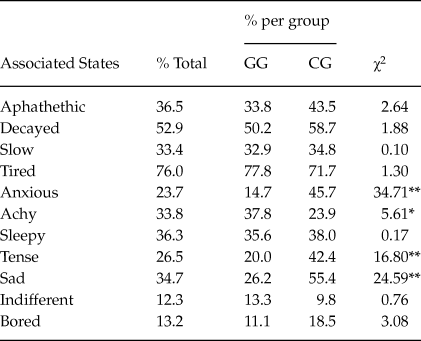
Analysis of the perceived states associated with the feeling of fatigue are shown in Table 1. The percentage of participants who reported the association between the sensation of fatigue and each of the key words related to different physical and emotional states is collected. These percentages are shown in relation to the total sample and to each of the study groups. The results yield that the feeling of fatigue was associated by most participants with the descriptor of tiredness, both for the entire sample (76%) and for the general (77.8%) and clinical (71.7%) groups, followed by the descriptors of weary and apathetic (Table 1).
Frequency differences in the states associated to the experience of fatigue among the general and clinical group

Note: GG = general group; CG = clinical group
* p < .05; **p < .01
The comparison between groups, performed through the Chi-square test, shows significant differences between groups in the key words related to “anxious”, “achy”, “tense” and “sad.” The general group associated most frequently states of physical discomfort with feelings of fatigue while the clinical group associated states of anxiety, tension and sadness (p < .05). There were no significant differences between the remaining descriptors.
In order to analyze the degree of agreement in the order of the descriptors according to the frequency scored by the participants, Kendall’s W test was applied for both the total sample and each of the groups. In the total sample, the participants established the following order of frequency: tired, weary, apathetic, sleepy, achy, sad, slow, tense, anxious, indifferent and bored, W= .143, χ2(10) = 444.78, p < .001. In the group analysis, the degree of coincidence in the sequence was, in the general group: tired, weary, achy, sleepy, lethargic, slow, sad, tense, anxious, indifferent and bored, W = .170, χ2(10) = 383.283, p < .001; and in the clinical group: tired, weary, sad, anxious, apathetic, tense, sleepy, slow, achy, bored and indifferent, W = .135, χ2(10) = 114.343, p < .001. According to this analysis, the descriptors referring to somatic states (tired and weary) occupied the first places in both groups but the general group used a greater number of somatic descriptors (e.g., achy, sleepy). In addition, those descriptors related to negative emotional states such as sad, anxious or apathetic had greater priority in the clinical group than in the general group. It is noteworthy that Kendall’s W test scored low values, indicating that the coincidence between the subjects in each group was significant but moderate.
Analyzing the intensity of fatigue and the associated reactions
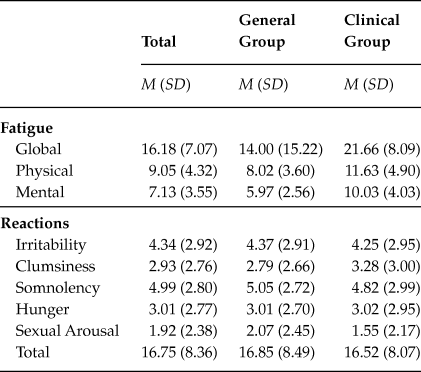
Given the age differences between groups, the analysis of the differences between them in the perception of physical and cognitive fatigue was performed globally through a general linear model, taking age as a covariate. Multivariate contrasts showed that the model was significant (p < .05) for the intersection, the group and the age. Differences between groups (see Table 2) were significant in the overall fatigue, F = 84.15, p < .001, with an effect size of partial Eta2 of .21 for the group and .01 for the age (F = 5.98, p = .015); in mental or cognitive fatigue (F = 95.41, p = .001), with an effect size of partial Eta2 of .23 for the group variable and .03 for the age variable (F = 9.91, p = .002); and in physical fatigue (F = 44.60, p = .001) with an effect size of partial Eta2 of .12 for the group and not significant for the age variable. In order to confirm the differences obtained between groups, a post hoc analysis was performed for the comparison of means by Student's t-test. The clinical group reported a significantly higher intensity in the scales of overall fatigue, t (315) = –8.27, p < .001, physical, t (315) = –6.29, p < .001, and mental, t (315) = –8.81, p <.001. The assumption of homogeneity of variance is violated. Age showed a significant effect in the global and cognitive fatigue but not in its physical manifestation. The older participants reported higher levels of fatigue (r xy = .26, p < .01 for cognitive fatigue; r xy = .15, p < .01 for physical fatigue).
Means and Standard Deviations of Fatigue and Associated Reactions

While levels of physical and mental fatigue were higher in the clinical group, it was not possible to conclude on the predominance of one or the other. For this purpose a Student t-test for paired samples was performed comparing for each group the averages from the different fatigue scales. The physical and mental scales were previously standardized. The levels of somatic and mental fatigue were similar in the general group, however, in the clinical group, the levels of mental fatigue (M = .81, SD = 1.13) were significantly higher, t (91) = –2.15, p = .034, than the levels of physical fatigue (M = .59, SD = 1.13).
The comparison of means between groups for the reactivity associated to the experience of tiredness related to fatigue was similar (p > .05) in each of the evaluated reactions (irritable, clumsy, sleepy, hungry, or excited) and in the overall reaction obtained from the sum of the scores of each specific reaction. From these results, it is clear that both the clinical group and the general group had similar levels of perceived reaction to fatigue for the emotions (e.g., irritability) and sensations (e.g., clumsiness, drowsiness, hunger, sexual arousal) evaluated. The mean scores and standard deviations of the above measures are shown in Table 2.
Discussion
The frequent presence of fatigue in numerous clinical terms and the complaints this causes among patients has led several authors to claim the need for better delineation and detailed study of this construct (Berrios, Reference Berrios, Luque and Villagrán2000; Costello, Reference Costello1992; Rodríguez-Testal & Mesa-Cid, Reference Rodríguez-Testal and Mesa-Cid2011). Derived from this claim, this present study has analyzed the contents and variations of the perceived experience of the sensation of fatigue in people with and without clinical alterations.
The results have shown that subjects, regardless of whether or not they suffer from a clinical disorder, describe the sensation of fatigue mainly by the term tiredness. However, those with a clinical disorder associated fatigue most commonly with negative emotional states of anxiety, tension and sadness. Furthermore, clinical subjects primarily use descriptors that refer to negative emotional states while non-clinical subjects primarily use somatic descriptors. In accordance with expectations, the term tiredness was the nuclear descriptor of the sensation of fatigue, supplemented with somatic or emotionally negative descriptors according to the absence or presence of a disorder in the person. These results are consistent with the delineation that has been made throughout history of the fatigue construct (Caballo et al., Reference Caballo, Salazar and Carrobles2011; Hernández et al., Reference Hernández, Berrios, Bulbena, Bulbena Vilarrasa, Berrios and Fernández2000; Rey-González & Livianos-Aldana, Reference Rey-González and Livianos-Aldana2000) but introduce a differential element that contributes to the clarification and delimitation of the sensation of fatigue when it occurs in the general versus clinical population (applicable to samples with psychopathological or psychiatric disorders): the presence of associated emotionally negative descriptors. Linking negative emotions with feelings of fatigue is consistent with those authors who have associated this feeling mainly with anxious and depressive symptoms (Brown & Kroenke, Reference Brown and Kroenke2009; Demyttenaere et al., Reference Demyttenaere, De Fruyt and Stahl2005; Schneider, Reference Schneider1997; Swindle et al., Reference Swindle, Kroenke, Braun, Sorkin, Summers and Farquhar2001; Tylee et al., Reference Tylee, Gastpar, Lépine and Mendlewicz1999; Walker et al., Reference Walker, Katon and Jemelka1993; Wessely, Chalder, Hirsch, Wallace, & Wright,, 1996) and highlights the importance of considering fatigue not only as a somatic but also emotional manifestation among people suffering from a clinical disorder. This probably indicates that both components (somatic and emotional) are different manifestations of the same global alteration or clinical disorder. Particularly, in relation to depressive symptoms, the presence of fatigue has been associated with a future increase of suffering depression (Addington, Gallo, Ford, & Eaton, Reference Addington, Gallo, Ford and Eaton2001; Kroenke & Price, Reference Kroenke and Price1993). However, the association between depressive symptoms and fatigue must be considered from a bidirectional and interdependent approach, given that any of these could facilitate the development of the other (Hickie, Davenport, Issakidis, & Andrews, Reference Hickie, Davenport, Issakidis and Andrews2002; Mason & Wilkinson, Reference Mason and Wilkinson1996; Pawlikowska et al., Reference Pawlikowska, Chalder, Hirsch, Wallace, Wright and Wessely1994). From this follows, firstly, the need to identify and accurately assess both manifestations when they concur in the same person; and secondly, the need to evaluate the isolated presence of any of these (fatigue or depression) beyond the presence or absence of the other (Walker et al., Reference Walker, Katon and Jemelka1993).
Beyond the specific descriptors used in the definition of the sensation of fatigue in the general and clinical group, we expected to find higher levels of intensity and reactivity among patients. Our results only partially support our expectations: although the clinical participants report higher levels of physical and mental fatigue than non-clinical participants, the intensity of the reactions associated with fatigue (e.g., irritability, clumsiness, drowsiness, hunger, sexual excitement) is similar in both groups. It is reasonable to find a higher intensity in the experience of fatigue among clinical subjects, since the presence of a clinical condition is associated with greater severity and discomfort of the psychological state of the person who suffers from it. However, it is possible that, since fatigue is not the main symptom for all the disorders, reactions associated with fatigue may be closer between the two groups or, as has been shown in other studies, some differences may depend on other intervening factors such as regulation of positive affect (Zautra et al., Reference Zautra, Fasman, Reich, Harakas, Johnson, Olmsted and Davis2005).
An important result was obtained through the analyzes. Mental fatigue in the clinical group was superior to physical fatigue, which did not occur in the general group. This highlights the importance of cognitive elements in the experience of the sensation of fatigue in the clinical population and establishes a new differential marker between the general and clinical population. The prevalence of cognitive elements associated clinical disorders is consistent with increased cognitive biases, hyperreflexivity, maladaptive thoughts that repeatedly have been associated with psychological disorders (e.g., Beck & Alford, Reference Beck and Alford2009; Clark & Beck, Reference Clark and Beck2009; Pérez-Álvarez, Reference Pérez Álvarez2012) and other neuropsychological variables involved in the general concept of central fatigue, such as the effort required to implement attentional resources, working memory, verbal fluency, skill sequences, or decision making (Kluger et al., Reference Kluger, Krupp and Enoka2013; Lou, Reference Lou2009; Sáez-Fracàs et al., Reference Sáez-Francàs, Hernández-Vara, Corominas-Roso, Alegre, Jacas and Casas2014).
There are some limitations to this study that may have biased to some degree the present results: the small number of subjects in the clinical group, the unequal distribution of the various disorders within this group, the non-random selection of clinical participants and age differences among the compared groups.
In summary and as a conclusion, the sensation of fatigue in subjects with a clinical disorder versus those without, is associated more to negative emotional states and shows a higher intensity, especially in its cognitive elements. These differences contribute to the improvement of the diagnosis and understanding of the significance and phenomenology of perceived fatigue in people suffering from a psychological disorder. Therefore, these results yield important clinical implications for the clinical assessment and intervention of fatigue: need to assess and intervene on somatic and cognitive components of fatigue; evaluate the intensity from a dimensional perspective; consider the specificity of the components and differential characteristics associated with fatigue in the clinical versus the general population. Furthermore, these differences may be relevant for a more accurate differential diagnosis between the clinical entities in which fatigue is a core pathological organizer, and may help to establish the role of mood variables (Hadlandsmyth & Vowles, Reference Hadlandsmyth and Vowles2009). Future work must delve into the conclusions and replicate the results of this present study in order to help clarify the possible effect of these biases.