Introduction
Diapause intensity is the duration of diapause under given conditions (Danks, Reference Danks1987). The intensity of diapause has generally been estimated by transferring diapausing insects to diapause terminating conditions, the period required for the completion of diapause development is used as an index of the intensity (Beck, Reference Beck1980; Hodek, Reference Hodek, Brown and Hodek1983; Tauber et al., Reference Tauber, Tauber and Masaki1986). The environmental cues used to end diapause appropriately are primarily photoperiod and temperature. It is now well known that photoperiod and temperature experienced by the pre-diapause growth stages influence the subsequent intensity of diapause.
The influence of the pre-diapause photoperiod on diapause intensity has been reported for a number of insects. In fruit flies, Drosophila auraria, Drosophila subauraria, Drosophila triauraria and bean bug, Riptortus clavatus, the photoperiods with longer scotophases induce more intense diapause than those with shorter scotophases (Kimura, Reference Kimura1983, Reference Kimura1990; Nakamura & Numata, Reference Nakamura and Numata2000). In the green lacewing, Chrysopa ocullata and the European corn borer, Ostrinia nubilalis, a 12 h scotophase evokes a greater intensity of diapause than either longer or shorter scotophases (Nechols, Reference Nechols1987; Beck, Reference Beck1989). In the Mediterranean tiger moth, Cymbalophora pudica, short photophases (11 or 12 h) induce a long prepupal diapause (mean 88 days), whereas long photophases (14, 16 h) induce a short diapause (mean 52 days) (Kostál & Hodek, Reference Kostál and Hodek1997). In the cabbage butterfly, Pieris melete, which undergoes summer and winter diapause, short photophases ≤12 h induce a short diapause (65–69 days) at 20 °C, whereas long photophases ≥13 h induce a long diapause (80–102 days) (Xiao et al., Reference Xiao, Yang and Xue2006).
The influence of pre-diapause temperature on diapause intensity is ambiguous. In some insects, high temperatures during diapause induction induce more intense diapause than that of low temperatures, such as the cricket, Teleogryllus emma (Masaki, Reference Masaki1962), codling moth, Cydia pomonella (Sieber & Benz, Reference Sieber and Benz1980), tobacco hornworm, Manduca sexta (Denlinger & Bradfield, Reference Denlinger and Bradfield1981), corn borer, O. nubilalis (Beck, Reference Beck1989), Hessian fly, Mayetiola destructor (Wellso, Reference Wellso1991), grape berry moth, Lobesia botrana (Roditakis & Karandinos, Reference Roditakis and Karandinos2001), yellow-spotted longicorn beetle, Psacothea hilaris (Asano et al., Reference Asano, Munyiri, Shintani and Ishikawa2004). In some species, diapause was more intense after rearing at a low temperature, such as the Indian meal moth, Plodia interpunctella (Bell, Reference Bell1976), lacewing fly, Mallada flavifrons (Brauer) (Principi et al., Reference Principi, Memmi and Sgobba1990), corn stalk borer, Sesamia nonagrioides (Fantinou et al., Reference Fantinou, Kourti and Saitanis2003), the cabbage butterfly, P. melete (Xiao et al., Reference Xiao, He, Li and Xue2008). In other species, the intensity of diapause was not influenced by temperature in lady beetle, Epilachna admirabilis (Imai, Reference Imai2004), zygaenid moth, Pseudopidorus fasciata (Wu et al., Reference Wu, Yang, Lai and Xue2006).
Many overwintering insects require cool temperature for successful completion of diapause development (Hodek, Reference Hodek2002, see table 2). However, increasing evidence now shows that chilling is not a prerequisite for the completion of hibernation diapause and diapause completion progresses well at intermediate or high temperatures, sometimes it is even stimulated by high or increasing temperatures (Hodek, Reference Hodek2002, see table 1 and 3; Takeda, Reference Takeda2006; Damos & Savopoulou-Soultani, Reference Damos and Savopoulou-Soultani2010; Mironidis & Savopoulou-Soultani, Reference Mironidis and Savopoulou-Soultani2012). However, low temperatures are important in overwintering diapause, as they (1) conserve metabolic reserves, (2) prevent resumption of post-diapause morphogenesis and thus synchronize the life-cycle and (3) represent contrast to the later increase in temperature (Hodek & Hodková, Reference Hodek and Hodková1988).
The cotton bollworm, Helicoverpa armigera (Hübner) (Lepidoptera: Noctuidae), is one of the most important agricultural pests of the Old World. Its wide distribution and pest status have been attributed to its polyphagy and its ability to undergo both facultative diapause and seasonal migration (Fitt, Reference Fitt1989). In China, this species is distributed ranging from almost northernmost to southernmost. The influence of photoperiod and temperature on diapause induction and termination in H. armigera has been studied in detail (Wu & Guo, Reference Wu and Guo1995, Reference Wu and Guo1996, Reference Wu and Guo1997; Qureshi et al., Reference Qureshi, Murai, Yoshida, Shiraga and Tsumuki1999; Shimizu & Fujisaki, Reference Shimizu and Fujisaki2006; Kurban et al., Reference Kurban, Yoshida, Izumi, Sonoda and Tsumuki2007; Chen et al., Reference Chen, Xia, Chen, Xiao and Xue2012). However, the influence of pre-diapause developmental conditions on diapause intensity has not been reported in H. armigera. The purpose of the present study was to examine: (a) whether diapause-inducing photoperiods and temperatures affect the subsequent intensity of diapause in H. armigera; (b) the modification in the intensity of diapause by transferring diapausing pupae to different temperatures; (c) effect of chilling for different periods on the intensity of diapause; (d) the termination of diapause under natural conditions; (e) modification of the intensity of diapause when diapausing pupae were kept in natural conditions for different periods and then transferred to diapause-terminating conditions.
Materials and methods
Insects
A laboratory culture of H. armigera was originated from dozens of fully-grown larvae which were collected from Langfang city (39°32′N, 116°41′E) in the corn fields in July, 2010. These larvae were reared on an artificial diet (Wu & Gong, Reference Wu and Gong1997) and maintained in the rearing room under LD 15: 9 at 25±1 °C until adult eclosion. These adults were reared in cages (40 cm×25 cm×18 cm) with a removable gauze cloth top to mate and for egg collection. The adults were fed with 10% honey solution. Eggs were collected on days 3, 4 and 5 after eclosion. After hatching, every 3–5 newly hatched larvae were together transferred to the plastic plates with 24 holes (for each hole: diameter: 1.5 cm; height: 2 cm) and reared on artificial diet until the third instar larvae, the third instar larvae were individually transferred to new plastic plates with 24 holes until the fifth instar larvae, then the fifth instar larvae were individually reared in plastic plates with 21 holes (length: 2.5 cm; width: 2.5 cm; height: 2.5 cm) until pupation. Offspring of the third generation were used to carry out our experiments. All the experiments were carried out in climate cabinets (LRH-250-GS, Guangdong Medical Instrument Manufacturer, Guangdong, China) equipped with six fluorescent 30 W tubes. The light intensity during photophase was approximately 2.0 W m−2 and variation of temperatures was ±1 °C.
Experimental design
Experiment 1: Effect of diapause-inducing photoperiod and temperature on the intensity of diapause
The effect of pre-diapause photoperiod and temperature on diapause intensity was evaluated by rearing newly-hatched larvae at different temperatures (20, 22 and 25 °C) combined with LD 11:13, LD 12:12, LD 13:11, LD 14:10, LD 15:9 and LD 16:8 photoperiods until diapause was determined. The incidence of diapause was shown in table 1. Those diapausing pupae (10-day-old) induced under the day lengths of 11, 12 and 13 h at 20, 22 and 25 °C were transferred to 25 °C and LD 15:9 to test diapause development. The emerged adults were recorded every day until all the diapausing pupae emerged.
Incidence of pupal diapause (%) in H. armigera at different temperatures and photoperiods.

Sample numbers are given in parentheses.
Experiment 2: Effect of diapause-terminating temperature on the duration of diapause
10-day-old diapausing pupae induced under LD 12:12 at 20 and 22 °C were transferred to six temperatures of 18, 20, 22, 25, 28 and 31 °C combined with LD 15:9 to terminate diapause. They were then examined daily for adult emergence.
Experiment 3: Effect of chilling on diapause termination
To investigate the effect of chilling on diapause development, 10-day-old diapausing pupae induced under LD 12:12 at 20 and 22 °C were placed at 5 °C for different lengths of time (ranging from 30 to 120 days) in continuous darkness. After chilling, the pupae were transferred to 25 °C and LD 15:9 to terminate diapause.
Experiment 4: Diapause termination of overwintering pupae
The diapausing pupae induced under LD 12:12 at 20 °C were divided into two groups. One group was kept under natural conditions until adult eclosion. Another group was kept under natural condition for different times and then transferred to LD 15:9 combined with 20 and 25 °C to terminate diapause. The date transferred to natural conditions was 1 November 2010.
Identification of diapause induction and termination
Diapause was determined by a lack of eye spot movement. Pupae that retained eyespots in the post genal region for more than 15 days were considered to be in diapause (Cullen & Browning, Reference Cullen and Browning1978). The criterion of diapause termination was adult's emergence. Thus, the duration of diapause included the period of post-diapause development.
Statistics
Statistical analyses were conducted using SPSS 17.0. The influence of diapause-inducing and diapause-terminating conditions on the duration of diapause was analyzed by the General Linear Model (GLM), the duration of diapause between different treatments was compared using multiple comparisons by Tukey's Honestly Significant Difference (HSD) test following one-way analysis of variance (ANOVA). Throughout the text all means are given ±1 SE.
Results
The effect of diapause-inducing photoperiod and temperature on the intensity of diapause
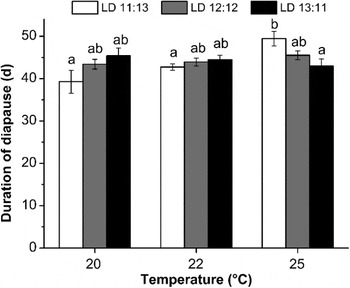
Fig. 1 shows that the effect of diapause-inducing photoperiod on diapause intensity depended on the temperature. At the diapause-inducing temperature of 25 °C, the duration of diapause induced by photoperiod of LD 11:13 (49.4 days) was significantly longer than those of LD 12:12 (45.5 days) or LD 13:11 (42.7 days) (F 2,288=3.851, P=0.022). However, there were no significant differences in the intensity of diapause induced by the three short photoperiods at 20 and 22 °C (fig. 1). The effect of diapause-inducing temperature on diapause intensity also depended on the photoperiod. At the diapause-inducing photoperiod of LD 11:13, the duration of diapause induced by temperature of 25 °C (49.4 days) was significantly longer than those of 22 °C (42.7 days) or 20 °C (39.3 days) (F 2,231=10.757, P=0.000). However, no significant difference was found in the diapause-inducing photoperiods of LD 12:12 and LD 13:11.
Duration of pupal diapause in H. armigera under LD 15:9 at 25 °C, diapause was induced at different photoperiods and constant temperatures. Values followed by different letters are significantly different based on Tukey's test after one-way ANOVA (n=29–149 for each treatment).

The effect of diapause-terminating temperature on the duration of diapause
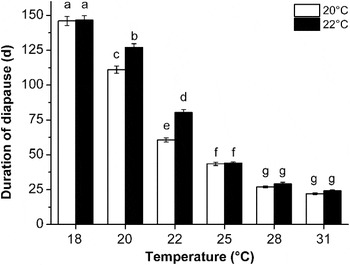
The duration of diapause significantly depended on diapause-terminating temperature (terminating temperature influence on duration of diapause: F 5,1104=1428.141, P=(0.000)<0.05) (fig. 2). The duration of diapause was significantly shortened from 146 days at 18 °C to 24 days at 31 °C, showing that high temperature significantly accelerates diapause development. Interestingly, the diapause-inducing temperature also affects the duration of diapause. The duration of diapause induced by 22 °C was longer than that induced by 20 °C at all temperatures. However, the significant difference was only observed when the diapausing pupae were maintained at 20 or 22 °C (multiple comparisons by Tukey's test, for all P<0.05).
Duration of diapause under LD 15:9 at different temperatures in H. armigera. Diapause was induced by 20 or 22 °C combined with LD 12:12 (n=63–148 for each treatment).

Effect of chilling on diapause termination
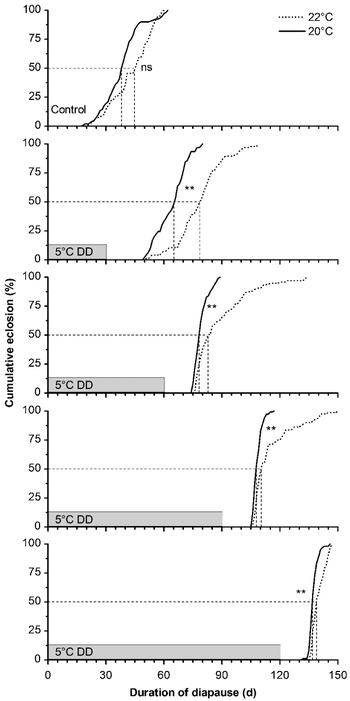
Fig. 3 shows the cumulative eclosion rate of diapausing pupae under LD 15:9 at 25 °C after chilling at 5 °C for different days. From this figure it is clear that the eclosion time significantly postponed with increase in chilling time if the time spent under chilling was regarded as part of the duration of diapause development (F 4,949=2905.1, P=0.000), suggesting that chilling at 5 °C did not shorten the duration of diapause but lengthened it. However, chilling plays an important role in synchronizing adult emergence. All adults emerged within 11–14 days at chilling treatment of 120 days. Fig. 3 also shows that the time for 50% adult emergence for all chilling treatments was earlier at the diapause-inducing temperature of 20 °C than those at the diapause-inducing temperature of 22 °C. There were significant differences in diapause durations between the two inducing temperatures (F 9,939=1384.5, P=0.000), further suggesting that the pre-diapause temperature has a significant effect on diapause intensity.
Effect of chilling on diapause termination in H. armigera. 10-day-old diapause pupae were transferred to 5 °C DD for 0, 30, 60, 90 and 120 days, and subsequently transferred to 25 °C and LD 16:8. Diapause was induced by 20 or 22 °C combined with LD 12:12 (n=59–148 for each treatment).

Diapause termination of overwintering pupae
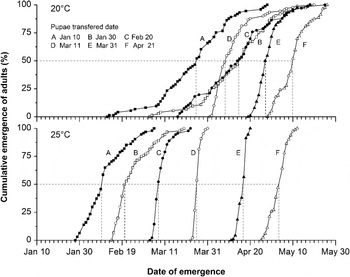
Fig. 4 shows the cumulative eclosion rate of diapausing pupae under LD 15:9 at 25 °C after keeping under natural conditions for different days. When the overwintering pupae were transferred at different times from natural temperatures (<13 °C) to 25 °C, it was found that, the earlier the transfer took place, the earlier the adults emerged when the time spent under natural conditions was included. For example, eclosion of 50% of the adults occurred on 10 February, 21 February, 8 March, 26 March, 17 April and 3 May when the overwintering pupae were transferred to 25 °C on 10 January, 30 January, 20 February, 11 March, 31 March and 21 April, respectively, without showing that cool temperatures during winter hastened diapause development. Surprisingly, eclosion of 50% of the adults occurred earlier at the treatment transferred on 11 March than those transferred on 30 January and 20 February, suggesting that cool temperatures before March may have an enhanced effect on diapause development. Fig. 4 also shows that adult emergence was much quicker and more synchronous at 25 °C than at 20 °C at all treatments. The duration of diapausing pupae at 25 °C was significantly shorter than that at 20 °C (F 11,997=355.97, P=0.05).
Diapause termination of overwintering pupae of H. armigera. Periodic samples from an outside insectary were transferred from natural mean temperatures of (A) 9.4 °C, (B) 7.8 °C, (C) 7.5 °C, (D) 7.8 °C, (E) 8.9 °C and (F) 13.8 °C on different dates to a constant temperature of 20 and 25 °C, respectively (n=73–94 for each treatment).

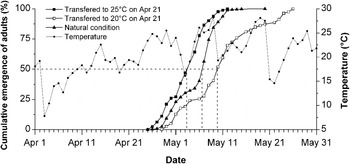
Fig. 5 shows a comparison of adult emergence among naturally overwintering pupae, diapausing pupae transferred on 21 April from natural conditions to 20 °C and 25 °C. The date for 50% adult emergence of the naturally overwintering pupae was about 3 days earlier than that of the diapausing pupae at 20 °C and 3 days later than that of the diapausing pupae at 25 °C. The mean daily temperature experienced by the naturally overwintering pupae from 21 April to 6 May (50% adult emergence) was 21.9 °C. The differences in adult emergence indicate that the rate of post-diapause development depends mainly on temperature. Under natural conditions a few pupae began to emerge on 26 April. According to laboratory observation, the mean pupal duration for non-diapause individuals was 15.9 days at 22 °C, thus the post-diapause development for those individuals should initiate on 10 April. Fig. 5 just shows that mean daily temperature quickly rises to 17.5 °C or more after 9 April.
A comparison of adult emergence among naturally overwintering pupae, diapausing pupae transferred on 21 April from natural conditions to 20 °C and 25 °C (n=73–410 for each treatment).

Discussion
The intensity of diapause could not only vary between species but also among individuals of the same species depending on how long they have been exposed to diapause-inducing conditions (Beck, Reference Beck1980). According to the present findings, the intensity of diapause in H. armigera pupae was affected by diapause-inducing photoperiod and temperature. However, the effect of diapause-inducing photoperiod on diapause intensity depended on temperature; the diapause-inducing photoperiod of LD 13:11 (close to critical day length) significantly shortened the duration of diapause at 25 °C but not at 20 and 22 °C (fig. 1). Similarly, the effect of diapause-inducing temperature on diapause intensity depended on photoperiod; the duration of diapause was significantly shortened at diapause-inducing temperature of 25 °C under the short photoperiod of LD 11:13 but not under the photoperiods of LD 12:12 and LD 13:11 (fig. 1).
When diapausing pupae were transferred to different temperatures to terminate diapause, the durations of diapause at 20 and 22 °C were significantly longer at the diapause-inducing temperature of 22 °C than at 20 °C , but no significant differences were found at 18, 25, 28 and 31 °C (fig. 2). Similarly, rearing temperature of 22 °C evoked significantly more intense diapause than did 20 °C at chilling treatments of 30, 60, 90 and 120 days but not at the control (fig. 3). The results suggest that there is a great variation in diapause intensity under different rearing conditions. Therefore, to determine whether photoperiod or temperature has a significant influence on diapause development, the experimental range for photoperiod and temperature ought to be adequately wide.
Our results showed that higher rearing temperatures induced more intense diapause than that of low temperatures (figs 2 and 3). Why? We think it may be a result of selection because the incidence of diapause in population is obviously lower at higher temperatures than that at lower temperatures as shown in table 1. Thus, those individuals that enter diapause at higher temperatures may have genetically strong diapause ability and tend to have more intense diapause. Of course, further investigations are needed to prove the hypothesis.
Our data revealed that the diapause can be terminated without exposure to chilling in H. armigera. Furthermore, the rate of diapause completion is positively related to temperature increase, the duration of diapause was significantly shortened from 146 days at 18 °C to 24 days at 31 °C (fig. 2), indicating that high temperature can rapidly terminate pupal diapause. The chilling experiment in fig. 3 showed that chilling at 5 °C did not shorten the duration of diapause when chilling period was included. Similarly, when the overwintering pupae were transferred at different times from natural temperatures to 25 °C, the duration of diapause increased with an elongation of cool exposure, without showing that cool temperatures during winter hastened diapause development. Interestingly, when the overwintering pupae were transferred at different times from natural temperatures to 20 °C, cool temperatures accelerated diapause development of part of population in the early stage of diapause (fig. 4). This result suggests that the diapause-terminating high temperature can offset the effect of chilling on diapause development. All results reveal that high temperatures can significantly accelerate diapause development; whereas low temperatures play a limited role in diapause development in H. armigera. Therefore, periods of low temperature during winter may be a means of conserving metabolic reserves and preventing post-diapause morphogenesis, which in turn synchronizes spring emergence (Hodek & Hodková, Reference Hodek and Hodková1988).
It must be mentioned that chilling as part of diapause development has been repeatedly stressed by Hodek (Reference Hodek2002). However, in recent study of H. armigera collected from cotton field in northern Greece (41°N, 23°E), Mironidis & Savopoulou-Soultani (Reference Mironidis and Savopoulou-Soultani2012) demonstrated that exposure of diapausing pupae to chilling conditions of 4 °C significantly accelerated diapause development and the time of adult emergence. It is obviously misinterpreted because the time spent at 4 °C is not added. In fact, only 14 days chilling at 4 °C slightly shortened the duration of pupal diapause compared with the unchilled controls, the other chilling treatments (28, 56, 70 and 84 days) resulted in the increase of diapause duration if the time spent at 4 °C is added.
According to observations of diapause termination in natural conditions (fig. 5), a few diapause pupae initiated their post-diapause development on 10 April when the mean daily temperature rose to 17.5 °C or more, suggesting that the developmental threshold for post-diapause development in H. armigera should be around 17.5 °C. Wu & Guo (Reference Wu and Guo1996) reported that the developmental threshold for post-diapause development was 17.6 °C for a northern population of H. armigera. Moreover, in the present study, the mean duration of diapause in H. armigera was about 5 months long (146 days) at 18 °C (fig. 3), similar with diapause duration of the naturally overwintering pupae under natural conditions (from November to April). Therefore, it is possible that the temperature of 18 °C is the lowest temperature to initiate post-diapause development under natural condition in H. armigera. Knowing the date of diapause termination in the field is essential for predicting insect appearance in the spring. Post-diapause development of wintering pupae depends mainly on temperature in H. armigera. We have shown the relation between the initiation of post-diapause development and temperature. Combined with the climatic data from the locality, the time of adult emergence in spring can be predicted.
Acknowledgements
The research was supported by a grant from National Natural Science Foundation of P. R. China (31260430) and Ministry of Education, Science and Technology Development Center (20103603110001).