“I must rattle my chains, and groan through keyholes, and walk about at night, if that is what you mean. It is my only reason for existing.”
“It is no reason at all for existing and you have been very wicked.”
Oscar Wilde, The Canterville Ghost, 1887
Since its political unification (1861), Italy has been a country characterized by limited investments in scientific research and innovative activities. At the same time, however, its performance in terms of economic growth has been nothing short of remarkable (especially keeping in mind that Italy is a country with a limited endowment of energy and other natural resources) and it is comparable with those of other major Western economies. Therefore, prima facie, the Italian case can provide us with some interesting insights concerning the relationship between scientific and technological activities and growth performance. Is the Italian case a historical example showing that technical change is not really the key driver of economic growth? Or perhaps, does the Italian case show that it is possible to attain substantial rates of technical progress without significant efforts in research and development (R&D) activities? Or is Italy perhaps just a “lucky exception” to the general rule, being the example of a country that, by design or accident, discovered some substitute that could replace the role played by science and technology as drivers of economic growth in other countries? In this article we tackle these questions by providing a comprehensive reappraisal of the complex interactions between scientific and technological activities and economic growth in Italy since the unification.
The study of the relationship between technical change and comparative economic development represents perhaps one of the most important themes of research in economic history. Although (mainstream) economists have, for a long time, conceived of technology as a “public good” that is freely accessible by all countries, economic historians have instead recognized that the successful assimilation of innovations is by no means automatic and that it requires significant efforts and investments in the concomitant development of new skills and competencies. Furthermore, the introduction of new technologies requires a creative process of adaptation to the specific local circumstances prevailing in the importing country. Footnote 1 In this perspective, the existence of technology gaps can be seen as the prime source accounting for differences in economic performance across countries.
The increasing recognition that country-specific factors shape the process of technological change at the national level was the main source of inspiration of the notion of the National Innovation System (NIS) in the late 1980s. Footnote 2 The concept of the NIS is based on the idea that innovation is the outcome of “social” processes in which a variety of actors (such as individuals, firms, public institutions, and the like) are involved. According to the NIS view, the key actors and the key interactions featuring in innovation processes have a predominantly national character.
This perspective, to some extent, overlaps with the “varieties of capitalism” approach. For example, Hall and Soskice argue that institutional differences between liberal market economies and coordinated market economies should lead to the emergence of different innovation patterns across countries, suggesting implicitly the possibility of constructing a typology of different NISs. Footnote 3 In this article, rather than looking at the Italian experience as an attempt to emulate the innovation systems of the leader countries, we consider it as an attempt to develop an appropriate ensemble of “substitutes” for supporting innovation in a technologically lagging country. The key interpretative issue then becomes the assessment of the peculiar Italian variety of NIS. As we shall see, in a comparative perspective, Italy is a country characterized by a structurally weak NIS. Our contention is that this weakness has forced the country to adopt a peculiar path toward “modern economic growth” characterized by a combination of low real wages and intensive use of unskilled labor. The rest of the article is organized as follows. In the next section, we summarize the main interpretations concerning the relationships among science, technology, and Italian economic growth. The third section reconstructs the historical evolution of the Italian NIS in comparative perspective, using both quantitative and qualitative evidence. The fourth section discusses the relationship between innovation systems and entrepreneurship. The fifth section deals with the role of real wages as a powerful contextual factor shaping the Italian pattern of innovative activities. The last section presents the conclusions.
Science, Technology, and Italian Economic Growth: Interpretations
Broadly speaking, in the literature it is possible to identify two main views about the role played by technological change in Italian economic growth. The first view, which may be labeled as the optimist perspective, considers the Italian pattern of technical change as a rational response to a resource endowment characterized by a scarce availability of natural resources and by a structural abundance of unskilled labor. In this context, it was pointless to invest a large amount of resources in the development of cutting-edge technologies. Rather, a more suitable strategy consisted in adapting technologies developed abroad to the specificities of the Italian context.
The second view, which can be called as the pessimist perspective, considers the Italian case as a prolonged failure to develop an autonomous innovative capacity. In this view, technical change is conceived as a tool for overcoming resource constraints and, accordingly, the weak Italian performance in innovative activities represent a missed opportunity to set the country on a more secure footing in its path toward “modern economic growth.”
The optimist approach is well summarized in a survey book by Cohen and Federico, Footnote 4 who adopt a neoclassical perspective in which technology is akin to a public good that can be easily acquired off the shelf without requiring the development of absorptive capabilities. Accordingly, for Italian firms the best option was to invest their limited resources in adapting imported technologies: “technology mixing and matching was a rational response to relative factor prices.” Footnote 5 The relevance of the connection between factor prices and choice of techniques has been also elaborated in other contributions: Federico emphasizes the relative success of Italian light industries in becoming internationally competitive by relying on essentially (unskilled) labor intensive production processes and not particularly sophisticated technologies; Footnote 6 Bardini, instead, argues that, in the case of Italy, the lack of coal represented a powerful obstacle preventing a satisfactory adoption of steam power technologies. Italy has instead been more successful in the introduction of the technologies based on electricity, which are more suited to its resource endowment. Footnote 7
The success of Italian small firms in light industries and traditional sectors is also a theme that has featured prominently in the literature on Italian “industrial districts.” Footnote 8 In the industrial districts, small firms are involved in continuous, cooperative, non-formalized learning processes, often leading to streams of successful incremental innovations. These activities are often underestimated by traditional innovation indicators. In this perspective, Italy has followed an alternative model of development not characterized by the central role of formalized R&D activities and the growth of high-tech industries. Footnote 9
The pessimist account has been delineated in two versions. The contribution of Giannetti may be defined as a “moderate pessimist” picture; he maintains that Italy has been able to develop effective capabilities for the assimilation of innovations from abroad, but not for the autonomous creation of new technologies. Footnote 10 He is keen on emphasizing the repeated Italian failure of entering high-tech sectors. However, he also emphasizes that the creation of absorptive capabilities allowed Italy to participate in some of the major technological trajectories of the first (although with considerable delay) and the second industrial revolutions. Footnote 11 The contribution of Malerba shares the same moderate pessimist view; he adopts the conceptual framework of NIS and considers the post-World War II period. Malerba argues that the Italian innovation system actually comprised two distinct innovation systems: (1) “small firm networks” operating either in traditional, low-tech industries or in equipment supplier industries, very often clustered in specific locations; and (2) a core R&D system comprising large firms, public research laboratories, and universities. The core R&D system is extremely fragile, with limited capabilities in the generation of new technologies. The performance of the small firm network is satisfactory, but this produces only adaptations and incremental innovations. Footnote 12 The contribution of Vasta has, instead, a pessimist view throughout: He adopts a broader conceptualization of the NIS that looks both at scientific and technology policies and at the formation of human capital, which is a crucial element of an effective absorptive capacity. Accordingly, the weaknesses of the Italian NIS have, in the long run, produced a number of structural deficiencies that had many detrimental cumulative effects that are not easily reversible. Footnote 13
The Italian NIS: A Historical Profile
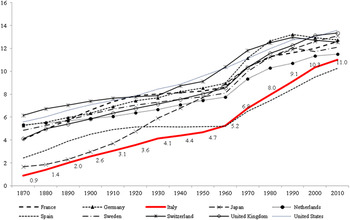
The aim of this section is to provide a description of the historical evolution of the Italian NIS. We adopt the traditional distinction between input and output indicators of innovation. The first input indicator we consider is the human capital endowment of a country that directly affects its ability to use, adapt and develop new technologies. Footnote 14 A useful proxy of the aggregate human capital endowment of a country, charted in Figure 1, is the average years of schooling of the population (aged between 15 and 64). The indicator shows a significant gap between Italy and the other major countries. Furthermore, Italy remains the country in the lowest position—except for Spain in the past forty years—going from 0.9 years in 1870 to 11 years in 2010.
Average years of schooling of population (15–64 years) in selected countries
Source: Our own elaborations on Morrisson and Murtin, “The Century of Education.”

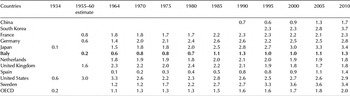
Turning our attention to more traditional input indicators, Table 1 shows the evolution of R&D expenditure on GDP for selected countries. The table shows that Italy is characterized by a very significant gap persisting throughout the entire period. Italy is far not only from the most advanced countries that traditionally invest significant amounts of resources in research (Germany, Japan and United States), but also from South Korea and China, which have overtaken Italy in the past decade.
R&D expenditure on GDP (%) for benchmark years (1934–2010)

Note: The OECD data in 1934 refers to a weighted estimate of twelve European countries; data for Japan from 1975 to 1995 are taken from “adjusted” series; for 1964, data of Italy and Unites States refer to 1963; for 1970, data of United Kingdom and Sweden refer to 1969; for 1980, data of Germany, United Kingdom, and Sweden refer to 1981; for 1990, data of China and Sweden refer to 1991; for 2010, data of China, Japan, and United States refer to 2009.
Source: Our own elaborations: for 1934, Freeman and Soete, The Economics of Industrial Innovation, 300; for 1955–1960, Malerba, “The National System of Innovation,” 232; for United States in 1964, OECD, A Study of Resources; for 1964–1980, OECD R&D statistics; for 1980–2010, OECD, Main Science and Technology, data extracted on April 1, 2012.
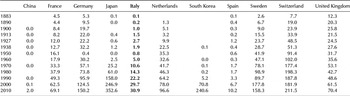
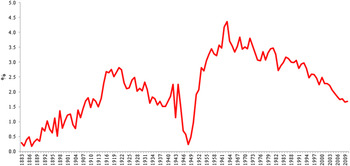
The first output indicator we consider is the number of patents. Table 2 shows the number of patents issued in the United States to residents in the major industrialized countries per million inhabitants. Footnote 15 Figure 2 complements Table 2 by charting the historical evolution of the share of Italian patents in the United States over time.
Patents granted to foreign residents in the United States by country, per millions of inhabitants and benchmark years (1883–2010)

Source: Our own elaborations on population estimates from Maddison, Historical Statistics; and on patents from, for 1883–1960, U.S. Department of Commerce, Patent and Trademark Office, Technology Assessment, and for 1970–2010, on USPTO.GOV Extended Year Set, data extracted on April 1, 2012.
Patents granted to Italian residents in the United states as a percentage of total patents granted to foreign residents (1883–2010)
Source: our own elaboration: for 1883–1962, on U.S. Department of Commerce, Patent and Trademark Office, Technology Assessment; for 1963–2010, on USPTO.GOV Extended Year Set, data extracted on April 1, 2012.

Table 2 shows that the Italian long-term innovative performance measured using U.S. patents was, in general, very weak and far from that of countries with similar levels of income. However, by looking at Figure 2, four distinct phases can be highlighted: the first, of rapid growth ending at the beginning of the 1920s, when Italy reached a peak (2.5 percent). This period was characterized by the effects of World War I, when several industries with high technological intensity developed, such as steel production and chemicals. Footnote 16 This phase is followed by a period of relative decline that coincided with the rise of fascism, the autarchic period, and World War II, during which the share of Italian patents decreased significantly. Indeed, the levels registered in the early 1920s were exceeded only in the early 1950s. This seems to contradict the interpretation of Petri, who considers this historical phase as a moment of consolidation of Italian technological capabilities. Footnote 17 The third phase coincides with the period of the Italian Golden Age (1950–1970), when the share culminated in the historical peak of 4.4 percent in 1963. The “effervescence” of this historical phase is also confirmed by the a number of success stories of breakthrough innovations, such as the polypropylene invented by Giulio Natta during the 1950s and the Perottina invented in 1964 by Giorgio Perotti. Footnote 18 Subsequently, a new phase of decline ensued with a constant reduction in performance, with an average value of 3.4 percent during the 1970s and of 3.1 percent during the 1980s. A drastic deterioration of the performance occurred from the mid-1990s, so that in 2000 the share was equal to the levels of the 1920s, with a further drop to 1.7 in 2010, the level reached at the eve of World War I.
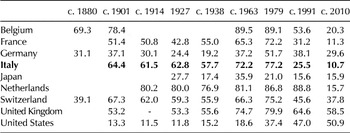
Further insights on Italian innovative performance emerge from a closer look at the historical development of the patent system in Italy. Conventional economic theory suggests that, without patent protection, incentives for innovation will be lacking. Hence, an effective system of patent protection is a necessary prerequisite for the attainment of substantial levels of innovative investment. The historical evidence instead suggests a much more nuanced picture, especially for countries that are catching up with the world’s technological frontier. Footnote 19 Indeed, many successful catching-up countries adopted judicious policies concerning intellectual property rights to make sure that patents could act not only as an incentive, but also as a tool for transferring technologies from abroad. Thus, many nineteenth-century patent systems contemplated the possibility of granting patents not only for new inventions, but also for importing technologies from abroad. More importantly, many nineteenth-century patent systems contained discriminatory measures against foreign inventors—sometimes explicitly, sometimes in the actual practice of the legal procedures. For example, in the United States, patents were initially restricted to American citizens (a ban that was gradually relaxed) and until 1861, foreign applicants were required to pay higher fees. Footnote 20 An illustration of discriminatory practices against foreign inventors is provided also by the obstacles raised by the German patent office against U.S. machine tool makers during the 1920s. Footnote 21 Italy did not follow these examples of discrimination against foreign patentees, but it developed a patent system that could also be used effectively by foreign inventors. Footnote 22 The lack of discrimination in the Italian system is particularly visible when we consider the relative openness of the patent system. Footnote 23 This may be measured by considering the share of patents granted to foreign applicants of the total number of patents granted (Table 3).
Share of foreign patents in total patents granted

Source: Our own elaborations on http://www.wipo.org, extracted July 1, 2012.
Until 1979, the Italian system was extremely open, with a share of patents granted to foreign inventors that exceeded 50 percent, which is very similar to that of small open economies such as those of the Netherlands and Belgium. Footnote 24 The general impression is that the “openness” of the Italian system may have induced the transfer of technologies from abroad but, on the other hand, it might have been also less suited in stimulating the use of foreign technologies as a base for autonomous innovations.
Turning our attention now to the generation of scientific knowledge, we consider the number of scientific publications as an output indicator. For this purpose, we use two different samples: the overall world scientific production extracted from the Scopus database (henceforth All-Scopus [AS]) and a subsample of this database, which should approximate the excellence of research activity, represented by the two leading “generalist” scientific journals in the world: the English Nature and the American Science (henceforth N&S). Figure 3 compares the shares of Italian publications in AS and in N&S with the shares of Italian patenting activity in the United States. To check the reliability of our estimates based on the Scopus database, in the figure we also include some alternative estimates of the Italian share provided by other scholars: the pioneering contribution by de Solla Price and the more recent studies by May and King. Footnote 25 Overall, Figure 3 points to some important characteristics of the Italian innovation system. First, looking at the whole period, scientific activities dominate patent activities. Second, scientific activity increases considerably in the early 1960s when, to the contrary, the share of patents declines. Third, the “mismatch” between science and technology becomes even more apparent after the 1980s, when the share of Italian publications in N&S grows rapidly, whereas the share of patents drops. This latter trend is probably due to the growing internationalization of the Italian academic system, at least in hard sciences.
Technological activity versus research activity, Italy (1883–2011).
Note: The series have been smoothed with a five-period moving average; all documents in AS concerning areas of life sciences, health sciences, and physical sciences. The countries considered are China, France, Germany, Japan, Italy, Netherland, Spain, South Korea, Sweden, United Kingdom, and the United States.
Source: Our own elaboration: for publications, Scopus database (http://www.scopus.com/home.url); data extracted on April 7 and June 26, 2012; de Solla Price, Little Science; May, “The Scientific Wealth of Nations”; King, “The Scientific Impact of Nations.” For patents, see Table 2.

The diverging performance between scientific and technological activities suggest the existence of major difficulties in the technology transfer of scientific results from universities to firms (lack of bridging institutions) and, more generally, the existence of research systems that seem able to deliver a reasonable performance, although not an outstanding one, and that are more sophisticated that the system of industrial research in business firms.
Figure 3 shows also different phases in Italian performance in scientific research. In the first phase, running from the unification up to the end of the 1880s, the Italian share of scientific papers is around 0.6 percent, whereas starting from the beginning of the 1890s, in the Giolittian era, this value grew considerably, overcoming the threshold of 2.5 percent. Footnote 26 World War I produced a drastic decline and, during the interwar period, even if characterized by a positive trend, the Italian share of world scientific production remained under 1 percent. Italian performance increased considerably during the Golden Age, passing from 1.8 percent in 1950 to 4 percent in 1973. After this period, the Italian share remained substantially stable, at around 4 percent.
This quantitative picture is consistent with accounts produced by historians of science in Italy. From the unification up to World War I, there was no real integration of the system of scientific research and industrial applications, so the growth of scientific research was due, by and large, to the expansion of the university system and to the sporadic initiative of some talented scientists, such as Vito Volterra. Footnote 27 On this point, one may be tempted to speculate whether the idealistic Italian cultural tradition that took root in this historical period may have also played a role in shaping the general cultural outlook of the country toward industrial innovation. Footnote 28 After World War I, a major restructuring of the system of scientific research took place, leading to the creation in 1923 of Consiglio Nazionale delle Ricerche (CNR). This was a major institutional reform adopted by the Fascist regime for allegedly boosting the performance of the Italian scientific system and increasing its connections with industrial firms, especially in military applications. In fact, most historians agree in considering this reorganization as a missed opportunity, because it was carried out with a very limited amount of resources and more with a view to propagandistic goals than to the real support of promising research projects. Footnote 29
Another missed opportunity is the period 1950 to 1963, when the experience of CNR was fraught by an excessive fragmentation of resources and by a political inability to focus on the most promising projects, as shown by the case of the lukewarm support of research in nuclear power systems. After the oil crisis, the Italian system was characterized by a structural lack of resources and by a confusing arrangement of the interaction between the CNR and the university system. Footnote 30
Innovation Systems and “High-Tech” Entrepreneurship
The quantitative picture outlined in the previous section is fully consistent with a stream of research that has pointed to the difficulties faced by “Schumpeterian” entrepreneurs in the Italian historical context. Interestingly, Amatori has recently updated his pioneering contribution, adding to his “classic” entrepreneurial typologies (“Milanese,” “supported,” and “public” entrepreneurs), the figure of the “real Schumpeterian” entrepreneur. Footnote 31 However, in his view, this new typology is limited to the Golden Age (1950–1970). In this period, the “glorious years,” few great figures were able to successfully exploit the mass production trajectory. According to Amatori, some of these entrepreneurs, such as Sinigaglia (Finsider) and Mattei (ENI), perform their role as managers of the most important state-owned enterprises of the country. Footnote 32 Recently, Toninelli and Vasta, by adopting multiple correspondence analysis and cluster analysis, have proposed a new taxonomy of Italian entrepreneurship. They show the structural absence of Schumpeterian innovative virtues in the Italian context. Moreover, their analysis indicates that the few genuine “Schumpeterian” entrepreneurs did not operate in high-tech sectors but, on the contrary, in traditional industries such as, for example, pasta (Piero Barilla) and world-renowned brands in clothing and fashion (Aldo Gucci). Thus, the Schumpeterian virtues of this category of entrepreneurs consists more of their the ability to find new markets and, more generally, their capacity to successfully expand their business abroad rather than their genuine innovative capabilities. In other words, we can say that the innovative virtues of the Schumpeterian component of Italian entrepreneurship are more linked to a consolidated feature of the entire history of modern Italy (producing traditional goods of superior quality), than to the real capacity to create new products or processes close to the technological frontier. Footnote 33
The link between the marginal role of Schumpeterian entrepreneurship and the structural deficiencies of the Italian innovation system may be appreciated by considering two cases of the failure of the Italian innovation system to exploit breakthrough inventions that were generated in the country. The first case is that of Guglielmo Marconi (1874–1937) and the invention of the radio. The invention (leading to the first successful experiments on transmission, carried out in the spring of 1895) was conceived completely in the Italian context. Immediately afterward, Marconi decided to move to England to try to exploit his invention there through the family connections of his (Irish) mother who was related to the Jameson family of whisky producers. As Guagnini has shown, the initial plan was to take a patent for the invention in England, sell it, and then return to Italy to further develop the innovation. In England, Marconi found access to key resources and capabilities that were of crucial importance for moving from a prototype invention to a commercial innovation and to the creation of a successful “high-tech” company. In particular, Guagnini points to two key factors: (1) the contribution offered by the patent agents (Carpmael & Co.) in drafting a very sound patent specification and in successfully extending this protection in the most important international patent offices; and (2) the contribution offered by a number of legal advisers in working out the agreements and contracts for the startup company. It is difficult to imagine counterparts of these ingredients in the Italian context. Footnote 34
The second case is the attempt by Olivetti to penetrate the international computer industry during the 1950s and early 1960s. In retrospect, the initial phase of this project was a success. In a short period, Olivetti was able to create a very strong research center in computer science, directed by Mario Tchou (1924–1961). The company also established a fruitful partnership with the research laboratory of the University of Pisa. The outcome of this efforts were the Elea 9003 (launched in 1959), which was the first fully transistorized commercial computer, and the P101, designed by the engineer Pier Giorgio Perotto (1930–2002) and launched in 1964, which might be regarded as the first personal computer. These were no mean feats for a country that, in the early 1950s, was completely lagging behind in this technological field. However, the subsequent history of computing technology in Italy clearly shows the exceptional character of these achievements that probably owed more to the exceptional entrepreneurial abilities of their founders than to the broader context in which they were nurtured. Thus, the untimely deaths of Adriano Olivetti (1960) and Mario Tchou (1961) represented a major blow for the creation of an Italian player in the computer manufacturing industry. Following the financial difficulties of the Olivetti company, the electronics department was sold to General Electric. Interestingly enough, in this decision, neither the private shareholders who were in control of the company at the time nor the public actors made any assessment of the possible long-term benefits of maintaining an Italian presence in such a strategic high-tech sector. Footnote 35
Contextual Factors: The Dynamics of Real Wages
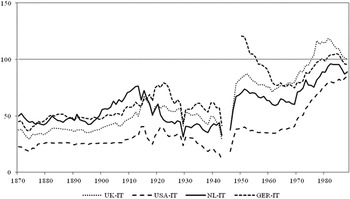
The final element of our quantitative overview of the Italian NIS is represented by what we consider an important contextual factor. The indicators we have considered so far provide the picture of a country characterized by a very limited investment of resources in scientific and technological activities and by a relatively marginal position in these areas when compared with those of other major industrialized countries. This configuration was sustainable because the Italian economy, as illustrated by Figure 4, could enjoy a relatively sluggish dynamics of real wages from the unification until at least the late 1960s. Footnote 36 Figure 4 shows the ratios between the indices of real wages for some major industrialized countries and the Italian level (if the ratio is lower than 100, then Italy has a proportionally lower real wage than the other country). Footnote 37
Comparative real wages, 1870–1988
Source: Our own elaborations on Williamson, “The Evolution of Global Labor Markets.”

In our view, it is plausible to assume that low real wages represented a powerful “compensating factor” for the structural weaknesses of the innovation system. In other words, low real wages were a safety valve that Italian firms and entrepreneurs could activate to counterbalance their own ineffective innovation activities. Furthermore, it is also likely that in the long run, this lethargic dynamics of real wages might have exerted further negative effects by discouraging the systematic search for improvements in labor productivity and the substitution of capital equipment for labor. Footnote 38
Conclusions
Our reappraisal has confirmed that the Italian pattern of “modern economic growth” is indeed a peculiar one, structurally characterized on the one hand by limited investments in R&D activities and in education and, on the other hand, by a limited capacity of generating innovations and being competitive in high tech industries. Our study shows that the origins of this structural weakness have deep historical roots. In the Liberal age, there was a substantial lack of appreciation of the key role of scientific research. During the Fascist period, it is possible to see a more determined attempt of constructing a system of scientific research capable of both generating scientific results and developing new industrial applications. However, the Fascist contribution to the construction of such a system was more rhetoric than real. Overall, this disregard toward science and technology constituted a very heavy burden that could not easily be overcome, even in the post-World War II phase. Although it is surely possible to identify a number of success stories both in scientific research and industrial R&D during the Golden Age (1950–1973), this historical phase remained a missed opportunity for an effective consolidation of the Italian NIS. One may also be tempted to speculate whether, since the 1980s, the rhetoric of the industrial districts and the anti-Chandlerian “small is beautiful” literature may also account for the complacency concerning the failure of the Italian NIS. Footnote 39 In this perspective, Italy’s position among the richest countries of the world is not to be regarded as firmly secured. In our view, the evidence discussed in this article clearly supports the pessimists’ view. In fact, the Italian model of development characterized by a scarce attention to innovative performance and by an inbuilt tendency to rely on a compression of the dynamics of real wages appears as an inherent fragile construction.
To sum up, our historical appraisal suggests that Italian NIS, from the unification until today, was characterized by a peculiar shadowy or “ghostly” nature. In Italian economic history, it has been largely invisible, forcing the country to adopt a peculiar road toward “modern economic growth” based on the combination of low real wages and the intensive use of unskilled labor. We should, of course, recognize that along specific dimensions, such as the assimilation and adaptation of foreign technologies, the Italian NIS provided a significant contribution and that, in a few historical moments, the Italian NIS was also, against all odds, capable of generating important advances in both scientific research and industrial applications. On further reflection, however, these sporadic appearances—which are more due to lucky accidents than to planning and design—also fit the analogy of the ghost rather well. In this perspective, one may even be tempted to extend the analogy to the frail and ineffectual ghost that, according to Oscar Wilde, was living in Canterville Chase.