INTRODUCTION
The Atlantic coast of Brazil stretches from a few degrees north of the equator to Uruguay approximately 9200 km south. Over this range of approximately 35° latitude, coastal geology, hydrologies and climate, among other environmental conditions, contrast considerably. Consequently, species composition and community structures along the coast are diverse and highly varied. To better understand such coastal biodiversity, patterns of geophysical and oceanographic change, as well as the distribution of organisms, must be assessed accurately.
In shallow-water habitats of the western Atlantic, fiddler crabs (genus Uca Leach, 1814) thrive along the shores of protected bays, estuaries and lagoons. Marcgrave (Reference Marcgrave, Piso and Marcgrave1648) conducted the earliest study of fiddler crab diversity in the New World, relying on first-hand collections and systematic observations. As a result of the 1638–1644 expedition to the north-eastern coast of Brazil commissioned by the Dutch Prince Maurice of Nassau-Siegen, Marcgrave described four land crabs and three forms of Cancer palustris cunicolas, known today as Uca (Barnwell, Reference Barnwell1986): Maracoani (=Uca maracoani Latreille, 1802–1803), Ciecie Ete or Cranguersinho des Manges (=Uca thayeri Rathbun, 1900) and Ciecie Panema (most likely either Uca rapax (Smith, Reference Smith1870) or Uca burgersi Holthuis, Reference Holthuis1967). Later expeditions have revealed that ten Uca species inhabit the coastal biomes of Brazil (Crane, Reference Crane1975; Melo, Reference Melo1996): Uca burgersi Holthuis, Reference Holthuis1967; Uca cumulanta Crane, Reference Crane1943; Uca leptodactyla Rathbun 1898; Uca maracoani, Uca mordax (Smith, Reference Smith1870); Uca rapax, Uca thayeri, Uca uruguayensis Nobili 1901; Uca victoriana von Hagen, Reference Hagen1987; and Uca vocator (Herbst, 1801).
In recent years, the geological history and structure of both South America and the coast of Brazil have become clearer. All Brazil lies on the South American tectonic plate, the major features of which are two large and three smaller cratonic areas separated from the western Andean orogenic belt by a wide foreland basin running the length of the plate (Cordani & Sato, Reference Cordani and Sato1999; Chew et al., Reference Chew, Kirkland, Schaltegger and Goodhue2007). The oldest crust (3.0 to 3.5 billion years) is located on the São Francisco craton in Bahia and Minas Gerais States. During the Late Mesozoic (100 Mya) the Gondwana supercontinent began to fragment. As South America separated from north-west Africa in the Late Cretaceous (≈70 Mya), the Equatorial Atlantic seagate opened, providing a permanent, deep-sea connection between the proto-North and the proto-South Atlantic Oceans (Reyment & Tait, Reference Reyment and Tait1972; Pletsch et al., Reference Pletsch, Erbacher, Holburn, Kuhnt, Moullade, Oboh-Ikuenobede, Söding and Wagner2001). During the Oligocene (≈30 Mya), southern South America separated from Antarctica, opening the Drake Passage and establishing the Antarctic Circumpolar Current (Sanmartín & Ronquist, Reference Sanmartín and Ronquist2004).
Simultaneously, as the South American plate collided with those underlying the Pacific Ocean, orogenic activity along its north-western edge during the late Oligocene and Miocene (30 to 5 Mya) altered the flows of the Magdalena, Orinoco and Amazon Rivers. As the Eastern Cordillera of the Colombian Andes and the Mérida Andes in Venezuela uplifted, the inland sea occupying north-western Brazil slowly evaporated and the palaeo-Orinoco and palaeo-Amazon Rivers began to flow to the east into the Atlantic rather than north into the Caribbean (Hoorn et al., Reference Hoorn, Guerrero, Sariento and Lorente1995, Reference Hoorn, Wesselingh, Steege, Bermudez, Mora, Sevink, Sanmartín, Sanchez-Meseguer, Andeson, Figueiredo, Jaramillo, Riff, Negri, Hooghiemstra, Lundberg, Stadler, Särkinen and Antonelli2010; Rossetti, Reference de Rossetti2001). The present watershed pattern was established by the end of the Miocene (≈9 to 6.5 Mya) producing a large, freshwater alluvial fan along the Atlantic coast of northern South America (Latrubesse et al., Reference Latrubesse, Cozzuol, da Silva-Caminha, Rigsby, Absy and Jaramillo2010). During the Pliocene, closure of the Central American Passage (3.7 to 2.8 Mya) separated the Pacific biota from their relatives in the Atlantic Ocean and Caribbean Sea (Keigwin, Reference Keigwin1982; Ibaraki, Reference Ibaraki1997; Lessios, Reference Lessios2008).
Many intertidal plants and invertebrates depend on tides and oceanic currents to disperse their propagules and larvae. Female fiddler crabs bear clutches of ova on their abdominal pleopods until the eggs mature. The first zoeae hatch into an adjacent body of water to continue development (Hyman, Reference Hyman1920). Since fiddler crabs in most of Brazil experience semi-diurnal tides (Barnwell, Reference Barnwell1963), the early larvae are likely transported as plankton, shifting away from the female's intertidal or supratidal habitat into the open bay or ocean using selective tidal-stream transport on an ebbing tide (Tankersley et al., Reference Tankersley, Wieber, Sigala and Kachurak1998). Planktonic larvae are distributed great distances over the coastal shelf by near-shore and oceanic currents (Epifanio et al., Reference Epifanio, Little and Rowe1988). As they mature, the later larval stages select the appropriate landward flood tide, seeking habitats for settling and transition to megalopae and juvenile crabs (Christy, Reference Christy1989; Little & Epifanio, Reference Little and Epifanio1991; O'Conner & Judge, Reference O'Conner and Judge1999; Behum et al., Reference Behum, Brodie and Stanton2005; Brodie et al., Reference Brodie, Behum, Monroe and Glenn2005; Lopez-Duarte & Tankersley, Reference Lopez-Duarte and Tankersley2007). Consequently, the relationship between larval development/behaviour and oceanic tides/currents may be a major factor that influences the geographical distribution of many species, including Uca populations (Grantham et al., Reference Grantham, Eckert and Shanks2003; Johnson & Allen, Reference Johnson and Allen2005; Teske et al., Reference Teske, Papadopoulos, Zardi, McQuaid, Edkins, Griffths and Barker2007).
In particular, surface ocean currents and temperatures appear to be a major influence on the biological features and biogeography of the South Atlantic Ocean (Peterson & Stramma, Reference Peterson and Stramma1991; Boltovskoy et al., Reference Boltovskoy, Gibbson, Hutchings, Binet and Boltovskoy1999). Bifurcation of the South Equatorial Atlantic Current near Brazil's most eastern projection, the Ponta do Calcanhar, Rio Grande do Norte, is a major biogeographical feature giving rise to two distinct circulation patterns, each possessing notably distinct dispersal potentials. The North Brazil Current flows toward the Amazon River and the Guianas, leading north into the Caribbean Sea. The South Brazil Current flows south toward Uruguay and Argentina (Espenshade & Morrison, Reference Espenshade and Morrison1974).
Recently, we collected fiddler crabs from mangroves, estuaries and rivers along the Brazilian coast between the States of Amapá and Santa Catarina. Here, we present accurate information on the distribution of the ten fiddler crab species encountered, based primarily on first-hand fieldwork undertaken in 2009 and 2010. We also examined preserved Uca specimens from the crustacean collection of the Museu de Zoologia of the Universidade de São Paulo (MZUSP) and records for Brazilian Uca in several North American and European museums. To corroborate our findings, we provide data from selected reports of Uca at other locations in Brazil. We analyse the distribution and relative abundance of Uca by correlating each species' range with geophysical factors such as tectonics, surface oceanic currents and climate, aiding our understanding of the evolution and dispersal of Uca. A further important outcome is the identification of high biodiversity areas. Fiddler crabs maintain the environmental health of mangroves and salt marshes (Penha-Lopez et al., Reference Penha-Lopez, Bartolini, Limbu, Cannicci, Kristensen and Paula2009; Smith et al., Reference Smith, Wilcox and Lessman2009). Knowledge about their distribution and ecology can guide future Brazilian conservation efforts (Beck & Odaya, Reference Beck and Odaya2001; Lourie & Vincent, Reference Lourie and Vincent2004; Amaral & Jablonski, Reference Amaral and Jablonski2005; Joly et al., Reference Joly, Rodriquez, Metzger, Haddad, Verdade, Oliveria and Bolzani2010) and is essential for restoration in light of potential coastal catastrophes. Since we anticipate publishing a series of reports on the comparative physiology, population genetics and comparative morphology of Brazilian Uca, this contribution describes the fieldwork underpinning our future papers.
MATERIALS AND METHODS
Field collections, authorized by the Instituto Brasileiro do Meio Ambiente e dos Recursos Naturais Renováveis (IBAMA, permits No. 2009/18559-1 and No. 2010/23976-1) were made at 63 localities along the Atlantic coast of Brazil between the States of Amapá (AP) and Santa Catarina (SC). From June to November 2009, 54 locations were sampled between Pernambuco (PE) (Itapissuma, Ilha de Itamaracá (north point)) and SC (Palhoça, Barra da Passagem, and Rio Massiambu). Further, nine habitats were sampled from AP (Calçoene, Rio Cacoal) to Ceará (CE) (Fortaleza, Rio Cocó) between June and August 2010. These sites were not randomly chosen but represent convenient accesses to littoral habitats by road, track, or boat. However, collections were conducted randomly at each locality but may be biased for rare or a particular species.
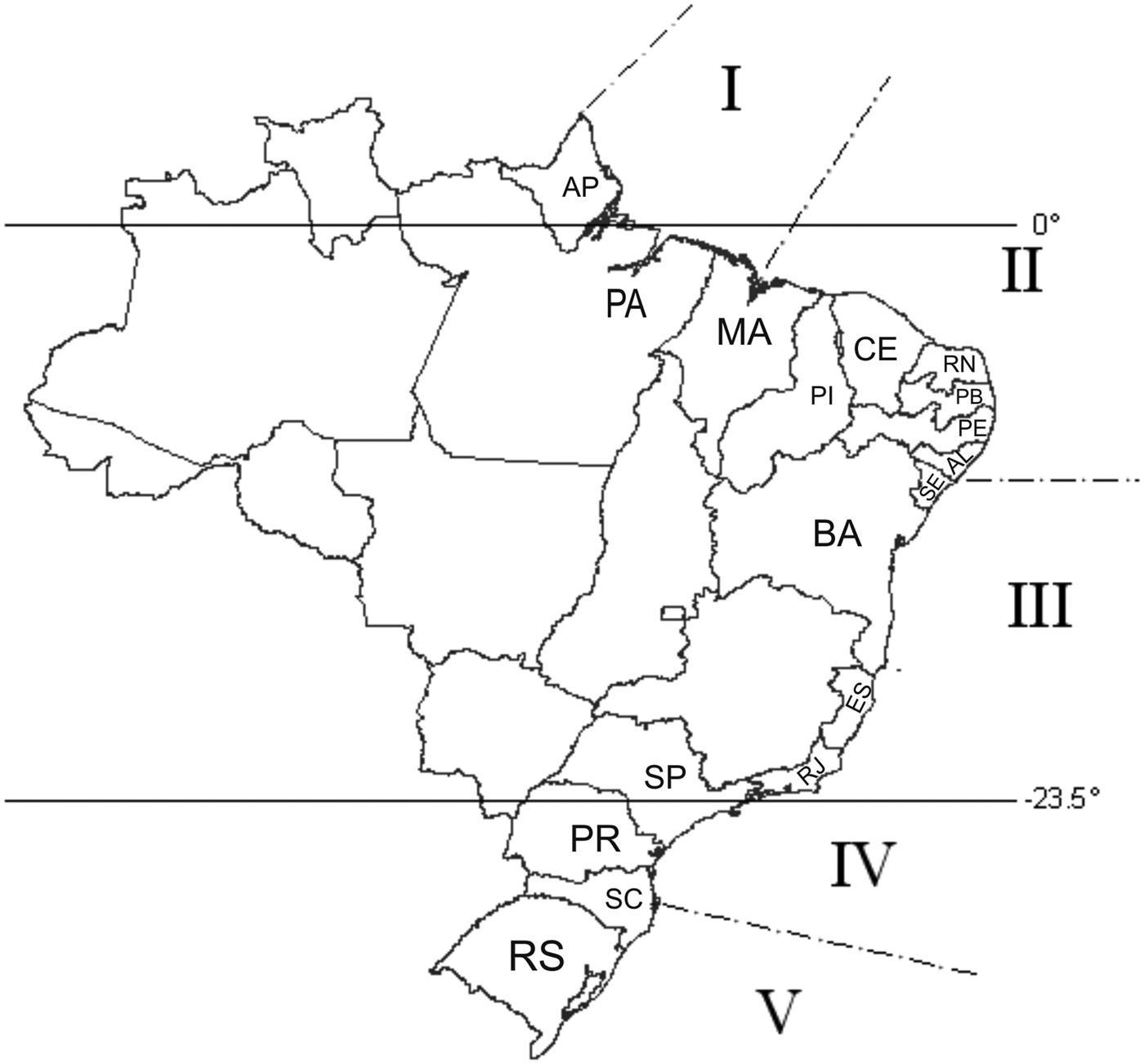
The following abbreviations are used throughout for Brazil's 17 coastal states (Figure 1): AL, Algoas; AP, Amapá; BA, Bahia; CE, Ceará; ES, Espírito Santo; MA, Maranhão; PA, Pará; PB, Paraíba; PE, Pernambuco; PI, Piauí; RJ, Rio de Janeiro; RN, Rio Grande do Norte; PR, Paraná; RS, Rio Grande do Sul; SE, Sergipe; SC, Santa Catarina; SP, São Paulo.
Coastal biomes of Brazil. Coastline delineated by predominant oceanic currents and geomorphology. Currents: Biomes I and II, north-western flow of North Brazil Current. Biomes III, IV and V, south-western flow of South Brazil Current. Geomorphology: Biome I, tropical alluvial plain of the Amazon River; Biome II, dry, sandy tropical coastal plain; Biome III, humid, tropical coast of the Atlantic rainforest; Biome IV, humid, subtropical coast of the Atlantic rainforest; and Biome V, dry, temperate coastal plain (pampas). The boundary between Biomes III and IV coincides with the Tropic of Capricorn (23.5°S) and is not shown.

A general description of the terrain, including notes on the nature of the substratum, was recorded at each collecting site. Surface sediments were classified according to Shepard's (Reference Shepard1954) nomenclature. Sediment consisting of equal portions of clay, silt and sand was designated as mud. A 25-ml sample of habitat water was collected at each location for measurement of habitat osmolality (=salinity). After capture, live crabs were transported by air and/or car to the Centro de Biologia Marinha (CEBIMar), Universidade de São Paulo in São Sebastião, SP.
The ten species of fiddler crabs collected were identified using traditional morphological characteristics. Five species occur in North America, and details of their morphologies are described elsewhere (Barnwell & Thurman, Reference Barnwell and Thurman1984). A dichotomous key (Melo, Reference Melo1996) was used to identify the Brazilian fiddler crabs, together with supplementary descriptions of the more cryptic species (Crane, Reference Crane1943; Holthuis, Reference Holthuis1967; Chase & Hobbs, Reference Chase and Hobbs1969; Coelho, Reference Coelho1972; von Hagen, Reference Hagen1987; Tavares & de Mendonça, Reference Tavares and de Mendonça2003; Bedé et al., Reference Bedé, Oshiro and Melo2007).
Details of external morphology and maxillipeds were examined using a Leica 5 Zoom stereo microscope. In some cases, digital image records were made using a Nikon D40 camera and an AF-S Micro Nikkor 105 mm macro lens. To examine the relationship between carapace size and the surface dimensions of the 3rd maxillipeds, ten preserved crabs were measured to the nearest 0.01 mm using an ocular micrometer and Vernier calipers. The c-index (Ono, Reference Ono1965; von Hagen, Reference Hagen1970b) was calculated as
 $$\eqalign{{\rm C} = \displaystyle{{\hbox{Max. width 3rd maxilliped} \times\!\! \hbox{ maximum length }}\over{\hbox{Max. width carapace} \times\!\! \hbox{ maximum length }}} \times \lpar 10^3\rpar}$$
Species with a c-index between 90 and 105 feed on coarse-grained, sandy substrates. A c-index between 89 and 60 is typical of species that process combinations of sand, clay and silt. Those with a c-index below 60 extract nutrients from silt and soft mud.
More than 7000 specimens were preserved in 70% ethanol and constitute the morphological basis of this investigation. Approximately 250 lots were donated to the crustacean collection at the Museu de Zoologia, Universidade de São Paulo in Ipiranga, São Paulo. Over 3000 samples of leg muscle tissue were taken and preserved in 95% ethanol for future analyses of DNA sequences and population genetics.
Besides our field collections, Uca records in Brazil were examined at the MZUSP, the US National Museum of Natural History (USNM, Washington, DC), the American Museum of Natural History (AMNH, New York), the British Museum of Natural History (BMNH, London), and the Muséo de La Plata (LPNM, Argentina). Records from the USNM collection are available at http://collections.nmnh.si.edu/search/iz.
In this study, we consider the genus Uca (sensu lato) Leach, 1814 in Brazil to be represented by ten species (Melo, Reference Melo1996) divided among four subgenera. Beinlich & von Hagen (Reference Beinlich and Hagen2006) defined eight subgenera in the genus based on the differential weighting of a few distinct apomorphic characteristics. This scheme has been accepted in the most recent comprehensive treatments of extant brachyuran crabs (e.g. Ng et al., Reference Ng, Guinot and Davies2008). Here, we use four subgenera: (1) subgenus Uca (sensu stricto) (Uca maracoani Latreille, 1802–1803); (2) subgenus Boboruca (U. thayeri); (3) subgenus Leptuca (Uca cumulanta Crane, Reference Crane1943, Uca leptodactyla Rathbun, 1898, and Uca uruguayensis Nobili, 1901); and (4) subgenus Minuca (Uca burgersi Holthuis, Reference Holthuis1967, Uca mordax (Smith, Reference Smith1870), Uca rapax (Smith, Reference Smith1870), Uca victoriana von Hagen, Reference Hagen1987, and Uca vocator (Herbst, 1804)). For simplicity, subgenus is incorporated into the species' name (e.g. Uca (Minuca) victoriana or U. (M.) victoriana).
For geographical analysis, the Brazilian coast is divided into five biomes (Figure 1, I–V) based on surface oceanic currents, landforms and traditional climate zones. As the Central South Equatorial Current flows toward South America from Africa, it splits into the North Brazil Current and the South Brazil Current at the Ponta do Calcanhar (RN) (Espenshade & Morrison, Reference Espenshade and Morrison1974). Within the areas bathed by the two ocean currents, landform varies considerably. The coastal climate from Amapá (AP) to Rio de Janeiro (RJ) is considered tropical. The coast between Rio de Janeiro (RJ) and Laguna (SC) is considered subtropical while more southern latitudes are considered temperate (Boltovskoy et al., Reference Boltovskoy, Gibbson, Hutchings, Binet and Boltovskoy1999). Here, we use the following biomes: Biome I, humid, tropical sedimentary plain from French Guiana to Baía de São Marcos, Maranhão (MA) (Psuty & Mizobe, Reference Psuty, Mizobe and Schwartz2005); Biome II, mixed, dry, tropical sedimentary plain and humid Gondwana Shield from Ilha de São Luís (MA), to the Rio São Francisco, Algoas (AL); Biome III, humid, tropical mountains and sedimentary plains from Sergipe (SE) to Paraty (RJ); Biome IV, subtropical mountainous Gondwana Shield from Ponta de Juatinga (RJ) to Cabo de Santa Marta (SC); and Biome V, humid, temperate sedimentary plain from Cabo de Santa Marta (SC) to Barra do Chuí (RS).
The osmolality (mOsm kg−1 H2O) of a 10-μl aliquot of the water sample taken from each habitat was measured in the laboratory (23°C) using a Wescor C5520 Vapor Pressure Osmometer (Logan, UT) by comparison with commercial standards. Osmolality can be converted to parts per thousand (‰), known as practical salinity units (1 psu = 30 mOsm kg−1 H2O). Habitats are classified by salinity according to the protocol of Hedgpeth (Reference Hedgpeth1957). Oligosaline (O) or freshwater habitats lie between 1 and 10 psu (≈30 to ≈300 mOsm kg−1 H2O). Habitats between 10 and 21 psu (≈300 to ≈630 mOsm kg−1 H2O) are mesosaline (M) or brackish, while those between 21 and 35 psu (≈630 to ≈1050 mOsm kg−1 H2O) are eusaline (E). Habitats of salinities greater than 35 psu (>1050 mOsm kg−1 H2O) are hypersaline (H).
RESULTS
Geographical distribution of Uca (sensu lato) species
A. Subgenus Uca (sensu stricto), Leach, 1814
DIAGNOSIS
Large species, width of interocular region less than 10% that of anterior carapace. Found in tropical and subtropical regions preferring very soft muddy substrates in the mid- to low intertidal zone. Anterior lateral margins either angular or with spine. Ten species form the subgenus Uca (sensu stricto). Seven species occur along the Pacific shores of Central and South America. In the Atlantic, there are three representatives of the subgenus. Of these, two inhabit the Atlantic and Caribbean shores in the New World, Uca major (Herbst, 1782) and U. maracoani. The third, Uca tangeri (Eydoux, 1853), occurs along the shores of the eastern Atlantic from southern Portugal and Spain to Central Africa. The subgenus is evident in the fossil record (Rathbun, Reference Rathbun1926; Brito, Reference Brito1972; Dominguez-Alonso, Reference Dominguez-Alonso2008).
Uca (Uca) maracoani (Latreille, 1802–1803)
HISTORICAL RECORDS
Brazil: AP, Ilha de Maracá (MZUSP 12871), Jipioca (MZUSP 13134); PA, Salinópolis (MZUSP 12058), Vigia (MZUSP 4564), Braquatius (MZUSP 16871), Airuperé (MZUSP 12305); MA, São Luís (MZUSP 6218, 6219), Tutóia (AMNH 4657); PB, Mamanguape (MZUSP 13259); PE, Recife (USNM 75562); AL, Estuário, Rio do Camaragibe (MZUSP 20523); BA, Salvador (USNM 138584); SP, Cananéia (MZUSP 3922), ??? Brazil (BMNH 1844.7).
MATERIAL COLLECTED
516 specimens. Brazil: AP, Calçoene, Amapá (MZUSP 23189, 23190, 23191, 23192, 23193 and 23194); MA, São Luís (MZUSP 23180, 23181, 23182, 23183, 23184, 23186 and 23187); CE, Fortaleza (MZUSP 23185 and 23188); PE, Ilha de Itamaracá (MZUSP 20967, 20983, 20984 and 20985); BA, Madre de Deus, Maragogipe (MZUSP 20977, 20978, 20979, 20980 and 20925); ES, Vitória, Santa Cruz (MZUSP 20927, 20981 and 20982); RJ, Barra de Sepetiba, Paraty (MZUSP 20968, 20969, 20970, 20971 and 20972); SP, São Sebastião (MZUSP 20926); PR, Baía de Guaratuba (MZUSP 20929, 20973, 20974, 20975 and 20976).
SUBSTRATES AND SALINITY PREFERENCES
Typically found low on exposed tidal flats in very soft silt, sandy silt, or mud near river mouths. Species prefers meso- or eusaline habitats. Salinity range (N = 17): 2.6 to 35.4 psu, 75 to 1010 mOsm kg−1 H2O; mode: 22.8 psu, 650 mOsm kg−1 H2O; mean: 21.2 ± 2 psu, 606 ± 72 mOsm kg−1 H2O.
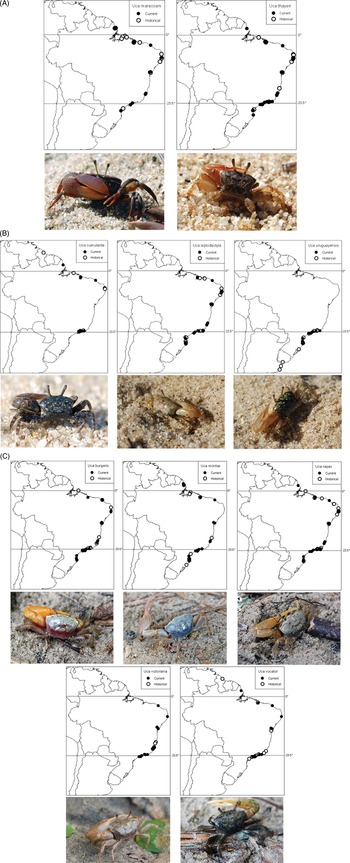
GEOGRAPHICAL RANGE ( Figure 2A )
Lectotype locality—Cayenne, French Guiana (Crane, Reference Crane1975). Distribution primarily Atlantic coast of South America from the Golfo de Paria, eastern Venezuela (Crane, Reference Crane1943) and Trinidad (von Hagen, Reference Hagen1970a, Reference Hagenb) to Baía de Guaratuba, PR, Brazil (Masunari, Reference Masunari2006) with one record from Florianópolis, SC (Branco, Reference Branco1991). Previous reports of U. (U.) maracoani from Jamaica (Sloane, Reference Sloane1725; Rathbun, Reference Rathbun1918) result from an erroneous identification of U. (U.) major (Barnwell, Reference Barnwell1986). Examination of AMNH 2644 indicates an aberrant geographical location (Santo Domingo, Dominican Republic: 1915) for this species. Since U. (U.) maracoani has not been collected at other locations in the northern Caribbean for almost 100 years, this may have been an accidental and isolated introduction.
Collecting sites and geographical distributions of ten Uca species along the Atlantic coast of Brazil: (A) subgenus Uca [U. (U.) maracoani] and subgenus Boboruca [U. (B.) thayeri]; (B) subgenus Leptuca [U. (L.) cumulanta, U. (L.) leptodactyla and U. (L.) uruguayensis]; (C) subgenus Minuca [U. (M.) rapax, U. (M.) victoriana, U. (M.) vocator, U. (M.) burgersi and U. (M.) mordax]. •, collection site; ○, museum record.

B. Subgenus Boboruca Crane, 1975
DIAGNOSIS
Fairly large species with interocular distance about 20% of maximum carapace width. Pile forms bow-tie pattern on dorsal surface of carapace. Merus of 3rd and 4th ambulatories very wide compared to length. In males, major cheliped with long, forceps-like fingers, palm with moderately raised oblique ridge. Carapace mostly velvety grey-green, posterior–lateral margin often appears purple. Cheliped coloured light orange. Two species in subgenus: U. (B.) thayeri (western Atlantic) and Uca (B.) umbratila Crane, 1941 (eastern Pacific).
Uca (Boboruca) thayeri Rathbun, 1900
HISTORICAL RECORDS
Brazil: PA, Bragautica (MZUSP 16865); MA, Alcântara (MZUSP 12857), São Luís (6226); PB, Mamanguape (MZUSP 13299), Cabedelo (USNM 23753 (type), 23793); PE, Recife (USNM 138129); AL, Estuário, Rio do Camaragibe (MZUSP 22331); BA, Salvador (USNM 138130); ES, Itaúnas (MZUSP 21856-21860); RJ, Ilha do Pinheiro (USNM 138131), PR, Pontal do Sul (MZUSP 11879).
MATERIAL COLLECTED
963 specimens. Brazil: AP, Rio Amapá (MZUSP 23133); MA, São Luís, Icatu (MZUSP 23127, 23130, 23132, 23134 and 23135); CE, Fortaleza (MZUSP 23128, 23131 and 23136); PE, Ilha de Itamaracá, Recife, Rio Maracaípe (MZUSP 20909, 20910, 20955 and 20956); BA, Madre de Deus, Maragogipe, Baía de Aratu (MZUSP 20898, 20902, 20946 and 20947); ES, Coqueiral, Santa Cruz, Vitória, Guarapari (MZUSP 20897, 20901, 20906, 20913, 20958 and 20959); RJ, Lagoa de Araruama, Itacuruçá, Lagoa de Guarapina, Barra de Guaratiba, Paraty (MZUSP 20903, 20904, 20905, 20908, 20924, 20948 and 20949); SP, Rio Juqueriquerê, São Sebastião, Bertioga (MZUSP 20911, 20912, 20957 and 23129); PR, Baía de Guaratuba (MZUSP 20899, 20900, 20950, 20951, 20952, 20953 and 20954); SC, Florianópolis, Balneário Daniela (MZUSP 20907).
SUBSTRATE AND SALINITY PREFERENCE
This species prefers pliable clay and mud rich in humus usually associated with vegetation. Especially common among roots in mangroves as noted by Marcgrave (Reference Marcgrave, Piso and Marcgrave1648: Cranguersinho des manges). Burrows may have a chimney formed from large, rolled mud pellets. Prefers habitats of meso- to eusaline salinity. Salinity range (N = 28): 1.2 to 42.1 psu, 33 to 1203 mOsm kg−1 H2O; mode: 17.8 psu, 508 mOsm kg−1 H2O; mean: 18.5 ± 2.2 psu, 529 ± 63 mOsm kg−1 H2O.
GEOGRAPHICAL RANGE ( Figure 2A )
Type locality—Rio Parahyba do Norte, Cabadelo, PA, Brazil (USNM 23753). USA: Haulover Creek, Duval County, north-east Florida; South Creek, Osprey, Sarasota County, south-west Florida; Mexico: Rio Champóton, Campeche (Barnwell & Thurman, Reference Barnwell and Thurman1984; Thurman, Reference Thurman1987); Central America, Caribbean (Thurman et al., Reference Thurman, Hanna and Bennett2010), and South America to Balneário Daniela, Ilha de Florianópolis, Santa Catarina, Brazil (Melo, Reference Melo1996).
C. Subgenus Leptuca Bott, 1973
DIAGNOSIS
A group of usually small-sized species, several with 4th to 6th pleon segments partly or fully fused. Carapace globular with interocular distance about 25% to 35% of maximum carapace width. Dactyl and pollex long, giving major cheliped in the male a forceps-like appearance. Ambulatory meral segment is thin and tubular. Setae and pile (pubescence) usually sparse to absent on ambulatory appendages. Subgenus Leptuca composed of 28 known species: eight species in western Atlantic and twenty in eastern Pacific (Beinlich & von Hagen, Reference Beinlich and Hagen2006).
Uca (Leptuca) Cumulanta Crane, 1943
HISTORICAL RECORDS
Jamaica: Kingston Harbour (USNM 22313); Guyana: Georgetown (USNM 138520); Brazil: PA, Bragautica (MZUSP 16868); PB, Mamanguape (USNM 25700), Cabedelo (MZUSP 8023); RJ, Ilha de Paquetá (USNM 71171, 138875), Angra dos Reis (MZUSP 3062), Paraty (MZUSP 11663).
MATERIAL COLLECTED
371 specimens. Brazil: AP, Rio Amapá (MZUSP 23166); MA, São Luís, Icatu (MZUSP 23167, 23169 and 23170); CE, Fortaleza (MZUSP 23168); RJ, Itacuruçá, Lagoa de Guarapina, Barra de Guaratiba, Paraty (MZUSP 20823, 20824, 20825, 20826 and 20827).
SUBSTRATE AND SALINITY PREFERENCE
Inhabits sandy clay to sandy silt with some clay. Common in mangroves and adjacent open mudflats. Prefers habitats of oligo- to mesosaline water. Salinity range (N = 11): 1.1 to 32.5 psu, 33 to 930 mOsm kg−1 H2O; mode: 9.5 psu, 273 mOsm kg−1 H2O; mean: 13.8 ± 3.7 psu, 385 ± 107 mOsm kg−1 H2O.
GEOGRAPHICAL RANGE ( Figure 2B )
Type locality—delta of Rio Amacuro, Pedernales, Golfo de Paria, Venezuela (USNM 137402). Jamaica: Dawkins Lagoon, Port Henderson, Kingston Harbour (Rathbun, Reference Rathbun1918: USNM 22313); Dutch Antilles: Curaçao (Rathbun, Reference Rathbun1918: USNM 22310); Guyana (Holthuis, Reference Holthuis1959); Brazil: Amapá to Mamanguape, Paraíba (Rathbun, Reference Rathbun1918: USNM 25700); Ponta Negra (MZUSP 40053), Ilha de Paquetá, Baía de Guanabara (Crane, Reference Crane1975: USNM 71171 and 138875), Paraty, RJ (Nunes-Pralon & Negreiros-Fransozo, Reference Nunes-Pralon and Negreiros2008: MZUSP 11663). Distribution of U. (L.) cumulanta is primarily northern South America. It is common from Ponta do Calcanhar north to Venezuela and islands of the southern Caribbean. The disparity of records for U. (L.) cumulanta between Bahia and Cabo Frio, RJ implies a disjunct geographical distribution in southern Brazil (Figure 3A).
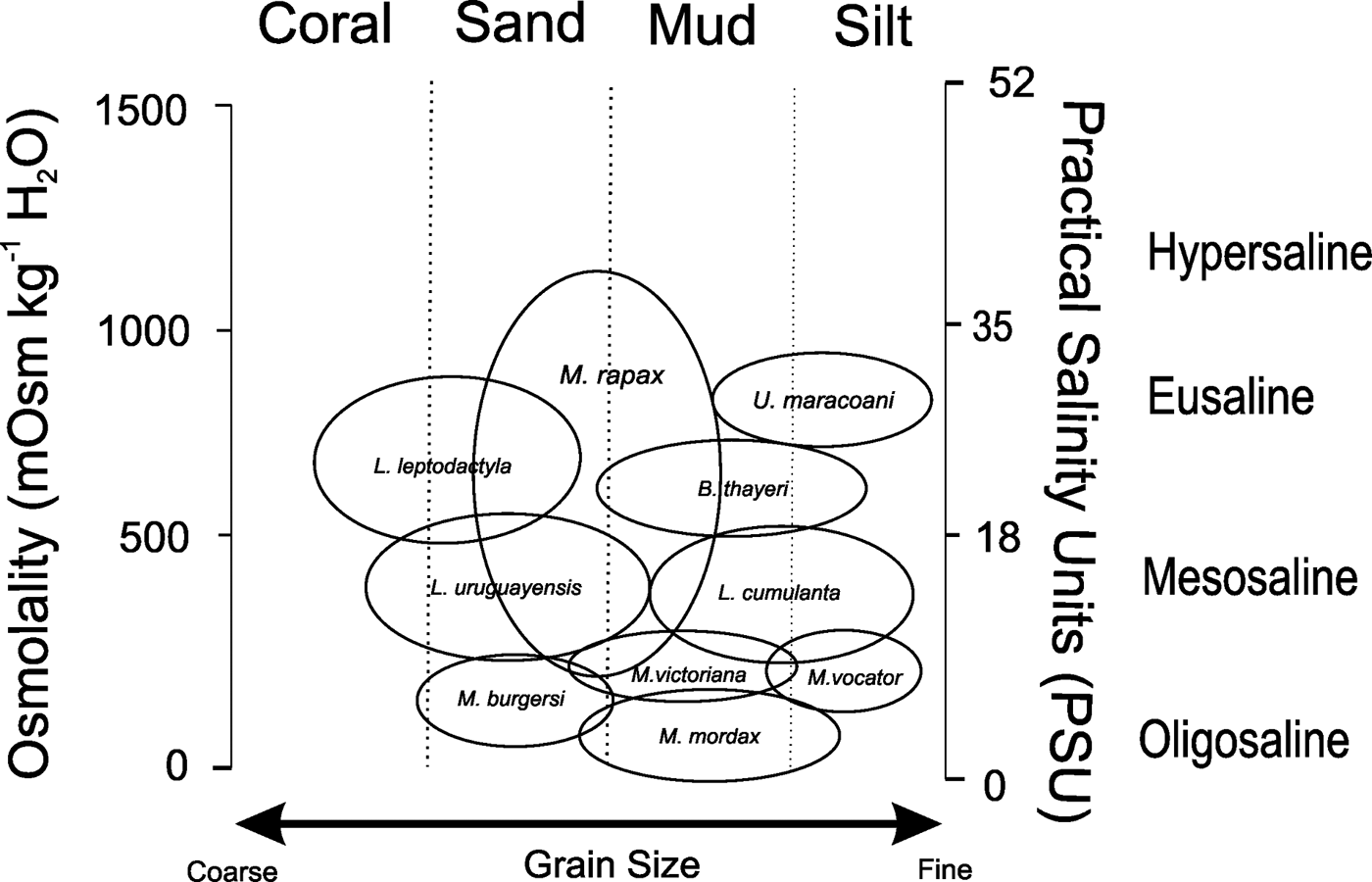
The general ecology of Uca in Brazil is based on habitat osmolality [mOsm kg−1 H2O] (salinity, psu) and substrate grain size. Vertical lines, approximate transition boundaries between substrates. Typical habitat of each species is delimited by an ellipse. Descriptive terminology after Hedgpeth (Reference Hedgpeth1957). psu, practical salinity units in ‰.

Uca (Leptuca) Leptodactyla Rathbun, 1898
HISTORICAL RECORDS
Brazil: PI, Amaração (MZUSP 559), Praia de Macapá (MZUSP 18607), Cajeiro da Praia (MZUSP 18605); PB, Mamanguape (MZUSP 13298); PE, Recife (USNM 138570); AL, Rio Camaragibe (MZUSP 22260); BA, Salvador (USNM 138571 and 138572); RJ, Araruama (MZUSP 9370), Niterói (MZUSP 18643); PR, Antonina (MZUSP 324), Pontal do Sul (MZUSP 9631); SC, Itajaí (MZUSP 677), Balneário Daniela, Florianópolis (MZUSP 6457), São Josė (MZUSP 6453).
MATERIAL COLLECTED
987 specimens. Brazil: MA, São Luís, Icatu (MZUSP 23141, 23143 and 23144); CE, Fortaleza (MZUSP 23145); PE, Ilha de Itamaracá, Rio Maracaípe (MZUSP 20930 and 20939); BA, Coqueiros, Iguape, Madre de Deus, Baía de Aratu (MZUSP 20933, 20936, 20941 and 20943); ES, Coqueiral, Santa Cruz, Bairro de Santo Antonio, Guarapari (MZUSP 20932, 20938, 20940 and 20945); RJ, Lagoa de Araruama, Itacuruçá, Barra de Guaratiba (MZUSP 20931, 20935 and 20944); SP, Ubatuba, São Sebastião (MZUSP 20934, 20937, 23140 and 23142); PR, Baía de Guaratuba (MZUSP 20942 and 21003); SC, Rio Massiambu (MZUSP 40094).
SUBSTRATE AND SALINITY PREFERENCE
Prefers sandy soil with meso- to euhaline salinity. Often burrows near upper tidemark in supralittoral zone. Salinity range (N = 22): 1 to 42.1 psu, 30 to 1203 mOsm kg−1 H2O; mode: 25.0 psu, 715 mOsm kg−1 H2O; mean: 21.3 ± 2.9 psu, 609 ± 84.
GEOGRAPHICAL RANGE ( Figure 2B )
Type locality—Bahamas: New Providence (USNM 22315); USA: Dade and Broward counties, east Florida (Barnwell & Thurman, Reference Barnwell and Thurman1984: USNM 180180), Mexico: Punta Nizuc, Yucatan (Thurman, Reference Thurman1987: USNM 171529 and 210467), Central America; Caribbean (Thurman et al., Reference Thurman, Hanna and Bennett2010); and Brazil: MA to Rio Massiambu, Palhoça, SC (MZUSP 40094). Widely distributed on sandy soil and coralline sand along neotropical shores of the western Atlantic.
Uca (Leptuca) uruguayensis Nobili, 1901
HISTORICAL RECORDS
Brazil: RJ, Ilha de Paquetá (USNM 138843), Ilha do Pinheiro (USNM 138841 and 138842), Angra dos Reis (MZUSP 3063); SP, Santos (USNM 138877); PR, Pontal do Sul (MZUSP 9638); SC, Praia Comprida (MZUSP 21722 part), Florianópolis (USNM 138844), RS, Lagoa de Tramandaí (MZUSP 6660). Uruguay: Montevideo (MZUSP 415). Argentina: Samborombom (LPMNH 25809); Mar Chiquita (Spivak et al., Reference Spivak, Gavio and Navarro1991).
MATERIAL COLLECTED
666 specimens. Brazil: RJ, Lagoa de Araruama, Barra de Guaratiba, Paraty (MZUSP 20871, 20874 and 20882); SP, Ubatuba, São Sebastião, Bertioga (MZUSP 20877, 20878, 20880, 23120 and 23121); PR, Baía de Guaratuba (MZUSP 20875 and 20881); SC, Itajaí, Balneário Daniela, Barra da Lagoa, Praia Armação, Rio Massiambu (MZUSP 20970, 20872, 20879 and 20986).
SUBSTRATE AND SALINITY PREFERENCE
Prefers silty sand or sandy silt soils with humus. Burrows are frequently found just below the upper edge of tidemark. Species prefers meso- to eusaline habitats. Salinity range (N = 15): 0.6 to 42.1 psu, 18 to 1203 mOsm kg−1 H2O; mode: 11.2 psu, 320 mOsm kg−1 H2O; mean: 17.5 ± 3.0 psu, 500 ± 87 mOsm kg−1 H2O.
GEOGRAPHICAL RANGE ( Figure 2B )
Type location—La Sierra, Uruguay. South Atlantic coast of South America; Brazil, Cabo Frio, RJ; Uruguay and Argentina to Mar Chiquita. Distribution primarily subtropical and temperate along South American coast. The population at Mar Chiquita, Provincia Buenos Aires, Argentina is the southernmost fiddler crab colony in the world (37°45′S 57°28′W: Spivak et al., Reference Spivak, Gavio and Navarro1991).
D. Subgenus Minuca Bott, 1973
DIAGNOSIS
Carapace slightly arched, not globular. Eyestalks short. Frontal interocular space between bases of eyestalks 33 to 43% of maximum carapace width. Lateral margins long and gradually curving inward posteriorly giving carapace a shield-like shape. Two posterolateral striae (Beinlich & von Hagen, Reference Beinlich and Hagen2006), merus of ambulatories broad with pile and numerous setae. Gonopores with tubercle in females but small in U. burgersi and U. mordax. Abdominal segments in male never fused. Excluding the two species forming the subgenus Boboruca, subgenus Minuca has 16 known species: 9 in the western Atlantic and 7 in the eastern Pacific (Beinlich & von Hagen, Reference Beinlich and Hagen2006; Landstofer & Schubart, Reference Landstorfer and Schubart2010). A fossil Minuca has been recovered from a Pliocene stratum in southern California (Rathbun, Reference Rathbun1926; Crane, Reference Crane1975).
Uca (Minuca) rapax (Smith, 1870)
HISTORICAL SPECIMENS
Brazil: PA, Curucá (MZUSP 12311 and 18657); MA, São Luís (MZUSP 6221 (part) and 6222; USNM 138814); PI, Praia de Macapá (MZUSP 18606); RN, Macau (USNM 1081531 and 1081532); PB, Mamanguape (MZUSP 13262); PE, Recife (USNM 138861; BMNH 1959.10.16.8-9); AL, Estuário, Rio do Camaragibe (MZUSP 22328); BA, Ilha de Itaparica (USNM 138817); RJ, Macaé (MZUSP 4217), Serra da Masache (USNM 50690), Lagoa Araruama (MZUSP 9367), Ilha do Pinheiro (USNM 138818, 138819, 138820 and 138830); SC, Praia Comprida (MZUSP 217229 part).
MATERIAL COLLECTED
1364 specimens. Brazil: AP, Rio Amapá (MZUSP 23153 and 23154); MA, São Luís, Icatu (MZUSP 23149, 23150, 23152 and 23153); CE, Fortaleza (MZUSP 23148 and 23151); PE, Ilha de Itamaracá, Recife (MZUSP 20993, 20996, 20997, 21000, 21001 and 21002); BA, Coqueiros, Madre de Deus, Baía de Aratu, Plataforma Lobato (MZUSP 20854, 20859, 20860 and 20862); ES, Coqueiral, Santa Cruz, Bairro Joana D'arc, Guarapari (MZUSP 20852, 20865, 20867, 20868, 20994 and 20995); RJ, Lagoa de Araruama, Lagoa de Guarapina, Rio Capelinha, Barra de Guaratiba, Paraty (MZUSP 20855, 20856, 20857, 20858, 20992, 20998 and 20999); SP, Rio Juqueriquerê, São Sebastião, Bertioga (MZUSP 20851, 20863, 20864, 23146 and 23147); PR, Baía de Guaratuba (MZUSP 20866); SC, Itajaí, Balneário Daniela, Barra da Lagoa (MZUSP 20853, 20861 and 20869).
SUBSTRATE AND SALINITY PREFERENCE
Colonies of this species often found in upper littoral or supratidal zone on firm sandy to silty clay with humus or clayey silt. Burrows may be exposed or associated with marsh grasses or mangroves. Prefers habitats with meso- to euhaline salinity. Rare in oligosaline habitats. Salinity range (N = 35): 1.0 to 42.1 psu, 28 to 1203 mOsm kg−1 H2O; mode: 16.1 psu, 460 mOsm kg−1 H2O; mean: 16.7 ± 2.2 psu, 476 ± 63 mOsm kg−1 H2O.
GEOGRAPHICAL DISTRIBUTION ( Figure 2C )
Type locality—Colón, Panama (Smith, Reference Smith1870). USA: Florida east coast—St Augustine County (Tashian & Vernberg, Reference Tashian and Vernberg1958); west coast Florida—Yankeetown, Levy County (Barnwell & Thurman, Reference Barnwell and Thurman1984), northern Gulf of Mexico—Dauphin Island, Mobile County, Alabama (Thurman, Reference Thurman2003a), Louisiana, Texas (Thurman, Reference Thurman1984); Mexico: Yucatan (Thurman, Reference Thurman1987); Caribbean (Thurman et al., Reference Thurman, Hanna and Bennett2010), Central and South America. Brazil: Amapá to Florianópolis, SC (Melo, Reference Melo1996). Not common between Cape San Blas and Santa Rosa Island, Pensacola, Florida (Thurman, Reference Thurman2003a, Reference Thurmanb). As many researchers have noted, this is the most wide-spread fiddler crab species in the Atlantic.
Uca (Minuca) victoriana von Hagen, 1987
HISTORICAL SPECIMENS
Brazil: BA, Mucuri (MZUSP 18641); ES, São Mateus (MZUSP 16292), Serra (MZUSP 18640), Vitória (MZUSP 18642; von Hagen UFES), Nova Betânia (MZUSP 18658 and 18571).
MATERIAL COLLECTED
519 specimens. Brazil: CE, Fortaleza (MZUSP 23138); PE, Recife (MZUSP 20891); BA, São Félix, Madre de Deus, Plataforma Lobato (MZUSP 20887, 20889 and 20892); ES, Coqueiral, Santa Cruz, UFES, Bairro Joana D'arc, Guarapari (MZUSP 20886, 20888, 20890, 20893 and 20896); RJ, Itacuruçá, Lagoa de Guarapina, Barra de Guaratiba (MZUSP 20884, 20894 and 20895); SP, Ubatuba, São Sebastião, Bertioga (MZUSP 20883, 20885, 23137 and 23139).
SUBSTRATE AND SALINITY PREFERENCE
Most common in mangroves on soft or dense micaceous sandy to silty clay or clayey silt in oligo- or mesohaline water. Salinity range (N = 16): 0.9 to 36.3 psu, 26 to 1037 mOsm kg−1 H2O; mode: 7.7 psu, 221 mOsm kg−1 H2O; mean: 11.8 ± 2.9 psu, 338 ± 82 mOsm kg−1 H2O.
GEOGRAPHICAL RANGE ( Figure 2C )
Type locality-Vitória, ES, Brazil. This species is endemic to the coast of Brazil. Previously the species was known from Rio Arinquindá, PE (Castiglioni et al., Reference Castiglioni, Almeida and Bezerra2010) to Itacuruçá, Mangaratiba, RJ (Bedé et al., 2007). Our collections extend the species' range to include the area from Fortaleza, CE to Bertioga, SP.
Uca (Minuca) burgersi Holthuis, 1967
HISTORICAL SPECIMENS
Brazil: PA, Curuçá (MZUSP 12313); CE, Fortaleza (USNM 138509); PB, Mamanguape (MZUSP 13255); BA, Itaparica (USNM 138510); ES, Conceição (MZUSP 18650), Achieta (MZUSP 18638); RJ, Ilha do Pinheiro (USNM 138511), Itacuruçá (MZUSP 17201), ??? (USNM 19971); SP, Ilhabela (USNM 136004); Santos (USNM 138512).
MATERIAL COLLECTED
786 specimens. Brazil: MA, Icatu (MZUSP 23176); CE, Fortaleza (MZUSP 23179); PE, Recife, Rio Maracaípe (MZUSP 20838 and 20841); BA, Madre de Deus, Plataforma Lobato (MZUSP 20843 and 20844); ES, Santa Cruz, Bairro Joana D'arc, Guarapari (MZUSP 20837, 20840, 20842, 20990 and 20991); RJ, Barra de Guaratiba (MZUSP 20839); SP, São Sebastião, Bertioga (MZUSP 20834, 20835, 20839, 23177 and 23178); PR, Baía de Guaratuba (MZUSP 20833); SC, Rio Itajaí-Mirim, Itajaí, Balneário Daniela, Barra da Lagoa, Praia da Armação (MZUSP 20828, 20829, 20830, 20831 and 20832).
SUBSTRATE AND SALINITY PREFERENCE
Most frequently colonizes red-brown clayey to silty sand or sandy clay in upper or supratidal zone with oligo- to mesohaline water. Salinity range (N = 19): 0.6 to 36.3 psu, 18 to 1037 mOsm kg−1 H2O, mode: 7.7 psu, 220 mOsm kg−1 H2O; mean: 12.2 ± 2.7 psu, 349 ± 79 mOsm kg−1 H2O.
GEOGRAPHICAL RANGE ( Figure 2C )
Type locality—Westpunta, Curaçao, Dutch (The Netherlands) Antilles. USA: east coast Florida, Dania Beach, Key Largo (Holthuis, Reference Holthuis1967; Barnwell & Thurman, Reference Barnwell and Thurman1984); Mexico: Vera Cruz, Tabasco and the Yucatan (Thurman, Reference Thurman1987); Belize; northern Caribbean (Thurman et al., Reference Thurman, Hanna and Bennett2010): Trinidad (von Hagen, Reference Hagen1970a, Reference Hagenb); southern Caribbean (Holthuis, Reference Holthuis1967) and Brazil: MA to Florianópolis, SC.
Uca (Minuca) vocator (Herbst, 1804)
HISTORICAL RECORDS
Guyana: Georgetown (USNM 138869 and 138870). Brazil: MA, São Luís (MZUSP 6220); BA, Ilha de Boipeba (MZUSP 13603); RJ, Macaé (MZUSP 325), Itacuruçá (MZUSP 17202); SP, Ubatuba (MZUSP 14519), São Sebastião (MZUSP 892 part, 298), Piaçaguera (MZUSP 301, 361), Iguapé (MZUSP 320).
MATERIAL COLLECTED
152 specimens. Brazil: AP, Rio Amapá (MZUSP 23123); MA, Icatu (MZUSP 23124); CE, Fortaleza (MZUSP 23125 and 23126); PE, Recife (MZUSP 20847); BA, São Félix, Plataforma Lobato (MZUSP 20848, 20988 and 20989); RJ, Lagoa de Guarapina, Barra de Guaratiba (MZUSP 20846, 20987 and 20845); SP, Rio Juqueriquerê, São Sebastião, Bertioga (MZUSP 20849, 23122 and 20850).
SUBSTRATE AND SALINITY PREFERENCE
Species prefers sandy to clayey silt in oligo- to mesohaline habitats with vegetation coverage. Salinity range (N = 13): 0.9 to 36.3 psu, 26 to 1037 mOsm kg−1 H2O; mode: 7.7 psu, 220 mOsm kg−1 H2O; mean: 10.7 ± 3.0 psu, 305 ± 87 mOsm kg−1 H2O.
GEOGRAPHICAL RANGE ( Figure 2C )
Neotype locality—Suriname River, Paramaribo, Suriname (Holthuis, Reference Holthuis1959). USA: Ingleside Cove, San Patricio County, Texas (Thurman, Reference Thurman1984), not Florida (an error by Abele & Kim (Reference Abele and Kim1986), personal communication), Mexico (Thurman, Reference Thurman1987); Central America; Belize; Caribbean: Puerto Rico (Thurman et al., Reference Thurman, Hanna and Bennett2010), Lesser Antilles, Tobago; Trinidad (Chase & Hobbs, Reference Chase and Hobbs1969; von Hagen, Reference Hagen1970b); Venezuela (Crane, Reference Crane1943); Suriname (Holthuis, Reference Holthuis1959); Brazil: Amapá to Ceará, south to Iguape, São Paulo (MZUSP 320). Species common between Ponta do Calcanhar, Brazil, and Brownsville, Texas, USA. Uncommon on small Caribbean islands (Chase & Hobbs, Reference Chase and Hobbs1969; von Hagen, Reference Hagen1970a; Thurman et al., Reference Thurman, Hanna and Bennett2010) and along coast of Brazil south of Fortaleza, CE (Bedé et al., Reference Bedé, Oshiro, Mendes and Silva2008).
Uca (Minuca) mordax (Smith, 1870)
HISTORICAL SPECIMENS
AP, Jipioca (MZUSP 13135); PA, Vigia (MZUSP 11992), Ananindeua (MZUSP 8210), Belém (USNM 138603); MA, São Luís (MZUSP 6221 part); ES, Mariricu (MZUSP 18083); SP, São Sebastião (MZUSP 892 part), Cananéia (MZUSP 4166); SC, Itajaí (MZUSP 668); Praia Comprida (MZUSP 21722 part); RS, Torres (MZUSP 12641 and 12642).
MATERIAL COLLECTED
853 specimens. Brazil: AP, Calçoene, Amapá (MZUSP 23156, 23157, 23158, 23160, 23161 and 23163); MA, São Luís, Icatu (MZUSP 23159 and 23163); CE, Fortaleza (MZUSP 23162); BA, São Félix, Plataforma Lobato (MZUSP 20916 and 20922); ES, Aracruz, Vitória (MZUSP 20963 and 20920); RJ, Barra de Guaratiba (MZUSP 20914 and 20918); SP, Ubatuba, Rio Juqueriquerê, São Sebastião, Bertioga (MZUSP 20915, 20917, 20921, 20962 and 23155); PR, Baía de Guaratuba (MZUSP 20961, 20965 and 20966); SC, Rio Itajaí-Mirim, Itajaí, Barra da Lagoa (MZUSP 20919, 20923 and 20960).
SUBSTRATE AND SALINITY PREFERENCE
Prefers sandy to silty clay or firm mud in oligosaline water. Salinity range (N = 22): 0.6 to 23.6 psu, 18 to 675 mOsm kg−1 H2O, mode: 2.0 psu, 58 mOsm kg−1 H2O; mean: 5.3 ± 1.3 psu, 150 ± 38 mOsm kg−1 H2O.
GEOGRAPHICAL RANGE ( Figure 2C )
Type locality—Canal near Belėm, Pará, Brazil (Smith, Reference Smith1870). Belize (Thurman et al., Reference Thurman, Hanna and Bennett2010) to Rio Mampituba, Torres, RS in southern Brazil (MZUSP 12641 and 12642). Unknown on Caribbean islands, the Yucatan, rivers around the Gulf of Mexico or south Florida (Salmon, Reference Salmon1967; von Hagen, Reference Hagen1970a; Barnwell & Thurman, Reference Barnwell and Thurman1984).
Biogeographical analysis of distributions
Our field study demonstrates species abundance along the Atlantic coast of Brazil (calculated as percentage of total collection, N = 7177) to be: U. (M.) rapax 19%, U. (L.) leptodactyla 13.8%, U. (B.) thayeri 13.4%, U. (M.) mordax 11.9%, U. (M.) burgersi 11%, U. (L.) uruguayensis 9.3%, U. (M.) victoriana 7.2%, U. (U.) maracoani 7.2%, U. (L.) cumulanta 5.2%, and U. (M.) vocator 2.1%. The three most common Uca species are unequivocally U. (M.) rapax, U. (L.) leptodactyla and U. (B.) thayeri. However, the number of U. (U.) maracoani collected may be underestimated since this species inhabits very deep silt and is difficult to collect. Given this shortcoming, these four species constitute approximately 53.4% of the collection. The moderate abundance of U. (M.) mordax and U. (M.) burgersi probably derives from the limited availability of their special habitats. Considering their endemism to the South Atlantic, U. (M.) victoriana and U. (L.) uruguayensis also are moderately abundant. The least common species, U. (L.) cumulanta and U. (M.) vocator, lie either at the edge of a distributional range or may represent invasive or vanishing species.
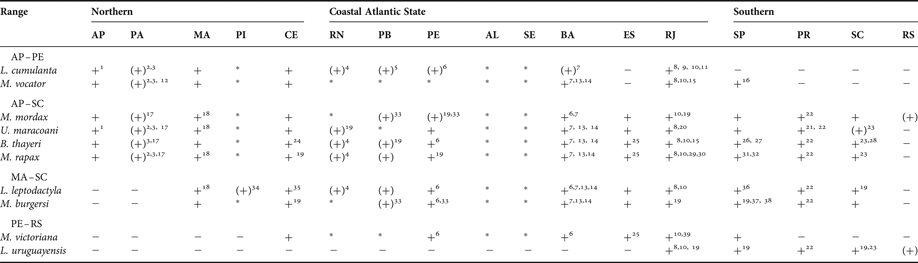
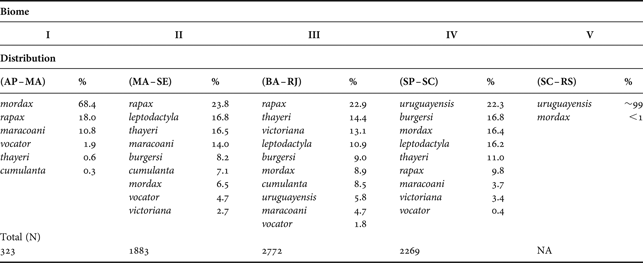
The Uca fauna of Brazil is, however, not uniformly distributed along the coast (Table 1). In particular, the endemic species U. (M.) victoriana and U. (L.) uruguayensis occur primarily along the southern coast (Biomes III, IV & V). From northern South America and the Caribbean, U. (M.) vocator and U. (L.) cumulanta occur sporadically as far south as RJ and SP. Of the six remaining species, U. (U.) maracoani, U. (M.) mordax, U. (M.) rapax and U. (B.) thayeri, appear to range from AP to SC. Two others, U. (M.) burgersi and U. (L.) leptodactyla, are found from MA to SC. The latter are not common in either AP or PA.
Geographical distribution of Uca spp. (subgenus/species) along the 17 Atlantic coastal states from northern to southern Brazil.

+, collected; (+) historical record/citation; *, likely but not reported; −, unknown. 1. Vieira, Reference Vieira2006. 2. Diel & Koch, Reference Diele, Kock, Saint-Paul and Schneider2010. 3. Koch & Wolff, Reference Koch and Wolff2002. 4. Ferreira & Pimenta, Reference Ferreira and Pimenta2006. 5. Bezerra & Coelho, 2010. 6. Castiglioni et al., Reference Castiglioni, Almeida and Bezerra2010. 7. Almeida et al., Reference de Almeida, Souza, Boehs and Bezerra2010. 8. Oshiro et al., Reference Oshiro, Silva and Silva1998. 9. Pralon & Negreiros-Fransozo, Reference Pralon and Negreiros-Fransozo2008. 10. Bedé et al., Reference Bedé, Oshiro, Mendes and Silva2008. 11. Hirose et al., Reference Hirose, Bolla and Negreiros-Fransozo2010. 12. Simith et al., Reference Simith, Diele and Abrunhosa2010. 13. Almeida et al., Reference de Almeida, Coelho, de Santos and Ferraz2006. 14. Almeida & Coelho, Reference de Almeida and Coelho2008. 15. Benetti et al., Reference Benetti, Santos, Negreiros-Fransozo and Scelzo2008. 16. Colpo & Negreiros-Fransozo, 2004. 17. Barnwell, Reference Barnwell1963. 18. Paixão et al., Reference Paixão, Coelho, Oliveria, Ribeiro, Alvite, Macedo, Silva, Sousa and Carvalho-Neta2007. 19. Crane, Reference Crane1975. 20. Hirose & Negreiros-Fransozo, Reference Hirose and Negreiros-Fransozo2008a, Reference Hirose and Negreiros-Fransozob. 21. Masunari et al., Reference Masunari, Dissenha and Falcão2005. 22. Masunari, Reference Masunari2006. 23. Branco, Reference Branco1991. 24. Bezerra & Mathews-Cason, Reference Bezerra and Mathews-Cascon2007. 25. von Hagen, Reference Hagen1987. 26. Negreiros-Fransozo et al., Reference Negreiros-Fransozo, Colpo and Costa2005. 27. Costa & Negreiros-Fransozo, Reference Costa and Negreiros-Fransozo2002. 28. Netto & Gallucci, Reference Netto and Gallucci2003. 29. Castiglioni et al., Reference Castiglioni, Negreiros-Fransozo and Mortari2006. 30. Costa & Soares-Gomez, Reference Costa and Soares-Gomes2008. 31. Castiglioni et al., Reference Castiglioni, Negreiros-Fransozo, Greco, Silveira and Silveira2007. 32. Castiglioni & Negreiros-Fransozo, Reference Castiglioni and Negreiros-Fransozo2005. 33. Coelho, Reference Coelho1972. 34. Lima et al., Reference Lima, Aragão, Lotufo and Melo2010. 35. Bezerra & Mathew-Cascon, Reference Bezerra and Mathews-Cascon2006. 36. Cardoso & Fransozo, Reference Cardoso and Negreiros-Fransozo2004. 37. Rieger, Reference Rieger1998. 38. Benetti et al., Reference Benetti, Negreiros-Fransozo and Costa2007. 39. Bedé et al., 2007. For species names in full and abbreviations for Brazilian States see text.
Clearly, species abundance is not uniform across the five biomes. Table 2 shows species' occurrence in the five coastal biomes. In Biome I, 97.2% of the collection is represented by only three species U. (M.) mordax, U. (M.) rapax and U. (U.) maracoani. Four species compose 71.1% of the collection in Biome II: U. (M) rapax, U. (L.) lepodactyla, U. (B.) thayeri and U. (U.) maracoani. If U. (M.) burgersi and U. (L.) cumulanta are considered, the six species in Biome II represent 86.4% of the Uca fauna. Biome III is the most diverse region of the Brazilian coast possessing 10 species. Here, 70.3% of the collected fauna is represented by five species: U. (M.) rapax; U. (B.) thayeri; U. (M.) victoriana; U. (L.) leptodactyla; and U. (M) burgersi. If U. (M.) mordax and U. (L.) cumulanta are also considered, 87.7% of the fiddler crab fauna is represented by seven species. In Biome IV, 81.9% of the fauna consists of five species: U. (L.) uruguayensis; U. (M.) burgersi; U. (M.) mordax; U. (L.) leptodactyla; and U. (B.) thayeri. If U. (M.) rapax is also considered, the six species form 91.7% of the fauna. Since it is the lone species in Biome V, except for the U. (M.) mordax from Torres (RS), U. (L.) uruguayensis represents more than 99% of the Uca fauna here.
Relative abundance of Uca spp. in each coastal biome of Brazil based on frequency of collection.

Morphometric data on buccal structures
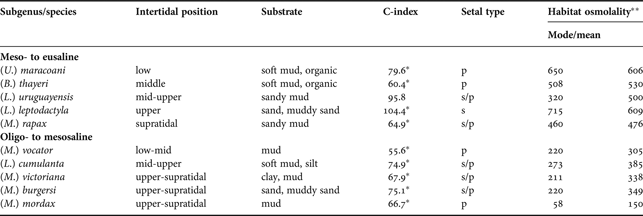
Data from the measurement and analysis of the 2nd and 3rd maxillipeds are given in Table 3 along with intertidal zonation, substrate and modal/mean habitat osmolality. Species are grouped by their apparent affinity for either oligo-mesosaline or meso-eusaline habitats.
Main habitat characteristics and predominant setal morphology of fiddler crabs (Uca) from the Atlantic coast of Brazil.

*, from von Hagen, 1970b; p, plumose and simple; s, spoon-tipped; s/p, mixed; **, mOsm kg−1 H2O.
DISCUSSION
This investigation clarifies the distributions of ten species of semi-terrestrial Uca (sensu lato) along the Brazilian coast, and constitutes a basis for biogeographical, ecological and evolutionary studies. The following sections address: (1) the geography of the various species; (2) the general ecology of each species; (3) areas of high species diversity; and (4) broader phylogeographical implications.
Geographical distributions of Uca (sensu lato)
Our survey reveals a lack of information on species in the north-eastern States of Piauí, Alagoas and Sergipe. The geography of species' distributions would be enhanced by collections and reports from these States. Nevertheless, we can draw several conclusions as to the biogeography of Uca (sensu lato) in Brazil. We recognized four fundamental patterns of geographical distribution: (1) Amapá to Santa Catarina (AP–SC); (2) Maranhão to Santa Catarina (MA–SC); (3) primarily southern coast between Pernambuco and Rio Grande do Sul (PE–RS); and (4) primarily north-eastern coast between Amapá and Pernambuco (AP–PE). The ten species of fiddler crabs collected are distributed among these four patterns (Table 1).
Four species clearly exhibit the AP–SC distribution pattern: U. (U.) maracoani; U. (M.) mordax; U. (B.) thayeri; and U. (M.) rapax. They occupy four of the five coastal biomes of Brazil (Biomes I–IV). Uca (M.) mordax was difficult to locate on the Ponta do Calcanhar between Rio Grande do Norte (RN) and SE where previous records indicate it to be sporadic (Table 1). The finding of U. (M.) mordax along the Rio Mampituba, Torres, RS (Biome V) gives it the most southerly distribution of all species except U. (L.) uruguayensis. The other three species encounter their southern limits of distribution at more northerly latitudes, around Florianópolis in SC.
Two species, U. (M.) burgersi and U. (L.) leptodactyla, although rare in AP and Pará (PA) are common from MA to SC (Biomes II to V: Tables 1 & 2). Previous records for U. (M.) burgersi by Holthuis (Reference Holthuis1959, Reference Holthuis1967), von Hagen (Reference Hagen1970a, Reference Hagenb, Reference Hagen1987) and Crane (Reference Crane1975) include Trinidad and the Caribbean shore of Venezuela but not the peripheral areas of the Golfo de Paria, Venezuela, and areas south to PA, Brazil. Likewise, U. (L.) leptodactyla occurs on the Caribbean shores of Venezuela and Trinidad and farther south in Ceará (CE), Brazil (Crane, Reference Crane1975). To our knowledge, there are no records for this species between the Orinoco River and the mouth of the Amazon River. Such a disjunct pattern can be linked to silting sediments from the Amazon River along the shores of AP, PA and the coasts of the Guianas. Consequently, the sandy habitats preferred by U. (M.) burgersi and U. (L.) leptodactyla may be shifting, unavailable or overlain by fine sediments in this region (Swennen et al., Reference Swennen, Duiven and Spanns1982). Nevertheless, six species of Uca exhibit distributional ranges from either AP or MA to SC.
The third pattern (Table 1: PE–RS) is seen in U. (M.) victoriana and U. (L.) uruguayensis. Uca (M.) victoriana is distributed mainly from CE to SP with a distribution centre in ES. Primarily, U. (M.) victoriana inhabits Biome III (Table 3). Endemic to the tropical Brazilian coast, it is unclear why this species is so restricted in range and found no farther north or south. Uca (L.) uruguayensis has been reported only from areas south of Cabo Frio, RJ to Argentina. It is found primarily in Biomes IV and V. It is equally unclear why this species does not occur at more northerly latitudes close to the equator like U. (M.) victoriana. The southern range limits for both species are most likely determined by the effect of cold water on larval development (Sanford et al., Reference Sanford, Holzman, Haney, Rand and Bertness2006). Interestingly, the distributions of the two species overlap for only a few hundred kilometres in RJ between Cabo Frio and Baía de Sepitiba.
The ranges of the remaining two species, U. (M.) vocator and U. (L.) cumulanta, are primarily along the north-eastern coast of Brazil (Table 1: AP–PE). These species are unusual in also having a few individuals or populations along the southern coast. According to historical records, U. (M.) vocator was common from Trinidad to SP, and is considered one of the main species from the Guianas to PA (Holthuis, Reference Holthuis1959; von Hagen, Reference Hagen1970a, Reference Hagenb; Swennen et al., Reference Swennen, Duiven and Spanns1982; Diele et al., Reference Diele, Kock, Saint-Paul and Schneider2010). Specimens identified by Luederwaldt at the MZUSP (numbers 298 (1895), 301 (1913), 320 (1920), 361 (1913) and 892 (1915)) indicate that U. (M.) vocator was abundant as far south as Santos, SP in the late 19th and early 20th Centuries. As recently as 1999 and 2000, more than 2600 were collected from three localities in SP (Colpo & Negreiros-Fransozo, Reference Colpo and Negreiros-Fransozo2004) which we re-visited in 2009 and 2010 but encountered very few U. (M.) vocator. Bedé et al. (Reference Bedé, Oshiro, Mendes and Silva2008) found only 30 individuals at Itacuruçá over the course of one year. We collected a total of 152 specimens of U. (M.) vocator. While 90% were taken between AP and BA, only 10% were captured in ES, RJ and SP, emphasizing the current scarcity of the species along the southern Atlantic coast. Although substantial along the north-east coast (Biomes I–II), U. (M.) vocator appears to be disappearing from southern estuaries and perhaps should be considered an endangered or threatened species in that region.
In contrast, U. (L.) cumulanta appears to be opportunistic and expanding. It has been studied thoroughly along the north-east coast of South America (Holthuis, Reference Holthuis1959; Ahmed, Reference Ahmed1976; Swennen et al., Reference Swennen, Duiven and Spanns1982; Diele et al., Reference Diele, Kock, Abrunhosa, de Farias-Lima, Brito-Simith, Saint-Paul and Schneider2010) and occurs from Venezuela to Mamanguape (USNM 25700: Crane, Reference Crane1975) and Itamaracá, PE (Coelho & Coelho-Santos, Reference Coelho and Coelho-Santos1989) in northern Brazil. In the south, specimens were found on Ilha de Paquetá, RJ (USNM 71171 and 138875), as early as 1925. In 2008, Pralon & Negreiros-Fransozo reported populations at Patitiba beach, Paraty, RJ and Bedé et al. described another population at Itacuruçá. Consequently, U. (L.) cumulanta is firmly established in the Baía de Sepetiba. Since there are few records of the species between PE and RJ (Table 1: Almeida et al., Reference de Almeida, Souza, Boehs and Bezerra2010), we consider this species to exhibit a disjunct distribution between northern Brazil and RJ. As for the Kingston Bay, Jamaica population (Rathbun, Reference Rathbun1918; Barnwell, Reference Barnwell1986), the species may have been introduced into this remote location by oceanic vessels where it successfully established founder populations over the last few hundred years. We hope to test this hypothesis using molecular biology methods (Schubart, Reference Schubart2003; Cunningham, Reference Cunningham2008).
Ecological preferences of each Uca species
The surface coastal waters of Brazil derive from the warm Equatorial Current (Peterson & Stramma, Reference Peterson and Stramma1991) and most of the species discussed here are tropical or subtropical. Only U. (L.) uruguayensis is considered a temperate zone species. Consequently, except for species in Biome V, daily and/or seasonal variation in air/water temperatures along the Brazilian coast is not expected to determine distribution. Rather, four other factors appear to be more significant: (1) position in the intertidal zone; (2) substrate composition; (3) salinity; and (4) behaviour (particularly larval migration and adult feeding). Data on zonation, and substrate and salinity preferences for each species are presented in Table 3 and Figure 3.
The tidal regimen along the east coast of South America is primarily regular and semi-diurnal (Doty, Reference Doty1957), and fiddler crabs here express tidal rhythms in their physiology and behaviour (Barnwell, Reference Barnwell1963). In the South Atlantic, tidal amplitude is routinely 1 to 3 m but along the north-eastern coast, amplitude is usually 3 to 6 m. In AP, amplitude is normally 5 to 6 m. Such large amplitudes create very strong tidal currents with each successive ebb and flood, which also produces a very short slack water period when the current turns. The megalopae of developing crabs ride the flood tide and settle into the adult habitat during transitional slack water (Behum et al., Reference Behum, Brodie and Stanton2005; Simith et al., Reference Simith, Diele and Abrunhosa2010). In the region from AP to PA, the large tide, strong currents and silty substrates may act in synergism with other factors to limit successful colonization by certain species of fiddler crabs.
Substrate is important for fiddler crabs in two ways: burrows and feeding. Species like U. (U.) maracoani, U. (M.) vocator, U. (L.) cumulanta and U. (B.) thayeri are able to construct burrows in soft mud near mangroves. Likewise, U. (M.) rapax, U. (M.) victoriana and U. (M.) mordax can excavate tunnels in firmer sandy- or silty clay habitats. However, Uca (M.) burgersi, U. (L.) leptodactyla and U. (L.) uruguayensis burrow into mud substrates with a greater sand component. Besides burrowing, fiddler crabs utilize substrate as a food source, which their mouthparts are structured to process (Miller, Reference Miller1961). There is a clear relationship between buccal anatomy and habitat granulometry. Since the c-index has been calculated previously for eight of the Brazilian Uca (von Hagen, Reference Hagen1970b; Thurman, Reference Thurman1984, Reference Thurman1987), those for U. (L.) uruguayensis and U. (M.) victoriana are now added in Table 3. For primarily sand feeding species (i.e. U. (L). leptodactyla and U. (L.) uruguayensis) the c-index is >90.0. For the sand–mud feeders (i.e. U. (M.) rapax, U. (M.) burgersi, U. (M.) mordax, U. (M.) victoriana and U. (L.) cumulanta), the c-index is between 60 and 90. For species preferring silty mud (i.e. U. (U.) maracoani, U. (B.) thayeri, U. (L.) cumulanta and U. (M.) vocator), the c-index lies between 80 and 50.
The morphology of the setae on the 2nd maxillipeds likewise reflects the substrate feeding preference (Miller, Reference Miller1961; Crane, Reference Crane1975). If a species feeds primarily on sandy soils, there is an abundance of spoon-tipped setae or hairs covering the edge of the 2nd maxillipeds. In species that prefer silt or fine-grained mud, there is a greater abundance of woolly hairs and the number of spoon-tipped setae is reduced. Here we add the morphology of the 2nd maxillipeds of U. (M.) victoriana to the list of those crabs possessing setae for processing substrate particles.
Although species transplantation and imposed substrates are yet to be explored, the relationship between mouthparts and substrate appears to be flexible. Uca uruguayensis from southern Brazil shows considerable feeding plasticity depending on the presence of congeneric species (Vernberg & Vernberg, Reference Vernberg and Vernberg1967). North of Florianópolis (SC), U. uruguayensis cohabits with U. rapax and U. leptodactyla on sandy substrates in the intertidal zone where it is limited mainly to shaded intertidal sand bathed by meso- to eusaline waters (Figure 3). However, south of Florianópolis where it is the sole species, U. uruguayensis occupies diverse habitats ranging from silt to mud to pure sand substrates, and from oligo- to hypersaline waters, constituting an opportunistic species that occupies niches vacated by the more tropical and sub-tropical species. Apparently, when interspecific competitive pressures relax, U. uruguayensis expands into less suitable habitats and survives. When confronted by congeners at more northerly latitudes, U. uruguayensis selects a narrower range of habitat characteristics that it occupies with greater feeding efficiency (Sayão-Aguiar et al., Reference Sayão-Aguiar, Pinheiro and Colpo2012) and osmoregulatory ability. Consequently, mouthpart structures appear to assure survival by allowing specialization under competitive pressures.
Different species inhabiting littoral regions often select habitats with very different osmotic properties (Teal, Reference Teal1958). Partitioning of the intertidal zone has been documented in fiddler crabs from Texas, Mexico and the northern Caribbean (Thurman, Reference Thurman1985, Reference Thurman1987; Thurman et al., Reference Thurman, Hanna and Bennett2010). In part, carapace physiology and morphology reduce desiccation in the more terrestrial fiddler crab species (Thurman, Reference Thurman1998; Yoder et al., Reference Yoder, Tank, Rellinger, Moore and Gribbins2007, Reference Yoder, Bosley, Chambers, Hart, Gribbins and Collier2010; Hopkins & Thurman, Reference Hopkins and Thurman2010). Those living low in the littoral zone usually survive meso- and eusaline conditions. In contrast, species inhabiting estuaries exhibit preferences for more dilute, oligosaline conditions (Teal, Reference Teal1958). In Brazil, species were found to be distributed along similar intertidal salinity transects (Table 3). In the meso- to eusaline zones, U. (U.) maracoani is found lowest in the zone, being covered every few hours by the tide. From the mid to upper littoral, U. (L.) uruguayensis, U. (L.) cumulanta and U. (B.) thayeri are common. The most common supralittoral species are U. (L.) leptodactyla and U. (M.) rapax. However, in oligosaline or riverine habitats, U. (M.) vocator, is found lower in the intertidal than U. (M.) burgersi, U. (M.) victoriana, or U. (M.) mordax. Figure 3 presents Brazilian fiddler crab habitats discriminated using two important physiographical components: substrate grain size and habitat osmolality (=salinity). Based on these characteristics, fiddler crab species in Brazil can be sorted across a simple two-dimensional niche array. Consequently, patterns of species diversity along the Brazilian coast are undoubtedly influenced to a great degree by heterogeneity in substrate and water/salt sources.
Areas of high diversity
Tropical mangroves and salt marshes are high diversity communities in Brazil (Por, Reference Por1994). Owing to their rapid degradation on a global scale, these ecosystems must be conserved before diversity is irretrievably lost (Valiela et al., Reference Valiela, Bowen and York2001; Lourie & Vincent, Reference Lourie and Vincent2004; Amaral & Jablonski, Reference Amaral and Jablonski2005). The mangrove environment itself is of wide interest to Brazilian society owing to its role as a very visible nursery area for larvae of many commercial fish, and as a specific habitat for commercially exploited, large mangrove crabs such as Ucides cordatus and Cardisoma guanhumi. Other notable inhabitants include mammals like the crab-eating raccoon Procyon cancrivorus, and once rare birds like the spectacular scarlet ibis, Eudocimus ruber. The São Paulo State government has made significant investments in conservation programmes to preserve its tropical diversity (Joly et al., Reference Joly, Rodriquez, Metzger, Haddad, Verdade, Oliveria and Bolzani2010). In São Paulo alone, a network of 64 state parks and preserves has been set aside to establish restoration and conservation.
Our findings reveal two regions along the South Atlantic coast of Brazil that warrant preservation based on their high species diversity. Presuming that an elevated number of species occurring in a fairly small area indicates environmental heterogeneity, these areas may be important for maintaining both intra- and interspecific variation. Further, for those species depending on oceanic movements for larval and genetic dispersal, such sanctuaries constitute sources of up-stream recruitment for the global ecosystem. Based on these criteria, conservation efforts should be focused: (1) along the north-eastern coast between Fortaleza, CE and Recife, PE; and (2) along the southern coast from Barra de Guaratíba, RJ, to Ubatuba, SP. In the former, we recovered nine species from habitats along the course of the Rio Cocó. From the latter, we recorded ten Uca species from the banks of a canal and tidal ditch in Barra de Guaratuba at the east end of the Baía de Sepetiba. Bedé et al. (Reference Bedé, Oshiro, Mendes and Silva2008) reported the same ten species in mangroves a short distance away at Itacuruçá.
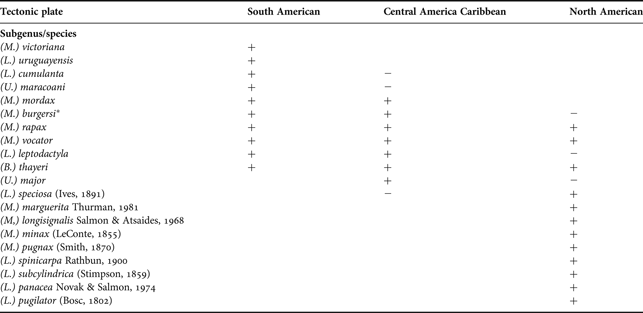
There are four subgenera and 20 species of Uca (sensu lato) on the western perimeter of the Atlantic Ocean. Along the Brazilian coast from AP to SC, all Atlantic subgenera (100%) are represented in the Uca fauna. Brazilian gamma diversity for Uca (sensu lato) is 50% of the total diversity for the western Atlantic (Table 4, N = 20). At Barra de Guaratíba, RJ, alpha diversity is equal to gamma diversity (Whitaker, Reference Whitaker1972). Corroborating findings by Bedé et al. (Reference Bedé, Oshiro and Melo2007, Reference Bedé, Oshiro, Mendes and Silva2008), we submit that the finding of ten species of Uca (sensu lato) along a 2-m wide, 8 to 10-m transect surpasses the phenomenal level of alpha biodiversity reported by Barnes (Reference Barnes2010) who found up to six species of Uca (sensu lato) within 2-m2 quadrants along a 25-m intertidal transect in Sulawesi (Indonesia). This may be the largest known number of Uca species occurring in any small area. Wallacea is an important source of biological diversity in the South Pacific and the region is strictly conserved. For these same reasons, we suggest that the coast of the Baía de Sepetiba and Baía de Paraty between Rio de Janeiro and Trindade, RJ, seriously be considered for conservation and protection.
Distribution of twenty Uca spp. on the tectonic plates of the western Atlantic Ocean.

+, known; −, uncommon; *, both colour morphs included.
Phylogeographical considerations
All the factors controlling the geography of littoral species and their cohorts may never be known. However, their distributions are determined, in part, by: (1) the availability of suitable habitat and climate; (2) the geomorphology and history of the potential colony; (3) the hydrodynamics of ocean currents and tides; (4) patterns of larval dispersion; and (5) the biotic composition of the area available for colonization. Patently, once a littoral species locates and settles in a suitable environment, it must be anatomically and physiologically competent for survival and reproduction. The overall dispersal potential of a species or cohort is a combination of all these capabilities together with other more subtle physical, chemical and biological factors. Previous sections addressed some of the habitat, climate and geomorphological characteristics circumscribing the apparent ecological niches of each of the ten species of Uca in Brazil. However, since the ranges of several of these species extend into the Caribbean Basin, Gulf of Mexico, and the Atlantic coast of the southern United States (Table 5; Figure 4) it is necessary to consider factors that regulate distributions on a larger geographical scale.
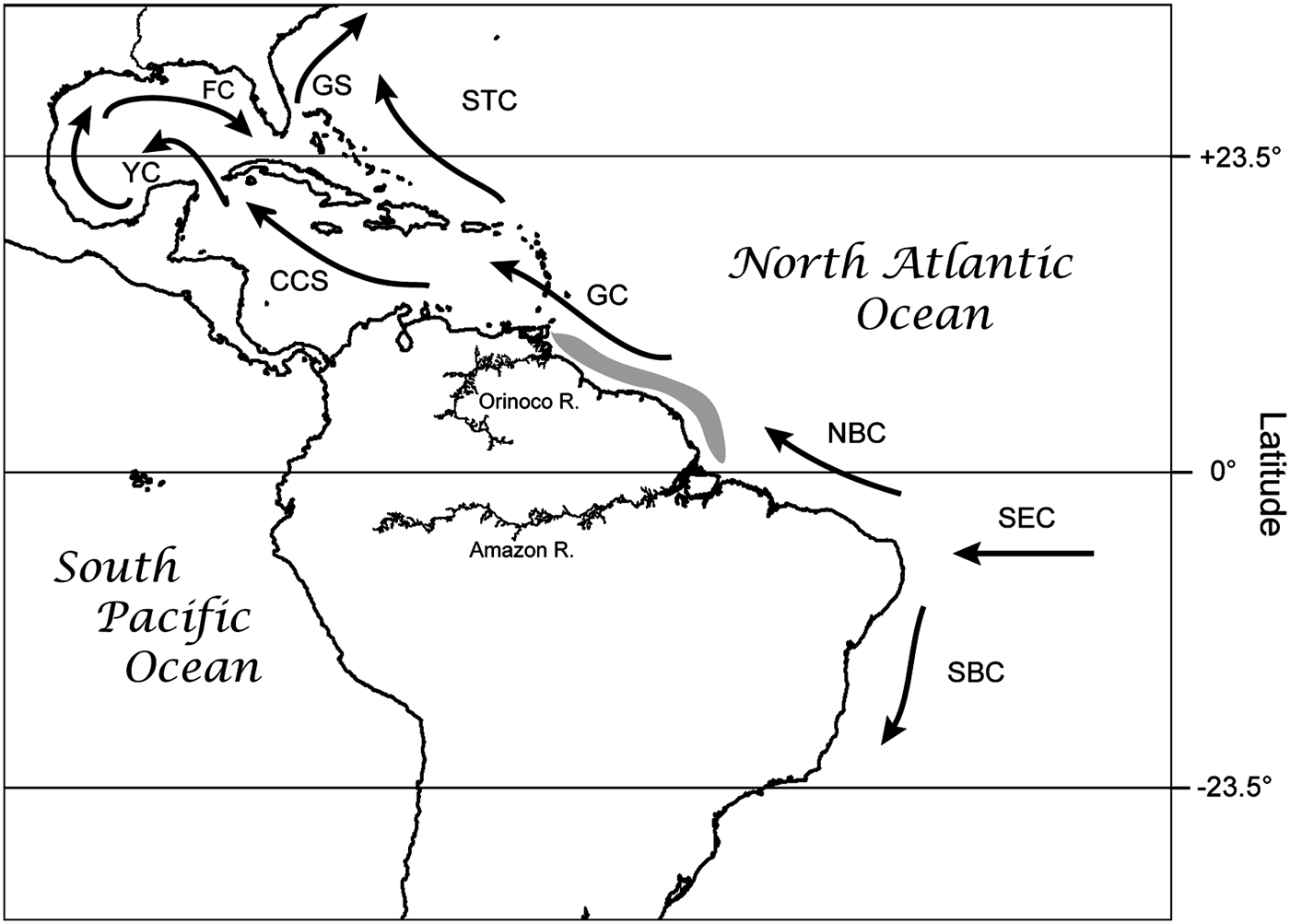
Tropical western Atlantic (redrawn from Rocha, Reference Rocha2003): general scheme of sea currents and their flows along the eastern coast of the Americas and Caribbean. CCS, Caribbean Current System; FC, Florida Current; GC, Guiana Current; GS, Gulf Stream; NBC, North Brazil Current; SBC, South Brazil Current; SEC, South Equatorial Current; STC, Subtropical Current; YC, Yucatan Current. Grey shading indicates approximate coastal area influenced by freshwater outflow from the Amazon and Orinoco Rivers.

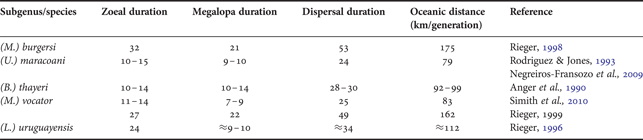
Estimated oceanic distances over which larval Uca spp. (subgenus/species) are transported by the North Brazil and the Guiana Currents. Oceanic distance (km/generation) is the product of pelagic duration (zoea + megalopa) in days and the mean current velocity (0.038 m s−1, Bourlés et al., Reference Bourlès, Gouriou and Chuchla1999). All other values are given in days.

Table 5 lists the developmental durations of zoeae and megalopae and passive dispersal potentials for five species of Brazilian Uca (sensu lato). Since there is no information available on larval development in U. (U.) maracoani, data for U. (U.) tangeri are used as an equivalent substitute. Based on the average speed of the North Brazil and Guiana Currents (Bourlès et al., Reference Bourlès, Gouriou and Chuchla1999), potential dispersal varies from 75 to 175 km/generation depending on species. However, this mechanism can be modified significantly by adult and larval behaviour (Salmon & Zucker, Reference Salmon, Zucker, Chelazzi and Vannini1988; Christy, Reference Christy2011).
It is clear that Uca zoeae behaviourally select tidal currents to control their dispersal (Lopez-Duarte & Tankersley, Reference Lopez-Duarte and Tankersley2007, Reference Lopez-Duarte and Tankersley2009). In estuarine species from North and Central America (N = 6 species), zoeae migrate with a tidal rhythm to catch the ebb tide while coastal species (N = 9 species) are arrhythmic. Such behaviour would assure the export of Uca living upstream versus local retention for the more marine species near the estuary mouth (Lopez-Duarte et al., Reference Lopez-Duarte, Christy and Tankersely2011). One case, the development and ecophysiology of larval U. (M.) vocator from north-eastern Brazil, is insightful in this regard. Along the shores of the Rio Caetá near Bragança, PA, populations of this species reproduce during the rainy season (250 to 300 cm yr−1) with peak numbers of ovigerous females in March and June (Koch et al., Reference Koch, Wolff and Diele2005). A combination of rainfall and freshwater outflow from the Amazon River reduces salinity to near 0 psu in the adult habitat, creating a strong hyposmotic challenge and potential larval mortality. Neither zoeae nor megalopae survive ≤15 psu. Consequently, it is unlikely that larvae will develop in the estuary near the parent crabs (Simith et al., Reference Simith, Diele and Abrunhosa2010, Reference Simith, de Souza, Maciel, Abrunhosa and Diele2011).
For the western Atlantic, the two oceanic currents determining the distribution of intertidal and shallow-water marine species at higher latitudes are the North and South Brazil Currents (Briggs, Reference Briggs1974: Figure 4). From the Ponta do Calcanhar (RN), the Southern Brazil Current carries water and planktonic larvae to the southern Atlantic. Since the southern coasts of Brazil, Uruguay and Argentina are mainly rectilinear, the relationship between current and species' distributions, coastal geomorphology and climate is fairly straightforward at least for Uca (sensu lato). Given that the locations of each species from PE to SP or SC are highly connected by larval distribution driven by the South Brazil Current, populations and species should be genetically uniform since they are controlled primarily by habitat quality and climate. Genetic studies of another sympatric brachyuran, Ucides cordatus, support this notion (Oliveira-Neto et al., Reference Oliveira-Neto, Boerger, Pue, Ostrensky and Hungaria2007).
The impact of the North Brazil Current is less clear (Figure 4). Since the North Brazil Current and the Guiana Current flow northward, the north-eastern coast of Brazil may have a significant long-term influence on the Caribbean, Central America, Gulf of Mexico and temperate North Atlantic (Briggs, Reference Briggs1974). The geography and hydrology of the intertidal zone along the north-eastern coast of Brazil presents a formidable habitat for colonization by shallow-water marine organisms. Here, the tides range from 2.3 to 6.3 m; consequently, with their turn every 6.2 hours, a tremendous volume of water ebbs and flows rapidly across the littoral zone. From Macapá, AP north to Trinidad, the surface water over the shelf is diluted by the world's largest freshwater discharge from the Amazon and Orinoco Rivers (Curtin, Reference Curtin1986) producing extensive soft bottoms and turbid water for about 2000 km. This freshwater surface plume extends downward to a depth of 30 m over the shelf and up to 500 km out to sea (Lentz, Reference Lentz1995). Most sediment from the Amazon River is deposited along the shores of Amapá and the Guianas forming extensive silt and clay banks (Figure 4). Fresh water and sediment discharged from the Orinoco River are carried north along the Atlantic shore and Golfo de Paria by the Guiana Current. Eventually, 70% of the Guiana Current flows around Barbados, Trinidad and Tobago into the Caribbean (Borstad, Reference Borstad1982).
Potentially, the nine species of Uca (sensu lato) found along the north-eastern coast of Brazil could be distributed into the Caribbean, Mexico and southern United States (Table 4). Based on laboratory studies (Table 5), the zoeae of Brazilian species could remain in the plankton for 25 to 30 days while the swimming megalopae are aquatic for an additional 12 to 20 days. Assuming that suitable settling habitat is available, larvae could move a maximum of 80 to 170 km northward along the coast with each generation. Consequently, moving approximately 2000 km across the mouths of the Amazon and Orinoco Rivers into the Caribbean would take approximately 14 generations (≈15 to 18 fiddler crab years). This pilgrimage to the Caribbean requires the larvae to survive in dilute, nearshore waters and settle in silty habitats (Swennen et al., Reference Swennen, Duiven and Spanns1982). Species such as U. (L.) leptodactyla and U. (M.) burgersi are likely unsuited for this task given their ecological requirements. However, as supported by our collections from Amapá and museum and historical literature records, a high degree of population connectivity probably exists for U. (M.) mordax, U. (M.) rapax, U. (M.) vocator and U. (B.) thayeri between north-eastern Brazil, Caribbean islands and the shores of the Panama isthmus. Until better collecting records are available across the southern Caribbean between Panama and the Windward Islands, U. (L.) cumulanta and U. (U.) maracoani appear to be naturally restricted to latitudes south of Trinidad and the Golfo de Paria. Curiously, both U. (L.) leptodactyla and U. (M.) burgersi are common throughout the northern Caribbean (Thurman et al., Reference Thurman, Hanna and Bennett2010) and are known from southern Florida and the Yucatan peninsula (Barnwell & Thurman, Reference Barnwell and Thurman1984). Clearly, populations of these species south of the equator are disjunct from their Caribbean relatives.
Tectonic plate movements undoubtedly influenced the evolution of Uca (sensu lato) subgenera and species in the western Atlantic basin (Salmon & Zucker, Reference Salmon, Zucker, Chelazzi and Vannini1988; Beinlich & von Hagen, Reference Beinlich and Hagen2006). In the Neotropics, north-western Africa and Europe, mangrove communities, which are associated with fiddler crabs, appeared during the late Eocene (≈40 Mya) (Plaziat, Reference Plaziat, Bosence and Allison1995; Hogarth, Reference Hogarth2004). By the early Miocene (≈22 Mya), fiddler crabs were genetically distinct from other cosmopolitan Ocypodidae (Levinton et al., Reference Levinton, Strumbauer and Christy1996; Sturmbauer et al., Reference Strumbauer, Levinton and Christy1996) and members of the subgenus Uca (sensu stricto) were distributed from Brazil to Honduras (Brito, Reference Brito1972; Dominguez-Alonso, Reference Dominguez-Alonso2008). The subgenus persists in western North America through the Pliocene (5 Mya) as indicated by the fossil U. (U.) oldroydi (Rathbun, Reference Rathbun1926). Other Pacific and American clades (i.e. subgenera) appeared later during the middle to late Miocene (≈17 Mya: Rathbun, Reference Rathbun1926; Sturmbauer et al., 1996). Closure of the trans-Panama seaway in the late Pliocene (3.5 to 2.8 Mya: Ibaraki, Reference Ibaraki1997) resulted in additional radiation within the four American subgenera (Rathbun, Reference Rathbun1926; Sturmbauer et al., 1996).
From three extinct and ten extant species, we can speculate on the vicariance and early dispersal history of the subgenus Uca (sensu stricto). Based on distribution centres, the apparent range of each ancestral narrow-fronted species is coincident with plate tectonics (von Hagen, Reference Hagen1968; Crane, Reference Crane1975; Prahl, Reference Prahl1982; Prahl & Toro, Reference Prahl and Toro1985; Dominguez-Alonso, Reference Dominguez-Alonso2008). Among the extant forms, the most widely distributed in terms of latitude are U. princeps, U. insignis, U. maracoani and U. tangeri (Crane, Reference Crane1975). Uca major is limited to the Caribbean basin and the Bahamas but probably occupies the greatest unit area. Isolated on the African plate, we suspect that U. tangeri separated from the Neotropical Uca about 50 Mya (Sanmartín & Ronquist, Reference Sanmartín and Ronquist2004). On the Miocene shores of the Neotropics, cohorts (or predecessors) of the subgenus Uca (sensu stricto) appeared to be distributed on each tectonic plate—on the South American plate, U. maracoani, U. antigua Brito, Reference Brito1972 (fossil), U. marinae Dominguez-Alonso, Reference Dominguez-Alonso2008 (fossil), U. insignis (Milne-Edwards, 1852) and U. ornata (Smith, Reference Smith1870); on the Caribbean plate, U. heteropleura (Smith, Reference Smith1870), U. major, U. intermedia Prahl & Toro, 1985 and U. stylifera (Milne-Edwards, 1852), with U. princeps (Smith, 1970), U. monilifera (Rathbun, 1914) and U. oldroydi (fossil) on the western shores of the North American plate. As the seaway connection closed approximately 2.8 to 3.1 Mya (Lessios, Reference Lessios2008), the ancestor of U. major was isolated in the Caribbean from those of U. intermedia, U. heteropleura and U. stylifera in Honduras, Costa Rica, Panama and Colombia along the Pacific coast. Across the northern edge of South America, the isthmus of Panama separated the Atlantic ancestors of U. maracoani and U. antigua from those of U. insignis, U. ornata and U. marinae in the Pacific. Ensuing glaciation over the last 1.0 Mya likely produced variation among U. princeps and U. monolifera as well as the extinction of U. oldroydi on the North American plate. Radiation of U. intermedia, U. heteropleura and U. stylifera on the western slopes of Central America, and the divergence of U. ornata and U. insignis on the Pacific coast of the South American plate may also be linked to palaeoclimate changes.
Since we have no fossil record or extant species from the subgenus Uca (sensu stricto) on the Atlantic shore of the North American plate, this area may well have been a refuge only for species in the subgenera Leptuca and Minuca. Beinlich & von Hagen (Reference Beinlich and Hagen2006) suggested a second Uca invasion of the Caribbean by a Paraleptuca-like predecessor from the Mediterranean–Arabian Basin during the late Miocene or early Pliocene (22 to 5 Mya) giving rise to the American clades prior to the closure of the Panama seaway. The fossil Uca (M.) hamlini Rathbun, Reference Rathbun1926 from California demonstrates that rapax-like Minuca had evolved by the Pliocene (Crane, Reference Crane1975). From distributional information on all western Atlantic subgenera (Table 4), it is clear that three Minuca (burgersi, rapax and vocator) and the Boboruca (thayeri) are distributed by oceanic currents across the South American, the Caribbean and the North American plate. The geminate species, U. (B.) umbratila, occurs from El Salvador to Colombia (Bott, Reference Bott1973; Crane, Reference Crane1975; Prahl, Reference Prahl1982) but has not been reported from the Pacific rim of the North American plate, supporting the notion that the predecessor of the subgenus Boboruca is of South Atlantic origin. However, there are four Minuca and four Leptuca endemic to the North American plate. Expansion of the subgenera Minuca and Leptuca into the Caribbean and South America may have been prevented by the prevailing directions of ancient Atlantic currents (Poulsen et al., Reference Poulsen, Seidov, Barron and Peterson1998).
Owing to their morphological similarity, a wide-ranging, meso- to eusaline species similar in morphology to U. (M.) rapax may have given rise to the oligosaline sister species U. (M.) victoriana and U. (M.) marguerita Thurman, 1981 by dispersal and recent (<3 Mya) sympatric speciation (Knowlton, Reference Knowlton1993). Closely related eusaline Leptuca (U. panacea, U. pugilator and U. subcylindrica) may be recent products of speciation wrought by a similar mechanism through the effects of glaciation and seismic activity in North America; these Leptuca lack true morphological counterparts on the shores of the Caribbean, Central America and South Atlantic. However, ecologically they are similar to U. (L.) leptodactyla and U. (L.) uruguayensis in the Caribbean and South America. Likewise, the closely related oligosaline Minuca, U. minax, U. longisignalis and U. pugnax, may be the products of recent North American glaciation events (Barnwell & Thurman, Reference Barnwell and Thurman1984) isolating them from U. (M.) mordax and U. (M.) vocator. The endemic, North American, oligosaline species U. (L.) spinicarpa is morphologically and physiologically similar to U. (L.) cumulanta from South America. Other authors (Crane, Reference Crane1975; Salmon et al., Reference Salmon, Ferris, Johnston, Hyatt and Whitt1979; Rosenberg, Reference Rosenberg2001) have suggested that U. (L.) spinicarpa is closely related to the eusaline species Uca (L.) speciosa (Ives, 1891). It is revealing that Rathbun (Reference Rathbun1918) confused specimens of U. (L.) cumulanta from Jamaica (USNM 22313) and Brazil (USNM 25700) with U. (L.) spinicarpa but not with U. (L.) speciosa. A cumulanta–spinicarpa distinction was not clear until Crane (1943) described U. (L.) cumulanta. Based on their morphology and distributions, there are two possible implications. Either an ancestor of U. (L.) cumulanta and U. (L.) spinicarpa was distributed from north-eastern Brazil to the northern Gulf of Mexico, or a relative on the Pacific shore of Central America was the link between the two species of Atlantic Leptuca.
Although these scenarios are speculative, they are rooted in geological history and the fossil record as well as in the distributions of extant species. The evolutionary origins of Neotropical fiddler crabs are most likely connected to changing climates and continental shores over the last 40 to 60 million years. Based on genetic divergence, at least two events or invasions seem likely: one occurring more than 22 Mya, the other more recent, about 17 Mya (Levinton et al., Reference Levinton, Strumbauer and Christy1996; Sturmbauer et al., 1996). These events established the ancestors of various subgenera. The evolution of the various sibling species and greater diversification within subgenera of Neotropical Uca (sensu lato) probably took place during the last 3 million years.
ACKNOWLEDGEMENTS
We thank Drs A. Migotto and A. Flores and the entire staff at the Centro de Biologia Marinha, USP, São Sebastião, SP for their help and support during this project (CEBIMar Project No. 2009/06). We also thank T. Alves, C. Antunes, F. de Assis, L. Bezerra, M. Capparelli, R. Faleiros, A. Filhos, J. Hall, M.J. Hopkins, S. Milograna, F. Penha, L. Perez, E. Ribeiro, H. Silva, C.M. Thurman and J. Veira for assistance during various phases of the fieldwork. Our transportation container was donated by M. Sommerlot, Hawkeye Corrugated Box (Cedar Falls, IA). Information on Uca specimens in museum collections was provided by E. Rodriquez (AMNH), M. Lowe (BNHM), C. Damborenea (LPMNH) and A. Cartaxana (LMNH). M. Tavares, M. Cardoso and A. Bennetti facilitated access and use of Uca specimens at MZUSP. O. von Hagen (Marburg University, Germany) provided preserved reference specimens of U. (M.) victoriana from the type locality. J. Kosmicki and A. Wieman produced the artwork. M.J. Hopkins (Field Museum of Natural History, Chicago) kindly reviewed a draft of our manuscript. We thank the IBAMA office at Amapá City, AP for the boat to collect at the mouth of the Amapá River. This research was supported by the Biology Department, the College of Natural Sciences, and the Graduate College at the University of Northern Iowa, the Fulbright Foundation, and the University of Iowa Global Regional Environmental Research Center (GRERC; SA No. 1000716062, G/P No, 1 802010001). The Conselho de Desenvolvimento Científico e Tecnológico (CNPq No. 450320/2010-3, No. 300662/2009-2), the Fundação de Amparo à Pesquisa do Estado de São Paulo (FAPESP No. 2009/50799-0) and the Coordenadoria de Aperfeiçoamento de Pessoal de Ensino Superior (CAPES) provided support in Brazil.