Research on Cognitive Behaviour Therapy for Personality Disorders
Personality disorders can predispose people to other disorders, rendering treatment difficult (Millon, Reference Millon2011), and a high degree of comorbidity exists between personality disorders and symptomatic disorders (Johnson, Cohen, Kasen, & Brook, Reference Johnson, Cohen, Kasen and Brook2005). A number of researchers have noted that cognitive behaviour therapy (CBT) is useful for the treatment of personality disorders (e.g., Davidson et al., Reference Davidson, Gumley, Miller, Drummond, Macaulay, Tyrer and Murray2006; Davidson, Tyrer, Norrie, Palmer, & Tyrer, Reference Davidson, Tyrer, Norrie, Palmer and Tyrer2010; Rafaeli, Reference Rafaeli2009), though there have been relatively few outcome studies to date, despite the prevalence of this diagnosis (Crits-Christoph & Barber, 2015). Much of the research has consisted of single case studies, case descriptions, and controlled or uncontrolled trials, with a general paucity of randomised controlled trials (RCTs), except for borderline personality disorder (BPD).
The subjects and their treatments have been quite varied. Studies have been conducted with patients who have a single personality disorder diagnosis, patients who have a variety of personality disorder diagnoses, and patients who have symptomatic diagnoses with comorbid personality disorders. Most patients received individual CBT treatment on an outpatient basis, though a few received group treatment instead of, or in addition to, individual treatment, and a few studies were conducted with inpatients or patients in day programs. Studies also differed in length of treatment and in outcome measures. Although all studies used some form of CBT, the focus of treatment and treatment interventions often varied, and some trials were conducted using concurrent treatments.
A number of studies have examined the effectiveness of CBT for symptomatic disorders in the presence of personality disorder comorbidity, with equivocal results. Two recent studies (Lopez & Basco, 2014; Bedard, Russell, & Myhr, Reference Bédard, Russell and Myhr2015) found that the presence of a personality disorder did not predict poorer outcome of CBT for symptomatic disorders. Several earlier studies (e.g., Fournier et al., Reference Fournier, DeRubeis, Shelton, Gallop, Amsterdam and Hollon2008; Kuyken, Kurzer, DeRubeis, Beck, A.T., & Brown, Reference Kuyken, Kurzer, DeRubeis, Beck and Brown2001) found that while clients with comorbid disorders improved with CBT treatment, their outcomes were not as positive as those who had a symptomatic disorder alone.
In reviewing CBT case studies for the treatment of a variety of personality disorders, Crits-Christoph and Barber (Reference Crits-Cristoph, Barber, Nathan and Gorman2015) found generally positive effects. A large-scale RCT of patients with various personality disorders who self-harmed was conducted by Tyrer and colleagues (Reference Tyrer, Thompson, Schmidt, Jones, Knapp, Davidson and Byrne2003, Reference Tyrer, Tom, Byford, Schmidt, Jones, Davidson and Catalan2004); patients who received CBT treatment were found to engage in less self-harm than those receiving treatment as usual (TAU). A meta-analysis of several personality disorders that included five RCTs found that CBT resulted in improvements in symptoms and personality measures (Leichsenring & Leibing, Reference Leichsenring and Leibing2003).
Research on CBT for Specific Personality Disorders
There have been no published, controlled outcome studies using CBT for a number of personality disorders — dependent, histrionic, narcissistic, paranoid, schizoid, or schizotypal (Crits-Cristoph & Barber, Reference Crits-Cristoph, Barber, Nathan and Gorman2015) — though these diagnoses are sometimes included in case studies or trials of mixed personality disorders. The greatest number of studies have investigated various forms of CBT for borderline personality disorder (BPD) and avoidant personality disorder (APD). Sanislow and McGashlan (Reference Sanislow and McGlashan1998) note that outcome studies using psychosocial treatment result in positive outcomes overall.
Little research exists for CBT for antisocial personality disorder (ASPD). One study of methadone-maintained patients with a diagnosis of ASPD found these patients had a ‘strong positive’ response to contingency management (Messina, Farabee, & Rawson, Reference Messina, Farabee and Rawson2003). A small exploratory study by Davidson et al. (Reference Davidson, Tyrer, Tata, Cooke, Gumley, Ford and Crawford2009) found that CBT did not improve outcomes for ASPD over TAU. Patrick and Nelson (Reference Patrick, Nelson and Hofmann2013) studied qualitative and quantitative reviews of the literature for ASPD and concluded that programs targeting offenders led to a small but stable improvement in recidivism, in the 10% range.
Borderline personality disorder has been more extensively studied than any other personality disorder. Dialectical behaviour therapy (DBT) was developed by Marsha Linehan (Reference Linehan1993, Reference Linehan2015). Miller, German, and Fortunato (Reference Miller, German, Fortunato and Hofmann2013) reviewed the literature on DBT for BPD and concluded that DBT has more empirical support than other treatments. Neacsiu and Linehan (Reference Neacsu, Linehan and Barlow2014) report nine RCTs for standard DBT, and Linehan (Reference Linehan2015) reports two RCTs of DBT skills training only for patients with BPD. Two important meta-analyses have been performed. Binks et al. (2005) reviewed seven studies; Stoffers et al. (Reference Stoffers, Vollm, Rucker, Timmer, Huband and Lieb2012) reviewed 28 studies. These trials and others have variously demonstrated that DBT improves global and social adjustment and decreases suicide attempts and self-injurious behaviour. DBT helps BPD patients with anger, emotion dysregulation, and impulsivity; and increases their retention in treatment. Patients treated with DBT usually have fewer emergency room admissions and shorter inpatient stays.
Schema therapy (ST), developed by Jeffrey Young (Young, Reference Young1990; Young, Klosko, & Weishaar, Reference Young, Klosko and Weishaar2003), has been shown in RCTs to be effective in the treatment of BPD. Gisen-Bloo et al. (Reference Gisen-Bloo, van Kijck, Spinhoven, van Tilburg, Dirksen, van Asselt and Arntz2006) found that patients treated with ST improved more on measures of quality of life than those who received transference-focused psychotherapy. Kellogg and Young (Reference Kellogg and Young2006) demonstrated that PBD patients receiving ST showed improvements in symptom severity, general dysfunction, and quality of life. Farrell, Shaw, and Webber (Reference Farrell, Shaw and Webber2009) found better outcomes for ST than TAU.
In an RCT using CBT, Brown, Newman, Charlesworth, Crits-Christoph, and A.T. Beck (Reference Brown, Newman, Charlesworth, Crits-Christoph and Beck2004) showed that clients with borderline personality disorder made moderate improvements on levels of depression, suicidal ideation, hopelessness, and borderline symptoms with a year of treatment. A significant number of patients continued to make improvements post-treatment; at 18-month follow-up, just 16% met criteria for BPD.
The Borderline Personality Disorder Study of Cognitive Therapy (BOSCOT) Trial, an RCT, demonstrated that CBT, added to TAU, improved outcomes in several areas in relatively few sessions (an average of 16 sessions offered over 12 months). CBT plus TAU was superior to TAU alone on measures of suicidal acts, inpatient psychiatric hospitalisations, and accident and emergency services visits during treatment and at 12 months’ follow-up. The data also suggested that brief therapy may ameliorate suicidal behaviour, with longer-term treatment needed to address other difficulties inherent in BPD; for example, social functioning, quality of life, interpersonal problems, and depression (Davidson et al., Reference Davidson, Gumley, Miller, Drummond, Macaulay, Tyrer and Murray2006). Davidson and colleagues (Reference Davidson, Gumley, Miller, Drummond, Macaulay, Tyrer and Murray2006) also found that CBT reduced suicide attempts but not hospitalisations, as compared to TAU.
An RCT comparing cognitive therapy (CT) to Rogerian supportive therapy for patients with BPD found that CT patients showed improvements in hopelessness and impulsivity and the therapy resulted in better long-term outcomes on global measures of improvement; they also stayed in therapy longer (Cottraux et al., Reference Cottraux, Note, Boutitie, Milliery, Genouihlac, Yao and Gueyffier2009). Another RCT found favourable results for a six-session, manual-assisted CT program added to TAU for patients with BPD, as compared to TAU alone (Weinberg, Gunderson, Hennen, & Cutter, Reference Weinberg, Gunderson, Hennen and Cutter2006); patients decreased the frequency and severity of non-suicidal self-injury, though there was not a significant difference in suicidal ideation.
In an RCT for Cluster C personality disorders (avoidant, obsessive-compulsive, and/or dependent), Svartberg, Stiles, and Seltzer (Reference Svartberg, Stiles and Seltzer2004) found that CBT resulted in improvement of symptoms, interpersonal relationships, and general functioning. In an open trial, Strauss et al. (Reference Strauss, Hayes, Johnson, Newman, Brown, Barber, Laurenceau and Beck2006) demonstrated that CBT was effective with patients who had an avoidant or obsessive compulsive personality disorder; they improved in levels of depression and personality symptoms. Muran, Safran, Samstag, and Winston (Reference Muran, Safran, Samstag and Winston2005) studied patients with Cluster C or a Not Otherwise Specified personality disorder who were treated with CBT. Their symptoms were reduced and improvements were made in interpersonal difficulties and personality pathology. Hoffart, Sexton, Nordahl, and Stiles (Reference Hoffart, Sexton, Nordahl and Stiles2005) used schema-focused CBT for patients with panic disorder, of whom 60% were comorbid with a Cluster C diagnosis. Personality disorder symptoms reduced and patients’ belief in maladaptive schemas also declined.
CBT seems well suited for the treatment of APD, which is often viewed as a more global form of social phobia (Thoma, Pilecki, & McKay, Reference Thoma, Pilecki and McKay2015). Sanislow and McGlashan (Reference Sanislow and McGlashan1998) identified six RCTs in which various forms of behaviour therapy or CBT were effectively used in individual or group treatment (Alden, Reference Alden1989; Argyle, Bryant, & Trower, Reference Argyle, Bryant and Trower1974; Cappe & Alden, Reference Cappe and Alden1986; Marzillier, Lambert, & Kellett, Reference Marzillier, Lambert and Kellett1976; Stravynski, Belisle, Marcouiller, & Lavallée, Reference Stravynski, Belisle, Marcouiller and Lavallée1994; Stravynski, Marks, & Yule, Reference Stravynski, Marks and Yule1982). In a more recent RCT, Emmelkamp et al. (Reference Emmelkamp, Benner, Kuipers, Feiertag, Koster and van Apeldoorn2006) found CBT led to improvements in avoidance and social phobia and obsessive symptoms.
McMain and Pos (Reference McMain and Pos2007) note the difficulty in drawing valid conclusions from the research on the treatment of personality disorders. The relatively limited number of RCTs are often characterised by unpowered studies, confounding concurrent treatments, and inadequate follow-up. In a later review of the literature, Matusiewicz, Hopwood, Banducci, and Lejuez (Reference Matusiewicz, Hopwood, Banducci and Lejuez2010) conclude that research generally supports the effectiveness of CBT for individuals with personality disorders. They caution, however, that additional research is needed.
Cognitive Formulation of Personality Disorders
How do individuals develop personality disorders? People are shaped by an interaction among factors including their genetics, epigenetics, biology, temperament, and environment. This interaction influences the behavioural strategies they develop and become proficient in to fulfill their basic drives for survival and reproduction. Individuals who are psychologically healthy generally have clear values and goals, accurately perceive themselves, their worlds and other people, view reality more or less clearly, have reasonable and adaptive rules for living, and are able to choose from an array of strategies to help them move toward the fulfillment of their goals.
Individuals with personality disorders, on the other hand, may have struggled since childhood or adolescence. They may not have clearly defined values and goals; they tend to distort reality in many situations and contexts; they have rigid and highly dysfunctional beliefs and rules, and they tend to possess a much smaller set of behavioural, or coping, strategies that they often use rigidly and maladaptively — that is, they often tend to act in ways that interfere with attaining their long-term goals (J.S. Beck, Reference Beck2005).
‘David’, for example, has paranoid personality disorder (PPD). He was likely genetically predisposed to develop certain PPD traits and his early experience reinforced them. Physically abused by his substance-dependent single mother, preyed upon by an older brother, and bullied at school — in combination with a dispositional inclination to withdraw from others — led him to develop core beliefs that he was vulnerable and that other people were likely to hurt him. The interaction of his genetic inheritance combined with chronic, adverse life events growing up led him to develop beliefs about the importance of being constantly on guard and suspicious of others’ motives. Trust and a serene outlook just did not seem to be part of his nature.
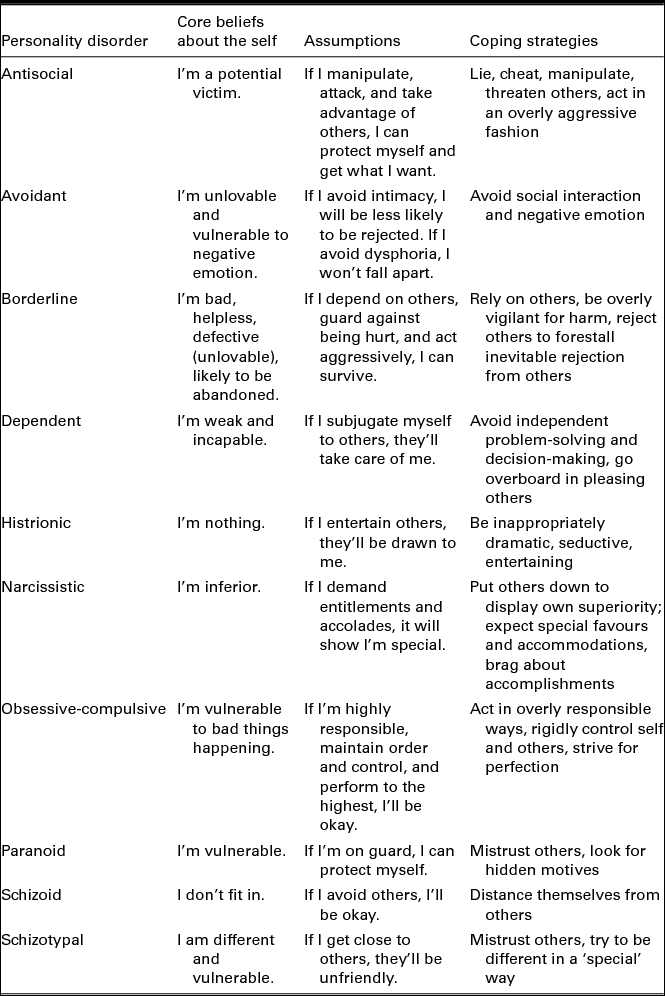
Each personality disorder has a characteristic set of beliefs and strategies. In reality, most individuals who meet criteria for a personality disorder also have subclinical traits of other personality disorders. Nevertheless, it is useful to be aware of the typical set of cognitions and behaviours that characterise each personality disorder. Table 1 provides a partial list of key beliefs and strategies for each personality disorder. For more comprehensive descriptions, see J.S. Beck (Reference Beck2005), and A.T. Beck, Davis, and Freeman (Reference Beck, Davis and Freeman2015).
Key Beliefs and Strategies of People With Personality Disorders

Cognitive behaviour therapy posits the existence of schemas, hypothesised mental structures that organise information. A.T. Beck et al. (Reference Beck, Davis and Freeman2015) describe personality as a ‘relatively stable organisation composed of schema systems and modes’ (pp. 36–27). Schemas affect the sequence of experience from the perceived stimulus to the individual's emotional and behavioural response. There are cognitive, affective, motivational, instrumental, and control schemas.
Modes are a network of interrelated schemas that become activated when the individual experiences a challenge or is actively engaged in trying to achieve an important goal or fulfill an important value. According to Clark and A.T. Beck (Reference Clark and Beck1999), the mind contains a primal mode (the most basic operation of the mind, responsible for fundamental needs such as safety), a constructive mode (which is responsible for attaining resources such as relationships, creativity, and life satisfaction), and a minor mode (which affects the individual's everyday activities). People with personality disorders may have impaired functioning in all three of these modes.
Clients with personality disorders often experience an activation of their schemas in the therapy session itself, as they tend to bring their dysfunctional core beliefs (about themselves, their worlds, and others); conditional assumptions, rules, and attitudes; and coping strategies to treatment. Clients with histrionic personality disorder, for example, often try to entertain their therapist to elicit a response that will make them feel special. Clients with narcissistic personality disorder may brag about their accomplishments, put their therapist down, and try to gain special favours in an attempt to feel superior. A client with antisocial personality disorder tends to try to manipulate and lie to his therapist to feel strong and get what he wants (J.S. Beck, Reference Beck2005).
It is important to recognise that clients with personality disorders do not have the same degree of freedom to consistently act in prosocial and productive ways due, at least in part, to their tendency to misinterpret situations and to their predominant beliefs and coping strategies. They may never have developed, or are at least significantly underdeveloped in, other strategies. Dependent clients, for example, have mastered strategies such as relying on others and avoiding autonomy, but are vastly underdeveloped in their ability to make decisions and operate independently. Paranoid clients have become highly adept at being suspicious but usually do not know how to assess and reasonably trust other people (A.T. Beck et al., Reference Beck, Davis and Freeman2015).
The strategies that clients with personality disorders employ are not ‘good’ or ‘bad’. They are just more or less adaptive according to the situation. People with relatively healthy personalities are able to accurately size up a situation, figure out their short- and long-term goals, and choose from a variety of behaviours. People with personality disorders often misperceive situations and are limited to the small set of strategies that are in their behavioural repertoire. These strategies may be appropriate and useful in some situations but are usually very dysfunctional in many other contexts.
Cognitive Conceptualisation
A cognitive conceptualisation diagram (CCD) can be useful in determining key beliefs and strategies and planning treatment (J.S. Beck, Reference Beck2011) for individuals with personality disorders. The CCD in Figure 1 shows the relationship of one's key lifetime experiences in the development of core beliefs. It also illustrates how individuals’ assumptions translate into behavioural coping strategies to protect them from the activation of their core beliefs. This background information is critical in understanding how clients perceive current situations and why they display characteristic emotional and behavioural reactions.
Cognitive conceptualisation diagram.

Therapists typically complete this diagram between sessions. They generally do not share the diagram with clients, especially a version that is already filled out by the therapist, as it appears complex. Instead, at strategic times in session, they verbally share their conceptualisation with clients, often in parts, and usually via a hand-drawn diagram. The CCD is useful only to the degree to which the therapist chooses situations in which clients’ automatic thoughts display characteristic themes (which differ from one another, if more than one theme is identified). Therapists continue to refine the diagram, always using the clients’ words, until the end of treatment.
Figure 1 helps explain why David, described earlier, in this diagram engages in certain patterns of behaviour that are highly dysfunctional much of the time. His actions in specific situations make sense once we understand his thinking. His thinking makes sense once we understand the basic way he views himself, others, and his world. These beliefs make sense once we understand how he interpreted key life experiences.
At the beginning of treatment, we tend to focus our therapeutic efforts on the situations at the bottom of the diagram, working indirectly on core beliefs and coping strategies as we help clients solve problems, gain a realistic perspective on their current difficulties, do cognitive restructuring, and learn new behavioural skills. As soon as possible, we add an additional focus in treatment on the top part of the diagram.
Treatment Strategies
Cognitive behavioural therapy treatment of personality disorders overlaps in many ways with standard CBT for depression and anxiety, and includes psychoeducation, structuring sessions, goal setting, problem-solving, collaborative empiricism, cognitive restructuring, behavioural experiments, improving interpersonal skills, relaxation, mindfulness, homework, eliciting feedback, and relapse prevention. But therapists may need to draw from a much wider repertoire of interventions, including those from acceptance and commitment therapy, compassion-based therapy, dialectical behaviour therapy, Gestalt therapy, interpersonal therapy, motivational interviewing, positive psychology, ST, psychodynamic psychotherapy, and others. All interventions are adapted and used within the context of the cognitive model.
There is also usually a far greater emphasis on the therapeutic relationship. While therapists elicit feedback from all clients, they must take greater care to uncover negative feedback, if there is any, from their clients with personality disorders, praising them for their willingness to be direct and honest (‘It's good you told me that’), regardless of the accuracy of the client's perception. When they receive negative feedback, therapists offer apologies, when appropriate, and gain clients’ permission to do problem-solving and/or to evaluate clients’ thoughts about the therapist or the process of therapy.
Therapists must strive to help clients feel safe, providing direct evidence that they are an exception to the view that clients generally have about other people. Judicious use of self-disclosure can help clients feel more connected. Therapists offer positive reinforcement that contradicts clients’ core beliefs about the self. They try to prevent problems in the relationship by predicting their own emotional responses and behavioural inclinations when clients become difficult in session — and they do cognitive restructuring themselves before the client enters their office. Therapists also need to become skilled in repairing inevitable ruptures as clients view their therapist in light of their overgeneralised negative ideas about others and engage in therapy-interfering behaviours. When therapeutic relationship problems are resolved, therapists help clients generalise what they have learned to relationships outside of therapy.
Finally, therapists tend to spend a greater amount of time and effort in helping clients modify coping strategies and teaching clients new behaviours. They also generally need to put more emphasis on helping clients modify assumptions and core beliefs at both the intellectual and emotional levels of reasoning. Experiential techniques, such as behavioural experiments, imagery, psychodrama, metaphors, storytelling, and restructuring the meaning of childhood memories are often used with clients who have personality disorders.
Schema Therapy
Conceptual Model
Schema therapy was developed by Young and colleagues (Reference Young1990, Reference Young, Klosko and Weishaar2003) in an attempt to improve the effectiveness of traditional CBT for individuals with characterological problems and personality disorders. In developing ST, Young and colleagues (Reference Young, Klosko and Weishaar2003) integrated CBT with elements of psychodynamic, attachment, and Gestalt perspectives into a unified conceptual and treatment model.
At the core of ST is the theory that personality disorders and characterological problems are largely the result of early maladaptive schemas. Young et al. (Reference Young, Klosko and Weishaar2003) define these schemas as dysfunctional pervasive themes or patterns about oneself and one's relationships with others that are developed in childhood or adolescence and elaborated on throughout life, and consist of memories, emotions, cognitions, and bodily sensations. Overall, Young and colleagues identify 18 early maladaptive schemas. For instance, the ‘Social isolation/alienation’ schema is defined as feeling isolated and different from other people and/or not part of any community.
Additionally, ST incorporates coping behaviours in its descriptions of some schemas, although Young and colleagues (Reference Young, Klosko and Weishaar2003) note that coping behaviours are not part of, but are driven by and reinforce the schemas. For instance, the ‘Self-sacrifice’ schema consists of focusing on the needs of others at one's own expense (Young et al., Reference Young, Klosko and Weishaar2003). In contrast, CBT therapists view ‘self-sacrifice’ as a coping strategy, influenced by clients’ core beliefs of helplessness or unlovability and their assumption, ‘If I subjugate myself to other people, they will stay with me’. CBT therapists reserve the term ‘schema’ for the hypothesised mental structure (in the Piagetian sense) whose function is information processing. When maladaptive schemas are activated, individuals tend to view their negative experiences as confirming their core beliefs and they discount or disregard disconfirmatory evidence.
Schema therapy describes schema modes, temporary states of mind with a cluster of schemas, emotions, and coping behaviours (Young et al., Reference Young, Klosko and Weishaar2003). At any point in time, a certain schema mode is active while others are dormant. Various triggers activate these modes, which may be accompanied by disturbing memories. The four categories of modes are child modes, dysfunctional coping modes, dysfunctional parent modes, and healthy adult modes. When activated in clients with personality disorders, the first three modes tend to be extreme and rigid. The goal of ST is to help clients strengthen healthy schema modes so that they are better able to cope with and switch out of dysfunctional modes.
Comparison of Schema Therapy and CBT Treatment
Overall, there are many commonalities between treatment components of ST and CBT. Both treatments involve the cognitive strategies of evaluating maladaptive beliefs through Socratic questioning, listing evidence for and against beliefs, and reframing evidence that appears to support the beliefs. Moreover, clients evaluate the impact of engaging in maladaptive coping behaviours through cost-benefit analyses and learn how to employ more adaptive coping strategies. Young and colleagues (Reference Young, Klosko and Weishaar2003) state that ST relies more heavily on experiential strategies involving imagery of past experiences that were important in the formation of early maladaptive schemas. Nonetheless, CBT also incorporates such strategies into treatment (e.g., J.S. Beck, Reference Beck2005), which are typically employed when clients are not progressing as expected.
Early in treatment, ST focuses on cognitive and experiential strategies to modify early maladaptive schemas. CBT tends to work indirectly on core beliefs initially, instead directing treatment toward alleviating the clients’ symptomatic disorders (formerly known as Axis I disorders). Once clients are less symptomatic, have learned skills, are functioning better, and have developed a strong therapeutic alliance, they are generally in a better position to tolerate the high degree of negative affect that accompanies schema activation. In contrast, Young and colleagues (Reference Young, Klosko and Weishaar2003) posit that clients are not likely to be able to maintain behavioural changes unless they have first adequately progressed through cognitive and experiential strategies.
Dialectical Behaviour Therapy
Conceptual Model
Dialectical behaviour therapy is a broad-based, cognitive behavioural treatment developed by Linehan (Reference Linehan1993) for individuals with chronic suicidality and BPD. The biopsychosocial theory underlying DBT is based on the premise that both BPD and suicidality are, at their core, disorders of emotion dysregulation (Linehan, Reference Linehan2015). DBT is a complex and compassionate treatment modality that is comprised of individual therapy and skills training sessions (often held in a group format), generally lasting for a year or longer. Between-session coaching is offered when clients are unable to apply new skills to manage difficult emotions. Both individual and skills training components are reviewed below.
Clients are taught a fundamental dialectical that permeates all aspects of therapy: the need to accept themselves for who they are and the need to change. While collaboratively deciding what to cover in individual therapy sessions, clinicians reduce the chaotic nature of the work with such clients by focusing on the following problems, in this order: suicidal behaviour, suicidal ideation, and self-injurious acts; therapy-interfering behaviours (such as not completing homework assignments or missing, or being late for, appointments); quality of life-interfering behaviours (such as risky sexual practices, substance use problems, and work- or school-related issues); and current difficulties. In skills training, either in group or individual sessions, the therapy agenda is determined by the behavioural skill to be taught (Linehan, Reference Linehan2015).
Treatment Strategies
Education about DBT and the biosocial origins of BPD are critical elements of the orientation phase of treatment. Assumptions underlying treatment are also presented and discussed with clients during this phase. Assumptions are presented as ‘beliefs that cannot be proved’, but participants are asked to abide by them anyway (Linehan, Reference Linehan2015). The seven assumptions are as follows: (1) People (i.e., clients) are doing the best they can; (2) People want to improve; (3) People need to do better, try harder, and be more motivated to change; (4) People may not have caused all of their problems, but they have to solve them anyway; (5) New behaviour has to be learned in all relevant contexts; (6) All behaviours (actions, thoughts, emotions) are caused; (7) Figuring out and changing the causes of behaviour is a more effective way to change rather than judging and blaming.
To help clients cope with high emotional dysregulation, and the resulting patterns of maladaptive problem-solving and impulsive behaviours, Linehan (Reference Linehan1993, Reference Linehan2015) developed four broad skill modules: Mindfulness, Interpersonal Effectiveness, Emotional Regulation, and Distress Tolerance.
Comparison of DBT and CBT Treatment
While both CBT and DBT use cognitive and behavioural techniques, there are differences in the emphasis placed on dysfunctional beliefs and problematic behaviours. Cognitive therapy, for example, has traditionally tended to focus more heavily on identifying and modifying dysfunctional cognitions as well as changing clients’ habitual behavioural patterns (coping strategies). DBT has traditionally placed a greater emphasis on behavioural skills to regulate emotion (though CBT therapists have adopted this and other DBT practices in recent years). DBT has also traditionally taught mindfulness to help clients accept reality and develop a non-judgmental perspective — which some, but not all, CBT therapists have also more recently adopted. CBT is traditionally conducted in weekly individual therapy sessions while DBT includes individual therapy sessions plus 2-hour group skills training sessions.
A significant commonality is the importance of the quality of the therapeutic relationship in both forms of treatment. However, CBT has historically placed a greater emphasis on collaborative empiricism (A.T. Beck, Rush, Shaw, & Emery, Reference Beck, Rush, Shaw and Emery1979), the working alliance that stresses mutuality in setting treatment goals, priorities, and session agendas. The client's deeply held core beliefs are treated as hypotheses for client and therapist to investigate together. The focus of DBT is on dialectics, ‘the reconciliation of opposites in a continual process of synthesis’ (Linehan, Reference Linehan1993, p. 19). One of the prevalent treatment dialectics is the balance between changing maladaptive behaviours while at the same time accepting oneself as is.
Conclusion and Future Directions
Cognitive behaviour therapy for personality disorders shares much in common with CBT for other disorders. A greater emphasis on the therapeutic relationship, on the meaning of developmental experiences, and on core beliefs, assumptions and coping strategies often results in a longer course of treatment for clients with personality disorders. Also contributing to the necessity for additional sessions is the propensity for these clients to experience an activation of their core beliefs in the treatment session, often resulting in their use of therapy-interfering coping strategies. Other forms of CBT treatment, ST and DBT, have been shown to be effective. They share some common features with standard CBT for personality disorders but also have some difference in conceptualisation and emphasis.
Paris (Reference Paris2006) concludes that the field of personality disorders is ‘coming of age’, noting that research in the field is growing, as evidenced by more controlled psychotherapy trials of personality disorders published from 2003–2006 than in previous decades. Much more research is needed, though, to establish the efficacy of psychotherapy for the range of personality disorders, in both effectiveness and efficacy trials. This need is especially apparent outside of BPD. Comorbidities also require further investigation. Finally, there has been little research to date on preventing the development of personality disorders and on the direct comparison of CBT to other psychotherapeutic modalities.