Brain-Computer Interfaces (BCI’s) are systems that allow the interaction between the human brain and an external device using brain activity of the users. People who have suffered a stroke, cerebral palsy, or who have been diagnosed with a neurological disease, such as Amyotrophic Lateral Sclerosis (ALS), could face severe motor deficiencies. In these cases, a BCI system could be an assistive technology that helps in the motor rehabilitation process and/or provide an alternative route of communication for the patient (Birbaumer, Reference Birbaumer2006).
The brain activity can be recorded using invasive and noninvasive techniques. Because it is a superficial measure and a low-cost procedure, the noninvasive techniques most used for controlling BCIs are those based on electroencephalographic signals (EEG) (Chaudhary, Birbaumer, & Ramos-Murguialday, Reference Chaudhary, Birbaumer and Ramos-Murguialday2016). EEG-based BCI systems can use a variety of signals from brain activity as, for example, systems based on the sensorimotor rhythms (SMR-Based BCI). The SMR-BCI could provide an additional communication channel that allows users to control a device by performing, voluntarily, at least two cognitive tasks, e.g. state of motor imagery (MI) of the right hand versus relaxed state (Ron-Angevin et al., Reference Ron-Angevin, Velasco-Álvarez, Fernández-Rodríguez. Á., Díaz-Estrella, Blanca-Mena and Vizcaíno-Martín2017; Velasco-Álvarez, Ron-Angevin, & Blanca-Mena, Reference Velasco-Álvarez, Ron-Angevin and Blanca-Mena2010; Velasco-Álvarez, Ron-Angevin, da Silva-Sauer, & Sancha-Ros, Reference Velasco-Álvarez, Ron-Angevin, da Silva-Sauer and Sancha-Ros2013).
For the use of these interfaces it is necessary that at least one of these two tasks be the MI, since it produces changes in the amplitude of the neuronal signal in the frequencies μ and β in the motor cortex, which gives rise to a de-synchronization of the neuronal activity of a particular zone compared to the relaxed state (Neuper & Pfurtscheller, Reference Neuper, Pfurtscheller, Pfurtscheller and da Silva1999). The applications of these interfaces are very numerous and promising, so it would not be surprising if their use was quite common in the future once certain limitations have been overcome, either for leisure time (Li, Zhang, Xue, & Wang, Reference Li, Zhang, Xue and Wang2017) or necessity in the case of people with certain types of neurodegenerative disease, as amyotrophic lateral sclerosis, even in complete locked-in state (CLIS) (Chaudhary, Xia, Silvoni, Cohen, & Birbaumer, Reference Chaudhary, Xia, Silvoni, Cohen and Birbaumer2017). However, since it takes a great deal of time and effort to modulate neuronal responses, obtaining synchronization and control of these systems is not a simple task for many individuals (Jeunet, Jahanpour, & Lotte, Reference Jeunet, Jahanpour and Lotte2016).
Currently, an important line of research in this area is the development of training procedures that minimize learning time and maximize the final performance of users (Lotte, Larrue, & Mühl, Reference Lotte, Larrue and Mühl2013). Due to the difficulty in acquiring the SMR modulation ability and the time required for its domain, it is important to maintain high user motivation, since it has been demonstrated how it influences positively in one’s performance (Nijboer, Birbaumer, & Kübler, Reference Nijboer, Birbaumer and Kübler2010).
On the other hand, it is convenient to offer the user a guide on how he is performing the task, so the feedback is also an important element to supports his execution (Neuper & Pfurtscheller, Reference Neuper, Pfurtscheller, Graimann, Pfurtscheller and Allison2010; Sollfrank et al., Reference Sollfrank, Ramsay, Perdikis, Williamson, Murray-Smith, Leeb and Kübler2016). When the user gets the adequate performance in the interaction, he/she has an incentive to keep working. So, a direct relationship is established between Motivation and Feedback because the positive perception of the Feedback is able to increase Motivation levels of the user (Burgers, Eden, van Engelenburg, & Buningh, Reference Burgers, Eden, van Engelenburg and Buningh2015). From this approach, the way of offering feedback and its influence in the learning process of managing a SMR-based BCI has been increasingly studied (Jeunet et al., Reference Jeunet, Jahanpour and Lotte2016; Lotte et al., Reference Lotte, Larrue and Mühl2013), even so, more studies are advised in the field (Lotte & Jeunet, Reference Lotte and Jeunet2015). In this line, Barbero and Grosse-Wentrup (Reference Barbero and Grosse-Wentrup2010) presented a study in which they applied biased feedback that made users believe that their performance was different from what it actually was. The main conclusion of this study supported the idea of feedback adapted to the user’s initial ability; biased positively for individuals with poor performance and no bias for high performance. On the other hand, the use of more immersive interfaces, through the use of more dynamic and motivating virtual environments, e.g., those that show the performance through a game interface, has been shown to positively influence performance (da Silva-Sauer, Valero-Aguayo, Velasco-Álvarez, Varona-Moya, & Ron-Angevin, Reference da Silva-Sauer, Valero-Aguayo, Velasco-Álvarez, Varona-Moya, Ron-Angevin, Rojas, Joya and Catala2015; Ron-Angevin & Díaz-Estrella, Reference Ron-Angevin and Díaz-Estrella2009).
Therefore, it seems that an adequate feedback will be one that is adapted to the ability of each user and will keep him or her motivated on the task. In psychological terms, feedback can be used to reinforce the behavior of the individual that is performed correctly, as well as extinguishing incorrect behavior by not expressly giving feedback. It is also possible to present negative feedback by punishing the user’s incorrect responses. Thus, through behavior modification techniques, we can manipulate the degree to which a neuronal physiological response can be acquired, reinforced, extinguished, or punished.
One way to manipulate the presence of the reinforcement (or its absence/extinction) is through the application of a training procedure called Shaping (Skinner, Reference Skinner1969), which allows gradual learning of a response as it is reinforced to a more demanding degree each time. The technique consists of specifying a series of performance levels (graded in ascending order of difficulty or proximity to the objective response) reinforcing the individual’s response to improving his or her performance to the next level and, once he reaches it, only offer the reinforcement when executing the response from a higher level, all the way until the individual learns the objective response. This procedure allows the person to learn step by step, through successive approximations, the final objective response. Since the ability to modulate the SMR can be trained, it would be of interest to test this technique on a psychological basis, which reduces learning time and increases the final performance of the user. In this way, our proposal is based on the application of the Shaping described above, already used by da Silva-Sauer, Valero-Aguayo, Velasco-Álvarez, Ron-Angevin, and Sancha-Ros (Reference da Silva-Sauer, Valero-Aguayo, Velasco-Álvarez, Ron-Angevin and Sancha-Ros2013) as training paradigm in SMR-based BCIs.
The basic idea of this procedure is to reinforce the user through a positively biased feedback that increases its hits and decreases its failures and withdraws this support according to your improved performance. In da Silva-Sauer et al. (Reference da Silva-Sauer, Valero-Aguayo, Velasco-Álvarez, Ron-Angevin and Sancha-Ros2013) they applied the same assistance for both tasks (MI and relax state); however, it was concluded that it would have been more appropriate to offer it independently for each cognitive task since they presented different levels of difficulty. Once this modification was made, the feedback offered to the user would be adapted to their current level of performance in each cognitive task, as proposed in Barbero and Grosse-Wentrup (Reference Barbero and Grosse-Wentrup2010) and da Silva-Sauer et al. (Reference da Silva-Sauer, Valero-Aguayo, Velasco-Álvarez, Ron-Angevin and Sancha-Ros2013), so that users with low performance were not frustrated and those with high performance don’t lose their motivation and stop striving. Also, a questionnaire will be used to measure the workload experienced by the user in the interaction with the system. The NASA Task Load Index (NASA-TLX) was applied in the first experiment. The NASA-TLX, proposed by Hart and Staveland (Reference Hart, Staveland, Hancock and Meshkati1988), is a method assesses work load on five 7-point scales.
Thus in the present study are presented two experiments to test whether this learning paradigm based on shaping learning in each cognitive task helps to improve the performance in an SMR-based BCI compared to the standard procedure used in previous studies (da Silva-Sauer et al., Reference da Silva-Sauer, Valero-Aguayo, Velasco-Álvarez, Ron-Angevin and Sancha-Ros2013; Ron-Angevin & Díaz-Estrella, Reference Ron-Angevin and Díaz-Estrella2009; Ron-Angevin et al., Reference Ron-Angevin, Velasco-Álvarez, Fernández-Rodríguez. Á., Díaz-Estrella, Blanca-Mena and Vizcaíno-Martín2017; Velasco-Álvarez et al., Reference Velasco-Álvarez, Ron-Angevin, da Silva-Sauer and Sancha-Ros2013). In the first experiment, a comparative study of two procedures, standard vs. shaping paradigm. In the second experiment, a single case study was conducted to analyze the progressive learning effect of the new shaping procedure.
Method
Participants
In both experiments, all subjects were university students without prior BCI experience, and they signed a document of informed consent for voluntary participation. All subjects had an initial error rate of less than 35% in the calibration session. The requirement of maximum-allowed error rate arises from the need to have users who have a minimum sense of control over the task. However, a 5% increase in this requirement was made with respect to Kübler et al.,(Reference Kübler, Neumann, Kaiser, Kotchoubey, Hinterberger and Birbaumer2001) since our interest is to improve the performance of users who do not necessarily have a high ability in modulating their SMR. So, the inclusion criteria for participants were that they had less than 35% error rate in initial calibration.
First experiment
In the first experiment a comparative study between two groups was performed. The aim was to compare the use control of BCI with the standard and the shaping learning processes. The participants were 14 females and 5 males (M = 22.39; SD = 1.42 years). They were divided randomly into two groups: one control (N = 10) with standard procedure and another experimental (N = 9) with the shaping procedure. The participants performed two sessions (4 blocks of 40 trials per sessions). The first session, in which the users had no feedback, was used to calculate the parameters that would be applied in the next session and to know the initial capacity of each participant to modulate their neuronal activity. In contrast, the second session was used for training, so that users improved their ability to modulate SMR, doing the best they can.
The NASA-TLX questionnaire was used with the relevant variables for our study: Mental demand, Performance, Effort and Frustration. This questionnaire was performed in the training session for each of the tasks after completing each block. For their later analysis, the scores of each variable in the different blocks were averaged in order to obtain just a single score, instead four. As result, each user obtained a single score per NASA-TLX’s variable (i.e. mental demand, performance, effort, and frustration), as well as the averaged score for shaping and control conditions.
Second experiment
In the second experiment, a single case study was performed. The aims were to replicate the shaping learning process and to test the differences in those learning process through the training progression essays. The participants were 5 university students, females with a mean age of 22.38 ± 2.5 years. In this experiment, the first two sessions were the same as experiment one and they made one more session with the shaping procedure.
Experimental procedure
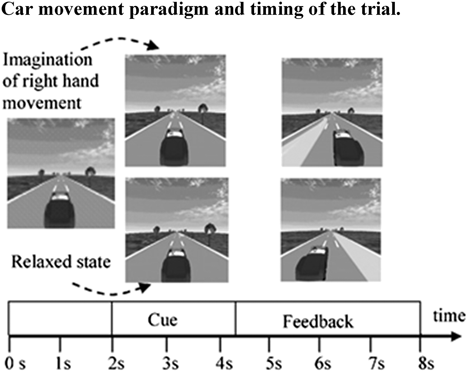
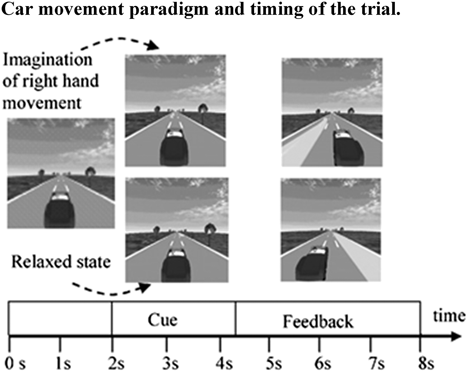
The virtual environment for both experiments was the same used by Ron-Angevin and Díaz-Estrella (Reference Ron-Angevin and Díaz-Estrella2009): the motion of a car is presented as feedback with the classifier adapted and associated with two cognitive tasks (the car paradigm can be seen at figure 1). Each session in both experiments corresponded to 4 blocks of 40 trials, with 8 seconds by trial. The two cognitive tasks used in this study were: (i) Right hand kinesthetic Motor Imagery (MI), and (ii) Relaxed State (RS). The 40 trials of each block were randomly divided into 20 trials for each cognitive task, with a rest period of 2 seconds between trials. The interval time between the blocks were chosen by participants to rest and prevent possible fatigue effects, they ranged from three to five minutes. In the two experiments, the first session is performed without feedback, as it was used for calibration. Also, the experiment was explained, hiding the fact they would go through a session with shaping (the shaping procedure is explained later). They were also asked to not move during the tests so as to not affect the EEG signal.
In the session without feedback, the car does not move sideways. At second 2, the participant will see the cue (puddle) and will start the mental imaginary task. The participants had to perform this task continuously for six seconds (while they saw the puddle). In the session with feedback, the car moves according to the classification of the participant.
Data acquisition
For recording the signal in the first experiment, nine active electrodes were placed on the surface of the scalp. The positions used for the placement of the electrodes were: F3, F4, T7, T8, C3, C4, P3, P4 and Cz, according to the international system 10–20. These channels were combined to give rise to two Laplacian configuration around C3 and C4 (right and left hand sensorimotor areas, respectively) according to the 10/20 international system. In both experiments, the ground electrode was placed at the FPz position. All signals were amplified and digitized at 200 Hz by an actiCHamp amplifier (Brain Products GmbH, Munich, Germany).
Signal processing
Signal processing in the BCI system involves extracting the characteristics of the EEG signals and classifying them. Such processing was based on that proposed by Guger, Edlinger, Harkam, Niedermayer, and Pfurtscheller, (Reference Guger, Edlinger, Harkam, Niedermayer and Pfurtscheller2003) without artefact detection. Extraction of characteristics consisted of estimating the average power of the signal in 0.5–second windows in a subject-specific reactive frequency band, which was automatically identified by comparing the power spectra of two traces in two different 1-second intervals: One in which the participants were not performing any specific cognitive activity, and another one in which they were (right hand MI). For each session, we obtained a curve for the error rate e(t) averaged over the 160 trials, as a result of a LDA (Linear Discriminant Analysis) classification, following the procedure proposed by Guger et al. (Reference Guger, Schlögl, Neuper, Walterspacher, Strein and Pfurtscheller2001).
After the calibration session, the parameters of the LDA classifier were selected for the instant in which the e(t) curve reached its minimum. In the feedback sessions, calculation of the average power for each of the two EEG channels and the result of the classification were obtained in real time. The LDA classification was then translated online into the length (L) of the feedback displacement of the car, according to the following equation:
 $$L(t) = {w_1}{P^{C3}}(t) + {w_2}{P^{C4}}(t) + {w_0}$$
Length (L) was updated on the screen every four samples; that is, every 32 ms to make feedback visually continuous. A negative/positive value of L was translated into left/right displacement of the car. Thus, classification consisted of a simple linear combination of the power from each channel (PC3 for C3 and PC4 for C4), with the LDA classification weights (W1, W2 and W0) obtained in the first session.
Shaping procedure
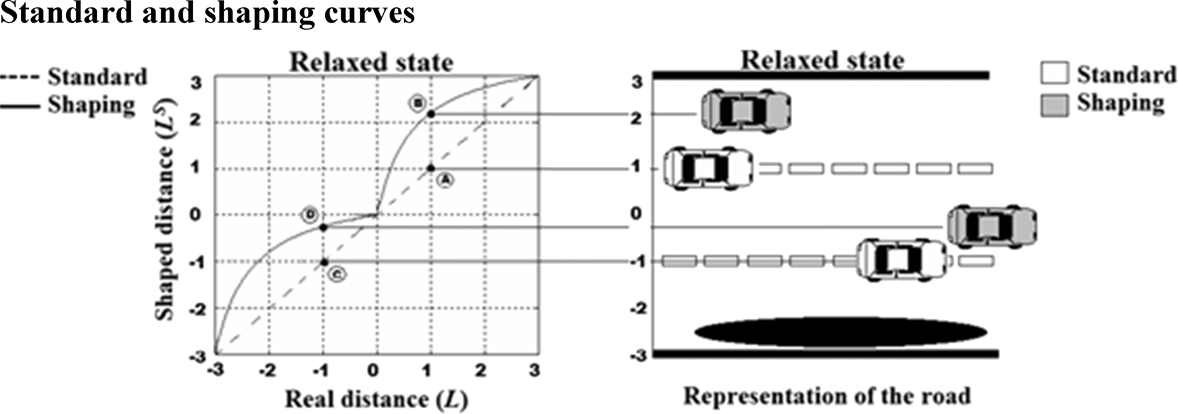
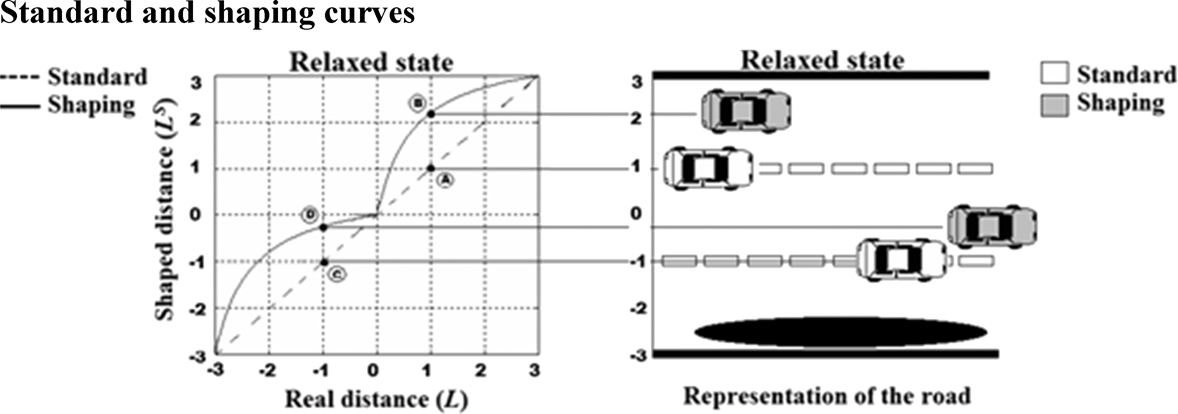
Shaping consisted of modifying the visual feedback, reinforcing correct behavior (avoiding the puddle) and attenuating errors (car on the puddle). Reinforcing a correct behavior meant, in this case, moving the car a greater distance than the actual one (corresponding to the subject’s performance in the standard procedure); attenuating an error meant making such distance shorter. This modification was implemented with a function that obtained the shaped distance (LS) from the unshaped distance (L). In the standard procedure (control group in the first experiment), this function was the straight line LS = L; that is, no shaping for hits or errors, the distance the car moved on the screen and the real one were equivalent. In training sessions with shaping, the shape of the function was a curve, in case of a hit |LS|>|L|; that is, the car moved more than the detected neuronal response, and in case of an error |LS|<|L|, which means that the car moved less than the neuronal response. A greater curvature of the function (curve farther away from the straight line LS = L) meant greater reinforcement. This way, the effect of reinforcement is maximized over the hits and minimized over the errors. This effect can be observed in Figure 2, in an example of a curve corresponding to the RS task. When the MI is requested, the curve is symmetrical to the former about the origin of coordinates.
The dashed curve corresponds to the standard procedure, and the continuous curve to the procedure that modifies the visual feedback. A hit that would have a 1 m displacement in the standard procedure (A), it would be represented by more than 2 m when using shaping (B), which implies positive reinforcement. In case of an error with a displacement of 1 m in the standard procedure (C), the represented displacement with shaping would be 0.3 m (D), thus, attenuating the consequences of the error.
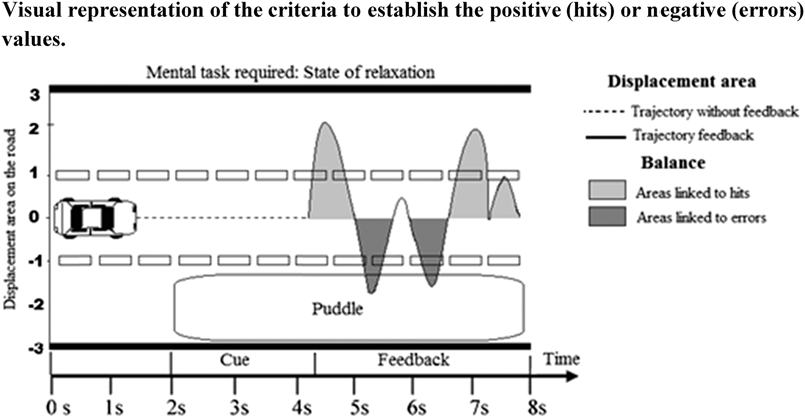
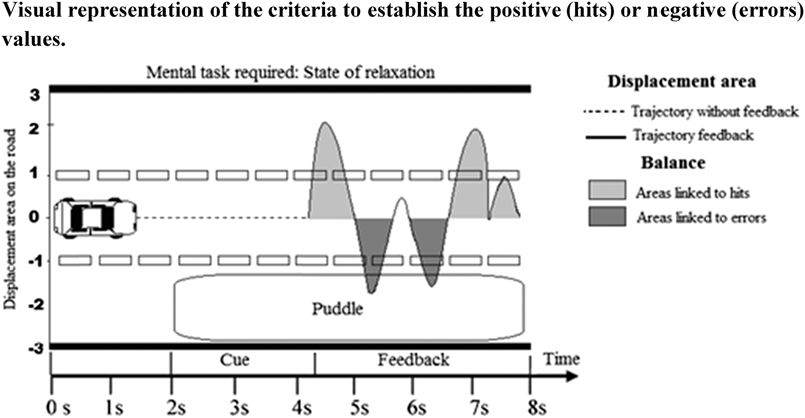
The “displacement area” is defined by the car trajectory in each trial. The values used for the calculation of the displacement area correspond to the feedback period (from time t1 = 4.25s to t2 = 8s), considering the distance value without shaping (L). A central line at the road was used as the reference to determine a positive or negative value of the area, so if the RS task is requested, all areas on the left side are positive and all areas on the right side are negative. The balance is established at the end of each trial by the sum of positive and negative displacement areas. The areas positive or negative are linked to areas of hits (AH) and areas of errors (AE) according to task requested and the movement of the car (see Figure 3). In the case of the "displacement area" is positive, means that the user was most of the time on the right side of the road and the trial is considered a hit.
In this example, the RS task was performed.
The variable "Cumulative Area of Motor Imagery" (CA_MI) was calculated as the average of all values of "displacement areas" balance in MI trials. The variable "Cumulative Area of Relaxed State" (CA_RS) is defined analogously. Depending on the performance in the trials, the variables (CA_MI and CA_RS) had positive or negative values.
To calculate these areas we used the equations:
 $$\eqalign{ &amp; {A_H} = \sum\limits_{i = 136}^{256} {\left| {{L_H}\left( i \right)} \right|\,{A_E} = \sum\limits_{i = 136}^{256} {\left| {{L_E}\left( i \right)} \right|} } \cr &amp; {L_H} = \left\{ {\matrix{ {L\left( i \right)} &amp; {hit} \cr 0 &amp; {error} \cr} } \right.\,{L_E} = \left\{ {\matrix{ {L\left( i \right)} &amp; {error} \cr 0 &amp; {hit} \cr} } \right. \cr}$$
Each subject started out with an initial Shaping level that depended on their control in the first session for each cognitive task. From the offline analysis of the first session, without feedback, the time instant in which the minimum error e(t) was obtained offline by an average of 160 trials. The optimum classifier was then calculated for this instant, which defined weights and parameters to classify each cognitive task. With this classifier, it is possible to carry out an online “playback”, simulating a feedback session with the EEG data from the calibration session.
In this way, the cumulative area balance of each of the 80 trials for each class was calculated (CA_MI and CA_RS). To each trial, if the resulting value was positive, the trial was considered a hit; if it was negative the trial was considered an error. The initial shaping curve for each task was calculated by dividing the number of errors by the total number of trials. The Shaping level is adapted to the learning level of each user and so that they can progress as they acquired the new learning, we decided to establish 10 thresholds for the error rate (0% to 50%), associated to 10 shaping curves (5% per curve). The upgrade (or not) of the Shaping level was done at the end of each block of 160 trials. The update is made calculating the “Cumulative Area” balance averaged between all trials of the block to each cognitive task. If the result was positive, the rate was decreased by 5% (one shaping curve less). So, they will have less help because had improved the skill in those conditions. When the value was negative, the shaping level remained equal in the next block.
Results
Results of Experiment 1
The results of the calibration session for the different participants was in the band between 5 to 17 Hz (minimum band, M = 9.79, SD = 2.42; maximum band M = 15, SD = 1.91). The percentage minimum error of participants in that calibration was between (M = 21.1, SD = 8.2), there were not statistical differences between both groups.
A mixed factorial design (2 x 2 x 2) was used with two intra-subject factors and one inter-subject. The dependent variable was the accumulated area in the movement of virtual car. The intra-subject factors were: The task (MI and RS), and the session (calibration session without feedback and training session with feedback). On the other hand, the inter-subject factor was the training paradigm, that is, the standard procedure or the shaping procedure.
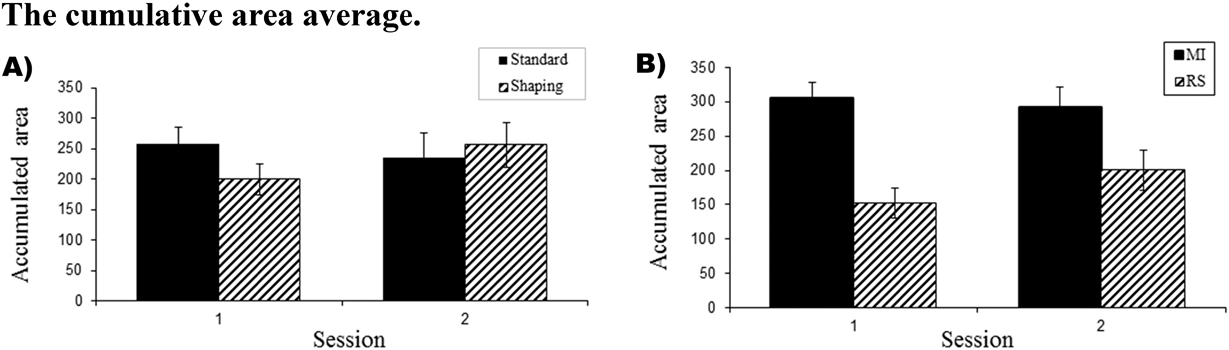
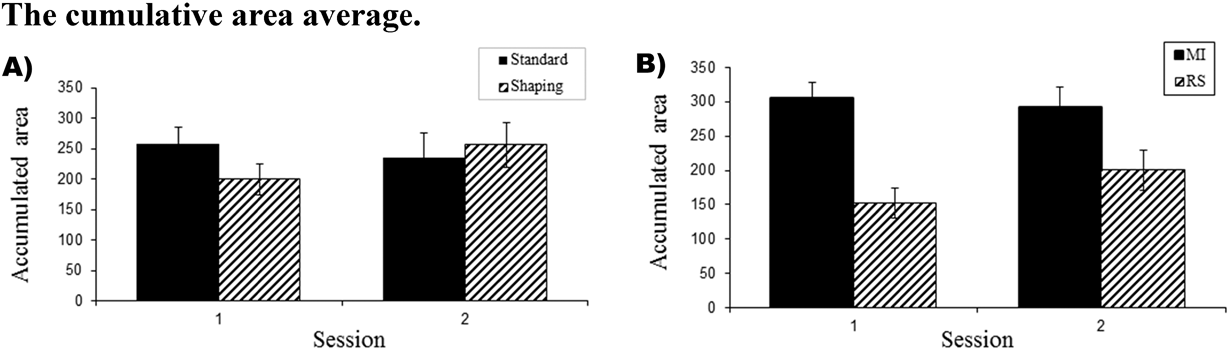
The ANOVA showed a main effect of the task, F(1, 17) = 29.893; p < .001, with a highest performance in MI task (M = 298.433, SD = 24.46) than the RS task (M = 176.319, SD = 24.019. This difference is obtained independently in both calibration session, t(18) = 5.953; p < .001, and in the second with feedback, t(18) = 3.381; p = .003. Also, an interaction effect between the session and the group was observed, F(1, 17) = 5.565; p = .031 (see Figure 4, A), as well as observing a great performance increase between sessions in the group to which the shaping paradigm was applied. Finally, a second interaction effect was found between the task and the session, F(1, 17) = 5. 038; p = .038), with a higher performance increase in the RS task (see Figure 4, B).
In A, the cumulative area average for each of the groups in the two training sessions. The B shows the cumulative area average for each of the tasks in the two training sessions.
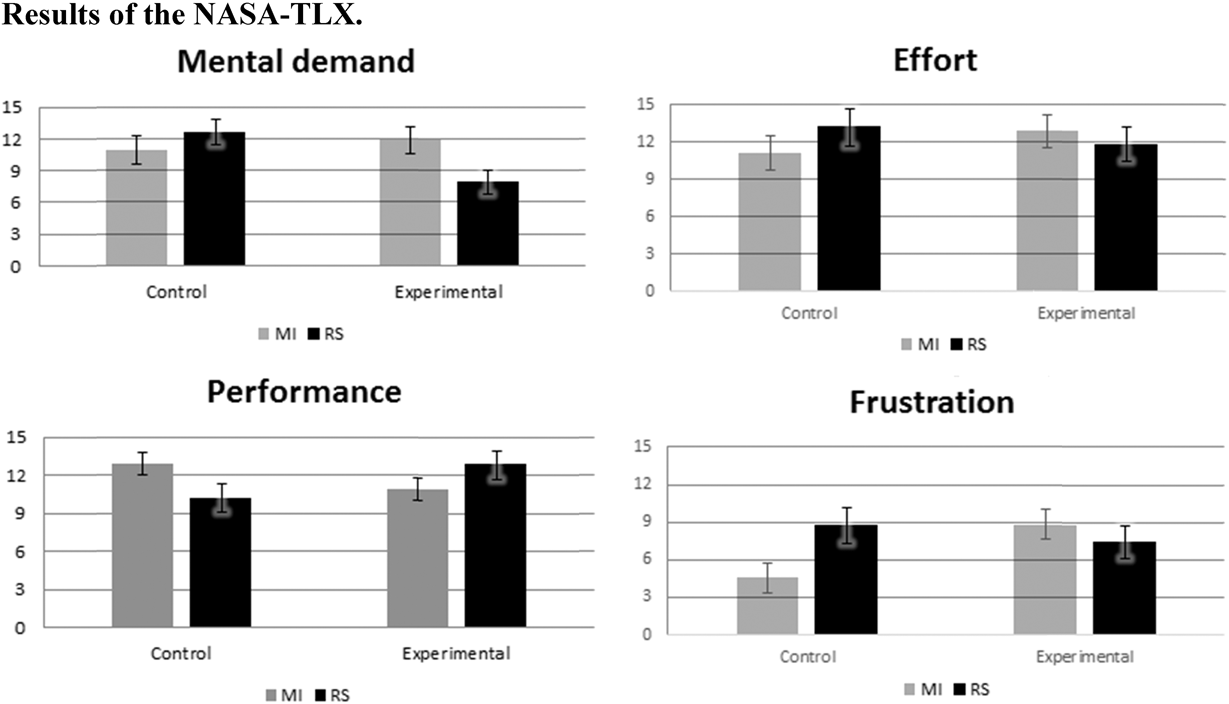
In Figure 5, the averages results to each cognitive task to the variables Mental Demand, Performance, Effort and Frustration obtained in the NASA-TLX questionnaire are presented. To statistical analysis, a mixed ANOVA was applied. An interaction effect was obtained between the group and the task in Mental Demand, F(1, 17) = 6, 809; p = .018), performance, F(1, 17) = 5, 725; p = .029) and frustration, F(1, 17) = 9, 735; p = .006, no significance was found in effort, F(1, 17) = 2, 505; p = .132.
Results of the NASA-TLX to following scales: 1) How hard did you have to work to accomplish your level of performance? (Effort); 2) How mentally demanding was the task?(Mental demand); How insecure, discouraged, irritated, stressed, and annoyed were you? (Frustration); How successful were you in accomplishing what you were asked to do? (Performance). Increments of high, medium and low estimates for each point result in 21 gradations on the scales.

In summary, both groups showed a better performance in the second session, where a feedback was presented, and also a better performance in the MI task. In the experiment sample, MI always is easier to performing by the subjects, but the RS showed better performed in the experimental group. Often, that activity is difficult to get without some previous training in breathing and relaxing, but the progressive shaping procedure in the feedback with that group showed better results in order to control the BCI task. So, the learning with the shaping procedure could produce a more homogeneous control of BCI when we want two different responses in participants. The performance results demonstrate that the all subjects have difficulty to discrimination the RS task. In this way, the responses obtained in NASA-TLX demonstrate that the participants of the experimental group perceived less mental demand, higher performance, less effort and less frustration in the RS task compared to the control group.
With those results, we wanted to test how that learning was produced progressively, and how the same person can learn two responses with a similar precision grade. So, we made a new experiment to specify this process.
Results of Experiment 2
The results of calibration session for each participant were in the band between 8 to 15 Hz (minimum band M = 10.6, SD = 1.67; maximum band M = 14, SD = 1.2). The percentage minimum error for participants was between 22 and 29% (M = 27, SD = 8).
In this single case design, the intrasubject variables contrasted were: "Trial Sequence”, which represents all the trials from 1 to 160 in order of execution, and the cognitive tasks (MI or RS) as independents variables and Accumulated area (CA_MI and CA_RS) and shaping level as dependents variables. We used a simple linear regression to determine if it was possible to explain the values of the accumulated area were growing or reducing linearly with the progression of trials.
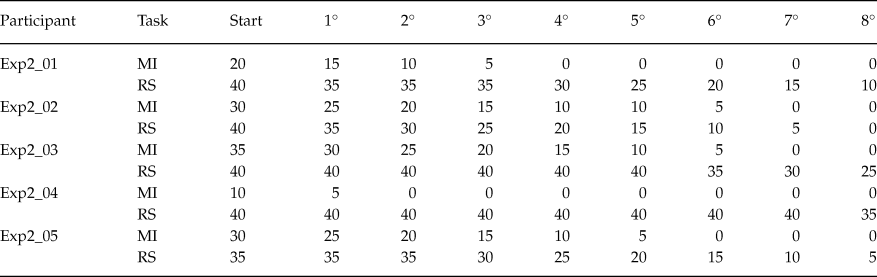
The shaping rate (percentage) was updated after the average of the accumulated area (CA_MI and CA_RS) in each block of 20 trials of each cognitive task. The Table 1 shows the index updates shaping presented for each participant. One can observe the evolution of the shaping index along eight blocks (which corresponded to two feedback sessions).
Updating of the Shaping Level (%) in Each Block (20 Trials)
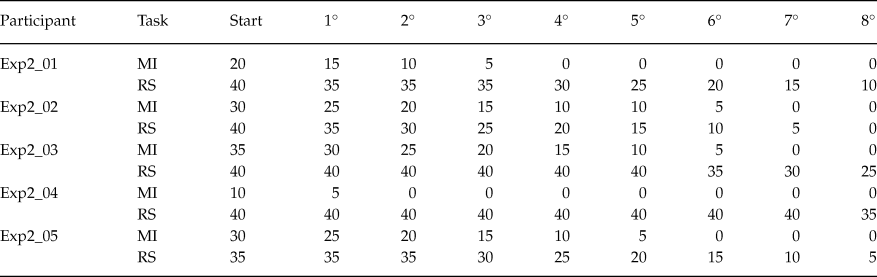
We can observe that the initial shaping rates for the MI task are all lower than those for the RS task indicating that all participants originally had better control of the MI task. A value of 0% meant that the subject was no longer receiving shaping. MI cumulative area values stayed positive, so the shaping level decreased reaching 0% before the 8th block. However, for the other task, higher initial rates were presented and, in the end, only one subject reached 0%. All other participants improved, but failed to achieve the feedback without the effect of shaping.
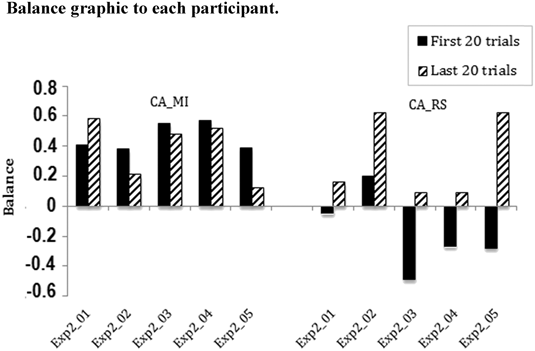
In Figure 6, variations of balance for the first and last block (20 trials each) to MI and RS task can be seen. For MI task, the participants already start with good initial control and keep it until the end. In RS task we observed an improvement in all participants between begin and the end of the experiment. In this way, they improve their level of control and all of them finished the experiment with positive averages balances.
The balance of each participant in the first 20 and last 20 trials of the total of 160 performed.
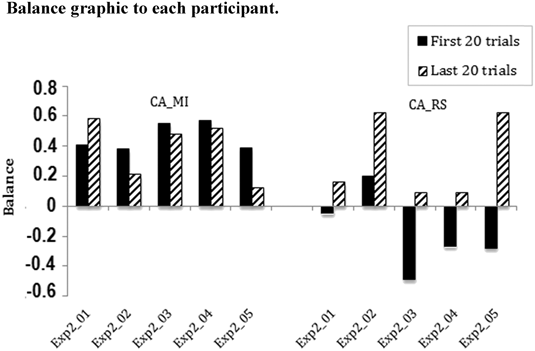
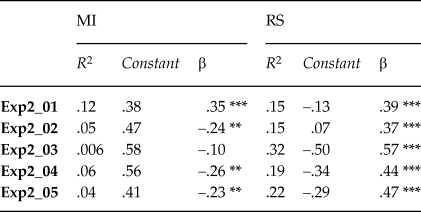
A trend analysis was made for each subject (for both cognitive tasks, MI and RS) that indicates whether the relationship of variables Trial Sequence (TrSeq) and CA_MI or CA_RS exhibits a linear relationship with the trials. The results are shown in Table 2 and it may be noted that they are similar to what is observed in Figure 6.
Trend Analysis
** < .01. *** < .001.
The high positive value of the Beta statistic indicates an increasing trend to all subjects in the RS variable during the sequence of the 160 trials. It means that there was a gradual improvement in the balance for this cognitive task. In MI there are 4 negative that means a progressive decrease between the first and the last block. In this subjects, the balance remained positive, this can be explained by none of the participants had shaping support when they were at the seventh block (they all had shaping level 0). To RS task, the high value of R 2 implies in a greater correlation between the time (trials) and the increase of positive areas on the balance sheet. So, in general to MI task and especially for the RS cognitive task, it was concluded that there was a linear relationship between the trial sequence and the improvement of the subject.
In summary, this second experiment showed that participants learned progressively the second cognitive task (relaxed state) that is more difficult to control for people using BCI. The curves and data changes showed how the improvement with the shaping procedure for that task. The imagination task usually is easier to make for everyone, and the data showed no progression, they were appropriate for a good neuronal response in each participant, but the second response to get relaxed was learned also only after that shaping procedure, so they get adequate index in both cognitive responses.
Discussion
In the present study, we propose two experiments to suggest the use of a learning procedure, the shaping, as a training paradigm in the control of a SMR-based BCI.
Corroborating with the previous study (da Silva-Sauer et al., Reference da Silva-Sauer, Valero-Aguayo, Velasco-Álvarez, Ron-Angevin and Sancha-Ros2013), in both experiments we conducted the RS task was significantly more difficult to perform than the MI task. There are several hypotheses for this phenomenon. On the one hand, the low performance in the RS task may be due to the difficulty of the user to maintain a state of relaxation during an experimental situation (impossibility of moving, discomfort, fatigue, etc.) in which, in addition, it must be attentive and motivated to achieve a good performance (da Silva-Sauer, Valero-Aguayo, de la Torre-Luque, Ron-Angevin, & Varona-Moya, 2016). Another possible explanation for this difference between cognitive tasks may be the lack of precision and the subjectivity of the instructions of the worst performing task. That hypothesis follows the lines of Corbit, Gabel, and Yu, Reference Corbit, Gabel and Yu2013; and Battison, Schlussel, Fuller, Yu, and Gabel, Reference Battison, Schlussel, Fuller, Yu and Gabel2015, in which they defend the importance of using specific and well-defined instructions to obtain an adequate control of a SMR-based BCI.
This effect can also be explained by the previous experience that the users have in the accomplishment of each cognitive task. It is easier to follow an instruction about something we have experience (Hattie & Timperley, Reference Hattie and Timperley2007; Moreno & Mayer, Reference Moreno and Mayer2007). The task of the motor imagination of the right hand implies a daily activity to which anyone (without motor problems) is accustomed to doing in their day by day. However, this is not the case in the RS task, in which most users may not have experience in maintaining a controlled relax state at will. This hypothesis could be related to studies showing better performance in users with training in meditation techniques in BCIs where both tasks were MI (Lakey, Berry, & Sellers, Reference Lakey, Berry and Sellers2011; Tan, Dienes, Jansari, & Goh, Reference Tan, Dienes, Jansari and Goh2014). It would be useful to observe the effect of this training in the case of being an MI versus RS task, which was shown in our second experiment.
Furthermore, in the first experiment, an interaction effect was found, according to which, with the experiment time the RS task improves its performance significantly more than MI task. This learning could be observed also in the second experiment with gradual improvement of cognitive activity, previously unlearned, after 160 trials. Maybe these results occur because the participants saw it easier to improve their performance through feedback in that task in which they performed a worse execution in the calibration session.
Besides, was observed in the first experiment a higher increase of the performance of the calibration session to the feedback session in the group to which the shaping procedure was applied. The same result was observed in the second experiment. The linear analysis showed the gradual improvement of performance in each participant. There was an improvement in the cognitive task that previously had worse performance (relax state). By another side, the cognitive task that the participant had previous control (MI of the right hand) keeps constant. In this way, this procedure has been suggesting as a learning enhancer in the modulation of the user’s SMR due to the adaptation of the feedback to the user’s skill.
In the first experiment, the NASA-TLX questionnaire showed that there is an interaction effect between the group and the task. This effect may be due to the fact that the RS is more complex to be performed and the shaping group received more help from the system. In this way, the real difficulty to modulate their EEG signals was not perceived by the participants. By another side, the difficult task reported by the user was that of MI, in which they performed well. For this cognitive task, the users almost no received help from the shaping, most of them even reaching to level 0 at the beginning of the trials. Thus, there increased perceived errors. Because of this, the experimental group would perceive that faced with the task of rest, the IM task required a greater mental effort, they had a worse execution and they were more frustrated in comparison to those perceived by the control group.
A learning technique that improves control has been proposed in the present study, in other words this means that users could more easily modulate their EEG signals. Özdenizci et al. (Reference Özdenizci, Yalçın, Erdoğan, Patoğlu, Grosse-Wentrup and Çetin2017) propose that modulation of SMR could be useful in stroke motor rehabilitation protocols that include neurofeedback because this BCI real-time feedback could help to reactivate a damaged motor area thanks to brain plasticity. For example, a person whose arm movements have been compromised by a stroke damaging sensorimotor cortex might employ a BCI that measures signals from the damaged areas and then excites muscles or controls an orthosis that improves arm movement. In this sense, the shaping technique could be used to assist in the initial control process to improve the natural Central Neural System output and thus helps to restore more normal arm control (Chaudhary et al., Reference Chaudhary, Birbaumer and Ramos-Murguialday2016).
In conclusion, the modulation capability of the SMR can be improved through an instrumental learning technique and, therefore, it is possible to improve the performance in the control of a SMR-based BCI. This psychological learning technique, shaping, has been able to make the training time more efficient in the control of these systems by adapting the feedback to the user’s ability independently to each cognitive task and, by other side, this technique has a potential to be used to adapt BCI assisted neurorehabilitation techniques for restoration of motor impairment after severe stroke or provide more autonomy to ALS patients.
The next step would be to apply this learning technique to a population with some kind of brain impairment that affects motor functions, such as people who have suffered a stroke or ALS patients. Even with promising initial studies, further research with new protocols, follow up studies and with larger samples are still needed. In the same way, for future experiments, it would be convenient to control that the difference in the accumulated area variable in the first session between groups was similar, which would facilitate finding a main effect between groups. Also, this procedure should be tested on users who have minimal control over their SMR, that is, eliminating the requirement to obtain an error rate of less than 35% in the calibration session. Likewise, it would be interesting to replicate this study with different pairs of cognitive tasks that might have similar difficulty, such as right hand versus left hand. Finally, we propose to expand the number of subsequent sessions to progressively observe the results that could be reached with long-term training.