1. Introduction
In various settings, compensation is provided to resource users who adhere to environmental guidelines. One example is the Conservation Reserve Program (CRP), in which US farmers are paid for controlling erosion from land they have taken out of production. In addition, considerable enthusiasm has been expressed for using payments for environmental services (PES) to save threatened habitats in poor countries. Among other economists, Simpson and Sedjo (Reference Simpson and Sedjo1996), Ferraro (Reference Ferraro2001), and Rice et al. (Reference Rice, Sugal, Ratay and da Fonseca2001) have highlighted the advantages of direct payments over the integrated conservation and development projects (ICDPs) that aid agencies and environmental organizations began favoring in the late 1980s.
Direct payments are starting to be harnessed for the sake of watershed conservation in the developing world (Robertson and Wunder, Reference Robertson and Wunder2005). In a typical undertaking, compensation is given to people in the upper reaches of drainage basins, who in return refrain from land uses that exacerbate flooding, seasonal water shortages, and other problems at lower elevations (Landell-Mills and Porras, 2001; Pagiola, Reference Pagiola, Pagiola, Bishop and Landell-Mills2002).
The norm in Latin America is for all participants in a PES scheme to receive uniform compensation. For example, the conservation payment for every forested hectare enrolled in Costa Rica's Pagos por Servicios Ambientales (PSA) program is the same throughout the country (Pagiola, Reference Pagiola2008). Uniform payments for each forest type are likewise a feature of a nationwide program in Mexico, focused on the hydrologic benefits of tree-covered land (Muñoz-Piña et al., Reference Muñoz-Piña, Guevara, Torres and Braña2008). On a smaller scale, uniform compensation for each land-use category (undisturbed primary forest, reforested farmland, etc.) is a feature of the best known community-level initiative in the Western Hemisphere, which was launched in 2000 to safeguard sources of water for Pimampiro, Ecuador (Wunder and Albán, Reference Wunder and Albán2008).
To say the least, the economic case for uniform compensation is weak. Some PES recipients, for instance, might accept something less than the standard, prevailing payment, in which case too much money is being spent to achieve environmental outcomes. An entirely different inefficiency arises among some individuals who reject a standard payment – in particular, if the compensation they demand is exceeded by the environmental benefits created by their participation in a PES scheme.
Households demand varying conservation payments because their sources of income differ, as do the risks they face. Many people engage in subsistence farming, which has long been the economic mainstay of the African, Asian, and Latin American countryside. For them, substituting conservation payments for some agricultural returns reduces the variability of overall earnings, which any risk-averse individual welcomes.
In contrast, PES may appeal less to rural dwellers with diverse sources of income. For example, numerous households in El Salvador have risen out of poverty by starting microenterprises, working in clothing factories, and so forth. Nevertheless, they do not abandon farming entirely. Since few of these households have savings accounts or deal in other ways with financial institutions, growing some of their own food is the way most of them deal with the downside risk of off-farm employment (González-Vega et al., Reference González-Vega, Rodríguez-Meza, Southgate and Maldonado2004; Rodríguez-Meza et al., Reference Rodríguez-Meza, Southgate and González-Vega2004). Clearly, any payment directed toward such households would need to reflect the de facto insurance value of resources needed for subsistence during hard times.
In this paper, we examine the linkage between livelihood strategies at the household level and the compensation that a household demands in exchange for following conservation guidelines. To begin, portfolio theory is used to demonstrate the influence of risk on conservation payments. Next, we analyze PES in two settings, one in Ecuador and the other in Guatemala. In each setting, we have undertaken contingent valuation (CV) to estimate the payments that households would demand in exchange for scaling back farmed area. While the two study sites differ in terms of economic realities, CV results indicate that the response to PES depends on what rural people do to survive and contain risk.
2. Conservation payments and risk-averse households
Since fluctuations in earnings have been shown to detract significantly from the well-being of low-income households in the countryside (Ligon and Schechter, Reference Ligon and Schechter2003), a conservation payment that does not vary has obvious attractions. This is particularly true for a household that is risk averse and survives entirely on the food it produces. Risk aversion is manifested by the concavity of the function relating utility to the net value of agricultural output. Because of this concavity, the minimum CRP-type payment that would be accepted in return for taking farmland out of production is less than the expected decline in net agricultural returns, which are meager on average.
While much of the rural population in the developing world engages solely in subsistence farming, a large and growing segment has two or more sources of income. This is certainly true in many watersheds in which conservation initiatives are being undertaken. These settings are not out of reach of cities and other market hubs; so opportunities exist to complement the production of one's own food with an alternative, such as earning wages, running a microenterprise, and engaging in commercial agriculture.
Two observations can be made about these alternatives. One is fairly obvious, which is that working for a wage or farming commercially is more rewarding on average than subsistence production. But the other observation is no less important and is well documented in the literature on economic development: the returns of subsistence farming tend to be less, not more, variable than the returns of alternative activities.
This latter relationship was emphasized by none other than Theodore W. Schultz, who won a Nobel Prize in part because he revolutionized economists’ views on farmers in poor countries as well as agriculture's role in overall economic development. Concerning the switch from subsistence (or traditional) farming to what can be called improved agriculture, he observed:
“In general, farmers who are limited to traditional agricultural factors are more secure in what they know . . . than farmers who are adopting and learning how to use new factors of production. The new types of risk and uncertainty about yield inherent in factors embodying an advance in knowledge are of real concern to farmers . . . . But since traditional agriculture is not introducing new factors, new elements of risk and uncertainty do not appear; they arise only when the transformation gets under way” (Schultz, Reference Schultz1964: p. 31).
What Schultz wrote about subsistence farming versus improved agriculture closely parallels what other economists have concluded about traditional production versus nonagricultural work in a city or town. Urban earnings are higher on average, although they also vary more – at least for people with limited skills and few personal contacts who have arrived recently from the countryside (Masson, Reference Masson2001). Some of this variability has to do with wage adjustments, resulting from changes in labor demand or supply. But the main reason for fluctuating earnings among recent migrants is labor-market rigidities, which often make it hard for them to find work at prevailing wages (Harris and Todaro, Reference Harris and Todaro1970; Fields, Reference Fields1975).
The implications of risk aversion for individual responses to PES can be demonstrated by drawing on the portfolio theory that won a Nobel Prize for its originator, Harry Markowitz (Reference Markowitz1952). How this theory applies to any particular household depends on various traits and circumstances: risk preferences, returns and variabilities of different sorts of work, and endowments of human capital, land, and other household resources. But for the purpose of clarifying how the response to PES depends on income diversification, we examine households that
-
• are risk averse;
-
• employ their human resources fully, either with PES or without it; and
-
• can produce their own food using traditional methods, work in a nearby city (which of course places no demands on the household's land holdings), or do both.
For reasons stated above, we assume that the returns to subsistence farming are lower on average than those of urban employment, although the former are also less variable.
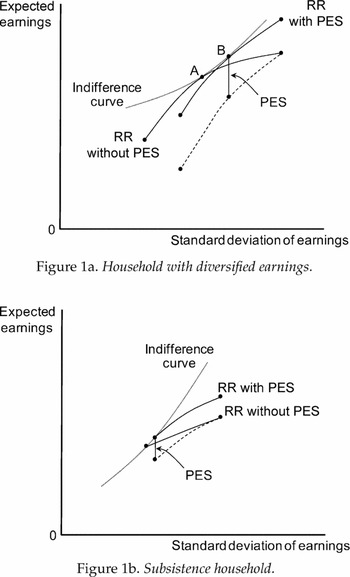
The risk–return (RR) frontier in the absence of PES for one sort of household with the preceding characteristics is provided in figure 1a. The frontier's upper, right-hand extreme corresponds to complete specialization in urban employment, and its concavity reflects the fact that as more labor is allocated to food production, small reductions in the standard deviation of overall earnings (measured on the horizontal axis) require ever-larger sacrifices in expected household income (measured on the vertical axis).
Returns, Risks and PES
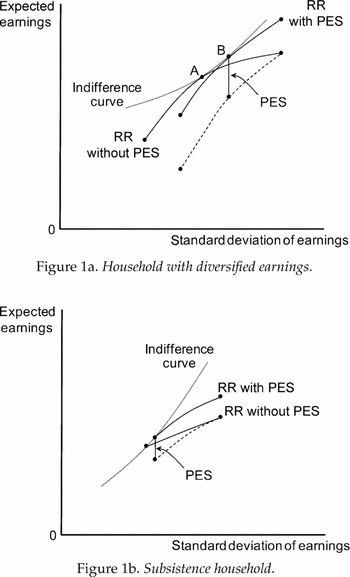
Let us suppose that if there are no conservation payments, the household opts for the combination of urban employment and subsistence farming represented by point A in figure 1a. At this point, the risk–return frontier is tangent to one of the household's indifference curves. The shape of that curve, like those of other indifference curves (which are not shown), reflects the convexity of household preferences – that is, ever greater increments in expected earnings needed to compensate for a marginal increase in risk as the standard deviation of earnings rises.
We now introduce PES. To understand the consequences for a household with diversified earnings, it is useful to identify two things. One of these is the impact of a reduction in farmed area, which diminishes the returns to labor allocated to subsistence production but not the returns to off-farm work. The other is the impact of a payment needed to compensate for this reduction.
Since the returns to off-farm employment remain the same, the upper, right-hand extreme of the risk–return frontier is unaffected as agricultural land use declines. However, expected returns associated with lower levels of risk are diminished, with the largest impacts registered at the other end of the frontier. As a result, the risk–return frontier hinges away from the vertical axis, as is shown in figure 1a. Along the new frontier, marginal tradeoffs between expected returns and risks are greater.
With subsistence production occurring in the absence of PES, a direct payment is needed to restore the household to its initial level of well-being, which is represented by the original indifference curve. This payment is nonfluctuating, and its inclusion in household earnings has no impact on the standard deviation of those earnings. Thus, an upward, parallel displacement in the risk–return frontier occurs. The minimum payment required to compensate fully for a reduction in agricultural land use creates the with-PES frontier shown in figure 1a. This frontier, like the without-PES one, is tangent to the original indifference curve.
There are two things to observe about the new point of tangency, B. First, it is closer to the upper, right-hand end of the risk–return frontier. In other words, the recipient household responds to a reduction in farmed area (required to qualify for PES) and in the returns to agricultural labor by specializing more in off-farm work. The second observation is that the new tangency point is above and to the right of point A, which of course is on the same indifference curve but at which a larger gain in expected earnings is being demanded in return for a marginal increment in the standard deviation of those earnings.
To summarize, the decline in the returns to labor allocated to subsistence production, brought about by a reduction in farmed area, causes a household with diversified earnings to devote more effort to urban employment, the rewards of which are greater although more variable. The payment it demands for making an increased marginal tradeoff between expected returns and risk depends on its convex preferences, as reflected in the specific curvature of its indifference curves.
Let us now consider a household with different characteristics – in particular one that is considerably more reluctant to experience risk. As illustrated in figure 1b, the combination of severe risk aversion, which is indicated by a steeply sloped indifference curve, and a without-PES risk–return frontier with a gentle slope leads to a corner solution, with the household having a low standard of living, as it engages solely in subsistence production. In a sense, this outcome can be explained almost entirely in terms of acute risk aversion, of the sort prevailing in places like rural India (Binswanger, Reference Binswanger1980). That is, someone who is very reluctant to run risks might never venture into the urban labor market, as is needed to develop the contacts needed to find a job and to endure periods of high unemployment. As a result, switching from subsistence farming to urban work causes income variability to increase substantially, and expected earnings to go up just a little, as reflected in the modest slope of the without-PES frontier.
As is true of the household that is less risk averse, reducing agricultural land use, as one must do to receive conservation payments, causes the risk–return frontier to hinge in the way shown in figure 1b. If the household is compensated for the reduction in expected earnings associated with any given level of income variability (except for the case of a complete switch to off-farm work), it might opt for a mix of subsistence production and urban employment. In this case, PES, which is invariable, offsets the risks of the latter source of income.
This possibility is not depicted in figure 1b. Instead, there is still a corner solution with conservation payments. Relative to compensation for the household with diversified earnings (figure 1a), a small payment is received by a poor household driven to engage only in subsistence production because of its acute risk aversion.
As previously acknowledged, there are myriad combinations of risk preferences and risk–return frontiers and not merely the pair of combinations depicted in figure 1. Nevertheless, the preceding analysis yields an important lesson about PES, which is that it is not necessarily an effective vehicle for poverty alleviation. On the contrary, we have demonstrated that impoverished households specializing in subsistence farming because of a great reluctance to undergo risks might well settle for conservation payments smaller than those demanded by better-off households with diversified earnings.
3. Research settings and data
How rural households react to conservation payments has been investigated in two locations in which PES could be used. If environmental deterioration continues in places like Cangahua, which is in the same Andean watershed as Quito, Ecuador, then satisfying the national capital's demand for water will require interbasin transfers, which promise to be very costly. Likewise, degradation of the Madre Vieja watershed, in western Guatemala, jeopardizes the benefits of irrigation and potable-water development along the southern coast of the Central American nation.
Data needed for CV analysis of CRP-type payments in each of the two settings were collected in household-level surveys. In Cangahua, where there is little commercial agriculture and off-farm work is the main alternative to subsistence farming, 199 interviews were conducted in January and February of 2004. The sample was drawn from a cross section of eight rural communities scattered throughout the valley in which the small town of Cangahua is located. Approximately 25 households, all randomly selected, were interviewed in each community.
The survey instrument, which was pretested in late 2003, contained questions about household members (e.g., age, schooling, etc.), agricultural activities (area planted to various crops, yields in 2003, etc.), and off-farm employment. Interviewees were also asked CV questions of the stylized form: “Would you be willing to stop farming on A hectares for five years in exchange for a monthly payment of B dollarsFootnote 1 during these same five years?” The time limit was placed on the transaction in order to emphasize that accepting payments would not jeopardize recipients’ property rights. Each respondent was randomly assigned a decrease in farmed area (A), which ranged from 1 to 5 hectares. If he or she owned less than 1 hectare, then a reduction of 25 or 50 per cent was specified. Monthly payments (B) were randomly drawn from the bid vector, $1, $10, $20, $30, $40, or $50. Of the 199 households interviewed in Cangahua, 152 answered the CV question. Nonresponding households were not found to be significantly different from the rest of the sample in terms of earnings and other key variables.
Field surveying was undertaken in the Madre Vieja watershed in early 2005 (Lundine, Reference Lundine2005). The sample comprised nearly all the 330 small farmers residing in the middle section of the watershed. Coffee production predominates in this area. However, a minority of households relies on a combination of subsistence production and off-farm employment, much like Cangahua's population.
The survey instrument, which was similar to the questionnaire used in Ecuador, was pretested in April 2005. After minor modification of the instrument, actual surveying was undertaken the same month. Along with data on household members and farming and other economic activities, perceptions of environmental problems and attitudes about environmental quality were elicited (Lundine, Reference Lundine2005).
The CV questions were essentially the same as those in the Ecuadorian questionnaire, although it was specifically stipulated in the Guatemalan survey that land taken out of agricultural production would be reforested. In addition, land dimensions were expressed in cuerdas (of which there are approximately 20 in 1 hectare) and conservation payments in the national currency, the quetzal (Q),Footnote 2 were offered on an annual, not monthly, basis. Of the 330 land owners in the full sample, 269 responded to the CV question in addition to completing the rest of the questionnaire. As in Cangahua, no significant differences were found between responders and nonresponders.
Small holdings are the rule for sampled households in Cangahua; median farmed area is 2.94 hectares. Practically all land is planted with potatoes and other staple crops, which are consumed mainly by the producing household. Much of the male population works outside the Cangahua valley, quite often in floricultural enterprises nearby or at construction sites in Quito and other cities. By and large, wages are modest, as reflected by an average annual income of $1,496 for households in the sample. Low wages are, in turn, a consequence of limited formation of human capital; the vast majority of the adults we interviewed either are illiterate or went to primary school for a few years.
General observations in the economic literature about subsistence production and other activities for rural households seem to fit the Ecuadorian site very well. Even by the modest standards of the country as a whole, crop yields are low. For example, the average annual yield of potatoes in Cangahua is 1.19 MT/hectare, which is less than one quarter the national average of 4.99 MT/hectare (INEC/MAG/SICA, 2002). However, analysis of survey data suggests that subsistence farming is less risky than working off-farm. In particular, the cross-sectional standard deviation of potato yields in Cangahua, which in part reflects sharp differences in elevation and other environmental factors, is 0.98 MT/hectare. Dividing this standard deviation by the local average, 1.19 MT/hectare, yields a ratio lower than what is obtained by dividing the cross-sectional standard deviation of off-farm income for surveyed households ($1,199) by average earnings ($1,249). To be sure, estimates of cross-sectional variability, which are the only measures available to us, are not ideal indicators of household-level risk. However, the preceding evidence is not inconsistent with the broad claim by Harris and Todaro (Reference Harris and Todaro1970) and others that subsistence agriculture is less risky than off-farm employment.
The median agricultural holding for the Guatemalan sample, 0.20 hectares, is smaller than in Cangahua. A strong similarity between the two settings is that educational attainment is very low, median schooling among adults being less than two years. Living standards are likewise modest, although data on incomes could not be collected. The problem was that tax authorities had investigated the study area just a few months before our survey, which left much of the population reluctant to provide any information about earnings (Lundine, Reference Lundine2005).
Of the 269 Guatemalans who answered the CV question, 69 do not raise coffee. Instead, these people support themselves by combining subsistence production with off-farm work, very much as their counterparts in Cangahua do. The other three fourths of the 269 households grow coffee. Yields average nearly 4.4 tons/hectare (Lundine, Reference Lundine2005). Furthermore, production risks are modest, since environmental conditions in the middle part of the Madre Vieja valley are ideal for coffee. Also, the crop has been harvested in the area since the 1800s, which means that the challenges of switching from traditional farming to commercial agriculture (Schultz, Reference Schultz1964) were overcome long ago. Prices fluctuate, of course. But aside from times when market values plunge, as happened shortly after the turn of the 21st century, the returns to coffee production are generally attractive and not subject to great variation. Under these circumstances, a coffee farmer has little reason to accept small payments for taking land out of production, as many subsistence households are willing to do.
4. CV model
Using a standard CV approach, we have investigated the relationship between household characteristics (including income sources) and participation in a PES scheme by analyzing dichotomous-choice willingness-to-accept (WTA) responses. We suppose that WTA per hectare (either a monthly or annual payment) for household i is

where X is a vector of the household's specific attributes; β is a vector of associated parameters to be estimated; the error term (ϵ i ) has a mean of zero; and unknown variance (σ2) and is normally distributed.
The household accepts the payment, $B, if WTA per hectare is less than the implied payment for the stipulated area (Zi ):

Substituting the expression for WTA, equation (1), yields
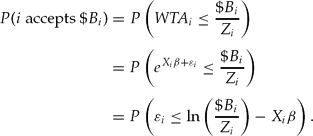
Normalizing by the standard deviation of the mean-zero error term, the probability of the household accepting the payment becomes
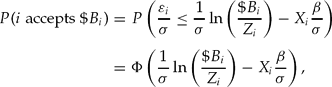
where Φ(•) is the standard normal cumulative distribution function. This is the standard probit probability, as described in detail by Haab and McConnell (Reference Haab and McConnell2002).
The probability of the respondent rejecting the bid is the complement of the above-derived probability of acceptance:

Defining  , and yi
= 1 if individual i accepts the payment of $B and yi
= 0 otherwise, the probabilities of acceptance and declination are P(yi
= 0) = 1 − Φ(X*
i
β*) and P(yi
= 1) = Φ(X*
i
β* ). Running a probit model of the yes/no responses on the vector of independent variables (Xi
) and the additional variable
 yields estimates of the normalized parameter vector
 .
Note that the estimated coefficient of will be an estimate of  , and the estimated coefficients of Xi
are estimates of
 . To recover consistent estimates of the parameters of the WTA function, we need to divide the estimates of by the estimate and switch the signs of the resulting parameter estimates.
5. Regression results
Although our two study sites share some important characteristics, such as an elevated incidence of poverty, each has distinctive features. Cangahua is an unpromising setting for crop production, due to its high altitude, poor soils, and limited precipitation. In contrast, the middle reaches of the Madre Vieja watershed are well suited to coffee farming, which can be fairly profitable. Largely because of this agroecological distinction, population densities are higher in the Guatemalan site than in Cangahua.
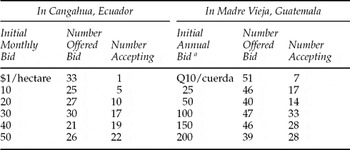
Responses to PES, which are reported in table 1, turned out to be similar in the two rural communities, with interviewees’ acceptance or rejection of a compensated reduction in farmed area being positively linked to compensation levels. When coffee farmers in the Madre Vieja watershed were offered $11 per month to retire 1 hectare (equivalent to an annual payment of 50 quetzals for a cuerda), 35 per cent of them accepted the deal. This share is similar to the 20 per cent of the households in Cangahua who would retire a hectare for $10 per month. Likewise, 72 per cent of the Guatemalan respondents and 90 per cent of the Ecuadorian interviewees would cut back on farmed area if offered per-hectare monthly payments of $44 and $40, respectively.
Responses to payments for reducing agricultural land use
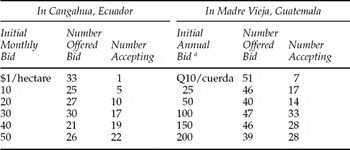
a One Guatemalan quetzal was equivalent to $0.132 at the time of the survey, in April 2005.
That consistent results were obtained in Ecuador and Guatemala suggests that CV methodology exhibits convergent validity. Thus, it is a useful tool for analyzing factors influencing acceptance or rejection of PES.
5.1 Ecuadorian findings
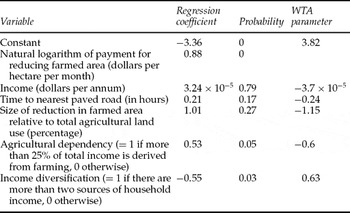
Reported in table 2 are the results of probit estimation using data obtained from the 152 households in Cangahua that responded to the CV question. The dependent variable is willingness to reduce farmed area in exchange for compensation (1 = yes, 0 = no). The independent variables include:
-
• the natural logarithm of the per-hectare bid, in dollars per month;
-
• annual household income, in dollars;
-
• the number of hours required to reach the nearest paved road from the household's dwelling, which serves as a proxy for market access;
-
• the proposed reduction in farmed area as a percentage of total agricultural land use by the household;
-
• an indicator of the household's dependence on subsistence production (equal to 1 if the value of farm output exceeds 25 per cent of total household income and 0 otherwise);Footnote 3 and
-
• an indicator of whether or not the household has more than two sources of incomeFootnote 4 (equal to 1 if there are more than two sources and 0 otherwise).
Probit estimates of WTA/hectare reduced function – Cangahua, Ecuador
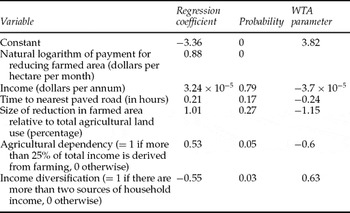
Note: Total observations = 152.
Reported in table 2 are raw probit results before coefficients have been transformed into WTA parameters. The exception is the coefficient of the logarithm of the per-hectare bid, which is an estimate of in equations (4) and (5). The sign of the marginal effects of each variable is the opposite of the sign of the estimated coefficient.
A household's willingness to retire farmland is positively tied to the size of the monthly per-hectare payment. Furthermore, the coefficient of the monthly bid is statistically significant.
The estimated parameter for annual income is positive. However, it is not statistically significant, mainly because most households in our sample have comparable earnings. Likewise, the coefficient for time to the nearest paved road is positive, which suggests that farmers are more willing to stop using remote parcels than those with good access to markets. However, the coefficient is not statistically significant.
In a study of Costa Rica's PSA program, Zbinden and Lee (Reference Zbinden and Lee2005) found that a household's willingness to participate is inversely tied to the percentage of farmed area it is being asked to reforest. The positive sign of the coefficient for this variable in table 2 indicates a different relationship, although the coefficient is statistically insignificant.
A positive and statistically significant parameter estimate for the first of the two dummy variables indicates that households that depend on subsistence farming are more willing to participate in a PES scheme. This is because the expected returns of subsistence farming are modest, and substituting a conservation payment for some of those returns reduces the variability of overall earnings.
The conceptual analysis provided earlier in this paper provides an explanation of the negative and statistically significant coefficient for the other dummy variable, which registers income diversification at the household level. Reducing agricultural land use, as a household would have to do to receive a conservation payment, lowers the marginal returns of farm labor relative to the marginal returns of off-farm work. Responding to this change in incentives, the household would dedicate more effort to the latter activity, even though it is riskier. All else remaining the same, the risks created by this reallocation of labor diminish the household's acceptance of PES.
WTA parameters are reported in the last column of table 2. As indicated at the end of the preceding section, these parameters can be recovered by dividing coefficients from the probit regression by the coefficient of the logarithm of the bid and switching the sign. WTA parameters can be interpreted as semielasticities of median WTA per hectare with respect to the associated variable. For example, a one hour increase in the time needed to reach the nearest paved road decreases median WTA per hectare by 24 per cent. Median per-hectare WTA is 60 per cent lower for households deriving more than one fourth of total earnings by raising crops and livestock than for households in which this share is under 25 per cent. Also, the average payment demanded by households with more than two sources of earnings is 63 per cent higher than median WTA per hectare for households with only one or two such sources.
5.2 Guatemalan findings
The Guatemalan study, which was undertaken a year after our research in Ecuador, used essentially the same research methodology (Lundine, Reference Lundine2005). The econometric model was similar in terms of the dependent variable: willingness to reduce agricultural land use in exchange for compensation (1 = yes, 0 = no). Also, some of the independent variables, such as the natural logarithm of the amount of the per-hectare bid, were the same.
Absent from the right-hand side of the probit regression for Madre Vieja is household income. This omission had to do with the circulation of tax authorities through the study area shortly before the survey, which made participants unforthcoming about earnings from various sources (Lundine, Reference Lundine2005). In contrast, a number of variables not featured in the Ecuadorian study were included, such as the gender of the respondent, a measure of educational attainment by adult members of the household, and the respondent's perceptions of local real-estate values. In addition, the best measure of income diversification was found to be a dummy variable: whether or not one or more household members have outside salaried employment.
Analysis of survey data revealed major differences between two groups of landowners. One segment of the population grows no coffee and instead engages in subsistence farming, often on very small plots. This group's responses to PES closely resemble those of rural households in Cangahua. The other part of the population raises coffee, which to repeat is a fairly rewarding activity in the middle part of the Madre Vieja watershed. The results of probit estimation using data for the 160 households in this second group indicate that, all else remaining the same, willingness to forgo some of the rewards of coffee production, as participation in a PES scheme would require, has much to do with income diversification.
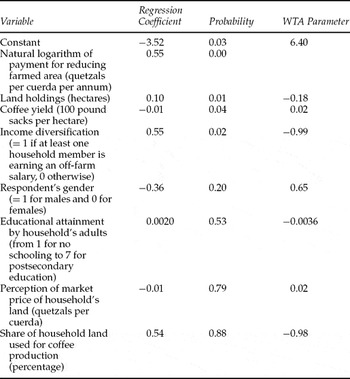
Results for the 160 coffee farmers are reported in table 3. As in the probit regression for Ecuador, the coefficient of the annual conservation payment is positive and statistically significant. So is the coefficient for the total number of hectares owned by the respondent, which is consistent with what was found in Costa Rica. As Zbinden and Lee (Reference Zbinden and Lee2005) pointed out, people “with larger farms are more likely to sacrifice a portion of land . . . without jeopardizing household food security or short-term income-generating potential” (p. 260). Per-hectare production of coffee has a statistically significant, though negative, parameter estimate. Clearly, people who are skilled at raising this commercial crop, possess productive resources, or both are more reluctant to cut back on agricultural land use and thus will demand higher conservation payments.Footnote 5
Probit estimates of WTA/hectare reduced function – Madre Vieja watershed, Guatemala
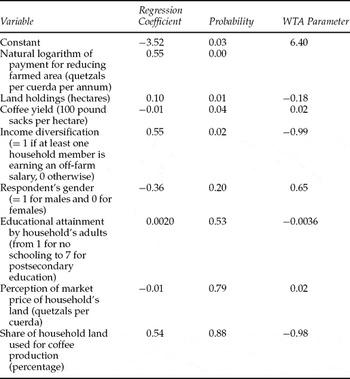
Total Observations: 160.
Another variable with a statistically significant regression parameter is the dummy variable for salaried employment for at least one member of the household. But whereas the coefficient of the measure of income diversification in the Ecuadorian study is negative, the coefficient for the dummy variable in the Guatemalan study is positive. To understand this result, one must remember that people opting for coffee production are not engaging in subsistence farming to guard against shortfalls in off-farm earnings. Having put subsistence farming behind them, they are in general more willing to scale back on a purely commercial sort of agriculture if off-farm salaries are being received.
Finally, WTA parameters, which as indicated above can be regarded as semielasticities, have been recovered from the probit regression using the same procedure employed in our Ecuadorian analysis. A unitary increase in household land would decrease the average conservation payment by 18 per cent. Raising coffee yields by 1 quintal (i.e., 100 pounds) would increase WTA per cuerda by 2 per cent. In addition, the median payment is 99 per cent lower for households with at least one member holding a salaried job than for households in which the value of the dummy variable is zero.
6. Summary and conclusions
As reported at the beginning of this paper, uniform payments are a feature of PES programs in Costa Rica, Mexico, and other places. This uniformity can create inefficiency if some recipients would accept less compensation in return for adopting conservation measures. Another source of inefficiency has to do with households that should be offered something more than the prevailing payment because the resulting environmental gains are greater.
This paper is about this variation in compensation demanded by different households – variation rooted in individual strategies for raising income and dealing with risk. Among other things, our findings call into question how some contributors to the PES literature have proposed setting conservation payments. To be specific, Rice et al. (Reference Rice, Sugal, Ratay and da Fonseca2001) and others have suggested that payments should equal the net expected market value of agricultural (or forestry) output of land that is taken out of production. Such an approach might actually exaggerate what some people would accept – in particular, those engaged solely in growing their own food. But as is emphasized in this paper, risk-averse households with diversified earnings are apt to demand more compensation, almost certainly something more than the net expected market value of forgone production.
A departure from the standard practice of uniform conservation payments makes sense in terms of achieving environmental outcomes at least cost. However, such a departure has the potential to widen the gap between poor households and other segments of the population. Our theoretical analysis indicates that the poorest households, which specialize in subsistence farming, are likely to receive lower payments than their better-off neighbors, who have diversified earnings. Likewise, regression analysis indicates that, all else remaining the same, diversified households with higher incomes must be paid more in return for adopting conservation measures.
Needless to say, our research does not exhaust the subject of household-level survival strategies and PES. Neither have we addressed each and every issue related to conservation payments. One of these issues is the expense of PES aside from compensation made to participating households. Since PES implementation has not actually begun at either of our research sites, we are unable to report monitoring and other costs. However, there is good reason to believe that these costs would be substantial. In Pimampiro, Ecuador, for example, monitoring and other expenses exceed total payments received by participating households (Wunder and Albán, Reference Wunder and Albán2008).Footnote 6
There is the broader issue of whether the total expense of PES is justified by the environmental benefits being created. Median WTA per hectare in our two study sites is over $50 per annum, and economic evaluation of the downstream impacts of watershed conservation is difficult in Cangahua and the Madre Vieja valley. Indeed, benefit estimation is barely under way in Pimampiro, where PES began in 2000 (Wunder and Albán, Reference Wunder and Albán2008). So the question of whether the benefits of PES exceed costs or vice versa remains unsettled, even where conservation payments are currently being made.
Truly, better understanding of the costs of PES, which our research addresses, as well as its environmental benefits is needed if this fiscal tool for watershed management is to be applied in other settings.