INTRODUCTION
Bryde's whales (Balaenoptera edeni, Anderson, 1879) have been reported in tropical, subtropical and warm temperate oceans around the world (inhabiting waters about 16°C or warmer), between latitudes 40°N and 40°S (Jefferson et al., Reference Jefferson, Weber and Pitman2008; Kato & Perrin, Reference Kato, Perrin, Perrin, Würsig and Thewissen2009). It is the only balaenopterid species that does not perform extensive latitudinal migratory movements, remaining in warm waters throughout the year (Kato & Perrin, Reference Kato, Perrin, Perrin, Würsig and Thewissen2009). Balaenoptera edeni is relatively common in Brazilian waters and it is known to occur over the coastal shelf until the bathymetry of 200 m, but appears to be more frequent in coastal areas of the south-eastern region wherever effort occurs (Zerbini et al., Reference Zerbini, Secchi, Siciliano and Simões-Lopes1997; Siciliano et al., Reference Siciliano, Santos, Vicente, Alvarenga, Zampirolli, Brito, Azevedo and Pizzorno2004).
Historically, B. edeni was exploited by two whaling stations in Brazilian waters: Costinha station (Paraíba State: 06°57′S 34°51′W) from 1910 to 1914 and from 1924 to 1985, and Cabo Frio station (Rio de Janeiro State: 22°53′S 42°01′W) from 1960 to 1963 (Williamson, Reference Williamson1975; Zerbini et al., Reference Zerbini, Secchi, Siciliano and Simões-Lopes1997). However, this whale was not distinguished from the Sei whale (Balaenoptera borealis) before 1967, which biased the catch number for the two species. The estimated total catches of Bryde's whales in Brazil were approximately 360 and 30 whales off Costinha and Cabo Frio stations, respectively (Williamson, Reference Williamson1975). This large cetacean was not heavily hunted when compared with other whales (e.g. blue, fin and Sei whales), but fewer than 8000 were taken in the southern hemisphere (Jefferson et al., Reference Jefferson, Weber and Pitman2008).
Bryde's whale is found stranded along the Brazilian coast more often than all six balaenopterids (genus Balaenoptera: blue whale—B. musculus; fin whale—B. physalus; Sei whale—B. borealis; Bryde's whale—B. edeni; Antarctic minke whale—B. bonaerensis; and dwarf minke whale—B. acutorostrata) which are known to occur in the region, with the exception of dwarf minke whales (Zerbini et al., Reference Zerbini, Secchi, Siciliano and Simões-Lopes1997). However, despite the relatively large number of strandings in comparison to other balaenopterids, still little is known about its seasonal occurrence and biology, such as feeding habits. Worldwide, B. edeni is considered as ‘data deficient' by the IUCN Red List (Reilly et al., Reference Reilly, Bannister, Best, Brown, Brownell, Butterworth, Clapham, Cooke, Donovan, Urbán and Zerbini2008) and it has been included in Appendix I of the Convention on International Trade in Endangered Species (CITES, 2011), and in Appendix II of the Convention on the Conservation of Migratory Species of Wild Animals (CMS, 2009).
It has been suggested that Bryde's whales are opportunistic feeders preying upon schooling of small pelagic fishes, such as sardines and herrings (Gallardo et al., Reference Gallardo, Arcos, Salamanca and Pastene1983; Siciliano et al., Reference Siciliano, Santos, Vicente, Alvarenga, Zampirolli, Brito, Azevedo and Pizzorno2004). They can also feed on euphausids, copepods, cephalopods and pelagic crabs (Omura, Reference Omura1962; Kawamura, Reference Kawamura1977; Best, Reference Best2001; Kato & Perrin, Reference Kato, Perrin, Perrin, Würsig and Thewissen2009). In south-eastern Brazil, the Brazilian sardine (Sardinella brasiliensis) (which is abundant in the region (Matsuura, Reference Matsuura1996)), appears to constitute an important prey item in the diet of B. edeni (Siciliano et al., Reference Siciliano, Santos, Vicente, Alvarenga, Zampirolli, Brito, Azevedo and Pizzorno2004). Fishes from the Engraulidae family seem to be also important in the diet of Bryde's whales from Brazil, as previously related by Lima et al. (Reference Lima, Gonçalves and Querioz2006) in an adult female stranded in north-eastern Brazil.
The availability of food resources is an important parameter that determines the distribution pattern of cetaceans, especially non-migratory species, such as B. edeni. Bryde's whales seem to have a preference for habitats with a predictable biological abundance, for example along the continental shelf break of the north-eastern Gulf of Mexico, and regions subjected to coastal upwelling, such as Chile and Cabo Frio, in south-eastern Brazil (Gallardo et al., Reference Gallardo, Arcos, Salamanca and Pastene1983; Davis et al., Reference Davis, Ortega-Ortiza, Ribic, Evans, Biggs, Ressler, Cady, Lebend, Mullin and Würsig2002; Jefferson et al., Reference Jefferson, Weber and Pitman2008). Studies carried out in the last and current decade have addressed the taxonomic status of Bryde's whales and recognized different forms, or even species (Wada & Numachi, Reference Wada and Numachi1991; Best, Reference Best2001; Wada et al., Reference Wada, Oishi and Yamadat2003; Sasaki et al., Reference Sasaki, Nikaido, Wada, Yamada, Cao, Hasegawa and Okada2006; Kato & Perrin, Reference Kato, Perrin, Perrin, Würsig and Thewissen2009). However, as a definite conclusion has not been reached so far on the taxonomic status or management groups based on different forms or species of the western South Atlantic specimens, we decided to use the denomination Balaenoptera edeni, Anderson, 1879, as standard form (Committee on Taxonomy, 2011).
The aim of this study is to evaluate the stranding pattern of Bryde's whales in south-eastern Brazil, based on literature reports and new information. In addition, we also present information on diet based on the examination of stomach contents.
MATERIALS AND METHODS
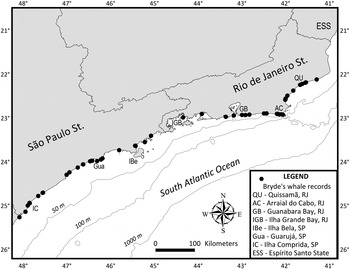
The region covered in this study comprises the States of Rio de Janeiro and São Paulo, located on the south-eastern coast of Brazil with approximately 1200 km of coastline (Figure 1).
Map of the study area including Rio de Janeiro and São Paulo States, south-eastern Brazil. The figure shows the locations of the strandings of Bryde's whales (Balaenoptera edeni).

The data of the present study are composed of published information, mainly from Siciliano et al. (Reference Siciliano, Santos, Vicente, Alvarenga, Zampirolli, Brito, Azevedo and Pizzorno2004) and Santos et al. (Reference Santos, Siciliano, Vicente, Alvarenga, Zampirolli, Souza and Maranho2010). Unpublished data were obtained from newspapers, TV news, provided by other researchers and personal observations through a monitoring programme established on the north coast of the study area. From 1999 to 2011 the marine mammal research group (GEMM-Lagos) regularly patrolled the coast of Rio de Janeiro State from São Francisco de Itabapoana (north: 21°25′10′′S 41°00′36′′W) to Saquarema (south: 22°55′12′′S 42°30′37′′W). During these surveys, awareness campaigns were implemented in the communities along the coast in order to promote a collaboration network and improve stranding reports.
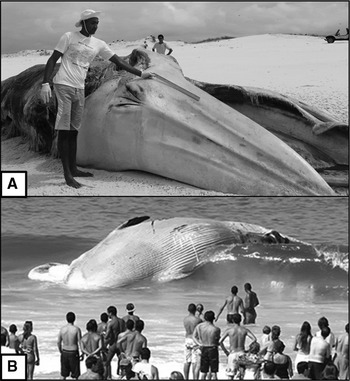
The unpublished data out of the monitoring system was only considered for this study if the available material (films and photographs) showed taxonomic characteristics of the species (e.g. the three prominent ridges on the dorsal surface of the head; the shape and height of the dorsal fin; the coloration pattern; the extension of the ventral grooves in relation to the navel, etc.) (Figure 2). On some occasions the material examined allowed us to obtain information of gender and total body length. The taxonomic identification of the carcasses recorded was based on the careful examination of morphological features, following commonly used scientific guides for identification of marine mammals (Jefferson et al., Reference Jefferson, Weber and Pitman2008; Kato & Perrin, Reference Kato, Perrin, Perrin, Würsig and Thewissen2009).
Showing images of two Bryde's whales (Balaenoptera edeni) stranded along the coast of Rio de Janeiro State. (A) Dorsal surface of the head of a Bryde's showing the three prominent ridges (photograph S. Siciliano; Arraial do Cabo, RJ, 11 October 2008); (B) ventral view of a dead whale in the surf zone showing the ventral grooves extending over the navel region, a characteristic to identify this species (photograph Marcelo Piu, http://www.abi.org.br/paginaindividual.asp?id=2189).

Stranding data were used as an additional tool to evaluate possible patterns related to the general distribution of the species. In this context, the location of each stranding event was converted into geographical coordinates in order to construct a spatial view of the distribution of the Bryde's whales using ESRI–ArcView 3.2® software. In these cases, the coordinates from the location of the records from the unpublished data (out of the monitoring programme) were obtained using the Google Earth® software.
The aim of the present study was to perform a compilation of the available information of strandings, thus the data collection has not been equally performed along the coastline of the study area. On the other hand we suppose that a stranding event rarely escapes notice from the media. Therefore we present the relationship of stranding events in the sampling area compared with 20 years of data collection. The year–stranding relationship was performed using simple linear regression (R2) at a P value less than 0.05.
To determine if there were seasonal trends of the strandings, the data were categorized into four seasons: January–March (summer); April–June (autumn); July–September (winter); and October–December (spring). A Chi-square test (χ 2) for equal proportions (at P < 0.05) was used to test differences in stranding frequencies between seasonal categories.
The whales were generally sexed when whale position allowed a view of the ventral region or when the carcasses were dissected. The total body length of the carcasses was measured from the tip of lower jaw to the caudal notch of the whales accessed. The whales were categorized into juvenile (≤8 m), sexually imature (>8; ≤11.22), and sexually mature (>11.22) (Jefferson et al., Reference Jefferson, Weber and Pitman2008). The Chi-square test was also used to verify some trends in the strandings for the body length categories.
Whenever possible, the stomach chambers were accessed to collect and identify food remains. The stomach contents analyses were only performed in two carcasses due to the difficulties in the field. The full stomach content of the two whales were recovered and carefully examined in order to identify all prey items, which were identified according to an illustrated key for the identification of Dendrobranchiata shrimps (Costa et al., Reference Costa, Fragozo, Melo and Freire2003).
RESULTS
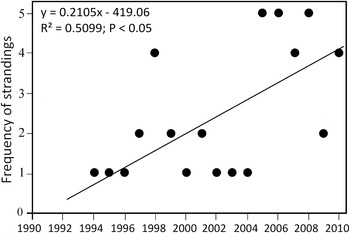
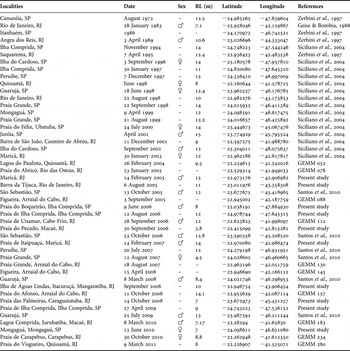
A total of 46 stranded Bryde's whales were recovered between 1972 and April 2010. A positive relationship was observed between the number of strandings in the period from 1991 to 2010 (R2 = 0.5099; P < 0.05) (Figure 3; Table 1). Although unevenly distributed over this 20 year period, there was a mean of two whales (standard deviation = 1.2).
Simple linear regression of the number of Bryde's whales (Balaenoptera edeni) stranded in the period from 1989 to 2008 (20 years) on the coasts of São Paulo and Rio de Janeiro States.

Data on the strandings of Bryde's (Balaenoptera edeni) whales along the coasts of São Paulo and Rio de Janeiro States, south-eastern Brazil. Coordinates in decimal degrees. BL, body length, ♂, female; ♀, male.

From the 46 records of B. edeni in the study area 20, representing 43% of the strandings, are new and unpublished information. The stranding events were distributed along the study area. However, the strandings seem to have concentrated on the south-eastern coast of Rio de Janeiro State, where there is a narrow shelf, and on the central coast of São Paulo State. No stranded whales were found on the extreme northern coast of Rio de Janeiro State and only one was found inside the Ilha Grande Bay (Figure 1).
No whale with signals of fishery interaction was reported in this study; however it is important to highlight that some whales could have stranded as a result of entanglement, but during field analyses it was not possible to detect, mainly due to the decomposition stage of the carcasses. The majority of the carcasses (> 75%) were classified as codes 3 and 4, according to the Geraci & Lounsbury (Reference Geraci and Lounsbury2005) protocol.
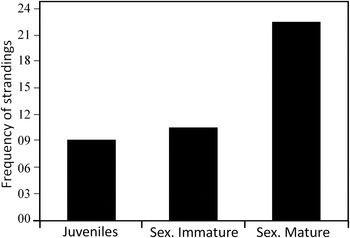
Data on body length were available for 41 specimens and these varied from 4 to 15 m. The data show that most of the whales that stranded were classified as sexually mature (52.4%) (χ 2 = 7.659; P < 0.05), although sexually immature (24.4%) and juvenile (21.9%) whales were also representative (Figure 4). Two whales with body length indicative of newborn were registered in the study area. One newborn recovered in northern Rio de Janeiro State presented a scar in the umbilical region indicating that it was recently born (3.8 m of body length). Another whale with 4.5 m of body length was found in São Paulo State. The newborns recorded in Rio de Janeiro and São Paulo States were found in September 2006 and August 2007, respectively.
Number of strandings of Bryde's whales (Balaenoptera edeni) in age categories along the south-eastern Brazil coast, between 1972 and 2011.

No statistical significance was observed in the frequency differences between males (N = 13) and females (N = 8) (χ 2 = 1.190; P > 0.05). However, 54.3% of the carcasses could not be sexed due to the decomposition stage, or animal position on the beach. In addition, the higher number of males when compared with females may be due to the fact that males are easier to identify, especially when the penis is exposed.
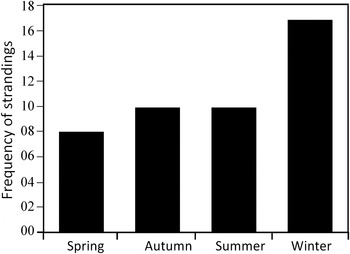
The observed differences in strandings between seasons were not statistically significant (χ 2 = 4.156; P > 0.05) (Figure 5). Although, most strandings occurred during winter (N = 17; 37.7%) with a great frequency in August (N = 7), followed by April and September (N = 06). Strandings in summer (N = 10), autumn (N = 10) and spring (N = 08) were almost equally distributed.
Number of strandings of Bryde's (Balaenoptera edeni) whales per season on the south-eastern Brazil coast, between 1991 and 2011.

The analyses of stomach contents were made in samples from two whales as already stated. Both whales presented a large amount of aviu shrimp (Acetes americanus) as the unique prey consumed. The degree of digestion of the shrimps consumed in both whales suggests these prey species were ingested few times before death.
DISCUSSION
The results show that Bryde's whales are common along the south-eastern coast of Brazil and seem to be present there throughout the year, as described in previous studies (Omura, Reference Omura1962; Zerbini et al., Reference Zerbini, Secchi, Siciliano and Simões-Lopes1997; Siciliano et al., Reference Siciliano, Santos, Vicente, Alvarenga, Zampirolli, Brito, Azevedo and Pizzorno2004). This species is commonly observed in Brazilian coastal waters mainly on the Rio de Janeiro and São Paulo coasts where the present study is focused (Gonçalves, Reference Gonçalves2006). However, the scarcity of records offshore is more related to the research effort in the oceanic region than the absence of the whales. As an example, Andriolo et al. (Reference Andriolo, Rocha, Zerbini, Simões-Lopes, Moreno, Lucena, Danilewicz and Bassoi2010) observed Bryde's whales in low density in offshore waters of north-eastern Brazil varying from 800 to 2900 m isobaths. The presence of whales in south-eastern Brazil may be related to the food availability of highly productive and upwelled waters, mainly on the eastern coast of Rio de Janeiro State. Bryde's whales tend to inhabit areas of unusually high productivity (Jefferson et al., Reference Valentin, Seeliger and Kjerfve2008).
Data on sightings and strandings seem to vary in relation to the seasons of the years. As an example Zerbini et al. (Reference Zerbini, Secchi, Siciliano and Simões-Lopes1997) in a review of the genus Balaenoptera recorded more sightings of Bryde's whales during summer along the Brazilian coast. Carneiro (Reference Carneiro2005) also found more Bryde's whales during summer and spring in the region around Arraial do Cabo, Rio de Janeiro State, through land based observation activities. Gonçalves (Reference Gonçalves2006) found similar results through boat surveys off São Paulo State. In contrast, our data, as well as the results presented by Zerbini et al. (Reference Zerbini, Secchi, Siciliano and Simões-Lopes1997) and Siciliano et al. (Reference Siciliano, Santos, Vicente, Alvarenga, Zampirolli, Brito, Azevedo and Pizzorno2004), indicate that there is no pattern of strandings among seasons, with a smooth tendency of stranding during winter. The environmental influences (e.g. wind direction and intensity and ocean currents behaviour) in the carcasses at sea may play an important role in increasing the encounter rate of whales ashore, mainly during winter when the prevalence of south-south-west winds may force the whale landward. Despite being not statistically significant, most whales stranded during winter in this present study. However we need to consider the actual poor taxonomic description of Bryde's whales in Brazilian waters and the identification of distinct populations. In South Africa, Best (Reference Best1977) identified two allopatric forms of Bryde's whales being recognized as inshore and offshore whales. The inshore form is restricted to coastal areas of less than 20 miles and is observed year round. In contrast, the offshore form inhabits water 50 miles over the coast, and performs a latitudinal migration to the equatorial region during winter. Zerbini et al. (Reference Zerbini, Secchi, Siciliano and Simões-Lopes1997) classified one stranded whale as being ‘offshore' based on the baleen measurements following the description by Best (Reference Best1977). According to Best (Reference Best1977), the baleen plate length/width ratio does not exceed 2.24 in offshore ecotypes and generally is more than 2.25 in inshore ecotypes. Additional observations on the presence and classification of offshore/inshore Bryde's whales along the Brazilian coast have not been evaluated. If we consider the presence of both inshore and offshore forms in our data and assume the life history differences for both forms (distribution, seasonality, body size, baleen shape, scarring, food type and possibly breeding behaviour) (Best, Reference Best2001) this study is subject to some degree of bias. During field examination no morphological differences were observed that should be attributed to the recognizable ecotypes of Bryde's whales (e.g. inshore/offshore and small/large forms) (Best, Reference Best2001; Kato & Perrin, Reference Kato, Perrin, Perrin, Würsig and Thewissen2009). Bryde's whales are commonly sighted in shore waters of the study area, mainly around the coast of Arraial do Cabo, which may indicate the presence of an inshore form. However, future studies on population genetics should be carried out to elucidate the taxonomic status of the Bryde's whales' complex in Brazilian waters (Sasaki et al., Reference Sasaki, Nikaido, Wada, Yamada, Cao, Hasegawa and Okada2006).
Sighting of Bryde's whales through land based observations carried out in Arraial do Cabo peninsula (Rio de Janeiro State) and in adjacent coastal waters shows that this whale is particularly common in the area in summer and spring (Carneiro, Reference Carneiro2005; Gonçalves, Reference Gonçalves2006). These sightings coincide with the strong seasonal upwelling which contributes with an ideal condition for a large whale such as Bryde's (Valentin, Reference Valentin, Seeliger and Kjerfve2001; Davis et al., Reference Davis, Ortega-Ortiza, Ribic, Evans, Biggs, Ressler, Cady, Lebend, Mullin and Würsig2002; Siciliano et al., Reference Siciliano, Santos, Vicente, Alvarenga, Zampirolli, Brito, Azevedo and Pizzorno2004).
Interestingly, two whales dissected presented the stomach chambers full of aviu shrimp, Acetes americanus. The aviu shrimp is distributed from pelagic zones to shallow waters on the Atlantic coasts of the Americas, from Cape Hatteras (USA) to Rio Grande do Sul (southern Brazil) (Oshiro & Omori, Reference Oshiro and Omori1996). This shrimp is commonly found on the Brazilian coast and seems to inhabit an important hole in the food web, preying upon a variety of organisms, such as diatoms and copepods, and being predated by several species of fishes and other invertebrates (Xiao & Greenwood, Reference Xiao and Greenwood1993).
Additionally to the other results, previous studies suggest that the whales feed on small fishes (mainly Sardinella brasiliensis) in coastal waters, generally showing interspecific feeding association with seabirds and large fishes (Siciliano et al., Reference Siciliano, Santos, Vicente, Alvarenga, Zampirolli, Brito, Azevedo and Pizzorno2004). Best (Reference Best2001) studied the feeding differences in preys consumed by offshore and inshore forms of Bryde's whales taken off South Africa. According to this author, the inshore form show a high preference for small pelagic fishes (genera Engraulis, Trachurus and Sardinops), while the offshore form prefer euphasiids (Euphausia lucens and E. recurva) and in low frequency mesopelagic fish (Maurolicus and Lestidium). If this difference is applicable in southern Brazil we should speculate that these two whales may belong to the offshore population. On the other hand, the coastal habits of A. americanus on the Brazilian coast also suggest that it may represent an important prey for coastal whales considering a non-potential latitudinal migrating species.
Our results show high frequency of sexually mature whales followed by juveniles, including two newborns stranded in different areas, but in close months (August and September). As additional information, two mother–calf pairs were sighted in November 2006 and December 2003 to January 2004 around Búzios Peninsula (22°44'S 41°48'W), Rio de Janeiro State during land based activities (J.F. Moura & S. Siciliano, personal observations). According to Best (Reference Best2001), there is no seasonal trend in reproduction of inshore Bryde's whales, while offshore reproduction occurs during autumn (March–May). However, Kato & Perrin (Reference Kato, Perrin, Perrin, Würsig and Thewissen2009) suggest that peaks for breeding and calving of the pelagic population are in winter. In the Azores most calves are observed in summer time and they are speculated to have been born during last winter period (Steiner et al., Reference Steiner, Silva, Zereba and Leal2008). No whales presented evidence of accidental or intentional capture in fishing apparatus or collision with ships, but we have to highlight that these threats are potentially present in the study area. Along the study area there are passive fishery activities which can promote negative impact to the whales, principally in coastal waters. In addition, the study area is responsible for more than 80% of the national oil and petroleum produced and the presence of important large harbours which are associated with the intensive movements of large ships that elevate the risk of whale collision. In conclusion, the present work confirms that Bryde's whales are common on the south-eastern Brazilian coast. The discrepancy in results from sightings and strandings (e.g. seasonal pattern) may be related to environmental conditions (e.g. wind direction and intensity and ocean currents) and possibly the presence of different forms (inshore and offshore). No whales showed signs of impact caused by human interactions, despite the potential threats in the study area. Future studies comparing morphology and genetics are suggested to be carried out to elucidate the taxonomic status of the Bryde's whale in Brazil. In addition, the collection and storage of biological samples are specially needed to better understand the stranding pattern of this whale.
ACKNOWLEDGEMENTS
The authors thank the researchers who contributed with records presented in this paper. Thanks go to the research team of GEMM–Lagos. We also thank the fishermen and lifeguards from the region, especially in Rio de Janeiro State who always helped us during fieldwork. J.F. Moura is supported by Fundacão Oswaldo Cruz (FIOCRUZ) and is a PhD student of the Escola Nacional de Saúde Pública Sérgio Arouca (ENSP–FIOCRUZ). S. Siciliano is supported by Conselho Nacional de Desenvolvimento Científico e Tecnológico (CNPq) (Processo no. 301544/2008-5). Finally, we thank the many scientists who contributed important data to our study.