Introduction
Identifying factors that may positively influence successful aging (SA) is of great interest both for individuals and the society, as the proportion of the world's population over 60 years is expected to almost double between 2015 and 2050 (World Health Organization, 2015). One of the most influential models of SA was proposed by Rowe and Kahn (Reference Rowe and Kahn1987). They drew a distinction between “usual aging,” i.e. aging with some decline and risk of disease and disability, and “successful aging” as aging with minimal or no physiological loss (Rowe and Kahn, Reference Rowe and Kahn1987). They later refined their model and described SA as consisting of three components: (i) absence of disease and disability, (ii) high cognitive and physical function, and (iii) active engagement with life (Rowe and Kahn, Reference Rowe and Kahn1998). The Rowe and Kahn model implies a partial hierarchical organization, with absence of disease and disability making it easier to maintain cognitive and physical function, which in turn enables engagement with life. The model is in line with the definition of health from the World Health Organization as “a state of complete physical, mental, and social well-being, and not merely the absence of disease or infirmity” (World Health Organization, 1948, p. 100). However, Rowe and Kahn did not operationalize their concept of SA in detail (Rowe and Kahn, Reference Rowe and Kahn1987,Reference Rowe and Kahn1997, Reference Rowe and Kahn1998). The model has been subject to criticism due to its biomedical focus, without explicit input of layperson perspectives (Phelan and Larson, Reference Phelan and Larson2002), and the fact that old age free of disease is unrealistic for most older persons (Bowling and Dieppe, Reference Bowling and Dieppe2005). Another critique has been that the focus on individual responsibility for health may overshadow the importance of structural factors for health, like adequate income, healthy neighborhoods, and other factors (Holstein and Minkler, Reference Holstein and Minkler2003). Other definitions or views of SA have been proposed, with more emphasis on adaption to the current life and health situation (Baltes and Baltes, Reference Baltes and Baltes1990), a stress-theory-based model of preventive and corrective proactivity (Kahana and Kahana, Reference Kahana, Kahana and Bengtson1996) and self-perceived SA (von Faber et al., Reference von Faber2001; Phelan et al., Reference Phelan, Anderson, LaCroix and Larson2004). However, although controversial, the Rowe and Kahn model has inspired much research and is the most widely used approach in the field of SA (Bowling and Dieppe, Reference Bowling and Dieppe2005). The model also gives a broad range of information of the health status among old adults on diverse areas (McLaughlin et al., Reference McLaughlin, Connell, Heeringa, Li and Roberts2010).
The lack of a standard definition of SA makes studies hard to compare, and affects prevalence estimates. In an extensive review (Cosco et al., Reference Cosco, Prina, Perales, Stephan and Brayne2014), the prevalence ranged from 0.4% in one study (Garfein and Herzog, Reference Garfein and Herzog1995) to 92% in another (Montross et al., Reference Montross2006). Larger population-based studies with a multidimensional concept of SA in line with Rowe and Kahn's definition based in various European countries, the United States, and Canada showed a prevalence of SA among adults aged 65 years and older that ranged from 8.5% to 37.2% (McLaughlin et al., Reference McLaughlin, Connell, Heeringa, Li and Roberts2010; Hank, Reference Hank2011; Meng and D'Arcy, Reference Meng and D'Arcy2014). A cross-national variation in SA was observed in the European sample, with the highest levels of SA in the included Scandinavian countries (Hank, Reference Hank2011). In the three studies from Europe, the United States, and Canada, absence of disease was defined as only those diseases which are “major causes of death among older adults” or “major diseases” (cancer, chronic lung disease, diabetes, heart disease and stroke, and depression). Another Canadian study using a wider range of chronic illnesses found a SA prevalence of 11% (Baker et al., Reference Baker, Meisner, Logan, Kungl and Weir2009).
Although there are a number of studies on the prevalence of SA as a multidimensional construct and correlates of the concept, there are few detailed analyses of how Rowe and Kahn's three components affect SA status across the age span. A Canadian study pointed to impaired cognitive and physical function as the variable primarily responsible for the lower rates of SA after the age of 80 (Weir et al., Reference Weir, Meisner and Baker2010). This indicates that the relative importance of the SA components may vary across old age.
In one review, SA was related to younger age, not smoking, absence of disability, arthritis and diabetes, better self-rated health, absence of depression and cognitive impairment, fewer medical conditions, and more physical activity and social networks. Few relationships to SA were found for demographic factors (Depp and Jeste, Reference Depp and Jeste2006). Studies using a multidimensional concept of SA have suggested that younger age (Li et al., Reference Li2006; McLaughlin et al., Reference McLaughlin, Connell, Heeringa, Li and Roberts2010; Hank, Reference Hank2011; Hamid et al., Reference Hamid, Momtaz and Ibrahim2012; Meng and D'Arcy, Reference Meng and D'Arcy2014), a higher level of education (Ng et al., Reference Ng, Broekman, Niti, Gwee and Kua2009; Hamid et al., Reference Hamid, Momtaz and Ibrahim2012), marriage (Li et al., Reference Li2006; Meng and D'Arcy, Reference Meng and D'Arcy2014), greater satisfaction with life (Li et al., Reference Li2006; Meng and D'Arcy, Reference Meng and D'Arcy2014), higher socioeconomic status (McLaughlin et al., Reference McLaughlin, Connell, Heeringa, Li and Roberts2010; Hank, Reference Hank2011), and higher income (Hamid et al., Reference Hamid, Momtaz and Ibrahim2012) are related to SA. Regarding gender differences, the results are inconclusive, as both male gender (Hank, Reference Hank2011) and female gender (Chou and Chi, Reference Chou and Chi2002; Ng et al., Reference Ng, Broekman, Niti, Gwee and Kua2009; McLaughlin et al., Reference McLaughlin, Connell, Heeringa, Li and Roberts2010) have been found to be associated with SA. Based on previous research, it is hypothesized that the prevalence of SA, the relative importance of components of SA, and the correlates of SA will change with increasing age. The aims of this study were to investigate (i) the prevalence of SA in a Norwegian cohort, (ii) the relative importance of Rowe and Kahn's three components across age, and (iii) the correlates of SA in a large representative sample of older adults. This study contributes particularly to the relative importance of the components.
Methods
The data were obtained from respondents aged 70–89 years who had participated in the cross-sectional HUNT3 Survey conducted in 2006–2008. HUNT is a large population-based longitudinal health survey, which has been conducted three times over 20 years in Nord-Trøndelag County, Norway. Nord-Trøndelag County is characterized by a stable, homogeneous population that constitutes 3% of the Norwegian population. All inhabitants of Nord-Trøndelag County aged 20 years or older (93,860 persons) were invited to HUNT3. A total of 50,807 participated (54.1%). The response rates were 66.8% of those aged 70–79 years and 41.6% of those aged 80–89 years. Details of the HUNT3 Survey have been reported previously (Krokstad et al., Reference Krokstad2013).
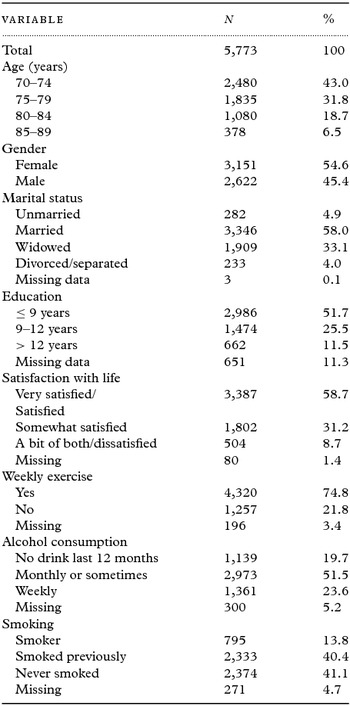
Only respondents who had complete data for the three components of SA were included in this study (n = 5773 of 8,040, 71.8%). Of the respondents included, 3,151 were women and 2,622 were men, with a mean age of 76.7 ± 4.7, see Table 1. The proportion of women increased with higher age. Ineligible respondents were more likely to be of higher age (p < 0.001) and to be unmarried (26.4% of the married, 30.0% of the unmarried or divorced, and 30.7% of the widowed were not included) (p < 0.001). Ineligible respondents were also more likely to have less or equal to nine years of education (29.8% compared to 23.5% for those with 9–12 years, and 19.3% for those with more than 12 years, p < 0.001). Ineligible respondents were as healthy as the selected respondents for nine of the ten conditions/diseases included in the component absence of disease, but were more likely to have a Hospital Anxiety and Depression Scale (HADS-D) score ≥8 (p = 0.002).
Characteristics of the eligible population

Dependent variables
In this study, self-reported health information from HUNT questionnaires 1 and 2 were used to match the Rowe and Kahn definition of SA (i) absence of disease and disability, (ii) high cognitive and physical function, and (iii) active engagement with life, as well as other studies of SA referring to the Rowe and Kahn model (Rowe and Kahn, Reference Rowe and Kahn1998; McLaughlin et al., Reference McLaughlin, Connell, Heeringa, Li and Roberts2010; Weir et al., Reference Weir, Meisner and Baker2010; Hank, Reference Hank2011). To satisfy Rowe and Kahn's criteria of SA, all three criteria had to be met.
Absence of disease
The first component was assessed as no self-reported history or presence of any of the following nine different diseases: myocardial infarction, angina pectoris, heart failure, other heart disease, stroke or brain hemorrhage, chronic bronchitis, emphysema or COPD, diabetes, or cancer. Individuals reporting any of these conditions were classified as having disease. All questions had to be answered with no for a person to be classified with absence of disease. In addition, absence of depression as defined by the depression subscale of the HADS-D was included. Absence of depression was defined as HADS-D less than eight (Stordal et al., Reference Stordal, Bjartveit Krüger, Dahl, Krüger, Mykletun and Dahl2001; Bjelland et al., Reference Bjelland, Dahl, Haug and Neckelmann2002). A valid rating of HADS-D was defined as five or more completed items on HADS-D. For respondents who had answered five or six items, the completed sum was multiplied with 7/5 or 7/6. This procedure has been used in previous HUNT studies (Solhaug et al., Reference Solhaug, Romuld, Romild and Stordal2012).
High cognitive and physical function
Physical capacity was measured in terms of physical activities of daily living (PADLs) and instrumental activities of daily living (IADLs). High functioning in terms of PADL was defined as being able to carry out the following activities independently: walk around indoors on the same floor, going to the toilet, washing, showering, dressing, eating, and get to bed and get up. IADLs were measured as ability to independently prepare warm meals, carry out light house work such as washing the dishes, heavy house work such as washing the floor, wash clothes, pay bills, do the shopping, take the bus, and take medication and go out. Respondents reporting to be unable to perform any of these 16 activities independently were recorded as having impaired physical function. An item measuring cognitive function was also added. Respondents who reported never having trouble remembering what happened some days ago were classified as having high cognitive function. If reporting having trouble “sometimes” or “often” remembering what happened some days ago, the respondents were classified as having impaired cognitive function. All questions regarding PADL, IADL, and memory had to be answered for a person to be included in the study.
Active engagement with life
Rowe and Kahn describe active engagement as both being related to others and being productive in society by doing paid or unpaid work (Rowe and Kahn, Reference Rowe and Kahn1998). Respondents were classified as being actively engaged in life if they reported (i) being currently in paid or unpaid work or (ii) having gone to a museum/art exhibition, a concert/theatre, film, church/chapel, or a sports event, or having participated in community service, a choir or theater, or church work at least once a month over the last six months. Respondents were included if they had answered positively to at least one of the questions of interest. All questions had to be answered negatively to be classified as non-active.
The relative importance of components was evaluated as the frequency of participants able to satisfy the criteria of the three components and as change in frequency across age.
Independent variables
Socio-demographic variables used in the analysis included age, gender, marital status, and education. Data on education were obtained from HUNT2, and were consequently collected 11 years before other measures. As the respondents were 70 years and older in HUNT3, it is likely that the data on education were reliable. Education was split into three levels, see Table 1. Other variables included were overall satisfaction with life, while health-related behavior included smoking, alcohol consumption, and exercise. Overall satisfaction with life was measured by the following item: “Thinking about your life at the moment, would you say that you by and large are satisfied with life, or are you mostly dissatisfied?” The original seven-leveled scale was transformed to a three-leveled scale (1 = very satisfied and satisfied, 2 = somewhat satisfied, and 3 = a bit of both to very dissatisfied). Health-related behavior measured included smoking (current smoking vs. ex-smoking and non-smoking), alcohol consumption (weekly consumption, monthly or sometimes, and no drink in the last 12 months), and exercise as going for walks, skiing, swimming, and working out/sports. The original five-leveled scale was transformed to exercising at least once a week or less.
Statistical analysis
The prevalence of SA and the relative importance of the three components were calculated for the total sample and according to age. Univariate and multivariate logistic regression analyses were performed to examine potential factors associated with SA. SPSS version 23.0 was used for the analyses.
Results
Prevalence of successful aging
The overall prevalence of SA was 14.5%, decreasing from 18.3% in the youngest cohort (70–74 years) to 8.2% in the oldest cohort (85–89 years; see Table 2). Across all ages, 44.9% satisfied the criteria for absence of disease, 41.3% met the criteria for high cognitive and physical function, and 61.2% reported being actively engaged in life. For all three components, the number of respondents satisfying the criteria decreased with advancing age, with the exception of active engagement with life, for which there was a small increase in the percentage in the group aged 80–84 years, in contrast to that aged 75–79 years.
Prevalence of successful aging (SA) in four age groups as a percentage

Note: aSignificant difference (p < 0.05) compared to age group 1.
b Significant difference (p < 0.05) compared to age group 2.
c Significant difference (p < 0.05) compared to age group 3.
d Significant difference (p < 0.05) compared to age group 4.
The relative importance of the three components across age
In Table 2, the pattern of prevalence across age groups and components is presented. The component most difficult to satisfy was high cognitive and physical function (41.3%), closely followed by absence of disease (44.9%). The relative change with increasing age was also greatest for high cognitive and physical function (47.5 % in the youngest cohort to 24.9% in the oldest). Active engagement with life changed least, from 64.0% in the youngest group to 56.9% in the oldest. The prevalence of the most telling component (SAII) decreased significantly across all age groups (all ps < 0.05 or less), whereas the least telling component (SAIII) deceased relatively little across age.
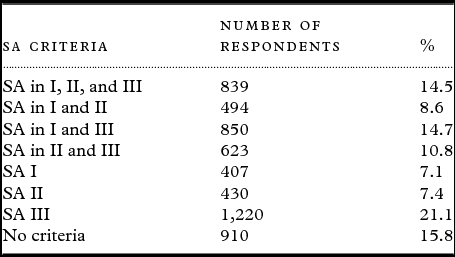
Table 3 shows the number of individuals classified as successful agers using different criteria and combinations of criteria. Across all age groups, 35.6% met the criteria for one of the three SA components (most commonly component III), whereas 34.1% met some combination of criteria (most commonly I and III). Only 15.8% did not meet any criteria.
Prevalence of the sample satisfying the three components of successful aging

Inter-relationships among the three components of successful aging
The correlation coefficients according to Kendall's tau between components I and II (absence of disease and high cognitive and physical function) and I and III (absence of disease and active engagement) yielded low positive correlations (r = 0.19, p < 0.001; r = 0.08, p < 0.001), whereas the correlation between components II and III was insignificant (r = 0.002, p = 0.90).
Correlates of successful aging
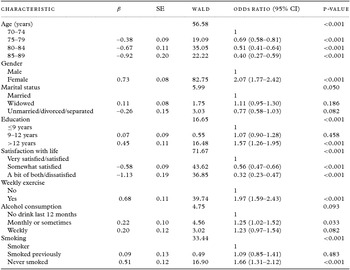
Variables regarded as likely to be related to SA, as suggested by previous research, were included in a univariate logistic regression model, see Table 4. Younger age, female gender, marital status, higher education, exercising every week, more satisfaction with life, and non-smoking were related to SA. Alcohol consumption was not significantly related to SA.
Variables predicting successful aging (univariate logistic regression analysis)

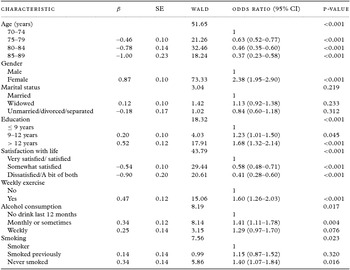
The variables with a p-value < 0.20 in the univariate analysis were included in a multivariate logistic regression model, see Table 5. The model, containing all predictors, was statistically significant, χ 2 (15, N = 4597) = 268.27, p < 0.001. The model accounted for between 5.7% (Cox & Snell R2) and 9.9 % (Nagelkerke R2) of the total variance. As shown in Table 5, seven of the eight variables made a statistically significant contribution to the model, whereas marital status was non-significant. The odds of being a successful ager were reduced with advancing age. The odds of being a successful ager were higher for women compared to men (odd ratio (OR) = 2.38), for weekly exercisers (OR = 1.60), for the higher educated groups (OR = 1.23 and OR = 1.68 times higher for 9–12 years and more than 12 years of education, respectively), and for the respondents most satisfied with life compared to the somewhat satisfied or a bit of both/dissatisfied group. Respondents who had never smoked were more likely to be SA than smokers (OR = 1.40), while the results for smokers versus ex-smokers were not reliably different. In addition, consuming alcohol monthly or sometimes was significantly related to SA compared to no consumption in the last 12 months (OR = 1.41), while there was no reliable difference between weekly alcohol consumption and no consumption last 12 months.
Variables predicting successful aging (multivariate binary logistic regression) (N = 4597)

Discussion
This study investigated the prevalence and the relative importance of the three components of SA as defined by Rowe and Kahn, and important demographic and health-related factors associated with SA in a large population-based Norwegian sample.
Prevalence of SA
The prevalence of SA was 14.5% in the total sample of participants aged 70–89 years. The proportion of the sample that was classified as successfully aging decreased with advancing age for two of the three components (absence of disease and high cognitive and physical function). In contrast, the component active engagement with life showed an unexpected minor increase between the ages of 75–79 and 80–84 years. The prevalence of the three components varied from highest 61.2% for active engagement to lowest 41.3% for high functioning.
A substantial proportion of the elderly participants satisfied only one criterion (35.6%) or two criteria (34.1%). Compared to a previous study by Chou and Chi (Reference Chou and Chi2002), 33.1% satisfied one criterion while two criteria were satisfied by 24.7%. However, results were different for the percentage of SA (0.7%) and no criteria (33.5%). To speculate, these differences may be due to four included criteria of SA, low education in the sample, and a more demanding cognitive criterion.
The prevalence of SA varies widely across previous studies, along a variation in how SA are defined and measured. Two recent studies with a multidimensional approach in line with Rowe and Kahn classified 11.9% of participants as aging successfully in the United States (McLaughlin et al., Reference McLaughlin, Connell, Heeringa, Li and Roberts2010), and a mean of 8.5% aging successfully across diverse European countries, but with substantial cross-national variation (Hank, Reference Hank2011). The prevalence in the present study is higher than some European countries, while in accordance with the prevalence of SA in the other Scandinavian countries (Hank, Reference Hank2011). Although the prevalence of SA also varies somewhat between studies even with a similar definition of SA, it is clear that with a multidimensional concept such as outlined by Rowe and Kahn, only a small proportion of elderly can satisfy all criteria. This may limit the usefulness of the concept for public health purposes and a less rigid definition of SA can be needed (McLaughlin et al., Reference McLaughlin, Connell, Heeringa, Li and Roberts2010). Nevertheless, the Rowe and Kahn definition catches different and important aspects of aging.
The Rowe and Kahn model has, however, been criticized for placing too much responsibility on individual choices on the expense of structural factors beyond the individual's control (Holstein and Minkler, Reference Holstein and Minkler2003). In Hank's study (2010), the prevalence of SA varied across the European countries included. Sweden and Denmark for example, had the highest percentages of successful agers, with 17.4% and 21.1% compared to 1.6% in Poland (Hank, Reference Hank2011). Hank suggested that the differences between European countries in the prevalence of SA offer some support to a hypothesis that in more egalitarian societies greater proportions of elders manage to age successfully (Hank, Reference Hank2011). In our Norwegian sample, 14.5% met the SA criteria. Norway, Sweden, and Denmark are egalitarian countries with many similarities in welfare state policies. Our prevalence estimate is in accordance with the findings in Hank's study (Hank, Reference Hank2011), underlining the possible importance of the availability of preventive health practices for improving the possibility of SA and the possible importance of structural factors out of the individual's control for SA.
The relative importance of the three components of SA across age
Rowe and Kahn proposed that SA is comprised of three components where absence of disease and disability make it easier to maintain cognitive and physical function, which in turn enables active engagement with life (Rowe and Kahn, Reference Rowe and Kahn1998). The implication of this model is that the components are to some extent overlapping. However, the relative importance of components across age has not been extensively investigated in previous studies. In the present study, the three components had weak, and in one case, no correlation to each other. Low correlations between the SA dimensions have been previously reported (Chou and Chi, Reference Chou and Chi2002; Hank, Reference Hank2011). The different criteria of the multidimensional SA concept therefore seem valid for measuring distinct aspects of aging, thus supporting a multidimensional view of SA. In the present study, the importance of cognitive and physical function increased with increasing age, whereas active engagement with life was relatively stable over the age range investigated. Increasing importance of cognitive and physical function with high age (80+) has also been reported in previous research (Weir et al., Reference Weir, Meisner and Baker2010). In our study, a large proportion of the sample was also regarded as actively engaged with life across all age groups, even though they were not necessarily successful in the other areas, also previously reported (Weir et al., Reference Weir, Meisner and Baker2010). Indeed, it seems possible to be actively engaged with life, regardless of disease and reduced functional ability. The high level of active engagement across age is positive, as disease and some functional reduction may be difficult to avoid for many older adults. One explanation may be that many elderly are able to compensate for health losses with external help (Baltes and Baltes, Reference Baltes and Baltes1990), possibly through the help of family members or others. The level of engagement can also be influenced by structural factors like day care services, the availability of cultural activities, etc. This indicates that interventions may be possible not only in the young elderly, but also in the oldest of the old.
Correlates of SA
The third purpose was to identify significant factors associated with SA. In agreement with previous studies (McLaughlin et al., Reference McLaughlin, Connell, Heeringa, Li and Roberts2010; Hamid et al., Reference Hamid, Momtaz and Ibrahim2012; Meng and D'Arcy, Reference Meng and D'Arcy2014), age was negatively associated with SA in this study. The role of gender in SA appears inconclusive. In our study, a greater proportion of women met the SA criteria, a finding also reported in previous studies (Strawbridge et al., Reference Strawbridge, Wallhagen and Cohen2002; McLaughlin et al., Reference McLaughlin, Connell, Heeringa, Li and Roberts2010), although other studies have found that male gender is related to SA (Li et al., Reference Li2006; Hank, Reference Hank2011), and still others have found no gender differences in SA (Meng and D'Arcy, Reference Meng and D'Arcy2014). This may be related to several factors. It may be due to differences between the samples, but can also be due to the operationalization of SA. The component absence of disease was operationalized as only major causes of death like cancer and heart disease. It was noted by McLaughlin et al. (Reference McLaughlin, Connell, Heeringa, Li and Roberts2010) that as heart disease is more frequent among men than women, more women could satisfy the criteria. On the other hand, a common condition among women like arthritis was not included in the definition. We observed a similar trend in our data. Marital status was not clearly related to SA in this study, in line with the general finding from the review by Depp and Jeste (Reference Depp and Jeste2006). Other studies have found a relationship, so the role of marital status seems unclear (Li et al., Reference Li2006; Meng and D'Arcy, Reference Meng and D'Arcy2014). Higher levels of education were related to SA, possibly through cognitive reserve (Stern, Reference Stern2009). More satisfaction with life was also related to SA, as has been reported in previous studies (Li et al., Reference Li2006; Meng and D'Arcy, Reference Meng and D'Arcy2014). Exercise was clearly related to SA. Findings regarding the relationship between exercise and a multidimensional concept of SA have also been reported in other studies (Baker et al., Reference Baker, Meisner, Logan, Kungl and Weir2009), supporting the focus on exercise in preventive health practices. Respondents who had never smoked were also more likely to be SA compared to current smokers, a finding in accordance with previous studies (Depp and Jeste, Reference Depp and Jeste2006). Less than weekly consumption of alcohol was also positively related to SA, compared to no consumption last year and weekly consumption. This finding corresponds to previous reports of a “J- shaped” curve between alcohol consumption and risk of mortality (Gmel et al., Reference Gmel, Gutjahr and Rehm2003). As the group of non-consumers in this study may be comprised of both ex-drinkers and lifetime abstainers, caution should be taken in making generalizations from the data.
Strengths and limitations
The major strengths of this study are that it used a large population-based sample (N = 5773) that included a relatively large proportion of the oldest of the old (80+ years, 25.2%). The total population of a county was invited to participate, and a relative large proportion participated compared to other epidemiological studies (Galea and Tracy, Reference Galea and Tracy2007). A broad range of health-related variables were also investigated across four different age cohorts. Another strength compared to other studies is that the three components of SA were studied as well as the relative importance of these three components.
Some possible limitation should be noted. First, as in much epidemiological research, the data in this study were self-reported, with the consequence that the reliability and validity of the information may vary.
Second, although a relatively large proportion of the oldest old (80+ years, 25.2%) participated in the study, in the HUNT Study in general, a smaller proportion of individuals aged ≥80 than <80 years participated (Langhammer et al., Reference Langhammer, Krokstad, Romundstad, Heggland and Holmen2012). This may to some degree affect SA prevalence estimates in the 80–84 and 85–89 year cohorts, as the higher proportion of non-attendance may be related to worse health status. This may have resulted in overestimation of SA in the very elderly. Third, some individuals with dementia, diagnosed either in nursing homes (N = 141) or in hospital (N = 99), have participated in the HUNT3 Survey (Bergh et al., Reference Bergh2014). The impact for the data's validity and reliability has not been estimated, but their responses might to a certain degree obscure some of the results. However, it seems unlikely that individuals with dementia would be included in the SA group, because of the multidimensional SA construct used. Fourth, the choice of SA criteria affects not only prevalence estimates, but also related factors. The high level of engagement in this study may be related to a less strict measure of active engagement compared to the criteria of absence of disease and high cognitive and physical function. For instance, the criterion we used to measure productive activity consisted of two items (unpaid or paid work and formal volunteerism), and the criterion for social relationships was measured in terms of attendance at diverse activities such as church, theater, cinema, and so on. Other activities that could be regarded as productive (like caring for or assisting a family member or neighbor) were not captured. Social relationships could possibly also have been measured in terms of the numbers of close relationships, friendships, and so on. More precise estimates of active social engagement as defined by Rowe and Kahn could be obtained with better measures of social relationships and productive activities.
Conclusions
In spite of limitations, this cross-sectional study has shown that the proportion of elderly participants meeting the criteria for high cognitive and physical function decreased substantially with advancing age, that a large proportion of even the oldest old were still actively engaged with life, and that few elderly participants, even in the youngest age cohort (70–74 years), met the Rowe and Kahn criteria for SA, largely because of the occurrence of functional disability and chronic diseases. Furthermore, the study has shown that SA was related to three demographic factors (younger age, female gender, and higher levels of education), and three modifiable factors (weekly exercise, non-smoking, and greater satisfaction with life). This could indicate that it may be possible to increase the prevalence of SA by interventions directed toward more exercise, non-smoking, and better satisfaction with life.
Conflicts of interest
None.
Description of authors’ roles
Ingunn Bosnes, Ove Almkvist, Ole Bosnes, Eystein Stordal, and Hans M. Nordahl designed the study. Ingunn Bosnes undertook the literature searches, participated in the statistical analysis, and had main responsibility for the paper. Ove Almkvist, Ole Bosnes, Eystein Stordal, and Hans M. Nordahl assisted with writing the paper. Ulla Romild was responsible for the statistical design of the study and for carrying out the statistical analysis. All authors have contributed to the final draft of the paper.
Acknowledgments
The Nord-Trøndelag Health Study (HUNT Study) is a collaboration between the HUNT Research Centre (Faculty of Medicine, Norwegian University of Science and Technology, NTNU), the Nord-Trøndelag County Council, and the Norwegian Institute of Public Health. Ingunn Bosnes has received funding from the Nord-Trøndelag Hospital Trust and the Liaison Committee between the Central Norway Regional Health Authority (RHA) and the Norwegian University of Science and Technology (NTNU).