Tom Dishion's pioneering research definitively established the role of association with deviant peers in adolescence in increasing delinquent and substance abusing behavior (Dishion & Andrews, Reference Dishion and Andrews1995; Dishion, Nelson, Winter, & Bullock, Reference Dishion, Nelson, Winter and Bullock2004; Dishion & Owen, Reference Dishion and Owen2002). Furthermore, this research has gone even farther to identify specific deviancy-training processes that underly this effect (Dishion, Spracklen, Andrews, & Patterson, Reference Dishion, Spracklen, Andrews and Patterson1996). The current study examined the hypothesis that the effects of associating with deviant friends in adolescence are even broader and longer lasting than first recognized. In addition to the impact of associations with deviant friends on delinquent behavior, these deviant peer associations are now hypothesized to affect a core developmental task—establishing positive relationships with peers during adolescence—as well as a number of key psychosocial outcomes extending well into adulthood.
Although the role of adolescent peer relationships as a potential socializer of delinquent behavior has long been recognized, more recently it has become clear that peer relationships also play a critical prosocial role in preparing adolescents to manage key social tasks and social relationships in adulthood (Allen, Narr, Kansky, & Szwedo, Reference Allen, Narr, Kansky and Szwedo2019; Roisman, Masten, Coatsworth, & Tellegen, Reference Roisman, Masten, Coatsworth and Tellegen2004). Adolescent peer relationships, particularly close friendships, provide a key training ground for future social relationships. These friendships provide feedback regarding important social behaviors, offer important social information, and give youths experience handling challenges ranging from establishing intimacy to managing conflict (Brown, Reference Brown, Steinberg and Lerner2004; Hartup, Reference Hartup1979). As adolescents transition into adulthood, close peer relationships also begin to take on significant attachment functions, providing critical emotional and instrumental support (Rosenthal & Kobak, Reference Rosenthal and Kobak2010; Zeifman & Hazan, Reference Zeifman, Hazan, Cassidy and Shaver2008). Competence in interactions with peers in adulthood, in turn, is central to success in functioning across romantic, career, and social contexts (DiTommaso, Brannen-McNulty, Ross, & Burgess, Reference DiTommaso, Brannen-McNulty, Ross and Burgess2003; Larson, Whitton, Hauser, & Allen, Reference Larson, Whitton, Hauser and Allen2007). It is not surprising, then, that qualities of adolescent close friendships have been found to predict both qualities of future romantic relationships and career competence in adulthood (Allen et al., Reference Allen, Narr, Kansky and Szwedo2019; Raby, Roisman, Fraley, & Simpson, Reference Raby, Roisman, Fraley and Simpson2015). Yet, as the extensive literature on the potential negative effects of peer relationships makes clear, much depends on the nature of the specific components of adolescent relationships being assessed.
Given the central role of peer relationships as primary socializing forces in adolescence, there is reason to expect that the effects of association with deviant peers may be problematic not only in terms of well-documented deviancy-training effects (Dishion, Andrews, & Crosby, Reference Dishion, Andrews and Crosby1995; Dishion & Owen, Reference Dishion and Owen2002; Patterson, Dishion, & Yoerger, Reference Patterson, Dishion and Yoerger2000; Van Ryzin & Dishion, Reference Van Ryzin and Dishion2013) but also with regard to broader patterns of socialization. In addition to encouraging deviant behavior, deviant peers also behave badly in the ways they interact with others. For example, careful observation by Dishion of friendship patterns involving deviant peers has found that these friendships are typically characterized by mutually coercive behaviors, insults, and continual struggles for dominance (Dishion et al., Reference Dishion, Nelson, Winter and Bullock2004). Similarly, others have found that deviance is linked to both alienation and victimization in the peer arena (Rudolph et al., Reference Rudolph, Lansford, Agoston, Sugimura, Schwartz, Dodge and Bates2014).
Prior exposure to coercive processes may partly drive adolescents’ decisions to associate with such peers. A well-established body of research, pioneered to a significant degree by Dishion's early work (Dishion, Duncan, Eddy, Fagot, & Fetrow, Reference Dishion, Duncan, Eddy, Fagot and Fetrow1994) indicates that disturbed and coercive parenting behaviors tend to lead to similar behaviors in young offspring (Dykas & Cassidy, Reference Dykas and Cassidy2011; Patterson, Reference Patterson1982; Simons, Whitbeck, Conger, & Chyi-In, Reference Simons, Whitbeck, Conger and Chyi-In1991). Adolescents’ exposure to and learned use of coercive behaviors within the family could then lead them both to expect and to tolerate such behavior on the part of peers, and to seek out peers who would in turn tolerate the adolescents’ own learned coercive behavior. According to this logic, the expectation and presence of coercive behaviors within relationships then partly drives association with deviant peers, and this process would appear likely to exist in addition to the well-recognized effect of teens’ own deviance leading to selection of deviant peers as associates (Dishion, Patterson, Stoolmiller, & Skinner, Reference Dishion, Patterson, Stoolmiller and Skinner1991; Patterson, DeBaryshe, & Ramsey, Reference Patterson, DeBaryshe and Ramsey1989). Although this coercive family process pathway to association with deviant peers has not been examined in adolescence, a somewhat similar process has been observed with aggressive behavior in preschool-aged children (Snyder, Horsch, & Childs, Reference Snyder, Horsch and Childs1997; Snyder, West, Stockemer, Gibbons, & Almquist-Parks, Reference Snyder, West, Stockemer, Gibbons and Almquist-Parks1996).
Given the disturbed interaction patterns that accompany friendships with deviant peers, these friendships might be expected to influence broader patterns of social development and functioning across a number of different points from adolescence into adulthood. Early in adolescence, extended engagement in patterns of coercion, chaos, and lack of empathy in deviant friendships would appear likely to lead to declining preference by other peers who would be expected to have little tolerance for such behaviors. Over time, as peer relationships begin to take on attachment-like functions (Furman, Reference Furman2001; Roisman, Masten, et al., Reference Roisman, Masten, Coatsworth and Tellegen2004), exposure to deviant peers and the accompanying disturbed patterns of interaction would seem likely to predict a general decline in adolescents’ ability to rely upon peers for support, as these peers are likely to be ill equipped to provide strong support.
Beyond adolescence, a good deal of evidence suggests that prior difficulties in social relationships are likely to have significant deleterious effects with respect to both internalizing and externalizing symptoms, as well as broader patterns of adjustment (Allen et al., Reference Allen, Narr, Kansky and Szwedo2019; Raby, et al., Reference Raby, Roisman, Fraley and Simpson2015). Research within adolescence has begun to link problematic peer interactions—of the type we might expect association with deviant peers to foment—to outcomes ranging from internalizing and externalizing symptoms to problematic career and romantic relationship functioning (Raby et al., Reference Raby, Roisman, Fraley and Simpson2015; Roisman, Aguilar, & Egeland, Reference Roisman, Aguilar and Egeland2004). With the exception of one study assessing links from deviant peer associations to externalizing behavior of youth in their early 20s (Shortt, Capaldi, Dishion, Bank, & Owen, Reference Shortt, Capaldi, Dishion, Bank and Owen2003), however, no work has yet examined the broader or longer term outcomes of association with deviant peers during adolescence.
Given that homophily exists in peer selection (i.e., teens and their peers tend to be similar in levels of deviance), so as to avoid the potential confounds this homophily creates, this study examined the extent to which a teen's closest friend engaged in deviant behavior over and above the extent to which such deviance would be predictable from the target teen's own level of deviance. This approach allows assessment of links of deviant peer associations to functional outcomes in ways that are fully independent of links to the teen's own deviant behavior. This study then used a multimethod approach in a diverse, community sample of adolescents and their peers, assessed repeatedly from age 13 through age 27, to address a series of linked hypotheses about the role of selection of deviant peers in predicting patterns of longer term social development, extending from early adolescence into the mid-20s.
It was first hypothesized that a repeated pattern of selection of deviant peers as close friends, even over and above what might be expected from the adolescent's own level of deviance, would be predicted by adolescents’ exposure to coercive parenting styles in their families of origin. Second, a pattern of association with deviant close friends across adolescence was hypothesized to be linked to declining levels of social adjustment, as seen both in terms of declining preference among peers in the broader peer group and in terms of the adolescents’ own perceptions of their quality of their peer relationships. Third, a pattern of deviant close friendships across adolescence was hypothesized to be predictive of problematic functioning across several domains in early adulthood, as reflected in heightened presence of both internalizing and externalizing symptoms and poorer overall adaptation. Fourth, these early adult outcomes were hypothesized to be mediated via the reduced quality of peer relationships experienced by the end of adolescence.
Method
Participants
This report was drawn from a larger longitudinal investigation of adolescent social development in familial and peer contexts. Participants included 184 seventh and eighth graders (86 male and 98 female) originally assessed at age 13 with 176 (96%) followed successfully through age 27. The sample was racially/ethnically and socioeconomically diverse: 107 adolescents (58%) identified themselves as Caucasian, 53 (29%) as African American, 15 (8%) as of mixed race/ethnicity, and 9 (5%) as being from other minority groups. Adolescents’ parents reported a median family income in the $40,000–$59,999 range at the initial assessment. During this period, data were also obtained from participants’ parents and close friends.
Adolescents were initially recruited from the seventh and eighth grades of a public middle school drawing from suburban and urban populations in the Southeastern United States. Students were recruited via an initial mailing to all parents of students in the school along with follow-up contact efforts at school lunches. Families of adolescents who indicated they were interested in the study were contacted by telephone. Of all students eligible for participation, 63% agreed to participate either as target participants or as peers providing collateral information. All participants provided informed assent before each interview session, and parents provided informed consent. Interviews took place in private offices within a university academic building.
Participants were first assessed annually over a 6-year period from early to late adolescence (at ages 13.35, SD = 0.64; 14.27, SD = 0.77; 15.21, SD = 0.81; 16.35, SD = 0.87; 17.32, SD = 0.88; and 18.38, SD = 1.04). At each age, adolescents also nominated their closest friend to be included in the study as well as an additional two peers from within their extended circle of friends and acquaintances. If the closest friend was not able to participate (which happened with 36% of participants), the next closest friend from within the circle of the teen's closest friends was selected. Friends were close in age to participants (i.e., average ages differed by less than a month from target adolescents’ ages). In adolescence, close friends were specified to be same-gender friends. Given that adolescents nominated friends anew at each stage, the same friend need not be specified across different waves. Close friends reported that they had known the target adolescents on average for periods ranging from a low of 4.01 years (SD = 2.90) at the first wave of data collection to a high of 6.79 years (SD = 4.76) at the age 18 assessment.
For the adult follow-up assessments, data was obtained from a one-time assessment of target participants’ parents regarding that participant at age 22.80 years (SD = 0.96). One or both parents provided data for 155 participants (149 mothers and 78 fathers provided ratings). Data was also obtained repeatedly, on an annual basis, from close friends at target adolescent/adult ages 23.78 (SD = 0.97), 24.65 (SD = 0.96), 25.69 (SD = 0.99), and 26.63 (SD = 1.01) years. In adulthood, close friends could be of either gender, but were specified to exclude romantic partners. Across these adult assessment periods, close friends reported that they had known target participants for between 10 and 11.5 years on average.
Attrition analyses
Attrition analyses examined missing data for each type of data obtained in follow-up assessments. Examination of baseline data yielded no findings of significant differences between participants with (N = 176) and without (N = 8) close friend reports at follow-up. Comparisons of baseline data for participants with (N = 155) and without (N = 29) parent reports at follow-up indicated that those without parent reports had higher levels of reported parental coercive behavior at baseline, lower close friendship competence scores, and lower grade point averages at baseline.
To best address any potential biases due to attrition in longitudinal analyses, full imputation maximum likelihood methods were used with analyses including all variables that were linked to future missing data (i.e., where data were not missing completely at random). Because these procedures have been found to yield the least biased estimates when all available data are used for longitudinal analyses (vs. listwise deletion of missing data; Arbuckle, Reference Arbuckle, Marcoulides and Schumaker1996), the entire original sample of 184 was utilized for these analyses. This full sample thus provides the best possible estimates of variances and covariances in measures of interest and was least likely to be biased by missing data.
Procedure
In the initial introduction and throughout all sessions, confidentiality was assured to all study participants, and adolescents were told that their parents and friends would not be informed of any of the answers they provided. Participants’ data were protected by a Confidentiality Certificate issued by the US Department of Health and Human Services, which protected information from subpoena by federal, state, and local courts. Transportation and childcare were provided if necessary. Adolescent/adult participants, their parents, and their peers were all paid for participation.
Measures
Close friend deviance (ages 13–18)
Level of close friend deviance, over and above what would be predictable from target participant deviance, was assessed using three indices of deviance (criminal behavior, alcohol and substance use, and valuing of misconduct) obtained from close friend self-reports each year from ages 13 through 18 as described below. To remove any confound of close friend deviance with target participant deviance, repeated assessments were also obtained from target participants of their criminal behavior, substance use, and externalizing behavior across this same period as also described below.
Criminal behavior was measured for both target participants and close peers, each via their own self-report, as the total number of times youths reported engaging in each of 37 nonoverlapping classes of illegal behavior (designed to assess all significant youth criminal behavior, except for drug use) during the previous 6 months (Elliott, Huizinga, & Menard, Reference Elliott, Huizinga and Menard1989; Huizinga & Elliott, Reference Huizinga and Elliott1986; Cronbach's αs across years ranged from 0.66 to 0.91, M = 0.77). When obtained by sensitive interviewers who have first established rapport with interviewees, self-reports of problem behaviors have long been found (a) to correlate significantly with reports obtained from independent observers and official records; (b) to be adequately reliable; and (c) to eliminate systemic biases present in official records of deviant behavior (Elliott et al., Reference Elliott, Huizinga and Menard1989; Huizinga & Elliott, Reference Huizinga and Elliott1986).
Alcohol and substance use involvement was assessed for both target participants and close peers, each via their own self-report, using a composite of level of use and problems resulting from use of alcohol and marijuana. Levels of substance use were assessed over the prior 30 days on a single 4-point scale for each substance, ranging from 0 = never to 4 = 10 or more times.
Peer valuing of behavioral misconduct (Allen, Porter, McFarland, Marsh, & McElhaney, Reference Allen, Porter, McFarland, Marsh and McElhaney2005) was assessed for close peers via an 8-item scale based upon the item content of Clasen and Brown's (Reference Clasen and Brown1985) Peer Pressure Inventory. The measure asked peers to what extent they valued items such as “having a reputation as someone who is tough,” “staying out of trouble” (reverse scored), “following rules at school” (reverse scored), or “drinking alcohol at parties.” Internal consistency for the measure was good (Cronbach α = 0.75).
Target participants’ externalizing behavior was assessed using a short form of the externalizing scales from the Youth Self-Report (Achenbach, Reference Achenbach1991). The short form versions of the aggression, delinquency, and hyperactivity externalizing subscales (in total, 21 items) were previously validated using a large sample of delinquent youth where these subscales reliably predicted delinquency similarly to the full scales (Lizotte, Chard-Wierschem, Loeber, & Stern, Reference Lizotte, Chard-Wierschem, Loeber and Stern1992). Cronbach's α for the scale of all externalizing items for target participant reports ranged from 0.73 to 0.79.
Using the following procedure, the above instruments were used to obtain a measure of the extent to which target participants associated with deviant friends across adolescence, and to have this measure not be simply a reflection of adolescents’ own deviance. At each age, the three measures of close friend deviance (criminal behavior, substance use, and valuing of misconduct) were standardized and summed to create a composite of raw close friend deviance. Then, so as to remove any confound with target participant deviance, linear regression was employed in which the three measures of target participant deviance (criminal behavior, substance use, and externalizing behavior) were used to account for friend deviance, and the residual of close friend deviance was then obtained. These selection effects accounted for anywhere from 6% to 36% of the variance in friend deviance across years. The residual obtained captures friend deviance that cannot be accounted for by target participant deviance. This residual score was obtained each year and then summed across years, to obtain an index of close friend deviance across adolescence that could not be accounted for by target participant deviance. Because the close friend selected could and typically did change over time, this measure is viewed more as an inventory measure, capturing adolescents’ exposure to deviant peers over time, rather than a scale measure, and thus high internal consistency would not necessarily be expected. Nonetheless, the measure displayed moderate internal consistency (Cronbach's α = 0.56).
Target participant deviant behavior (ages 13–18)
The target participant measures described above were also standardized and summed within each assessment wave and then also summed across waves to yield an overall measure of the target participants’ pattern of deviant behavior across adolescence. This measure displayed high internal consistency across ages (Cronbach's α = 0.84).
Coercive parenting (age 13)
Adolescents reported on their parents’ use of psychologically coercive parenting via the psychological control subscale of the Childhood Report of Parenting Behavior Inventory (Schaefer, Reference Schaefer1965; Schludermann & Schludermann, Reference Schludermann and Schludermann1988). This subscale includes 10 items, using 3-point scales, assessing the degree to which mothers and fathers use guilt, anxiety, love withdrawal, or other hostile and coercive methods to control their adolescents’ behavior. Example items include “My mother is a person who is less friendly with me, if I do not see things her way.” Scores across items were summed, and adolescents’ perceptions of maternal and paternal control were combined (scores from just one parent were used if the other was absent). Past work has demonstrated good validity and reliability for this subscale (Schludermann & Schludermann, Reference Schludermann and Schludermann1970, Reference Schludermann and Schludermann1988). Internal consistency was good (Cronbach's α = 0.82 for both the maternal and paternal scales).
Desirability as a companion by peers (ages 13–15)
Adolescents’ capacity to establish themselves as preferred social companions with a range of their peers was assessed using a limited nomination procedure. Each adolescent, his or her closest friend, and two other target peers were asked to nominate up to 10 peers in the same grade with whom the adolescent would “most like to spend time on a Saturday night.” The raw number of “like” nominations each teen received from across the entire cohort of participant teens and collateral peers in the study was standardized within grade level, following the procedure described in Coie, Dodge, and Coppotelli (Reference Coie, Dodge and Coppotelli1982), as a measure of desirability as a social companion in the broader peer group. Though originally developed for use within classrooms, the design of this study and the lack of discrete classrooms in secondary schools led to students being rated by other members of their grade who were participating in some form in the study (e.g., as other target participants or as one of three collateral peer reporters associated with each target participant). As a result, instead of friendship nominations being done by 15 to 30 children in a given classroom, each teen's nominations were culled from among 72 to 146 teens (depending on the teen's grade level). This approach to assessing social acceptance has been previously found to be relatively stable over time and related to adolescent attachment security, qualities of positive parental and peer interactions, and short-term changes in levels of deviant behavior (Allen et al., Reference Allen, Porter, McFarland, Marsh and McElhaney2005; Allen, Porter, McFarland, McElhaney, & Marsh, Reference Allen, Porter, McFarland, McElhaney and Marsh2007; McElhaney, Antonishak, & Allen, Reference McElhaney, Antonishak and Allen2008).
Peer relationship quality (ages 13–18)
The Inventory of Parent and Peer Attachment (Armsden & Greenberg, Reference Armsden and Greenberg1987) was used annually to assess adolescents' perceptions of the overall quality of their relationships with their peers in terms of the degree of trust, communication, and alienation (reverse-scored) in peer relationships. A composite score of the adolescent's perceptions of the overall quality of these relationships is obtained from 25 5-point Likert scale items. Cronbach's α in this sample ranged from 0.92 to 0.94 across this period. For mediation analyses, a summary score for the end of adolescence was obtained from the average of the age 17 and age 18 assessments.
Depressive symptoms (ages 13–17)
Adolescents reported the degree of their depressive symptoms each year using the 27-item Child Depression Inventory (Kovacs & Beck, Reference Kovacs and Beck1977). This measure uses a continuum/severity approach to assessing depressive symptoms that recognizes that levels of depressive symptoms below diagnostic thresholds may nevertheless be important predictors of significant dysfunction (Lewinsohn, Solomon, Seeley, & Zeiss, Reference Lewinsohn, Solomon, Seeley and Zeiss2000). Internal consistency for this scale was high (Cronbach's α ranged from 0.84 to 0.87 across the five waves of assessment). Scores were averaged across years to create a measure of depressive symptoms experienced across adolescence.
Parent-rated target participant global adjustment (age 23)
Using the Young Adult Adjustment Scale (Capaldi, King, & Wilson, Reference Capaldi, King and Wilson1992), parents rate their young adult offspring via 37 items answered on a 5-point scale across six different areas of functioning, tapping young adult positive peer relations, career ambitions, functional independence, lack of antisocial behavior, and overall success and apparent happiness. Cronbach's alpha for the combination of these six scales was high (α = 0.87) and mothers’ and fathers’ ratings were averaged (with one or the other used if both were not available) to yield an overall measure of youth's global adjustment as rated by parents (correlation between mother and father ratings: r = .46, p < .001).
Peer-rated target participant internalizing and externalizing symptoms (ages 23–27)
Each year during this period, close friends of each participant completed the Adult Behavior Checklist (Achenbach & Rescorla, Reference Achenbach and Rescorla2003) regarding the target participant, a 122-item measure that yields overall factors capturing internalizing (e.g., anxious, withdrawn, and depressed) and externalizing (e.g., aggressive, rule-breaking, and intrusive) symptoms. The checklist was completed annually, and items were rated on a 3-point Likert scale. Scores were averaged across years to yield a measure of overall internalizing symptoms and overall externalizing symptoms during this period. The internal consistencies assessed via Cronbach's α across these ages ranged from 0.84 to 0.93.
Results
Preliminary analyses
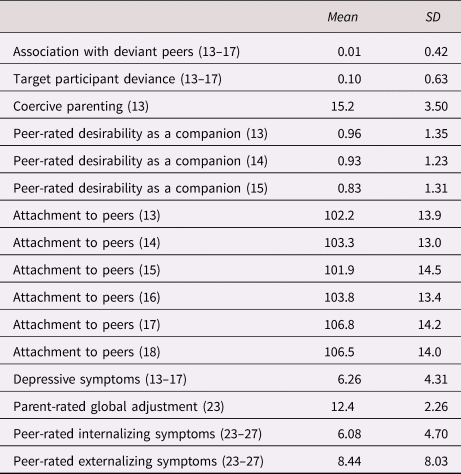
Means and standard deviations for all substantive variables examined in the study are presented in Table 1. Initial analyses examined the role of gender and family income in early adolescence on the primary measures examined in the study. Several variables of substantive interest in the study were related to both adolescent gender and income in adolescents’ families of origin; hence, these factors were considered as covariates in analyses below. We also examined possible moderating effects of gender and family income on each of the relationships described in the primary analyses below. All moderation effects analyzed were obtained by creating interaction terms based on the product of the centered main effect variables. No moderating effects were found beyond what would be expected by chance.
Means and standard deviations of primary measures

Note: Age of assessment is in parentheses.
Correlational analyses
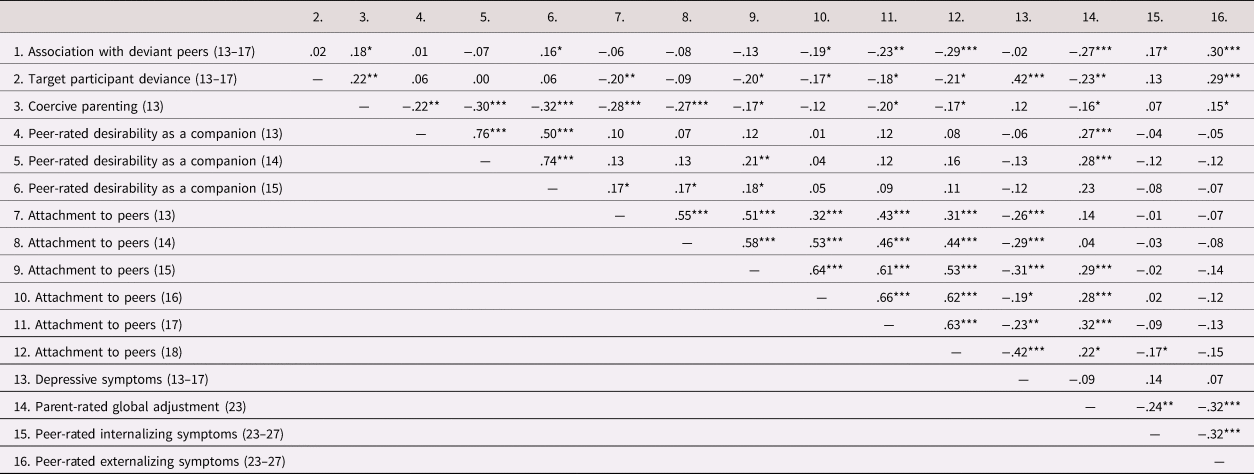
For descriptive purposes, Table 2 presents simple correlations among all primary constructs examined in the study. These analyses indicate numerous simple correlations between association with deviant friends and other constructs of interest in the study, each of which are explored in detail below.
Intercorrelations of substantive variables

Note: Age of assessment is in parentheses. *p < .05. **p < .01. ***p < .001.
Primary analyses
Hypothesis 1: Association with deviant friends will be predicted by exposure to coercive parental behavior
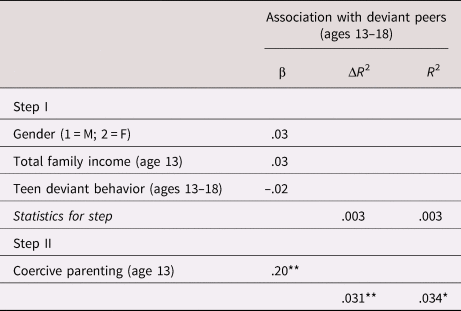
Analyses first examined the extent to which association with deviant friends, assessed across adolescence, over and above adolescents’ own levels of deviance, would be predicted by adolescents’ experience of coercive parental behavior reported at age 13. A three-step hierarchical approach, using SAS PROC CALIS (version 9.04; SAS Institute, 2015) and full information maximum likelihood handling of missing data was employed. In the first step, adolescent gender and family income were entered as predictors. Although the deviant friend measure was created so as to be independent of the level of target participant deviance within any given year, it remained possible that it captured target participant deviance from prior and succeeding years. To address this possibility, the overall measure of target participant deviance across adolescence was next added as a covariate. In the third and final step, parental coercive behavior was entered. Results, presented in Table 3, revealed a significant predictive relationship indicating that higher levels of parental coercive behavior were directly related to close friend deviance across adolescence.
Predicting deviant peer associations from coercive parenting behavior after accounting for teen deviance and demographic covariates

Note. β weights are from final model. *p < .05. **p < .01.
Hypothesis 2: Association with deviant friends will be linked to declining quality of peer relationships across adolescence
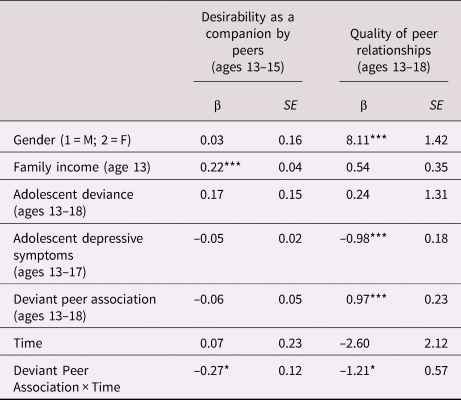
Latent growth curve analyses were used to next examine the extent to which association with deviant friends was linked to changes over time in adolescents’ desirability as a companion by their peers and their sense of attachment to their peers. Table 4 presents both sets of results. Results regarding desirability as a social companion, based on a highly significant overall linear growth model, χ2 (3) = 315.24, p < .001, indicate that association with deviant peers was linked to declining desirability as a peer companion from age 13 to age 15 (βTIME × DEVIANTPEER = –1.197, p = .04). Results regarding adolescents’ perceived quality of relationships with their peers, based on a highly significant overall linear growth model, χ2 (3) = 268.35, p < .001, indicate that the residualized measure of association with deviant friends was also linked to declining quality of relationships with peers from age 13 to age 18 (βTIME × DEVIANTPEER = –0.27, p = .02).
Growth curve models predicting change in peer preference and quality of peer relationships from association with deviant peers

*p < .05. ***p < .001.
Hypothesis 3: Association with deviant peers will predict a range of negative outcomes in adulthood
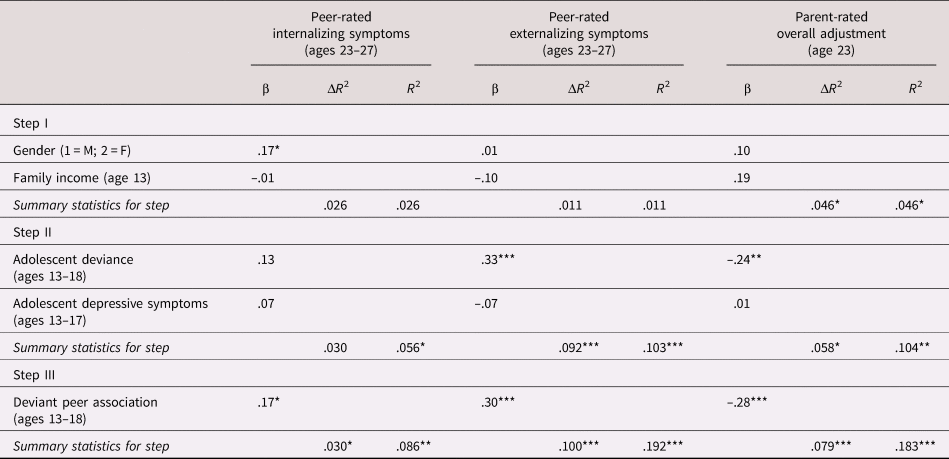
Using the same hierarchical regression procedure described above for Hypothesis 1, association with deviant peers was examined as a predictor of peer ratings of target participants’ levels of internalizing and externalizing symptoms across ages 23–27, and parent ratings of overall adjustment at age 23. Baseline family income and gender were entered in the first step, adolescent-era levels of deviance and depressive symptoms were entered next, followed by the residualized measure of deviant friend association. As shown in Table 5, association with deviant friends was predictive of higher levels of peer-rated externalizing symptoms, higher levels of peer-rated internalizing symptoms, and lower parental ratings of overall functioning, even after accounting for adolescent-era levels of deviance and depressive symptoms.
Regressions of association with deviant peers on adult outcomes after accounting for covariates

Note: β weights are from final models. *p < .05. **p < .01. ***p < .001.
Hypothesis 4: Prediction of outcomes from association with deviant friends will be mediated by lower quality peer relationships at the end of adolescence
Analyses next assessed quality of peer relationships at the end of adolescence (ages 17 and 18) as a potential mediator of the relationships observed in Hypothesis 3. These analyses, using a bootstrapping approach (Preacher, Rucker, & Hayes, Reference Preacher, Rucker and Hayes2007) via the Process Macro in SAS (Hayes, Reference Hayes2017), revealed no significant mediating effect of late-adolescent peer relationships on any of the relations observed in Hypothesis 3 above.
Post hoc analyses
Post hoc tests examined whether it was possible that the experience of coercive parenting was actually driving all of the findings that were otherwise being attributed to association with deviant peers. Primary analyses for Hypotheses 2–4 above were all rerun, but now including the measure of coercive parenting as a predictor. Results were substantially unchanged in these analyses, with all original findings remaining significant at similar levels. This suggests that that experience of coercive parenting was not driving the outcome findings of the study.
Discussion
This study found that association with deviant close friends over the course of adolescence was linked to a broad range of maladaptive behaviors and functional outcomes extending from adolescence into adulthood. Selection of deviant peers as close friends across adolescence was predicted by teens’ early adolescent experience of coercive parenting behaviors in parent–teen interactions. Deviant peer selection was further linked to a pattern of deteriorating social acceptance by peers and declining perceived quality of peer relationships. Ultimately, exposure to deviant close friends predicted a host of negative outcomes in adulthood, even after controlling for baseline levels of functioning in adolescence. Of note, all of these links existed independently of the target adolescent's own level of deviance, and all were found when comparing constructs assessed by different raters, eliminating any possibility that methods confounds inflated results. Taken together, these findings support a view of adolescent relationships with deviant peers that extends well beyond their previously identified role in producing deviant adolescent behavior.
Given that we assessed association with deviant peers in a way that measured it independent of any links to the adolescent's own level of deviance, the natural question arises: Why would adolescents choose these deviant peers as close friends? Although an adolescent's own deviant behavior has been previously identified as a primary agent leading to association with deviant peers (Dishion et al., Reference Dishion, Patterson, Stoolmiller and Skinner1991; Patterson et al., Reference Patterson, DeBaryshe and Ramsey1989), this study found that it was also possible to predict the presence of such associations, over and above adolescents’ own level of deviance, from early adolescent experiences of coercive parenting behavior. Observed links to coercive parenting behavior at age 13 suggest that choices to associate with deviant peers may reflect both adolescents’ expectations that the coercive behavior that often characterizes deviant peer relationships is normal, and adolescents’ selection of friends who would be likely to tolerate this behavior on the part of the target adolescent. This process closely resembles Bowlby's attachment-related concept in which individuals form internal working models of attachment relationships that they then generalize to other future relationships (Bowlby, Reference Bowlby1988).
A related explanation is that adolescents may select deviant friends in part as a result of their own lack of social skill. It is also possible that this lack of skill, rather than the presence of deviant friendships, could be at least partly driving key observed outcomes. One finding that mitigates against this social skills explanation, however, is that a pattern of selection of deviant friends was not linked to overall low social success with peers at baseline age 13 in simple correlations, but rather to a pattern of steadily deteriorating social success following that period.
The breadth of predictions from association with deviant friends, and the independence of these predictions from teens’ own levels of deviance, suggests that we may be observing a process that could be described as deviancy-training-plus, in which the “training” is not simply about rule-breaking behavior but actually reflects key socialization experiences that may affect a range of social behaviors and functional outcomes both during and beyond adolescence. Although the within-adolescence links we observed were correlational, the finding that teens with deviant friends display a deteriorating pattern of social relationships with peers over time is highly consistent with this deviancy-training-plus explanation. These findings differ from, but are not at all inconsistent with, prior deviancy-training findings (Dishion et al., Reference Dishion, Andrews and Crosby1995; Dishion & Owen, Reference Dishion and Owen2002; Patterson et al., Reference Patterson, Dishion and Yoerger2000; Van Ryzin & Dishion, Reference Van Ryzin and Dishion2013). They do, however, suggest that deviancy-training regarding rule-breaking behavior may be only one aspect of a broader pattern of adverse socialization that has wide- and long-ranging implications. These findings raise the possibility that the “active ingredient” of deviant friendships may not be just the deviance per se, but rather the disturbed social interaction processes occurring within the friendship. If further research supports this idea, it would have implications for parents of adolescents seeking to identify potential risks to their teens’ development. These parents may find it easier to observe disturbed interaction patterns their teens have with friends (which may be less likely to be hidden) than to observe those friends’ actual deviant behavior.
The observed longer term predictions from association with deviant friends in adolescence to functioning in adulthood suggest that this adverse socialization process has potentially enduring implications. Friendships with deviant peers predicted long-term levels of externalizing behavior. However, these friendships also had implications well beyond levels of adult deviance. They predicted heightened levels of internalizing symptoms, even after accounting for adolescent levels of depressive symptoms, and also predicted a marker of overall functioning as rated by parents. This pattern of findings is consistent with the view that association with deviant peers is actually linked to a broader pattern of maladaptive social development that extends well beyond deviance and deviancy-training.
Overall, the range of markers of adult functioning associated with deviant adolescent close friendships was quite broad, ranging from peer preference to reported attachment to peers to internalizing and externalizing symptoms and a parental rating of overall adult functioning. These markers of functioning were also observed over an extended time span, from age 13 to age 27. This form of long-term heterotypic continuity (i.e., to outcomes far removed in type and in time) from the predictor is consistent with the perspective that deviant friendships are significantly interrupting a core developmental task. A growing body of research, from longitudinal studies to research on hormonal and brain changes in adolescence, is now suggesting that adolescence is likely to be a highly sensitive period for learning about the nature of peer relationships and developing social skills for handling these relationships (Allen et al., Reference Allen, Narr, Kansky and Szwedo2019; Crone & Dahl, Reference Crone and Dahl2012; Roisman, Masten, et al., Reference Roisman, Masten, Coatsworth and Tellegen2004). These relationships appear likely to shape teens’ internal working models of their future adultlike relationships in ways consistent with the predictions of attachment theory (Allen & Tan, Reference Allen, Tan, Cassidy and Shaver2016; Dykas & Cassidy, Reference Dykas and Cassidy2011) and thus likely to have enduring consequences. The current findings are fully consistent with this perspective.
The relatively modest level of internal consistency of the deviant friendship measure across years also provides clues about the nature of this phenomenon. Although to some degree adolescents appeared to be displaying a traitlike tendency to select deviant friends over time (i.e., there was some consistency across years), this process was likely also driven by factors external to the adolescent and not necessarily stable over time (i.e., neighborhood effects, school microculture effects, etc.). This perspective suggests that adolescents’ choice of deviant close friends may reflect family relationship processes as well as other, more transient factors in their social environment. In any case, the effects of deviant peer selection clearly “add up” across years, such that the overall measure led to numerous theoretically expected findings, even given its modest internal consistency. From this perspective, the deviant friends measure appears best conceptualized as an inventory/emergent process measure, in which effects of deviant friendships each year may accumulate much as a series of unrelated (i.e., uncorrelated) physical accidents might nevertheless add up to impair health.
Several limitations to these findings also warrant note. Although the potential causal import of association with deviant peers is obviously of central interest, even the longitudinal change analyses used in this study are sufficient only to disconfirm causal hypotheses, not to confirm them. In addition, other unmeasured processes could also be operating. For example, we did not assess levels of peer depression, yet contagion of depressogenic styles is at least a possible explanation for some of the long-term links to internalizing symptoms (Stevens & Prinstein, Reference Stevens and Prinstein2005). Relatedly, the findings of links to declining peer relationship quality within adolescence are correlational in nature, and it is not only possible, but appears likely, that to some degree a mutually reinforcing process is operating between poor social skills, declining functioning with peers, and association with deviant peers. Finally, this study employed a community sample of adolescents that, though demographically diverse and representative of the population from which it was drawn, would not necessarily permit generalizations to higher risk populations of teens.
Notwithstanding these limitations, the results of this study provide significant further evidence of the substantial role of friendships during adolescence in broader and longer term patterns of social development. Although much research to date has focused on peers as influences toward delinquent behavior—work pioneered by Tom Dishion—the present study suggests that this early work was in reality likely uncovering a still broader socializing force, critical for developmental scientists to understand. The implications of these adolescent friendships now appear likely to be of relevance not just to deviance, nor even just to adolescence, but to broader patterns of development that are linked to well-being or dysfunction throughout the life course.
Financial Support
This study and its write-up were supported by Grants 9R01 HD058305-11A1 and R01-MH58066 from the National Institute of Child Health and Human Development and the National Institute of Mental Health.