1. Introduction
Modern developed economies have become increasingly reliant on regulation to address social and economic issues. The U.S. federal government has progressively employed regulatory measures in recent years in order to address various social and economic disputes between parties. Several assessments of regulatory measures adopted by the U.S. federal government substantiate the growing reliance on regulation. The Federal Register, which publishes final rules from federal agencies, has displayed increasing page counts throughout the 21st century (Office of the Federal Register, 2012). The Industry-Specific Regulatory Constraint Database also indicates growth in regulatory activity at the federal level through examining the number of constraints necessitated by federal regulation (Al-Ubaydli and McLaughlin, Reference Al-Ubaydli and McLaughlin2015). Federal regulatory staff size and regulatory budgets at the federal level have increased throughout the 21st century as well (Dudley and Warren, Reference Dudley and Warren2013).
Shleifer (Reference Shleifer2005; Reference Shleifer and Kessler2011) examines why modern developed economies have become highly regulated, specifically considering whether regulation is an efficient institutional choice. Employing an institutional tradeoff framework developed in Djankov et al. (Reference Djankov, Glaeser, La Porta, Lopez-de-Silanes and Shleifer2003), the tradeoffs between the choice of private orderings, private litigation, regulation, or government ownership to address social issues regarding firm behavior are examined. Acknowledging that all options are imperfect, Shleifer (Reference Shleifer2005; Reference Shleifer and Kessler2011) notes that private ordering may be insufficient to deal with some disputes, while private litigation may be inadequate when some private parties possess significant advantages over others in the litigation process or if the courts are expensive, unpredictable, or biased. This suggests that regulation may be the most efficient solution when social costs are too great for private ordering or private litigation, particularly if power checks on the government exist to help offset the potential for abuse through regulation.
However, little attention has been visited on the relationship between the accumulation of regulatory measures and the courts. While Djankov et al. (Reference Djankov, Glaeser, La Porta, Lopez-de-Silanes and Shleifer2003) and Shleifer (Reference Shleifer2005, Reference Shleifer and Kessler2011) carefully review the pros and cons associated with the various institutional choices available to address social and economic disputes, it is important to note that the choice of regulation to address an issue can ultimately result in court cases. Shleifer (Reference Shleifer and Kessler2011) acknowledges that regulated issues may lead to court cases, noting that regulation can at least narrow the scope of issues to be debated in the courts. Research in the field of law has started to examine the methods that courts employ to interpret regulation when regulatory issues result in court cases (Stack, Reference Stack2012). Nonetheless, the overall impact of the increasing reliance of regulation on the courts has yet to be examined in detail. Regulatory court cases can arise for numerous issues, including the prosecution of a regulated party, a challenge to a regulation by a regulated party, or disputes between regulators and regulated parties. If regulation is the efficient institutional choice to address an economic or social problem, the role of the courts must be understood to maximize the efficacy of the use of regulation.
This paper examines the relationship between the growing use of regulation and criminal judicial actions utilized by regulatory agencies. Data regarding regulation at the federal level in the U.S. and the U.S. district courts is analyzed to gain insights into the effect of regulation on the courts. In particular, this study investigates whether the growing reliance on regulation in the U.S. impacts the annual number of regulatory cases and criminal defendant filings in U.S. district court.
Shleifer's consideration of the efficiency of regulation and the merits of the use of regulation are outlined in Section 2. The enforcement mechanisms upon which regulators rely to enforce regulation are discussed in Section 3, with a specific discussion of situations in which regulators may rely on administrative action, civil judicial action, or criminal judicial action to enforce regulation. Data regarding the incidence of regulatory criminal court cases and criminal regulatory defendant filings in U.S. district courts and the volume of federal regulation across specific regulatory categories is examined in Section 4. When considered with Shleifer's (Reference Shleifer2005) theory of regulatory usage, several implications regarding the use of regulation and the impact of regulation on the courts emerge from the consideration of the relationship between regulatory accumulation and the courts. These implications are outlined in Section 5 while Section 6 concludes.
2. Regulation as an institutional choice
Shleifer (Reference Shleifer2005) provides a review of the three primary theories of economic regulation that emerged throughout the 20th century and offers an innovative method of considering the potential for regulation to solve problems. The first theory of economic regulation considers the government as a benevolent source that can solve social and economic problems through regulation, often associated with the original work of Pigou (Reference Pigou1938). This theory is in fact the basis for an active government and the beginnings of the field of public economics in the traditional sense. A second theory initiated by Coase (Reference Coase1960) notes that impartial courts can address social and economic problems by enforcing the rule of law, which suggests that regulation should play a relatively insignificant role in addressing economic and social issues. The third primary regulatory theory of the 20th century resonates from the work of Chicago school economists (Posner, 1974; Stigler, Reference Stigler1971), which suggests that the government may not necessarily serve as an unbiased source of benevolence. According to this view, regulated parties influence the political process through regulatory capture and political actors are imperfect, resulting in regulation failing to accomplish stated objectives.
Shleifer (Reference Shleifer2005) discusses potential setbacks to each of the economic theories of regulation discussed above. He notes that the public interest theory of government can overstate the extent of market failures, thus overselling the need for government intervention through regulation as private ordering or the court system can also alleviate economic and social issues. However, Shleifer argues that other factors suggest that regulation may be an efficient institutional choice.
While Shliefer (Reference Shleifer2005; Reference Shleifer and Kessler2011) acknowledges that courts are often the best option to address disputes when flexibility is necessary to determine criminal fault or tort liability, he states that reliance on courts can result in challenges as courts are not necessarily unbiased and some parties have power advantages over others in court. Additionally, he argues that courts may be too expensive or unpredictable to handle situations where disputes occur at a high frequency while regulation can provide a common standard that can be consistently applied. Further, courts may be ill-equipped to handle disputes that are extremely complex, where regulators may be more specialized and thus better prepared to address some disputes.
Although Shleifer argues that critiques of the regulatory process in the Chicago School line of reasoning have merit, he contends that some situations are simply not well suited to be resolved after the fact through private litigation. For example, Shleifer notes the potential for deadly accidents on planes or trains, which may be good candidates for regulatory actions. Furthermore, Carpenter (Reference Carpenter2004) shows that regulatory outcomes that may appear to be evidence of regulatory capture can be the result of a regulator's preference for large and established firms by examining pharmaceutical approval durations. A regulator that lacks full information, faces political pressure, and is concerned with their own reputation may favor larger and established firms as the large firms are more familiar to the regulator, have a consumer base, and can withstand time delays.
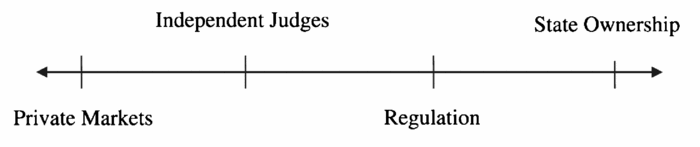
Shleifer (Reference Shleifer2005) provides an alternative synthesis of the available methods to address economic and social issues, noting that private ordering, courts, regulation, or government control may be employed to address a social or economic problem. These options are displayed in Figure 1. Shleifer (Reference Shleifer2005) suggests that there are tradeoffs between the options, where the potential for social losses due to injuries from private parties rises as you move toward the private party options to the left of Figure 1 and the potential for social losses due to injuries from the government increases as you move toward to more centralized options to the right of Figure 1. While there are pros and cons associated with all choices, a cost-benefit analysis approach may suggest that regulation is the optimal answer when private orderings and the courts are insufficient to address social and economic problems.Footnote 1 Shleifer (Reference Shleifer2005; Reference Shleifer and Kessler2011) argues that these tradeoffs justify the growth and ubiquity of regulation in developed countries as an efficient institutional choice.
Strategies of social control.

Data regarding the use of regulatory measures to address economic and social issues confirm Shleifer's observation of the increased use of regulation at the federal level in the U.S. A page count of the Federal Register (Office of the Federal Register, 2012) and data from the Industry-Specific Regulatory Constraint Database (Al-Ubaydli and McLaughlin, Reference Al-Ubaydli and McLaughlin2015), which provides a regulation index at the federal level, both display increases in federal regulatory activity over recent years. Once regulatory measures are adopted, the government must enforce the regulatory measures and provide an avenue for challenges to regulatory rulings. The enforcement and challenge mechanisms for regulation include the use of administrative tribunals, civil judicial actions, and criminal judicial actions.
Shleifer's identification of regulation as an efficient institutional choice under certain circumstances provides the justification for the growing usage of regulation to address economic and social problems in the U.S. Given the increasing reliance on regulation, an additional consideration that arises is the impact of regulation on the methods upon which the government relies for the enforcement of regulation. The remainder of this paper focuses on the relationship between regulation and regulatory enforcement, focusing specifically on regulatory criminal cases and defendants filed in federal district courts.
3. Regulatory enforcement: administrative action and the courts
While the institutional choice between the alternatives of the court system or regulation to address social and economic issues is an extremely important question for society, it is also critical to recognize the relationship between regulation and the mechanisms employed to enforce regulatory measures. Although the majority of regulated activity in society does not result in conflict between regulators and regulated parties, regulators must ultimately ensure that regulated parties understand and follow regulatory measures. Regulators monitor regulated parties and often create regulatory guidance materials to assist regulated parties in complying with regulation. There are a number of somewhat informal methods that regulators can employ to attempt to compel regulated parties to adhere to regulatory measures if regulated parties are out of compliance. These approaches include warning letters, bilateral agreements, and the use of a memorandum of understanding. When informal measures are insufficient or regulated parties violate regulations, regulators may invoke administrative actions or judicial actions to enforce regulation and penalize violators. This section reviews these regulatory enforcement mechanisms in consideration of the rise in the use of regulation to address economic and social issues.
Administrative actions
Administrative actions on the part of regulatory agencies are a prominent source of regulatory enforcement for many regulatory agencies in the U.S. In addition to creating and interpreting regulatory measures, many regulatory agencies possess the power resolve issues through their own regulatory tribunals. Regulatory agencies may seek to issue a notice of violation, provide an order to bring a regulated party into compliance, and/or impose fines and penalties.
Once an agency identifies a regulated party that is suspected to be out of compliance with a regulatory measure, the agency may proceed with an administrative adjudicatory process. Independent agency-specific administrative law judges preside over the process. Affected regulated parties also often have the ability to request an administrative law judge to review a ruling by a regulatory agency in many cases. The administrative law judge weighs evidence related to the regulatory violation and issues a decision that may include various sanctions for the regulated party should they be found to be out of compliance with a regulatory measure. While the ruling is final, both the agency and the regulated party may appeal the decision.Footnote 2
Although the process of administrative action described above is generally similar across agencies, the use of administrative action and the specific details of processes may vary across regulatory agencies. Data regarding the use of administrative actions on the part of regulatory agencies to enforce regulatory measures and punish regulatory offenders suggests that administrative action is an important regulatory instrument. For example, the Environmental Protection Agency averaged 1,235 administrative compliance orders and 1,740 final administrative penalty orders from 2009 through 2013 (Esworthy, Reference Esworthy2014).
Civil judicial enforcement, appeals, and other regulatory civil cases
Regulatory agencies may choose to pursue civil judicial enforcement instead of administrative action under certain circumstances. In general, civil judicial enforcement can be viewed as a next step when administrative action does not suffice to accomplish a regulatory objective. The choice to seek a civil case may be the result of a regulated party violating a regulatory requirement, ignoring an administrative order, or neglecting to meet the obligations of regulatory administrative actions. The specific rationale for the pursuit of a civil case varies depending on the regulatory agency involved. For example, the Environmental Protection Agency outlines their use of civil judicial enforcement on their website (U.S. EPA, 2016). Civil regulatory case data is not clearly delineated for U.S. district courts, although some data compiled by agencies regarding civil cases does exist. Esworthy (Reference Esworthy2014) finds that the Environmental Protection Agency referred an annual average of 205 civil judicial cases from 2009 to 2013.
Regulatory civil court cases may also arise when regulated parties challenge regulatory orders or the constitutionality of regulation. Regulated parties may employ the judicial system to challenge a regulatory order or penalty, question the validity of a regulation, clarify the requirements of a regulation, or dispute elements of the regulation. These instances may also have broader implications as the legal ruling regarding the regulation can impact all parties involved in the regulatory process going forward. Data regarding regulatory challenges in court are difficult to identify as the cases are not clearly identified in reports. For the years of 2006–2015 in which data are available, an average of 136 regulatory offense appeals cases per year occurred in the U.S. Court of Appeals (Administrative Office of the U.S. Courts, 2001–2015). Regulatory challenges may also occur as other civil cases, so the data likely underestimate the extent of regulatory challenges in civil courts.
Criminal judicial enforcement
In some cases, regulatory agencies may choose to prosecute a regulated party for criminal actions for a regulatory offense. The potential for regulators to rely on criminal judicial enforcement for resolution is noted in Glaeser and Shleifer (Reference Glaeser and Shleifer2001), who model a regulatory interaction between regulators and a regulated firm with the possibility that the regulator decides to prosecute the regulated firm through the judicial system. While the circumstances in which a regulatory agency may choose to pursue criminal cases against regulated parties may vary, the decision to pursue a criminal case to address a regulatory violation generally depends on the intent and severity of the actions of the regulated party. For example, Esworthy (Reference Esworthy2014) observes that the Environmental Protection Agency pursues criminal cases for deliberate actions where the violator is aware or should be aware that the action could result in damages.
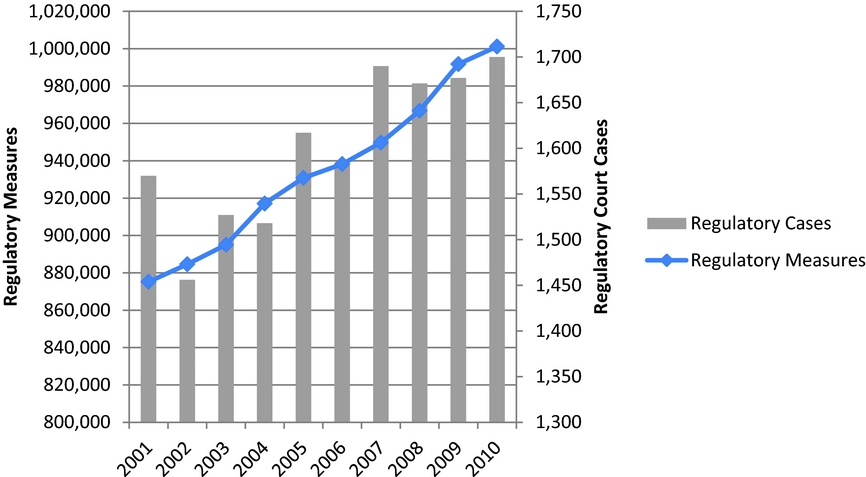
The Administrative Office of the U.S. courts caseload statistics show that criminal court cases involving regulatory issues have increased in recent years, corresponding with the increase in regulatory rulings at the federal level in the U.S. Figure 2 displays a plot of the number of regulatory criminal court cases in U.S. district courts and the number of annual Federal Government regulatory measures in the U.S., which consists of a count of the terms ‘shall’, ‘must’, ‘may not’, ‘prohibited’, and ‘required’ in the Code of Federal Regulations (Al-Ubaydli and McLaughlin, Reference Al-Ubaydli and McLaughlin2015). While this visual does not prove cause, it highlights the concurrent growth of regulatory measures at the federal level and regulatory court cases in U.S. district courts.
Regulatory measures and regulatory court cases.
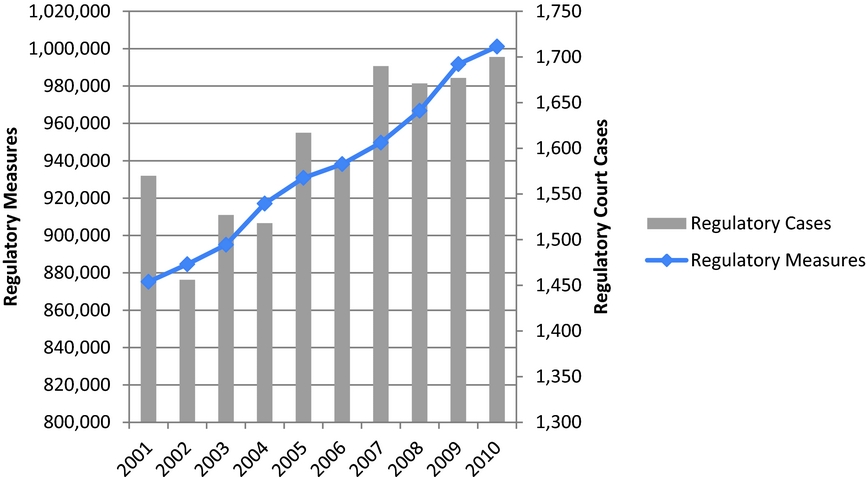
Regulatory criminal court cases in U.S. district courts increased at an average rate of 1.13% per year between 2001 and 2011. While this seems in line with the 1.54% annual growth rate of all U.S. district court criminal cases over the same time period, it is important to note that the 9.88% annual growth rate of immigration offenses significantly skews the total U.S. district court criminal case growth over the time period. After removing immigration offenses from all other U.S. district court criminal cases, U.S. district court criminal cases declined by an average of 1.08% on an annual basis from 2001 to 2011. Additionally, data from caseload statistics from the Administrative Office of the U.S. courts show that regulatory cases between 2005 and 2011 were nearly twice as likely to result in non-convictions when compared to all cases in U.S. district courts. Approximately 18.6% of regulatory cases resulted in non-convictions in comparison to just 9.7% of all cases (Administrative Office of the U.S. Courts, 2001–2015).Footnote 3
4. Data analysis
Shleifer (Reference Shleifer2005; Reference Shleifer and Kessler2011) explains and justifies the observed increase in the use of regulation in countries around the world in recent decades. The impact of increasing regulatory measures on the mechanisms of regulatory enforcement becomes a question of interest given the rise in the use of regulation to address economic and social issues. While the rise in the use of regulation would suggest an increasing reliance on criminal judicial enforcement other things constant, regulators possess other enforcement mechanisms that include the use of administrative action and civil judicial enforcement as discussed above. This section analyzes the relationship between regulatory measures and criminal judicial enforcement in U.S. federal district courts. The primary interest in this analysis is whether an increase in regulatory measures is related to an increase in regulatory criminal court cases and regulatory criminal defendant filings. The analysis does not examine regulatory civil cases as the data regarding regulatory civil cases is not readily available by category of regulatory offense.
The empirical estimation utilizes standard ordinary least squares methodology. The first dependent variable examined is the total number of annual criminal regulatory cases commenced by offense in U.S. district courts from 2001–2010 (Administrative Office of the U.S. Courts, 2001–2015).Footnote 4 A second set of regressions employ the per capita total number of annual criminal regulatory cases commenced by offense in U.S. district courts from 2001–2010 as the dependent variable to ensure that changes in population are not the driving case growth. The timeframe was selected due to data reporting on regulatory criminal court cases by the Administrative Office of the U.S. courts.
Beginning in 2011, the Administrative Office of the U.S. courts ceased reporting on criminal cases in U.S. district courts and began to focus exclusively on criminal defendants filed. The rationale for this change was that criminal case reports fail to capture the true complexity and characteristics of cases in which multiple defendants are involved (Administrative Office of the U.S. Courts, 2011). In order to further analyze the relationship between increasing regulation and enforcement in the courts, the total annual number of regulatory filings for criminal defendants by offense in U.S. district courts from 2001–2014 are examined as a dependent variable in a third set of regressions.Footnote 5 A fourth set of regressions analyzes per-capita regulatory filings for criminal defendants by offense as the dependent variable. Sources and descriptions for all data are included in Appendix 1.
The criminal cases and regulatory filings for criminal defendants employed as the dependent variables encompass 16 broad categories of offenses occurring in the 94 district courts around the country. While the average number of cases and filings for defendants in each category of offense varies, there is no specific category of offense that strictly dominates in the data. Additionally, the criminal cases and filings for criminal defendants are spread relatively evenly across the 94 district courts throughout the time period examined.
Previous research has examined the primary factors that influence court cases (Heydebrand and Seron, Reference Heydebrand and Seron1990; Landes, Reference Landes1971; Posner, Reference Posner1996; Shughart II and Karahan, Reference Shughart and Karahan2003). While there are many unobservable variables that may impact the quantity of court cases, Shughart II and Karahan (Reference Shughart and Karahan2003) identify the primary socioeconomic factors that are determinants of course cases at the state, district, and circuit levels.Footnote 6 Following their work, this analysis employs U.S. population density (World Bank, 2014), size of government (Office of Management and Budget, 2014), and unemployment (Bureau of Labor and Statistics, 2014) to account for socioeconomic variables across years. Size of government is measured as the federal government share of U.S. gross domestic product.
The primary independent variable of interest is the measure of regulation. This analysis employs data from RegData, a measure of industry regulation designed by Al-Ubaydli and McLaughlin (Reference Al-Ubaydli and McLaughlin2015). The authors utilize a count of the number of regulatory binding restraints that pertain to a given industry in the Code of Federal Regulations on an annual basis to obtain a sense of the degree of regulation that each industry faces. Al-Ubaydli and McLaughlin count the terms ‘shall’, ‘must’, ‘may not’, ‘prohibited’, and ‘required’ as the terms generally restrict the legal choices available in an industry. The Code of Federal Regulations serves as a store of all existing regulations for a given year, which allows for a comparison of changing regulation across years.
An annual index of regulation that pertains to a given category of regulatory cases and defendant filings in U.S. district courts is developed in this paper to measure the impact of changing levels of regulation on court cases and defendants filed. In order to design this index, each category of regulatory case defendant filing in U.S. district courts is paired with 1 of 50 titles in the Code of Federal Regulations that best corresponds to the regulatory category of court case and defendant filing.Footnote 7 The total number of annual regulatory binding constraint counts in a title for a given year, which consists of counts of the terms ‘shall’, ‘must’, ‘may not’, ‘prohibited’, and ‘required’, is compared to the number of annual regulatory binding constraint counts in a title for year 2000, one year before the start of the analysis in this paper. The result is an independent variable that provides an index of the regulatory constraints that pertain to a specific category of regulatory court cases and defendant filings on an annual basis.Footnote 8
The first model specification in each set of regressions includes the regulatory index measure and the socioeconomic independent variables. A second model specification includes a dummy variable to account for the category of the regulatory case and defendant filing in U.S. district courts to control for category-specific fixed effects in addition to the other independent variables from the first model specification. The dummy variable takes a value of one when the case or defendant filing fits into a specific category of regulatory offense and a value of zero otherwise. The categories of regulatory cases and defendant filings are civil rights, copyright, food and drug, hazardous waste, telegraph/telephone/radiograph, national defense, antitrust, labor, game and conservation, national parks, customs, postal service, reporting of monetary transactions, migratory bird, maritime and shipping, and aircraft regulations.
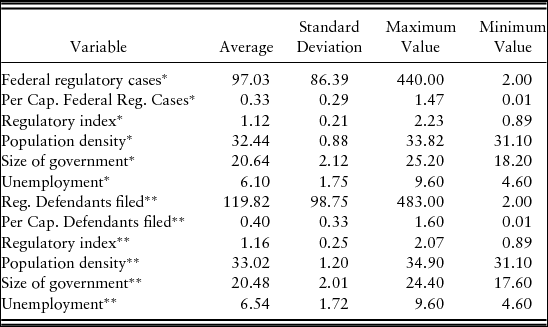
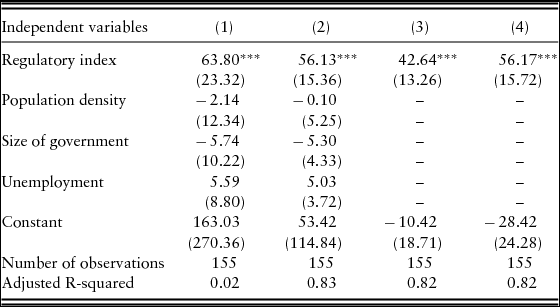
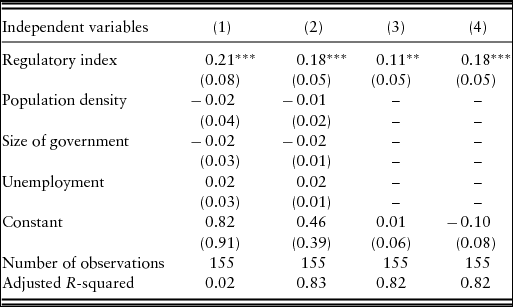
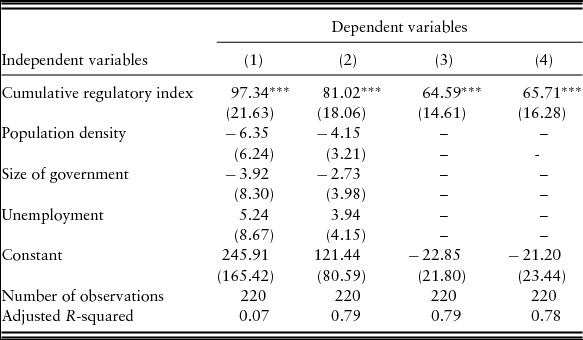
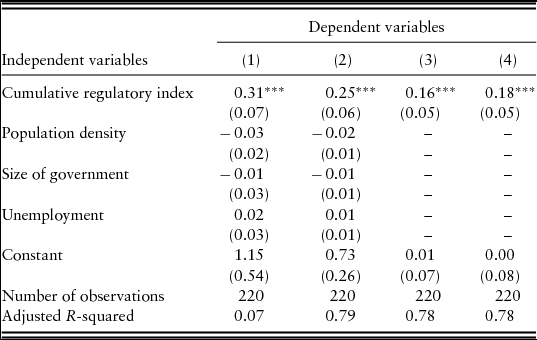
A third model specification includes just the regulatory measure and the category-specific dummy variables to ensure that the socioeconomic variables are not interacting with other variables and driving the results. A final model specification includes year dummy variables to check for year fixed effects in addition to the regulatory measure and the category-specific dummy variables. Summary statistics are included in Table 1. The results of the regression analysis with regulatory cases by category as the dependent variable are displayed in Table 2 while Table 3 displays the results with per capita regulatory cases by category as the dependent variable. Tables 4 and 5 display the results with the annual number of regulatory filings for criminal defendants by offense and per capita regulatory filings for criminal defendants by offense as dependent variables, respectively.
Descriptive statistics

Note: There are 155 observations covering 16 categories of regulatory cases in U.S. federal district courts from 2001–2010 for all variables (denoted by *). There are 220 observations covering 16 categories of regulatory defendant filings in U.S. federal district courts from 2001–2014 for all variables (denoted by **).
Estimation of federal regulatory cases
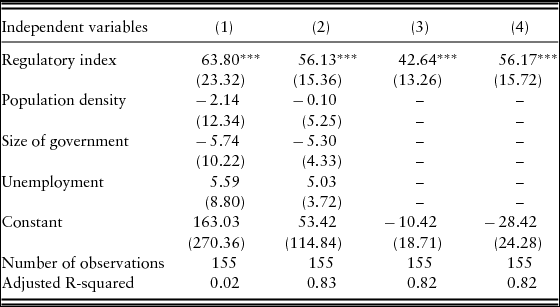
Note: The dependent variable is the number of regulatory cases by category in U.S. district courts from 2001–2010. Case offense category dummy variables are included in specifications (2), (3), and (4) and year dummy variables are included in specification (4); coefficients are not reported. Standard errors are noted in parenthesis. Asterisks indicate significance as follows: ***= 1%, **= 5%.
Estimation of per capita federal regulatory cases

Note: The dependent variable is the number of per capita regulatory cases by offense category in U.S. district courts from 2001–2010. Case category dummy variables are included in specifications (2), (3), and (4) and year dummy variables are included in specification (4); coefficients are not reported. Standard errors are noted in parenthesis. Asterisks indicate significance as follows: ***= 1%, **= 5%.
Estimation of regulatory criminal defendants filed

Note: The dependent variable is the number of regulatory filings for criminal defendants by offense category in U.S. district courts from 2001–2014. Case category dummy variables are included in specifications (2), (3), and (4) and year dummy variables are included in specification (4); coefficients are not reported. Standard errors are noted in parenthesis. Asterisks indicate significance as follows: ***= 1%, **= 5%.
Estimation of per capita regulatory criminal defendants filed

Note: The dependent variable is the number of per capita regulatory filings for criminal defendants by offense category in U.S. district courts from 2001–2014. Case category dummy variables are included in specifications (2), (3), and (4) and year dummy variables are included in specification (4); coefficients are not reported. Standard errors are noted in parenthesis. Asterisks indicate significance as follows: ***= 1%, **= 5%.
The results in Table 2 suggest that an increasing level of regulation in a specific regulatory category leads to more regulatory court cases in that category. The coefficient on the regulatory index independent variable is positive and significant at the 1% level across all specifications. The regulation index coefficient is 63.8, 56.1, 42.6, and 56.1 across the four specifications, respectively. For interpretation purposes, consider the coefficient of 63.8 from the first specification. A one-unit increase in the regulation index for a given category of regulatory offense, which corresponds to a 100% increase in regulatory restrictive terms, will lead to approximately 64 more regulatory court cases in U.S. district courts according to this analysis. For comparison purposes, approximately 97 annual regulatory court cases by category are reported on average in Table 1. The results in Table 3 display similar outcomes, with per capita regulatory court cases exerting a positive and significant impact on regulatory court cases across all specifications.
The results reported in Tables 4 and 5 also suggest that increasing levels of regulation result in greater reliance on the courts. Increases in regulatory measures result in a statistically significant increase in regulatory filings for criminal defendants in Table 4 and per capita regulatory filings for criminal defendants in Table 5. The coefficient on the regulatory index independent variable in Table 4 is 97.3, 81.0, 64.6, and 65.7 across the four specifications, respectively. When compared to the increase in regulatory cases in Table 2 due to the regulation index independent variable, the results in Table 4 suggest that increasing levels of regulation increase criminal regulatory filings to a greater extent. The coefficients on the regulatory index independent variable for criminal regulatory defendant filings across the model specifications are larger than the coefficients on the regulatory index independent variable for regulatory cases across specifications in Table 2.
While the results suggest that increasing levels of regulation result in more court cases and filings for criminal defendants, it is important to note a few cautions regarding the results. There are many factors that can impact the number of court cases and filings for criminal defendants. Many of the factors are difficult to measure as each case and defendant can be unique. The observed court cases and defendants may also have different ramifications, with some court cases simply ruling against regulatory offenders and other court cases resulting in broader-reaching consequences. Some categories of cases and defendants may require more time or effort on the part of the courts, which means that the true burden of cases and defendants on the courts may vary across cases and defendants. Additionally, the measure of regulation employed in this analysis likely does not include every regulation that applies to a category of regulatory offense as the regulatory measure for each category in this analysis includes only the primary category of regulation in the Code of Federal Regulations. Finally, the data do not allow us to identify precisely why growing regulation appears to cause regulators to lean on the courts for enforcement over the time period observed.
5. Implications
The finding that greater reliance on regulation to address social and economic issues results in increased regulatory court case activity and an increase in regulatory criminal defendant filings has implications for the institutional choice of regulation as the method to address social and economic issues. Shleifer (Reference Shleifer2005; Reference Shleifer and Kessler2011) readily discusses the tradeoffs between regulation and other methods of addressing problems, recognizing the possible involvement of the courts even when regulation is employed. Shleifer (Reference Shleifer and Kessler2011: 38) notes that, ‘Even if the determination of violation and damages is left to courts, regulation may reduce the costs of litigation because it effectively provides a judge with a checklist of items that need to be verified, as opposed to leaving open the scope of issues to be debated to the litigants’. Regulation may remain the efficient institutional choice to address disputes when the courts are too expensive or unpredictable, when specific issues surrounding disputes are extremely complex, or when there are severe inequalities between the litigants involved in a dispute. In fact, some regulations have likely reduced court cases in some specific policy areas as the regulation effectively served as a substitute for the courts.
However, Shleifer (Reference Shleifer and Kessler2011) notes that the primary rationale for regulation is the inability of courts to resolve disputes in a cheap, predictable, and impartial fashion. These same courts are often responsible for ruling on regulatory issues when a regulator prosecutes a regulated party, when a regulated party challenges a regulation, or when some dispute arises between regulators and regulated parties. While regulation can certainly help to frame legal decisions, the involvement of the courts should be made explicit in the discussion of regulation as an institutional choice to address social and economic disputes. Rather than a separate option, regulation and the courts should likely be viewed as complementary processes.
Given the growing use of regulation and the relationship between regulation and the courts, regulators should acknowledge the complementary nature of regulation and the courts throughout the entire regulatory process. Regulators must often design, implement, interpret, and enforce regulation in a constantly changing environment. While a large amount of research in the public administration literature provides guidance regarding policy implementation, consistent acknowledgement of the role of the courts on behalf of regulators could lead to more accurate outcomes if and when regulatory cases reach the courts. Additionally, regulatory agencies rely on a mix of administrative action, civil court actions, and criminal court actions to enforce regulation. Further attention should likely be paid to the mix of enforcement options with a focus on the costs and benefits associated with each method. Recent regulatory agency activity suggests that some agencies are in the process of adjusting their regulatory enforcement mix. For example, the U.S. Environmental Protection Agency explicitly noted that a new focus on complex and high-impact criminal investigations reduced EPA-related regulatory cases in recent years (U.S. Environmental Protection Agency, 2015).
Some potential implications for the judiciary arise out of the results as well. The data regarding regulatory court cases and filings of criminal defendants show that cases and filings are spread relatively evenly throughout the 94 federal court districts. Additionally, no specific category of regulatory criminal case or defendant filing dominated in the data. This relatively uniform increase in regulatory criminal cases may suggest that the increase in regulatory court cases and defendant filings could sustain if regulatory measures increase going forward. While regulatory filings of criminal defendants are just over 2% of all annual criminal defendant filings on average from 2010–2014, it is important to recognize that the increased filings may represent an additional burden for the courts due to both the number of defendants filed and the complexity of the regulatory criminal cases. While Congress is unlikely to allocate additional funding for new additional district judges as the number of overall criminal case filings in U.S. district courts decreased each year from 2011 through 2015, the judiciary could consider specialized training to assist in the handling regulatory cases. The federal judiciary essentially received their full funding request from Congress from 2014–2016 (Administrative Office of the U.S. Courts, 2015). Perhaps, some moderate additional funding could be allocated for regulatory training purposes.
The judicial system should also attempt to adopt a common methodology to interpret regulations and dispose of regulatory cases with the rise in regulatory-related criminal cases. Recent research in the law literature has recognized the challenges of addressing regulation in the courts, focusing on the methodology employed to interpret regulation. Stack (Reference Stack2012) discusses the importance of regulatory interpretation in legal rulings, noting that the interpretation of regulation in the courts remains inconsistent across interpretive theory and administrative law. Stack advocates for the courts to interpret regulations by identifying the original regulatory intent through examining the statement of purpose that is associated with a regulatory ruling. Georgosouli (Reference Georgosouli2010) highlights the lack of a common method to interpret regulations across parties in general, noting that regulation and legal rulings are closely related but regulatory interpretation and legal interpretation are not synonymous. He suggests that rather than interpreting regulations in a conversational method where the parties involved in the regulatory process mutually develop an interpretation of a regulation, regulation should be interpreted in a constructive method where the political history of the regulation is invoked to identify an interpretation that best fits the goal of the original regulation. The increasing reliance on the courts to enforce regulation through criminal cases suggests that the development of a consistent methodology for the interpretation and application of regulation in the courts could be of great value. This issue could also potentially be addressed through additional research and training.
Finally, additional research surrounding the relationship between regulatory enforcement mechanisms and measures of regulation should be considered. In addition to the analysis of criminal action in this paper, growing regulation could impact administrative actions and civil judicial actions on the part of regulators as well. An assessment of the effect of growing regulatory measures on regulatory challenges and appeals in the courts could prove valuable as well. Sobel and Dove (Reference Sobel and Dove2014) utilize regulatory challenges in state courts as a measure of regulatory activity, which provides insight into a potential method to utilize appeals to examine additional challenges of the impact of growing reliance on regulation.
6. Conclusion
Given the findings in this paper, the increasing dependence on regulation as a method to address social and economic disputes will likely continue to result in a growing reliance on the courts to assist with regulatory matters. The courts should be viewed as a complementary process to regulatory mechanisms when regulation is employed to address a social or economic issue. While this should not necessarily deter the use of regulation in general, regulators and researchers may benefit from further considering the role of the courts in the regulatory process when designing, implementing, and interpreting regulation. Additionally, the judiciary should expect regulatory rulings and regulatory cases to continue to impact the courts. This suggests that appropriate attention to regulatory issues and a consistent approach to regulatory interpretation in the courts could improve the efficacy of regulatory systems.
A great deal of work regarding regulation, the courts, and their relationship remains. Research surrounding the relationship between regulation and the courts could help to further clarify both the substitute and complementary elements of the connection between regulation and the courts. Additional research regarding the costs and benefits associated with the use of a mix of administrative actions, civil actions, and criminal actions by regulatory agencies to enforce regulation would offer benefits. An examination of differences in the mix of enforcement strategies across individual regulatory agencies could result in valuable information as well. Further developments of regulatory mechanisms to assist the courts in accurately interpreting and applying regulation in court cases could help to improve the efficacy of regulation. Advances in the progress toward a more common methodology in the courts to address regulatory issues could also enhance regulatory outcomes. The examination of the nature of regulation and the courts at both the international level and the subnational level would also promote a better understanding of the impact of regulation on the courts. Finally, more research regarding the institutional choice of regulation compared to the use of the courts to address economic and social issues across locations would be useful in understanding the development of institutions.
Acknowledgements
The authors would like to thank Bo Liu, Mike Tasto, and Rob Salvino for helpful comments. Additionally, the authors are thankful for valuable comments from the editor and two anonymous referees.
Appendix 1: Data sources and variable definitions