

The series dedicated to grammatical text editions, Collectanea Grammatica Latina, has been enriched with this new volume, which completes the critical edition published two years earlier by M. Rosellini (Prisciani Caesariensis Ars, liber XVIII. Pars altera. 1. Introduzione, testo critico e indici [2015]). The publication of the ‘lexicon of Atticism’, which forms the final part of Priscian's Ars grammatica (previously published by M. Hertz, Grammatici Latini 3 [1859], pp. 278–377), is justified by the nature of this part of Priscian's text, since it is a kind of annex whose Greek lemmas are organised alphabetically (see pp. xliv, lvii–lviii): it therefore presents a kind of overview of aspects of the Ars as a whole.
It is worth mentioning that some material from this ‘lexicon’ seems to have been reused by Priscian on several occasions in other parts of the grammar (pp. lxv–lxvi: ‘Prisciano fonte di Prisciano’). Its organisation has been inherited from Priscian's sources, but with some modifications to the arrangement that will be discussed below.
This new edition has been preceded by the publication of the proceedings of a conference (L. Martorelli [ed.], Greco antico nell'Occidente carolingio. Frammenti di testi attici nell'Ars di Prisciano [2014]; cf. review by F. Cinato, REA 119/2 [2017], 789–98) on the text, which is a real textual rarity in western European early Middle Ages, now called a ‘Syntactic Lexicon’. Therefore, in addition to Martorelli's volume, S.Y.’s commentary completes a valuable triptych with Rosellini's edition (cf. the review of Martorelli's and Rosellini's volumes in CR 67 [2017], 123–7).
S.Y.’s book provides a bibliography (pp. ix–xli) as well as an introduction (pp. xliii–lxxii), which resumes the conclusions published in Martorelli's volume, adding the information needed for reading the commentary (pp. lxx–lxxii). The remainder of the volume (pp. 1–526) is devoted to a detailed commentary on the lexicon.
Parallel to the Italian editing project (supported by Sapienza, University of Rome), the Groupe Ars grammatica headed by M. Baratin completed the commented translation of Ars Book 18 in 2018 (Priscien: Grammaire Livre XVIII – Syntaxe, 2 [2018]; ‘Catalogue alphabétique de constructions comparées chez les auteurs grecs et latins’ on pages 250–515: Latin text, French translation, notes). The Groupe Ars grammatica sometimes take into account new insights of the Rosellini edition (see Syntaxe, 2, pp. 70–2). It will therefore be fruitful for the reader to compare these two parallel works in order to measure the differences in interpretation, because, as the Groupe Ars Grammatica notes: ‘la composition quelquefois incertaines des articles [de Priscien] fait que le caractère marginal ou non des certaines observations est affaire d'appréciation’ Syntaxe, 2, p. 70). Notable differences include the division of a few entries: 350 entries in Rosellini/S.Y.’s work versus 340 entries according to the French translators. One might only regret that the references to the text were not made with a number identifying the entry of the lexicon, as has been done in the translation of the Groupe Ars grammatica. Nevertheless, eight entries are the cause of discrepancies in matters of interpretation, namely:
— no. 48 = 25, 10–14 + 25, 15–26 R
— no. 65 = 31, 8–12 + 31, 13–15 R
— no. 109 = 43, 18–19 + 44, 1–3 + 44, 4–17 R
— no. 132 = 51, 6–9 + 51, 10–13 R
— no. 176 = 63, 7–13 + 63, 14–64, 2 R
— no. 198 = 73, 5–6 + 73, 7–8 + 73, 9–14 R
— no. 200 = 73, 16–74 + 74, 9–12 R
— no. 203 = 75, 6–9 + 75, 10–76, 16 R
The numbers refer to Syntaxe, 2, while the references to pages and lines followed by ‘R’ are references to Rosellini's edition and S.Y.’s commentary.
It should be noted that the alphabetical arrangement of the two first letters that emerges (inherited from Priscian's sources) is somewhat masked, in the sense that the disposition of the Priscian text, as it stands in the most ancient witnesses, does not in any way reflect this underlying organisation, like it would be done in a ‘real’ glossary where lemmas were evidently located at the beginning of each entry. Thus, it is a hidden composition, because the Greek lemmas are in context and often found after the corresponding Latin examples.
Although Priscian often emphasises the lemma with a recurrent formula such as ‘Attici + lemma’ or simply ‘illi + lemma’, sometimes, when an entry starts with Latin, the alphabetical arrangement seems looser, as for example in no. 169 [61, 6–8 R] Habere pro esse [‘To have’ with the value of ‘to be’] construed with dative (μηδενὶ ἔχειν / tibi habent), where the lemma, to fit in the alphabetical sequence, must begin with ‘M’ and thus implies that it is the first word of the Demosthenes quotation μηδενί [dat. ‘for no one’]; that word seems not the immediate theme of this entry: maybe Priscian chose this Demosthenes quotation to illustrate a syntactic fact different from that originally intended? S.Y.’s commentary here is not really clear, because it gives as its title ‘ἔχω con avverbio: bene se habere’ (p. 285) and considers that Priscian focuses on the construction with the adverb.
Even if the designations of ‘lexicon’ (lessico, Rosellini) or ‘catalogue’ (Groupe Ars grammatica) are appropriate, it seems that Priscian has actually composed a repertory of syntactic facts (as stated by S.Y., p. lii ‘un repertorio di usi sinttatici latini e attici’), with some violations of the alphabetical order. Some of them could have been caused during transmission, but the majority seem to reflect the intentions of Priscian. What can be made of the fact that some entries are repeated, sometimes with more detail, especially at the beginning? For example, it should be noted that the entries whose lemmas begin with the letter A have been split into two series: a first series (nos 1–17 [7, 1–12, 13 R]) and a second, comprising 24 or 25 entries, inserted between the entries devoted to the preposition εἰς (no. 47 [24, 12–25, 9 R] and no. 72 [33, 14–34, 4 R]), where it is remarkable to see some overlap with the beginning of the first series. These are not real duplicates, as some quotes are different, as well as some glosses provided by Priscian:
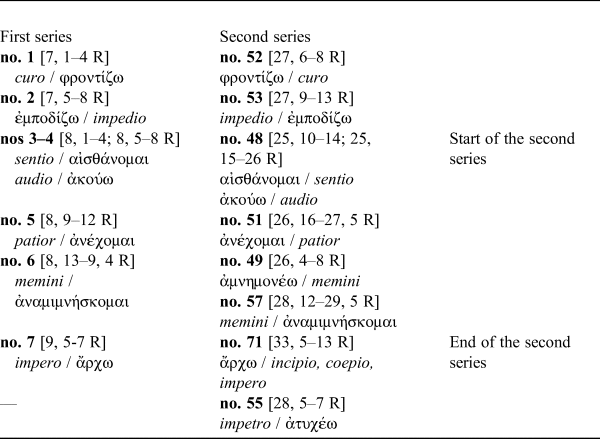
The violations of the alphabetical order (nos 1–2 / 52–3 and nos 5–6 / 51, 49 and 57) at the beginning of the two series reflect Priscian's wish to group similar syntactic facts together, as he says at the end of entry no. 48:
Prisc. (3, 295.16–18 H = 25, 18–26, 3 R): Nec licet aliter Latinis nisi accusativo supra dicta verba coniungere: ‘sentio illum, audio illum’, quomodo et ‘curo, patior, impetro, impedio’, quae Graeci etiam genetivis solent sociare vel dativo.
There is no other possibility in Latin than to link the verbs mentioned above with the accusative: sentio illum [I perceive him], audio illum [I hear him], as also ‘curo, patior, impetro, impedio’ [I care for, I bear, I get, I entangle (verbs)] that Greeks usually combine also with genitives or with dative.Footnote 1
Indeed, nos 6 and 7 give examples of Latin verbs construed with accusative or genitive (memini) and dative (impero). One can notice also that in the two series the place of the Latin lemmas is inverted (no. 1 Latin / Greek vs no. 52 Greek / Latin; no. 2 Greek / Latin vs no. 53 Latin / Greek; etc.), even nos 6 and 57, which seem to keep the same order Latin / Greek, show a different order of quotations: no. 53 has the Greek quotations first (Dem. 19.27 + Hom. Il. 24.486 / Virg. Aen. 4.335 + Ecl. 9.45), while no. 6 presents Latin first, with a few variants (Virg. Ecl. 9.45 + Aen. 4.335 / Dem. 19.27 + Hom. Il. 9.527). In spite of a very precise description of each entry and although links between similar entries and previous parts of the Ars are carefully pointed out, I think that sometimes, like in this case, the Priscian perspective regarding the composition has not always been explicitly stressed enough. These questions, mostly discussed in the introduction (‘Struttura del testo nella rielaborazione priscianea’, pp. liii–lvii), seem somewhat drowned out among abundant philological considerations, and the sequence of entries is rarely addressed. The overall structure is not evidently emphasised, and one might appreciate a table as that found in Syntaxe, 2, pp. 507–15.
These few remarks take nothing away from the quality of this impressive work. S.Y.’s commentary shows great erudition and produces for each entry a discussion supported by relevant bibliography and parallels. The commentary is highly standardised and systematically reiterates the same points of analysis distributed under six headings when applicable: a description of the main elements contained in the entry (‘struttura della voce’), discussions about lemmas and quotes (‘lemma greco’, ‘citazioni greche’, ‘lemma latino’, ‘citazioni latine’) and finally the mention of textual problems (‘problemi testuali’), which concern various philological, linguistic or ‘historical-literary’ issues. As the author announces, an important place was left to the discussions relating to the Latin materials that Priscian added to his Greek sources. Clearly the result of hard work, this volume is an essential companion and guide for understanding the final part of Priscian's grammar.


