Introduction
Data from epidemiological studies suggest that schizophrenia cannot be considered a disorder with a similar distribution in different parts of the world (McGrath, Reference McGrath2005, Reference McGrath2007). This variable prevalence of schizophrenia is influenced not only by aetiological and environmental factors, but also by factors related with the characteristics of the studies. Indeed, there is increasing agreement that the variation in the results of different epidemiological studies can be explained by the variation in the methodology and that use of the case-finding strategy is one of the reasons for these different results (Përalä et al. Reference Përalä, Suvisaari, Saarni, Kuoppasalmi, Isometsä, Pirkola, Partonen, Tuulio-Henriksson, Hintikka, Kieseppä, Härkänen, Koskinen and Lönnqvist2007; Moreno-Küstner, Reference Moreno-Küstner, Martín and Almenara2014).
The case-finding strategy to detect the prevalence of schizophrenia can be divided into three types. The first relies on clinical databases recording the patients' contacts with mental health services to estimate the prevalence or incidence of cases treated by these services (Jörgensen et al. Reference Jörgensen, Ahlbom, Allebeck and Dalman2010). The second, the key informant method, can be used to expand information derived from the mental healthcare facilities. The key informant method involves establishing a list of services and agencies in a defined area that are likely sites of contact for potential cases, so the case-finding strategy in this particular method covers an extensive network of both mental and non-mental health services. This method was used several times in studies of the prevalence of schizophrenia during the 1990s (Bamrah et al. Reference Bamrah, Freeman and Goldberg1991; Youssef et al. Reference Youssef, Kinsella and Waddington1991; Harvey et al. Reference Harvey, Pantelis, Taylor, Mccabe, Lefevre, Campbell and Hirsch1996; Jeffreys et al. Reference Jeffreys, Harvey, Mcnaught, Quayle, King and Bird1997; McCreadie et al. Reference McCreadie, Leese, Tilak-Singh, Loftus, Macewan and Thornicroft1997; Widerlöv et al. Reference Widerlöv, Lindström and Von Knorring1997; Thornicroft et al. Reference Thornicroft, Strathdee, Phelan, Holloway, Wykes, Dunn, McCrone, Leese, Johnson and Szmukler1998). Finally, the third type concerns population surveys undertaken through household interviews to identify all cases of a disorder within an entire population or a representative random sample.
The relationship between gender and the prevalence of schizophrenia has been analysed frequently in population-based studies, but fewer studies have been undertaken in samples of persons in contact with health services and the results are controversial (Iniesta et al. Reference Iniesta, Ochoa and Usall2012). Saha et al. (Reference Saha, Chant, Welham and McGrath2005), in a systematic review, found no differences in the prevalence of schizophrenia between urban and rural dwellers. However, other studies have found a higher prevalence in urban areas (Harvey et al. Reference Harvey, Pantelis, Taylor, Mccabe, Lefevre, Campbell and Hirsch1996; Widerlöv et al. Reference Widerlöv, Lindström and Von Knorring1997). Measures of social deprivation are usually included as another factor associated with the incidence and prevalence of schizophrenia. Socioeconomic deprivation in urban areas has been associated with higher incidence (Drukker et al. Reference Drukker, Krabbendam, Driessen and vas Os2006, Kirkbride et al. Reference Kirkbride, Boydell, Ploubidis, Morga, Dazzan, McKenzie, Murray and Jones2008; March et al. Reference March, Hatch, Morgan, Kirkbride, Bresnahan, Fearon and Susser2008) and prevalence rates (Jörgensen et al. Reference Jörgensen, Dalman and Allebeck2014).
In this study, we attempted to overcome many of the case-finding problems inherent to general population studies calculating the prevalence of schizophrenic disorders. Accordingly, we screened multiple large healthcare registries, as well as using information from case notes and key informants, which increases the case detection substantially.
The primary aim of this study was to calculate the 1-year prevalence of schizophrenia and related disorders in one hospital catchment area of Malaga (Spain), in 2008. The secondary aim was to determine the prevalence of schizophrenia and related disorders in relation to gender, dwelling (rural or urban) and socioeconomic area (deprived or non-deprived area).
Methods
Study area and health services
This cross-sectional study was carried out in Malaga, a province in Andalusia, Southern Spain, with a population of nearly 1 million inhabitants. Specifically, the study involved one of the two mental health areas in Malaga, the Mental Health Department of Carlos Haya Hospital, which is an administrative and geographically defined area with a population of 315 159 inhabitants. The total population aged 14 years or older was 265 229 persons in 2008. The study area includes not only the capital city but also villages, with a rural population of about 14%. Of the population involved, 9.7% were living in socioeconomic deprived areas, all located in the urban zone and defined by the Andalusian Government as ‘places with extreme poverty and social marginalisation’. For measurement purposes, homes where the family income was less than 50% of the mean Andalusian income were considered to be experiencing ‘social exclusion’ and the geographic location of these homes was identified as belonging to socioeconomic deprived areas (Junta de Andalucía, 2004).
This Mental Health Department of Carlos Haya Hospital comprises two community mental health centres, one day centre, one general-hospital psychiatric unit (with 45 beds), one medium and long-stay ward (30 beds), one child and adolescent mental health unit, and a mental health unit attending the homeless (the only one in Andalusia). In Malaga, there is a network of public residential shelters used mainly by persons with severe mental illness. The province of Malaga has 120 beds in a private psychiatric hospital supported by public funding (San Juan de Dios hospital). Private psychiatry is well developed in Malaga although we do not know the official figures.
Mental health emergencies are covered by a call phone centre attended by medical staff and by ambulance medical services that assess the patients and transport them to hospital if they need specialised care. At the hospital there is a psychiatrist on duty 24 h/day integrated in the general emergency services. Primary care physicians act as gatekeepers to the health services in Spain. Patients attended by the community mental health services are referred there by their general practitioner or by the emergency services, or after discharge from an acute ward at the general hospital. All these settings are included in the case finding procedure.
Patient identification
All patients older than 14 years of age with a clinical diagnosis of schizophrenia or related disorders attended by health services in the catchment area in the index year (2008) were identified. The clinical diagnosis of a patient identified for the study was checked against the mental health team case notes, where possible, before inclusion of that patient in the study. Thus, diagnoses were confirmed by senior psychiatrists who knew the patients as the majority of cases were extracted from psychiatric case notes. In cases obtained from the primary care setting or emergency services we confirmed that the diagnoses were made by a psychiatrist before including the patients in the study.
For the purposes of this study we confirmed that patients were living in the catchment area by consulting the address in the clinical databases and if this information was missing we asked the patients directly. Concerning patients living in the psychiatric hospitals, we only included those who were resident in the study area before hospitalisation.
Patients included were those living in the catchment study area, with diagnoses of schizophrenia or related disorders and who had any contact with health services during 2008.
Case-finding procedure
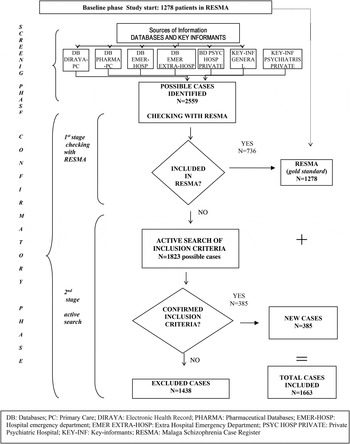
The case-finding procedure was divided into three phases (Fig. 1).
Flow-chart for the inclusion of patients in the study. Screening and confirmatory phases.

Baseline phase, RESMA
The Mental Health Department of Carlos Haya Hospital was created in 2003 and one of its main objectives was to improve the care of patients with severe mental illness. The strategy included the development of a case register of patients with a diagnosis of schizophrenia or other related disorders attending in this area: the Malaga Schizophrenia Case Register (RESMA). The RESMA is based on health care data routinely collected from several psychiatric record systems merged into one database, as described previously (Moreno-Küstner et al. Reference Moreno, Mayoral, Pérez, García-Herrera, Algarra, Rivas, Pérez, Becerra and Gornemann2009, Reference Moreno-Küstner, Mayoral, Rivas, Angona, Requena, García-Herrera, Navas, Moreno, Serrano-Blanco and Bellón2011).
The main source of information for the present study was therefore RESMA. Thus, information (e.g., diagnoses and personal information) about patients who contacted the mental health services during 2008 was revised and those patients for whom the study inclusion criteria were confirmed were considered cases for this study.
Screening phase: identification of possible cases
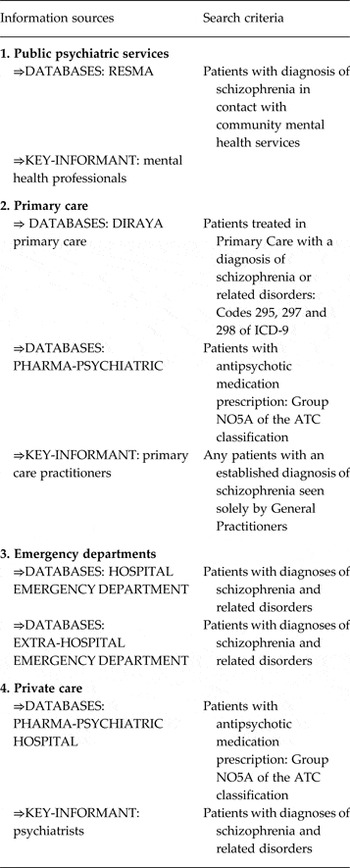
In order to identify the maximum number of possible cases this phase involved a census of all individuals who had contact with any of the health departments at which patients with schizophrenia or related disorders might be seen during 2008. Here and subsequently, as Jablensky (Reference Jablensky2000) did, we use the term ‘mainstream’ to denote the predominantly public psychiatric services (inpatient, outpatient, and day patient services, mental health unit for homeless), general practice centres, emergency department (in-hospital and extra-hospital) and private care (hospital and ambulatory). Complementary to this procedure, and for the purpose of possible case identification, the key informants (GPs and private psychiatrists) were asked to provide a list of patients who fulfilled the diagnostic inclusion criteria (Table 1).
Information sources and search criteria

ATC – Anatomical, Therapeutic, Chemical Classification System.
Confirmatory phase of inclusion criteria
We compared possible cases from all agencies with the RESMA, the latter considered to represent gold standard patients (stage 1). Record linkages between the various data sources were enabled using common information, including such data as health care identification number, identity card number and names. After checking, those patients already included in RESMA were considered as study cases.
Concerning the cases not included in RESMA (possible cases) we made an active search for information about diagnoses and place of residence with mental health services teams, and amended the results as necessary (stage 2).
The field work took place from 2009 to 2010. An introductory letter detailing the project aims, methodology and diagnostic inclusion criteria was sent to all information providers.
This study was approval by the Malaga Health District and Carlos Haya Hospital Ethics Committees. Data confidentiality was guaranteed under Organic Law 15/1999 on the Protection of Personal Data.
Variables included in the analysis
The sociodemographic information gathered for each patient included the following variables: gender, year of birth, marital status, type of living arrangement, educational level and employment status. Data were also recorded on place of residence, considering rural v. urban classified as in our previous study, with Malaga city considered an urban area and all the other municipalities considered as rural (Moreno-Küstner et al. Reference Moreno-Küstner, Mayoral, Rivas, Angona, Requena, García-Herrera, Navas, Moreno, Serrano-Blanco and Bellón2011). Patient residence was considered to be in a socioeconomic deprived area (yes/no) according to the classification of the Andalusian Goverment (Junta de Andalucía, 2004). The clinical diagnoses corresponded to F20–F29 codes of the 10th version of the International Classification of Diseases (ICD-10) (World Health Organization, 1993): schizophrenia (F20), schizotypal disorder (F21), persistent delusional disorder (F22), acute or transient psychotic disorder (F23), schizoaffective disorders (F25), or other and unspecified non-organic psychotic disorder (F28, F29).
Statistical analysis
We calculated the 1-year prevalence rate per 1000 inhabitants for the Mental Health Department of Carlos Haya Hospital in Malaga (Spain). We adjusted rates for population age older than 14 years and gender, which attempts to account for different population age structures (e.g., large numbers of children will lower the prevalence) (Fletcher et al. Reference Fletcher, Fletcher and Wagner2002). The 95% confidence intervals were calculated by the exact method, showing the standard error. The χ 2 test was used to examine for potential differences in the prevalence of schizophrenia and related disorders between gender, dwelling (rural or urban) and socioeconomic area (deprived area or otherwise). A probability level of p < 0.0001 was used to indicate significant differences between groups. Data were analysed using STATA (Stata Corporation, 2009).
Missing data for sociodemographic variables were imputed using the method of multiple imputation based on discrete statistical distribution. For the imputation of the sociodemographic variables (except age and gender, which were not imputed) we assumed discrete statistical distributions defined by the original database values and based on basic statistics (means and standard deviations).
Results
Case-finding procedure
From the RESMA and after revising the diagnoses, place of residence, and contact with services in 2008, 1278 patients were included in the study as gold standard cases.
As the result of the screening phase in the different sources of information (Table 1), a total of 2559 individuals were identified by key informants or from clinical databases as fulfilling the criteria of possible study cases. After cross-checking these with the RESMA we found that 736 were already included in the RESMA while the remaining 1823 were identified as possible cases for whom we had to actively seek information in order to confirm the diagnosis and place of residence. After the active search 1438 were excluded and 385 were considered as new cases for the study and therefore added to the RESMA (n = 1278), giving a total of 1663 (n = 1663) cases included in this study (Fig. 1). The reasons for exclusion were: 974 with no diagnosis of schizophrenia or related disorders, 187 living outside the study catchment area, six had died and 271 lacked sufficient information to be included in the study.
Concerning the key informants, 76 of 165 general practitioners responded to the invitation to participate, giving a responses rate of 46%. Of the 30 private psychiatrists contacted only four (13%) responded, providing information about possible cases. In order to maintain the confidentiality of their patients, they only gave initials rather than full names.
Diagnoses and sociodemographic profile
Schizophrenia was the most frequent diagnosis, accounting for 1052 (63.3%) of the 1-year census sample. A further 268 (16.1%) cases were diagnosed with persistent delusional disorder, and 155 (9.3%) had acute or transient psychotic disorder. Another 108 (6.5%) had schizoaffective disorders. The remaining 80 (4.8%) did not meet the ICD-10 criteria for any of the above diagnoses and were retained in the study sample as a heterogeneous category that included schizotypal disorder (because of the low number of cases), induced delusional disorder, other non-organic psychotic disorders or unspecified non-organic psychosis.
The demographic characteristics of the 1663 patients with schizophrenia or related disorders were: mean age 45.5 years (standard deviation 13.5; range 15–88); 64.7% male; 64.3% single, 25.34% married/cohabiting and 10.4% separated, divorced or widowed. The majority of patients (51.4%) were living with their parents or other relatives, 23.4% with their own family in independent accommodation, 23.4% in sheltered accommodation, 8.8% living alone and 1.2% were homeless. Concerning education, 47.9% had not completed secondary schooling and 19.6% had not attained any school qualification. However, 22.1% had completed secondary schooling and 10.4% had a tertiary education diploma or degree. Concerning employment status, 38.5% were unable to work (receiving benefits), 16.7% were working, 14.2% without work, 9.2% studying, and 6.1% housekeeping; other categories comprised the remaining 15.3%.
Prevalence of schizophrenia and related disorders
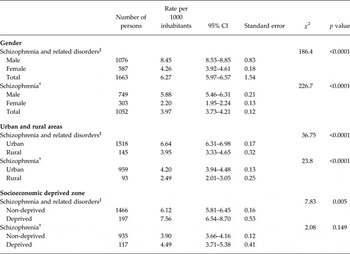
In the catchment study area, the number of prevalent cases in 2008 aged 14 years or older was 1663 for schizophrenia and related disorders and 1052 for the subgroup of schizophrenia only, corresponding to 1-year prevalence rates of 6.27 per 1000 (95% CI, 5.97–6.57) and 3.97 per 1000 (95% CI, 3.73–4.21), respectively (Table 2).
The 1-year prevalence of schizophrenia and related disorders by gender, urban/rural areas and deprived and non-deprived zones

CI, confidence interval.
‡ICD-10 F20–F29 codes or corresponding group of diagnoses.
†ICD-10 F20 codes or corresponding group of diagnoses.
The estimates for schizophrenia and related disorders were higher for men than women: men, 8.45 per 1000 (95% CI, 8.53–8.85) and women, 4.26 per 1000 (95% CI, 3.92–4.61), with a male-to-female ratio of 1.98. For the subgroup of schizophrenia, the rates were: men, 5.88 per 1000 (95% CI, 5.46–6.31) and women, 2.20 per 1000 (95% CI, 1.95–2.24), with a male-to-female ratio of 2.67. The prevalence rate in males was significantly higher than in females, for both schizophrenia and related disorders (p < 0.0001) and for the schizophrenia only subgroup (p < 0.0001).
In the urban area, the prevalence of schizophrenia and related disorders was 6.64 per 1000 (95% CI, 6.31–6.98) while in the rural area the figure was almost half (3.95 [95% CI, 3.33–4.65]) (p < 0.0001). The same pattern was found for the subgroup of schizophrenia, with a prevalence of 4.20 per 1000 (95% CI, 3.94–4.2) in the urban area and 2.49 per 1000 (95% CI, 2.01–3.05) in the rural area (p < 0.0001).
The prevalence of schizophrenia and related disorders was higher in socioeconomic deprived areas, 7.56 per 1000 (95% CI, 6.54–8.7), compared with non-deprived areas, 6.12 per 1000 (95% CI, 5.81–6.45) (p = 0.005) For the subgroup of schizophrenia the respective figures were 3.9 per 1000 (95% CI, 3.66–4.16) and 4.49 per 1000 (95% CI, 3.71–5.38) in non-deprived and deprived areas, respectively (p = 0.149), although the differences were not large enough to reach statistical significance (Table 2).
Discussion
Methodological issues
This study has a number of strengths. First of all, in order to provide the most reliable and valid estimates of the rates of schizophrenia and related disorders we used a two-stage procedure for case identification, gathering extensive information from case registers, clinical databases, case notes and key informants. A sampling procedure on this scale involved a large amount of information resources, a great number of patients included in clinical databases, and a high number of key informants. We therefore considered this an accurate methodology for the identification of a district-based population of people with broadly defined schizophrenia. In addition, although, as it is known that about 0.3 per 1000 patients with schizophrenia or related disorders are not treated by psychiatric services (Jablensky, Reference Jablensky2000) and assuming that some individuals with severe mental illness might never be treated, or have had just intermittent contact with psychiatric services (Katschnig, Reference Katschnig2011), we also included in our study a range of other agencies besides the mental health services. Consequently, this study represents a complete screening of persons with schizophrenia and related disorders as we included all the care organisations considered to have information about these individuals. Thus, users of the mainstream services involved different groups: (i) patients treated in mental health services, (ii) patients under the care of general practitioners, (iii) patients attended by private psychiatrists, (iv) patients in contact only with the emergency departments, (v) patients attended by private psychiatrists and (vi) homeless persons, as in this area there is a mental health team which attends persons living on the street. As far as we know, this is the first study in Spain in which a method including large clinical databases complemented by key informants has been used to determine the prevalence of schizophrenia. Furthermore, we have found no study in the international literature that includes patients with schizophrenia or related disorders from the emergency services (either hospital or extra-hospital) in their calculations of the prevalence rates.
The results, although, should be viewed in light of some possible limitations. Using multiple sources often has the potential to introduce diagnostic misclassifications (reliability) (Byrne et al. Reference Byrne, Regan and Howard2005; Morgan & Jablensky, Reference Morgan and Jablensky2010). However, we tried our best to confirm that all patients included in the study had a diagnosis confirmed by a psychiatrist. Several authors have demonstrated the validity of the clinical diagnoses made by professionals and included in case notes, concluding that the reliability of this diagnostic procedure is satisfactory (Ruggeri et al. Reference Ruggeri, Leese, Thornicroft, Bisoffi and Tansella2000; Aräjarvi et al. Reference Aräjarvi, Suvisaari, Suokas, Schreck, Haukka, Hintikka, Partonen and Lönnqvist2005; Oiesvold et al. Reference Oiesvold, Nivison, Hansen, Skre, Ostensen and Sorgaard2013). Another limitation of our study is the classification of a socieconomic deprived area according to the Andalusian Government, which is based on administrative criteria; although as it is used at the local level to implement more health services it could still be useful in our case. Finally, we are aware that in the statistical analysis we did not take into account possible confounders using a regression analysis to examine the effects of one variable while the others are controlled for. However, future studies will include this type of analysis.
Findings
Global prevalence
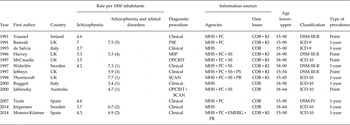
As far as we know, the 1-year prevalence rates for schizophrenia and related disorders of 6.27 per 1000, and 3.97 per 1000 for the subgroup of schizophrenia, for persons aged over 14 years in one catchment area of Malaga are the highest yet found in Spain (Ayuso et al. Reference Ayuso-Mateos, Gutierrez-Recacha, Haro and Chisholm2006; Tizón et al. Reference Tizón, Ferrando, Parés, Artigué, Parra and Pérez2007), but are within the limits of past studies when compared with international studies (Table 3, appendix 1).
To place these findings in a broader perspective comparisons with similar studies conducted elsewhere would be of interest, with the proviso that any such comparisons must take into account the design and methodology of each study, as well as differences related to the background characteristics of the populations, the health care context, the point in time of data collection and the methods of case ascertainment (Anderson, Reference Anderson2013). Despite these methodological aspects, we have attempted to compare our data with those derived from studies published since 1990, especially those most similar to ours in that the patients were selected from a varied range of health services, including mental and primary care or social services and using databases and key informants.
As can be seen in Table 3 (appendix 1), for studies reporting figures for the subgroup of schizophrenia only, de Salvia et al. (Reference de Salvia, Barbato, Salvo and Zadro1993) reported the lowest prevalence rate (2.7 per 1000) using the Case Registry of Portogruaro (Italy). The highest figure was that reported by Bamrah et al. (Reference Bamrah, Freeman and Goldberg1991) in an inner-city population, who found a prevalence rate in Salford (UK) of 7 per 1000. Analysis of those studies that give figures for the whole group of schizophrenia and related disorders shows that the rates range from 3.4 per 1000, offered by Ruggeri et al. (Reference Ruggeri, Leese, Thornicroft, Bisoffi and Tansella2000) from the South Verona Psychiatric Case Register, to the 6.7 per 1000 (the rate most similar to ours, which was 6.9 per 1000), recently reported by Jörgensen et al. (Reference Jörgensen, Dalman and Allebeck2014), although it was extracted from clinical databases of psychiatric services only (Table 3, appendix 1).
Gender prevalence
We found a higher prevalence in males than females. Although recent studies on the prevalence of schizophrenia in the general population found no gender difference (Përalä et al. Reference Përalä, Suvisaari, Saarni, Kuoppasalmi, Isometsä, Pirkola, Partonen, Tuulio-Henriksson, Hintikka, Kieseppä, Härkänen, Koskinen and Lönnqvist2007; McGrath et al. Reference McGrath, Saha, Chant and Welham2008), our results are similar to those of other studies, especially of persons in contact with mental health services (Aleman et al. Reference Aleman, Kahn and Selten2003; Usall et al. Reference Usall, Haro, Araya, Moreno, Muñoz, Martínez and Salvador2007; Morgan et al. Reference Morgan, Castle and Jablensky2008; Iniesta et al. Reference Iniesta, Ochoa and Usall2012; Ochoa et al. Reference Ochoa, Usall, Cobo, Labad and Kulkarni2012; Jörgensen et al. Reference Jörgensen, Dalman and Allebeck2014) and also in agreement with those of McGrath & Susser (Reference McGrath and Susser2009), who concluded that schizophrenia does not affect men and women equally; specifically, for every three affected men there are two affected women. The male-to-female ratio found in our study is higher than that in most studies of the prevalence of schizophrenia but it is consistent with previous studies in Andalusia (Moreno-Küstner et al. Reference Moreno, Arroyo, Torres, Luna and Cervilla2007, Reference Moreno, Mayoral, Pérez, García-Herrera, Algarra, Rivas, Pérez, Becerra and Gornemann2009). A possible explanation for the differences is that the social course of schizophrenia is less favourable in men than in women (Häfner et al. Reference Häfner, Maurer and Heiden2013) and the disorder affects men more seriously, reflected in their greater utilisation of health care services. Thus, when examining treatment prevalence, men are overrepresented because they contact services more often than women over time.
Urban and rural prevalence
The 1-year prevalence of schizophrenia and related disorders in one catchment area of Malaga showed a higher rate in the city than in the rural area, with the same occurring for the subgroup with just schizophrenia. Our data are compatible with other results showing higher prevalence rates in urban v. rural areas (Harvey et al. Reference Harvey, Pantelis, Taylor, Mccabe, Lefevre, Campbell and Hirsch1996; Widerlöv et al. Reference Widerlöv, Lindström and Von Knorring1997). However, our results are in disagreement with two systematic reviews by Saha et al. (Reference Saha, Chant, Welham and McGrath2005) and Kirkbride et al. (Reference Kirkbride, Errazuriz, Croudace, Morgan, Jackson, McCrone, Murray and Jones2012), who found similar prevalence rates in both dwelling areas. We need to better understand what these patterns of distribution of schizophrenia are telling us (Tandon et al. Reference Tandon, Keshavan and Nasrallah2008).
Socioeconomic deprived and non-deprived area and prevalence
Our results showing a higher rate of schizophrenia in socioeconomic deprived areas failed to reach statistical significance. This might be because this classification, done by the Andalusian Government, is based on administrative parameters. However, our results are in accordance with those of Jablensky et al. (Reference Jablensky, McGrath, Herrman, Castle, Gureje, Evans, Carr, Morgan, Koerten and Harvey2000) in that the majority of psychotic persons live in extreme social isolation and adverse socioeconomic circumstances or tend to reside in the most deprived areas (Lix et al. Reference Lix, Deverteuil, Walker, Robinson, Hinds and Roos2007) and are more likely to stay in or migrate to the most socially or materially deprived territories (Ngamini Ngui et al. Reference Ngamini Ngui, Cohen, Courteau, Lesage, Fleury, Grégoire, Moisan and Vanesse2013). Similarly to us, Jörgensen et al. (Reference Jörgensen, Dalman and Allebeck2014) found a correlation between the 1-year prevalence of persons with non-affective psychoses and persons receiving social welfare benefits in the geographical area of Stockholm, and Kirkbride et al. found that greater levels of neighbourhood income inequality and absolute deprivation (neighbourhood social composition) were associated with the incidence of non-affective psychosis (Kirkbride et al. Reference Kirkbride, Jones, Ullrich and Coid2014). Further studies are needed in our local area to better explain the differences between the socioeconomic deprived and non-deprived areas in relation with the distribution of the schizophrenia figures.
Conclusion
The prevalence of schizophrenia and related disorders is not uniform in terms of gender or place (urban/rural). We found high figures for the prevalence of schizophrenia, supporting the idea that multiple sources of information are essential to estimate accurate rates. Such precise estimates of the prevalence of schizophrenia have important repercussions concerning resource allocation and policy planning, because these rates reflect the true burden of the disease in the mental health services. The results also provide an extensive database on persons with schizophrenic disorders as a reference framework for future epidemiological studies.
Acknowledgements
The authors acknowledge the Primary Care District of Malaga, particularly Maximiliano Vilaseca, Francisco Javier Navarro and Patricia Moreno, for their support and also Carlos García (ETEA, Córdoba) for his collaboration. We are also grateful to all the agencies which collaborated with this study offering their databases, especially, from Malaga Primary Care Sanitary District (Pharmaceutical Department, Carmen Vela, Users Department, Ma Dolores Domínguez and Emergency Department, Ana María Martínez), also, from Carlos Haya Hospital (Information System Department) and from San Juan de Dios Hospital (Diego Arenas), and finally, general practices directors and general practitioners and also the private psychiatrists who collaborated with this study.
Financial Support
This study was supported by the Andalusian Government (grant references, 05/353, PI-0338/08, PI-0332/08, P10-CTS-5862, CTS-945) and the Spanish Ministry of Health (RedIAPP, RD06/0018/0039).
Conflict of Interest
The authors declare that they have no conflict of interest.
Ethical Standards
The author asserts that all procedures contributing to this work comply with the ethical standards of the relevant national and institutional Committees on human experimentation and with the Helsinki declaration of 1975, as revised in 2008.
Appendix 1
(Appendix 1). Epidemiological studies (since 1990) reporting prevalence figures of schizophrenia and related disorders in patients seen by health services