Introduction
Disaster Medicine and Disaster Public Health are relatively new and complex disciplines. Although the practices of Disaster Medicine and Disaster Public Health seem to be evolving rapidly, their science is not well-developed. The question, “Why have we not learned from what we have learned?” was raised during the World Health Organization (WHO; Geneva, Switzerland)-sponsored conference convened in 2005 in Phuket, Thailand following the earthquake and tsunami of December 2004. 1 The science of the health aspects of disasters (HADs) has been considered by some to be evidence-informed or eminence-based and not based on scientific evidence.Reference Bradt 2
Science is the pursuit and application of knowledge and understanding of the natural and social world following a systematic methodology based on evidence. 3 Evidence is something that should show that something else exists or is true; 4 the available body of facts or information indicating whether a belief or proposition is true or valid. 5 Science is built on evidence from quality investigations published in the peer-reviewed literature. In an examination of the health aspects of the 2004 earthquake and tsunami in South East Asia, of the more than 1,200 articles and reports examined, only 11% were found in the peer-reviewed literature. In addition, the material referenced was unstructured, making analysis difficult; the terminology used was inconsistent; the material consisted primarily of narrative epidemiological descriptions; and very little information could be found regarding the interventions provided. Most of the information referenced was published in the “grey literature” (non-peer-reviewed magazines, reports, or textbooks). 1 These observations raised some important questions regarding the existing science of the HADs: (1) What is the current state of the peer-reviewed, Disaster Medicine and Disaster Public Health literature? (2) What gaps exist in the available peer-reviewed literature? (3) Are there consistent systematic, qualitative problems with published reports? and (4) Does the published material contribute to developing the science of Disaster Medicine and Disaster Public Health?
Currently, there is no inventory of the types or categories of articles that have been published in the peer-reviewed, disaster health literature. Furthermore, no scheme for the categorization of published articles could be identified. Thus, examination of the peer-reviewed literature was undertaken in order to try to answer the above questions.
Methods
All peer-reviewed articles published from June 2009 through June 2014 in two of the medical journals known for publishing articles related to the HADs, Prehospital and Disaster Medicine (PDM) and Disaster Medicine and Public Health Preparedness (DMPHP), were examined. A categorization system was developed based on a set of descriptors abstracted from the frameworks provided in Research and Evaluations of the Health Aspects of Disasters.Reference Birnbaum, Daily, O’Rourke and Loretti 6 The initial set of categories was tested and modified during an initial examination of consecutive papers published in PDM during 2009-2014. Keywords commonly used in certain study types were collected and used as guides for determining the most appropriate category for each article examined. The categories and definitions that evolved and were utilized for categorization are summarized in Appendix A (available online only).
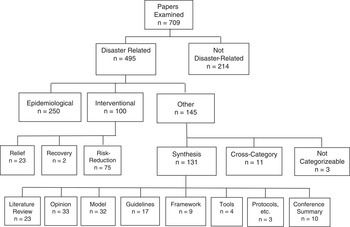
Initially, each article examined was classified either as disaster-related or not disaster-related. Disaster was defined as requiring assistance from outside the affected area or area-at-risk after an event.Reference Birnbaum, Daily, O’Rourke and Loretti 6 Two major categories of the disaster-related articles were identified: (1) Epidemiological; and (2) Interventional (Figure 1). Epidemiology was defined as the science concerned with the study of factors determining and influencing the frequency and distribution of disease, injury, and other health-related events and their causes in a defined human population for the purpose of establishing programs to prevent and control their development and spread;Reference Anderson 7 the study of the incidence and distribution of diseases and of other factors related to health.Reference Thompson 8 No sub-categories for Epidemiological studies were identified.
Categorization Flowchart. Note: Numbers in each box = total numbers of articles assigned to each category and sub-category. Disaster Medicine and Public Health Preparedness and Prehospital and Disaster Medicine 2009-2014.

Interventions are action(s) by humans to prevent, attenuate, create, or enhance change.Reference Thompson 9 Studies identified as Interventional were sub-categorized using the definitions provided in the frameworks for Research and Evaluation: (a) Relief Responses; (b) Recovery Responses; and (c) Risk-Reduction Interventions.Reference Birnbaum, Daily, O’Rourke and Loretti 6
A third category, “Other,” was created for those disaster-related articles that could not be categorized either as Epidemiological or Interventional. The articles in the “Other” category varied substantially, but during a second examination, this category was sub-divided into three subcategories: (a) Synthesis; (b) Cross-Category; and (c) Non-Categorizable. The Synthesis sub-category was further divided into eight sub-categories based on content and methods used: (a) Literature Review; (b) Opinion; (c) Suggested Model; (d) Framework; (e) Guidelines; (f) Tools; (g) Protocol, Policy, or Criteria; and (h) Conference/Congress Summary. The sub-categories of Literature Review; Models; Protocols, Policies, and Criteria; Guidelines; Frameworks; and Tools were comprised of reviews of existing literature and information. The articles in the Suggested/Proposed Model, Protocols, Guidelines, Frameworks, and Tools sub-categories were directed at using available information to develop a proposal. Models articles consisted of descriptions of preliminary work derived from review of available facts/information that could be used to provide a simplified description of a system in order to assist in calculations and predictions.Reference Thompson 10 The Models articles generally included equations to be used in predicting consequences (eg, surges of victims). Frameworks were based on a set of assumptions, concepts, values, and/or practices derived from review.Reference Pickett 11 They provided an essential supporting structure.Reference Thompson 12 Articles were categorized as Guidelines if they consisted of a review and interpretation of information that outlined a suggested course of action.Reference Pickett 13 Protocols articles described a set of rules for interventions based on the information from reviews of the literature and the experience of the authors.Reference Thompson 14 And Tools articles described anything used to perform an operation or to achieve an end. 15 Articles that could not be classified into any one of the categories/sub-categories generally spanned more than one category, or could not be classified into any of the three categories, and were labeled as Cross-Category or Non-Categorizable.
The utility and validity of the categories selected were established during a second blinded examination of the initial articles that were used to establish and test the categories. In this second examination, each article was assigned into the same category as during the first examination. The system then was used to assign each of the subsequent articles examined into its most appropriate category. As it was not possible to assign articles into a category or sub-category using only their title or abstract, the complete article was examined.
During the categorization process, each complete article was projected onto a screen and the four authors examined each article until unanimous agreement on the most appropriate category was reached. The group consisted of two Masters of Public Health (MPH) candidates (now graduated; SA and ED), one senior medical student with a MPH (JRM), and the Emeritus Editor-in-Chief of PDM (MB). Articles with the following journal headings were excluded: Supplement, Editorial, Editorial Comments, Editor’s Corner, A Tribute, Forum, Letter, Commentary, Miscellaneous, Erratum, and Letter to the Editor. No articles from other journals or the “grey literature” were examined.
The number of articles in each category and sub-category was tabulated and the percentages of the total number of articles in each category and their respective sub-categories were calculated. A trend analysis of categories and sub-categories as a percentage of the number of articles published for each year (June 2009 through June 2014) was calculated for each category and sub-category for all of the disaster-related articles.
In addition, during the examination of each complete article, some qualitative observations that were relatively common across many of the articles were noted. These included consistency of terminology across the articles regardless of their category, identification of a common structure of the reports, and a clearly articulated reason for the conduct of the study in the form of an objective or set of objectives. The type of investigation (ie, case study, randomized controlled trial (RCT), comparative controlled trial (CCT), or narrative report) was determined. The types of injuries/diseases sustained and their treatments and morbidities and mortality rates were sought. Was a comprehensive description of the event that caused the disaster included or referenced? And, were the findings applied into additional studies? No statistical analyses of these observations were attempted.
Results
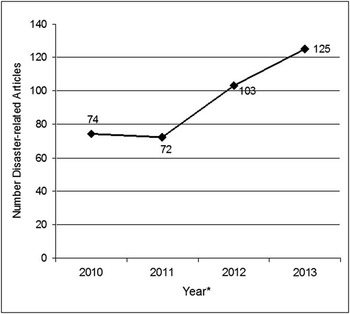
A total of 709 consecutive articles were examined: 454 from PDM and 255 from DMPHP (DMPHP was published quarterly in 2009 through 2011 and bimonthly from 2012 through 2014). A diagram (PRISMA) of the category and sub-category assigned to each of the articles examined and the total numbers of articles classified in each category and sub-category is in Figure 1. Of the 709 articles examined, 214 (PDM, 206 (45.4%); DMPHP, eight (3.2%)) were not disaster-related (Table 1). A total of 495 articles were disaster-related: 248 (54.6%) in PDM and 247 (96.8%) in DMPHP (Table 1). The total number of disaster-related articles increased progressively in both journals from 2010 to 2013 (Figure 2). Data from 2009 and 2014 were not included in this trend analysis as the study included only one-half of each of these years. Eleven of the 495 disaster-related articles (2.2%) were categorized as Cross-Category and three (0.6%) could not be assigned into any of the categories.
Number of Disaster-Related Articles Published/Year. Note: Disaster Medicine and Public Health Preparedness and Prehospital and Disaster Medicine, 2009-2014 (2009 and 2014 not included as data available only for one-half year).

Total Disaster-Related and Not Disaster-Related Articles Examined 2009-2014

Abbreviations: DMPHP, Disaster Medicine and Public Health Preparedness; PDM, Prehospital and Disaster Medicine.
Distributions by Category
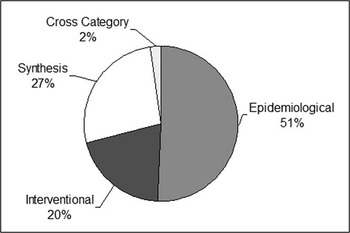
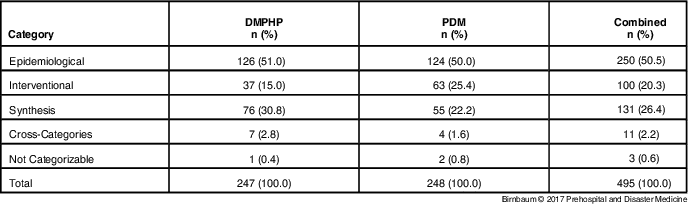
Within the disaster-related category, Epidemiological articles comprised the largest proportion of articles in each journal (Figure 3; Table 2). One-half (50.5%) of the disaster-related articles published were categorized as Epidemiological (PDM, 124 (50.0%); DMPHP 126 (51.0%)). A total of 100 (20.3%) disaster-related articles were categorized as Interventional, and 131 (26.5%) disaster-related articles were categorized as a Synthesis. Prehospital and Disaster Medicine published more disaster-related Interventional articles (63 (25.4%)) than did DMPHP (37 (15.1%)), while DMPHP published more disaster-related Synthesis articles (77 (31.0%)) than did PDM (57 (23.0%)).
Distribution of Articles by Category. Note: n=495; Disaster Medicine and Public Health Preparedness and Prehospital and Disaster Medicine, 2009-2014.

Distribution by Categories 2009-2014

Abbreviations: DMPHP, Disaster Medicine and Public Health Preparedness; PDM, Prehospital and Disaster Medicine.
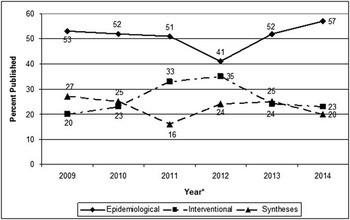
The proportions of disaster-related articles in each category for both journals for each year are plotted in Figure 4. A small decrease in the proportion of Epidemiological disaster-related articles occurred in 2012, while the proportions of Interventional studies increased slightly in 2011 and 2012
Trends of Percent of Published Disaster-Related Articles over Five Years (2009-2014) by Category and Sub-Category. Note: Disaster Medicine and Public Health Preparedness and Prehospital and Disaster Medicine 2009-2014.

Distributions by Sub-Categories
Epidemiological
No sub-categories for the Epidemiological articles were identified.
Interventional
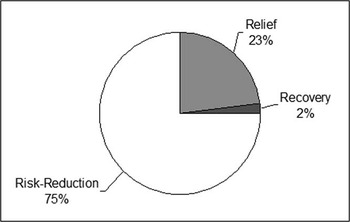
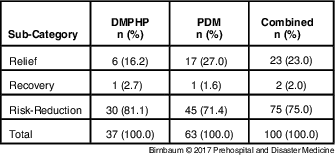
In accordance with the Conceptual and Temporal Research Frameworks,Reference Birnbaum, Daily, O’Rourke and Loretti 6 , Reference Birnbaum, O’Rourke and Daily 16 , Reference Birnbaum, Daily and O’Rourke 17 three sub-categories for Interventional studies were used: (1) Relief Responses; (2) Recovery Responses; and (3) Risk-Reduction Interventions (Table 3; Figure 5). Three-quarters (75; 75%) of the 100 disaster-related Interventional articles were classified as reports of Risk-Reduction Interventions. Only 23 (23%) disaster-related Interventional articles were assigned into the Relief Responses sub-category, while only two articles (2%) could be categorized as Recovery Responses. Prehospital and Disaster Medicine published more Interventional articles (63) than did DMPHP (37; Table 3) in the years studied. Each journal published only one article that was assigned into the Recovery Response sub-category. The Risk-Reduction Intervention articles primarily described educational programs (a course of instruction) in which achievement indices were used as outcomes (number passing a written test or showing improvement between a pre- and post-test). No impacts of the programs on practices were described.
Distribution of Sub-Categories of Interventional Articles. Note: n=100; Disaster Medicine and Public Health Preparedness and Prehospital and Disaster Medicine, 2009-2014.

Distribution of Sub-Categories of Interventional Articles 2009-2014

Abbreviations: DMPHP, Disaster Medicine and Public Health Preparedness; PDM, Prehospital and Disaster Medicine.
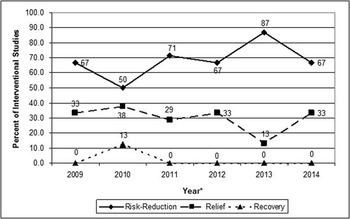
The trends in the proportions of each of these of the three Interventional sub-categories during the period studied are in Figure 6. The proportion of the papers categorized as Risk-Reduction Interventions uniformly exceeded those in the Relief and Recovery Response sub-categories across the five years. With the exception of the years 2010 and 2013, the proportion of Relief Responses and Risk-Reduction Interventions articles remained relatively constant over time.
Trend of Sub-Categories of Interventional Research Category. Note: Disaster Medicine and Public Health Preparedness and Prehospital and Disaster Medicine. NB. Rounding error in 2010; year includes only six months of years 2009 and 2014.

Syntheses
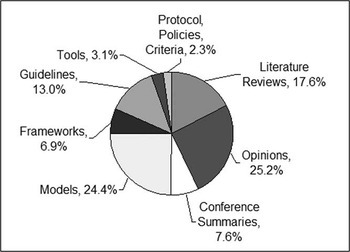
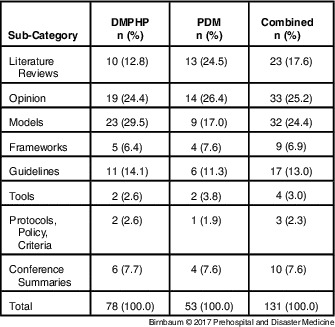
Of the 495 disaster-related articles examined, 131 (26.5%) were assigned into the Syntheses category. One-quarter of the 131 Syntheses articles were assigned into the Opinion sub-category (33 (25.2%)), and another one-quarter were assigned into a Suggested Model sub-category (32 (24.4%); Figure 7; Table 4). Opinion articles comprised one-quarter of the Syntheses in both journals (PDM, 26.4%; DMPHP, 24.4%). Overall, Proposed Models articles appeared more frequently in DMPHP (29.5%) than in PDM (17.0%), and 23 (17.6%) of Syntheses consisted of Literature Reviews (4.6% of the disaster-related articles) and appeared twice as frequently in PDM (24.5%) compared with DMPHP (12.8%). The proportions of articles in the remaining sub-categories were the same between the two journals. Articles in the Suggested Guidelines sub-category comprised 13.0% of the Syntheses articles, while Conference Summaries (7.6%); Frameworks (6.9%); Tools (3.0%); and Protocols, Policies, or Criteria (2.3%) each comprised <10% of the articles classified as Syntheses. Articles classified as a Suggested Model, Protocol, Guideline, Framework, or Tool consisted of a proposal derived from existing information (directed review of literature); none were validated in actual or simulated disaster settings. Articles assigned into the Literature Review sub-category of Synthesis articles consisted of collection of information from multiple sources followed by syntheses and conclusions based on the syntheses. Opinions based on discussions and experience, but not labeled as Editorials, occurred more frequently than any of the other Synthesis sub-categories. Only 10 articles (8% of Syntheses and 2% of all disaster-related articles) consisted of summaries of major conferences/congresses. No systematic reviews were published in either journal during 2009-2014.
Distributions of Sub-Categories of the Syntheses Articles. Note: n=131; Disaster Medicine and Public Health Preparedness and Prehospital and Disaster Medicine, 2009-2014. Suggested Models, Protocols, Guidelines, Frameworks, or Tools.

Distributions of Sub-Categories of Suggested Elements of Synthesis Articles 2009-2014

Abbreviations: DMPHP, Disaster Medicine and Public Health Preparedness; PDM, Prehospital and Disaster Medicine.
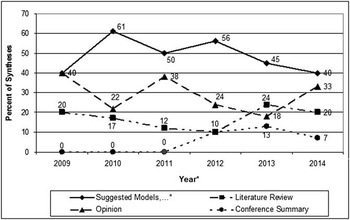
The trends of the proportions of disaster-related articles in the sub-categories of the Syntheses category are in Figure 8. The proportions were relatively consistent across the period. Due to the relatively small numbers of articles in each of the sub-categories, no individual trends were plotted for Models, Frameworks, Guidelines, or Tools.
Trend Analysis Over Five Years by Percent and by Sub-Categories of Synthesis Category. Note: Disaster Medicine and Public Health Preparedness and Prehospital and Disaster Medicine, 2009-2014.

Qualitative Observations
Several common features of the articles were observed, although the numbers of each were not accounted. No common terminology was used. The same terms were used in similar contexts but with different meanings. No common structure was used in articles within the same category or sub-category. Only rarely was the purpose/objective/hypothesis of the study clearly stated in the Introduction. Abstracts and Titles often did not accurately reflect the features of the actual study. Methods used were poorly described and many seemed inadequate for the Conclusions reached.
Epidemiological articles mostly consisted of case studies. No common structure was used for the descriptions. Generally, the reports tended to be very broad with little detail. Descriptions of the precipitating event were superficial and incomplete (only the type of event, the time of onset, and magnitude (when available); eg, earthquake, December 26, 2004, magnitude 8.0) were provided. Often, the structural damageReference Birnbaum, Daily, O’Rourke and Loretti 6 to relevant structures was superficially described and the functional damage and needs generated by the structural damage sustained were not specified. For example, the numbers of dead, missing, injured, and displaced typically were the only variables accounted. The number of medical facilities structurally damaged may have been noted, but the compromises of functions that resulted were not described.
Interventional articles also followed no common structure. No RCTs or CCTs (quasi-experimental) were reported. Few studies were published by non-governmental or inter-governmental organizations, and hence, it was unclear as to what was done, who did it, and what happened. Outcomes were limited to the reporting of achievements indices (how many were done/completed). Outcomes or impacts were not reported. For the most part, the studies were broad and lacked focus. No systematic reviews of disaster-related health interventions were published.
The articles included in the Syntheses sub-category also had no common structure. The reasons for conducting the study often were not explicitly explained and the Methods used for the synthesis often were unclear. The Models, Protocols, Guidelines, Frameworks, and Tools that were suggested were logical and derived from a synthesis of “evidence,” but none were validated in actual or simulated settings. They were proposed, but not used. The Opinion articles were based on the Syntheses of experiences and available information by “experts.” The information used often included impressions derived from the “grey literature” (non-peer-reviewed). Each of the Models; Protocols, Policies, or Criteria; Guidelines; Frameworks; and Tools articles were a logical development based on selection and interpretation (synthesis) of information abstracted from the available literature combined with experience. No reports of testing or direct application of any of the components of suggested elements were discovered during the examination process; they were suggestions based on the synthesis of selected information.
Discussion
The current state of research into the HADs as reflected by the findings in this study is not surprising given that: (1) research into the HADs still is in its infancy; (2) the breadth of the field (including a multitude of dependencies on other health-related and non-health-related disciplines) is larger than that of many other health disciplines; and (3) the logistical limitations posed by the very nature of disasters and other emergencies create difficulties in the ability to conduct research.
Science is built on evidence published in peer-reviewed articles. This study provides an inventory of the articles relative to the HADs that have been published in two of the major peer-reviewed medical journals that concentrate on emergencies and the HADs.
While the actual numbers of disaster-related articles increased progressively and substantially during the study period, the major contributing factor was the increase in the frequency of publication of the DMPHP journal from quarterly to bimonthly. However, this increase in the number of articles published during that period did not change the distributions of the proportions of disaster-related articles in each category or sub-category.
The system/scheme used in the categorization process was developed using the published Disaster Research frameworks.Reference Birnbaum, O’Rourke and Daily 16 - Reference Birnbaum, Loretti, Daily and O’Rourke 21 Initial attempts to categorize articles based on the publication titles and the criteria for assignment using only the Abstracts or Keywords were unsuccessful. The Abstract often did not clearly reflect important information included in the body of the article. Consequently, in order to assign each article into an appropriate category and sub-category, the complete article was examined. Greater efforts must be directed into the construct and contents of the Abstracts of the published articles.
Overall, there were few differences detected between the distributions of disaster-related articles published in the two journals. These minor differences did not affect the conclusions drawn from the inventory. The trend analyses indicate that the distributions of articles essentially remained unchanged over the course of the study. This finding adds credence to the methodology and indicates that the findings should be reproducible. Little changed during the period of study.
Epidemiology
Articles assigned into the Epidemiological category dominated the publications. The primary purpose of conducting Epidemiological studies relative to disasters is to determine what happened, why it happened, what to expect next time an event occurs, and to suggest interventions that likely will decrease the likelihood that a hazard will produce in a disaster. The Epidemiological articles consisted primarily of individual case studies. However, the science relative to the Epidemiology HADs depends on repeated, similar finding in a synthesis of many case studies or reports. Single studies describing the Epidemiology of an event and its consequences do contribute to the body of evidence, but by themselves do not build the science.
In the analysis of the health effects of the earthquake and tsunami of 2004, the lack of structure made identification of the common and the different findings difficult. In order to codify what actually happened in the affected countries, the material had to be structured using the Conceptual, Temporal, and Societal Systems Frameworks provided in the Research and Evaluations frameworks of Birnbaum et al.Reference Birnbaum, O’Rourke and Daily 16 - Reference Daily, Birnbaum and O’Rourke 18 Without a common structure that can be used for comparisons, it is difficult to identify commonalities and differences. The lack of structure in the Epidemiological articles examined impedes the generation of knowledge of what to expect during and following the next event. Risks and changes in levels of risk were not identified, estimated, or discussed in the Epidemiological studies examined in the current study.
The lack of sufficient descriptions of the event that resulted in the disaster makes it difficult to project what could be expected from a future similar event in the same, similar, or even a dis-similar setting. Without adequate descriptions of the event, it is not possible to assess the differences in the relative absorbing capacities of the structures damaged or not damaged.
The Epidemiological studies examined tended to be very broad and lacked focus. Although the numbers of persons killed, missing, injured, evacuated, and/or displaced often were provided, such limited information provides little upon which to base future actions. The mechanisms of injury/transmission of the disease, where and when the injuries/illness occurred, types, location, and severity of injuries/diseases (severity scores); along with their respective mortality rates and types and severities of the residual morbidities, the locations and times at which the deaths occurred (ie, prehospital, receiving facility, or referral facility), why they died, treatments provided and where they were delivered, indirect injuries/diseases, co-morbidities and vulnerabilities, and estimations of possible preventable deaths were not provided. Although the number of victims displaced internally or as refugees often were accounted, descriptions of where they were settled and what happened to them short-, medium-, and long-term were not included, nor were the burdens imposed on the health care facilities discussed.Reference Birnbaum, Daily, O’Rourke and Kushner 20
Often, the numbers of health facilities structurally damaged were reported, but generally, the types and locations of the damage were not specified and the associated functional damages (compromised functions) and the impact of the compromised services were not described.
Such incomplete reports do not contribute to the design of Risk-Reduction Interventions. More medical and public health information is required to make appropriate changes (Risk-Reduction) and to determine the priorities for such changes. The use of common Frameworks (ie, Conceptual, Temporal, and Societal SystemsReference Birnbaum, O’Rourke and Daily 16 - Reference Daily, Birnbaum and O’Rourke 18 ) should be required for future publication of Epidemiological studies.Reference Kulling, Birnbaum, Murray and Rockenschaub 22
Interventional Studies
Interventions are actions provided to create change. Disaster-related Interventional studies are essential to provide the evidence needed to establish best practices for a given setting. Given the current operational emphasis on “responses,” 23 it was expected that reports of disaster-related interventions would have comprised a greater proportion of the articles published. However, reports describing disaster interventions made up only one-fifth of the disaster-related studies published over the time period in the two journals. One-quarter of these described Relief Responses, while only two reports described a Recovery Response. Thus, very little evidence has been generated about which Interventions really work and which do not during and following an event. Relief Responses aim to limit further deterioration in functions related to the structural damage sustained from the precipitating or subsequent events, or to fill gaps in functions due to the inability of the community to meet the needs created by the functional damages. Reports of comprehensive disaster-related Interventional studies are necessary to develop and test new interventions.
Recovery Responses are directed towards restoring the pre-event levels of function. Reports of interventions directed towards recovery basically were absent. There was nothing in these two journals leading to improved recovery to pre-event levels of function.
It is presumed that many, many reports of Relief and Recovery Interventions have been generated by responding organizations (after-action reports). However, the information contained within such reports is not readily accessible and does not appear in the peer-reviewed literature, and therefore, does not contribute to establishing the evidence needed to support standards and best practices. This valuable information is lost to science. 24 , Reference Overtveit 25
Three-quarters of the published articles of disaster-related interventions were assigned into the Risk-Reduction sub-category. These papers consisted mainly of descriptions of educational programs (a course of instruction). Generally, the outcomes only used achievement indices that described the differences between examination scores completed before and following a course of instruction. The impact of such knowledge changes on performance during actual or simulated multi-casualty events was not reported. Reporting of achievement indicators (how many were accomplished) does not contribute to the science, but achievement indicators may have relevance to planning, especially as related to the costs of the intervention being considered. Certainly, the impact of Risk-Reduction Interventions is very difficult to assess. Often, demonstration of the impact cannot be assessed until the next event happens in the same or similar setting, or through evaluation during exercises and/or drills (see Epidemiological studies above).
No disaster-related RCTs were reported during the time period encompassed by this study. It is recognized that RCTs may not be logistically or ethically possible during the Relief phase of a sudden-onset event. The use of RCTs was debated during the Thematic Working Session on Research convened by the WHO in January 2016, 24 but no conclusions were reached. However, it may be possible to design and conduct RCTs during the Recovery phase or for Risk-Reduction (development). The use of RCTs in the study of the HADs requires further discussion and study. Additionally, no reports of non-randomized (quasi-experimental) CCTsReference Overtveit 25 were identified. The use of quasi-experimental studies may have an important role in the study of the HADs.
In addition, many Interventional articles lacked a clear definition of the goals and objectives of the intervention, and thus, the outcomes and impacts of the interventions could not be defined.Reference Birnbaum, Daily, O’Rourke and Kushner 20 And, as there were no RCTs, CCTs, or systematic reviews of interventions published in these two journals, it is difficult to identify which interventions work and which do not work in a given setting
The current state of disaster health-related Interventional articles indicates that: (1) there is a paucity of reports on Relief and Recovery Interventions; and (2) existing reports are unstructured and difficult to compare and synthesize.
Syntheses
Synthesis articles comprised one-quarter of all the disaster-related articles published in the two journals. Given the inherent limitations in conducting and reporting of research in disaster health, Syntheses are essential for the development of the science of Disaster Medicine and Disaster Public Health. Syntheses amalgamate the available evidence into useful information that can be translated into the science and practices of appropriate organizations and personnel.
Syntheses of multiple disaster Epidemiological studies are used to identify what to expect, to define the impacts of applied Risk-Reduction Interventions, and to recommend interventions to improve the epidemiology associated with the next event. They facilitate the identification of the absorbing, buffering, and response capacities of the affected communities and their respective Societal Systems.Reference Daily, Birnbaum and O’Rourke 18 Syntheses of disaster Interventional studies are used to define the best practices that reflect the standards, and adapt them to a given setting.Reference Overtveit 25 , Reference Pickett 26 Without the structure provided by RCTs, facts are established by identifying commonalities through comparisons with similar studies. Given the absence of RCTs and CCTs in the peer-reviewed literature of the HADs, in order to establish facts, it is necessary to synthesize the results from similar studies.Reference Bradt 2 This also applies to comparative, controlled, non-randomized studies (quasi-experimental; lower level of evidence 1 ). For example, the WHO has published many narrative reports that have no consistent structure. 1 Without a common, useful structure, such narrative reports are difficult to synthesize with other reports, and consequently have not contributed much to the science of HADs.
Published summaries of congresses/conferences were subjected to peer-reviews as part of the process used to select papers/abstracts for presentation (oral and posters, and plenary and focus group sessions). However, caution must be exercised in applying the information presented in the Conference Summaries given the observation that the Abstracts often did not accurately reflect the Methods and findings of the research. Such summaries should be considered informational and provide a low level of evidence,Reference Bradt 2 , Reference Bradt 27 even though they may contain important information for consideration and perspective. Plenary sessions reflect the views of the presenter and hence, are biased to the presenter’s beliefs. Information presented during congresses and conferences should be referenced and considered as evidence-informed or eminence-based evidence.Reference Bradt 2 , Reference Bradt 27
Opinion articles comprised an average of 25% of the disaster-related Synthesis articles (seven percent of all disaster-related papers). In some of the years examined, Opinions articles comprised as much as 40% of the articles assigned into the Synthesis category. Opinion articles are based primarily on carefully selected elements of the relevant literature synthesized with the knowledge and expertise of the author(s). Regardless of the recognized expertise of the authors, the opinions/conclusions provided may be biased by the selection of the information used to support or form the opinion.Reference Bradt 2 , Reference Overtveit 25 Opinion articles do shape perspectives and focus attention, may set the stage for future research and study, and may play a future role in assigning priorities for systematic reviews pertaining to understanding the epidemiology and establishing standards and best practices.Reference Pickett 26 - 29 However, care must be exercised in applying the conclusions provided in such Opinion articles due to the bias inserted by the authors.
Many Models were developed relative to assessing Disaster Medicine. The reasons for these differences are beyond the scope of this inventory. None of the Results or Conclusions from these Models were validated by applications in disaster settings or exercises.
The disaster-related Syntheses articles published also had no common structure, and thus, were difficult to assimilate making their potential contributions to the science of the HADs unclear. Further analysis seems warranted. More rigorous syntheses and analysis are required to develop higher levels of evidence than can be derived from the currently published works. Codification of the evidence from such articles will depend on systematic reviews.
Lastly, a Cross-Category was created as a category of exclusion for studies that did not fit into any one of the other disaster-related categories; only three articles would not fit into any of the designated categories. Perhaps, the criteria were constructed in such a way that enabled the creation of this category of exclusion. However, these few exceptions add credence to the value of the categorization scheme used in the current study.
There were some differences in the proportions of the articles assigned from the two journals. However, these differences were minimal and do not subtract from the significance of the findings in terms of the objectives of this study. Overall, the distributions were sufficiently similar to allow combining the data from the two journals.
Many publications within the same categories were inconsistent in the terminology used and how it was used; the terms used often were defined differently. Even the term disaster was used in various ways ranging from a condition following an event in which the affected community or the community-at-risk required outside assistance to meet the needs, to meaning the event itself (ie, a hurricane was labeled as the “disaster” rather than as a consequence of the event that resulted in a disaster).Reference Birnbaum, Loretti, Daily and O’Rourke 30
Limitations
There are several limitations to this study. Only papers published in two of the current, peer-reviewed disaster health journals were categorized. It is not known whether similar examinations of papers published in other journals would change the overall distributions of papers assigned into their respective category/sub-category. However, the two journals reviewed publish the bulk of English language papers related to the HADs.
In addition, information contained in the “grey literature” was not studied. Although, important information contained in papers published in the “grey literature” may influence the opinions and practices, science is built on evidence provided in the peer-reviewed literature or derived from systematic reviews that may include “grey literature” in the process. Inclusion of the information published in the “grey literature” may be of value, especially in the development of standards and best practices from interventions provided.Reference Hemingway and Brereton 28 - 31
This project was not intended to evaluate the scientific quality of any of the articles examined. It is an attempt to inventory what has been published. It did not include any evaluation of the content, including the appropriateness of the needs for the study, the Methods used for data collection and processing, or for the validity of the Conclusions reached.
Recognizing the current infancy of Disaster Medicine as a discipline, building the science of disaster health will require substantial time. Yet, there is a pressing need to synthesize what is known into readily useful information that will help to identify the essential gaps in research and establish priorities for the research necessary to fill these gaps. This study, hopefully, will assist in moving the science of disaster health to the next level. The information provided is meant to point to ways in which this next step may be achieved, and is not meant to be critical.
In order to further evaluate and increase the external validity of the categorization criteria used in the current study, additional studies must be conducted to validate and further refine the classification system so that a final form may be used to build a structured, disaster-related health literature repository.
Summary
The answers to the four questions posed in the Introduction follow:
1. What is the current state of the peer-reviewed literature related to the HADs?
The literature is unstructured and lacks uniform terminology. It largely is eminence-based or evidence-informed and lacks the rigor associated with scientific investigations. The disaster-related Epidemiological studies tend to be shallow case studies and the Interventional studies do not include essential information (ie, outcomes, impacts, and costs). Therefore, the scientific evidence is sparse and the Syntheses are replete with opinions and the bias of the authors.
2. What gaps exist in the available peer-reviewed literature?
There were no randomized, controlled, experimental or non-randomized, quasi-experimental studies or systematic reviews published in either journal in the time period studied. More information about the Epidemiology (ie, description of the event and its impacts (or potential impacts; risks) on health) is needed to be able to compare and synthesize the studies. Little has been reported relative to disaster Relief and Recovery Interventions—it is not known what was done and by whom, why it was done, or what outcomes and impacts resulted from the interventions. Costs associated with the interventions have not been accounted.
3. Are there consistent systematic problems with published reports?
The lack of structure and common terminology impair the ability to synthesize the results from multiple studies and evolve common findings. Greater depth is needed for all studies.
4. Does the published, peer-reviewed material contribute to developing the science of disaster health?
The contributions of the current literature add little to the science of the HADs. Structuring of the available material will be required to contribute to the scientific database.
Conclusions
The current study provides an inventory according to categories of the peer-reviewed, health-related disaster publications from 2009-2014 in two prominent Disaster Medicine journals. Given that all of the articles examined lacked a uniform terminology and structure, the science is fragmented and analysis is difficult. Epidemiological studies comprised the majority of the papers, but they lacked the detail needed to apply the findings into planning for the next event, especially as related to the probable impact of the hazards on human health and mechanisms to reduce the risks for the development of disasters. Similarly, Interventional studies lacked a common language and structure, as well as descriptions of outcomes and impacts. Although it is known that many interventions are provided during the Relief and Recovery phases of a disaster, there is little evidence in the peer-reviewed literature to support best practices for a given setting. There is an absence of articles describing Recovery Responses and a remarkable paucity of studies of Relief Responses. Risk-Reduction articles consisted primarily of descriptions of educational programs that used achievement indices as the only outcome. None were validated in either actual disaster settings or exercises. Syntheses articles were unstructured and must be viewed with caution due to bias. No systematic reviews were published.
Research into the HADs is in its infancy, and it must move to the next step in the generation of evidence that will provide the discipline with information required to understand the epidemiology of the HADs, evaluate the utility of Risk-Reduction Interventions, and to develop standards and best practices for interventions. A road map with carefully established priorities for research into the HADs for the development of the science must be agreed and acted upon.
Acknowledgements
The authors are grateful for the editorial assistance and advice provided by Elaine Daily in the critique and preparation of this manuscript. Special thanks to Cambridge University Press for facilitating access to both Prehospital and Disaster Medicine and Disaster Medicine and Public Health Preparedness. The work was carried out at the Emergency Education Center of the University of Wisconsin Hospital and Clinics (Madison, Wisconsin USA).
Supplementary Material
To view supplementary material for this article, please visit https:/doi.org/10.1017/S1049023X17006525