INTRODUCTION
The South American fur seal Arctocephalus australis (Zimmermann, 1783) is found in central Peru and Brazil, southwards to Tierra del Fuego and in the Falkland Islands, where its population is estimated to be between 18,000 and 20,000 animals (Strange, Reference Strange1992). Unlike some other species of fur seals, this population is not migratory, though some movement away from breeding sites occurs in midwinter. Fur seals are known to breed at about ten sites, the most important colony being that at Bird Island (52°10′11″S 60°56′07″W), which accounts for about 10,000 seals (Strange, Reference Strange1992; Thompson & Moss, Reference Thompson and Moss2001). The breeding season begins in early November with the majority of births occurring in December. Lactation lasts for six to twelve months (Strange, Reference Strange1992).
Factors affecting seasonal distribution of fur seals in Falkland waters are poorly known. A total of fourteen fur seals from the Bird Island colony were satellite tracked during October 1999 to September 2000 (Thompson et al., Reference Thompson, Moss and Lovell2003). These data provide a good source of information for this colony's foraging range and timing of feeding activity. Observations from fishery patrol boats by scientists from Falklands Conservation demonstrated occasional presence of the species more or less all over the Falkland shelf and upper slope with an increase of abundance during offshore foraging in June–July (White et al., Reference White, Gillon, Black and Reid2002).
This paper aims to describe the species distribution on the western, southern and eastern Falkland shelves and its relation to the oceanographic situation around the Falkland Islands. It was possible to do this in October 2007, during large-scale survey of spawning grounds of red cod, Salilota australis and around, which is the period immediately before the start of the breeding season.
MATERIALS AND METHODS
Data on fur seal occurrence have been collected at 73 oceanographic stations (60 during daylight hours and 13 at night time) that were carried out, between 4 and 21 October 2007 onboard RV ‘Dorada’, depth-range 50–1100 m. A logging CTDO (current, temperature, depth and oxygen) (SBE-25, Sea-Bird Electronics Inc., Bellevue, USA) was deployed from the surface to 1–20 m above the bottom to obtain profiles of temperature (°C), salinity (PSU), and dissolved oxygen (ml l-1). Temperature was measured directly whereas the other variables were calculated using Seasoft v.4.326 software (Sea-Bird Electronics Inc.) from the following measured parameters: pressure (db), conductivity (S/m), oxygen current (μA) and temperature (°C). For each station, vertical profiles of temperature, salinity and density were constructed using the Seasoft software. Iso-surfaces were constructed using the VG gridding method included in the Ocean Data View package v. 3.0-2005 (Schlitzer, Reference Schlitzer2006).
Presence/absence, number and sex of fur seals at every station were recorded by the author during all the period of CTDO deployment. Because seals invariantly were coming for close inspection of CTDO, there was no need to use binoculars because they were just a few metres distant. They remained mostly at port side where the device was deployed and followed behind the boat that drifted starboard forwards that simplified estimation of their numbers. Because there were never more than five animals (usually one to three), a possible mistake is negligible. Seals remained at the boat during all the period of observation. It never happened that seals did arrive, did leave, and then did return—a situation when double-counting is possible. Only stations surveyed during daylight were taken into account when analysing data, because at night seals for some reason never came to the boat.
RESULTS
Fur seal behaviour
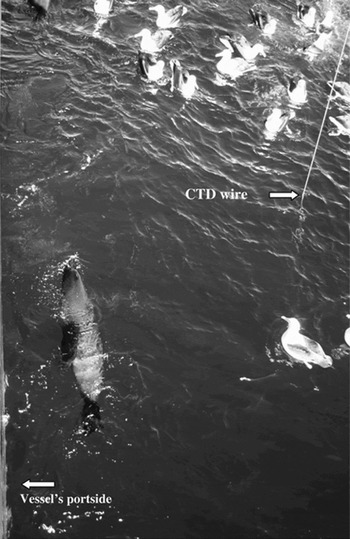
The duration of each oceanographic station varied from 5 to 70 minutes, usually 5–15 minutes (time for the boat to slow down and to start sailing again is not taken into account). Fur seals, if they did appear, arrived to the port side in 1–3 minutes after the CTDO deployment (Figure 1). Their presence was regardless of whether the vessel had just hauled a catch onboard before the CTDO or if the vessel had just arrived at the trawl site. Also, they were observed regardless of whether the vessel was discarding a catch after sampling or not. Animals were represented mostly by females and subadults (82%) though some adult males were also observed (18%).
A fur seal at CTDO deployment.

Occasionally some animals were seen feeding on discards but usually they were just inquisitive, moving towards and backwards the port side and diving around the hydrological cable. Many of them seemed playful doing fake attacks on black-browed albatrosses Thalassarche melanophyis, and giant petrels Macronectes giganteus, that were either sitting on the surface or scavenging. On one occasion (51°57S 61°51W, depth 171 m) a male fur seal was seen repeatedly bringing to the surface discarded hoki, Macruronus magellanicus, and albatrosses were seen feeding on this fish.
Fur seal distribution
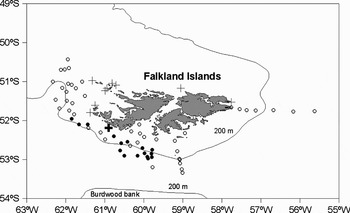
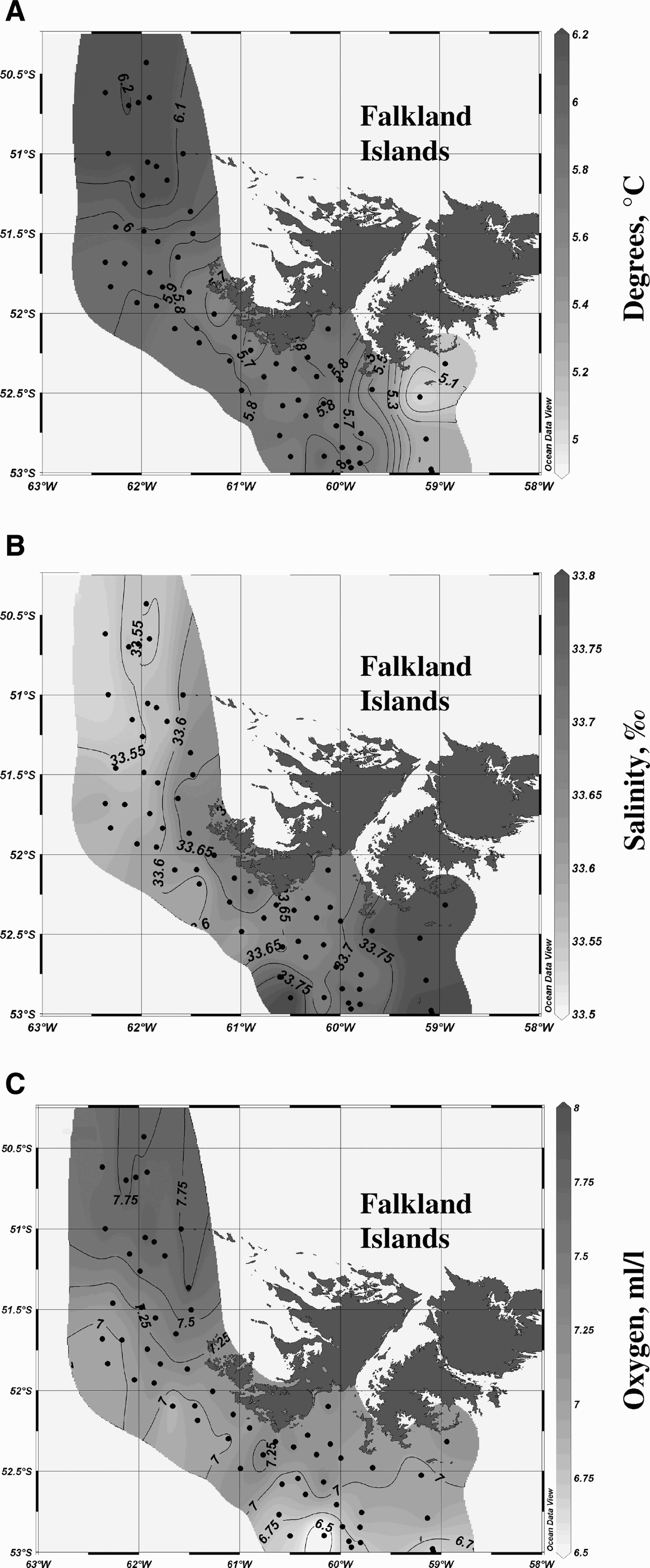
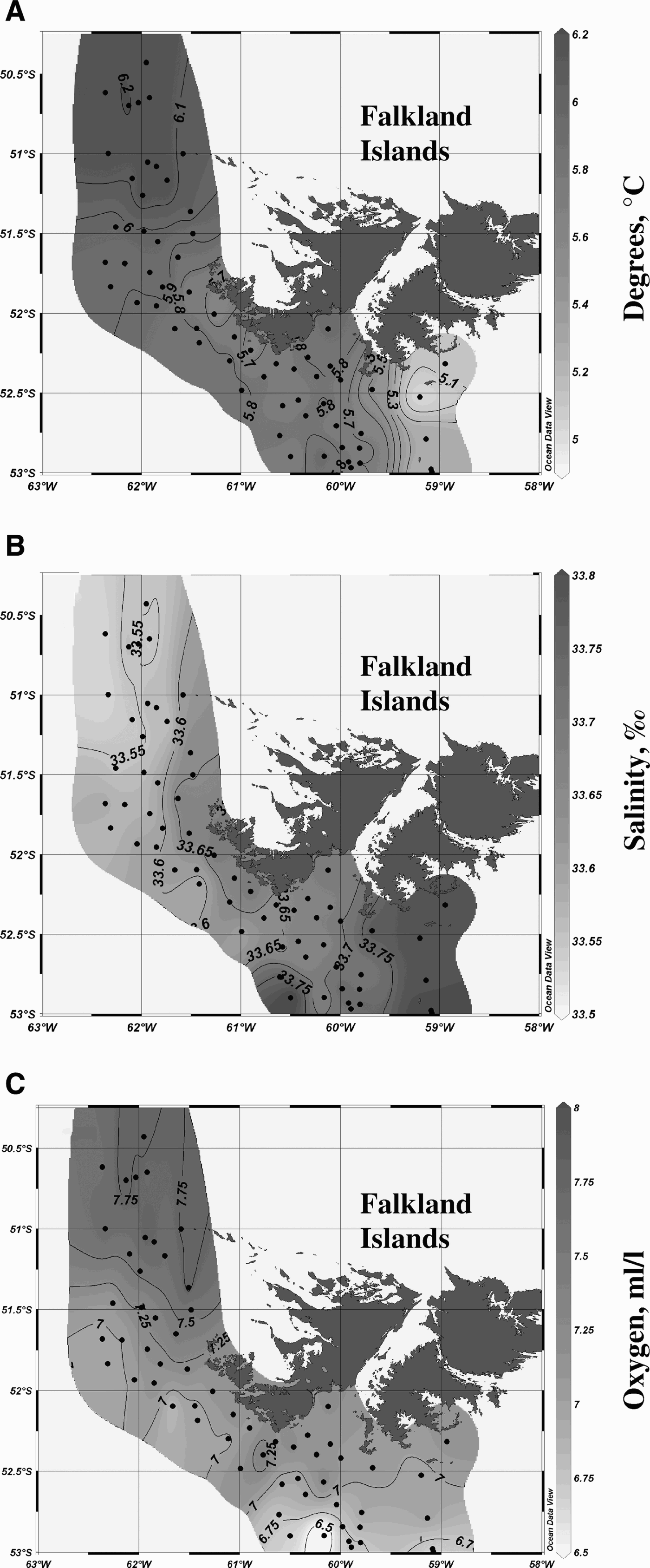
Fur seals were recorded south and south-west of West Falkland, west of 59°30W and south of 52°S (Figure 2) and were present in numbers varying from 1 to 5 per station. Seal distribution to the east was restricted by a frontal zone situated between isotherms 5.2 and 5.4°C and isohaline 33°75‰ (Figure 3) so animals obviously did not penetrate into the main stream of the relatively cold and saline Falkland Current. On the western side their distribution extended until the inflow of relatively warm (>5.9°C), less saline (<33.6‰) and rich in oxygen (>7.25 ml/l) waters of the Argentine Drift. Generally, fur seals were foraging in waters over the shelf edge, above the depth-range 155–478 m.
Positions of oceanographic stations in October 2007 that were visited during daylight (open circles). Stations where fur seals were observed are shown by filled circles. Crosses denote fur seal breeding colonies locations (from Strange, Reference Strange1992); that of the Bird Island is shown by a thick cross.

Surface temperature, °C (A) and salinity, ‰ (B), and oxygen, ml/l (C) in October 2007.
DISCUSSION
Fur seals are curious creatures and it is likely that the inquisitiveness was a good reason for them approaching the vessel, although an expectation of feeding on discarded fishery offal was also possible. Arctocephalus spp. are known to play with captured or discarded fish at the sea surface sometimes without the intention of eating it (Martin, Reference Martin2004; author's own observation in offshore Namibian and Falkland waters). Probably this play behaviour unintentionally developed into the observed ‘feeding of albatrosses’.
Swimming speed in A. australis is about 1–1.5 m/second (Thompson et al., Reference Thompson, Moss and Lovell2003). Because fur seals always appeared shortly after the beginning of the oceanographic station, it is possible that animals were attracted to the boat from a distance of no more than 1 km. It means that the collected data provide a good picture of the spatial distribution of the fur seal population in the area. Satellite tracking data indicated that seals apparently forage with no clear water-depth preference, between 50 and 600 m and mean duration of the female foraging trip in October–December is 126 hours (Thompson et al., Reference Thompson, Moss and Lovell2003). This means that fur seals were present at sea during night oceanographic activity but were not attracted to the boat.
The range of fur seal distribution south-west of the Falkland Islands could be split into two parts. The larger of them, east of 61°W, coincided with that tracked in two adult females from the Bird Island colony between June and September (figure 5E in Thompson et al., Reference Thompson, Moss and Lovell2003). In the second, smaller part, alongside of a 200 m isobath between 61°W and 62°W, no seals from this colony were recorded during the study by Thompson et al. (Reference Thompson, Moss and Lovell2003). Probably, this smaller area is a foraging ground of animals from another breeding site, because in fur seals foraging areas are colony-specific (Boyd et al., Reference Boyd, Staniland and Martin2002; Baylis et al., Reference Baylis, Page and Goldsworthy2008a).
The foraging grounds found in this study coincided with a zone of quasi-stationary eddies and a periphery of the upwelling area that occurs at divergence of the Falkland Current into eastern and western branches. This upwelling could be seen (Figure 2) as a region with high salinity (>33.75‰), low temperature (<5.8°C) and low oxygen (<6.75 ml/l). Such a use of productive periphery of upwelling waters for foraging by fur seals is known in A. forsteri off Australia (Baylis et al., Reference Baylis, Page and Goldsworthy2008b).
From a biological point of view, foraging area of the fur seals south-west of the Falklands is the region of the highest abundance of the lobster krill, Munida spp. (Clausen et al., Reference Clausen, Arkhipkin, Laptikhovsky and Huin2005). This crustacean is the most important food resource of fur seals off the Falklands (Strange, Reference Strange1992; Thompson & Moss, Reference Thompson and Moss2001) and like krill, Euphausia superba that represent bulk of prey of Antarctic fur seals, A. gazella in South Georgia (Klages, Reference Klages1996). It is also where spawning of both red cod, Salilota australis, and the southern bluewhiting, Micromesistius australis, occurs in August–October close to the 200 m isobath (Pajaro & Macchi, Reference Pajaro and Macchi2001; our data) that probably provide fur seals an opportunity to hunt this fish. It is noticeable that although the squid Loligo gahi was found in the fur seals' diet, seals generally neither breed nor forage in the zone of the maximum squid abundance south-east of the islands. Probably they found it difficult to sustain themselves on this highly seasonal resource, where other prey is relatively scarce.
Distribution of fur seal colonies around the Falkland Islands is certainly influenced by the availability of preferred breeding grounds which are rocky elevated sites with shelving rock faces or steep incised ridges (Strange, Reference Strange1992). In contrast to this, position of foraging grounds probably depends on distribution of prey. Fur seals often target particular oceanographic features where food is aggregated, like upwellings and frontal zones (Baylis et al., Reference Baylis, Page and Goldsworthy2008a, Reference Baylis, Page and Goldsworthyb). In spite of the colony-specificity of foraging grounds, there are distinct seasonal (Thompson et al., Reference Thompson, Moss and Lovell2003; Baylis et al., Reference Baylis, Page and Goldsworthy2008b) and inter-annual (Lea et al., Reference Lea, Guinet, Cherel, Duhamel, Dubroca, Pruvost and Hindell2006) differences in foraging distribution of fur seals, Arctocephalus spp. depending on distribution of oceanographic factors. Seasonal variations in intensity and position of both Falkland Current and Argentine Drift could be the reason for seasonal changes in direction of lactating females' trips that were found in seals of Bird Island colony where sometimes seals can switch their foraging grounds at the same date (Thompson et al., Reference Thompson, Moss and Lovell2003). Knowledge of oceanographic factors influencing feeding behaviour of fur seals is necessary to judge about possible impact of global climate changes on their populations.
ACKNOWLEDGEMENTS
The author sincerely thanks Dr A.I. Arkhipkin and A.M.M. Baylis, as well as three anonymous referees for valuable comments, and Judith Brown for editing the English.