Mighty oaks from little acorns grow. From the acorn-like micro-ethnography of an “ecological” village in Sichuan, Christof Lammer’s Performing State Boundaries proposes to grow a mighty oak, a whole new way to see the state in China and elsewhere, along with a complex vocabulary to describe it.
Lammer’s overarching thesis is that when we view the state as substance (as Weber, Marx, and liberals all did or do), or when we view it as relations (as political anthropologists tend to do), we are missing something. Both substantive and relational models are, according to Lammer, based on the idea that there is a constant and discernible boundary between state and non-state. Even talk of a blurred boundary is still too essentialist. Instead, Lammer suggests, the best way to see the state is as a web of fluid and shifting boundaries that vary as they are performed by different actors on different “stages.” A person, a document, an organization, an artifact, can be state at one time or from one angle or in the eyes of one person (including themselves) and non-state at another time or at the same time in someone else’s eyes. When we see the state this way, the endless disputes about whether China has a civil society, whether Chinese state–society relations are still premodern, whether China’s state works differently from those in the “West” because of historically deep cultural differences, even whether the Chinese state is authoritarian or not, all disappear into the essentialist trash-bin of intellectual history. We should replace them in our thinking by seeing the state in China (and by extension, anywhere else) as the performance of boundaries or, in the most central of Lammer’s neologisms, boundary work.
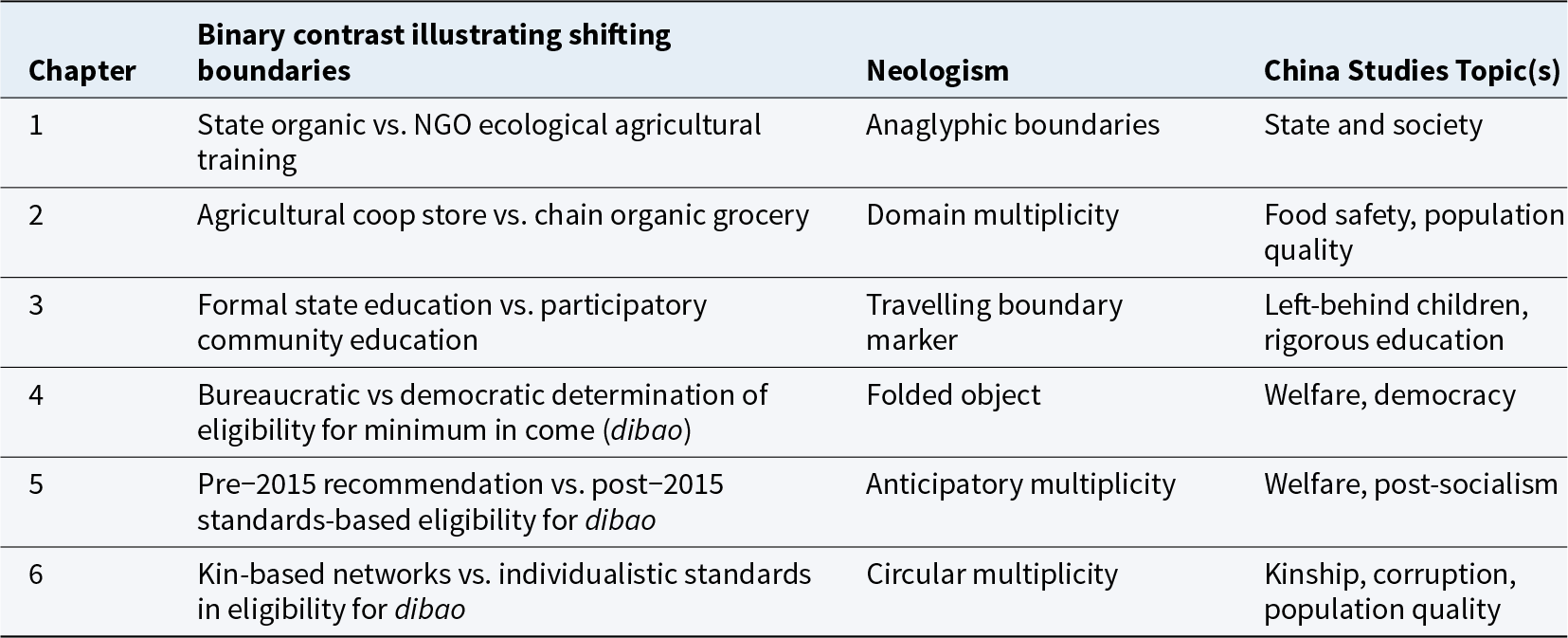
Lammer states this thesis in his introduction and refines and systematizes it in his conclusion; in-between are six substantive chapters about Daxi and neighbouring villages in Qiuling Township, Yinhe County (all pseudonyms), about an hour’s drive from Chengdu. The chapters are formulaic – each centres around a rich ethnographic anecdote illustrating a contrast between two ways in which state boundaries are performed in the same process. In addition to narrating each process, Lammer also discusses (often exhaustively) pertinent theoretical debates about the issues raised, characterizes the multiplicity of boundaries with a neologism, and reflects on the implications of that situation for a topic in China studies. The first three chapters deal with aspects of relations between rural folk, urban people of goodwill (consumers, philanthropists, or both) and bureaucrats; the last three chapters all deal with determining rural households’ eligibility for dibao, or guaranteed minimum household income. Table 1 summarizes these chapters.
Structure of chapters

Lammer’s ethnographic narrations are detailed and fascinating, and demonstrate beyond any reasonable doubt his bona fides as a careful and attentive ethnographer. For example, in chapter one, he shows how his local mentor Dong Jie (a pseudonym) manipulates his own dual identity as township agronomist (a state cadre) and Daxi native (a local community member) in two different agricultural training sessions, and thus shifts state boundaries to include and exclude himself for different audiences on differing stages. In the first session, held in an auditorium with the audience facing PowerPoint-presenting experts speaking from a dais, Dong introduces state programmes of organic agriculture. In the second, held in the office of a village ecological rice mill with participants sitting around a circular table, Dong collaborates with food-activist NGOs to introduce community-centred programmes of ecological agriculture. Not only does Dong himself move from inside to outside the state boundary, but the agricultural practices of a village trying to make money off “green foods” are in one context part of a state-led, top-down, modernizing project, and in another context part of a community-led, bottom-up, counter-modernist project. There is no doubt that Lammer’s vision of the state defined by its shifting boundaries fits this situation much better than conventional models of state-society relations.
In another example, in chapter three Lammer relates the story of an NGO-sponsored summer camp for so-called left-behind children (whose grandparents care for them as their parents are off working outside Sichuan) to illustrate how programmes to rectify the (sometimes disputed) school-and-career disadvantages these children encounter exemplify both “Material care as a marker of the father-state” (p. 104) and “Emotional care as a marker of mother-society” (p. 105). The NGO simultaneously promotes the modernist idea of the nurturing nuclear family (grandparents are not good substitutes for mother and father) and the romantic, communitarian idea of what is lost when organic rural communities are disrupted by the very modernization that has deprived the poor children of the village that it takes to raise a child. From one perspective the boundaries of the state’s activities include care for left-behind children, and from another they force the children outside the purview of state activities and into the warm bosom of community and NGO.
Examples such as these abound and are valuable just as instances of what really happens in a Sichuan village, both because of and despite state policies and the boundaries they create and shift. At another level, the combination of Lammer’s meticulous ethnographic description and observation with his compulsive theoretical systematization raises epistemological issues of categorization and generalization. Everyday life is messy and does not come in categories; when we try to make sense of what happens, we perforce reduce experience to categories and pigeonholes. Doing this raises the question of whether the clarity and possible insight gained from categorizing analysis is worth the cost of the faithfulness to the messy facts of reality that we have traded away. Lammer is not quite sure, and thus proposes to create a new, more complex analytical framework of categories to replace what he sees as the simplistic frame of state-society relations. In his conclusion, he presents “an analytical vocabulary to grasp different dimensions of state boundaries’ complexity” (p. 216) consisting of eight kinds of multiplicity: domain, segregated, anaglyphic, temporal, folded, anticipative and circular. Is this finer-grained analytic framework more useful for understanding the Chinese state than the old dichotomies of state and society, traditional and modern, authoritarian and democratic?
The most important question here is whether it is possible to grow two great oaks – a new way of seeing the state and a new way of seeing China – from the little acorns of a few meetings in one village in Sichuan. Daxi is a small place, and dibao is a minor programme. Lammer has certainly made intriguing use of his narrow-but-deep personal experience. As a result, there are sprouts. Whether they turn into great trunks and branches in Chinese studies or in the study of the state depends on whether and how others decide to nurture them.