Introduction
Hazelnut is an economically important tree nut crop with a world market valued at over $2 billion in 2018 (FAO 2021). The United States accounts for about 3.5% of the global hazelnut production; the vast majority of the 36,000 ha of US hazelnut production is in Oregon (USDA 2021). These orchards are grown in western Oregon in the Willamette Valley because of the ideal climatic and edaphic conditions there. Rainfall exceeds 120 cm yearly and is primarily concentrated in winter and early spring. The dry summer and early fall facilitate the mechanical harvest of hazelnut. Hazelnuts grow naturally as a multi-stem bush, but they are trained as single-trunk trees to allow mechanical harvest (Mehlenbacher and Smith Reference Mehlenbacher and Smith1992). The trees are spaced at 6 m between rows to allow ample light penetration into young orchards, promoting greater flower density and yields (Hampson et al. Reference Hampson, Azarenko and Potter1996). The orchard floor is kept level and weed- and debris-free to allow for efficient mechanized harvest. Newer orchards are drip irrigated during the dry spring and summer months. Irrigation improves hazelnut growth and yield. Several weed species thrive in hazelnut orchards; weed management is essential to reduce weed competition and promote efficient harvest (Kaya-Altop et al. Reference Kaya-Altop, Haghnama, Sarıaslan, Phillippo, Mennan and Zandstra2016). Two perennial weeds, field bindweed and Canada thistle are especially troublesome, because control options are limited.
Field bindweed is deep rooted, grows vigorously, and is drought tolerant. These characteristics strengthen its survival capability (Davis et al. Reference Davis, Mangold, Menalled, Orloff, Miller and Lehnhoff2018; Degennaro and Weller Reference Degennaro and Weller1984). Its shoots resume growth and emerge when daytime temperatures are close to 14 C, and nighttime temperatures are ≥2 C (Whitesides Reference Whitesides1979). Shoots emerge in late March to April in Oregon’s Willamette Valley (personal observation, M.L. Moretti), and foliage is killed by autumn frost, often first occurring in late October or November. Roots of field bindweed survive the winter and resume growth the following season. The negative impacts of field bindweed in hazelnuts include direct competition with the crop and interference with the harvest. The abundant foliage and long shoots entangle the harvest brushes that sweep the nuts off the orchard floor. Management of field bindweed is most effective with systemic herbicides in mode-of-action Groups 4 and 9 (Davis et al. Reference Davis, Mangold, Menalled, Orloff, Miller and Lehnhoff2018); 2,4-D and glyphosate are the options registered in hazelnuts (Moretti Reference Moretti and Peachey2022). Applications of 2,4-D (0.56 kg ae ha−1) or a mixture of 2,4-D (0.56 kg ae ha−1) with glyphosate (0.57 kg ae ha−1) suppressed field bindweed in drylands (Enloe et al. Reference Enloe, Westra, Nissen, Miller and Stahlman1999b; Westra et al. Reference Westra, Chapman, Stahlman, Miller and Fay1992). In addition to the limited efficacy of 2,4-D in controlling field bindweed, glyphosate use in hazelnuts is often restricted to the dormant period to avoid exposing suckers to glyphosate, which causes tree damage. This overlaps the period when field bindweed is dormant. Growers manage field bindweed with postemergence herbicides such as carfentrazone and glufosinate that provide short-term suppression followed by field bindweed regrowth.
Canada thistle is likewise a problem in hazelnut orchards. Its extensive creeping root system allows it to spread locally. The vigorous growth of vertical stems, reaching over 1.8 m, when coupled with the prolific production of windborne seeds, makes this perennial weed a prolific invader (Tiley Reference Tiley2010). Shoots emerge between April and May, whereas flowering begins in early June and continues throughout the summer. Shoots are then killed by autumn frosts. Currently registered postemergence herbicides such as mesotrione (Armel et al. Reference Armel, Hall, Wilson and Cullen2005), rimsulfuron (Sprague et al. Reference Sprague, Frasier and Penner1999), 2,4-D (Anonymous 1996), and glufosinate suppress Canada thistle but require multiple applications for proper control (personal observation, M.L. Moretti). Herbicide mixtures are often more effective in controlling Canada thistle (Davis et al. Reference Davis, Mangold, Menalled, Orloff, Miller and Lehnhoff2018; Zargar et al. Reference Zargar, Bayat, Lyashko and Chauhan2019), but control is limited by the low number of effective herbicides currently registered for use in hazelnut orchards. A similar scenario is observed for field bindweed control in this crop. Thus, increasing the herbicide options to manage field bindweed and Canada thistle in hazelnut is important for herbicide resistance management.
Quinclorac and clopyralid are synthetic auxin herbicides, herbicide Group 4, documented to control field bindweed and Canada thistle, respectively. Quinclorac belongs to the quinoline carboxylic acid family; it has both foliar and soil activity with a 210-d soil half-life and preemergence activity, which generally lasts 3 to 5 wk (Grossmann Reference Grossmann1998; Shaner Reference Shaner and Shaner2014a). Quinclorac controlled field bindweed better than glyphosate or 2,4-D (Enloe et al. Reference Enloe, Westra, Nissen, Miller and Stahlman1999b). Foliar and soil uptake of quinclorac was shown to be essential for best performance (Enloe et al. Reference Enloe, Nissen and Westra1999a), likely because of the more significant acropetal movement of quinclorac (Lamoureux and Rusness Reference Lamoureux and Rusness1995). Irrigation or rain promotes root uptake of quinclorac. Clopyralid is grouped with the picolinic acid chemical family and has foliar and soil activity as well. Its soil persistence is 12 to 70 d (Shaner Reference Shaner and Shaner2014b). Clopyralid was shown to control Canada thistle at rates as low as 140 g ae ha−1 when applied with petroleum adjuvants (Renner Reference Renner1991). Efficacy is greater when clopyralid is applied to plants at the rosette stage than at the bolting stage; the greater effectiveness of clopyralid at the rosette stage was associated with increased translocation to the roots (Miller and Lym Reference Miller and Lym1998). Rain or irrigation events also facilitate clopyralid uptake from the soil and contribute to Canada thistle control (Donald Reference Donald1988; Hall et al. Reference Hall, Bestman, Devine and Born1985).
Current literature is lacking regarding the tolerance of hazelnut to either quinclorac or clopyralid. Both field bindweed and Canada thistle emerge in Oregon in the spring. This is also the season when rain is most frequent and soil moisture is most consistently available, making it an optimum period to apply these herbicides. The objectives of this study were to evaluate hazelnut tolerance to quinclorac and clopyralid during the growing season and evaluate their efficacy when applied alone or in mixtures for the management of field bindweed and Canada thistle.
Materials and Methods
Field studies were conducted to evaluate hazelnut tolerance to and weed control by quinclorac and clopyralid in hazelnut orchards. In all studies, treatments were applied using a CO2-pressurized backpack sprayer calibrated to deliver 187 L ha−1 at 137 kPa applied at 4.8 km h−1. The spray boom was equipped with three TeeJet AI-11002 nozzles (TeeJet Technologies, Springfield, IL) placed at 45 cm above the ground such that 1.5 m on each side of the tree row was covered. One application consisted of a single pass on each side of the trees.
Hazelnut Tolerance to Quinclorac and Clopyralid
Field studies were conducted at three commercial orchards near Amity (45.11° N, 123.20° W), Canby (45.26° N, 122.69° W), and Corvallis (44.45° N, 123.36° W) in Oregon’s Willamette Valley during 2019 and 2020. The Amity study was carried out in a 2-yr-old drip-irrigated orchard located on a Woodburn silt loam soil. This orchard had been interplanted with ‘McDonald’ and ‘Wepster’ hazelnut cultivars spaced at 3 m by 6 m and at a 50:50 mix, in which every other tree was one of the two varieties. The Canby study was conducted in a 1-yr-old orchard with the same varieties, spacing, and soil type as Amity, but without irrigation. The Corvallis study was conducted in a sprinkler-irrigated 5-yr-old nursery of the cultivar ‘Jefferson’ hazelnuts spaced at 1.5 m by 1.5 m. The soil type was a Willamette silt loam (Soil Survey Staff 2022). Soil pH and organic matter content ranged from 6.2 to 6.5 and from 4% to 6% across all sites, respectively, and within the region commonly observed range.
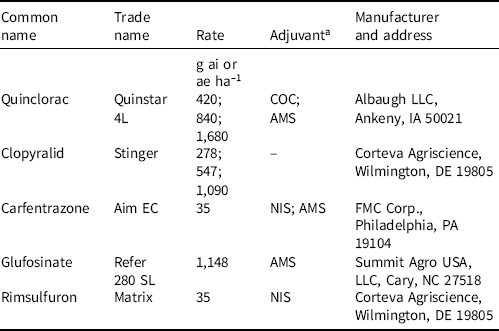
At each location, hazelnut was treated with quinclorac at 420, 840, and 1,680 g ai ha−1 or clopyralid at 278, 547, and 1,090 g ae ha−1. Herbicide formulations and adjuvants are included in Table 1. Herbicides were applied once yearly, with the first application taking place in May 2019 and repeated in April 2020. All studies were designed as randomized complete blocks and replicated four times. Experimental blocks were placed on individual planting rows. The hazelnut tolerance studies experimental units consisted of plots of three to four hazelnut trees. Plots were irrigated, fertilized, and kept weed-free following the grower’s standard practice.
Efficacy studies of herbicides for hazelnut crop tolerance and weed control in Oregon in 2019 and 2020.

a Abbreviations: AMS, ammonium sulfate (BroncMax; Wilbur Ellis, Aurora, CO) added at 1% v/v; COC, crop oil concentrate (Mor-act Crop Oil; Wilbur Ellis, Aurora, CO) added at 1% v/v; NIS, nonionic surfactant (Rainier; Wilbur Ellis, Aurora, CO) added at 0.25% v/v.
Assessments included visual estimates of crop injury on a scale of 0 (absence of injury) to 100% (complete kill). Crop injury was rated at 0, 14, 90, and 455 d after initial treatment (DAIT). Crop tolerance was also quantified via tree biometric evaluations: tree trunk caliper was measured at 0.5 m above ground level at 265 DAIT and 556 DAIT and converted to trunk cross-sectional area (cm). The length of one leader shoot (i.e., the most developed shoot) per plant was measured, corresponding to three to four measurements per plot; nodes of selected shoots were also counted. These data points were used to calculate internode length at 556 DAIT. Leaf chlorophyll content was measured at 420 DAIT using a leaf chlorophyll content meter (CCM 300; Opti-Sciences, Hudson, NH); one fully developed leaf was measured per tree, with three to four measurements performed in each experimental unit. Tree height and width were measured in two directions for each tree. Canopy volume was calculated by the formula for the volume of a cylinder (Hill et al. Reference Hill, King, Zollinger and Moretti2021). Measurements were performed at 420 DAIT and 584 DAIT. Because of tree removal, these variables could not be quantified in 2020 (year 2) for the Corvallis trials. Tree growth was compared by evaluating percent change over the study period at each location. Yields were recorded in 2020 in Corvallis and Amity by harvesting nuts from all trees in a plot with a push-behind harvester (Bag-a-Nut, Jacksonville, FL). Trees at Canby did not yield as a result of their juvenility.
Weed Control Study
Two additional field studies were conducted to evaluate the efficacy of selected herbicide treatments on field bindweed and Canada thistle. The first trial was conducted near Corvallis, OR, where field bindweed and Canada thistle were present. The 4-yr-old rainfed hazelnut orchard was planted to cv. ‘Jefferson’ at 3 m by 3 m in a Chealis silt loam soil. Treatments included clopyralid (278, 547, or 1,090 g ae ha−1) sprayed alone or mixed with carfentrazone (35 g ai ha−1) or glufosinate (1,148 g ai ha−1), and a nontreated check. A nonionic surfactant (NIS) (Rainier; Wilbur Ellis, Aurora, CO) was included at 0.25% v/v when carfentrazone was included in the treatment mixture. Ammonium sulfate (AMS) (BroncMax; Wilbur Ellis, Aurora, CO) was added to treatment mixtures containing either carfentrazone or glufosinate per label instruction. Treatments were applied in May 2020 when field bindweed shoots were approximately 15 to 50 cm in length, and Canada thistle plants were about 25 cm in height, both in vegetative growth stages.
The second study was conducted in Newberg, OR (45.30° N, 122.97° W). The 4-yr-old orchard had been treated previously with glufosinate, and field bindweed had regrown. Treatments included quinclorac (420 g ae ha−1) with crop oil concentrate (Mor-act Crop Oil; Wilbur Ellis, Aurora, CO) and AMS, applied either alone or mixed with carfentrazone (35 g ha−1) or rimsulfuron (35 g ha−1). The latter two sprays included 0.25% v/v NIS and AMS when not mixed with quinclorac, and a nontreated check was included. Treatments were also applied in May 2020 when field bindweed shoots were ≤50 cm in length.
Field bindweed and Canada thistle control were visually assessed at 14 and 24 d after treatment (DAT) using a scale of 0–100% representing absence and complete kill, respectively. Percent ground cover was assessed using digital image analysis (Ali et al. Reference Ali, Streibig, Duus and Andreasen2013) by taking a single photograph of the ground per plot at 1.3 m above the soil surface. The RGB image was segmented using the scientific image-analysis program ImageJ (Image Processing and Analysis in Java; National Institutes of Health, Bethesda, MD), with the color threshold macro set at 46–120, 0–255, and 20–255 for hue, saturation, and brightness, respectively. The output was a binary format, and the number of pixels was quantified as the proportion of total pixels. Weed ground coverage was digitally assessed at 16 and 24 DAT for the Corvallis study and 20 DAT for Newberg. Finally, field bindweed aboveground biomass was determined by harvesting, drying, and weighing samples collected at 20 DAT from a 0.25-m−2 area per plot. Experimental units consisted of 12-m2 plots, replicated four times, and arranged as complete randomized blocks.
Data Analysis
Data were subjected to ANOVA using RStudio 2021.09.1 build 372 (RStudio Team 2021). Experimental sites, evaluation timing, and treatment were considered fixed effects, whereas experimental blocks and their interactions were treated as random effects. Field bindweed and Canada thistle control, weed coverage, and crop injury were analyzed with the glmmTMB package (v. 1.1.2.3) by employing a generalized linear mixed model (GLMM) with beta error distribution (Brooks et al. Reference Brooks, Kristensen, van Benthem, Magnusson, Berg, Nielsen, Skaug, Machler and Bolker2017). The aboveground biomass, chlorophyll content, internode length, trunk cross-sectional area, tree canopy volume, and hazelnut yield were log (x + 1) transformed and analyzed in a linear mixed-effect model with lmer function in the lme4 package (v. 1.1–27.1) (Kniss and Streibig Reference Kniss and Streibig2020). The emmeans package (v. 1.7.0) and the cld function with Sidak’s test (P ≤ 0.05) were used to separate treatment means when appropriate (Kniss and Streibig Reference Kniss and Streibig2020; Lenth Reference Lenth2019; Šidák Reference Šidák1967).
Results and Discussion
Hazelnut Tolerance to Quinclorac and Clopyralid
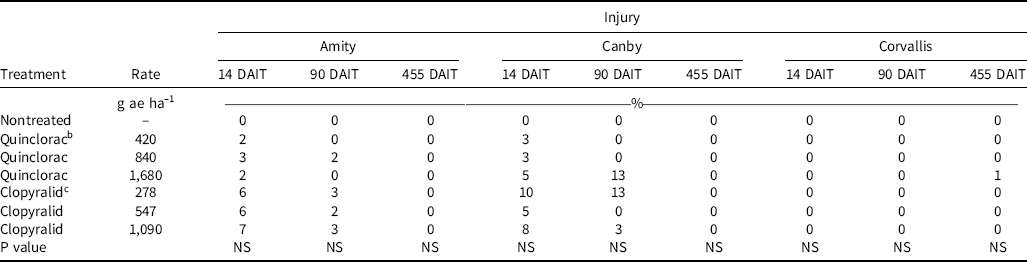
Experimental site and evaluation timing were significant effects for all data analyzed; hence these were analyzed independently by each timing and site combination. Crop injury from clopyralid or quinclorac was minimal at all rates and sites and did not differ from the nontreated control (Table 2). Injury symptoms observed included subtle leaf cupping and chlorosis of the leaf border and were observed principally on hazelnut suckers or lower canopy leaves. None of the treatments controlled hazelnut suckers (data not shown).
Hazelnut injury in response to basal-directed applications of quinclorac and clopyralid at three commercial orchards in the Willamette Valley of Oregon. Treatments were applied in the spring of 2019 and reapplied in the spring of 2020.a

a Abbreviations: DAIT, d after initial treatment in May 2019; NS, nonsignificant (P > 0.05).
b Crop oil added at 1% v/v spray solution, and ammonium sulfate added at 2.5% v/v.
c Nonionic surfactant added at 0.25% v/v spray solution.
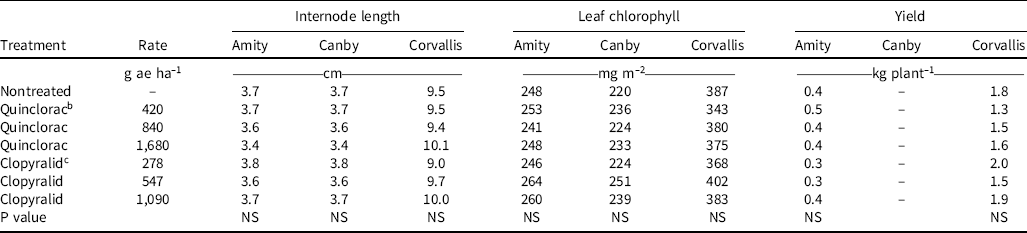
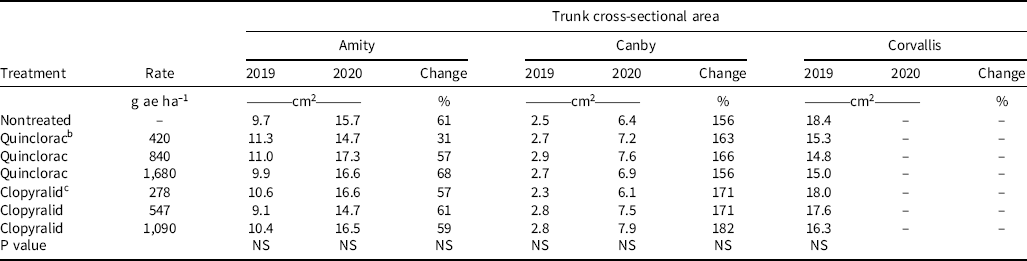
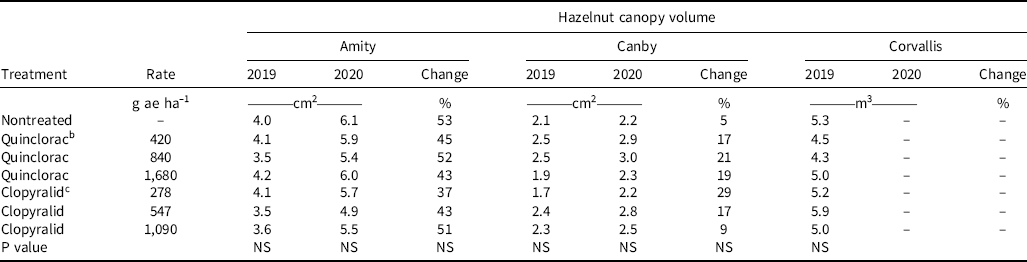
Hazelnut tolerance to quinclorac and clopyralid was also evident by the absence of any effect on internode length at any site (Table 3). Nor was leaf chlorophyll content affected, with values ranging from 224 to 264 mg m−2 in Amity and Canby and 343 to 402 mg m−2 in Corvallis. Similarly, there were no significant differences among treatments in internode length, leaf chlorophyll content, and hazelnut yields (Table 3), which averaged 0.4 to 1.6 kg plant−1 in Amity and Corvallis, respectively. Measurements of trunk cross-sectional area and canopy volume confirm that hazelnuts tolerate quinclorac and clopyralid. No effect was observed on trunk cross-sectional area or canopy volume at any site or year, even on 1-yr-old trees in Canby (Tables 4 and 5).
Hazelnut internode length, leaf chlorophyll content, and yield in response to basal-directed applications of quinclorac and clopyralid at three commercial orchards in Oregon. Treatments were applied in spring 2019 and reapplied in spring 2020.a

a Abbreviations: NS, nonsignificant (P > 0.05).
b Crop oil added at 1% v/v spray solution and ammonium sulfate added at 2.5% v/v.
c Nonionic surfactant added at 0.25% v/v spray solution.
Hazelnut trunk cross-sectional area in response to basal-directed application of quinclorac and clopyralid at three commercial orchards in Oregon. Treatments were applied in spring 2019 and reapplied in spring 2020.a

a Abbreviations: NS, nonsignificant (P > 0.05).
b Crop oil added at 1% v/v spray solution and ammonium sulfate added at 2.5% v/v.
c Nonionic surfactant added at 0.25% v/v spray solution.
Hazelnut canopy volume in response to basal-banded application of auxinic herbicides in commercial orchards in Oregon. Treatments were applied in spring 2019 and reapplied in spring 2020.a

a Abbreviations: NS, nonsignificant (P > 0.05).
b Crop oil added at 1% v/v spray solution and ammonium sulfate added at 2.5% v/v.
c Nonionic surfactant added at 0.25% v/v spray solution.
Weed Control Study
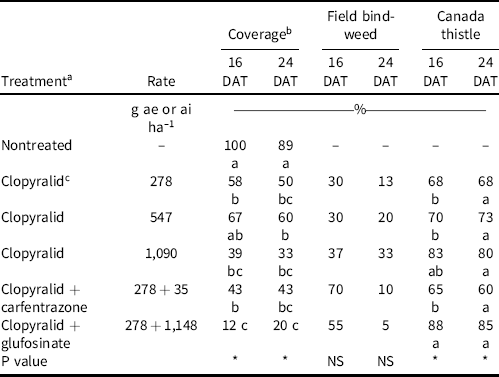
All treatments reduced weed ground coverage relative to the nontreated control in the Corvallis study (Table 6). The lowest coverage was observed with clopyralid (278 g ae ha−1) plus glufosinate (1,148 g ai ha−1). Clopyralid at 278 to 1,090 g ae ha−1 suppressed but did not control field bindweed; control levels ranged from 30% to 70% at 16 DAT and decreased to 5% to 33% at 24 DAT. Mixing clopyralid with carfentrazone or glufosinate did not improve field bindweed control.
Weed ground coverage and control of field bindweed and Canada thistle at 16 and 24 d after treatment (DAT) with clopyralid alone or mixed with carfentrazone or glufosinate in a 3-yr-old hazelnut orchard in Corvallis, OR. Treatments were applied in spring 2020.a

a Abbreviations: –, Not included in the analysis; *, significance at P ≤ 0.05.
b Means (n = 4) within a column followed by the same letter are not different based on Sidak’s significance test (P ≤ 0.05).
c Nonionic surfactant added at 0.25% v/v spray solution.
Canada thistle control ranged from 65% to 88% with clopyralid, regardless of the rate or mixtures tested. Furthermore, Canada thistle control with clopyralid did not change between 16 and 24 DAT, indicating no regrowth had taken place up to 24 DAT and indicating a clear window of time for the mechanical harvest of the nuts. Combinations of clopyralid with carfentrazone or glufosinate did not improve control of Canada thistle. Clopyralid did not control field bindweed (<33%) at 24 DAT. Mixtures of clopyralid with carfentrazone or glufosinate provided an initial control of field bindweed, but there were no treatment differences at 16 or 24 DAT. Canada thistle control levels with clopyralid were much lower than those reported by Renner (Reference Renner1991), who reported excellent Canada thistle control following clopyralid applications at rates as low as 140 g ae ha−1. Canada thistle control in this study (∼70%) was slightly lower than results by Enloe et al. (Reference Enloe, Lym, Wilson, Westra, Nissen, Beck, Moechnig, Peterson, Masters and Halstvedt2007), who reported that clopyralid at 420 g ae ha−1 resulted in 81% to 86% control of Canada thistle 1 yr after treatment. In addition to plant growth stage differences at the time of treatment, which can affect herbicide efficacy (Miller and Lym Reference Miller and Lym1998), these differences could also be attributed to the relatively short rating period (maximum of 24 DAT) of the present study and to clopyralid’s requirement of more time to work in some instances (Enloe et al. Reference Enloe, Lym, Wilson, Westra, Nissen, Beck, Moechnig, Peterson, Masters and Halstvedt2007). Hazelnut growers in Oregon often seek options for fast weed burndown, especially close to mechanical harvest when the ground must be kept weed- and debris-free; for this reason, we ended the evaluation period at 24 DAT.
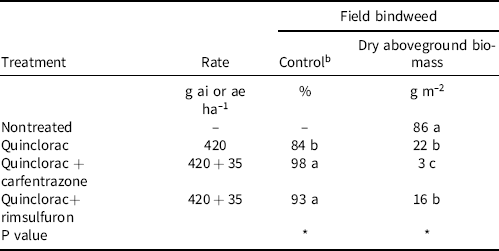
Quinclorac at 420 g ae ha−1 provided 84% control of field bindweed (Table 7). Mixtures with rimsulfuron (35 g ai ha−1) and carfentrazone (35 g ai ha−1) improved control, reaching 93% to 98%. Field bindweed biomass ranged from 3 to 22 g m−2, with the lowest biomass in a mixture of quinclorac and carfentrazone, although field bindweed biomass for every treatment was significantly lower than the nontreated control (86 g m−2). These results agree with previous reports demonstrating the efficacy of quinclorac in controlling field bindweed (Marsalis et al. Reference Marsalis, Lauriault, Jones and Renz2008; Orloff et al. Reference Orloff, Mangold, Miller and Menalled2018).
Field bindweed percent control and dry aboveground biomass 20 d after treatment with quinclorac alone or mixed with carfentrazone or glufosinate in a 4-yr-old commercial hazelnut orchard in Newberg, OR. Treatments were applied in spring 2020.a

a Abbreviations: –, Not included in the analysis; *, significance at P ≤ 0.05.
b Means (n = 4) within a column followed by the same letter are not different based on Sidak’s significance test (P ≤ 0.05).
The negligible injury observed during this study strongly indicates that hazelnuts have a high tolerance to quinclorac and clopyralid, even at rates as high as 1,680 and 1,090 g ha−1, respectively (Table 2). Few studies have evaluated the tolerance of other tree nut crops to these herbicides. In tree fruit crops, clopyralid 90 g ha−1 injured 1-yr-old apple trees (Malus pumila Mill.) without reducing tree growth (Kviklys Reference Kviklys2009), and clopyralid is currently labeled for use in apple orchards in many parts of the United States at 278 g ha−1 (Anonymous 2020b). European ash (Fraxinus excelsior L.), sweet cherry (Prunus avium L), English oak (Quercus robur L.), sycamore (Acer pseudoplatanus L.), hybrid black poplar (Populus × canadensis cv. ‘Ghoy’), Douglas fir [Pseudotsuga menziesii (Mirb.) Franco], Corsican pine [Pinus nigra ssp. laricio (Poiret)], Japanese larch [Larix kaempferi (Lam.) Carrière], Norway spruce [Picea abies (L.) Karst.], and Sitka spruce [Picea sitchensis (Bong.) Carrière] were reported tolerant to clopyralid at 100 g ha−1 followed by 200 g ha−1 3 wk later (Willoughby et al. Reference Willoughby, Jinks and Stokes2006). However, European ash, Japanese larch, and hybrid black poplar were more sensitive, displaying leaf injury weeks after treatment (Willoughby et al. Reference Willoughby, Jinks and Stokes2006). Clopyralid at 420 g and 140 g ha−1 did not injure cranberry (Vaccinium macrocarpon Ait) or strawberry (Fragaria × ananassa Duchesne), respectively (Sharpe et al. Reference Sharpe, Boyd, Dittmar, MacDonald and Darnell2018). Again, transient crop injury was reported without a long-term impact on plant growth or yield. In this study, hazelnuts have shown minimal to no injury up to 1,090 g ha−1 of clopyralid (Tables 2–5). Little to no injury from quinclorac at 563 g ha−1 was observed in American sycamore (Platanus occidenthalis L.) under simulated drift (Adams et al. Reference Adams, Pelkki, Ford and Humphrey2017), whereas eastern cottonwood (Populus deltoids L.) was greatly sensitive to quinclorac, expressing injury symptoms and growth reduction at 56 g ha−1, a fraction of the rates used for weed control (Adams et al. Reference Adams, Pelkki, Ford and Humphrey2017). Quinclorac is currently registered for use in several perennial fruit crops, including blueberry (Vaccinium corymbosum L.), blackberry (Rubus L. subg. Rubus Watson), raspberry (Rubus idaeus L.), and European gooseberry (Ribes uva-crispa L.) (Anonymous 2020a).
The results presented here demonstrate hazelnut tolerance to herbicides quinclorac and clopyralid applied during the growing season. These herbicides can selectively control field bindweed and Canada thistle without damaging the trees, providing hazelnut growers a significant advantage compared to glyphosate, which is not selective. Quinclorac and clopyralid also have low to negligible volatility, with a vapor pressure of 9.98 × 10⁻⁵ and <1.33 × 10⁻⁵ Pa at 25 C, respectively (Shaner Reference Shaner and Shaner2014a, 2014b). The low to negligible volatility of quinclorac and clopyralid reduces the risk of secondary drift during the spring and summer, a period when producers may want to apply these herbicides. However, primary drift is still a concern because of the diversity of crops grown in the Willamette Valley region. Therefore, we recommend that producers use quinclorac or clopyralid early in the spring as field bindweed and Canada thistle emerge, so as to suppress weed growth during the season. This treatment timing will likely reduce the need for additional applications in the summer, lowering the chances of drift.
Acknowledgments
The Oregon Hazelnut Commission funded this work. No conflicts of interest have been declared. The authors thank the IR-4 program, Albaugh LLC, and Corteva for assisting in registering quinclorac and clopyralid in hazelnut.