Introduction
Waxy corn (Zea mays L. var. ceratina Kulesh) is a type of specialty corns. Unlike USA where it is grown to produce corn starch with 100% amylopectin (Fergason, Reference Fergason2001), direct human consumption of boiled or steamed ears is the purpose of cultivation in Asia (Lertrat and Thongnarin, Reference Lertrat and Thongnarin2008). The market for fresh waxy corn in South Korea began to grow from the 1990s through the introduction of F1 waxy corn hybrid Yeonnong1 (YN1) (Lee et al., Reference Lee, Lee, Choi, Choi, Choe and Park1992). The hybrid is known to have exceptionally thin pericarp contributing to its high palatability among other eating qualities. This thin-pericarped hybrid has become an important breeding material in waxy corn breeding programmes in South Korea. Consequently, two leading waxy corn hybrids Ilmichal (KW35 × KW51) and Mibaek2 (HW10 × HW7) have one of its parents developed directly from or a cross with YN1 (Jung et al., Reference Jung, Moon, Son, Kim, Cha, Min, Choi and Ryu2006; Park et al., Reference Park, Park, Ryu, Goh, Seo, Min, Jung, Huh and Ryu2007). A follow-up hybrid, YN2 (BH20 × BH30) shares one of its parents BH20 with YN1 (Choe and Rocheford, Reference Choe and Rocheford2012). Parents of YN1 hybrid were bred from domestic waxy corn landraces (Lee et al., Reference Lee, Lee, Choi, Choi, Choe and Park1992). Extensive use of YN1 as a breeding material in majority of breeding programmes would potentially narrow the genetic diversity among waxy corn cultivars. In search of new genetic resources for waxy corn breeding programmes, we examined pericarp thickness of maize landraces collected across the country and stored in the National Agrobiodiversity Center (NAC) of South Korea.
Experimental
This study included a set of 2414 maize accessions. There were 87 public waxy corn inbreds included which were developed and deposited by the National Institute of Crop Science of Rural Development Administration (RDA) to the NAC. All the others were landraces collected across South Korea. The landraces with recorded collection site were chosen from a list of maize accessions in the NAC. The accessions were visually grouped into three endosperm types. When all 100 kernels provided had waxy or translucent endosperm, whether dent or flint, it was classified as waxy or normal type, respectively. Accessions with mixed endosperms were classified as segregating type. Also included was the F1 waxy hybrid YN1 as a check. Since the pericarp is maternal tissue (Wang et al., Reference Wang, Zhong, Chin, Register, Riley, Niebur and Smith2002), measured thickness of the hybrid represented the pericarp thickness of maternal parent of the hybrid.
Pericarp thickness was measured as described by Helm and Zuber (Reference Helm and Zuber1972) with a modification. After soaking the seeds in distilled water for 24 h, the tip and crown was cut with a razor blade, a pericarp strip from abgerminal side was excised and dried at room temperature. A digital thickness gauge (MITUTOYO model no. ID-C112XBS, Japan) with 1 mm diameter contact point was used. Several readings were taken from the middle of an excised pericarp strip and averaged. Ten kernels were measured and averaged per accession.
Statistical analyses were performed using SAS ver. 9.2 (SAS Institute, Cary, NC). A two-way analysis of variance followed by mean separation via the Tukey–Kramer test was carried out for the differences among collection provinces and endosperm types. Pearson's correlation coefficient was also computed between the average and standard deviation.
Discussion
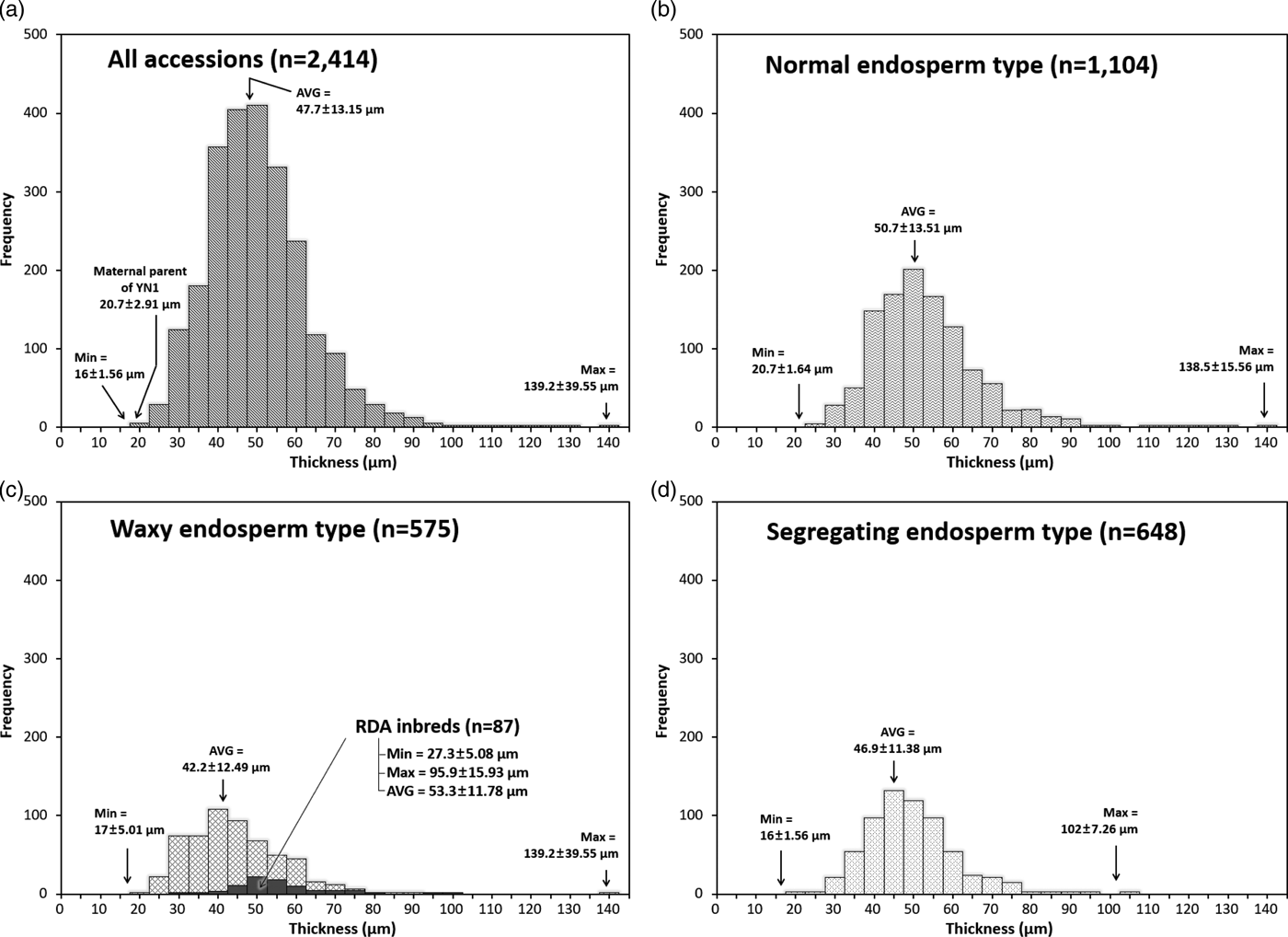
A total of 24,150 kernels from 2414 accessions and the check YN1 was examined. The overall mean of pericarp thickness was 47.7 µm and the standard deviation was 13.15 µm (Fig. 1). The frequency appeared to follow normal distribution with the minimum and maximum pericarp thickness of 16.0 ± 1.56 and 139.2 ± 39.55 µm, respectively. It, however, was skewed rightly meaning the tail was stretched to thick side. Since YN1 is a commercial hybrid, seeds of maternal and paternal parent of the hybrids were not available. Instead, pericarp measurement of the maternal parent was taken from F1 seeds and was 20.7 ± 2.91 µm. Although we failed to find supporting evidences from the literature that there is no difference in pericarp thickness between homozygous maternal and heterozygous F1 seeds, we generally observed that pericarp thickness of the two is not different.
Frequency distribution of pericarp thickness in 2414 maize accessions of South Korea. Average (AVG) was shown with standard deviation obtained from means of accessions used to make each frequency distribution. Accession with minimum (Min) and maximum (Max) pericarp thickness was indicated with 10 sample mean and standard deviation. The distribution of waxy endosperm type (c) did not include RDA waxy inbred lines. Instead, the distribution of RDA inbreds was overlapped to compare to that of waxy endosperm type from landrace accessions.

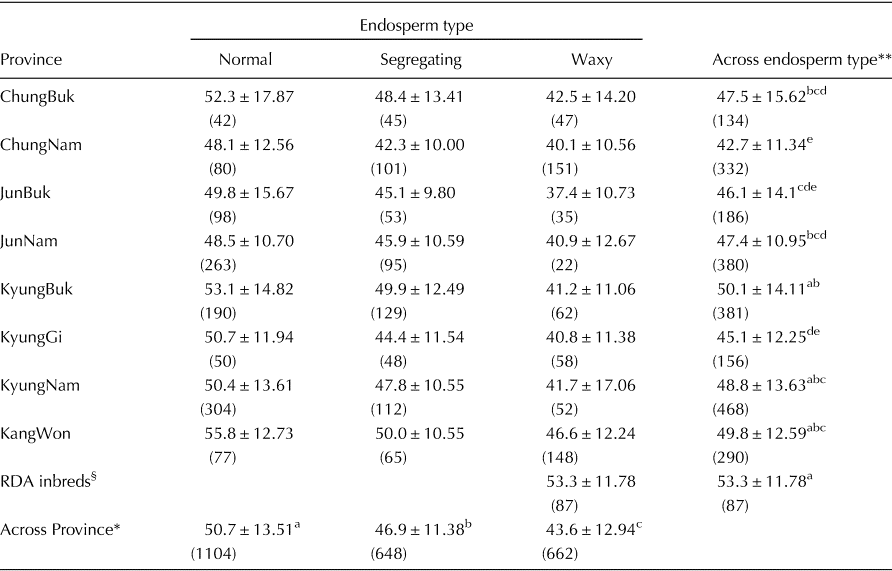
Analyses of variance indicated that there were significant differences among endosperm types (P < 0.0001) and collection province (P < 0.0001) with no significant interaction between them (P = 0.5541) (online Supplementary Table S1). The average and standard deviation for waxy (n = 662), normal (n = 1104) and segregating (n = 648) types was 43.6 ± 12.94, 50.7 ± 13.51 and 46.9 ± 11.38 µm, respectively (Table 1) and was significantly different from each other at α = 0.05. The differences were perhaps due to large sample sizes and may not be considered as practical differences in palatability. Lee et al. (Reference Lee, Choe, Lee and Lee1993) suggested that the pericarp thickness of waxy corn hybrids should be <50 µm to be acceptable for Korean fresh ear market. Since the overall mean was 47.7 µm, about half of the Korean landraces could be potentially used as genetic resources for high-tender waxy corn development. Although there were also significant differences among collection provinces, no geographical difference appears to be associated with such administrative district.
Average and standard deviation of pericarp thickness (μm) for maize landraces collected from different provinces of South Korea and their endosperm types

Values in parenthesis indicate the number of accessions.
§ RDA inbreds: public waxy corn inbred lines developed by the National Institute of Crop Science, Rural Development Administration, South Korea.
*, ** Means followed by the same letters are not significantly different at α = 0.05 by Tukey–Kramer tests in ‘Across Province’ and ‘Across Endosperm type’, separately.
The 87 RDA inbreds had the thickest pericarp (53.3 ± 11.78 µm). Many of them were bred more than 20 years ago when agronomic traits for sustainable cultivation were more important than eating qualities. The parents of Ilmichal, KW35 and KW51 were still measured 40.9 ± 8.91 and 42.8 ± 4.29 µm, respectively.
Pearson's correlation showed that mean and standard deviation of pericarp thickness was positively correlated (r = 0.55, P < 0.001) (online Supplementary Fig. S1). This may implement that we could sample less for thin-pericarped waxy corn selection and more for thick pericarp such as popcorn and field corn for mechanical harvest.
Accessions investigated in this study were not produced from a single environment, which poses a potential issue on the estimated thickness being confounded with environment effects such as year and location. Helm and Zuber (Reference Helm and Zuber1972), however, reported that the narrow sense heritability for corn belt maize was very high (h 2 = 80%). We conclude that selection for thin pericarp from such data could also be successful.
High palatability is a complex trait. Tenderness, sweetness, stickiness, texture and flavour of cooked corn ears all contribute to palatability in waxy corn. Tenderness is mostly represented by thin pericarp (Ito and Brewbaker, Reference Ito and Brewbaker1981). From the result, top 10% of the accessions in waxy endosperm type were selected and intercrossed to form a waxy corn population with thin pericarp.
Supplementary material
The supplementary material for this article can be found at https://doi.org/10.1017/S147926211800028X
Acknowledgements
This work was supported by the research grant of the Chungbuk National University in 2011. The author is thankful to National Agrobiodiversity Center (NAC) of South Korea for providing the maize accessions.