This is a hero who truly dared to die. I wish every household could offer incense to him, worshipping him as if worshipping religion, immortals, buddhas, sages, and Western heroes.
No aspiration is beyond reach in this world. If everyone harbors such resolve, we would succeed not only in the anti-American boycott, but also in protecting our railroad rights, mining rights, as well as in restoring a Han nation!
—He Yongfu from Nanhai CountyThis elegiac couplet memorializes Feng Xiawei, an ethnic Chinese activist who committed suicide in 1905 during the anti-American boycott movement (Wong Reference Wong2001, 244). Despite his hyperbolic rhetoric, the author nonetheless captures a curious symbiosis between the “hero” and “everyone” that characterized popular movements of his time. On the one hand, the couplet reflects the author's elementary understanding of popular participation: that everyone has the right, as well as the obligation, to decide national matters. On the other hand, the author reveres a transcendent, quasi-religious power that can only be unleashed through one superhero's extraordinary self-sacrifice, which remains beyond the reach of ordinary political actors.
Popular participation and suicide protests are frequent pairs in history, as in rhetoric. Chinese political movements in the first decade of the twentieth century often mobilized unprecedented broad publics, and almost all inspired suicidal passion. Wu Zhihui (1865–1953), the doyen of Chinese anarchism, jumped into the moat of Tokyo to his near death during the 1902 sit-down protest of the Qing government's restrictions on studying in Japan. The anti-Manchu activist Chen Tianhua (1875–1905) drowned himself at Tokyo's Omori Beach during the campaign targeting Japan's discrimination against Chinese nationals. Hui Xing (1870–1905), a Manchu widow who pioneered women's schooling, took her life with opium when her fundraising campaigns faltered. The list goes on, with suicides during the mining rights and railway rights movements mentioned in the memorial of Feng, including those of Li Peiren (1866–1906) of Shanxi Province, Wu Gang (?–1907), Tang Dichen (?–1907), Fan Xiongguan (?–1907) of Zhejiang, and Guo Shuqing (?–1910) of Sichuan. This pattern of self-sacrifice poses the question, why did popular participation, present in all these political movements, albeit to various degrees, give rise to the urgency of suicide protest?
To address this question, I reconstruct Feng's death in the anti-American boycott as witnessed, interpreted, and reenacted in a range of venues—from journalism and political fiction to reformed opera and advertisements—that form a panorama of the motivations and ideals behind the suicide protest. There is no denying that Feng's death expressed an embryonic nationalist sentiment about China's fin-de-siècle awakening to its embeddedness in a modern international order. The boycott campaign erupted from the conflict over the mistreatment of Chinese immigrants and travelers to the United States, initiated by the restrictions in the Angell Treaty of 1880 and subsequent exclusionary treaties and laws over the following two decades. In response to the pending renewal of an 1894 treaty, the Shanghai Chamber of Commerce (SCC) announced the first boycott resolution on May 10, 1905, calling on people to boycott American goods, services, and employers. This resolution soon won transnational support in Chinese communities from San Francisco and Sydney to Hubei Province in central China.
Tracking the movement's discourses about a united Chinese race, scholars have examined how a robust variety of participants collaborated across social and ideological divides, with coolie laborers joining hands with educated elites and even Qing officials, and reform-minded intellectuals’ clubs with more traditional gentry-merchant organizations (Chen Reference Chen2000, 148–61; Larson Reference Larson2007; McKee Reference McKee1977; Wong Reference Wong2002). This imagined national community was further empowered by the rising technology of print media and telegraph, which not only enacted camaraderie among geographically scattered patriots, but also orchestrated concerted actions around the Pacific Rim (Wang Reference Wang1995; Wong Reference Wong2000; Zhou Reference Zhou2006, 80–92).
Although Feng's death appeared to be part of the nationalist outcry against America, this article contextualizes his suicide within a deep-seated anxiety about the democratic condition inside the boycott—namely, anxiety concerning the plurality of activists with irreconcilable differences in identities and agendas working against a monolithic nationalist narrative. In other words, while the movement granted its participants the right to express various opinions and defend individual interests, the conflict inherent in this pluralist sentiment also entangled the campaign in prolonged indeterminacy and a lack of public consensus. Admittedly, the boycott cannot be characterized as a “democratic movement” if contextualized against the contemporary Western usage of the term, since general and equal participation in governmental procedures was never a part of the campaign's agenda. Yet the movement can be qualified as “democratic” in terms of its organizational and participatory process, since it engaged a plurality of social forces and perspectives, in an egalitarian fashion, to allow for free contest. As Guanhua Wang observes (Reference Wang2001, 9), the boycott was never a “vertical structure” with clear distinctions between leaders and followers, reinforced by an overarching ideology; rather, it was more of a loosely structured network in which heterogenous participants had to work out their differences.
Building on Wang's focus on the internal interaction between various boycotters, I examine how pluralist contest inside the movement was perceived by late Qing observers as a problem that could be overcome by an alternative political sentiment registered in suicide protest. In the absence of hegemonic leadership within the campaign that could anchor the quarrelsome public, I argue that Feng's action attests to a widespread urge during his time to locate an inner source of absoluteness. While democratic agonism threatened to disenchant the campaign by banishing any social authority, suicide protest sought to re-enchant it by establishing a spiritual authority through the extreme act of self-sacrifice.
Pluralism, or the natural development of diversified interests and the free expression of differences—crucial features of Western democratic thinking—have remained largely obscured in discussions of democracy in the late Qing intelligentsia. This is because the multivalent term “democracy,” during its transculturation process into China, skewed toward a different interpretation of “people's rule” (minzhu or minquan), which emphasized popular sovereignty or populism as opposed to monarchism or elite rule (Esherick and Wasserstrom Reference Esherick, Wasserstrom, Wasserstrom and Perry1994; Huang Reference Ko-wu1991; Lorenzo Reference Lorenzo2013; Nathan Reference Nathan1986; Perry Reference Perry2015; Zarrow Reference Zarrow2012). This emphasis on majoritarianism and collectivism informed the late Qing preference for national unity over partisan competition, which prevailed into the Republican era. The boycotters in 1905 partook of this one-dimensional understanding of democracy by emphasizing the discourse of hequn (uniting as a community) and, in contrast, rarely explicitly expressing a penchant for competition within the unity. However, the scarcity of discourse about pluralist contest should not preclude us from noting its existence in political and cultural practices. Looking at the participatory process of the boycott gives us a rare opportunity to locate registers of this long-neglected dimension of democracy in China and its resonance in literature of the time. By focusing on how pluralist competition was enacted and performed, rather than how it was articulated and intellectualized, I illuminate the ways in which democratic sensibility existed in what is commonly considered a nondemocratic society.
More importantly, Feng Xiawei's suicide can be read as a backfiring against the pluralist contest within the boycott, offering us explanations as to why this crucial dimension of democracy was unable to take roots during its formative era of the early twentieth century. My discussion of antipluralist sentiments is partly informed by the theoretical framework of agonistic democracy. Focusing on the notion of agon and tragedy in Greek antiquity, this approach of democratic philosophy configures a tension between the spirit of agonism—which constitutes the core of democratic values—and the foundationalist thinking that subscribes to a putative universal truth (Wenman Reference Wenman2013; Wingenbach Reference Wingenbach2011). While agonistic thinking insists on the validity of multiple local perspectives and interests, as shown in the internal negotiation and division of the boycott, the foundationalist impulse enacts transcendental convictions to override differences and build hegemony, in the way that suicide protest aspired to anchor public cacophony with inner virtue. Borrowing this conceptual dualism to illuminate the dynamic between Feng's death and the boycotters’ pluralist contest, I also present an alternative scenario that is missing in Western idealizations of agonism. Whereas agonistic democracy in the West stems from disavowing foundationalist ideas, Feng's case demonstrates a different dynamic, in which the political cost of agonism gave rise to the longing for a new foundationalist ground that empowered political faith.
The Agony of Democracy
Before the summer of 1905, Feng Xiawei (1880/81–1905) had been at sea about what to do with his life. Born into a poor family in Nanhai County of Guangdong, he traveled to Mexico as a “coolie,” or migrant laborer, whose work conditions often bordered on chattel slavery. After years of contract work, he gained a reputation as a formidable wrestler, established a small business in the local community, and accumulated enough money to plan for a permanent return to his hometown. But Feng—known as Fernando Ruiz in Spanish—aspired to achieve more. In the spring of 1905, he attempted to enter America, planning to receive more education, for “he regretted not having sufficient learning to engage in scholarship and contribute to his country” (Liang Du Reference Du1905a). He was denied entry at customs. On the return trip to Shanghai, however, he stopped in Tokyo for a few days and made new plans to attend Tōhin Army Academy there in the coming fall. Military force, or so he heard, had overtaken intellectual learning as the key to China's revival.Footnote 1
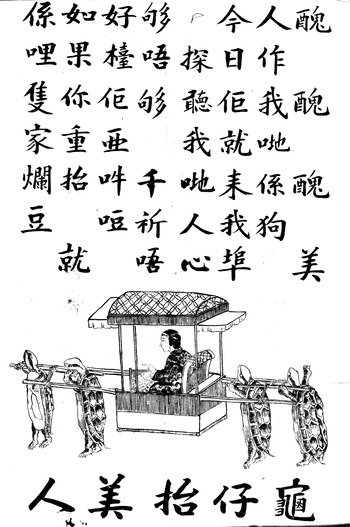
While waiting in Shanghai to return to Tokyo, Feng changed his plans for a final time. Arriving in the city shortly after the SCC issued its call for a boycott on May 10, he encountered a maelstrom of public passion swirling around the issue. If he opened a newspaper, he would find himself drowning in group announcements and personal letters endorsing the boycott from all over the country. If he entered a teahouse, he would enter a storm of debates about boycott strategies among radical students, alongside tragic stories of overseas Chinese sung by female entertainers. And if he walked down the street, he could not fail to miss the boycott slogans on the outsides of shops or caricatures of those who failed to obey (see figure 1).
One of the most widespread boycott posters in Guangzhou urged palanquin drivers not to carry American passengers, with the punned title stating, “Those Who Are Carrying This Beauty [American] Are Tortoises [Cuckolds].” The doggerel in Cantonese reads: “Shame! The Americans treat us as dogs. They will come to our city tomorrow [referring to the visit of Theodore Roosevelt's daughter in September 1905] to sound out whether we have gathered enough resolution. By all means, decline their business, you fools! If you continue to carry them around, you are nothing more than this scum!” Source: Despatches from United States Consuls in Canton, China, 1790–1906, vol. 20, National Archives, Washington, D.C.

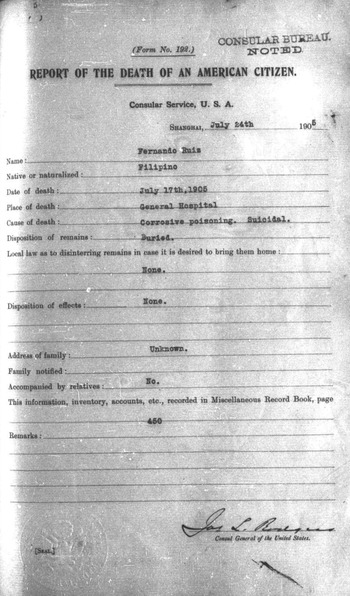
During his stay at the guest house of the Men's Mirror Study Association (renjing xueshe), one of the most active groups in the campaign, Feng must have found a cause that not only explained but also redeemed his experiences as an overseas Chinese. On July 16 around 2 p.m., four days before the designated launch of the boycott, he donned a Japanese kimono, left the association without bidding farewell to anyone, and drank a dose of muriatic acid in front of the American Consulate in the International Settlement. Despite attempts at revival, Feng died in Shanghai General Hospital thirteen hours later (see figure 2). In the pocket of his kimono and in his room at the guest house, identical notes were found addressed to the American Consul:
Today I die in protest against the exclusion treaty and its mistreatment of the overseas Chinese. If such outrages are not corrected, my compatriots, like me, will not hesitate to sacrifice their lives in fighting against it in the future. We Chinese people, from children to elders, are all aware of the treaty's malicious nature. (Feng Reference Xiawei1905)
A report on Feng's suicide in Despatches from United States Consuls in Shanghai, China, 1847–1906, vol. 52, National Archives, Washington, D.C. The document misidentifies Feng as a Filipino.

Feng's assertion that the boycott drew support from children and elders alike rightly captures the unprecedented scale of popular participation in the movement—a broad base reflected in the microcosm of his brief life. Just as Feng's journey symbolically spanned the hardships facing Chinese communities around the Pacific, the boycott, as a transnational collaboration, connected coastal cities in China with overseas Chinese. Similar to the way that his career and aspirations encompassed a diverse array of identities—from coolie and small business owner to student and soldier—the boycott drew together “every horizon of the upper, middle, and lower classes,” to quote a popular phrase of the time.Footnote 2 Right after the SCC announced its resolution, an expansive democratic alliance seemed imminent. In California as well as Australia, Chinese immigrants eager to show their support sent remittances to boycott organizations in their native towns (Wang Reference Wang2001, 172; Wong Reference Wong2001, 154–59). In Guangdong Province, home to many overseas Chinese, the boycott enjoyed strong support in all echelons of society, from gentry and merchants to gamblers and boatwomen (Wong Reference Wong2002, 71–72). Anti-Qing revolutionaries and loyalist reformers in Singapore and Malaysia united in condemning exclusionary policies, a stance that sympathetic officials in the Qing government supported, if only tacitly (Larson Reference Larson2007; Wong Reference Wong2001, 67–86; Zhang Reference Cunwu1982, 73–6). Moreover, the movement incorporated diverse social forces in a spontaneous and egalitarian fashion, further infusing a pluralist imagination into the organization of the campaign. Although the SCC was the first to issue the resolution, no party monopolized hegemony at any point. As Wang (Reference Wang2001) shows in his research, the campaign unfolded more as a spontaneous emergence of public coordination in which multiple players’ awareness happened to be aligned.
Feng's confidence in the prospect of a unified Chinese public, however, conflicted with his misgivings about the campaign's inner division that hindered its implementation. In addition to the note to the American Consul, he left a second note addressed to his compatriots, urging them to persist in the boycott: “those who still have a breath in this world, whether you are rich or poor, please do convince the Americans of our persistence in fighting for a cause” (Feng Reference Xiawei1905). Such words were testament to the campaign's shaky foundation, which, ironically, resulted from the pluralist participation that invigorated the movement in the first place. According to the SCC's statement on May 10, the boycott was scheduled to start two months later, should America fail to amend its exclusionary practices within that time frame. But even before the campaign could take off, tensions simmered over three different articulations of its ultimate goal. Those who sought to simply modify the 1894 treaty were ready to acknowledge the right of the United States to enact a protective policy, proposing only a more narrowly defined class of excluded Chinese “laborers.”Footnote 3 This proposal was met with objections from those who insisted on a complete termination of the treaty on the grounds that no differentiation should be made between laborers and other classes.Footnote 4 In contrast to the preoccupation of these first two camps with the treaty itself, a third focused on the Exclusion Acts passed by the US Congress, which provided a legal basis for discrimination.Footnote 5 In the absence of an agreed-upon goal, the SCC's two-month ultimatum appeared arbitrary and vague, neither demanding specific changes from the Americans nor voicing absolute imperatives to launch the boycott. Uncertainty loomed large as the July 20 deadline approached. At a fraught moment, a mere four days before the deadline, Feng's suicide was both a symptom of the movement's disintegration and a call for the public to resist it.
Underlying the split consensus was an even wider rift in the activists’ identities and agendas, which resisted unification under the umbrella term of “Chinese compatriots.” The merchant class that spearheaded the movement was the first to disintegrate, because of uneven shares in the economic loss of the boycott. Wholesalers from Zhejiang Province, for instance, were major importers of American goods such as textiles and tobaccos. They were thus more reluctant to embrace the boycott than merchants from Fujian and Guangdong, who conducted business mainly in the South Sea and had a stronger connection with overseas communities (Wang Reference Wang2001, 102–7). As the merchant class withdrew from the front lines of the movement, students and intellectuals moved front and center, adopting a more hard-line stance in order to “mobilize [their] compatriots’ sentiments to counter the encroachment of foreign powers” (Shibao 1905b). Yet their grand vision often overshadowed the practical concerns of the direct victims of exclusion: Chinese immigrants in America, who were more concerned with removing concrete barriers, such as US Customs Service regulations. Discord was also heightened between the elite and grassroots boycotters. Although most activists in Shanghai promoted a peaceful campaign, in the city of Amoy, occasional popular riots incited overreactions from the local government. The fear of another Boxer Rebellion added to reservations about the campaign back in Shanghai, clouding its horizons even more.Footnote 6
Although the unease about the movement's disintegration was often expressed in moral terms, such as the call for “persistence” in Feng's second letter, it ran deep in the democratic roots of the campaign, which not only informed its organization, but also formed the grounds for its fundamental agenda. During its transculturation process into China at the turn of the twentieth century, the loan term “democracy” was primarily comprehended as the people's rule (minzhu or minquan), with a focus on the consensus of the popular base instead of natural competition among people. Among other things, late Qing observers drew inspiration more from the democratic tradition represented by Jean-Jacques Rousseau and G. W. F. Hegel, which prioritizes general will and universal interest, than from the liberal strain of John Stuart Mill, which emphasizes democracy's compatibility with free market competition. This bias against a pluralist contest partly stemmed from traditional political ideology about gong (public) and ren (benevolence), two concepts that observers often held as native equivalents of Western democracy. The utopian ideal of a harmonious unity and people's ability to relinquish difference further contributed to the excoriation of division. Moreover, the urgency of national salvation in the face of Western encroachment further reinforced this semantic preference, disparaging “competition from within” (neijing) as a moral delinquency of the Chinese race, or to be more accurate, deporting the idea of competition to the international domain (waijing).
While leading intellectuals of the time emphasized a populist sense of democracy, the boycotters were among the first to inadvertently tap into the term's pluralist dimensions. One of the campaign's elementary demands was to request equal rights (pingquan) for the Chinese in the American labor market, which had been enjoyed by other immigrants from across the globe. As Huang Zunxian (1848–1905) (Reference Zunxian1933, 102) declares in a poem depicting the tragedy of the Chinese exclusion: “Be it yellow, white, red or black, every race is on an equal footing as a native born (tuzhu).” Huang's acknowledgment of the pluralist coexistence of various peoples as the foundation of American democracy echoed a similar rhetoric deployed by boycotters, who compared the disenfranchised Chinese in the United States with antebellum American “black slaves” (Meng Reference Meng2006, 112–35). The failure to extend the same civil rights to Chinese laborers that African Americans theoretically had been granted after the abolition of slavery, according to such rhetoric, revealed America's violation of its own democratic contract. Admittedly, the boycotters rarely broadened such discussions about American democracy to the normative discourses about minzhu in the Chinese reading public, nor did they seek to bridge the inconsistency between the two. But similar calls for equal rights within a pluralist community continued to be invoked during the repeal of the Chinese Exclusion Acts in the early 1940s, inspiring liberal-minded American intellectuals to envision a new conception of democracy more encompassing of national and racial differences (Lye Reference Lye2004, 204–41; So Reference So2010).
The campaign's democratic legacy, however, sowed the seeds of its own undoing. The outward goal of demanding “equal footing” for Chinese nationals abroad rebounded back into the movement itself, whereby each group was entitled to advance its own position. Embracing the diversity of social existence also brought people face to face with its consequences, such as irreconcilable group interests and political deadlock. The diplomatic note sent to the American Consul in Guangzhou from Cen Chunxuan (1861–1933), governor-general of Liang Guang, illustrates the corollary of a pluralist contest. In response to the consul's request to officially ban the movement, Cen (Reference Chunxuan2017) concedes that no one can prevent another from consuming American goods, since it is within everyone's “right of liberty” to do so. Yet he also argues that, by the same token, no one can force another to consume such goods either, for those who have chosen not to are also exercising their right of liberty. In other words, no social group could coercively promote or inhibit the boycott on behalf of its peers. Citing liberty as an equally shared right among people of different agendas, this letter offers an explanation for the hard-wired inability of the boycott to produce consensus.
More ironically, the conflict and partisanship within the boycott was sometimes justified in the very name of democratic pluralism. In response to the most radical boycotters’ high-minded calls for sacrifice, the newspaper Xinwen bao (1905) published an essay expressing sympathy for those who seemingly had cold feet: merchants who conducted business directly with the Americans. Since the movement sought to fight for the benefit of the entire Chinese race, the essay suggests that there could be no ground to demand sacrifice from the merchants, forcing them to “die before hundreds of thousands of Chinese laborers.” As with the former parallel between the Chinese and enslaved black people, the essay implicitly grants domestic merchants and overseas laborers equal rights. Unlike the traditional Confucian discourse that denigrates the pursuit of self-interest as morally inferior, this line of argumentation not only justified self-interest as an issue of social justice, but further promoted it as a rational choice: any economic loss of the merchants from the boycott would cause intense turbulence in the market, bringing chaos to the entire nation.
Bogged down by the legitimate principle of “equal footing,” the boycott got caught in an old Tocquevillian question: how can consensus be achieved in the discordant and experimental realm of democratic politics without a path toward traditional hegemony? For a brief moment, consensus within the movement seemed triumphantly forthcoming. On July 20, the SCC and other groups managed to hold multiple public gatherings in Shanghai to announce the launch of the boycott. Among the unanimous cheers of “long live the boycott,” a fervent participant even smashed his expensive American-made watch as a pledge of resolution (Minrenshe Zhuren Reference Zhuren1942, 18–19). This moment of unity, however, was short-lived. After July 20, the movement split into two opposing factions. To reduce economic loss from the backlog of American goods, the “do not order” faction (buding pai) advocated for controlled retail of the stock through particular channels, while also limiting the boycott's scope to the wholesale of American goods. In contrast, the “do not use” faction (buyong pai) opposed any form of clearance sales, calling on average consumers to stop purchasing American goods once and for all. The two factions grew increasingly polarized, splintering the boycott after the fall of 1905 (Zhang Reference Cunwu1982, 147–56). As the initially united Chinese public succumbed to the clamor of democratic partisanship, what Feng had killed himself to prevent eventually became a reality.
Turning Inward
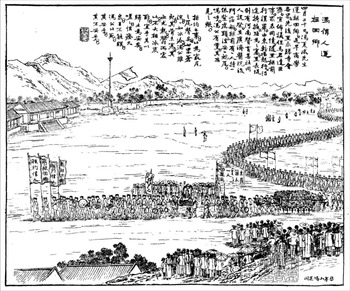
Partly because of his obscure origin, Feng's death drew little public attention at first. It was not until October 1905—when his casket was transferred from Shanghai to his hometown—that his sacrifice became widely recognized, and memorial services were held along the route (Wong Reference Wong2001, 228–33). However, the actual social efficacy of Feng's suicide cannot be overestimated. After being reinterred to his birthplace, Shatoubao, Feng's suicide no longer made headlines. In fact, as one of the contemporary caricatures poignantly remarks, his death might have been the last memorable event in the dwindling course of the boycott: just as mourners slowly trailed off in the queue that escorted his reinternment, the campaign also languished to no avail (see figure 3). In September 1908, when gentry-merchants in Shanghai, who had pioneered the boycott, went to great lengths to hail the visit of the US secretary of war, the leader of the Men's Mirror Study Association, Wu Jianren (1866–1910), was so disgusted by their reversal that he wrote a satirical piece ending with Feng's ghost sobbing about his ineffectual death (Ah Ying Reference Ying1960, 417–19). The impracticality of suicide, however, invites inquiry into the act's expressive, symbolic purpose. Rather than singlehandedly salvaging the boycott, how did Feng's death, as a political performance on its own terms, imagine the cure for democratic agonism?
A caricature under the headline “The Great Man Feng's Casket Transfers to His Hometown,” in Shishi huabao (1907, no. 11), with a caption that reads, “Such [the transferring of the casket] is the coda of the boycott movement. The world is vast and indifferent as it is cold and frigid…It begs the question whether Master Feng can rest in peace after all.”

In Feng's time, no one better articulated the cure for democracy than the foremost public intellectual Liang Qichao (1873–1929). After a trip to America in 1903, during which Liang observed its politics, he concluded that democratic agonism had led to the United States’ exclusionary policies in the first place. On the one hand, he acutely noted that the enmity against Chinese workers stemmed from their competition and conflict with other immigrants, including Italians, Swedes, Jews, and Germans. Such agonistic struggle was legitimized in the system of democratic politics, as shown in these groups’ rights to lobby against the Chinese. On the other hand, the “maladies of democratic politics” (Liang Reference Qichao and Ying1960, 488) also plagued Chinese communities in America, especially the microcosmic San Francisco Chinatown. Witnessing firsthand the elections of the Chinese Consolidated Benevolent Association (zhonghua huiguan), Liang was shocked by the conflict among various clans and native-place associations, which directly contradicted his aspiration to build a unified Chinese nation. With a sense of disillusionment, he linked the chaos to the absence of “a higher end”—love of beauty, a sense of social honor, and a religious notion of the future—that could enable each party to look beyond their ad hoc interests (Liang Reference Qichao1989, 7:22:121–24).
Hoping to locate “a higher end” to neutralize the agonistic struggle in democratic exchange, Liang expressed his foundationalist longing for the absolute power of hegemony, which Western philosophers deem to be the nemesis of pluralist contest. Claude Lefort ascribes the absence of absolutism to the triumph of modern democracy, which banished from public life all forms of truisms and moral high grounds. As Lefort (Reference Lefort1988, 17) famously theorizes, following the death of monarchism and its transcendent source of legitimacy, the ultimate foundation for hegemony within social spaces became an “empty place.” Filling this empty seat of power is continual contest, as foundational issues such as the subjects, goals, and principles of politics all become open to debate. This pervasive lack of consensus in favor of conflict also characterizes Chantal Mouffe's (Reference Mouffe2000, 80–107; Reference Mouffe2013, 1–18) vision of democracy as a salutary site of agonism. In her view, agonism between various social forces should be intentionally cultivated and encouraged, lest any ostensibly universal claims silence dissidents or obscure the contingent, arbitrary nature of power. In other words, the lack of certainty in public life offers an opportunity for the genuine expression of pluralism. The essence of democracy, after all, lies in its allowing for a free play of social difference, while also recognizing the partial status of all political stances.
This tension between democratic agonism and a universal foundationalist claim can also be detected in Liang's writings, though he presented it in a different manner. His conclusion about “a higher end” echoes but reverses Lefort's and Mouffe's claims regarding the relationship between an “empty place” and democratic agonism. Whereas Lefort and Mouffe see the absence of foundationalist thinking as the sine qua non of benign democratic agonism, Liang laments this absence as what incurs the extreme heteroglossia in the social domain. His trip to America, after all, had triggered doubt concerning the value of pluralism in democratic politics, leading him to impute it to the void of “a higher end.”
After returning from the trip, he further sought to fill that void with a new truth claim in one of his most controversial essays, “On Private Virtue” (Lun side, 1903). In the essay, Liang laments how Western notions such as “freedom,” “equality,” and “rights” promote self-interests over communal ones. To save the nascent Chinese community from premature disintegration, he proposes first establishing an inner source of moral legitimacy on an individual level. Here he borrows the rhetoric of “probing the conscience” from the Wang school of neo-Confucianism. Conscience, in other words, serves as an internal authority that one brings to bear upon political aspirations to ensure motivational integrity. This is achieved through the process of “probing” as a way of self-inspection, which Liang (Reference Qichao1989, 6:4:118–43) compares to praying in Christianity. He thereby establishes a transcendent state of conscience that can confer quasi-religious power on political actors, constituting one's commitment to such a degree that one will unfailingly adhere to it, regardless of external circumstances. This “primary spirit and true fire” (yuanshen zhenhuo), Liang (Reference Qichao1989, 6:4:131) indicates, can conquer democratic discord from without by dictating absolute action from within.
Traditionally, the most extreme adherence to conscience would externalize in death-defiant action, as can be located in premodern forms of political martyrdom, especially those informed by the neo-Confucian tenet of self-cultivation. This time-honored connection between inner power and self-sacrifice was not lost on Feng's commenters. In one of Feng's memorial essays, the author imitates the “Song of the Righteous Chi” (Zhengqi ge) by Wen Tianxiang (1236–83), compiling a martyrology to which Feng belongs, following Ming scholar-officials such as Yang Jisheng (1516–55), who was renowned for his moral fortitude in the face of torture. The common ground between Feng and his predecessors lies in their “acting in accords with where the heart can find peace,” to the extent that “it does not matter whether the cause is successfully fulfilled” (Liang Du Reference Du1905a). The argument pushes Liang's point one step further, as it deems Feng's self-sacrifice as not only motivated internally by conscience, but also self-sufficient as to override external efficacy. In terms of its remonstrative gesture, Feng's suicide also evokes “remonstrating by one's corpse” (shijian), whereby scholar-officials relied on suicidal behavior to influence imperial rulers’ political decisions.Footnote 7 Admittedly, commenters who made such an analogy did not mention the contradiction between the valence of Confucian loyalty and Feng's apparent nationalist sentiment. However, shijian's underlying spirit still dovetails with their elevation of conscience. Consistent with the moral ideals of Confucian noble men, it was a heroic gesture showing allegiance to the mandate of heaven, or its internalization as one's moral principle, which often braved the rulers’ umbrage. In gesticulating about such moral transcendence, shijian connotes a symbolic retreat from external political engagement to internal self-cultivation.Footnote 8
It is in exhibiting a similar inward turn that Feng's suicide overlapped with his predecessors’, despite his unequivocal modern agenda. Moreover, his case further pushed that tradition to an extreme by exclusively focusing on inner cultivation with an unusual reticence, which constituted a stark contrast with the external communicative relationships emblematic of pluralist struggle. This is a point highlighted by Feng's admirers, who interpreted his reticence in light of his preference for private commitment over communication with his fellow activists. Singing his praises, one essay reminds readers that Feng embarked on a journey to death quiet and alone. Such death attests to an inner resolution so firm, the author remarks, because Feng committed suicide so secretly, without discussion with family or friends (Liang Du Reference Du1905a). Another commenter makes a bitter comparison between Feng and the reformist leader Kang Youwei (1858–1927), also from Nanhai County. An early advocate of the boycott, Kang and his mouthpiece of several newspapers in Guangzhou were then accused of defaming more radical boycotters.Footnote 9 Compared with the newspapermen's sophisms, Feng's unusual reticence offered a more authentic model, which the commenter deems “worthier of the title, Master of Nanhai”—which Kang styled for himself with seeming complacency (Wong Reference Wong2001, 247).
As Feng's story found its way into the popular imagination, the inward turn implied in his suicide permeated relevant fictional narratives. The tension between democratic agonism and “private virtue” is most visible in The Golden World (Huangjin shijie, 1907), a popular fiction that represents the 1905 boycott through imaginary characters and plots. Its twenty chapters revolve around a successful overseas Chinese merchant named Xia Jianwei, who sells his properties in the United States to support the boycott. Upon his return to China, he meets activists from all walks of life, who together form a union that fights for the campaign. Portrayed as a business mogul, Xia's background is drastically different from Feng's grassroots origin. But the overlap between the two figures can hardly be ignored. The protagonist's name, Xia Jianwei (“China establishing its majesty”), apparently derives from Feng's first name Xiawei (“China's majesty”). Xia's friends sometimes refer to him as “Feng the Second,” as his unusual devotion to the campaign also reminds them of the suicide hero. More significantly, Feng is mentioned as inspiring Xia's campaign strategies, which deviate from those of his fellow activists. Unfolding the tension between Xia and his friends, The Golden World fleshes out “private virtue” and democratic agonism through opposing narrative forms.
As with many contemporary fictional works about the boycott, The Golden World faithfully reproduces major public debates through the words of different characters. In particular, it represents democratic agonism through a distinctive conversational style. Dialogue made up much of the late Qing political fictions because of the rise of political speech and discussions in urban spaces (Yeh Reference Yeh2015, 162–230). But hardly any fiction surpasses The Golden World, which consists almost exclusively of dialogues between activists from various socioeconomic backgrounds, to the extent that the narrator is largely edged out of the text. As the activists debate strategies, multiple political positions of the campaign are fully articulated. Noteworthy, though, is that no particular line of argument is allowed to overwhelm others. The agonistic dialogue constantly moves between multiple perspectives and voices, giving equal weight and reason to all of the speakers—a gentry family from Guangdong, female activists from Shanghai, coolies from Cuba, and an exiled descendant of the royal family of the Ming dynasty—without reaching any conclusive note. Through “the fictional representation of equal social exchanges across class and other hierarchies,” the conversational style of the work can be seen as celebrating what Simon During (Reference During2012, 94) calls “conversational democracy,” creating a social space of heterogeneity.
But this conversational democracy has an important exception: the protagonist Xia, or “Feng the Second.” In contrast to the other activists’ exchange of ideas, Xia often single-mindedly holds on to his own maverick vision, deeming conversation to be yet another form of compromise. In regard to campaign strategy and the deadlock between “do not order” and “do not use,” he proposes an outlandish third solution: that the leftover inventory be sold to Japan and Europe. When this strategy fails to win wide approval, he concocts an even more idiosyncratic scheme, proposing to use his own resources to transport as many overseas laborers back to China as possible. “Although I cannot convince anyone to follow my own belief,” he states when friends attempt to talk sense into him, “nobody can dissuade me from it either. All I need is to fight as much as I can. It is not my concern whether I can hence advance an inch or a foot” (Biheguan Zhuren Reference Zhuren and Ying1960, 201). For Xia, both the social processes of negotiation and the actual effects of boycott strategies are beyond consideration. What alone matters is his private resolve to adhere to his position and act upon it, even if resulting in failure.
More importantly, Xia's exclusive inner vision is strikingly singular in its narrative style. When Xia speaks up in a group conversation, the fiction suspends the seemingly unbiased exchange of characters’ dialogue, shifting the perspective to first-person monologue. At one point, Xia has a heated debate with some boycotters in a teahouse, whose advocacy for terminating the treaty contradicts his own proposal to repeal exclusionary acts. This conversation is entirely narrated, however, through Xia's own lengthy, uninterrupted recounting of the event to his friends. As a result, other opinions are all filtered through his pre-established voice, paraphrased in his outraged tone, and ultimately, dismissed by him as petty and short-sighted. In the place of an open-ended, multi-perspectival dialogue, the text presents us with a case of self-indulgence that Richard Rorty (Reference Rorty, Voparil and Bernstein2010) would call an “egotist” gesture that defends oneself to others, not a dialogical gesture that engages oneself with others. In extreme cases, Xia's single-mindedness even puts him into a trance-like state. When realizing that he cannot effectively defend his position in the teahouse, Xia describes himself as being so saddened that his soul leaves his body, “wandering around for a long time before it returned” (Biheguan Zhuren Reference Zhuren and Ying1960, 169). This scenario pushes his monologue-prone disposition even further, transforming it into a condition not very far from derangement.
This encompassing interiority in The Golden World not only differentiates Xia from his fellow activists, but also draws him closer to Feng. In a key passage, when the news of Feng's suicide breaks, Xia is so shocked and moved that he can neither move nor communicate, other than to murmur Feng's name to himself. Deeply submerged in an essentially monotone monologue, he remains unresponsive to the touch and words of his friends, who attempt to bring him out of losing his mind. If Feng's suicide suggests an inward turn in the sense that he followed the calling of his own conscience, Xia's textual behavior matches this introversion. Acting as if he were haunted by Feng's spirit or struck by a telepathic connection from beyond, Xia “literally is the second Mr. Feng,” as his friends remark (Biheguan Zhuren Reference Zhuren and Ying1960, 153). As readers watch Xia unwittingly stroking his chest, shaking his head, and staggering back and forth, it may bring to mind the quintessential performance of delirium or ecstasy in traditional operatic stagings. By developing monologue into madness, the fictional account theatricalizes the lone hero's retreat from the social domain. In contrast to agonistic conversations that circulate between speakers, Xia's obsession with Feng's death enacts a dive into introspective inspiration, which responds only to a higher spiritual calling. The metaphysical process of “probing the conscience,” as indicated in Feng's suicide, is thereby substantiated with embodied gesticulations of spirit possession.
In the last three chapters, The Golden World further spatializes Feng's deranged mentality into a dreamscape. When Xia and his friends find their endeavors frustrated on all fronts, they decide to retreat to an island in the South Pacific where they can create a “golden world” of their own. Moving away from the documentary-style account of the boycott to a utopian world, the text decisively shifts from historical mimesis to downright adventure fantasy. This genre shift allows the activists to indulge in their illusions about a new China, in the same way that Xia delves into his own illusions through monologue and madness. Moreover, the island's self-sustaining economy enables Xia's solipsism—as manifest both in the character's maniacal adherence to his own political stance, and in the fiction's stylistic rendition of the character in monologue—to reach its climax. The activists now have no need to trade with outsiders, as the island possesses enough agricultural and mining resources. Moreover, they no longer feel driven to fight the Chinese exclusion in America, as Xia has transported a large number of Chinese workers as human resources for the island. Adding a touch of industrial savor to the age-old isolationism of the Peach Blossom Spring, the “golden world” is thus immune to the modern order of exchange and negotiation. Independent of international trade and commerce, it also keeps in check the agonistic social forces that had previously riven the boycott. By escaping from their boisterous peers, what the activists ultimately create in the “golden world” is a gilded world without otherness.
Performing Possession
While illuminating Feng's death as an array of affective symptoms, The Golden World does not discuss suicide protest's social impact. As a political sensibility, the foundationalist impulse underlying suicide is, in the final analysis, intended to communicate to the public. The Spring of Overseas Chinese (Haiqiao chun chuanqi, ca. 1906), a twelve-act play that unfurls panoramic tales of the boycott, offers an additional rich site to explore such social effects as staged in theater. Despite its conventional format as chuanqi drama, the play belongs to the emerging category of “current affairs new play” (shishi xinju) in the early twentieth century, which had sources in recent newspaper stories. In keeping with contemporary theater reform to train the masses with enlightened sociopolitical content, current affairs theater was frequently employed as an extended public space that combined speech making, public meeting, and protests—at times performed as part of political campaigns for dramatic appeal (Li Reference Li2019). At least two Cantonese operas about Feng's suicide were produced in Singapore (Wong Reference Wong2001, 235). Although there are no historical records of The Spring being staged, the published script of the play develops distinctive modes of spectatorship designed to mobilize the audience into potential political actors.
While The Spring echoes The Golden World's feature of agonistic dialogue, it focuses on the more specific form of pluralist deliberation in public gatherings. In Act 8, the play reenacts the launch of the boycott on July 20, with four historical figures discussing its agenda in public. Simulating public gatherings with plain-style speech was a common practice in theatrical productions of the time. To spread a play's political agenda, social activists would blur the boundary between theatrical and public spaces, lecturing directly to the audience to absorb them right into the illusion on stage. Yet The Spring rejects this absorption effect with two meta-theatrical characters—a fictional scholar Nanquan and his female student Dunyun—who play fictive audience members sitting between the stage and the real audience. After each speaker delivers his or her opinion on stage, the duo then evaluates the performance not as speakers but as actors. For example, after the character of Ma Xiangbo (1840–1939), based on the prominent gentry-merchant in Shanghai, gives a speech full of patriotic passion, the two fictive viewers’ attention is drawn not to the content of Ma's speech, but to how well the actor meets the expectations of his particular role type as chou (clown). As Nanquan commends, “he certainly releases his sad tears with seasoned control” (Nanquan Jushi Reference Jushi and Ying1960, 469). The content of the speeches thus becomes a mere footnote to the acting of operatic roles. Self-referentially highlighting performativity, the play acts out a model of spectatorship for both theater and politics: democratic deliberation is to be observed as yet another histrionic show, only for the purpose of entertainment rather than engagement.
This dismissal of pluralist deliberation as theatrical went beyond the theater itself, thanks to the historical overlapping of public spaces and entertainment venues, especially in the city of Shanghai. Popular leisure sites of this time, such as Zhang Garden and Yu Garden, provided a hybrid space where operatic performances alternated with political discussions. The sense of equality inherent in such gatherings characterized contemporary reformed theater as well, which leveled the social hierarchy of audience members by offering them equivalent perspectives of the stage (Goldstein Reference Goldstein2007, 55–88). Yet the traditional bias against theater as a hotbed of superficiality and insincerity also tainted public perceptions of the democratic space. In his unfinished novel Roars of the Lion (Shizi hou), Chen Tianhua (Reference Tianhua1994, 149) satirizes as “parrot-like aspiring youth” (yingwu zhishi) those enthusiasts of political talks and debates in restaurants, teahouses, theaters, and public gatherings in Zhang Garden and Yu Garden. The profusion of words in these democratic occasions strikes the author as little more than senseless clamor on a playground. In contrast, political suicides are often distinguished by their lack of empty talk and grandiose speeches. Chen himself eventually committed suicide during a protest against the Japanese government's discriminatory policies toward Chinese students. His final statement, in addition to pouring outrage against Japan and the Qing regime, suggests a deeper frustration with fellow activists who failed to translate their arguments to direct action (Chen Reference Tianhua1994, 171–72).
In contrast to the theatricality of verbal speech, an alternative mobilizing effect of direct action can be observed in The Spring's portrayal of Feng's suicide protest in Act 6. Titled “The Knight-errant's Death,” the act opens with historically accurate anecdotes that introduce Feng's background, while the following scene strays from fact into dramatic speculation. As Feng pledges to commit suicide and departs for the American Consulate, he appears to lose his way. When his fellow activists decline to help, a fictional character called National Spirit the Junior, who incarnates the spirit of a new China, comes to his aid. Junior is so moved by Feng's resolve that he tosses a paper ball to the hero to give him directions, on which are written two verses alluding to the address of the American Consulate. Although the message reads like a straightforward route guide, Feng reacts to it as a man suddenly reaching spiritual enlightenment. From the moment he picks up the paper ball with the address, the story swiftly moves toward a crescendo, in which Feng performs an aria in an outburst of fervor, rushes to the consulate in a fit of excitement, drinks the poison, and collapses into the arms of the policemen.
The act of giving directions with a paper ball in The Spring—symbolic of a spirit delivering spiritual guidance and enlightenment—recycles an oft-used technique in traditional opera to stage transformative moments of religious conversion. Seasoned theatergoers at the time would not fail to recognize the loss of direction and the intervention of a mystic guide as a critical rite of passage to spiritual enlightenment. The way that National Spirit the Junior directs Feng to his destination is strongly reminiscent of the popular zaju drama The Golden Millet Dream to Enlightenment on Handan Road (Handan dao xingwu huangliang meng). Feng's contemporary admirers used to quote the play in their memorial writings, self-analogizing to its hero, who is enlightened by a Daoist god as they themselves by Feng's spirit.Footnote 10
More significantly, the play's critical moment of spiritual enlightenment also underlies the theatrical reenactment of Feng's own. In Act 3 of The Golden Millet, when the hero loses his way in a blizzard—a metaphor for his spiritual crisis—the Daoist god disguised as a woodsman comes to his rescue, offering directions to a lodge that symbolizes spiritual shelter (Ma Reference Zhiyuan2002, 161–5). In similarly preparing Feng to abandon his secular existence with a guided route, The Spring simply replaces the Daoist god with a vaguely defined “national spirit.” What remains unchanged, however, is that a seemingly modern heroic act still entails a primitive ritual of spirit mediumship.Footnote 11 In fact, Feng's stylized performance after receiving guidance is not unlike the heightened state of spirit possession, with his subsequent actions and songs displaying an abrupt shift in pace and expressive intensity.
In other words, the foundationalist impulse, as shown in Feng's inward turn toward the authority of conscience, unfolds here as the direct contact with a supernatural deity. Highlighting the performance of spirit initiation, The Spring further illuminates the potential of suicide protest in creating a spectatorship of co-feeling and co-action. It is characterized by a lack of verbal communication and the presence of embodied action. Note that the only interaction between Feng and the spirit—the message written on the paper ball—hardly constitutes verbal communication. It is certainly not the address of the American Consulate that decisively galvanizes Feng to action; in fact, no verbal utterance in this scene is anywhere near sufficient to spur Feng's suicide. What is significant instead is the silent, symbolic act of tossing and retrieving the paper ball, which gestures toward a relationship of guidance and compliance, modeling and imitation. In this relationship, the spirit guide's order is so irresistible and compelling that the disciple obeys with such readiness, as if no words were ever needed. If words, as seen in Act 8, corrupt the integrity of the democratic gathering on stage, thus alienating the audience from it, Feng's speechless action of responding to the spirit points to an opposing theatric operation of integration: it enhances the illusional unity of theatrical space, wherein the dictates of the deity, the action of the hero, and the attention of spectators are all infused with a ritualistic aura. In this sense, suicide seems to have finally addressed the foundationalist impulse behind Feng's suicide: to rise above social polyphony, forging an unexpected alliance around a god-like icon.
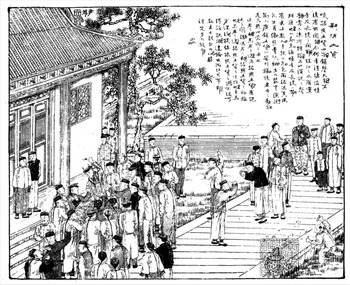
Immediate as it is in galvanizing direct action, the mobilization effect of suicide protest sometimes ran the risk of being compromised exactly because of its separation from deliberative speech. Without verbal elaboration, Feng's death could become volatile. This was especially true when his icon was mass produced and consumed. The anti-American boycott offered an opportunity for domestic brands that appealed to the patriotic sentiments of their consumers to seize the market share against Western imports. In one of the most interesting cases, Feng's established reputation helped native tobacco companies reverse the market trend that had so far worshipped only American brands (see figure 4). In the summer of 1906, the East Guangdong Tobacco Company began to promote a new brand, The Great Man Feng Xiawei (Shishi huabao 1906). The new cigarette label was an immediate success, but with a side effect that diluted Feng's political agenda. As the boycott ebbed, Feng increasingly blurred into a name brand in public memory. This ironic consequence of depoliticization did not go unnoticed by Feng's contemporaries. In one of the parodies published in 1907, the author adopts the voice of Feng's ghost, complaining that nobody can remember his name except chain smokers. When Feng is recognized by chain smokers’ ghosts trapped in hell, they scramble to “ignite the great man in flesh,” recognizing him only to the extent that he embodies their beloved brand. In the end, together with the ghosts of four other suicide heroes of the time, Feng bemoans their fate of being forgotten by the living, who no longer remember the causes for which they died (Ya Hun Reference Hun1907).
A caricature under the headline “Promoting Sales of Domestic Goods” in Shishi huabao (1907, no. 1), with a caption that reads, “Several aspiring youth (zhishi) carried cigarettes packed with the portrait of Mr. Feng Xiawei. While selling the cigarettes, they made speeches on the importance of selling domestic goods to salvage national rights.”

Admittedly, the despondence of Feng's ghost in a sense reveals his defeat: while he strived to overcome the democratic agonism of the boycott, the heroic aura he established could not resist being tarnished in the variegated use of his iconography. One might be tempted to reach the conclusion that a hero's sacred status is inevitably degraded by mass reproduction, as Water Benjamin (Reference Benjamin and Arendt2019) would suggest, or that his charisma risks collapsing after his demise, as Max Weber (Reference Weber1968) would claim. It should be noted, however, that the democratization of Feng's icon does not necessarily result in depoliticization and banalization, as shown in the chain smokers’ memory of him. Rather, Feng continued to create a symbolic sacred center for a variety of sociopolitical movements, and his fatal commitment stood to spellbind and mobilize the public. Even though his original agenda was lost, Feng was still lionized as a new idol for new causes. In Australia, reform-oriented Chinese immigrants saluted Feng as an exemplar of non-violent resistance, emphasizing his thoughtful message of calling for peaceful demonstration.Footnote 12 In Hong Kong, where anti-Qing revolutionaries were based, Feng was memorialized as a paragon of military spirit, only short of actually hurling dynamite at his enemies.Footnote 13 The citable icon of Feng allowed him to be remixed into diverse political and social groups, who enshrined him at their own altars, thus inheriting his urge to reclaim a foundationalist ground of sacredness amidst a discordant public. By sacrificing himself for that ground, Feng established himself as its placeholder, one among many others to come after his death with names such as the nation, the people, the capital, the celebrity, and beyond.
Conclusion
Feng's suicide epitomized the collective yearning for a spiritual certainty in place of the empty seat of authority that occasioned social disintegration. The tension between democratic agonism and foundationalist impulse articulated itself through opposing modes of political performance: one marked by verbal speech, the other by corporeal action; one making sense from afar, the other felt under the skin; one circulating and alienated as a show, the other direct and immediate as spirit possession. This bifurcation registered in historical scenarios of the anti-American boycott as much as in various venues of popular imagination of the time. While contemporary observers regarded the will of self-sacrifice as a testament to inner moral resolve, political fiction contoured the affective symptoms of suicide as delirium. Meanwhile, reformed opera saw Feng's potential in mobilizing rapt audiences, though mass consumption at times obscured and supplanted his cause. As Feng's avatars, all of these cultural texts participated in his grappling with democracy. It is through their coauthorship that Feng's suicide protest took on a spectrum of implications, unfolding its sincerity, its insanity, its charisma, as well as its recyclability.
At a glance, Feng seems to have left little but a gravestone, a replica built in the 1980s as the old one was demolished during the Cultural Revolution. But his case illuminates the ways in which the meta-politics of pluralist deliberation versus extraordinary action were evaluated at a fin-de-siècle moment of experimentation, one that profoundly shaped Chinese political culture for years to come. Even in popular movements with drastically different political agendas a century apart, Feng's choice keeps returning with moral, affective, and communicative purposes not dissimilar to his own time. One observes a similar foundationalist passion in the hunger strike on Tiananmen Square in May 1989, where student protesters appealed to the corporeal performance of starvation to contest the state authority. It also brings to mind the chain of suicides since July 2019 in Hong Kong's antigovernment protests, which ignited more belligerent demonstrations unprecedented in the territory's recent history of civil unrest (Hollingsworth, Shelley, and Coren Reference Hollingsworth, Shelley and Coren2019). Although these suicides were usually commemorated as acts of martyrdom against the Goliathan authoritarian government in mainland China, one should look to the more complex question of how such extraordinary actions refract a general sense of impatience and disillusionment with ordinary politics represented by democratic deliberation, which at times degenerate into fatigued negotiation and an indeterminate lingering of the status quo. Feng leaves his most enduring legacy in this potential to address the challenges facing popular movements across the globe.
Acknowledgments
I am grateful to Oscar Aguirre-Mandujano, Craig Agule, David Cheng Chang, Neil J. Diamant, Sheila Miyoshi Jager, Janet M. Theiss, Jiyul Kim, James Reichert, Stephen J. Roddy, Peter Zarrow, Xiaobing Tang, Jolyon Thomas, Ban Wang, Chenshu Zhou, Yiqun Zhou, Y. Yvon Wang, and two anonymous reviewers for their suggestions and comments. During various stages of revision, I also benefited from audience feedback on my presentations at the Association for Asian Studies Annual Conference and in the Mellon Research Seminars at the University of Pennsylvania. Special thanks to Gordon H. Chang, Shelley Fisher Fishkin, and Ke Ren, whose interests in the Chinese Exclusion Acts first inspired this research.