Introduction
Weeds are a serious threat to crop production because of their constant competition with crops for light, water, and nutrients; they cause approximately 34% yield losses worldwide (Oerke Reference Oerke2006). Traditionally, managing weeds primarily relied on manual labor. The introduction of herbicides in the mid-1940s revolutionized weed management. To date, synthetic chemicals have dominated weed management because of increased efficacy and reduced labor and cost. Herbicides have contributed greatly to global agricultural production. The extensive use of herbicides, however, facilitates the development of resistance in weeds. The first case occurred in 1957, when spreading dayflower (Commelina diffusa Burm. f.) and wild carrot (Daucus carota L.) were found to have evolved resistance to the first commercial herbicide, 2,4-D and MCPA, in the United States and Canada (Heap Reference Heap2019). They were followed by common groundsel (Senecio vulgaris L.), which developed resistance to atrazine and simazine in 1968 in the United States (Ryan Reference Ryan1970). Since then, there has been a steady increase in the occurrence and distribution of herbicide-resistant weeds worldwide. To date, there have been 497 unique cases (species by site of action) of herbicide-resistant weeds, with 255 species (107 monocots and 148 dicots) resistant to 23 of the 26 known herbicide sites of action within 92 crops globally (Heap Reference Heap2019). These weeds are primarily resistant to seven herbicide groups, including acetolactate synthase (ALS) inhibitors, acetyl-CoA carboxylase (ACCase) inhibitors, 5-enolpyruvylshikimate-3-phosphate synthase (EPSPS) inhibitors, synthetic auxins, photosystem II (PSII) inhibitors, PSII inhibitors (ureas and amides), and PSII inhibitors (nitriles), and account for 85.4% of the total number of resistant biotypes (Heap Reference Heap2019). These herbicide-resistant weeds essentially fall into five families, Poaceae, Asteraceae, Cruciferae, Cyperaceae, and Amaranthaceae, distributed in 70 countries. The United States has the greatest number of herbicide-resistant cases, followed by Australia, Canada, and France (Heap Reference Heap2019).
In China, before the use of herbicides, weeds were managed primarily by hand weeding, hoeing, and plowing, which are labor-intensive and no longer suited to current agricultural production (Zhang Reference Zhang2003). Chemical management in China began in 1956 with the introduction of MCPA for broadleaf weed control in wheat (Triticum aestivum L.). Sodium pentachlorophenate and nitrofen were subsequently applied in the early 1960s for barnyardgrass [Echinochloa crus-galli (L.) P. Beauv.] control in rice (Oryza sativa L.) (Zhang Reference Zhang1997). Since the 1970s, with the influx of herbicide field trials and demonstrations for weed control in major cropping systems, synthetic herbicides have been widely adopted in China (Zhang Reference Zhang1997, Reference Zhang2003). By the late 1990s, herbicides were used extensively to control weeds in China; especially, after the mid-2000s, when (1) costs were reduced more than 50% due to the availability of domestically manufactured herbicides, (2) rural labor shifted to cities, and (3) the annual wages for rural labor and off-farm employment increased (Gianessi Reference Gianessi2013; Haggblade et al. Reference Haggblade, Minten, Pray, Reardon and Zilberman2017; Huang et al. Reference Huang, Wang and Xiao2017). As a result, China has become one of the leading herbicide producers and consumers (GACC 2015), and herbicide resistance has dramatically increased in the past 10 yr and has become a serious threat to agriculture.
According to the International Survey of Herbicide Resistant Weeds (Heap Reference Heap2019), the first appearance of herbicide resistance in China occurred in 1990 in redroot pigweed (Amaranthus retroflexus L.) to atrazine and Japanese foxtail [Alopecurus japonicus Steudel) to chlorotoluron. There were 12 cases of resistance before 2007, with the number climbing to 43 in 2018. A total of 27 weed species (14 monocots and 13 dicots) have developed resistance to 35 different herbicides in wheat, rice, corn (Zea mays L.), soybean [Glycine max (L.) Merr.], cotton (Gossypium hirsutum L.), peanut (Arachis hypogaea L.), and orchards, representing 12 of the 26 known herbicide sites of action (Table 1). However, the number of unique cases of herbicide resistance is likely underestimated, because survey responses were voluntarily submitted by researchers who are interested in resistance issues. Herbicide resistance is one of the greatest challenges in agriculture today. A recent review by Peterson et al. (Reference Peterson, Collavo, Ovejero, Shivrain and Walsh2018) summarized the challenge of herbicide resistance around the world. However, reported cases of herbicide resistance in China only involve the weed species in rice, wheat, and corn fields. Moreover, although reports on individual instances of herbicide resistance have increased steadily in recent years, a systematic review analyzing the status of herbicide-resistant weeds in China is lacking. Here, we carried out research to (1) investigate the development of herbicide resistance and (2) assess the status of herbicide resistance in major cropping systems in China. Given that herbicide resistance is an emerging issue, it is important to fill this knowledge gap to facilitate the development of a sustainable herbicide-resistance management framework in China. Additionally, the dramatic increase of herbicide-resistance issues/cases in China is a reflection of the current global situation. A quantitative review of documentation of herbicide resistance in China, therefore, will contribute to our overall understanding of the global weed resistance issue and offer future directions for the development and implementation of resistance management in weeds on a global scale.
Herbicide-resistant weeds in major cropping systems in China.

a Data were collected from the International Survey of Herbicide Resistant Weeds (Heap Reference Heap2019) website on January 30, 2019.
b Abbreviations: ACCase, acetyl-CoA carboxylase; ALS, acetolactate synthase; EPSPS, 5-enolpyruvylshikimate-3-phosphate synthase; HRAC, Herbicide Resistance Action Committee; PPO, protoporphyrinogen oxidase; PSI, photosystem I; PSII, photosystem II.
Materials and Methods
Quantitative Literature Review
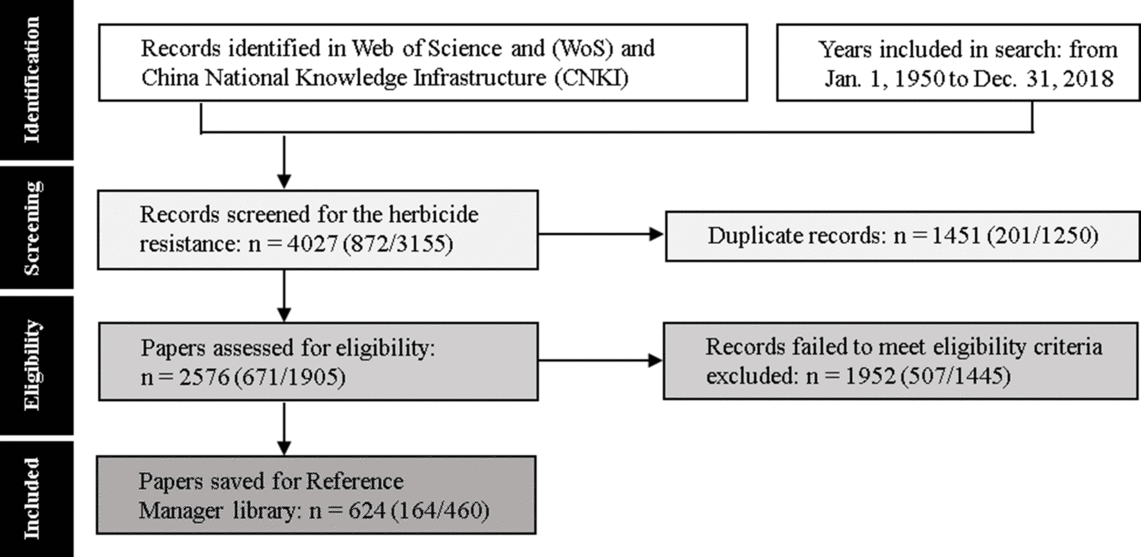
Following an evidence-based PRISMA (preferred reporting items for systematic reviews and meta-analyses) approach (Moher et al. Reference Moher, Shamseer, Clarke, Ghersi, Liberati, Petticrew, Shekelle, Stewart and Group2015), we carried out a quantitative literature review to assess the status of herbicide resistance in China. A literature search of the Web of Science (WoS) database for reports in English and of the China National Knowledge Infrastructure (CNKI) database for reports in Chinese was performed. The following search items were used: topic: “weed resistance” or “herbicide resistance”; location: “China”; and time span: from 1950 to 2018. The returned records (n = 2,576, WoS = 671 and CNKI = 1,905), which excluded any duplicates, were screened via their full abstracts and/or full text. The retained records (n = 624, WoS = 164 and CNKI = 460) were downloaded to a searchable database if they concurrently satisfied the following three additional criteria: (1) the study was conducted on a weed species/cropping system format in China (studies in non-croplands and aquatic ecosystems were excluded), (2) the report was on herbicide-resistant weeds (herbicide-tolerant weeds, herbicide-tolerant/-resistant crop species, and transgenic crop species were excluded), and (3) we had access to the abstract or the full text of the article. A flowchart of search and selection of the literature is presented in Figure 1.
Flowchart of the quantitative literature review procedures used in this study. The number (n) of records included and excluded at various stages of the quantitative review process, where numbers are specified as WoS/CNKI.
Documentation of Herbicide Resistance in China
First, we retained the number of reports by year, and then manually categorized them into three groups: (1) confirmation of resistance, such as resistance monitoring, rapid diagnosis, and the occurrence of herbicide-resistant weeds; (2) resistance mechanism; and (3) resistance management, such as resistance management strategies and risk evaluation of resistance.
Distribution of Herbicide-Resistant Weeds in China’s Major Crop Systems
We manually scrolled through the retained records (n = 624) from the quantitative literature review and documented the weed species, plant families, geographical distributions, and number of herbicide-resistant weeds for each major cropping system in China.
To determine which group of herbicides is most likely to develop resistance, we first documented the herbicide-resistant weeds in the major cropping systems in China, then we categorized these specific herbicides into groups by site of action according to the Herbicide Resistance Action Committee (HRAC) classification system, and finally, we sorted out the resistant weeds based on their respective herbicide groups.
Results and Discussion
Documentation of Herbicide Resistance in China
Despite the extensive use of herbicides, the first article reporting herbicide-resistant weeds in China was not published until the 1980s. Figure 2 shows the increase in reports on herbicide-resistant weeds in China. In the 38-yr period from 1980 to 2018, 624 records in total were retrieved from the WoS and CNKI databases; of those papers, approximately 6.3% (39 of 624) were before 2000, 16.5% (103 of 624) were before 2007, but 83.8% (523 of 624) were from 2008 to 2018. Herbicide resistance has clearly attracted researchers’ attention and interest during the recent decade. A total of 310 of those 624 papers concerned resistance confirmation, and 306 of 624 involved understanding the resistance mechanisms; only 158 of 624 concerned herbicide-resistance management. These findings indicate that current research focuses on resistance confirmation and hereditary resistance traits and that the management of herbicide-resistant weeds is still in the preliminary stage in China. They also indicate that the occurrence of herbicide resistance in China is increasing. This issue is at the forefront of weed science research.
Documentation of herbicide-resistant weeds in China.

Herbicide Resistance in China’s Major Cropping Systems
In China, the total acreage of cultivated areas was 166,939,000 ha in 2016. Corn, rice, and wheat were the top three crops, which accounted for 22.1%, 18.4%, and 14.5% of the total acreage, respectively (NBSC 2016). Not surprisingly, herbicide-resistant weeds were predominantly distributed in these major cropping areas. The number of unique cases and the acreage infested with herbicide-resistant weeds are the two parameters to monitor the development of herbicide resistance in the field (Peterson et al. Reference Peterson, Collavo, Ovejero, Shivrain and Walsh2018). The occurrence of herbicide-resistant weeds and their geographical distribution in various cropping systems are presented as follows.
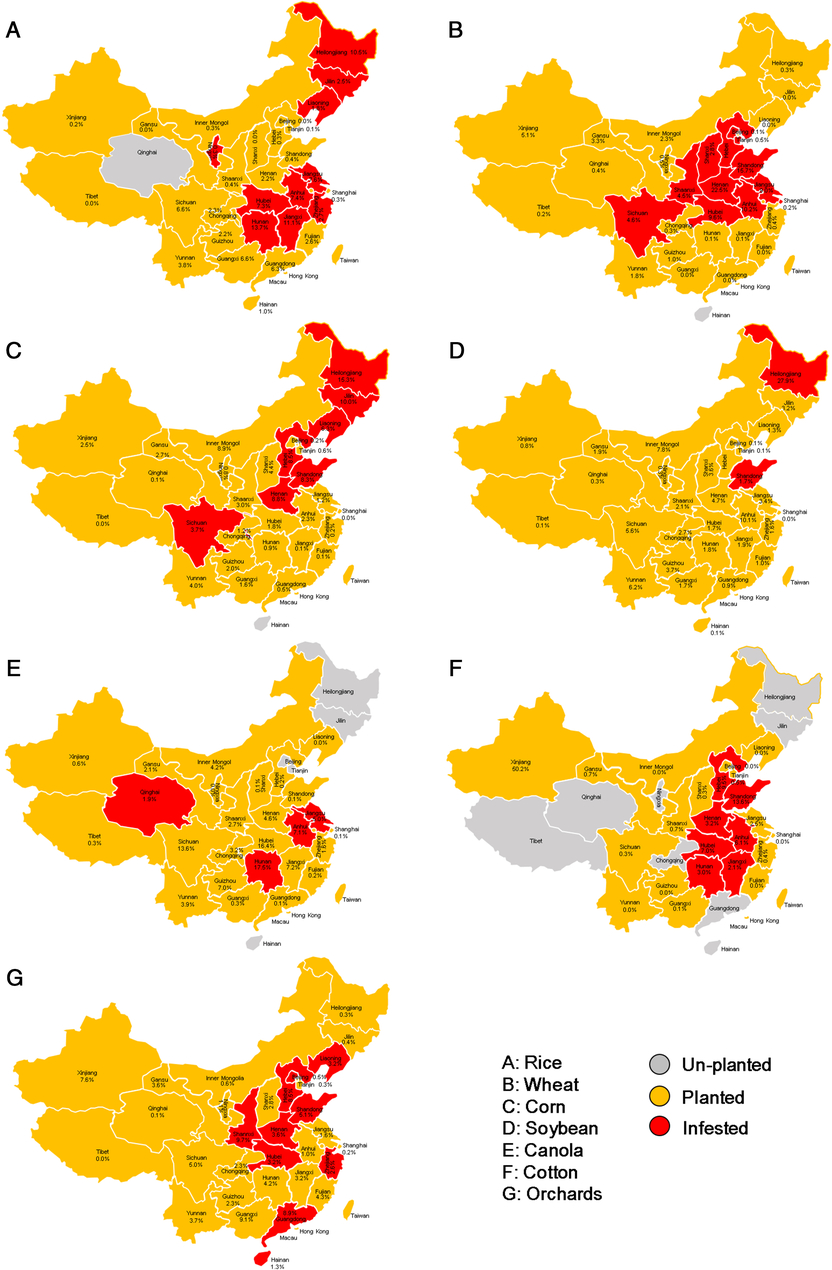
Rice. Rice is widely planted throughout China, except in Qinghai Province. Resistant weeds have been recorded in 10 provinces, including Hubei, Hunan, Anhui, Jiangsu, Jiangxi, Liaoning, Heilongjiang, Zhejiang, Jilin, and Ningxia (Figure 3A). To date, 26 weed species (21 monocots and five dicots) have developed resistance to eight sites of actions from HRAC (Supplementary Table S1). A total of 20 species are resistant to ALS inhibitors, including penoxsulam, bensulfuron-methyl, pyrazosulfuron-ethyl, cyhalofop-butyl, and bispyribac-sodium. The most damaging weeds are Echinochloa spp. (seven species), followed by Sagittaria spp. A total of nine monocotyledonous weed species have developed resistance to long-chain fatty-acid inhibitors. The worst case involved resistance to butachlor in Echinochloa spp., including E. crus-galli, Echinochloa glabrescens Munro ex Hook. f., early water grass [Echinochloa oryzoides (Ard.) Fritsch.], Echinochloa caudata Roshev., and junglerice [Echinochloa colona (L.) Link]. A total of seven monocotyledonous and one dicotyledonous weed species have developed resistance to synthetic auxin herbicides. The worst case involved resistance to quinclorac, again in Echinochloa spp. In addition, some of the weed species have developed cross- and multiple resistance. Penoxsulam-resistant E. crus-galli has evolved cross-resistance to other ALS inhibitors, including bispyribac-sodium, propyrisulfuron, and pyribenzoxim. Quinclorac-resistant E. crus-galli has developed multiple resistance to both penoxsulam and bispyribac-sodium. Currently, approximately 60 weed species from 24 families have been identified in rice fields. Among them, the 26 herbicide-resistant weed species belong to seven weed families, including Poaceae (10 species), Alismataceae (four species), Cyperaceae (five species), Pontederiaceae (two species), Lythraceae (three species), Potamogetonaceae (one species), and Asteraceae (one species). Several factors potentially contribute to the current situation in the rice fields: (1) The history of herbicide applications: For instance, butachlor, thiobencarb, and molinate have been used for weed control in rice since 1980s. The repetitive and continuous use of herbicides for the past 40 yr led to the development of herbicide-resistant weeds in the rice fields. (2) High frequency of herbicide application: Some herbicides, such as penoxsulam, metamifop, and bispyribac-sodium are applied up to four times annually in rice fields. (3) Changes in agricultural practice: Since the mid-2000s, the economic boom has shifted the focus of the labor force in China from farming to urban centers. The rapid adoption of direct sowing has increased the use of herbicides in rice fields.
Geographic distribution of herbicide-resistant weeds for the major cropping systems in China. Percentages displayed in the maps represent the percentage of each crop within the total planting area.

Wheat. Wheat is a common grain crop throughout China, except in Hainan Province. Resistant weeds are mainly distributed across 12 wheat production regions, including Jiangsu, Anhui, Shandong, Sichuan, Henan, Hebei, Shanxi, Shaanxi, Tianjin, Hubei, Shanghai, and Beijing (Figure 3B). A total of 18 weed species (10 monocot and 8 dicot species) have developed resistance to five herbicide groups in wheat (Supplementary Table S2). These weed species belong to six weed families, including the Poaceae (10 species), Cruciferae (two species), Caryophyllaceae (three species), Rubiaceae (one species), Boraginaceae (one species), and Fabaceae (one species). A total of eight monocot species have developed resistance to ACCase inhibitors. The key weed species in wheat fields are A. japonicus and American sloughgrass [Beckmannia syzigachne (Steud.) Fernald.], which have developed both multiple (e.g., ACCase inhibitors, ALS inhibitors, and PSII inhibitors) and cross-resistance (e.g., ACCase inhibitors × ALS inhibitors) (Supplementary Table S2). A total of 12 weed species (five monocots and seven dicots) have developed resistance to ALS inhibitors.
Tribenuron-methyl-resistant flixweed [Descurainia sophia (L.) Webb ex Prantl] is a common species in wheat production provinces, including Hebei, Henan, Shandong, Jiangsu, Anhui, Gansu, Shanxi, and Shaanxi provinces. In Shaanxi, D. sophia, is highly resistant to tribenuron, with a resistance index of 1,595 (Cui et al. Reference Cui, Zhang, Zhang, Liu, Liu, Wang, Huang and Wei2008; Deng et al. Reference Deng, Liu, Yang, Mei, Li and Zheng2015; Han et al. Reference Han, Dong, Sun, Li and Zheng2012), which often leads to control failures. As one of the most sensitive herbicide groups for the development of resistance, ALS inhibitors have induced resistance in nearly all broadleaf species and several grass species in the wheat fields in China. For example, D. sophia has developed ALS inhibitor cross-resistance to seven herbicides, including tribenuron-methyl, imazethapyr, pyrithiobac-sodium, cloransulam-methyl, pyroxsulam, bispyribac-sodium, and florasulam, and multiple resistance to three herbicides with different sites of action, including ALS inhibitors, synthetic auxins, and protoporphyrinogen oxidase (PPO) inhibitors (Cui et al. Reference Cui, Zhang, Wei, Zhang, Li, Zhang and Wang2011). In wheat fields, weeds have developed resistance primarily to ACCase inhibitors and ALS inhibitors for two reasons. First, there are multiple active ingredients and diverse chemical classes within these two herbicide groups. Specifically, ACCase inhibitors contain 21 active ingredients across three chemical classes, while ALS inhibitors have 56 active ingredients within five chemical classes. Second, the excellent selectivity, high efficacy, and low environmental risks of ACCase inhibitors and ALS inhibitors made them attractive choices for weed control, leading to overreliance on these herbicides and, ultimately, strong selection pressures for weeds.
Corn. Corn is a major crop in China and covers the largest acreage. It is widely cultivated throughout China, except in Hainan Province. Resistant weeds are distributed across seven provinces, including Shandong, Sichuan, Hebei, Jilin, Heilongjiang, Liaoning, and Henan (Figure 3C). A total of nine weed species (six monocots and three dicots) have developed resistance to three herbicide sites of action (PSII inhibitors, ALS inhibitors, and PPO inhibitors) (Supplementary Table S3). These weed species belong to four weed families, including Poaceae (five species), Amaranthaceae (one species), Equisetaceae (one species), and Cucurbitaceae (one species). Atrazine and nicosulfuron are the dominant herbicides used in cornfields. Consequently five of the nine herbicide-resistant weeds are resistant to atrazine, and all nine have developed resistance to nicosulfuron.
Soybean. Soybean is planted in all 31 provinces and autonomous regions in China. A total of 11 weed species (four monocots and seven dicots) have developed resistance to four herbicide groups (ALS inhibitors, ACCase inhibitors, microtubule inhibitors, and PPO inhibitors) (Supplementary Table S3). These weed species belong to seven weed families, including the Poaceae (three species), Commelinaceae (one species), Asteraceae (two species), Polygonaceae (one species), Solanaceae (one species), Caryophyllaceae (one species), Amaranthaceae (one species), and Cucurbitaceae (one species). These families are distributed across Heilongjiang and Shandong, which are the main soybean production provinces in China (Figure 3D). Supplementary Table S3 shows that all of the monocots are resistant to ACCase inhibitors, except for Asiatic dayflower (Commelina communis L.), which is resistant to microtubule inhibitors and PPO inhibitors. The majority of broadleaf weeds are resistant to trifluralin, a microtubule inhibitor, while A. retroflexus and cantaloupe (Cucumis melo var. agrestis L.) have developed resistance to both ALS inhibitors and PPO inhibitors.
Canola. Canola (Brassica napus L.) is grown in the majority of provinces in China. A total of five weed species have developed resistance to ACCase inhibitors, all of which are Poaceae (Supplementary Table S3). These ACCase inhibitor–resistant weed species are distributed across Jiangsu, Hunan, Anhui, and Qinghai provinces (Figure 3E). The most damaging weeds in canola fields are A. japonicus, shortawn foxtail (Alopecurus aequalis Sobol.), and Asia minor bluegrass (Polypogon fugax Nees ex Steud.), because these species have evolved cross-resistance to most of the commercially available canola herbicides, including haloxyfop-P-methyl, fluazifop-P-butyl, quizalofop-P-ethyl, fenoxaprop-P-ethyl, clodinafop-propargyl, and cyhalofop-butyl.
Cotton. Cotton is planted in 23 provinces in China. A total of five weed species (three monocots and two dicots) have developed resistance to two herbicide groups, EPSPS inhibitors and ACCase inhibitors (Supplementary Table S3). These resistant weeds belong to three families, including Poaceae (three species), Amaranthaceae (one species), and Portulacaceae (one species), and occur in seven provinces, including Hunan, Hubei, Henan, Hebei, Shandong, Anhui, and Jiangxi provinces (Figure 3F). Goosegrass [Eleusine indica (L.) Gaertn.] is the most damaging weed and has developed resistance to EPSPS inhibitors (e.g., glyphosate) and ACCase inhibitors (e.g., haloxyfop-P-methyl and quizalofop-P-ethyl). Cross-resistant and multiple resistant weeds have not yet been identified in the field, which means cotton growers have other herbicides with different modes of action available to them to manage resistant weeds. Interestingly, no herbicide-resistant weeds were recorded in Xinjiang Province, which is the largest cotton-producing region in China. However, the major weed species in Xinjiang have already developed herbicide resistance in other cotton-producing regions in China. Therefore, resistance monitoring is critically important for cotton growers and researchers in Xinjiang.
Orchards. Each province in China has its local trademark fruits. A total of three weed species, E. indica, horseweed (Erigeron canadensis L.), and Asian copperleaf (Acalypha australis L.) have developed resistance to three groups of herbicides, photosystem I (PSI) electron diverters (e.g., paraquat), EPSPS inhibitors (e.g., glyphosate), and ALS inhibitors (e.g., bispyribac-sodium). These resistant weed species belong to three families, including Poaceae (one species), Asteraceae (one species), Euphorbiaceae (one species), and Cucurbitaceae (one species). A total of four resistant weeds are widely distributed in paradise apple (Malus pumila Mill.), tangerine (Citrus reticulata Blanco), banana (Musa spp.), and papaya (Carica papaya L.) and orchards. Glyphosate is the most extensively used herbicide in orchards, followed by paraquat and bispyribac-sodium; however, overreliance on glyphosate has selected for glyphosate-resistant E. indica, E. canadensis, and A. australis in Shannxi, Henan, Shandong, Hebei, Liaoning, and Beijing. Paraquat-resistant E. indica and E. canadensis are common weed species in banana plantations in Guangdong and Hainan provinces. Bispyribac-sodium–resistant E. indica and A. australis are widely distributed in citrus orchards in Zhejiang Province (Figure 3G; Supplementary Table S3).
Other crops. In peanut fields, large crabgrass [Digitaria sanguinalis (L.) Scop.] and E. indica have developed resistance to ACCase inhibitors (e.g., quizalofop-P-ethyl, sethoxydim) in Shandong Province, and melon (Cucumis melo L. var. agrestis Naud.) has developed resistance to ALS inhibitors (e.g., nicosulfuron, imazapic) and PPO inhibitors (e.g., fomesafen) in Henan and Hebei provinces (Supplementary Table S3). In sugarcane (Saccharum officinarum L.) fields, D. sanguinalis has developed resistance to atrazine in Guangxi Province (Supplementary Table S3). In ramie [Boehmeria nivea (L.) Gaudlich.] gardens, E. canadensis has developed resistance to glyphosate in Hunan Province (Supplementary Table S3).
Herbicide Groups Most Prone to Resistance in China
Currently, there are three classification systems for herbicide sites of action: the Weed Science Society of America (WSSA), Australian, and HRAC. However, the WSSA classification system is used exclusively in the United States and Canada, while the Australian classification system is used only in Australia. In contrast, the HRAC system has been adopted by all other countries around the world. Here, we categorized the herbicide groups following the HRAC classification system. Based on our records, weeds have developed resistance to 13 herbicide sites of action in 10 major crops in China, including rice, wheat, corn, soybean, canola, cotton, peanut, sugarcane, ramie, and orchards. The 13 herbicide sites of action include ALS inhibitors (HRAC Group B), ACCase inhibitors (HRAC Group A), synthetic auxins (HRAC Group O), long-chain fatty-acid inhibitors (HRAC Group K3), EPSPS inhibitors (HRAC Group G), PPO inhibitors (HRAC Group E), microtubule inhibitors (HRAC Group K1), PSII inhibitors (HRAC Group C1), PSII inhibitors (ureas and amides) (HRAC Group C2), lipid inhibitors (HRAC Group N), PSI electron diverter (HRAC Group D), PSII inhibitors (nitriles) (HRAC Group C3), and glutamine synthase inhibitors (HRAC Group H). These groups account for 50% of the 26 known herbicide sites of action in the HRAC classification system. Group B has the greatest number of herbicide-resistant weed species, followed by Group A and Group O (Figure 4, ALS inhibitors, ACCase inhibitors, and synthetic auxin), which represent the herbicides most prone to resistance in China.
Number of resistant species to herbicide groups in China. The letters refer to the Herbicide Resistance Action Committee (HRAC) code to identify herbicide sites of action. Based on the classification, herbicides can be categorized into the following groups: B, acetolactate synthase inhibitors; A, acetyl-CoA carboxylase inhibitors; O, synthetic auxins; G, 5-enolpyruvylshikimate-3-phosphate synthase inhibitors; E, protoporphyrinogen oxidase inhibitors; K3, long-chain fatty-acid inhibitors; K1, microtubule inhibitors; C1, photosystem II inhibitors; C2, photosystem II (PSII) inhibitors (ureas and amides); N, lipid inhibitors; D, photosystem I electron diverter; C3, PSII inhibitors (nitriles); and H, glutamine synthase inhibitors.

Current Situation and Outlook
Herbicide resistance has increased dramatically in the last 10 yr and has posed a serious threat to weed management in China. During the past decade, a great deal of effort has been focused on herbicide resistance in China. However, in comparison to the United States and Australia, China’s research on herbicide resistance is still in its infancy. We list here the notable characteristics concerning herbicide-resistant weeds in China.
First, the number of resistant weeds is high, and associated resistance mechanisms are complex. Resistant weed species from 19 families have developed resistance to 12 groups of herbicides. Conservatively, there are now at least 26, 18, 11, 9, 5, 5, 4, 3, 1, and 1 resistant weed species in rice, wheat, soybean, corn, canola, cotton, orchards, peanut, sugarcane, and ramie, respectively. The actual number of herbicide-resistant weeds has likely been underestimated, because our literature search was based on only two databases: CNKI and WoS. A more exhaustive search will likely lead to more published reports of infestations. In comparison with the International Survey of Herbicide Resistant Weeds (Heap Reference Heap2019), our search indicates that the number of herbicide-resistant weed species in different crops is much greater, especially in rice (Figure 5). Moreover, the evolution of herbicide-resistant weed species is rapid. For example, pinoxaden was temporarily registered in China in 2009, and in less than 3 yr, A. japonicus developed resistance to this herbicide (Mohamed et al. Reference Mohamed, Li, You and Li2012). In China, gramineous weeds dominate the various cropping systems, account for more than 50% of the total resistant species, and are resistant to 9 out of 12 herbicide-resistant HRAC groups. Therefore, gramineous weeds are the primary target for resistance management in China.
Herbicide-resistance cases in China broken out by the different cropping systems. Data were collected from the International Survey of Herbicide Resistant Weeds (ISHRW; Heap Reference Heap2019), Web of Science and (WoS), and China National Knowledge Infrastructure (CNKI).

Second, the distribution of herbicide-resistant weeds is extremely broad. Based on the records we reviewed, herbicide-resistant weeds in rice are widely distributed in major cropping systems in China. For example, nearly 50% of the rice fields in Nanling County of Anhui Province and Yuanjiang city of Hunan Province are under serious threat of developing resistance. In addition, in three provinces, Jiangxi, Anhui, and Hunan, more than 200,000 ha of the rice fields are currently infested with penoxsulam-resistant E. crus-galli.
Third, cross-resistance and multiple resistance are becoming the greatest threats to the crop production and food safety in China. Tribenuron-methyl is one of the most important herbicides for wheat weed management. However, D. sophia, threeleaf arrowhead (Sagittaria trifolia L.), and shepherd’s purse [Capsella bursa-pastoris (L.) Medik.] populations have developed cross-resistance to ALS-inhibiting herbicides (Deng et al. Reference Deng, Cao, Yang, Liu, Mei and Zheng2014; Fu et al. Reference Fu, Shafi, Zhao, Li, Zhu, Wei and Ji2017; Zhang et al. Reference Zhang, Li, Guo, Wu, Wang, Liu and Wang2017). Similarly, fenoxaprop-p-ethyl–resistant A. japonicus, A. aequalis, and B. syzigachne populations have developed cross-resistance to ACCase-inhibiting herbicides (Cui et al. Reference Cui, Wang, Han, Chen and Li2015; Du et al. Reference Du, Liu, Yuan, Guo, Li and Wang2016; Guo et al. Reference Guo, Lv, Zhang, Li, Wu, Lu, Liu and Wang2016). A major challenge in chemical control is that some weed species common to cropping system have developed multiple resistance. Echinochloa crus-galli in rice fields has developed multiple resistance to synthetic auxins and ALS-inhibiting herbicides (Yang et al. Reference Yang, Zhang, Gu, Dong, Peng, Bai and Li2017). A. aequalis, A. japonicus, and B. syzigachne typically exhibit multiple resistance to ACCase and ALS inhibitors (Bi et al. Reference Bi, Liu, Guo, Li, Yuan, Du and Wang2016; Guo et al. Reference Guo, Yuan, Liu, Bi, Du, Zhang, Li and Wang2015; Li et al. Reference Li, Zhang, Zhao, Guo, Liu, Li and Wang2017). In particular, pyroxsulam-resistant A. japonicus is cross-resistant to five classes of ALS inhibitors and is multiple resistant to ACCase and PSII inhibitors (Feng et al. Reference Feng, Gao, Zhang, Dong and Li2016). These cases involving multiple resistance and cross-resistance are an emerging issue in weed management. Even worse, the occurrence of some “super weeds” leads to control failures, even with new herbicides that have never been applied. Farmers have few or no alternative herbicides for weed management, and growers are forced to adopt nonherbicidal controls due to the increase of cross- and multiple resistance.
The prevalence of cross- or multiple resistance (or both) to herbicides in weeds is posing a great threat to integrated weed management in China and the rest of the world. There is an urgent need for improved knowledge of the occurrence of herbicide resistance and the distribution of resistant weeds. Both weed surveys (particularly involving species, distribution, and damage) and surveys of resistance of the major weed species to common herbicides in agricultural production areas should be conducted regularly. These survey results should be released in a timely way to provide a basis for both the choice of herbicides in the near future and the establishment of an early warning system of herbicide resistance in major cropping systems. In addition, a better understanding of weed biology and herbicide resistance mechanisms will facilitate the herbicide-resistance management in weeds.
Supplementary material
To view supplementary material for this article, please visit https://doi.org/10.1017/wsc.2019.46
Acknowledgments
This work was supported by grants from the National Natural Science Foundation of China (award no. 31672043) and the Natural Science Funds of Hunan Province (award no. 2018JJ2165) and from a China Postdoctoral Science Foundation–funded project (award no. 2015M582329) and the China Scholarship Council (File No. 201608430210). The authors are grateful to the anonymous reviewers for their constructive comments. No conflicts of interest have been declared.