Dedicated to helping establish a “black musical idiom”Footnote 1 in the twentieth century, Florence Price (1887–1953) often embedded “Black vernacular”Footnote 2 songs into her works, including her fantasies, several of which pianist Samantha Ege has recently recorded.Footnote 3 Price's two violin fantasies are likewise suffused with Black vernacular thematic material. Violin Fantasy No. 2 in F-sharp minor (1949) is built on the spiritual “I'm Workin’ on My Buildin.’” As Michael Cooper has observed, “Price's version of this tune does not concur with any other published version, but one of the autographs specifies that her version was written ‘as sung to Fannie Carter Wood of Chicago by her grandmother Melinda Carter/a former slave from Memphis Tennessee.’”Footnote 4 The tune seems to have resonated for the composer with special force. In 1940 she arranged it as the second of the Two Traditional Negro Spirituals, finished on March 26, 1940 (published 1949). Just days later, on March 29 and 30, 1940, she quickly dispatched Violin Fantasy No. 2, a textless, poignant rumination on the melody. The earlier Violin Fantasy No. 1 in G minor (1933) also explores the relationship between the fantasy genre and vernacular tunes, which, though newly composed here, also provide an underlying foundation for the music.
This article argues that both fantasies, as representatives of the violin fantasy genre, showcase an approach that allowed Price to explore and develop further telltale characteristics of her mature style. Noteworthy in regard of Price's choice of the genre was her extensive background in writing for the violin, acquired already as a student at New England Conservatory and then deepened in Chicago. Being a member of NANM (“National Association of Negro Musicians”) afforded opportunities for her to collaborate with violinist Walter H. Dyett (1901–69). At the same time, her performative engagement with these two compositions—which Price would have experienced while playing the piano parts—may have allowed her to reflect on musical meanings of freedom as Price pondered and utilized genre-specific markers characteristic of the fantasy genre. These may not only have fostered her own expression of creative freedom but perhaps also symbolized “freedoms in the most oppressive of social environments … [that] gave a powerful musical language to the politically voiceless.”Footnote 5 Indeed, the “oppressive” social context that Florence Price shared with others, not least “Fannie Carter Wood of Chicago” and her grandmother “Melinda Carter/a former slave from Memphis Tennessee,” did not disappear when Price abandoned the Jim Crow South for Chicago in 1927.Footnote 6 Performing works with Black vernacular elements, as embedded in these fantasies, created a link to Price's lived experience as a Black composer–pianist.
By exploring the two violin fantasies—her most important works for violin and piano—at the nexus of genre, vernacular elements, performative meanings, and symbolic meanings, we aim to build on what recent Price scholars have explored in investigating the rapprochement between African-American folksong and the European concert tradition.Footnote 7 If comparatively small in scope, Price's fantasies nevertheless represent an important step toward her larger goal of establishing a viable option for U.S. music in the twentieth century.
Only recently released in print,Footnote 8 each violin fantasy was composed within the short span of just 2 days; happily, the autograph manuscripts survive at the University of Arkansas, the primary repository of the composer's archives.Footnote 9 Price's two violin works take their place among a relatively short list of similarly scored contemporary works by Black-American composers in various genres including the sonata, romance, suite, and fantasy: The Six Plantation Melodies (1901) and Four Southland Sketches of Harry Burleigh (1866–1949); the exquisite miniature Silver Urn (date unknown) of Margaret Bonds (1913–72); the Suite for Violin and Piano (1943) of William Grant Still (1895–1978); the violin works by violinist and leading figure in the founding of the NANM, Clarence Cameron White (1880–1960); and the Sonata in A major (1927) of William Dawson (1899–1990).
The violin fantasies come from different periods of Price's life. Fantasie No. 1 (1933) originated from the time of her Piano Sonata in E minor and Symphony No. 1 in the same key, conceived in 1932 for the Rodman Wanamaker CompetitionFootnote 10 and subsequently performed at the Chicago World's Fair and premiered the following year by the Chicago Symphony Orchestra. It was the first symphony by a Black-American woman to be performed by a major orchestra. At the time of composing the first fantasy, Price had been living in Chicago for 6 years, following her move from Arkansas to Chicago in 1927. After her divorce in 1931 from her first husband, Thomas J. Price, she became involved with various music clubs in Chicago, and continued her studies in composition, harmony, and orchestration with figures such as the Danish-born composer Carl Busch (1862–1943). In fact, between the time around 1906, when Price left the New England Conservatory, and her move to Chicago—a span of some 20 years—she mostly gave lessons and composed small pieces in her spare time, including “teaching pieces for violin with piano accompaniment.”Footnote 11 As her biographer Rae Linda Brown (1953–2017) has written, Chicago was an environment “conducive to her creative energy,” where finally her “artistic impulse was liberated” fully.Footnote 12
In 1940 Price finished her second violin fantasy, which represents the composer at the peak of her career. That same year, she premiered at the Detroit Institute of Arts her Symphony No. 3, a commission from the Works Progress Administration during the height of the Great Depression. Also in 1940, she became a member of ASCAP. As Brown describes, during the 1930s Price's life “[revolved] around the composition, promotion, performance, and critical reception of three major works: Symphony No. 1 in E minor (1932), Piano Concerto in One Movement (1934), and Symphony No. 2 in C minor (1940).”Footnote 13 Nevertheless, smaller compositions such as the violin fantasies allowed her to cultivate further her chamber music skills and to solidify her compositional approach. Despite the 7-year gap between her two fantasies, both illustrate what Brown has identified as one of Price's main compositional accomplishments:
Price's compositions fuse Euro-American structures with elements from her own American cultural heritage, which creates an art music that, while utilizing European forms, affirms its integrity as an African American mode of expression. The musical synthesis she creates demonstrates how the African American composer could transcend received musical forms in articulating a unique American artistic and cultural self.Footnote 14
However, how exactly Price navigated between European and U.S. traditions of art music on the one hand, and vernacular and folk styles of Black-American music on the other, differs from one work to the next. Aside from Cooper's critical edition, her approach in the violin fantasies has thus far not been discussed separately. That being said, Price's place in, and contribution to, an extensive Black concert tradition has been researched thoroughly within the last few years. Important to understand is Price's identity as a “black nationalist”Footnote 15 within this concert tradition; without it, we cannot apprehend what it meant for Price—and other composers of African descent—to work in musical traditions and spaces coded as “white,”Footnote 16 among them Western classical instrumental genres and institutions such as the Chicago Symphony Orchestra.
This article offers a preliminary reading of her two violin fantasies, arguing that the genre appealed to Price not least because it offered relative freedom from formal constraints while also allowing her to anchor the works in her own musical identity, and to link herself to a long existing art tradition, the Romantic virtuoso violin fantasy. As we shall also argue, Price approached the positioning of the Black vernacular tunes in such a way that made them appear in particularly prominent places with special preparation beforehand, sometimes involving an “onward-sweeping force” that allowed the arrival of the tune to function as a release, sometimes incorporating timbral contrasts to showcase the tune, and other times involving textural contrasts, or combinations of these elements. We begin by summarizing Price's conceptual, formal, and thematic approach to the violin fantasies, which highlights cultural-historical and music-analytical inquiry into the scores and their contexts. In the second and third sections, our approach shifts to an embodied performance methodology that offers a subjectively grounded reflection about the fantasies-as-sound (vs. as-text). Here we aim to bring together Price's imagined and retraced performer's knowledge, evident in her gestural and aural compositional choices, with the violin and piano voices as particular performers having recourse to their own “lived experience” on these instruments. This encounter, in turn, generates reflections on the possible interpretive, feeling-related and body-sensation-related impacts and meanings in Price's fantasies.Footnote 17
I
Price's bridging of the classical art tradition with the vernacular realm lends each fantasy its individual, personal character. This method allowed her to use thematic materials that resonated with her identity in a manner that the fantasy genre uniquely advocated, namely, via thematic display. In nineteenth-century violin fantasies, themes appeared either at, or near the beginning of a fantasy while later sections typically portrayed the tune more ornately, a custom that some twentieth-century composers, including Price, reconsidered in ingenious ways. In the nineteenth century, fantasy tunes often were sourced from operas by Bellini, Donizetti, or others, or from national or nationally inflected melodic repositories—for example, Joseph Joachim's choice of the folk song “Jo Anderson My Jo, John” for the opening of his Fantasy on Irish [Scottish] Themes in D major (1850–52); Heinrich Wilhelm Ernst's selection of “The Last Rose of Summer” for the sixth of his Mehrstimmige Studien für die Violine, based on a tune by the same name from the fifth volume of Thomas Moore's popular Selection of Irish Melodies (1813) that referenced Ireland via the flower “Rosa ‘Old Blush’”; or Max Bruch's Scottish Fantasy (several examples, 1880). Sometimes the choice of theme betrayed subjective cultural ties or evidence of a lived experience, as in the case of the young Joseph Joachim, who, it seems, tucked into his setting of “Jo Anderson My Jo, John” within the Fantasy on Irish [Scottish] Themes a reference to Mendelssohn's oratorio Elijah to acknowledge his grief over the passing of Mendelssohn in 1847.Footnote 18 Similarly, Bruch's Scottish Fantasy for violin and orchestra “uses folk melodies collected on his travels in Britain” rather than in Scotland, as if to refer implicitly to Bruch's own travels.Footnote 19
Florence Price's fantasy tunes likewise offer a personal touch. Using a sectional form, as is standard in many fantasies, she chose pre-existing or newly composed tunes that either explicitly or implicitly interacted with Black musical idioms to anchor her music securely to “an African-American folkloric heritage.”Footnote 20 As Samantha Ege has argued, Price's inquiry into vernacular musics emanated out of her search for a “national musical idiom”—that is, a national, uniquely American sound that had captivated Dvořák's imagination and those of other composers before her. In this article we follow Ege's lead who regards Price's vernacular tunes as deeply enmeshed with “African-American folkloric influences,” which are distinct from the broader area of “contemporary African-American influences such as blues, jazz, gospel, or Broadway.” Black-American folkloric influences, on the contrary, are, according to Ege's interpretation of Price's Piano Sonata in E minor, “determined by Price's own language concerning the significance of the Negro Spirituals and antebellum dance influences in the establishment of what she termed a ‘national musical idiom.’”Footnote 21 Because Fantasy No. 2 in F-sharp minor is particularly relevant to a discourse similar to Ege's in the context of the E-minor Sonata—here Price's own words support the interpretation of thematic material as strongly associated with the tradition of “Negro Spirituals”—this focus on the “folkloric” seems suitable and justified for reading Price's violin fantasies. We use “folkloric” as pertaining to both pre-existing “Negro Spirituals,” such as in Fantasy No. 2, and invoking the style of spirituals through certain vocal, rhythmic, and harmonic markers and inflections.
We may now turn to Violin Fantasy No. 1 in G minor. As Cooper has suggested, the work falls into seven sections, with a framing introduction (1) and coda (7); a first theme presented after the introduction and reinstated before the coda (2 and 6); a second theme located at the center of the composition (4); and two transitional sections, which include a third important theme and frame the second thematic area (3 and 5). In terms of keys, G minor predominates; the supporting keys are the altered mediant B major in the first transition (3), and mediant B-flat major at the center of the piece for the second theme (4), which has all the qualities of a folk song, although Price did not specify a source. The first and second themes in G minor and B-flat major create a notable symmetry within the work's structure (see Table 1), but above all, each theme transports the listener from the generic figurations of the fantasy into a more personalized, individualized sound realm.Footnote 22
Florence Price, Violin Fantasy No. 1 in G minor, Formal Overview, after Cooper, foreword to Florence Price, Violin Fantasy No. 1 (New York, NY: G. Schirmer, 2019), iii

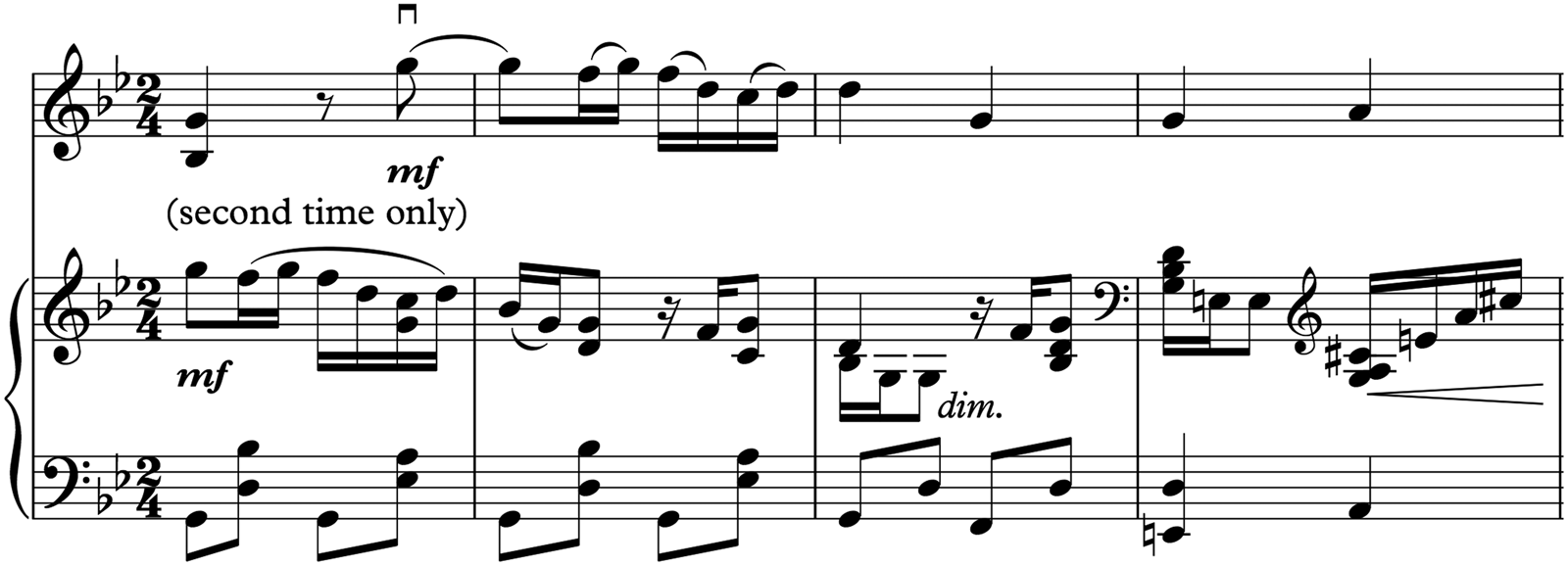
The G-minor theme (m. 13), with its clash between on-the-beat and syncopated gestures, highlights the flat seventh scale degree, F, thereby adding a folkloric modal touch. The first eight measures of the theme consist of a descending pentatonic gesture in G minor (mm. 14–17), subsequently repeated on the minor dominant (mm. 18–21), once again conspicuously avoiding the raised seventh degree leading tone (Example 1).
Florence Price, Violin Fantasy No. 1 in G minor (mm. 14–17), used with permission.

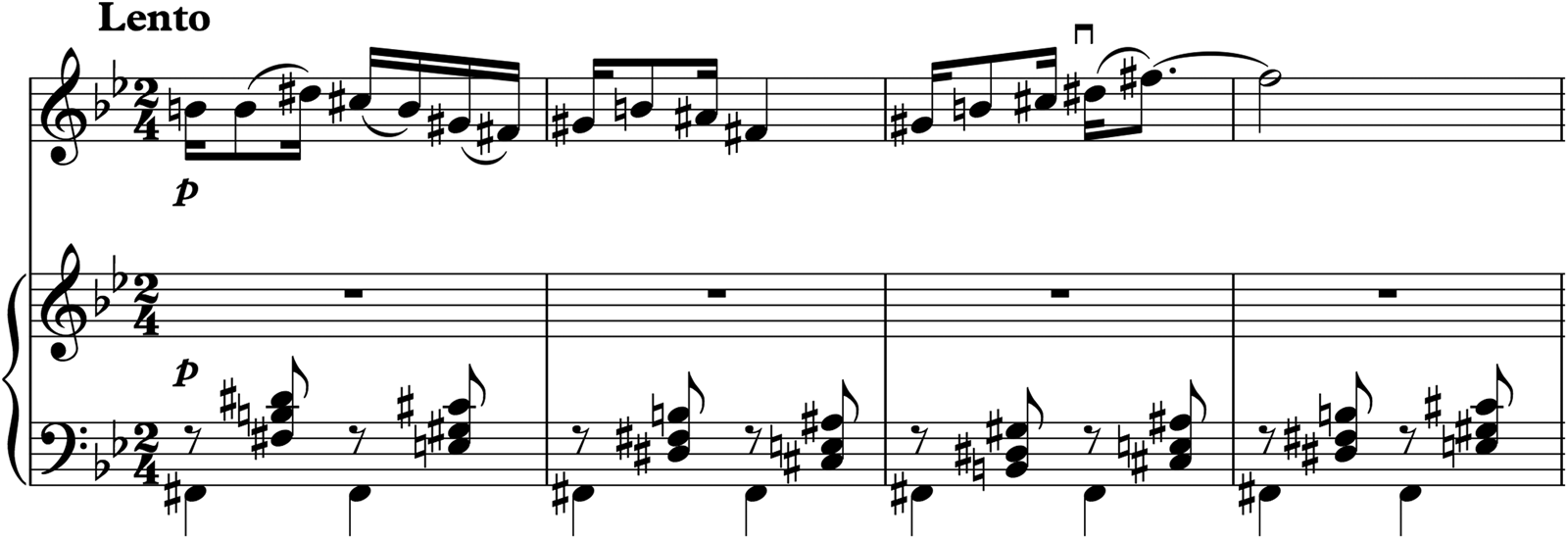
The varied repeat of the theme beginning in m. 22—this time in the piano—trails off into a transition generated by the head motive of m. 14, with its characteristic lowered seventh. Noteworthy is the transition's premature turn to V of B-flat major in m. 35; not for some time does the mediant actually materialize. Instead, another theme in the altered mediant, B major, briefly takes center stage (Example 2).
Florence Price, Violin Fantasy No. 1 in G minor (mm. 38–41), used with permission.

Although Cooper does not acknowledge the thematic status of this brief gesture, we assign it some structural weight owing to its separate tempo marking, “Lento,” and its distinctive stylistic markers: Syncopation; lyrical “vocal” thirds that would support a portamento-inflected manner of singing; a piano accompaniment emphasizing off-beats; and a symmetrical descending and ascending sequence of sixth chords over a static F-sharp pedal. However like a mirage, the raised mediant is soon enough destabilized; the incipient theme vanishes, and the music modulates to the tonic G minor via chromatic bass motion connecting the F-sharp pedal with D, the root of the dominant of G minor, which we may relate to Price's interest in chromatic accompaniments in her first piano fantasy, the Fantasie Nègre No. 1 in E minor.Footnote 23
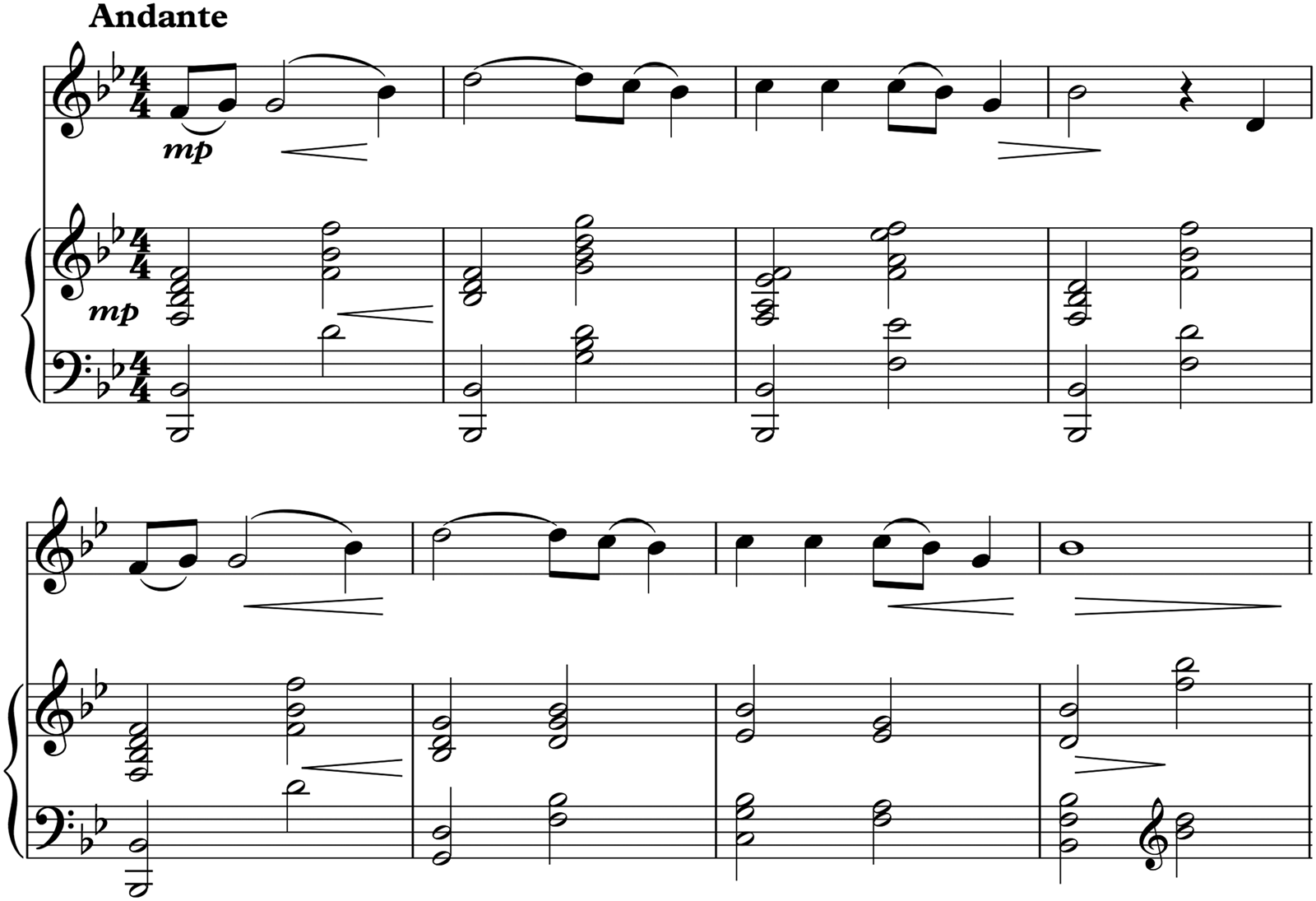
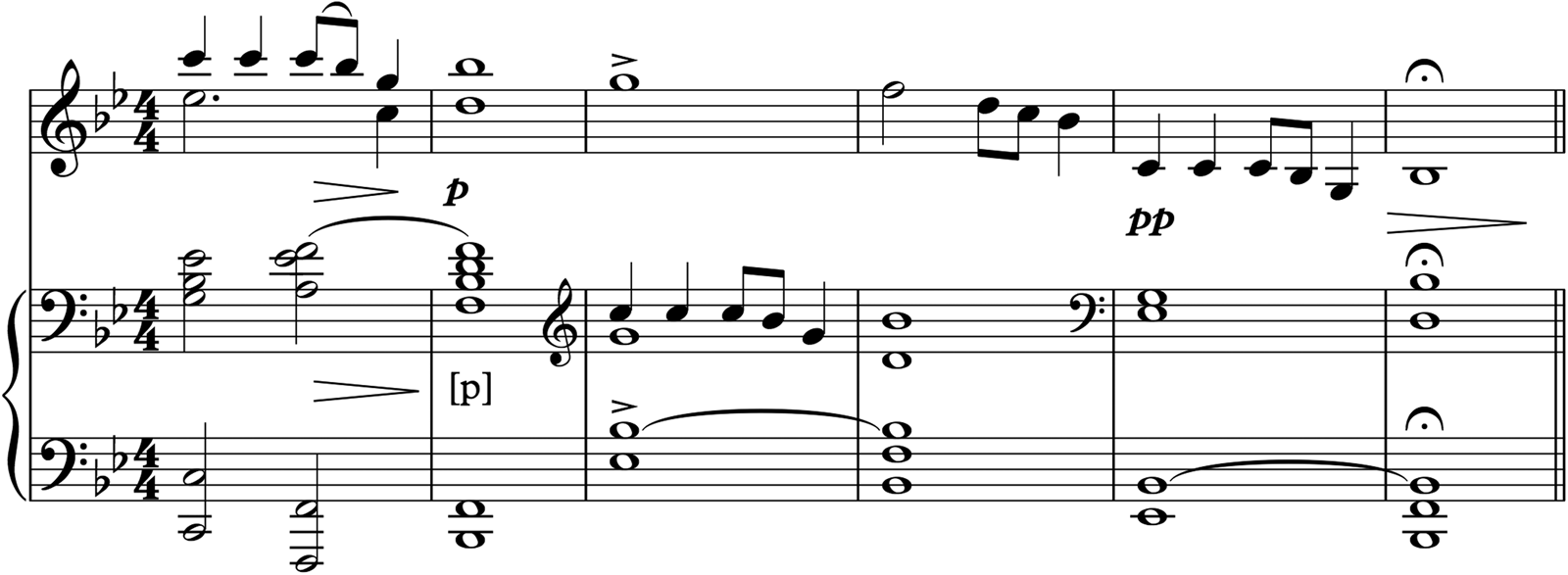
Leading into the next section (Andante), the D serves as a pivot point to introduce the secondary theme, a pentatonic melody based in B-flat major (mm. 61–68, Example 3). The eight-measure theme is repeated with modifications, but this restatement (m. 81) is delayed by an eight-measure excursion on v—again with the lowered seventh scale degree—which plays with the defining short–short–long rhythm of the secondary theme. Significantly, Price ends her exploration of this Andante section by considering one “answer” to the question of how to establish a “national musical idiom,”Footnote 24 thereby showing an awareness of past approaches. In mm. 83–88 of the fantasy (Example 4) we hear the motive C-C-C-B-flat-G-B-flat no fewer than three times in three different octave registers, alternating between violin and piano. The passage is remarkably close to mm. 39–41 of the second movement from Dvořák's New World Symphony (premiered in 1893 in Carnegie Hall; see Example 5) in which, as is known, Dvořák was attempting to assimilate the qualities of Black spirituals.Footnote 25 His knowledge of this repertory was owing to his relationship with Harry Burleigh at the American Conservatory in New York, which Dvořák directed in the 1890s during his sojourn in the United States.
Florence Price, Violin Fantasy No. 1 in G minor (mm. 61–68), used with permission.

Florence Price, Violin Fantasy No. 1 in G minor (mm. 83–88), used with permission.

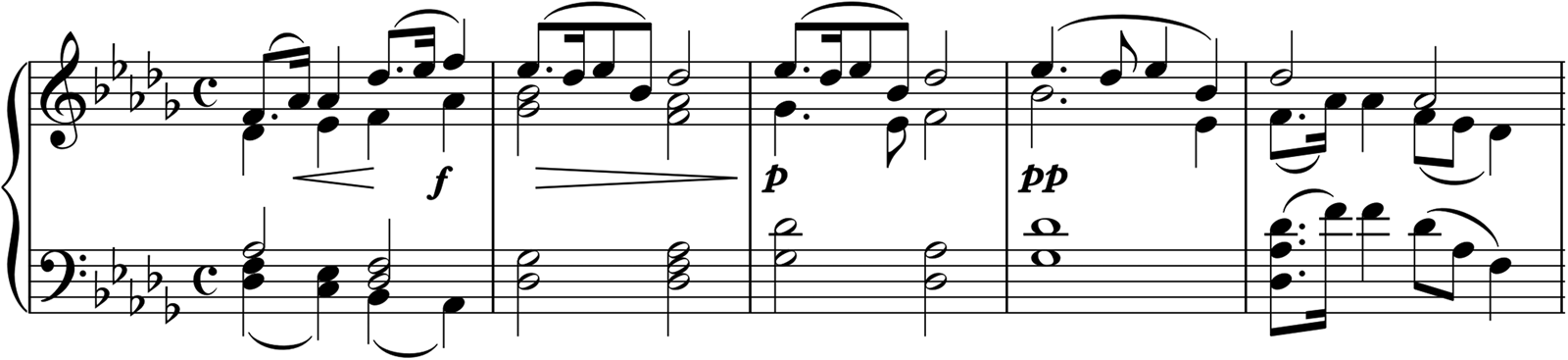
Antonín Dvořák, Symphony No. 9 (New World), Movement 2 (mm. 38–42), piano arrangement by Paul Juon (Berlin: Simrock, 1899).

In Dvořák's symphony the relevant motive is heard three times; admittedly, it is in a fixed register, though it is featured in three different timbres, the English horn, clarinet, and first violins. In effect, Price uses register as a way of providing variety for the restatement of the motive. By referencing loosely Dvořák's symphony, Price seems first to acknowledge Dvořák's search for an American idiom; and second, and more importantly, to propose a different path that showcases Black folkloric spirituals as an answer to the quest for a “national musical idiom.” After this (possibly intended) Dvořák reference, Price brings back the transitional theme, which had appeared first in B major, and places it now in G minor, thereby referencing the sonata principle of “resolving” themes in the tonic key in the end, a move often followed by composers of nineteenth-century fantasies. In summary, Price's three themes—the buoyant, passionate first theme in G minor, the inkling of a transitional theme in B-major, and the central, lyrical second theme in B-flat major forming the center of this fantasy—offer a rich range of expression and meaningful harmonic relationships. There is the altered mediant relationship between G minor and B major, the half-step tonal shift from B major to B-flat major (i.e., from the raised to normal mediant), but also the introduction of pentatonicism in the thematic profiles—all in all, a sophisticated blend of Black folkloric elements in the context of a freely sectional, European genre.
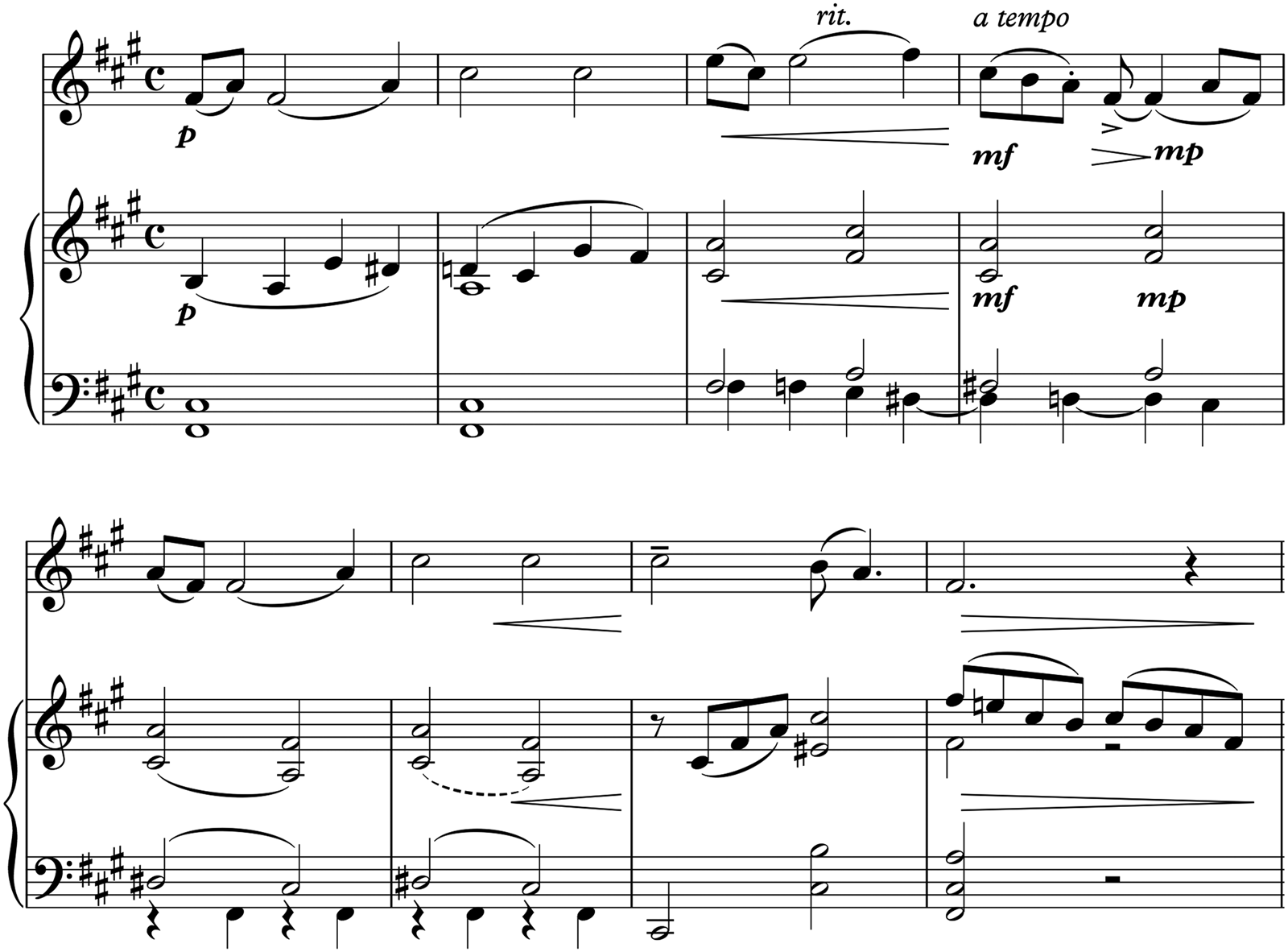
Like the introduction to Violin Fantasy No. 1, No. 2 begins with several measures to set the mood; here the harmonies are again inflected by chromaticism and pursue a descending trajectory, which gives the opening the quality of a lament. When the violin enters with the folkloric principal theme in m. 17 (Example 6), it plays with the lowered seventh scale degree E, which also features significantly in the final measures of the piece. At the same time, however, other passages move the fantasy closer to the domain of European art music, and its recent, nineteenth-century past. There are, for instance, liberal applications of diminished-seventh sonorities and ascending sequences based upon them. The Allegro that follows in mm. 64ff. suggests a popular style that then swerves to freely ranging chromatic progressions (mm. 68ff.). In m. 79 we reach the submediant D major, which quickly enough yields to another series of chromatic modulations before the inevitable return to the tonic F-sharp minor and reprise of the theme (m. 105) (Example 6).
Florence Price, Violin Fantasy No. 2 in F-sharp minor (mm. 17–24), used with permission.

Michael Cooper has identified the principal theme (Example 6) as a Black spiritual with the text “I'm Workin’ on My Buildin.’” As described above, Price's version of this tune differs from other published versions, but one of the autographs specifies that her rendition of the spiritual was written “as sung to Fannie Carter Wood of Chicago by her grandmother Melinda Carter/a former slave of Memphis Tennessee.”Footnote 26 Quoting Cooper again, “the meaning of the melody becomes clear only when one considers that in slavery blacks were legally forbidden to own property, and the same was true either by law or simply as a practical matter in the Jim Crow South that Price abandoned in 1927.”Footnote 27 Indeed, though Price's southern hometown of Little Rock had once provided relatively stable conditions, where her parents had been able to live a comparably good life as members of the town's “black upper class,” since the early 1900s, when Price left for college, the standard of living had taken a sharp turn for the worse.Footnote 28 Thus, when Price refashioned the pre-existing spiritual “I'm Workin’” as the bedrock of Fantasy No. 2—having just finished the original tune, the second of Two Traditional Negro Spirituals, 3 days earlier on March 26, 1940—she created a deep link with her cultural identity and experience as a Black composer–pianist.
We might summarize some of the subtle and artful retouches of the spiritual “I'm Workin’ on My Buildin’” as it appears in the violin fantasy. In the vocal setting, the melody begins with a quarter-note upbeat that is missing in the fantasy. Also, a full whole note F-sharp in the piano precedes the tune in the spiritual, transferred in m. 16 of the fantasy to the deep octave bass of the piano, as if, in keeping with the building imagery, to suggest the foundation upon which she builds her tune. Other changes, such as a ritenuto in m. 19 of the fantasy instead of the fermata in m. 4 of the spiritual, or changes in slurs in the violin part, which do not always accord with the text declamation in the spiritual, are seemingly less significant. Especially noticeable, though, is the evolution of the piano accompaniment: Its relatively unassuming and spare diatonic harmonies in the spiritual metamorphose into more active, chromatic dissonances in the fantasy proper, forming a moving contrapuntal undercurrent in the music that supports the poignant presentation of the melody above. In sum, if the second fantasy, like the first, is a relatively small work, it afforded Price another opportunity to hone her skill in combining a Western classical genre with vernacular folklore, an approach she could then develop more extensively in the symphonies to come. Moreover, though little is known regarding its performance and reception history, Fantasy No. 2 proves that the spiritual was meaningful to her, hence its reuse. Fantasy No. 2 engages the metaphor of a sonic foundation-building. Being a Black-American woman composer enduring a time of racial oppression, the uplifting message of the spiritual's text can be read as a metaphor of hope for Price herself, and as an indicator of her faith, as she expressed poignantly in 1936:
I feel deeply thankful for progress, but satisfaction—no, not satisfaction. I am never quite satisfied with what I write. I don't think creators ever are quite satisfied with their work. You see there is always an ideal toward which we strive, and ideals, as you know, are elusive. Being of spiritual essence they escape our human hands, but lead us on, and I trust upward, in a search that ends. I believe, only at the feet of God, the One Creator, and source of all inspiration.Footnote 29
II
Price's two violin fantasies were composed within the tradition of the nineteenth-century virtuoso violin “fantasia” that flourished during the “Golden Age” of virtuosity before falling out of favor around the mid-nineteenth century. As William Drabkin notes, “The form of the operatic fantasia often resembles that of a theme and variations, with a freer introductory section and an extended finale.”Footnote 30 Although the violin fantasies by Ernst, Joachim, Wieniawski, Bruch, and others display a great variety of themes and methods of treatment, they all share a loosely knit, sectional approach to form and are animated by an increasing energy that drives to the end.
This teleological focus, ending with a bang, is also evident in violin fantasies of the twentieth century, although some examples reconceptualize the concept of “theme” or “thematic” and redefine the role of violinistic virtuosity. Although only one other twentieth-century violin fantasy by a woman is known to these authors—Mathilde Kralik's Phantasy in E minor for voice, violin, and piano (1928)—there is, of course, also Schoenberg's Fantasy for violin and piano, Op. 47 (1949), a twelve-tone work bristling with combinatorial hexachords. More broadly, the twentieth century also witnessed the production of fantasies for piano, orchestra, organ, and other instruments.Footnote 31 Some composers, such as Max Reger and Ferrucio Busoni, clearly built upon the precedents of earlier key figures central to the fantasy, such as Franz Liszt. As Drabkin writes, “[I]n the early 20th century the fantasia became something of a retrospective form” that in fact allowed composers more freedom of creation within the genre.
Bearing all of Price's fantasies in mind arguably justifies highlighting her as a key figure in the early-to-mid twentieth-century genre of the instrumental fantasy. Aside from the two violin fantasies, her output encompasses four fantasies titled Fantasie Nègre for piano, composed, in their first versions, between 1929 and 1932 (No. 1 in E minor for piano, No. 2 in G minor, No. 3 in F minor, and No. 4 in B minor); two fantasies for organ (“Fantasy” from Suite No. 1 and Prelude and Fantasie, both 1942); and a fantasy for piano and orchestra (date unknown, survives in two incomplete autographs).Footnote 32 William Drabkin reminds us that in the twentieth century the genre “became something of a retrospective form,” meaning that it continued to privilege characteristic nineteenth-century features, rather than promote a modernist rethinking or complete reinvention, as was the case in other genres.Footnote 33 What had been true earlier—that the fantasy “offered far greater freedom in the use of thematic material and virtuoso writing” than did the sonata—was still true for composers in the twentieth century. In addition, the fantasy had grown “in size and scope,” as well as status and prestige, to become a significant genre in its own right.Footnote 34 These aspects were not inconsequential for Price, who demonstrated that she was attracted to genres with Western historicist flavors, because they allowed her at once to participate in an existing generic discourse and at the same time rethink and redefine it through her own, individual approach. On a personal level, the imaginative, open-ended possibilities, performative freedom, and options for improvisation afforded by the fantasy genre attracted her as much as its bravura and connotations of virtuosity.
Two questions now arise. First, how do Price's violin fantasies navigate between thematic spotlighting and markers of performative freedom and improvisation? Second, considering that, as a skilled pianist,Footnote 35 she herself would have performed these pieces, how might her own subjective experience of performing and living with these fantasies have interacted with some of the concepts involved? Given that no records about her thoughts and feelings in relation to performing these fantasies survive, the second question remains hypothetical but can be restated: Can certain artistic and interpretive choices be understood by considering the cultural context that engendered these individual choices?
As Norman Denzin has commented, “Freedom is never given. Race, class and gender oppressions limit the real and perceived degrees of freedom of individuals in any given instance.”Footnote 36 As a Black woman who had escaped the “Jim Crow” South for Chicago and divorced her abusive husband, the concept of freedom had palpable, real-life meanings for Price's day-to-day life. Indeed, as Brown describes:
Issues of gender, class, and race were ever-present for black women in the first half of the century, and the inherent conflicts that were prevalent for professional women were difficult to reconcile. For this reason, Price maintained an active involvement in the National Association of Negro Musicians (NANM). It was NANM and, by extension, the Chicago Defender, which covered the activities of the black community, both locally and nationally, that kept Price's name before the public for the twenty-five years she resided in Chicago.Footnote 37
For Price, writing fantasies afforded the contemplation of improvisatory musical freedoms in a way other genres did not. Originating in the Renaissance, the fantasy had been “an instrumental composition whose form and invention had sprung ‘solely from the fantasy and skill of the author who created it,’” in the words of composer Luis de Milán (1500–61). “From the sixteenth to the nineteenth centuries the genre tended to retain this subjective license, and its formal and stylistic characteristics consequently varied widely from free, improvisatory types to strictly contrapuntal and more or less standard sectional forms.”Footnote 38 Terms such as subjective “license,” “fantasy … of the author,” and “free” improvisatory moments all stood in tension with the genre's anticipated sectional structure. As it happens, both of Price's fantasies negotiate this space between formal freedom and planning in their own individual ways.
Violin Fantasy No. 1 takes up the nineteenth-century model with a nod to the Romantic age, when “the fantasia, like the slow introduction to a sonata-allegro movement, a variation set or a fugue, provided the means for an expansion of forms, both thematically and emotionally.”Footnote 39 Thus, Price expands her fantasy by beginning with a slow introduction, Andante (mm. 1–12), which uses several markers that point to an “ad libitum” style. Tonally centered in G minor, the work's opening could have been composed by any other Romantic violin composer such as Saint-Saëns, Bruch, or Joachim. First, Price draws the listener's attention to the realm of improvisation by composing into the violin part freely repeated, accentuated eighth notes on a single pitch (m. 2), which invite the violinist to linger here and there, taking more time on one eighth than the other, thereby creating the impression of the music being composed on the spot (Example 7).
Florence Price, Violin Fantasy No. 1 in G minor (mm. 1–13), used with permission.

Second, Price uses virtuosic runs, flourishes, and improvisatory garlands in the violin part (mm. 3, 6, 10, and 11), allowing the sense of breathless virtuosity to unfold before the listener's eyes and ears, as the violinist decides in the moment exactly how fast to dispatch the descent marked “accel.” (m. 3), how to distribute the notes of the diminished-seventh flourish (m. 6), how to phrase the ascent with its expressive augmented second between B-flat and C-sharp (m. 10), and how to fantasize freely in the improvisatory spirit of m. 11: Fourteen notes all notated under a slur with small note heads, that is, outside the counted metrical contents of the measure. Third, the sixteenth-note patterns that dominate the violin line in mm. 7–8 feature a three-note motive, C-B-flat-A, that generates cross accents: The notes on the beat of m. 8—beat 1: C, beat 2: B-flat, beat 3: A, beat 4: C—create cross-rhythms when the motive is repeated five times. Nineteenth-century violinist/composers, for example Joseph Joachim in his cadenzas, often applied this type of figuration.Footnote 40 Taken together, all these improvisatory gestures conduce to an interpretive freedom, as if reminiscing about earlier improvisatory, often violin-centered, styles such as the style hongrois, evidenced, for example, in the last two variations of Joseph Joachim's Variations on an Original Theme in E minor Op. 10 (1854). Florence Price's expressive opening then yields to the primary theme in G minor; from here on, the sectional nature of the fantasy shapes the continuation of the piece, although, to be sure, additional intimations of improvisation return later.
In the brief transition after the secondary theme in B-flat major, a compact section materializes (mm. 89–93) that recalls the earlier arrival on B major (mm. 38–41). The violin and piano enter in turn in a call-and-response pattern, with the piano beginning by proposing a trill on scale degree 5 (D), supported by its double upper neighbor notes, lowered-7 and 6 (F and E-flat). The violin repeats this trill and descending gesture. Then the piano and violin accelerate the surface rhythm, driving the music to a dramatic fermata on the dominant sixth, before proceeding to the repeat of the first theme in G minor.
As in the first fantasy, Violin Fantasy No. 2 also contains striking “vocal” moments that call out for a text; in this case, we can identify it as the pre-existing spiritual “I'm Workin’ on My Buildin,’” the second of the Two Traditional Negro Spirituals and inspiration for Violin Fantasy No. 2. The text reads:
How does the violin embody the voice? Comparing the rubato of the vocal part with that of the violin highlights the vocality of Price's writing for the violin and allows us to make some observations about performance practice issues, which we shall briefly explore here.
The spiritual calls for a fermata in m. 4 on the word “my,” which correlates with F-sharp, the eighth scale degree, whereas the violin instead has a ritenuto, written not above F-sharp but rather above E, the lowered seventh scale degree. Rubato (“stolen time”) allows the performer to indulge in time when one does not have time; rubato invites the performer to be free even if this sense of freedom is constrained because the music must soon continue. As a metaphor, this momentary rubato can carry considerable weight; at the very least it can create a moment of performative freedom, a brief liberation into a mode of complete agency, where the performers together achieve the intended musical ideal by articulating, phrasing, and interpreting a passage exactly according to their wishes and needs.
Another vocal element comes to the fore in m. 23 of the violin part, when the threefold repetition of the pitch C-sharp emphasizes via a tenuto the third and last repetition. This tenuto is the goal of a short but intense crescendo (see Example 6, mm. 6–7 above). The vocal part does not feature this crescendo; but if it were part of a vocal line, we could imagine the voice turning to a more intense and strongly inflected, possibly even chest-voice-imitating quality (the C-sharp would seem to be approaching the limit of using actual chest voice).
With the second appearance of the theme in F-sharp minor (m. 47), Price uses dynamics for expressive purposes and, again, for evoking a sense of freedom. In m. 51, she instructs the piano to roll the two half-note chords at a ff level. The subito mp dynamic in the next measure, 52, needs to be delayed slightly in order to recede convincingly from that dynamic climax. The violin, although playing the fourth beat mp during the pianist's ff, should wait for the second ff rolled chord to subside and disappear, which takes some time, before articulating this fourth-beat quarter-note in m. 51. Once again, this moment of stretching time is full of potential, in effect an open invitation for performers. We might view such rubato moments as auto-ethnographic maneuvers based on self-reflection or personal experiences. Indeed, it is difficult not to ask how Florence Price may have constructed this freedom as an act of self-reflection in dialogue with her own lived experience.
III
By now it should be apparent that one of the ways in which Price's violin fantasies are grounded in her use of existing or newly composed vernacular tunes is to employ the violin in a hybrid way: Situating it in an active discourse between traditional idiomatic writing on the one hand, and a style of playing that magnified the violin as an extension of the voice on the other. In short, she allowed the violin to “sing” many of the tunes, including the spiritual “I'm Workin’ on My Buildin’” in the second fantasy.
Although few sources discuss Price's direct experience with the violin, Rae Linda Brown does assert: “When she married, Price abandoned her college teaching career and, like many women, she stayed at home to raise her children. In her spare time, she taught private lessons in her home, both piano and violin.”Footnote 41 In addition, one of Price's friends from her Boston period was the violinist/composer Clarence Cameron White; another colleague was the violinist Walter H. Dyett; Price remained connected with both through NANM.Footnote 42 Finally, Price would have gained significant practical experience in writing for strings in her Symphonies No. 1 (1931–32) and No. 2 (ca. 1935), as well as her two string quartets, No. 1 (1929) and No. 2 (published 1935). Violin Fantasy No. 1 originates near these works, while Violin Fantasy No. 2 (1940) is closer to her two Violin Concertos; the first, in D major, composed in 1939, the second, in D minor, in 1952. More likely than not, Price was quite knowledgeable and experienced as a violinist, though she was better known as a virtuoso pianist and organist.
In her two fantasies she treats the instrument in a highly idiomatic and sophisticated manner, betraying her intimate understanding of the instrument. Unlike Brahms, for example, who, despite the presence of Joseph Joachim and other violinists in his life, wrote a concerto “against the violin” (to quote Hans von Bülow), Price created her fantasies in a manner that embraced and supported the instrument.Footnote 43 She betrayed her deep affinity for the violin by showcasing her ability to balance expression and variety of timbre against, when needed, stimulating virtuosity.
For example, Price shows an awareness of the four strings of the violin and the placement of their particular pitches, where they are located on the fingerboard, and how the placement of certain pitches allows for idiomatic techniques such as broken four-voice chords in other cross-string legato patterns. Thus, in mm. 122–125 of the first fantasy, near the end, and in m. 70 of the second fantasy, we hear classic legato lines of broken chords across all four strings.
However even more nuanced are passages such as m. 33 in the first fantasy and m. 35 in the second, where Price organizes runs by position and string on the violin. In No. 2, m. 35 (and similarly, m. 37), she writes a succession of notes that a skilled violinist could play in this manner:
As Example 8 shows, the slurring notably does not align with these string and position changes; nonetheless, the result is that the passage is actually comfortable, avoiding large leaps and string crossings that would create breaks in the music's flow. A similarly practical, easy-to-play, and smooth legato strategy is evident in mm. 39, 43, 67 of Fantasy No. 2.
Florence Price, Violin Fantasy No. 2 in F-sharp minor (m. 35), used with permission.

In addition, there is a satisfying balance in Price's use of all four string timbres of the violin. She often organizes the main themes to allow the violinist to remain for an extended period on a single string, maximizing expressivity and brilliance, and underscoring the timbre of the respective string. Such is the case too in Fantasy No. 2, mm. 17–24, 47–55, and 87–88. Regarding the bow, Price exploits a range of idiomatic bowings: Spiccato, marked with dots and with the instruction spiccato (No. 2, m. 72); flying staccato, marked with notes and dots and a large slur as well as the instruction “flying staccato” (No. 1, mm. 114–15); and tremolo, with both double and quadruple repetitions (No. 1, mm. 50–53; No. 2, mm. 101–30).
Quite notably, Price does not invoke a fiddle or any other popular idiom of violin playing in these fantasies, which she could well have, given the obvious allusions to vernacular music. Rather, she must have had an interest in the violin as an instrument connected to a long tradition of Western art music, which encouraged her to explore traditional techniques of playing in this highly sophisticated manner.
IV
In conclusion, let us briefly consider the musical context for Price's fantasy tunes. Although Price references the sonata principle both in the structure of Fantasy No. 1 in G-minor (e.g., in the return of secondary material in the tonic) and also of her piano Fantasy No. 4 in B minor, on which we may draw for comparison,Footnote 44 the sonata principle is definitely not the primary means by which she employs her tunes within each fantasy viewed as a whole. Price famously wrote about one of her compositional principles in her program notes for Three Little Negro Dances: “Rhythm is of preeminent importance. In the dance, it is a compelling, onward-sweeping force that tolerates no interruption… All phases of truly Negro activity—whether work or play, singing or praying—are more than apt to take on a rhythmic quality.”Footnote 45 Fantasies are not dances; but if we briefly consider her remark regarding “not tolerating interruption” and creating an “onward-sweeping force,” we may better understand her extraordinary skill in the violin fantasies. We will attempt a reading whereby “not tolerating interruption” and pushing forward with an “onward-sweeping force” are taken to signify a sense of cohesion, whereby changes of texture and/or changes from quasi ad lib to sounding “measured” are what creates “interruption” and breaks the “onward-sweeping force” of the music.
The first version of Fantasie nègre No. 4 (1932) could have served Violin Fantasy No. 1 (1933) as a sort of model in terms of the opening structure, whereas the last version of Fantasie nègre No. 4 (1937) chronologically approaches Violin Fantasy No. 2.Footnote 46 Both Violin Fantasy No. 1 and Fantasie nègre No. 4 begin with an improvisational introduction before presenting the first vernacular tune in the tonic. Fantasie nègre No. 4, encompassing the opening introduction, the main theme (B minor), a secondary tonal area (G major) and a coda, begins with an improvisatory mood-setting passage directed toward the dominant. A lavish arpeggio gesture in the tonic (m. 1) gives way to an ensuing descending B harmonic minor scale (m. 2). Then Price presents and fragments brief motivic cells (mm. 3, 5–7, 8–10, and 12–17). Heightening the simulation of improvisation are the brief insertions of expressive wave-shaped and circular motives (mm. 8–9, 13, and 16), which recur as if freely unmeasured. Lastly, the introduction comes to a fermata on the dominant. After this “interruption” there emerges the exquisite main tune in B minor. Price used a similar procedure in her first violin fantasy, written only 1 year later.
Likewise, Violin Fantasy No. 1 in G minor begins with an improvisational introduction that, as in the B-minor piano fantasy, yields to a measured, structured vernacular theme (m. 14). As in Fantasie nègre No. 4, Price uses a wave-shaped repeating motive (mm. 4–5), this one anticipating her later emphasis on syncopation, and she also resorts to circular motivic repetitions (m. 8). Although the fourth piano fantasy places greater emphasis on alternating motivic and preluding styles (the motivic notes being offset in normal-size noteheads from the preluding style with small note-heads), the introduction of Violin Fantasy No. 1 highlights the rising harmonic motion from I to V via a stepwise ascent from G to A (m. 6), B-flat (m. 9), C (m. 11), and D (m. 12). Both pieces are equally efficient at setting the stage for the first vernacular theme by means of an “interruption” and a change from an improvisatory ad lib mode to a measured melodious mode.
Violin Fantasy No. 2 in F-sharp minor also contains an introduction that, although similar in length to that of Fantasy No. 4 (both sixteen measures; thirteen measures in Violin Fantasy No. 1 in G minor), pursues an entirely different strategy. In the second violin fantasy Price allows the piano to set the stage for the vernacular tune, which then appears in m. 17 with the violin's first entrance. On closer inspection, the opening plan of sixteen preparatory measures in the piano introducing a sixteen-measure theme in the violin invites the question whether the piano's material is in any way related to the violin's tune? Possibly Price had in mind to connect here the thirty-two bars through a descending tetrachord from F-sharp to C-sharp. Indeed, this motivic link could almost inspire the listener to hear the piano introduction as a free improvisation on the violin theme that follows. However because the descending tetrachord as a motivic link is found only in the piano and not in the violin, and because the violin's tune is so clearly the first thematic “event” of the fantasy, not least due to its link with “I'm Workin’ on my Buildin,’” this opening, overall, supports the first reading: The piano prefatory material creates a timbral contrast to the “ voice” that delivers the message, the “voice” being the violin's presentation of the tune “I'm Workin.’”Footnote 47
In the final analysis, we can trace a clear trajectory between Price's compositional approach in the early 1930s and in 1940: After highlighting textural contrast in the early 1930s, she explored timbral contrast in 1940. By applying in all three fantasies a nuanced treatment of “interruption,” that is, a break and change in textural/timbral activity, she generated an “onward-sweeping force,” a sense of strong momentum that at once reinforced the cohesion of larger structural sections while at the same time promoting the listener's identification with the vernacular tunes. These are, in effect, powerful “time-out” moments, similar perhaps to a measured aria that stops and reflects after a speech-like, forward-pushing recitative. Furthermore, the improvisatory openings of these fantasies play with certain meanings of freedom—musical meanings—by employing elements of ad libitum, as well as seemingly unmeasured motivic repetition, pauses including fermatas, and, in the case of Violin Fantasy No. 2, an opening that seems like an improvisation on a theme about to enter in the violin.
Owing to the work of several scholars, the Florence Price revival has gained considerable traction in recent years and shows no signs of abating. In addition to Michael Cooper's pioneering critical editions of a substantial selection of her music, Douglas Shadle and Samantha Ege are now preparing a monograph on Price's life and music, advancing efforts to right the record of an unjustly neglected composer, many of whose manuscripts were found in an abandoned house in Illinois and only fortuitously saved from oblivion. The two violin fantasies may now take their deserved place in the composer's oeuvre, as they connect two different visions of U.S. music, revealing, for instance, how a slave spiritual could inspire a fantasy in which Price's artistry could manifest itself freely. Perhaps these fantasies were an answer to Amy Beach's private criticism of Dvořák's New World Symphony (1893), that the music of its second movement, destined to become the spiritual “Goin’ Home,” “[represented] only the peaceful side of the negro character and life. Not for a moment [did it suggest] their sufferings, heartbreaks, slavery.”Footnote 48 Price, on the contrary, took a different approach from Dvořák. By drawing on the world of spirituals and citing in Violin Fantasy No. 2 “I'm Workin’ on My Buildin,’” she allied her music with deeply felt associations, not only realized here musically, but also tied to the experiences of being a Black woman composer with personal limitations, and the legacies of her race. By specifically pointing to her Black sisters and ancestors in her manuscript of the spiritual “I'm Workin’ on My Buildin,’” Price referenced the first-hand experience of slavery of Fannie Carter Wood's grandmother Melinda Carter, a former slave of Memphis, who sang this particular spiritual to her granddaughter in Chicago. By knowing the song's history, Price chose to lend a voice to Melinda Carter and many others who shared her experience of racial oppression, past or present. Certainly, the unusual key of F-sharp minor, the lament-like opening of the piano introduction, and the poignancy of the violin's rendering of that main spiritual all helped to underscore the living ties between the music and its real past, even if, as in all fantasies, the theme underwent transformations in manners specific to the genre. To be sure, Price set this particular rendition of “I'm Workin’” for violin rather than for voice and advanced the idea of freedom in the subtle and not-so-subtle ways she treated both instruments. Lastly, by acknowledging a nineteenth-century conception of this Western genre and allowing it to enter into dialogue with Price's identity via the use of certain spiritual and other folkloric elements, Price offered her own answer to the question of how a “national musical idiom” for the United States might develop. Unlike Dvořák's music in Amy Beach's eyes, Price's music did not avoid, but confronted the totality of the Black lived experience with an unfettered authenticity all its own.
Acknowledgments
The authors would like to thank Samantha Ege, Michael Cooper, and Douglas Shadle for assistance of various kinds. The authors are grateful to the reviewers of this journal for their insightful feedback.
Competing Interest Statement
The authors declare that they have no known competing financial interests or personal relationships that could have appeared to influence the work reported in this paper.
Katharina Uhde, DMA, PhD, is an associate professor of music at Valparaiso University. She is the author of The Music of Joseph Joachim (Boydell & Brewer, 2018) and has edited for Bärenreiter two compositions by Joseph Joachim (2018). She has written chapters, articles, and encyclopedia entries related to Joachim. As a violinist, she has won prizes in competitions, released several CDs, and has recorded virtuoso violin works by Joseph Joachim with the Radio Orchestra Warsaw, released under the Soundset label in December 2020. She has received grants from the Fulbright Commission, the Andrew W. Mellon Foundation, the Fritz Thyssen Foundation, and the American Brahms Society.
R. Larry Todd is arts & sciences professor at Duke University. His books include Mendelssohn: A Life in Music, “likely to be the standard biography for a long time to come” (New York Review of Books), and Fanny Hensel: The Other Mendelssohn, which received the Slonimsky Prize. He has published numerous articles on topics ranging from Obrecht to Webern. A fellow of the Guggenheim Foundation, he edits the Master Musician Series (OUP). He studied piano at Yale University, and has issued with Nancy Green the Mendelssohns’ cello works. He has co-authored Beethoven's Cello: Five Revolutionary Sonatas and Their World.