Introduction
In one of the largest lichen families, Teloschistaceae, the majority of lichens produce yellow-orange-red anthraquinone pigments in the superficial tissues of their fruiting bodies and/or thallus (e.g., Søchting Reference Søchting1997). They are produced in various Teloschistaceae in 1) both thallus and apothecia, 2) in apothecial disc and margin only, 3) in apothecial disc only or 4) are entirely absent. Anthraquinones are known to protect lichens from absorption of UV radiation (Solhaug et al. Reference Solhaug, Gauslaa, Nybakken and Bilger2003); their content in Xanthoria parietina (L.) Beltr. (Teloschistaceae) significantly increases with exposition to solar radiation (Gauslaa & McEvoy Reference Gauslaa and McEvoy2005).
Some Teloschistaceae also have the ability to synthesize green or grey pigments of unknown structure, for example, ‘Lecidea-green’ (Wetmore Reference Wetmore1996; Arup et al. Reference Arup, Arneng and Søchting2007) or ‘Sedifolia-grey’ (e.g., Wetmore Reference Wetmore1996; Meyer & Printzen Reference Meyer and Printzen2000), which may have the same function, that is, protection against UV radiation (e.g., Hauck et al. Reference Hauck, Dulamsuren and Mühlenberg2007). These pigments usually occur in parts of the thalli or apothecia where anthraquinones are absent, although both pigments may co-occur in the superficial tissues of the apothecia of some species. These species, for example, Caloplaca conversa (Kremp.) Jatta, C. exsecuta (Nyl.) Dalla Torre & Sarnth., C. oleicola (J. Steiner) van den Boom & Breuss and C. pollinii (A. Massal.) Jatta, may resemble those with an entire absence of anthraquinones, because their old apothecia turn black as they contain large amounts of melanin pigments. In these cases, the anthraquinones may be identified by the reactions of the apothecial sections (K+ strongly purple-violet, K→HCl+ yellow, N+ orange, N→ K+ purple-violet-blue, N→K→HCl+ yellow; Vondrák et al. Reference Vondrák, Khodosovtsev, Lőkös and Merkulova2010a).
The absence of anthraquinones is known at various levels; their absence in the thallus has arisen in many lineages throughout Teloschistaceae, for example, the C. cerina group (Šoun et al. Reference Šoun, Vondrák, Søchting, Hrouzek, Khodosovtsev and Arup2011). Occasional loss of anthraquinones in the thallus is also documented in individuals or populations of species that usually have a pigmented thallus (Søchting Reference Søchting1973; Vondrák et al. Reference Vondrák, Šoun, Sogaard, Søchting and Arup2010b). Aberrant populations lacking anthraquinones completely are suggested in C. tiroliensis Zahlbr. (Hansen et al. Reference Hansen, Poelt and Søchting1987; Søchting Reference Søchting1989) or C. xerica Poelt & Vězda (Poelt Reference Poelt1975).
Species (or individuals) of Teloschistaceae with a complete loss of yellow-orange-red pigments, sometimes grouped under Pyrenodesmia (Caloplaca variabilis group), have been studied since the 19th century but attempts to treat them systematically began with Magnusson (Reference Magnusson1950), followed by Wunder (Reference Wunder1974) in the Old World and Wetmore (Reference Wetmore1994) in North America. More recently, several works have dealt with this group using single locus (ITS) molecular data (Arup & Grube Reference Arup and Grube1999; Tretiach et al. Reference Tretiach, Pinna and Grube2003; Tretiach & Muggia Reference Tretiach and Muggia2006; Muggia et al. Reference Muggia, Grube and Tretiach2008; Vondrák et al. Reference Vondrák, Khodosovtsev and Říha2008; Xahidin et al. Reference Xahidin, Abbas and Wei2010).
Although the absence of anthraquinones in Teloschistaceae has often been treated as an important grouping character, no studies to date have tested whether or not this is a reliable character for classification, or whether species with such characters represent a monophyletic group. The purpose of the present study is to test this hypothesis using a broad sampling of species lacking anthraquinones, which would traditionally be treated as closely related (e.g., Muggia et al. Reference Muggia, Grube and Tretiach2008). Specifically, we will test whether or not these species can be recovered as a well-supported monophyletic group.
Materials and Methods
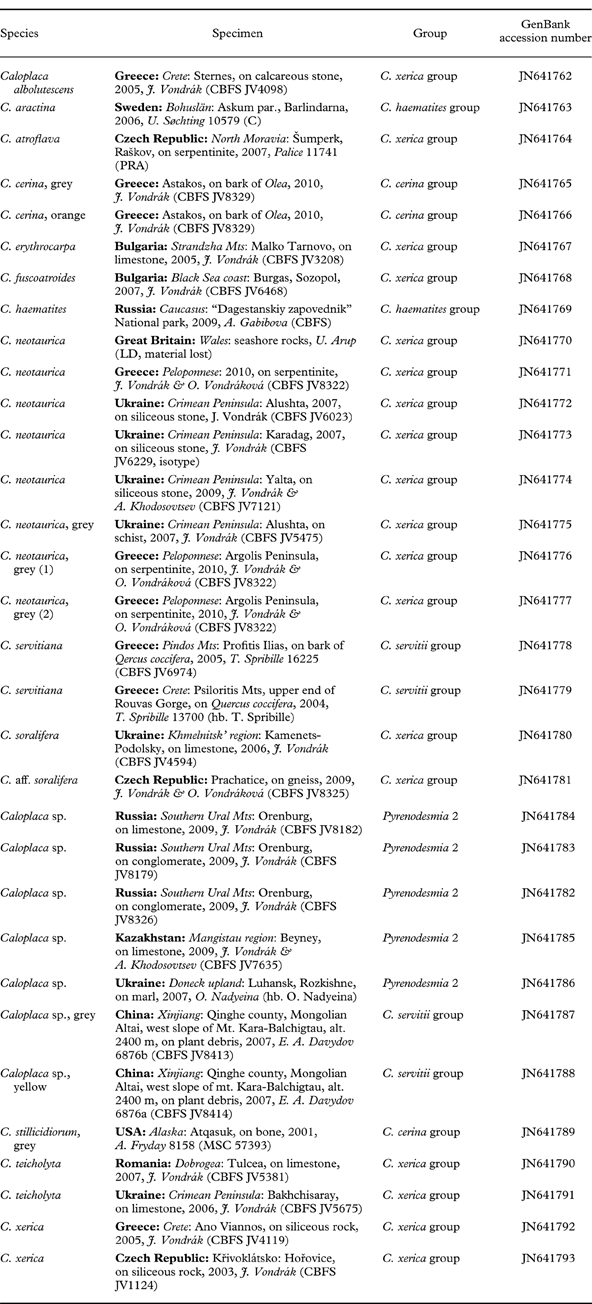
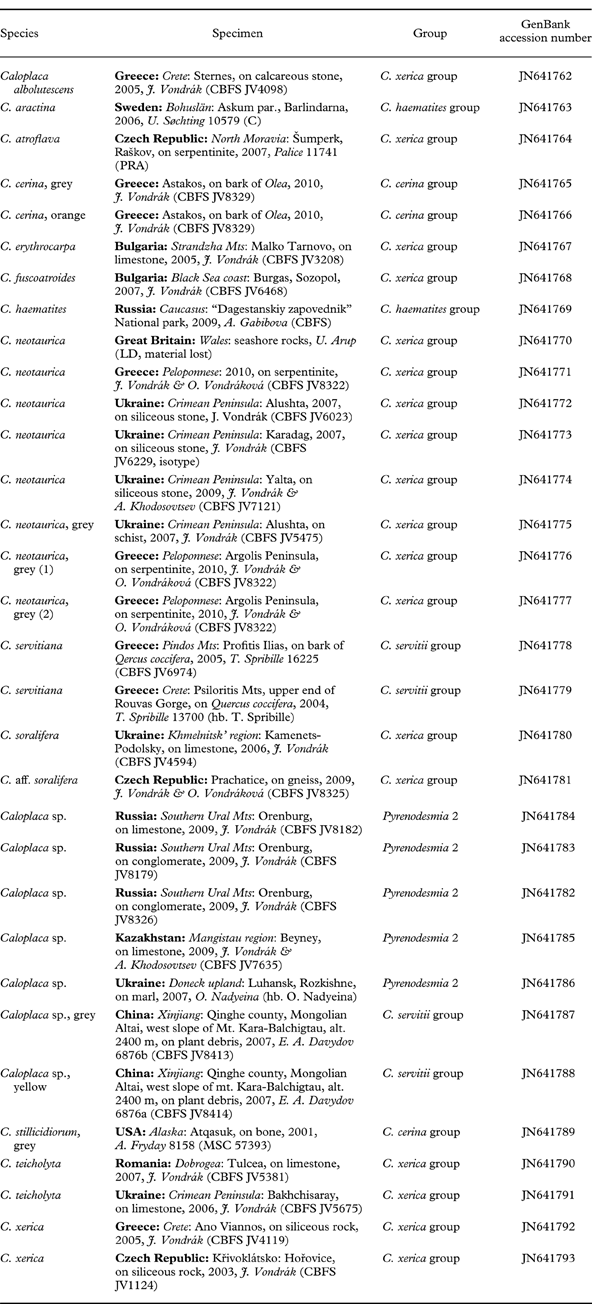
Lichen samples were collected by the authors from various localities in the Northern Hemisphere. Detailed herbarium data for specimens used in our phylogenetic studies are given in Table 1. Data for paratypes of C. neotaurica are abbreviated; full information for samples from CBFS is available at http://botanika.bf.jcu.cz/lichenology/data.php.
Sample data, engaging to groups and GenBank accession numbers of the ITS sequences newly generated for phylogenetic analyses.
Morphological examinations
A detailed morphological description is given only for the new species. Measurements are accurate to 0·25 µm for cells (e.g., conidia and ascospores), 1 µm for width of asci, or 10 µm for larger structures (e.g., hymenium, width of exciple). All measurements of cells (ascospores, conidia, asci, paraphyses) include their walls. Paraphyses tips were observed after treatment with c. 10% KOH. Only those ascospores with well-developed septa were measured; in these ascospores, loculi were connected with a thin cytoplasmatic channel, never disconnected. Measurements with more than ten repeats (n≥10) are given as (min.−)  ±SD (−max.), where =mean value and SD=standard deviation. Morphological terminology follows Smith et al. (Reference Smith, Aptroot, Coppins, Fletcher, Gilbert, James and Wolseley2009).
Chemistry
The acetone extracts from apothecia were subjected to high-performance liquid chromatography (HPLC) analysis. Reverse phase column (C18, 5 µm, Lichrocart 250-4) was eluted with MeOH / 30%MeOH+
1%H3PO4 for 77 min and the absorbances at 270 nm were recorded (for details see Søchting Reference Søchting1997). The compounds were determined on the basis of their retention times and absorption spectra. In the newly described species, five specimens were examined (CBFS JV2048, 5925, 6023, 7094, 7105).
Apothecial pigments were also examined by reactions in sections with Cl (C), KOH (K), HCl and HNO3 (N) according to Meyer & Printzen (Reference Meyer and Printzen2000).
DNA extraction and amplification
Direct PCR was used for PCR-amplification of the ITS regions including the 5.8S gene of the nuclear rDNA following Arup (Reference Arup2006). Primers for amplification were ITS1F (Gardes & Bruns Reference Gardes and Bruns1993) and ITS4 (White et al. Reference White, Bruns, Lee, Taylor, Innis, Gelfand, Sninsky and White1990). PCR cycling parameters follow Ekman (Reference Ekman2001).
Phylogenetic analyses
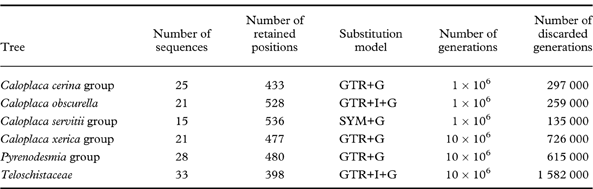
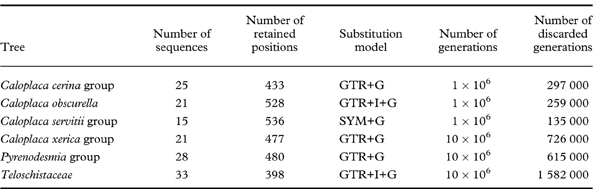
Sequences were aligned using MAFFT 6 (on-line version in the Q-INS-i mode; see Katoh et al. Reference Katoh, Kuma, Toh and Miyata2002) and manually trimmed to eliminate the unaligned ends and ambiguously aligned regions of ITS1 and ITS2. Bayesian phylogenetic analyses were carried out using the program MrBayes 3.1.1 (Ronquist & Huelsenbeck Reference Ronquist and Huelsenbeck2003). The optimal nucleotide substitution models were found using the program MrModeltest v2.3 (Nylander Reference Nylander2004). The MCMC analyses were performed in two runs, each with four chains starting from a random tree and using the default temperature of 0·2. Every 100th tree was sampled and standard deviation of splits between runs less than 0·01 as a convergence criterion was used to assess burn-in. Models of nucleotide substitution, numbers of generations and discarded generations, numbers of sequences and lengths of each alignment are given in Table 2. Posterior probabilities are shown in all depicted phylogenetic trees (Figs 1–6). Tree terminals of samples without anthraquinones are in green (absence on population level) or yellow (absence on species level).
Models of nucleotide substitution, numbers of generations and discarded generations, numbers of sequences and lengths of alignments for the molecular analyses.
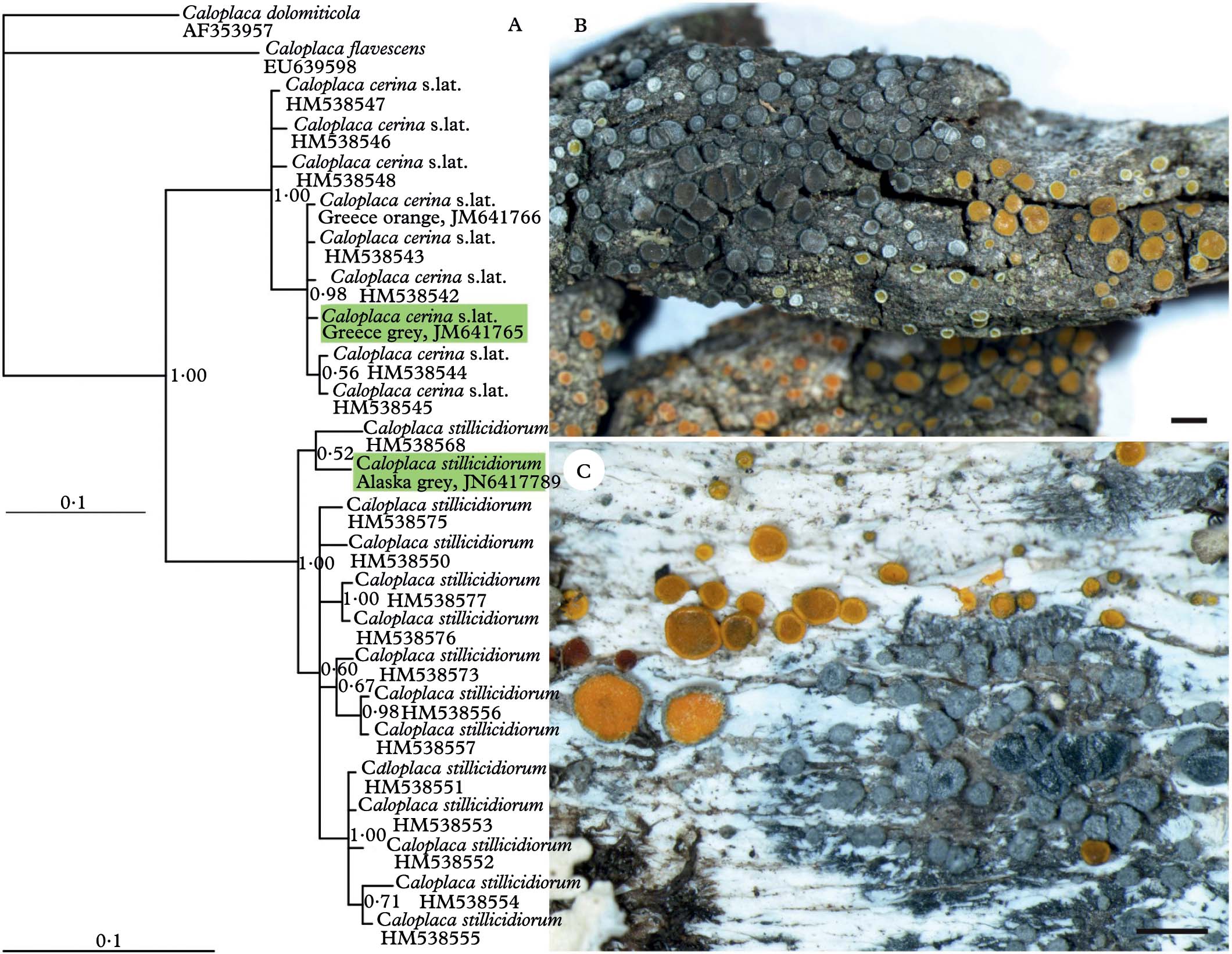
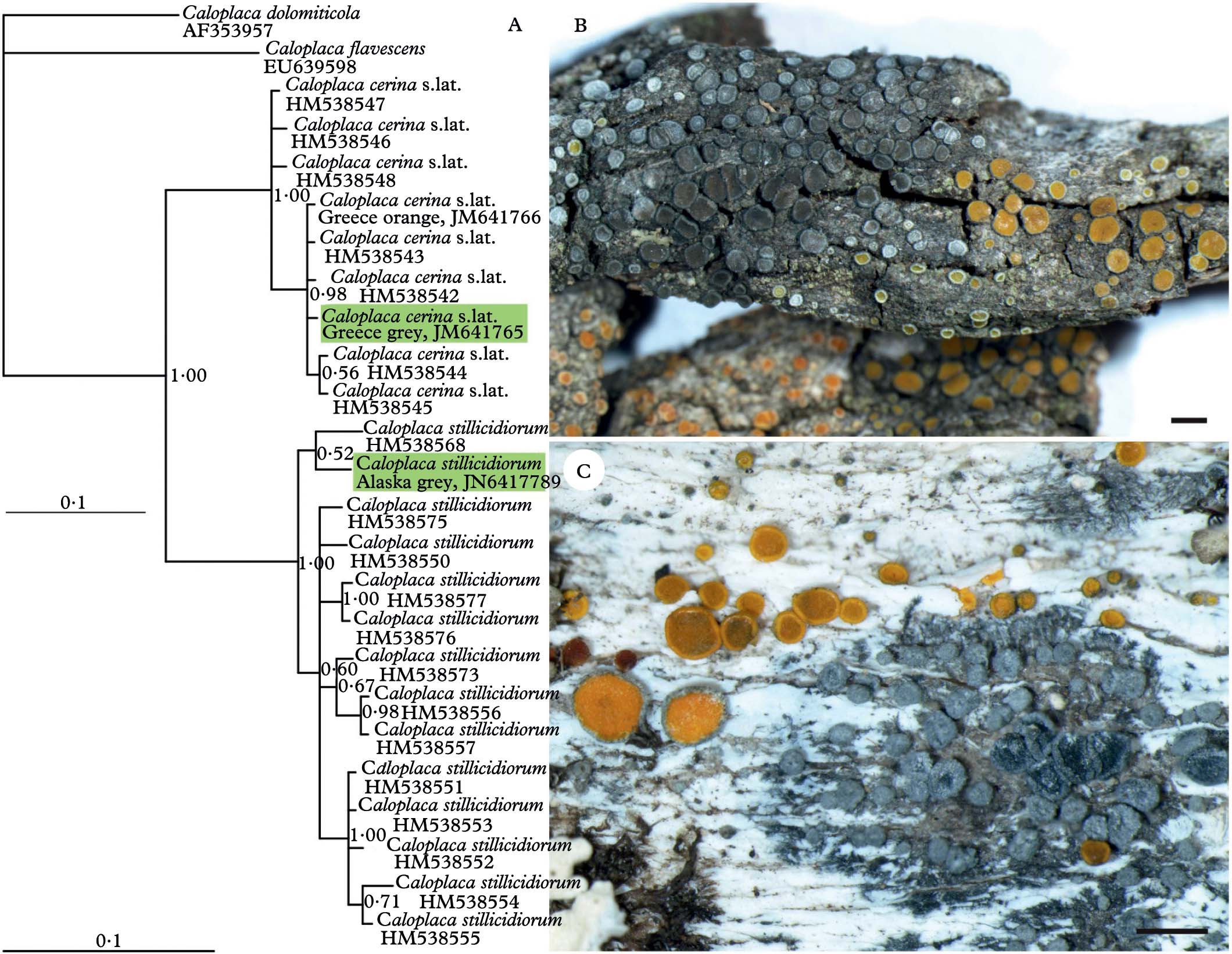
Caloplaca cerina group. A, Bayesian phylogeny (ITS nrDNA regions) of a part of the group containing lineages of C. cerina and C. stillicidiorum with individuals lacking anthraquinones (in green); B, two phenotypes of C. cerina (CBFS JV8329), grey apothecia without anthraquinones (left) and normally coloured apothecia (right); C, C. stillicidiorum (Fryday 8158; MSC) with grey, white pruinose apothecia (right) and with orange, normally coloured apothecia (left) and with C. cf. tiroliensis in the upper part. Scales: B & C=1 mm.
Results and Discussion
We generated 29 new sequences and used them in six different alignments. Five alignments were for specifically studied groups and one for a broad context. We found that the character of anthraquinone absence is polyphyletic, occurring in five different clades; the Caloplaca cerina group, C. obscurella, the C. servitiana group, the C. xerica group and the C. variabilis group (Pyrenodesmia). In some cases, whole lineages of anthraquinone-containing species contain one or more species that lack these pigments (‘absence on species level’), whereas in others loss of yellow-orange pigments is restricted to individuals or populations of species that normally contain anthraquinones (‘absence on population level’). In the latter case, specimens lacking anthraquinones always have some alternative pigment in their apothecia (usually Sedifolia-grey), which is not identified in apothecia with anthraquinones; that is, it is not apparent in the apothecial sections after dissolving the anthraquinones in K. Each case will be discussed specifically.
Caloplaca cerina group (absence on population level)
This homogeneous group (Šoun et al. Reference Šoun, Vondrák, Søchting, Hrouzek, Khodosovtsev and Arup2011) clusters crustose Teloschistaceae with a white/grey/black thallus without anthraquinones, and lecanorine apothecia with distinct thalline exciple lacking anthraquinones but with anthraquinone pigmented (yellow/orange/red) discs.
We have observed individuals entirely lacking anthraquinones in the Mediterranean lineage of Caloplaca cerina (Hedw.) Th. Fr. s. lat. (group A in Šoun et al. Reference Šoun, Vondrák, Søchting, Hrouzek, Khodosovtsev and Arup2011) and in the arctic lineage of Caloplaca stillicidiorum (Vahl) Lynge (group 3 in Šoun et al. Reference Šoun, Vondrák, Søchting, Hrouzek, Khodosovtsev and Arup2011). Both examples are morphologically similar to their closest relatives; important similarities are lecanorine exciples, distinct cortex in lower exciple and presence of Sedifolia-grey pigment in the thalline exciple. The arctic sample has smaller ascospores (c. 10–15×6–8 µm) than the phylogenetically closest observed specimens of C. stillicidiorum with orange discs (c. 13–16×7–9 µm). Both samples differ from other specimens in the C. cerina group by the presence of Sedifolia-grey in the apothecial disc (in section: K+ violet, C+ orange-carmine, N+ orange-red-purple); we have not observed this pigment in orange, anthraquinone-containing discs. Both specimens investigated are placed into the named groups (PP=1·00 in both; Fig. 1A). In the available material, non-anthraquinone phenotypes occur side by side with their counterparts with orange discs (Fig. 1B & C).
The arctic specimen of C. stillicidiorum lacking anthraquinones is probably conspecific with C. celata Th. Fr., which appears to have the same ecology and identical morphology (Magnusson Reference Magnusson1950; Poelt Reference Poelt1955; Hansen et al. Reference Hansen, Poelt and Søchting1987; Søchting et al. Reference Søchting, Lorentsen and Arup2008). Caloplaca abbreviata var. lecideoides H. Magn., a lignicolous lichen from the Russian arctic, seems to be another name referring to C. stillicidiorum lacking anthraquinones; the type specimen in S (http://andor.nrm.se/kryptos/kbo/kryptobase/200803/max/32948.jpg) apparently contains a mixed population with orange and grey apothecia.
The description of Pyrenodesmia monacensis Leder., currently known as Caloplaca monacensis (Leder.) Lettau, is also based on non-anthraquinone containing specimens (Lederer Reference Lederer1896). Nevertheless, our data have shown that C. monacensis is a well-characterized, widely distributed and usually anthraquinone-containing species from the C. cerina group (Šoun et al. Reference Šoun, Vondrák, Søchting, Hrouzek, Khodosovtsev and Arup2011).
Caloplaca xerica group (absence on population level)
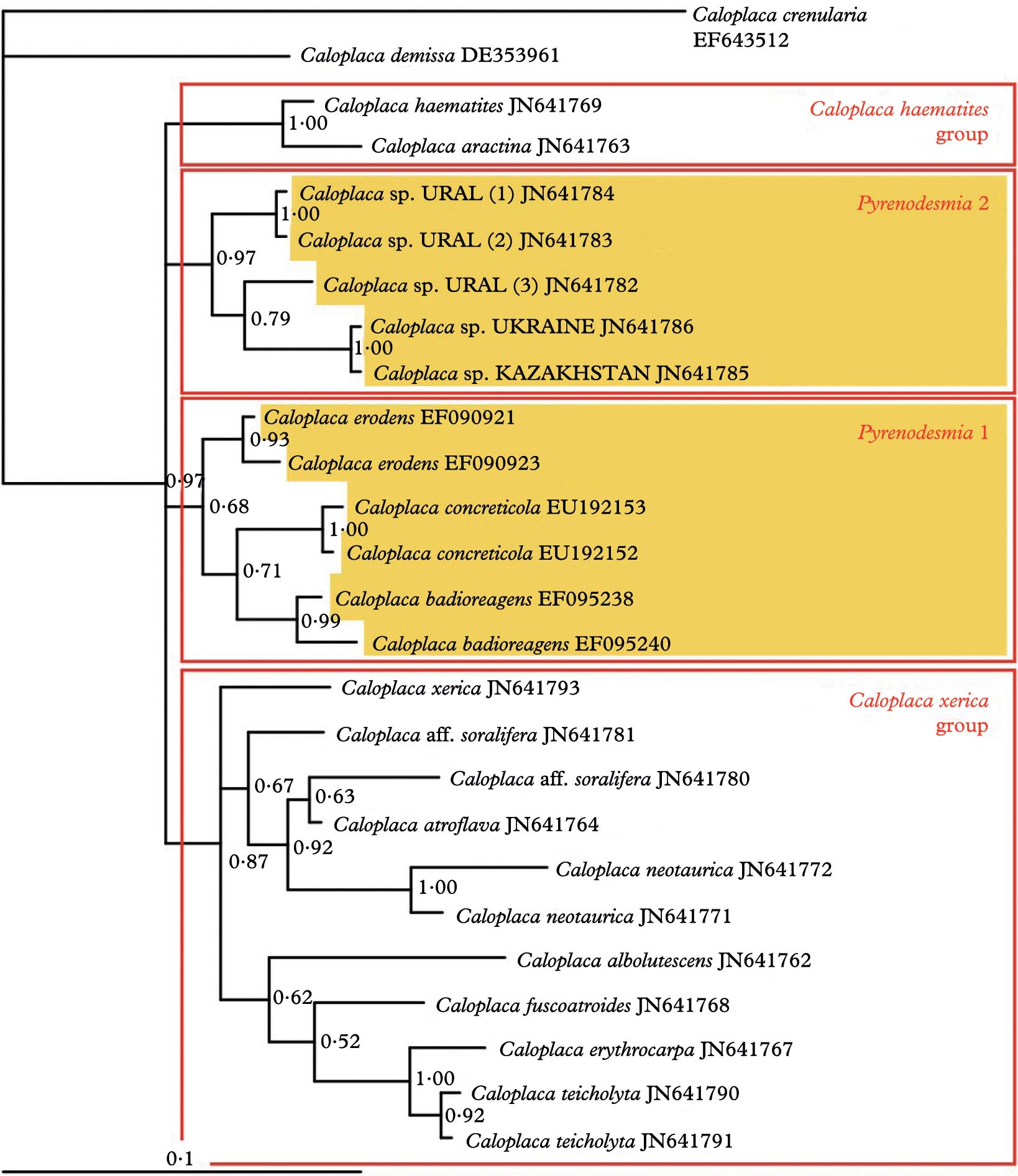
The ‘Caloplaca xerica group’ represents a monophyletic group (PP=1·00 in Fig. 2A) of mainly saxicolous species with the following characters: thallus without orange-red pigmentation, devoid of anthraqinones but with Sedifolia-grey in cortical tissues (K+ violet reaction in sections); apothecia orange to red, containing anthraquinones; ascospores never narrowly ellipsoid, length/breadth ratio 1·4–2·6; pycnidia grey-black, devoid of anthraqinones. The C. xerica group is related to Pyrenodesmia and the C. haematites complex (Fig. 3).
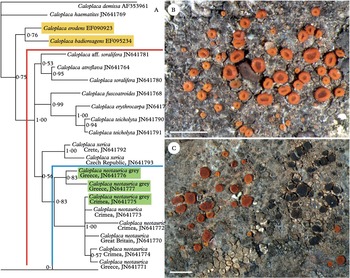
Caloplaca neotaurica. A, Bayesian phylogeny (ITS nrDNA regions) of the C. xerica group (delimited by the red line) with the monophylum of C. neotaurica (delimited by the blue line); species without anthraquinones in yellow; specimens of C. neotaurica without anthraquinones in green; B, C. neotaurica, isotype (CBFS JV6229); C, C. neotaurica, phenotype with anthraquinones (left) and phenotype with grey apothecia (right) in Peloponnese (CBFS JV8322). Scales: B & C=1 mm.

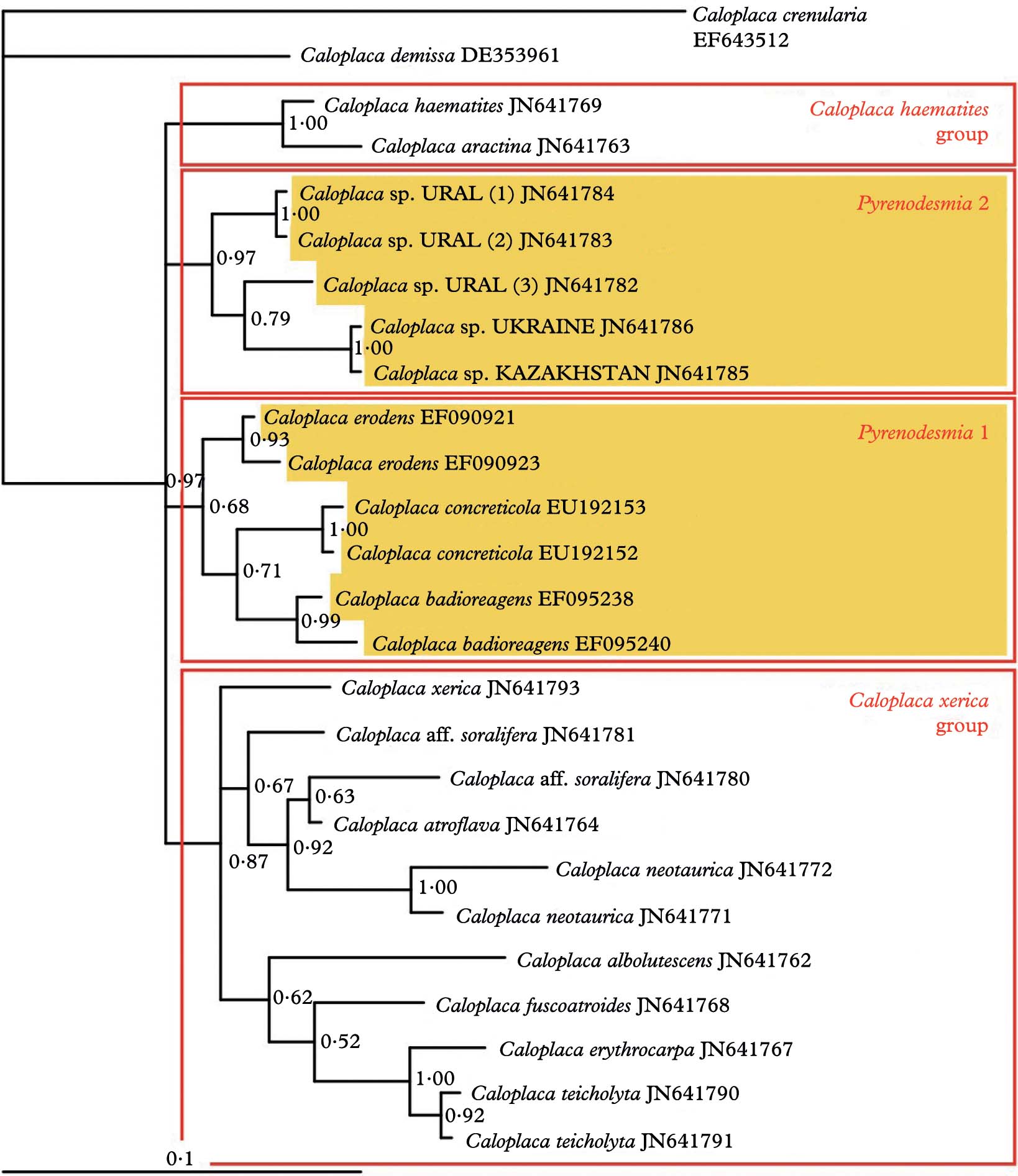
Bayesian phylogeny of ITS nrDNA regions showing the two groups of Pyrenodesmia in polytomy with the C. haematites group and the C. xerica group; species without anthraquinones highlighted in yellow.
This species-rich group contains many unnamed taxa, one of which is Caloplaca neotaurica (Fig. 2B) that is formally described at the end of this paper. Caloplaca neotaurica is unusual within the group because it also has phenotypes with complete loss of anthraquinones, which usually occur along with phenotypes with red apothecia (Fig. 2C). Non-anthraquinone phenotypes are morphologically±identical to their counterparts with red apothecia, but all samples observed without anthraquinones had apothecia containing Sedifolia-grey (in section K+ violet, C+ orange-carmine, N+ orange-red-purple-black); this pigment is present only in the thallus of the variant with red apothecia. The non-anthraquinone specimen from the Crimean Peninsula (CBFS JV6942) nests safely inside the C. neotaurica monophylum (PP=1·00), but specimens examined from Greece have aberrant ITS sequences and the Bayesian phylogeny placed them as a sister group to other C. neotaurica samples (Fig. 2A).
Although he did not do so explicitly, Poelt (Reference Poelt1975) already recognized the absence of anthraquinones at the population level within this group in Caloplaca xerica; its anthraquinone-lacking populations are named C. xerica var. venostana.
Pyrenodesmia group (absence on species level)
The C. variabilis group (Pyrenodesmia) is a well-known group containing most of the European saxicolous species without anthraquinones but with Sedifolia-grey in the apothecia (in section K+ violet, C+ orange-carmine, N+ orange-red-purple-black). Our data show that Pyrenodesmia is unresolved within the Caloplaca xerica group and the C. haematites group (PP=0·97 for the whole group; Fig. 3). The internal taxonomy and phylogeny of this group have been reported (Tretiach et al. Reference Tretiach, Pinna and Grube2003; Tretiach & Muggia Reference Tretiach and Muggia2006; Muggia et al. Reference Muggia, Grube and Tretiach2008; Vondrák et al. Reference Vondrák, Khodosovtsev and Říha2008), but the group is still only partially known in Europe and North America and it is little known in Asia. For instance, the group is species-rich in Central Asia (J. Vondrák, unpublished data). Based on our set of sequences, two main internal lineages are to be found within Pyrenodesmia; Pyrenodesmia 1 with most of the European taxa (unsupported) and Pyrenodesmia 2 containing mainly unknown taxa from the southern Ural Mountains, the Near East and the steppe-desert zone of the most SE region of Europe (PP=0·97).
Caloplaca obscurella (absence on species level)
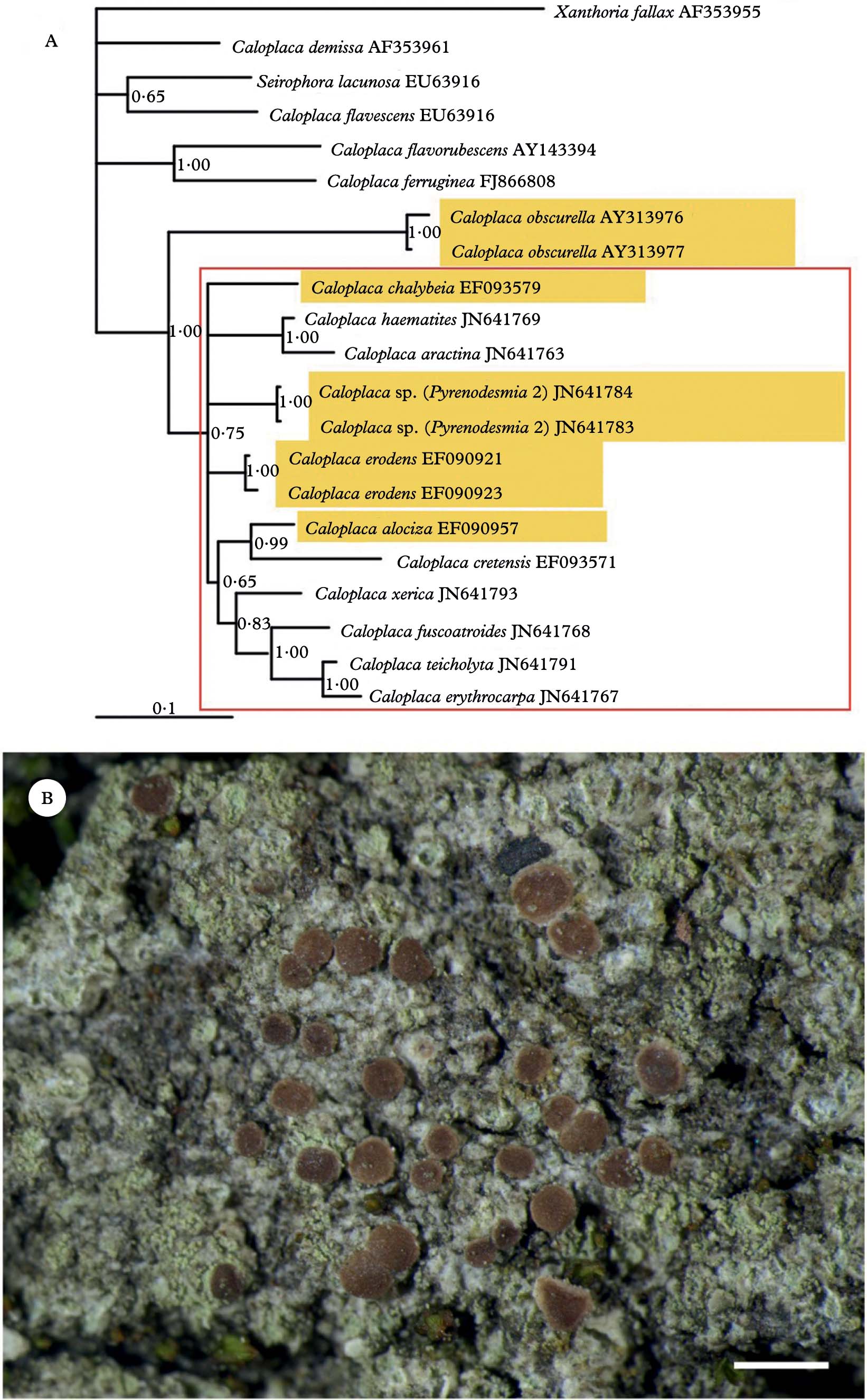
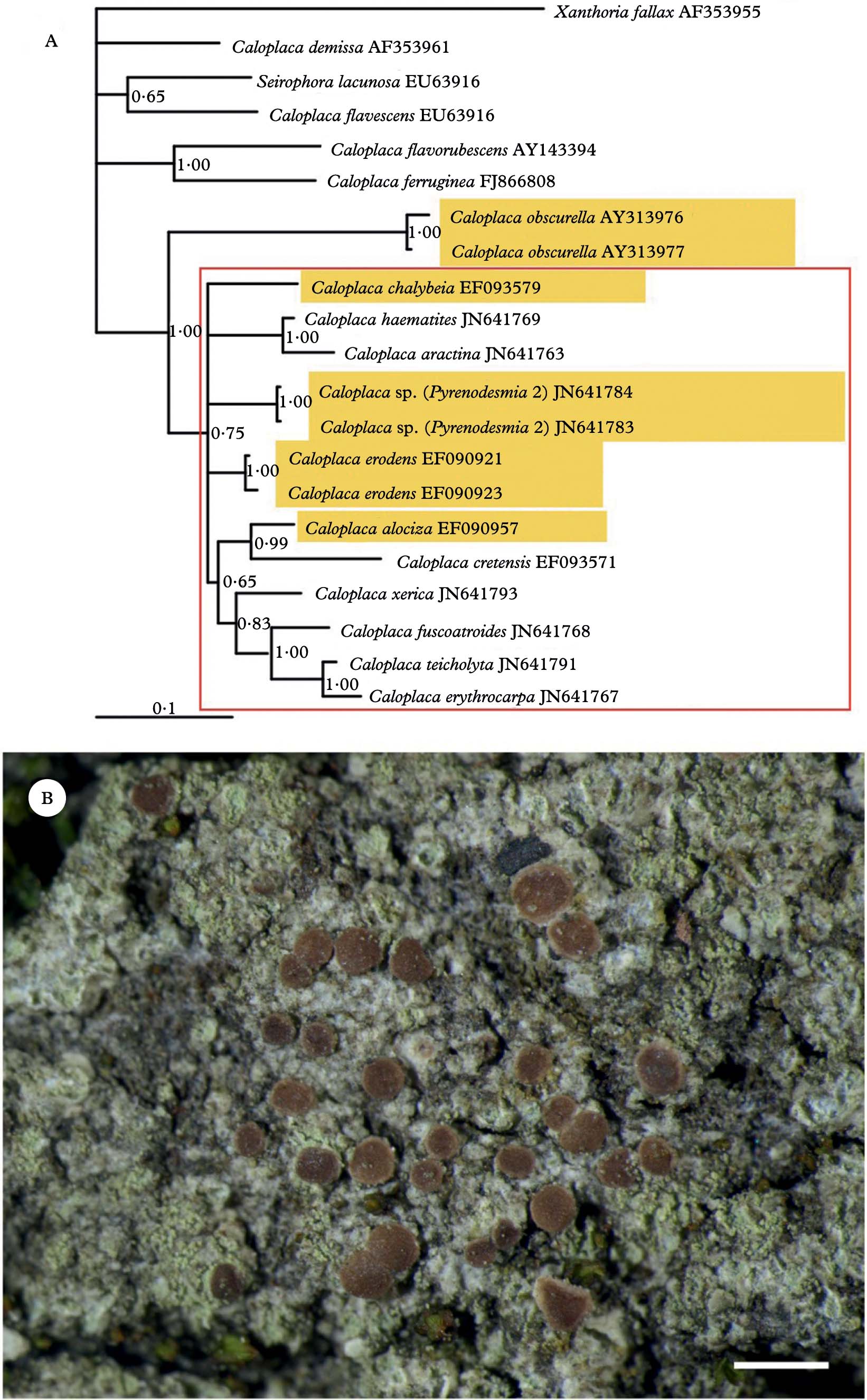
Currently, we know little about the closest phylogenetic relatives of Caloplaca obscurella (J. Lahm) Th. Fr. (Fig. 4A). It forms a strongly supported clade (PP=1·00), sister to the large monophylum containing the C. haematites group, the C. xerica group and Pyrenodesmia (PP=1·00), but we failed to find closer relatives. It is also unclear whether the C. obscurella clade contains only a single species. We suggest that the North American species C. brunneola Wetmore, C. camptidia (Tuck.) Zahlbr. C. dakotensis Wetmore (Wetmore Reference Wetmore1994) and C. lecanoroides Lendemer (Lendemer et al. Reference Lendemer, Knudsen and Fryday2010) might belong here because all these species contain brown pigments in the epihymenium that resemble those in C. obscurella (K−, C−, N−, acetone insoluble, not detectable by HPLC).
Caloplaca obscurella. A, Bayesian phylogeny of ITS nrDNA regions; sister relationship of C. obscurella is shown to the clade containing C. haematites group, C. xerica group and Pyrenodesmia (delimited by the red square); species without anthraquinones highlighted in yellow; B, richly fertile specimen from Russia (CBFS JV7641). Scale=1 mm.
Caloplaca servitiana group (absence on both species and population level)
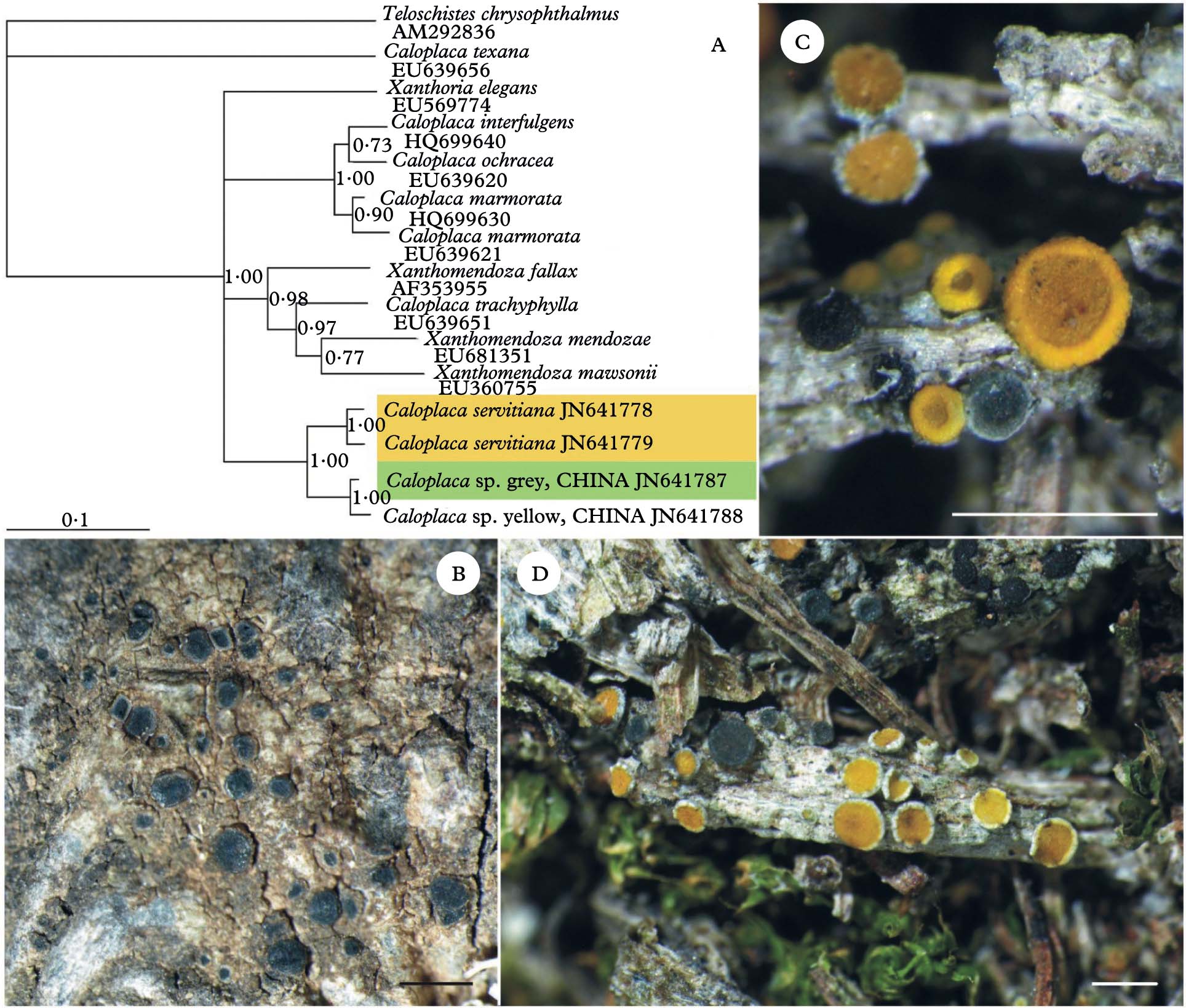
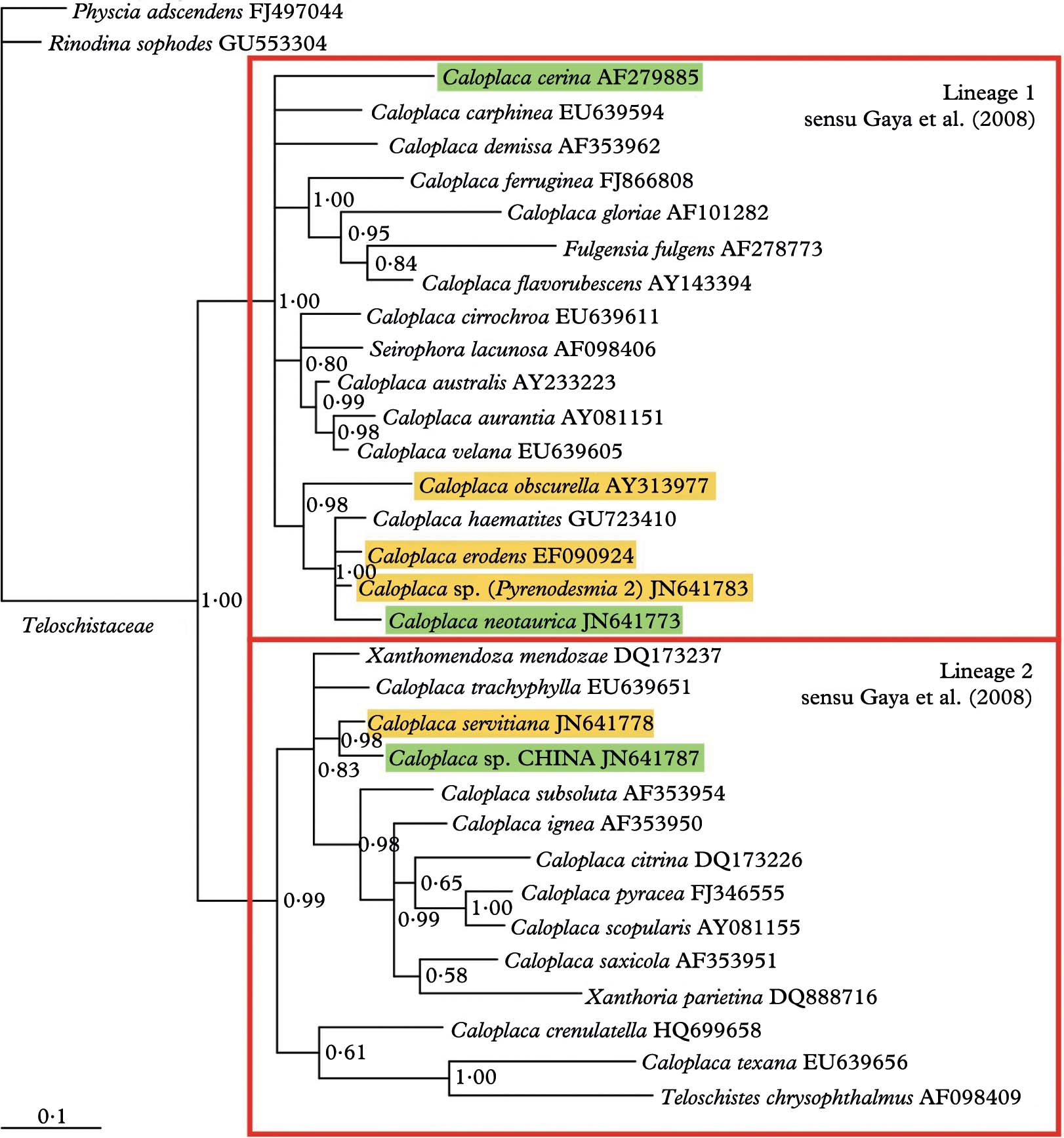
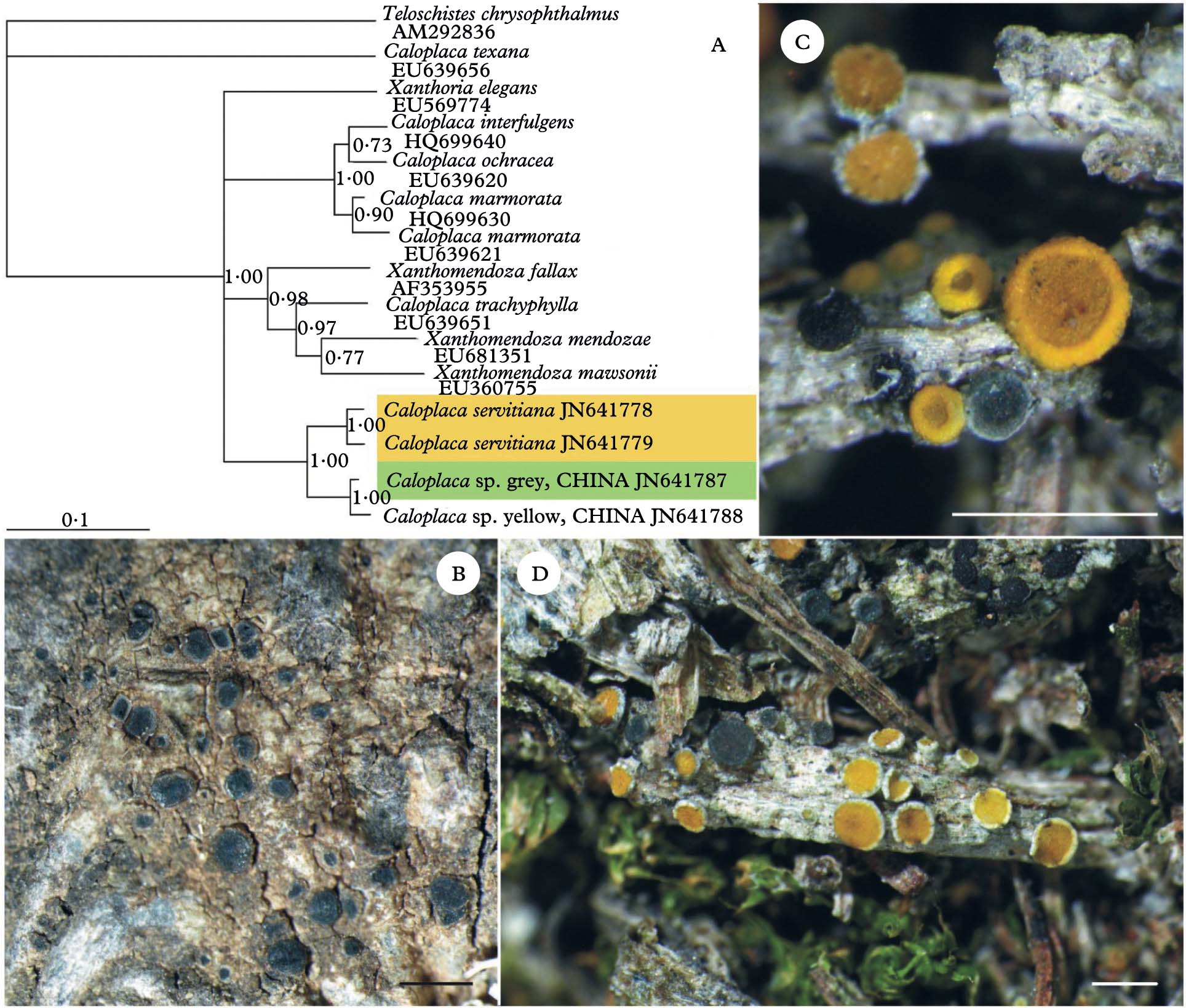
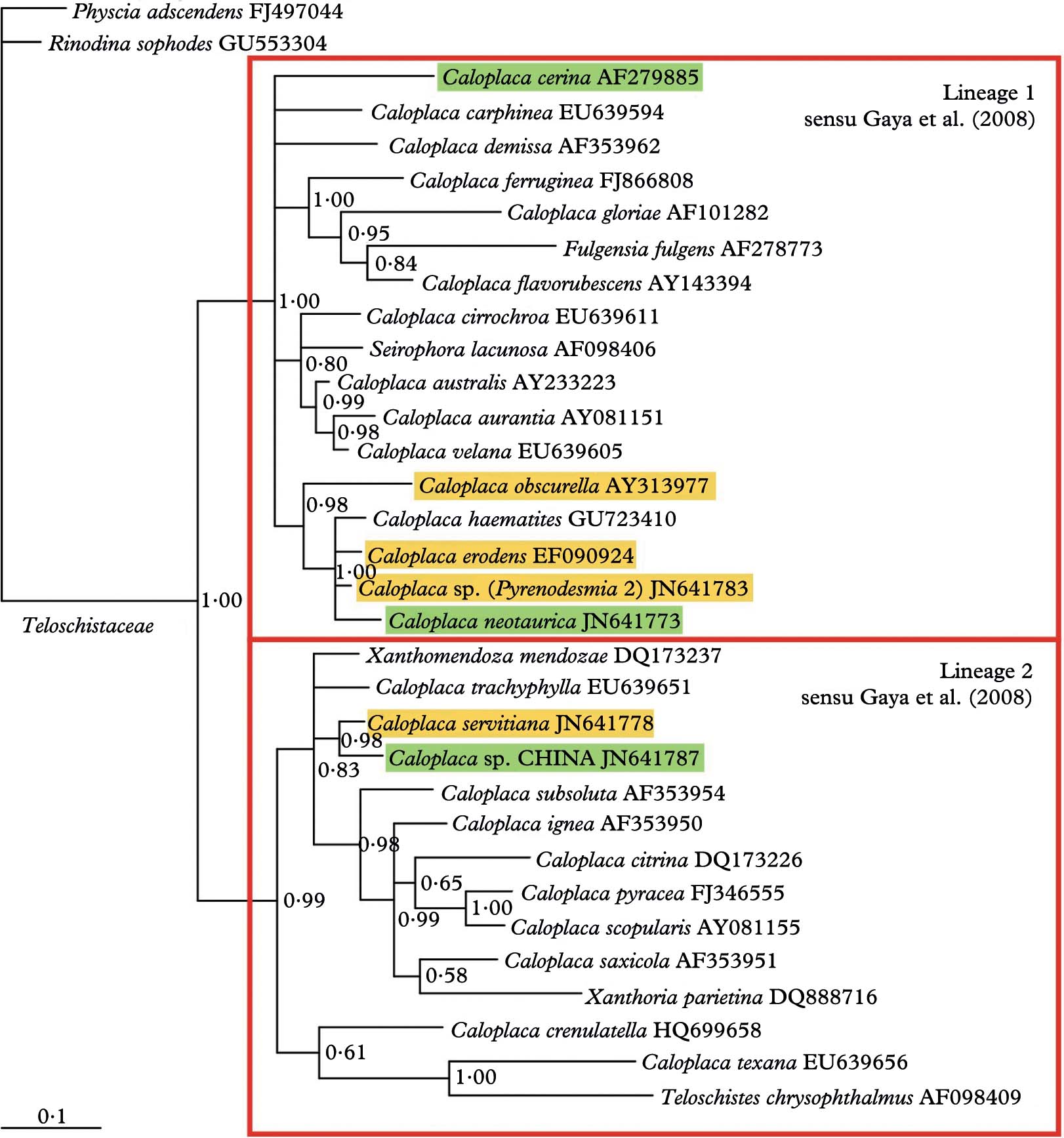
We revealed two species in the Caloplaca servitiana group (Fig. 5A); 1) C. servitiana Szatala s. str. (absence on species level; Fig. 5B) and 2) an unnamed species from China (absence on population level; Fig. 5C & D). This group is the only one with the lack of anthraquinones found in the ‘Lineage 1’ of Teloschistaceae (sensu Gaya et al. Reference Gaya, Navarro-Rosinés, Llimona, Hladun and Lutzoni2008; Fig. 6). It is a rather isolated group with no known closely related lineages.
Caloplaca servitiana group. A, Bayesian phylogeny of ITS nrDNA regions containing C. servitiana with absence on species level (in yellow) and a species from China with absence on population level (in green); B, C. servitiana (Spribille 13705); C, species from China (Davydov 6876; CBFS) with yellow and grey apothecia growing side by side; D, species from China, the phenotype with grey apothecia (Davydov 6876b; CBFS) together with C. stillicidiorum (orange apothecia with white margins). Scales: B–D=1 mm.
Bayesian phylogeny (ITS nrDNA regions) of Teloschistaceae with two sequences of Physciaceae as an outgroup. Representatives of the main lineages within the family have been selected for the tree terminals. Lineages lacking anthraquinones at the population level are in green and at species level in yellow.
1) A brief description of C. servitiana is available in Vondrák et al. (Reference Vondrák, Khodosovtsev, Lőkös and Merkulova2010a). It is known only from several sites in the eastern Mediterranean, where it grows on trees with various other Caloplaca species. Our comparison of this phenotype with co-occurring Caloplaca species showed that it had a strong similarity with C. aegatica Giralt et al., which challenged us to test if C. aegatica and C. servitiana are a single species. Our results show that C. aegatica is closely related to C. cerinella (Nyl.) Flagey, whereas C. servitiana is not closely related to any known European species.
2) The unnamed specimen from the Altai Mountains (north-west China) is characterized by an inconspicuous, simplified thallus and biatorine to zeorine apothecia with a distinct, c. 70–100 µm wide, proper exciple. The thalline exciple is usually reduced and restricted to the lower part of the apothecial margin. The ascospores, c. 14–18×7–9 µm, have a characteristic ‘obtuse rhomboid’ shape. In the specimen observed, the apothecia have two colour variants (Fig. 5C & D). The first is yellow, contains anthraquinones and lacks Sedifolia-grey, whereas the second is grey, devoid of anthraquinones, and contains Sedifolia-grey (in section K+ violet, C+ red, N+ red) in the epihymenium and superficial cells of the excipulum.
Other Teloschistaceae without anthraquinones
Among the genera of Teloschistaceae, the entire loss of anthraquinones is known only in the paraphyletic genus Caloplaca (Fig. 6). Species or populations with entire loss of anthraquinones are not known within foliose and fruticose genera of Teloschistaceae, although in some specimens of, for example, Seirophora lacunosa (Rupr.) Frödén and some Teloschistes species, whole thalli are grey with anthraquinones restricted to the apothecial discs and the walls of pycnidia (e.g., Søchting & Frödén Reference Søchting and Frödén2002).
Our study has been carried out only on specimens from arctic-temperate-(subtropical) zones of the Northern Hemisphere, but species without anthraquinones are known from the tropics and the Southern Hemisphere: for example, Caloplaca filsonii Hafellner et al. (Australia; Kondratyuk et al. Reference Kondratyuk, Kärnefelt, Elix and Thell2007), C. gambiensis Aptroot (Gambia; Aptroot Reference Aptroot2001), C. jatolensis Y. Joshi & Upreti (India; Joshi et al. Reference Joshi, Upreti and Sati2008), C. lewis-smithii (Antarctica; Søchting & Øvstedal Reference Søchting and Øvstedal1998), Caloplaca yammeraensis S. Y. Kondr. et al. (Australia; Kondratyuk et al. Reference Kondratyuk, Kärnefelt, Elix and Thell2009) and some tropical species with tri- to tetralocular ascospores (Hafellner & Poelt Reference Hafellner and Poelt1979). It is probable that these species belong to diverse groups that are unrelated to the lineages shown in this study.
Additional lineages with species or individuals that do not produce anthraquinones will also certainly be found in the Northern Hemisphere. We have examined the pigments contained in herbarium specimens of some little-known arctic species, Caloplaca atrocyanescens (Th. Fr.) H. Olivier, C. concinerascens (Nyl.) H. Olivier and C. diphyes (Nyl.) H. Olivier. These species have blackish apothecia without anthraquinones, but contain different pigments (blue-green-olive) with various reactions with K, N and C in sections, but the identity of these pigments is unknown. The phylogenetic positions of these taxa are also not yet known. Other rare and little-known European species with black apothecia that contain unknown pigments are C. concilians (Nyl.) H. Olivier and C. conciliascens (Nyl.) Zahlbr. In addition, Caloplaca sorocarpa (Vain.) Zahlbr. has brown apothecia but is very rarely fertile and it is not known which pigments are present in its apothecia.
Caloplaca atrosanguinea (G. Merr.) I. M. Lamb is a North American corticolous species which has brown (young) or black (old) apothecia. Its apothecial pigment is violet-blue in section and reacts: K+ violet-blue intensifying, K→HCl+ sordid green, N− unchanged, N→K+ weekly purple→discoloured, N→K→HCl− discoloured, C− discoloured. These reactions do not correspond to anthraquinones, which are typically K→HCl+ strongly yellow. The HPLC chromatogram shows one major unknown substance with a short retention time (Rt=13·6 min, which is less than any known anthraquinone in Teloschistaceae) but also a minor substance (Rt=33·3 min) with the absorption spectrum similar to emodin that we identified as an unknown anthraquinone. Caloplaca atrosanguinea is related to, but not within, the C. cerina group (J. Vondrák, unpublished data).
Caloplaca demissa (Körb.) Arup & Grube also lacks anthraquinones, but it has probably never been found with apothecia. If it is able to produce apothecia, they may contain anthraquinones because its closest related species, C. carphinea (Fr.) Jatta (Gaya et al. Reference Gaya, Navarro-Rosinés, Llimona, Hladun and Lutzoni2008), has anthraquinone-containing apothecia.
Another lineage in Teloschistaceae that lacks anthraquinones is represented by the genus Huea C. W. Dodge & G. E. Baker (Dodge & Baker Reference Dodge and Baker1938). This genus was erected for a group of crustose Antarctic species of Teloschistaceae characterized by lacking anthraquinones, and having black apothecia with a carbonaceous exciple and a bright blue epihymenium. The status of Huea is controversial, with some authors accepting it (Øvstedal & Lewis Smith Reference Øvstedal and Lewis Smith2001) whereas others include the species in Caloplaca (e.g., Poelt & Hafellner Reference Poelt and Hafellner1980). Søchting et al. (Reference Søchting, Øvstedal and Sancho2004) cited unpublished preliminary molecular data showing that the two species transferred to Huea by Dodge & Baker (Reference Dodge and Baker1938) formed a distinct clade in Caloplaca. Unfortunately, there are problems with the typification of Huea because Dodge & Baker (Reference Dodge and Baker1938) chose as the type species their newly described species Huea flava C. W. Dodge & G. E. Baker. This is usually considered to be a sterile crust of uncertain identity but was shown by Fryday (Reference Fryday2011) to be conspecific with Lecidea capsulata C.W. Dodge & G. E. Baker. As this species is now included in the synonymy of Carbonea vorticosa (Flörke) Hertel, (http://www.indexfungorum.org/Names/NamesRecord.asp?RecordID=107792) this makes Huea an earlier name for Carbonea. Søchting et al. (Reference Søchting, Øvstedal and Sancho2004) proposed a conserved type for Huea [Huea coralligera (Hue) C. W. Dodge & G. E. Baker] but, because they did not do so as a formal proposal, this has no relevance. The typification of Huea is dealt with in detail by Fryday (Reference Fryday2011).
Apatoplaca Poelt & Hafellner and Cephalophysis H. Kilias are monotypic genera with an absence of anthraquinones affiliated to Teloschistaceae mainly because of their Teloschistaceae-type asci (Poelt & Hafellner Reference Poelt and Hafellner1980; Kilias Reference Kilias1985); however, their phylogenetic identities are uncertain.
Also of interest is the genus Hueidea Kantvilas & P. M. McCarthy (Kantvilas & McCarthy Reference Kantvilas and McCarthy2003), which was erected for a single Australian species, H. australiensis Kantvilas & P. M. McCarthy, with characters intermediate between Teloschistaceae and Fuscideaceae V. Wirth & Vězda. The authors characterized their new genus as lacking thalline chemistry and showing all spot-test reactions negative, and placed it in Fuscideaceae. However, inspection of a specimen of H. australiensis revealed a weak K+ crimson reaction in the epihymenium, suggesting the presence of anthraquinones and that the genus may be better placed in Teloschistaceae.
Conclusions
1. Non-anthraquinone lineages or populations represent a minor part of Teloschistaceae but they originated repeatedly in various sites in the phylogeny of the family (Fig. 6).
2. We have observed individuals without anthraquinones (absence on population level) in the Caloplaca cerina group, the C. servitiana group and the C. xerica group. Lineages containing non-anthraquinone species (absence on species level) were recognized in Caloplaca obscurella, the C. servitiana group and Pyrenodesmia.
3. Loss of anthraquinones is always followed by synthesis of alternative pigments (often Sedifolia-grey); fully unpigmented apothecia have not been observed by us. Anthraquinones and the alternative pigments may perform the same function, perhaps protection of ascospores against absorption of the UV-B radiation.
Taxonomy
Caloplaca neotaurica Vondrák, Khodosovtsev, Arup & Søchting sp. nov.
MycoBank No: MB563136
Caloplacae fuscoatroidis similis sed thallo ambitu squamulis nullis, tenui, atrogriseo vel nigrescenti, epruinoso vel raro pruinoso.
Typus: Ukraine, Crimean Peninsula, Sudak, Karadag Mts, Mt Svyataya, alt. 320 m, 44°56′03·27′′N, 35°13′06·17′′E, on volcanic rock, 24 May 2007, J. Vondrák (CBFS JV5925—holotypus; CBFS JV5960, 6022, 6229 & C—isotypi). ITS sequence of the isotypus: JN641773.
(Fig. 2)
Thallus thin, less than 150 (rarely 250) µm high, grey to brown-black, rarely white pruinose, indistinctly areolate; areoles (150−) 322±112(−600) µm wide (n=20). Prothallus±present, dark grey. Marginal squamules and vegetative diaspores absent. Cortex absent; alveolate cortex (sensu Vondrák et al. Reference Vondrák, Říha, Arup and Søchting2009) present in spots (<20 µm thick).
Apothecia <0·7 mm diam., biatorine, orange to red (grey in variants without anthraquinones), K+ purple, C+ purple, I− (disc I+ blue due to reaction with asci), P− (but red pigment dissolves in acetone solution of P), UV−; no visible spot reactions in grey apothecia. Exciple usually paler than the disc. Proper exciple c. 100–130 µm thick proso-plectenchymatous. Thalline exciple c. 60–120 µm thick. Hymenium c. 90–110 µm high. Paraphyses±branched and anastomosed, with tips widened to (3·3–)4·4±1·5(–6·0) µm (n=10). Asci clavate, c. 55–75×18–26 µm. Ascospores (13·0–)14·7±1·4(–17·3)× (7·0–) 8·9 ± 1·0(–11·3) µm (n=25); ratio of ascospore length/breadth (1·4–)1·7± 0·2(–2·0); (n=25); ascospore septa (3·5–) 5·7±0·9(–8·0) µm wide (n=25); ascospore septa/spore length (0·27–)0·39± 0·07(–0·54); (n=25).
Pycnidia common, usually observable as darker spots in thallus (higher concentration of Sedifolia-grey around ostiole). Conidia ellipsoid c. 2·5–3·5×1·0–1·5 µm.
Chemistry. In apothecia, the main anthraquinone is 7–Cl-emodin; additional anthraquinones: 7–Cl-emodinal, 7–Cl-emodic acid, 7–Cl-citreorosein, ±citreorosein, ±emodinal, ±emodin (chemosyndrome C2, sensu Søchting Reference Søchting2001). Sedifolia-grey in thallus and in grey variants of apothecia (K+ violet, C+ orange-red, N+ purple in section).
Etymology. The species is very common in the Crimean Peninsula, which was known as ‘Taurica’ by the Greeks and Romans. The name Caloplaca taurica Mereschk. nomen nudum [=C. inconnexa (Nyl.) Zahlbr.] already exists and, although this is not validly published and so does not prevent the use of that name for our species, we have decided not to use it in order to avoid confusion.
Diagnostic characters. Thallus dark grey to brown-black (rarely white pruinose), thin, usually up to 150 µm thick; without marginal squamules and vegetative diaspores. Apothecia small (up to 0·7 mm), biatorine, orange-red, C+ purple (except in grey apothecial variants). Ascospores c. 14–17×7·5–10·5 µm, with septa c. 4·0–7·5 µm wide. Pycnidia grey, conidia ellipsoid. Chemosyndrome C2 (details above).
Variability. Apart from two variants of apothecia (with/without anthraquinones), the species varies strongly in the content of Sedifolia-grey in the thallus. While northern specimens from Great Britain have a pale grey thallus with an indistinct amount of the grey pigment, specimens from the Mediterranean regions have a darker thallus, with an observable Sedifolia-grey content in sections.
Similar species. Caloplaca atroflava (Turner) Mong. differs in its paler and C− apothecia (absence of chlorinated anthraquinones). Caloplaca crenularia (With.) J. R. Laundon and related species have red pycnidial walls (with anthraquinones) and chemosyndrome C3 or C4 (with constant content of parietin and fragilin). Caloplaca fuscoatroides J. Steiner differs in its thick thallus (100–350 µm high), usual presence of marginal squamules (up to 2 mm diam.) and chemosyndrome C5 (with stable content of fragilin and absence of citreorosein and emodinal), while Caloplaca xerica Poelt & Vězda has a blastidiate-isidiate-lobulate thallus, ±zeorine apothecia and chemosyndrome C5 (as in C. fuscoatroides).
Chemosyndrome C2 (absence of parietin and fragilin and traces of citreorosein and emodinal) has been observed only in Caloplaca ligustica B. de Lesd. (Søchting Reference Søchting2001), which is probably unrelated to the new species having narrow ascospores with thin septa (Bouly de Lesdain Reference Bouly de Lesdain1936) similar to C. subpallida s. lat.
Phylogeny. Most sequences of the new species examined form a well-supported monophylum (PP=1·00), but two sequences (not identical) of one Greek specimen with grey apothecia are somewhat different, and their relationship to the core clade is unsupported. Based on phenotype similarities, we decided to place the Greek specimen (containing also individuals with red apothecia) into Caloplaca neotaurica. The nearest related species may be a morphologically different C. xerica, but the relationship is unsupported.
Ecology and distribution. The species occurs on siliceous cliffs, outcrops or stones not far from the sea coast and is only rarely observed further inland (only in the Peloponnese and in the Rhodopes, Bulgaria). It is distributed in the Mediterranean and the Black Sea coast (especially in the Crimean Peninsula) and along the Atlantic coast of Europe (confirmed from Great Britain). Phenotypes with grey apothecia are known only from the Crimean Peninsula, Cyprus and Greece.
Specimens examined with red apothecia. Bulgaria: Black Sea coast: Burgas, Sinemorets, 2007, J. Vondrák (CBFS JV6497); Burgas, Sozopol, 2007, J. Vondrák (CBFS JV6452). Rhodopes: Momchilgrad, Bregovo, 2004, J. Vondrák (CBFS JV2043).—Cyprus: Distr. Paphos: Tripylos, 1987, M. & H. Mayrhofer 7750 (GZU).—Great Britain: Wales: V.C. 45 Permbrokeshire: 1992, U. Arup (LD 1118360, 1118540, 1424694).—Greece: Peloponnese: Argolis Peninsula (Peiraias administrative district), Driopi, 2010, J. Vondrák & O. Vondráková (CBFS JV8322); Methana, Kypseli, 2010, J. Vondrák & O. Vondráková (CBFS JV8435); Thermissia, Vlachaiika, 2010, J. Vondrák & O. Vondráková (CBFS JV8436); Tripoli, Kastri, 2010, J. Vondrák & O. Vondráková (CBFS JV8438).—Italy: Sardinia: Núoro, Barbágia Seúlo, alt. 950–1080 m, 1986, H. Mayrhofer 6156, 5941 (GZU, sub C. atroflava).—Turkey: Sea of Marmara coast: Kapıdağı Peninsula, 2007, J. Vondrák (CBFS JV6459).—Ukraine: Crimean Peninsula: Alushta, Demerji Yayla, 2007, J. Vondrák (CBFS JV5996); Alushta, Kanakskaya balka, 2007, J. Vondrák (CBFS JV6023, 6041); Feodosia, Karadag, Mt Levinsona-Lessinga, 2000, A. Khodosovtsev (KHER 200, 201 sub Caloplaca atroflava); Feodosia, Mt Choba-Tepe, 2001, A. Khodosovtsev (KHER 2874, 2873 sub Caloplaca scotoplaca); Sudak, Dachnoe, 2008, J. Vondrák (CBFS JV7231); Sudak, Mt Echkedag, 2008, J. Vondrák (CBFS JV7213, 7232); Yalta, Foros, 2001, A. V. Yena (KHER 2889); Yalta, Oliva, 2009, J. Vondrák (CBFS JV7094, dupl. in C; 7103; 7105, dupl. in C; 7121).
Specimens examined with grey apothecia. Cyprus: Distr. Laranca: Stavrovouni, 1987, M. & H. Mayrhofer 7198 (GZU).—Greece: Peloponnese: Argolis Peninsula (Peiraias administrative district), Driopi, 2010, J. Vondrák & O. Vondráková (CBFS JV8322).—Ukraine: Crimean Peninsula: Alushta, Kanakskaya balka, 2007, A. Khodosovtsev & J. Vondrák (CBFS JV5475, KHER); ibid., 2008, A. Khodosovtsev & J. Vondrák (CBFS JV6942, 7188, KHER); Feodosia, Karadag, 2001, A. Khodosovtsev (KHER 1452).
We are grateful to Toby Spribille, Ulrik Søchting and Ulf Arup for their comments on this paper. Our research received support from the Visegrad Fund (grants 51000067 and 51100753), the whole-Institute grant (AV0Z60050516) and the SYNTHESYS Project http://www.synthesys.info/, which is financed by European Community Research Infrastructure Action under the FP7 “Capacities” Program.