INTRODUCTION
Within the phylum Apicomplexa the haemospororins, or malarial parasites, produce sexual stages called gametocytes in their vertebrate host. Once in the dipteran vector, a macrogametocyte produces a single female gamete that must be fertilized by one of the several (up to 8) male gametes produced by each microgametocyte. Mated gametes tend to originate from a single bloodmeal within a few minutes from ingestion by the insect vector. For most species of these parasites the sex ratio in the blood sexual stage is easily identifiable in blood smears and several studies have pursued the adaptive significance of sex ratio (the proportion of male gametocytes) in malarial parasites when a single (or low numbers of) genotype is present in a host (Read et al. 1992; Paul et al. 1995; West, Reece and Read, 2001; Read et al. 2002). Hamilton (1967) demonstrated that when a small number of females produce offspring that mate among themselves, a female-skewed sex ratio is favoured by natural selection. This situation is called local mate competition (LMC) because the higher number of females reduces competition among brothers for mates (Taylor, 1981). In the extreme, where all matings are between sibs, the prediction is that females produce enough sons to mate with all their daughters. Haemosporidians have life-cycles that might lead to biased sex ratios through LMC; as males produce several gametes, a female skew in sex ratio may maximize successful transmission by optimizing zygote production (Ghiselin, 1974; Pickering, 1980; Schall, 1989; Read et al. 1992; Paul et al. 1995; West et al. 2001). However, less biased sex ratios may also be adaptive under several circumstances (Shutler and Read, 1998, Paul, Raibaud and Brey, 1999; Paul et al. 2000). For example, in cases of infections by several clones, those producing more male gametocytes will obtain more mates and thus a greater contribution to the next generation (Fisher, 1930; Hamilton, 1967; Read et al. 1992). Alternatively, under low gametocyte densities male gametes would have difficulty meeting female gametes and natural selection would favour a less female-biased sex ratio to ensure mating of female gametes (Shutler and Read, 1998; Paul et al. 1999; Paul et al. 2000; West et al. 2002; Gardner, Reece and West, 2003). The low probability of a male gamete encountering a female gamete can result from a low number of gametocytes in the vector's bloodmeal, or reduced gamete mobility or viability due to immune responses. This ‘fertility insurance hypothesis’ has received recent empirical support from an experimental study of variation on sex ratios in the avian malarial parasite Haemoproteus. A change from female-skewed towards male-skewed sex ratios followed medication with the antimalarial drug primaquine, which produces a reduction in density of infection by the parasite (Merino et al. 2004).
Malarial parasites may produce multiple gametocyte infections (MGIs) where there is more than one parasite in the same erythrocyte (Fallis and Desser, 1977; Jovani et al. 2004; Valkiunas, 2005). These infections have been reported in taxonomic studies of malarial parasites from several vertebrates and are usually considered as by-products of high asexual and sexual parasite densities of infection inducing the infection of the same cell by 2 parasites, which are thereby forced to compete for the food available for their development inside the cell (Valkiunas, 2005). However, Jovani (2002) has proposed that this multiple infection may also be a way to facilitate encounters between gametes and thus function as a fertility insurance mechanism. Jovani (2002) assumed 2 prerequisites for his hypothesis to work: (1) that male-female multiple infections naturally occur, and (2) that male-female multiple infections are viable. Both prerequisites are apparently fulfilled (Jovani, 2002; Jovani et al. 2004) although viability of apparently mature multiple infections should be more thoroughly investigated. Although Jovani (2002) did not propose mixed multiple infections as an adaptive strategy by the parasite but as a beneficial by-product of a random process (Jovani, personal communication), it is obvious that parasites being able to produce multiple infections by gametocytes of different sex may obtain a selective advantage when there exist difficulties for male gametes to reach female gametes. Thus, we propose that multiple infections by gametocytes of different sexes inside the same erythrocyte may be an adaptive strategy by malarial parasites to ensure fertility. In fact, this resembles adaptive syzygy (when a single male and a single female gametocyte pair together physically or in close proximity just prior to fertilization), and local mate competition in this case may therefore not be relevant (West, Smith and Read, 2000).
The hypothesis of multiple infections as an adaptive strategy by the parasite to facilitate gamete encounters or of multiple infections as a non-adaptive by-product of high intensities of infection produce contrasting predictions that can easily be tested. (1) Under the adaptive hypothesis we expect an increase in the number of multiple infections as density (abundance of gametocytes in blood) decreases. This is because fertility insurance is especially needed in conditions of low density of gametocytes. However, under the non-adaptive hypothesis we can expect a higher number of multiple infections as density of infection increases, because it is more probable that 2 parasites reach the same cell when many parasites are looking for cells to infect. (2) Multiple infections must be able to reach maturity by both parasites infecting the same cell in most cases under the adaptive hypothesis, but not under the alternative non-adaptive hypothesis where parasites may compete for resources, leading to most of them not reaching maturity. (3) Multiple infections may also be produced preferentially by parasites of different sexes if they are produced to ensure fertility, but this is not needed under the non-adaptive hypothesis (infection by parasites of the same sex may also be frequently found).
Gametocyte density in birds infected by Haemoproteus tends to show a maximum during host reproduction and to decrease towards the end of the reproductive season due to the effect of host immune responses (Atkinson and Van Riper, 1991; Morales et al. 2004). In fact, if immune pressure reduces gametocyte or gamete survival or motility, a shift towards less biased sex ratios is predicted to favour fertility insurance (West et al. 2001). So we can also expect that reduction in gametocyte density due to immune responses may play a role in a potential adaptive response by the parasite producing more multiple gametocyte infections. Here we present data on the number of multiple infections, their maturity and sex in a wild population of breeding birds infected by the malarial parasite Haemoproteus and being subjected to experimental reduction of infection by medication with the antimalarial, primaquine, in order to test these predictions. We compare the effects of experimental reductions and of natural reductions in gametocyte abundance due to immune responses on the number and composition of multiple gametocyte infections.
MATERIALS AND METHODS
The study was conducted during the spring of 2004 using a blue tit (Parus caeruleus) population breeding in next-boxes, in a Pyrenean oak (Quercus pyrenaica) forest in Valsain (Segovia, central Spain). Infection by malarial parasites in this population has been under study since 1994 (Fargallo and Merino, 1999). Adult birds were randomly assigned to one of two treatments (medicated and control groups) when their nestlings were 3 days old. Birds were captured and injected subcutaneously with either 0·1 mg of the antimalarial primaquine (Sigma, St Louis, MO, USA) diluted in 0·1 ml of saline solution (medicated group) or with the same volume of saline solution (control group). Primaquine has been previously used as a subcurative dose to reduce the density of infection by blood parasites in wild birds (Merino et al. 2000). Primaquine has been shown to have effects on gametocytes of several species of Plasmodium (Lopez-Antuñano, 1999; WHO, 2001). Apparently, primaquine acts by binding and modifying the parasite's DNA and disrupting parasite mitochondrial membranes (Lopez-Antuñano, 1999; Baird and Rieckmann, 2003). Based on these mechanisms of action, we did not expect a differential effect of medication on gametocytes of each sex. Before injection, a blood sample was obtained from the braquial vein (initial sample). Ten days later birds were recaptured and a second blood sample was obtained (final sample). Pre-patence time for Haemoproteus is about 12–14 days as shown by the lack of infections on smears from nestlings of 13 days. For infections developed in internal organs, the time for release and maturation of new gametocytes should be lower. Therefore, 10 days allows for the new production and release of gametocytes to blood and for maturation of current MGIs, while excluding any newly inoculated infections that can affect results after drug treatment.
Blood samples were immediately smeared and air-dried and later fixed in ethanol (96%) and stained with Giemsa (1/10 v/v) for 45 min. Each smear was examined for extra- and intra-erythrocytic haematozoa, following the procedure reported by Merino and Potti (1995) and Merino, Potti and Fargallo (1997). We calculated the density of infection by Haemoproteus majoris as the number of parasites per 2000 erythrocytes scanned at 1000×magnification. The number of MGIs (2 or 3 parasites infecting the same erythrocyte) was also counted per 2000 erythrocytes (Jovani, 2004). All smears were checked by the same person (J.M.-P.). MGIs were considered mature when parasites were sufficiently developed to differentiate their sex (that is approximately when they reach at least 75% of their maximum size).
Samples were included in the analyses when found to be infected by the malarial parasite Haemoproteus in at least 1 of the 2 smears (initial or final sample). Host sex was not included in analyses as it did not influence the results. The intensities of parasite infection were normalized by log transformation (initial density K-S d=0·071, P>0·20; final density K-S d=0·048, P>0·20).
RESULTS
Overall, 115 adult blue tits were found to be infected (59 medicated and 56 controls). Before the primaquine injection (initial sample) no significant differences in gametocyte density were observed between individuals subjected subsequently to different treatments (t-test independent by groups; t=0·86; D.F.=113; P=0·39). The density of infection by Haemoproteus was significantly reduced for medicated birds (t-test for dependent samples: t=3·60; D.F.=58; P=0·001). There was also a reduction in gametocyte density for control birds but this was not significant (t=1·03; D.F.=55; P=0·31). Mean density (S.E.) was 26·88 (2·69) for initial infections (Controls=23·05 (3·25); Medicated=30·50 (4·22)) and 21·16 (2·48) for final infections (Controls=21·62 (3·57); Medicated=20·71 (3·48)).
The number of multiple infections detected and their maturity and sex are shown in Table 1. Only 3 multiple infections were triple and 109 were double. All triple and most of double infections were immature (Table 1). The number of mature MGIs was maintained for medicated and control hosts across the experiment (6 mature MGIs for medicated birds and 7 mature MGIs for controls). The number of MGIs was significantly and positively correlated with the density of the infection in both captures (Spearman Correlation; initial: rs=0·57; n=115; P<0·001; final: rs=0·70; n=59; P<0·001 for medicated and rs=0·48; n=56; P<0·001 for controls). In addition, initial density of infection was significantly higher when MGIs were present as compared to infections where they were absent (t=6·60; n=115; P<0·0001). This was also true for controls and medicated individuals for final samples (t=3·47; n=56; P=0·001 and t=7·05; n=59; P<0·001 respectively).
Table 1. Number of MGIs detected per 2000 erythrocytes with respect to their maturity and sex composition (Percentages are shown in parentheses.)

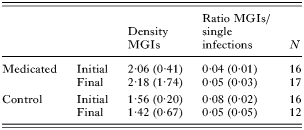
On the other hand, we have not observed any relationship between treatment (medicated or control) and the presence or absence of MGIs for final samples (with Yates' correction: Chi22=0·49; D.F.=1; P=0·49). The number of new MGIs found in final samples did not differ from the number of those lost for medicated or control hosts (McNemar Chi2 <0·001; P>0·99 and Chi2=0·45; P=0·50 respectively). The numbers of MGIs counted on initial and final samples were significantly correlated (rs=0·32; n=115; P<0·001), although this circumstance was only maintained for the medicated group (rs=0·51; n=59; P<0·001) and not for controls (rs=0·079; n=56; P=0·56). The average MGI density and the ratio of MGIs to single infections for hosts with MGIs are shown in Table 2. Both measures indicate that MGIs are present in low densities/proportions as compared to single infections. Density and ratio did not vary between initial and final samples for medicated or control hosts (P>0·19, data not shown).
Table 2. Average MGI density (infections per 2000 erythrocytes) and ratio of MGI to single gametocyte infections for hosts with MGIs (S.E. is shown in parentheses.)

DISCUSSION
Our results do not support the adaptive hypothesis of multiple infections being a parasite strategy to ensure fertility. Infections by several merozoites in the same erythrocyte are relatively frequently encountered (26·5%), but they are dependent on a high density of infection and independent of a reduction due to both natural immunity and experimental medication. In his detailed review of avian malarias, Valkiunas (2005) also reported that multiple infections are positively related to the density of infection.
Following the non-adaptive hypothesis we can expect a reduction in MGIs with reduction in density but an increase following the adaptive hypothesis. The higher reduction in density of infection produced in medicated hosts did not produce a higher number of MGIs as we could expect following the adaptive hypothesis. However, the number of new MGIs produced 10 days after injection with primaquine did not differ from the number of MGIs lost in the same period, and therefore we cannot support any of the hypotheses in this respect. In any case, the tight positive relationship between density of infection and MGIs is maintained for medicated hosts, and therefore the adaptive hypothesis is not supported. With respect to the second prediction, our data clearly support the non-adaptive hypothesis as immature MGIs represent more than 76% of the total number. Only infections by 2 parasites reach maturity (Valkiunas, 2005; this study). Although most multiple infections in our study are produced by 2 parasites, only a reduced number of MGIs reach maturity (23·2%). In addition, in only one case did we detect MGIs by parasites of both sexes and the number of mature MGIs did not change across the experiment with treatment. Therefore the third prediction of the adaptive hypothesis is also not supported.
The positive correlation between the initial and final number of MGIs only for medicated hosts may be related to the lower natural immune responses in medicated hosts (authors unpublished). In this case, it is possible that natural immunity in controls affects MGIs slightly more than in the case of medicated hosts, where density of infection is reduced mainly through medication and less through their own defences.
However, although not being a good mechanism to facilitate gamete encounters under low parasite density, multiple infections may be still of some help by ensuring fertility as they are present even in final samples and their number is significantly correlated with initial numbers for medicated individuals. However, for multiple infections being able to play a role in fertility insurance, they should develop to maturity before being ingested by the vector. Only if multiple infections produced by parasites of the same sex are viable, they may increase probabilities of fertilization by altering the sex ratio of blood parasites in the vector bloodmeal. Overall, these facts imply that multiple infections are not very effective in ensuring fertility in Haemoproteus majoris infections. Our results show that multiple infections are more probably produced by a random infection when intensities are high and that they probably do not play an important role in fertility insurance for malarial parasites. However, as most MGIs apparently do not attain maturity, competition by resources inside erythrocytes may not be the cause of this failure. Double infections may be caused when 2 merozoites being antibody cross-linked contact and infect the cell at the same time (Ramasamy et al. 1999). That being the case, merozoites in double infections may be negatively affected by previous contact with antibodies. Moreover, gametocyte sex ratios in this species have been found to be close to 50[ratio ]50 in similar conditions (Merino et al. 2004), so we can expect about 50% of infections by gametocytes of the same sex and about 50% of male-female infections. However, these proportions are clearly not found in our sample. One potential explanation for this fact is that antibodies were only able to cross-link merozoites of the same sex. In this case MGIs were not produced at random and the successful transmission of the parasite was indeed reduced in this way. The infection of the erythrocyte may allow parasites to avoid further immune responses but not necessarily to increase successful transmission, as maturity by these infections is not always completed. In the case that multiple infections have more difficulties to attain maturity or that they are not viable, the double infections produced by bivalent antibodies may reduce successful transmission of the parasite. Mechanisms of reduction in transmission efficiency may finally render increases in virulence, whilst parasites try to maintain higher densities in hosts' blood. Alternatively, it is possible that the red blood cell type may determine which gametocyte sex is able to develop inside, thus preferentially producing MGIs of the same sex, or even that MGIs were produced close to schizonts producing, preferentially or exclusively, cells of one sex. On the other hand, it is possible that MGIs are important in species where red cells are likely to become limiting, for example when both asexual and sexual parasites utilize the red cells. Another possibility is that parasites do not have a facultative MGI response to their own population size, and might only be selected for in species where gametocyte density is always low enough to compromise fertilization success. All these possibilities merit further investigations.
The study was financially supported by projects BOS2003-05724 to S. Merino and J. Martínez and BOS2001-0587 to J. Moreno (Ministerio de Ciencia y Tecnología). J. Morales and E. Lobato were supported by FPI and FPU grants from the Spanish Ministry of Education and Science and G. Tomás by CAM grant. We also thank Tonantzin Calvo and Consuelo Corral for help in the field. We were authorized by Javier Donés, Director of Centro Montes de Valsaín to work in the study area. Dirección General del Medio Natural (Junta de Castilla y León) authorized the capture and ringing of birds. This paper is a contribution from the El Ventorrillo field station. Sarah E. Reece, Roger Jovani and two anonymous referees improved considerably a previous version of the manuscript.