INTRODUCTION
Mosquito stage transmission blocking vaccines (MSTBV) that target antigens expressed on the mosquito mid-gut stages of malaria parasites (gametes, zygotes and ookinetes) are under development (Saul, Reference Saul2007). Antibody ingested at the time of the infected blood meal blocks transmission by preventing parasite development in the mosquito. These vaccines are primarily intended as part of integrated control programmes to reduce the level of transmission of malaria in a community and would be an example of a ‘herd immunity’ vaccine (Carter et al. Reference Carter, Mendis, Miller, Molineaux and Saul2000).
Animal studies show that it is possible to generate antibody levels that efficiently block malaria transmission. Recently, vaccine studies with the P25 protein from Plasmodium vivax (Malkin et al. Reference Malkin, Durbin, Diemert, Sattabongkot, Wu, Miura, Long, Lambert, Miles, Wang, Stowers, Miller and Saul2005) and the P. falciparum orthologue (Y. Wu et al. unpublished observations) demonstrated that humans can also generate antibodies that block infectivity of mosquitoes in laboratory-conducted membrane-feeding experiments. These experiments typically measure the decrease in oocyst numbers in mosquitoes fed on infectious blood with antibodies from individual vaccinated volunteers compared to control feeds (Miura et al. Reference Miura, Keister, Muratova, Sattabongkot, Long and Saul2007).
However, the efficacy of vaccine under field conditions will depend on the proportion of mosquitoes that have no oocysts as well as the proportion of the human gametocyte carriers that are vaccinated and their antibody responses. This paper uses a mathematical model to link these parameters as the basis for planning MSTBV development.
MATHEMATICAL MODEL
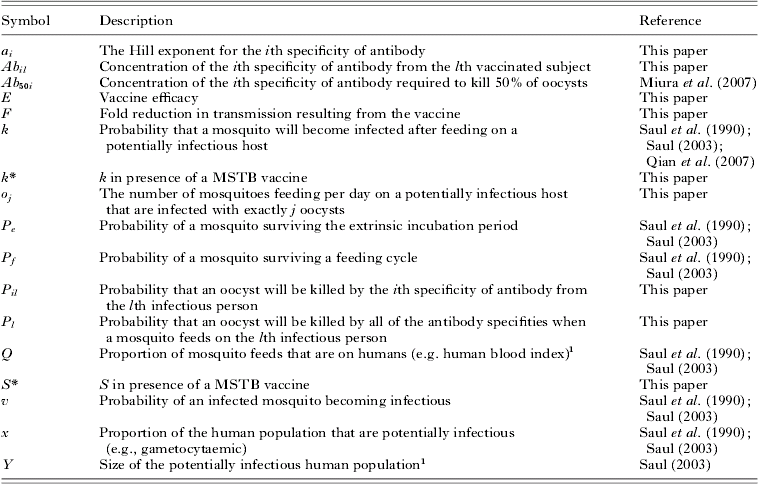
The model is a deterministic simulation model with the following sub-components. The symbols used in this paper are defined in Table 1.
Symbols used in the text

1 In previous papers, subscripts were used e.g. Q h and Y h to designate different types of blood meals or populations. This paper only considers human populations. Therefore, for simplicity, the subscripts have not been used.
Human antibody responses
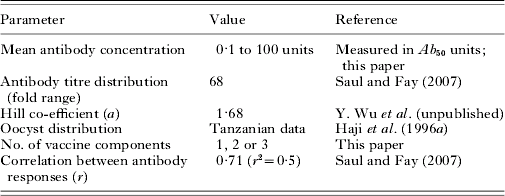
It is assumed that different individuals within a vaccinated human population will make different amounts of antibody and that the distribution of these antibody titres among individuals will be log normal (Saul and Fay, Reference Saul and Fay2007). The range of antibody response within the log normal distribution (i.e. the minimum and maximum antibody values to be expected) is not yet known for particular MSTBV formulations so it will be assumed that these will be similar to other human vaccines. In a large dataset of human immune responses to vaccines, the median value of the fold range (defined as the ratio of upper to lower 95% limits) was 68 fold with a 95% confidence interval of 9 to 6664 (Saul and Fay, Reference Saul and Fay2007).
This model assumes that a vaccine may contain more than one immunogen, e.g. a mixture of Pfs25 and Pfs28. The modelling of vaccine responses to these multi-component vaccines follows the framework of Saul and Fay (Reference Saul and Fay2007). The correlation between antibody responses to different vaccine components may vary from uncorrelated (correlation coefficient=0) to absolutely positively correlated (correlation coefficient=1). This model assumes no immunological interference between the production of antibodies.
Killing of mosquito stage parasites
This model assumes that killing of mosquito stage parasites in field conditions will approximate the killing observed with membrane feeding conducted in the laboratory. Specifically, it is assumed that the probability that antibody will prevent the development of individual oocysts in the field will show the same modified hyperbolic (non-linear) relationship between oocyst development and antibody concentration as observed in membrane-feeding experiments (Miura et al. Reference Miura, Keister, Muratova, Sattabongkot, Long and Saul2007). Several modified hyperbolic functions all give reasonable fits (Miura et al. Reference Miura, Keister, Muratova, Sattabongkot, Long and Saul2007; A. Saul, unpublished observations). For this model, the Hill equation (Hill, Reference Hill1910) is used,

where:
• P il is the probability that antibody (Ab il) to the ith immunogen in a multi-component vaccine in the lth subject vaccinated will kill a parasite;
• Ab 50i is the concentration of Ab i required to kill 50% of parasites;
• a i is the Hill coefficient for the ith antibody. Where a i=1, this equation describes a simple rectangular hyperbola. In a recent trial with Pfs25 (Y. Wu et al. personal communication), over a range of human antibody concentrations that gave up to 94% reduction in oocysts density in membrane feeding experiments, a=1·68.
In this paper, antibody concentrations are scaled so one antibody unit=Ab 50. Thus, using this definition, the above equation simplifies to,

Different antibodies are assumed to act independently (formally, Bliss independence) (Greco, Bravo and Parsons, Reference Greco, Bravo and Parsons1995) on oocysts thus giving rise to additive (but not synergistic) impact on parasite survival (Miura et al. Reference Miura, Keister, Muratova, Sattabongkot, Long and Saul2007). With this model, the probability that a parasite will survive to form an observed oocyst is the probability that the oocyst will develop in the absence of any antibodies (assumed to be equal to 1) multiplied by the separate probabilities of surviving each antibody specificity in the anti-serum. Therefore, the overall (per oocyst) probability of not developing within the mosquito due to the multicomponent vaccine, i.e. the overall probability of a parasite being killed, P l, is,

for the n immunogens present in a vaccine used to immunize the lth subject.
Reduction in the number of infectious mosquitoes
It is assumed that mosquitoes are infectious if any sporozoites are present in their salivary glands. However, the probability that a sporozoite-positive mosquito infects an individual with a single bite is independent of the density of infection in that mosquito. With this assumption, the reduction in transmission will be directly proportional to the reduction in the number of mosquitoes that become infected. Thus, the impact of transmission blocking immunity will depend on the number of mosquitoes that fail to develop a single oocyst, rather than the reduction in the number of oocysts formed. There is a possibility that mosquito feeds on high parasite densities may result in antibody depletion giving parasites a higher probability of survival than would have occurred in feeds with low parasite densities. However, no significant density dependence was observed in feeds with anti-Pfs25 (Miura et al. Reference Miura, Keister, Muratova, Sattabongkot, Long and Saul2007) and contrary to laboratory feeds, most feeds in the field involve low to very low gametocyte densities in the infecting blood (Haji et al. Reference Haji, Smith, Charlwood and Meuwissen1996a; Schneider et al. Reference Schneider, Bousema, Gouagna, Otieno, van de Vegte-Bolmer, Omar and Sauerwein2007). Thus, in this model, it is assumed that the probability of each parasite surviving antibody attack is independent of the number of other parasites present.
Distribution of the number of oocysts per mosquito
The densities of infection (as measured by the number of oocysts per mosquito) in individual mosquitoes feeding on a single infected blood source vary considerably and this density distribution is highly overdispersed (Billingsley et al. Reference Billingsley, Medley, Charlwood and Sinden1994). In principle, there could be a different oocyst distribution in mosquitoes feeding on each infectious person in a community. Since this model only considers the overall oocyst distribution in the population, this is not important for this model. This lack of importance was tested by assuming that mosquitoes in the field collections infected with one or two oocysts were infected by ‘poorly infectious’ humans and mosquitoes with >2 oocyst from ‘highly infectious’ humans (i.e. with three classes of humans: non-infectious, poorly infectious and highly infectious), running the model with separate human populations and calculating the average result. In all cases, the average was the same as the model treating the human population as two groups: non-infectious and infectious (data not shown).
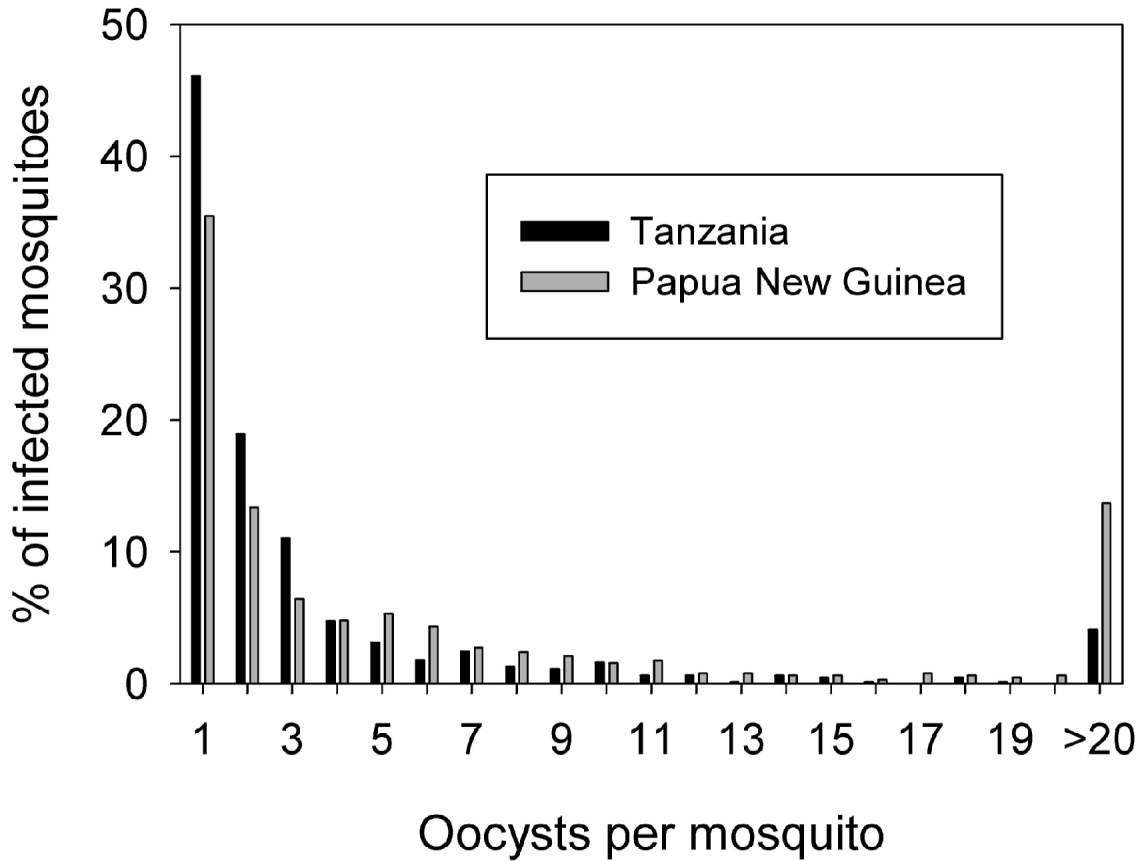
There are few measurements of this average distribution of oocysts in wild caught mosquitoes. Two such examples are shown in Fig. 1 for 620 infected Anopheles punctulatus s.l. complex mosquitoes (An. punctulatus s.s., An. koliensis and An. farauti) from Papua New Guinea (Graves et al. Reference Graves, Burkot, Saul, Hayes and Carter1990; Burkot and Graves, Reference Burkot, Graves, Eldridge and Edman2004) and for 612 infected An. gambiae s.l. and An. funestus from Tanzania (Haji et al. Reference Haji, Smith, Charlwood and Meuwissen1996a, Reference Haji, Smith, Meuwissen, Sauerwein and Charlwoodb). The Tanzanian data set was arbitrarily chosen as the standard set in this paper. As is shown later, estimates of efficacy in the field for specific situations depends on the data set used.
Oocyst distributions in infected mosquitoes collected near Ifakara, Tanzania (black bars) or Madang Province, Papua New Guinea (open bars). For both studies, blood-fed mosquitoes were caught after natural feeding, housed in a laboratory until oocysts developed, dissected, and the number of oocysts per mosquito counted. For this graph, all mosquitoes with >20 oocysts have been pooled for clarity of display. In the simulation analysis, the actual numbers of oocyst were used for all mosquitoes.

In the field using wild caught mosquitoes, it is not usually possible to distinguish fed mosquitoes that fail to develop any oocysts after feeding on a potentially infectious person from a mosquito that fed on a non-infectious person and therefore had no oocysts. What can be measured is the proportion of infected mosquitoes that have j oocysts (o j). After vaccination, the probability that any individual oocysts will be present when the mosquito has feed on the lth infectious person is (1–P l). Therefore, if k is the probability that a mosquito will become infected after feeding on a potentially infectious host, the probability k l* of a mosquito becoming infected after feeding on the lth infectious person after vaccination will be,

where the asterisk indicates after vaccination and the mean probability of mosquitoes becoming infected after the opportunity of feeding on the population of Y infectious humans will be,

The proportion of mosquitoes with sporozoites
Following the cyclical feeding model of Saul, Graves and Kay (Reference Saul, Graves and Kay1990), the resulting proportion, S, of mosquitoes that are infectious (i.e. sporozoite positive) having become infected and having survived the extrinsic incubation period is,

(equation 8 from Saul et al. (Reference Saul, Graves and Kay1990)), where x is the proportion of infectious people in the population, Q is the proportion of bloodmeals of human origin, ν is the probability of an infected mosquito becoming infectious, P f the probability of mosquito survival from one feeding cycle to the next and P e is the probability of surviving the extrinsic incubation period). Assuming that the (expected) decreased entomological inoculation rate (EIR) does not change in the short-term, the proportion of people who are infectious (x), and that the decreased probability that a mosquito will become infected does not affect its survival, the efficacy (E) of a MSTBV, measured as the proportion by which EIR decreases in a community would be,

(Note that the EIR includes the product of the proportion of infectious mosquitoes, S, and the number of mosquitoes feeding per person per day, but the latter would not be affected by the vaccine.) Under many situations, superinfection in the mosquito will be relatively unimportant, i.e. both (xQkP f) and (xQk*P f)≪(1−P f) and

Use of this approximation will slightly underestimate the efficacy of a vaccine, and thus will lead to a conservative error in evaluating potential vaccines. This approximation will be used in all results presented in this paper.
In some cases, we will be interested in a direct measurement of the reduction of the number of infectious bites as the ratio of infectious bites without a vaccine to bites in the presence of the vaccine. This fold reduction is given by,

Program
This transmission blocking vaccine model has been implemented as a Microsoft® Excel spreadsheet. A copy of the spreadsheet and instructions for use are available from the author. More details of the original Saul et al. (Reference Saul, Graves and Kay1990) model on which this is based is available in the on line model that accompanies Saul (Reference Saul2003).
RESULTS
Vaccine efficacy at 100% coverage
Antibody distribution and correlations
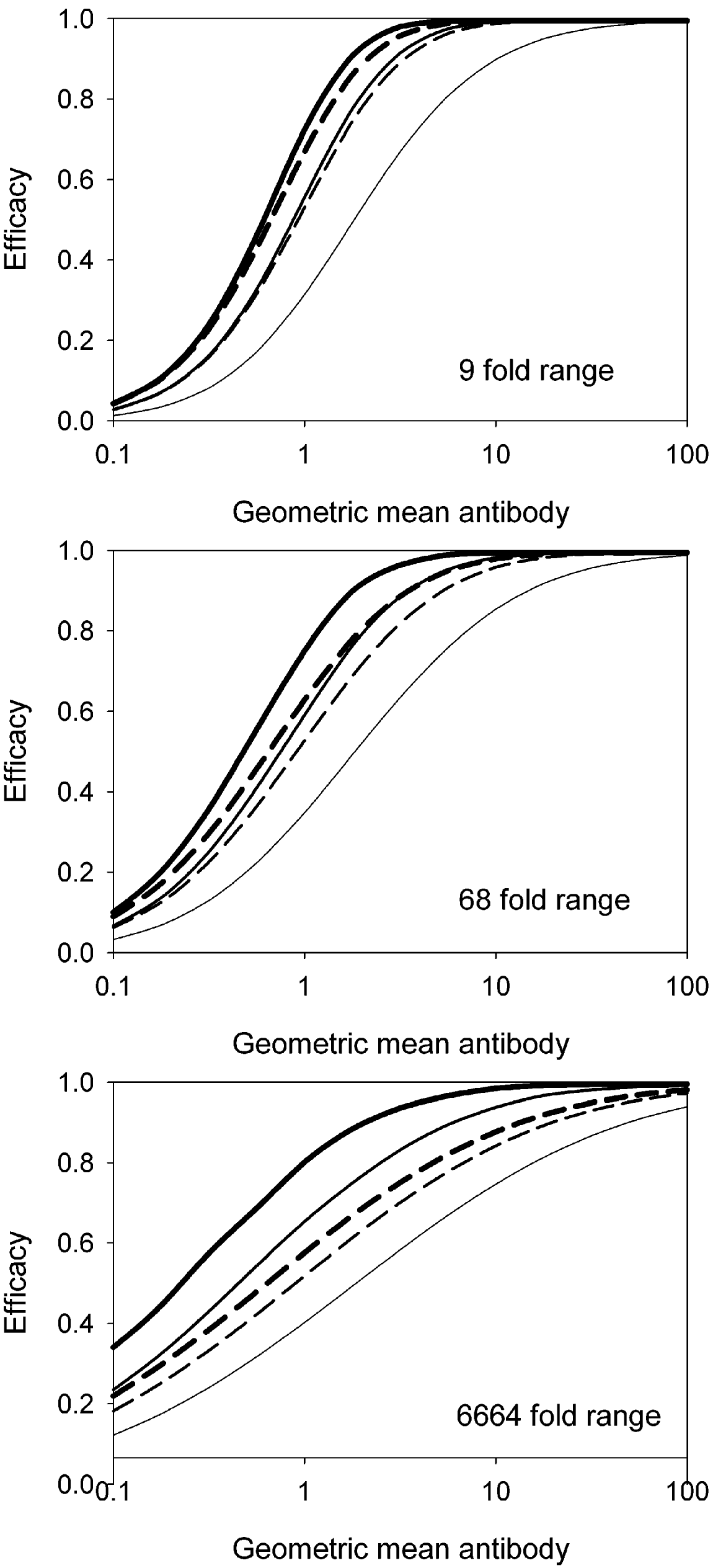
The vaccine efficacy with 100% coverage of the potentially infectious population and for vaccines that give a 9, 68 and 6664 fold range in antibody response is shown in Fig. 2a, Fig. 2b and Fig. 2c, respectively. The graphs show how the efficacy (E) increases as the geometric mean antibody concentration (measured as Ab 50 units) in the population increases. Both the average antibody response and the fold range of that response in the vaccinated population have substantial impacts on the level of transmission blockage. For example, a single component vaccine with 100% coverage needs to generate a geometric mean antibody response of 10·1, 14·6 or 49·2 times the Ab 50 to give a 10 fold reduction in transmission (90% efficacy) if the range of the immune response is narrow (9 fold), average (68 fold) or broad (6664 fold), respectively.
Predicted vaccine efficacy for vaccine trials with vaccines containing 1 (thin line), 2 (medium line) or 3 (thick line) immunogens as a function of the geometric mean antibody (expressed in Ab 50 units) in the population. For multicomponent vaccines, each immunogen is assumed to generate the same geometric mean antibody level with no correlation (solid lines) or total correlation (dashed lines) between immune responses in individuals. Predictions are shown for vaccines that generate a 9 fold range of antibody in the vaccinated populations (ratio of the 97·5% percentile to the 2·5% percentile=9) (Fig. 2a); a 68 fold range (Fig. 2b) and for a 6664 fold range (Fig. 1c). These values correspond to the median (68 fold) and upper and lower 95% ranges (9 and 6664 fold, respectively) recorded for a set of immune responses in 574 human trials using a variety of vaccines. Other parameters were the standard values in Table 2.


Inclusion of additional immunogens to the mixture substantially reduces the antibody concentration required for a given reduction in transmission. Using the example of a 10 fold reduction in transmission with 100% coverage quoted above, a two-component vaccine that generated equal geometric mean antibody levels in the population for both components would need 2·8, 3·5 or 6·0 times the Ab 50 for a 9, 68 or 6664 fold range of vaccine responses provided the immune responses to the two antigens are not correlated (i.e. an individual who makes a weak response to one antigen is as likely to make a strong response to the second antigen as a person who made a strong response to the first antigen; Pearson's correlation coefficient r=0). On the other hand, the gain in efficacy is lower if the immune response is highly correlated (for r=1, antibody concentrations for a 10 fold reduction are 3·3, 5·2 and 19·7 times Ab 50, respectively). Thus, for multi-component vaccines, the lack of correlation is more important for immunogens that elicit a broad range of responses in the vaccinated population than for vaccines with a narrow range of antibody responses.
Oocyst distribution
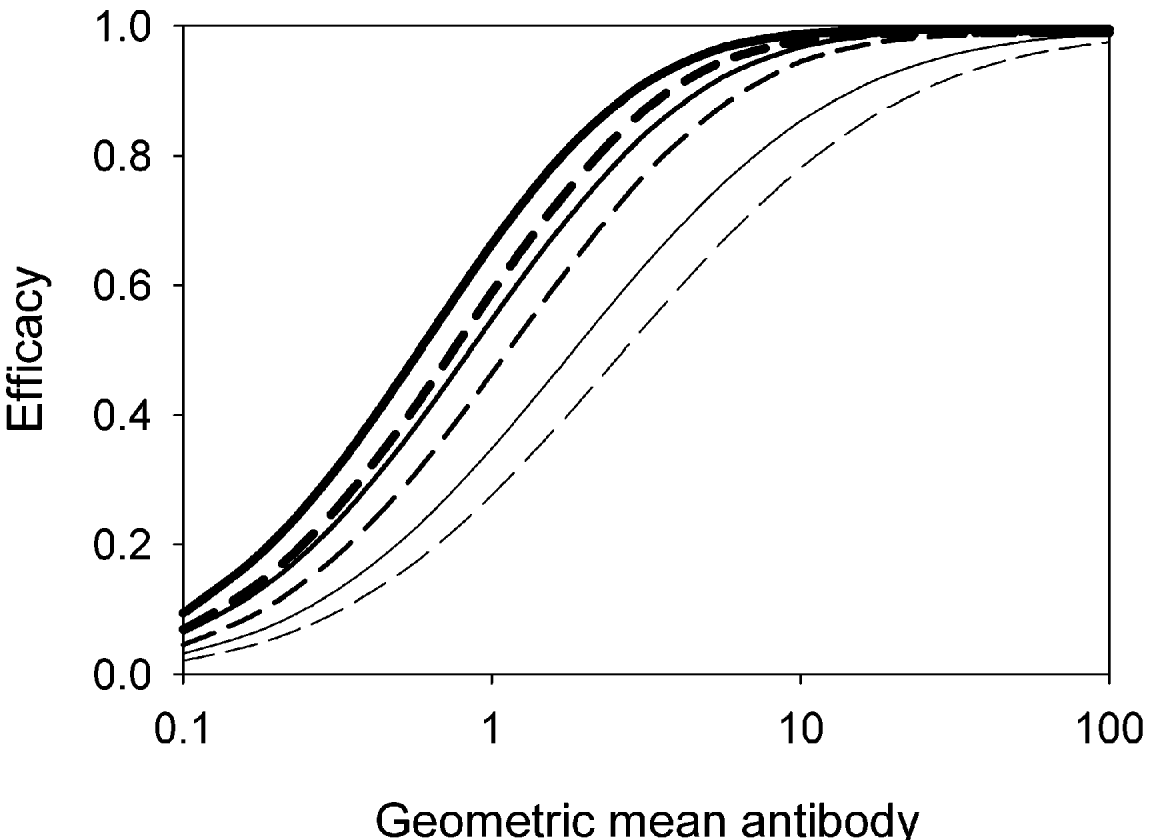
The model is highly dependent on the oocyst distribution occurring naturally. The overall distribution in the data sets from Tanzania and Papua New Guinea was similar. However, the Tanzanian data had a lower average oocyst load per mosquito than the Papua New Guinean data set (geometric mean 2·2 and 3·7 oocysts per mosquito, respectively). This difference in oocyst load resulted in a lower predicted efficacy for a given antibody concentration against transmission by the Papua New Guinean mosquitoes than by the Tanzanian mosquitoes (Fig. 3). To achieve comparable efficacy, approximately 40% higher antibody levels would be required in Papua New Guinea than in Tanzania.
Effect of oocyst distribution on predicted efficacy with mosquito stage transmission blocking vaccines with one (thin line), two (medium line) or three (thick line) immunogens using the oocyst distribution recorded from Tanzania (solid lines) or Papua New Guinea (dashed lines). Other parameters were the standard values in Table 2.

Hill exponent
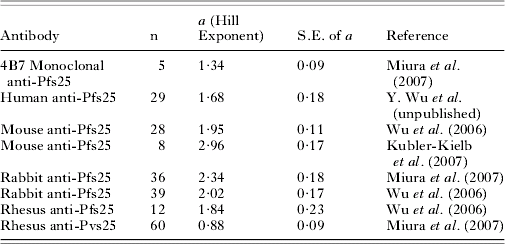
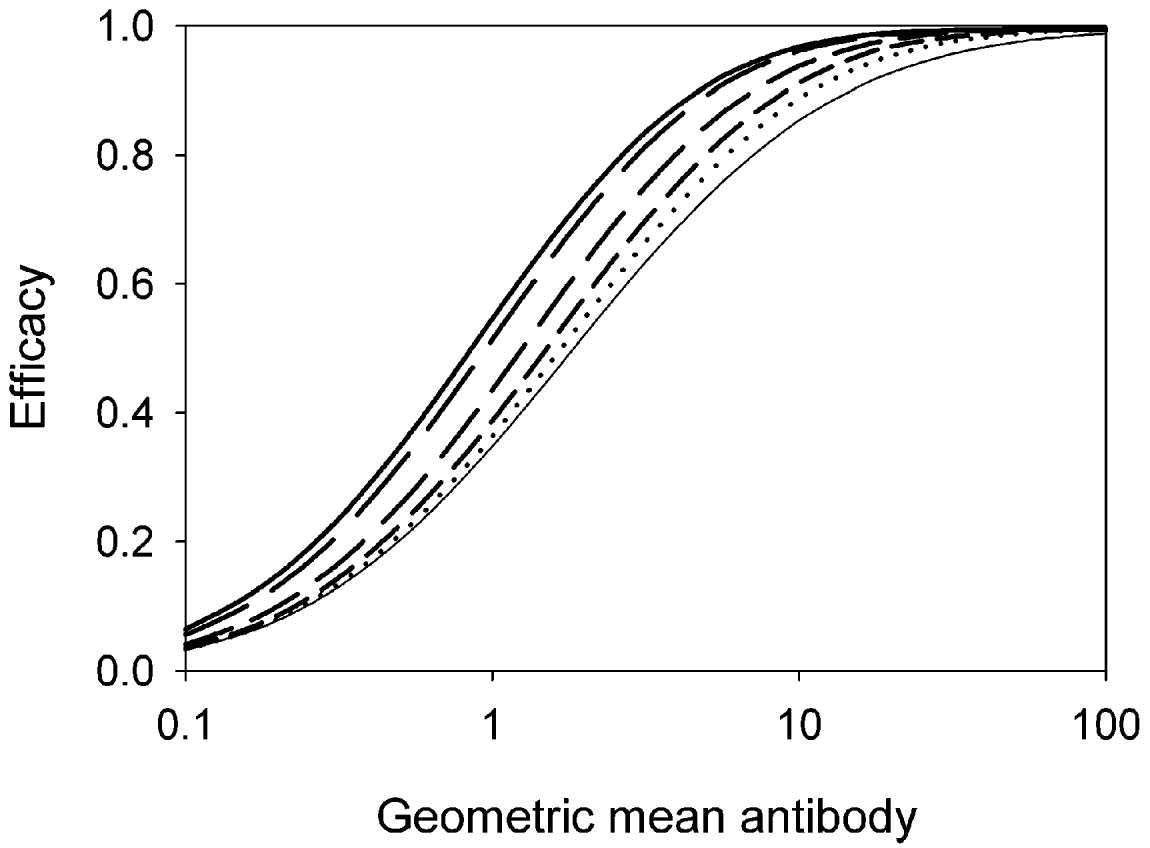
In this paper, the relationship between the reduction in oocyst numbers and antibody determined in membrane feeding experiments has been fitted using a Hill plot. Where the Hill exponent is 1, the curve is a simple hyperbola. As listed in Table 3, for most experiments, the relationship is steeper (Hill exponent >1) than the simple hyperbola expected for a mass action process. Since in this model, the relationship between antibody concentration and reduction in oocyst numbers is an integral part of calculating the impact of antibody levels on transmission, errors in estimating the Hill coefficient potentially impact on the estimated vaccine efficacy. As shown in Fig. 4, estimates of the efficacy of the vaccine depend on the value used for the Hill coefficient. However, the effect is relatively small over a credible range of values for the exponent, especially for vaccines that contain two or three immunogens.
Experimental values for the Hill exponent

n: number of individual feeding experiments used to determine a.
Effect of Hill exponent on predicted efficacy for a standard set of vaccine parameters with one (thin line) two (medium line) or three (thick line) components. The Hill exponent used was 1·0 (dotted line), 1·68 (solid line) or 2·0 (dashed line). Other parameters were the standard values in Table 2.

Multiple immunogen components
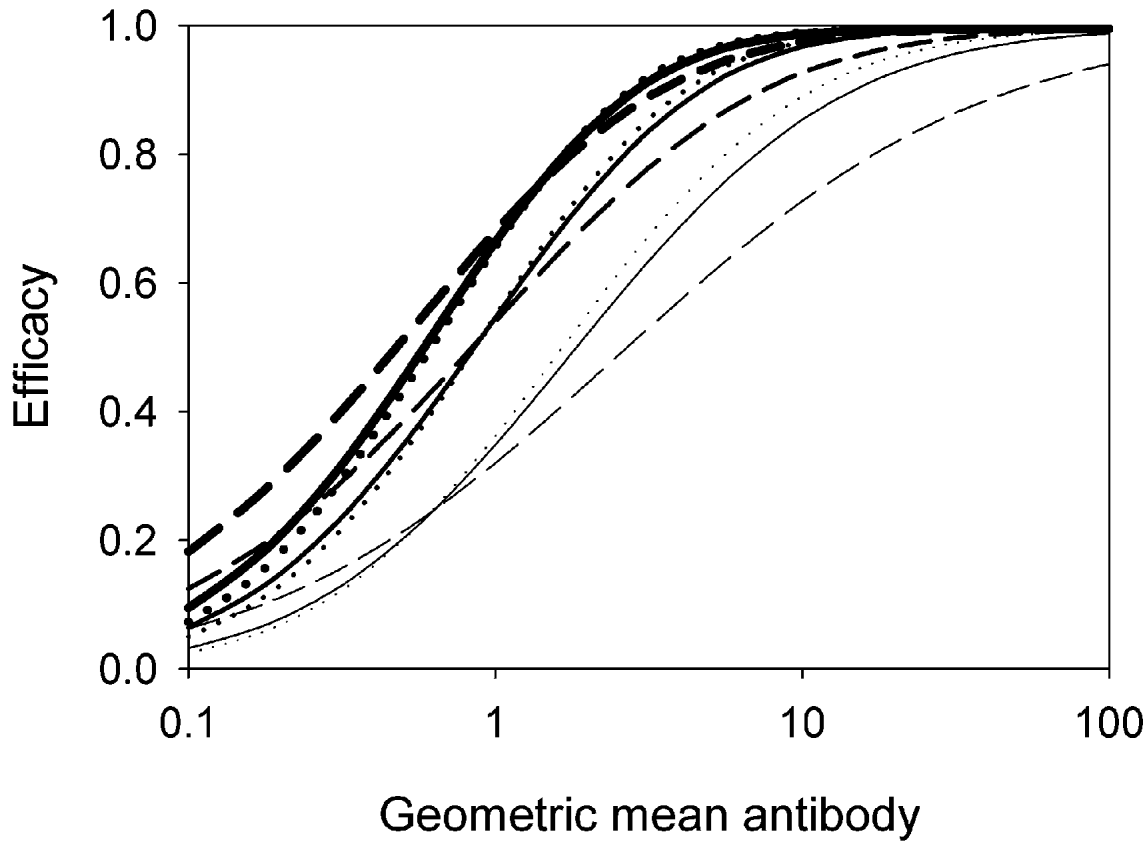
As shown in Fig. 2, substantial gains in efficacy may result from combining several antigens in the vaccine. However, as shown in a previous general vaccine model (Saul and Fay, Reference Saul and Fay2007), in the transmission blocking vaccine model presented here, the gains in efficacy upon making multicomponent vaccines are critically dependent on the relative immunogenicity of the components. Without a synergistic activity, gains in efficacy require that the separate components generate approximately equal transmission blocking activity (Fig. 5).
Effect of relative immunogenicity in a two-component vaccine on predicted efficacy with vaccines with one immunogen (thin line) or two equally immunogenic component (medium line). Two-component vaccines with the second component giving a geometric mean antibody concentration of 80% (long dash), 40% (medium dash), 20% (short dash) or 10% (dotted) of the first immunogen are shown (black). Other parameters use the standard values in Table 2.

Vaccine impact at <100% coverage
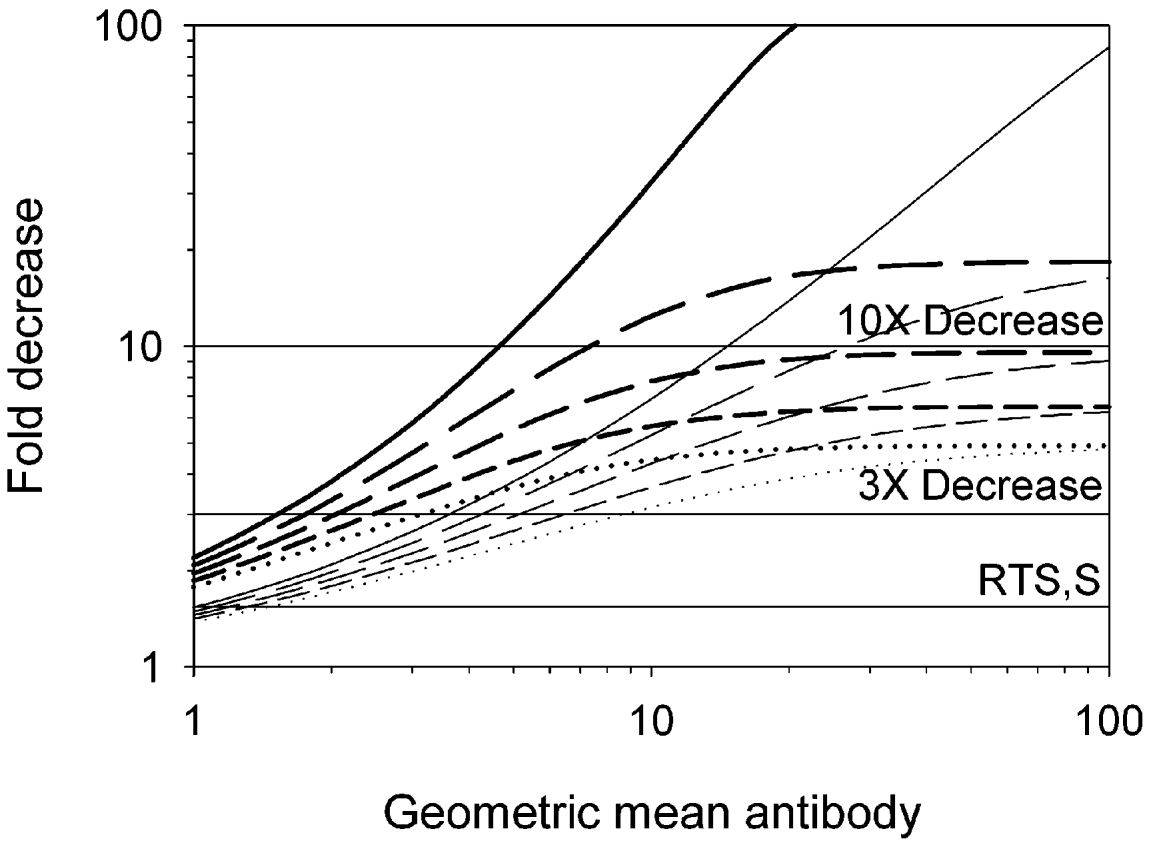
The proportion of the infectious population vaccinated (i.e. gametocyte-positive people) has two separate effects on the impact of a vaccine on transmission. First, the proportion covered imposes an absolute upper limit on the reduction in transmission. If 90% of the infectious population is vaccinated, then the vaccine cannot directly reduce the transmission by >10 fold. Second, where the reduction in transmission is not limited by coverage, reduced coverage still reduces the impact on transmission. Under these conditions, reduced coverage could be compensated by improving the immunogenicity of the vaccine. For example, to obtain a 3 fold reduction in transmission, for a single component vaccine that generated a 68 fold antibody range would require a geometric mean antibody in the population 4·2 or 8·7 times the Ab 50 for a 95% or 80% coverage, respectively. For a two-component vaccine, 1·7 or 3·2 times Ab 50 would be required, respectively.
DISCUSSION
Now that human trials are being conducted with vaccines aimed at blocking malaria transmission by attacking antigens on the surface of mosquito stage parasites, it would be useful to be able to predict the level of immunogenicity, as measured by serology (e.g. ELISA) and laboratory-based membrane-feeding experiments, required to make a useful vaccine. More specifically, it is expected that Phase 3 trials of MSTBVs will be placebo controlled, randomized trials where the unit of randomization will be a village and where the outcome will be the reduction in transmission as measured by decreased incidence of infection and/or decreased EIRs. Since these will involve large numbers of vaccinees, it will be important to develop realistic Go/No Go criteria for immunogenicity before moving from Phase 1 trials into the development plan leading to these large scale field trials.
Fortunately, for vaccines that target mosquito stage antigens, an extensive quantitative framework has been developed, particularly by Ronald Ross and by George Macdonald (Macdonald, Reference Macdonald1957; Bailey, Reference Bailey1982), that forms the basis for quantitatively describing transmission. There is also a direct experimental procedure, the membrane feeding assay, which is believed to provide a reasonable direct measure of the impact of anti-parasite antibodies on mosquito infectivity, so these provide both the theoretical and experimental basis for developing models for predicting vaccine efficacy as measured by a reduction in malaria transmission. The impact of reducing transmission on the final desired outcome: either a total interruption of transmission or a reduction in disease, is still a matter of discussion and investigation (Smith et al. Reference Smith, McKenzie, Snow and Hay2007), and will depend critically on the epidemiology of a transmission zone, but especially if transmission blocking vaccines were to be combined with other anti-malarial measures, reductions in transmission of the order of 5 to 10 fold would appear potentially worthwhile (Carter, Reference Carter2002; Smith et al. Reference Smith, McKenzie, Snow and Hay2007).
In linking these elements, several factors besides the intrinsic immunogenicity of the vaccine were identified that have a significant impact on the predicted efficacy. Of these, the fold range of antibody responses in the vaccinated population is important. In a survey of responses to a series of vaccines, a wide range of responses was recorded (Saul and Fay, Reference Saul and Fay2007) with vaccines based on protein toxoids typically giving relatively uniform responses although even for these, the 95% range typically was >10 fold between the highest and lowest responders. For vaccines like Hepatitis B, that give a wide range of responses, a significant proportion of vaccinees may remain unprotected or poorly protected following a standard vaccination regimen. For most vaccines, this is a problem for the individual. However, for an MSTBV that relies on herd immunity, a significant proportion of poor responders decreases the protection for everyone in the community. In determining the level of antibody response needed before designing a field efficacy trial for an MSTBV, Phase I trials will need to be designed to measure the fold range of responses as well as the average response.
Combining two or more antigens in a vaccine is predicted to decrease substantially the concentration of antibody to each immunogen required to achieve a given level of protection (Fig. 2). Combinations will produce the greatest impact on efficacy where the individual antigens generate a wide fold range of immune response, and where the immune response to each antigen is not correlated. Under these conditions, there is a reasonable probability that a poor responder to one antigen will be an adequate responder to another component in the vaccine. However, the model presented in this paper predicts that there are likely to be major limitations on how many antigens are worth combining: unless there was a synergistic response, in order to generate an enhanced response each antigen needs independently to generate approximately the same average level of protection (Fig. 5). Depending on the costs and complexity of combining several antigens, it seems unlikely that it would be worth combining two antigens that differ by more than a factor of 2 or 3 in their ability to generate anti-parasite activity. Given the few antigens currently under development, or based on the latest proteomic data that could possibly be developed (Saul, Reference Saul2007), it seems unlikely that more that two or three antigens will emerge as having approximately equal ‘best’ immunogenicity and so a fully developed MSTBV is also unlikely to have more than two or three antigens.
For any herd immunity vaccine, the level of coverage is a critical factor in determining the impact of the vaccine on disease transmission (Fig. 6). Malaria transmission is highly focal and local (Carter, Reference Carter2002), limited by the flight range of the mosquito vector. An example of how local transmission occurs is provided by the trials of insecticide-impregnated bed nets in western Kenya. These trials produced a significant mass protection effect but this effect dissipated over a transition zone of a few hundred meters (Hawley et al. Reference Hawley, Phillips-Howard, ter Kuile, Terlouw, Vulule, Ombok, Nahlen, Gimnig, Kariuki, Kolczak and Hightower2003).
Effect of coverage on the predicted fold reduction in transmission for single- (thin line) or two- (medium line) component vaccines with 100% (solid line), 95% (long dashed line), 90% (medium dashed line), 85% (short dashed line) or 80% (dotted line) coverage of the infectious reservoir. Horizontal black lines indicate a 3× and 10× reduction and for comparison, the reduction obtained in volunteers immunized in the Mozambique RTS,S trial (Alonso et al. Reference Alonso, Sacarlal, Aponte, Leach, Macete, Milman, Mandomando, Spiessens, Guinovart, Espasa, Bassat, Aide, Ofori-Anyinam, Navia, Corachan, Ceuppens, Dubois, Demoitie, Dubovsky, Menendez, Tornieporth, Ballou, Thompson and Cohen2004). Other parameters were the standard values in Table 2.

Furthermore, for an MSTVB, coverage is only important for the infectious reservoir of the population. Depending on the level of malaria endemicity, the critical reservoir may be a subset of the community. In moderate to high endemic areas, older children and young adults are the important target group. Fortunately, infants rarely constitute an important part of the reservoir in any endemicity since they generally have lower parasite prevalence than older children and are also bitten less frequently (Port, Boreham and Bryan, Reference Port, Boreham and Bryan1980; Smith et al. Reference Smith, Maire, Dietz, Killeen, Vounatsou, Molineaux and Tanner2006). Certain other groups (e.g. pregnant women and chronically ill patients) within a population potentially create difficulties in achieving high vaccination coverage. In the context of a control programme, prophylactic treatment with anti-malarial drugs would ensure they are not part of the infectious reservoir. Given that vaccination of the target population is relatively straightforward and that it is local, not national coverage that is critical, in a vaccine trial or a local intensive control programme it should be possible to achieve high coverage level, e.g. >90%.
The most developed MSTBVs are based on the P25 proteins from P. vivax and P. falciparum. In the most recent published trial, the P. vivax protein (Pvs25H) adjuvanted with aluminum hydroxide, at 14 days after the 3rd vaccination gave a geometric mean antibody concentration almost exactly equal to the Ab 50 (1·02X – based on feeds containing non-heat inactivated sera) in the 18 subjects who received either 20 or 80 μg of protein per vaccination (Malkin et al. Reference Malkin, Durbin, Diemert, Sattabongkot, Wu, Miura, Long, Lambert, Miles, Wang, Stowers, Miller and Saul2005). There were several subjects who were poor responders and the antibody responses covered approximately a 7000 fold range. Assuming a 90% coverage of gametocyte carriers and an oocyst distribution similar to that seen for Tanzanian mosquitoes infected with P. falciparum, this model predicts that this vaccine would give a 1·6 fold reduction in transmission in all members of the population. To put this in context, the RTS,S vaccine, which is designed to prevent transmission of parasites from mosquitoes to people achieved 1·6 fold reduction in transmission in the Mozambique children vaccinated (Alonso et al. Reference Alonso, Sacarlal, Aponte, Leach, Macete, Milman, Mandomando, Spiessens, Guinovart, Espasa, Bassat, Aide, Ofori-Anyinam, Navia, Corachan, Ceuppens, Dubois, Demoitie, Dubovsky, Menendez, Tornieporth, Ballou, Thompson and Cohen2004) as judged by decreased incidence of infection. Several developments are underway that would substantially improve the immunogenicity of P25 based vaccines (Wu et al. Reference Wu, Przysiecki, Flanagan, Bello-Irizarry, Ionescu, Muratova, Dobrescu, Lambert, Keister, Rippeon, Long, Shi, Caulfield, Shaw, Saul, Shiver and Miller2006; Kubler-Kielb et al. Reference Kubler-Kielb, Majadly, Wu, Narum, Guo, Miller, Shiloach, Robbins and Schneerson2007; Qian et al. Reference Qian, Wu, Muratova, Zhou, Dobrescu, Duggan, Lynn, Song, Zhang, Reiter, Macdonald, Narum, Long, Miller, Saul and Mullen2007). Importantly, based on the immune responses in 9 Rhesus monkeys receiving either 4 or 40 μg Pfs25 conjugated to the outer-membrane protein complex of Neisseria meningitidis, this vaccine not only gave a much stronger antibody response (geometric mean 11 times Ab 50), but also gave a narrow 19 fold range of antibody responses. If this or one of the other vaccine formulations under development gives similar immunogenicity in humans, this model predicts a 5·4 fold decrease in transmission at 90% coverage.
These recent results highlight the need for this model: it was not obvious how decreased oocyst intensities in membrane-feeding experiments translate into likely vaccine efficacy. The model suggests that we may be closer to an effective transmission blocking vaccine than widely believed and provides a quantitative basis for proceeding.
The model is a relatively simple one and designed for guiding vaccine trial design. Use of the model for more general purposes (e.g. in predicting long-term effects of natural or induced transmission blocking immunity in human populations) would require re-examination of the underlying assumptions. In some cases (e.g. the assumption that there is no significant dependence by parasite densities on oocyst development) the assumptions are probably robust at least for P. falciparum. In the example quoted, there is evidence for a lack of density dependence in laboratory feeds (Miura et al. Reference Miura, Keister, Muratova, Sattabongkot, Long and Saul2007) and as the gametocyte density in these feeds usually far exceeds natural gametocyte density, the model should hold in field situations even if density dependence is found in laboratory feeds, it may not be a problem in the field. Other assumptions, e.g. that the presence of induced transmission blocking antibody does not alter the prevalence of gametocyte carriers in the field, is likely to be incorrect (at least one may hope so), especially in areas of low endemicity. More sophisticated models that take into account changing parasite prevalence with time will be needed.
For the limited purpose for which this model was created, it can be further refined and validated as more data become available. However, that is not likely to happen until field trials of MSTBVs are underway.
ACKNOWLEDGEMENTS
I am grateful to Tom Smith, Patricia Graves, Bernard Okech and Chris Drakeley for supplying oocyt density data and to my colleagues in the Malaria Vaccine Development Branch, NIAID and the Fogarty International Center of the NIH for suggestions on the content of this paper. The study was supported by the Intramural Research Program of the National Institute for Allergy and Infectious Diseases, National Institutes of Health.