Introduction
Nordenskiöld (Reference Nordenskiöld1877) described hyalotekite as a new Pb-silicate mineral from Långban, Värmland, Sweden. A more comprehensive chemical analysis of holotype material was given by Lindström (Reference Lindström1887), showing the presence of Ba, Pb, Be and B, and both analyses of holotype hyalotekite show Ba in excess of Pb (Table 1). Based on the chemical analysis of Lindström (Reference Lindström1887) and calculated on 29 (O + F) anions, the empirical formula of hyalotekite from Långban is (Ba1.96Pb2+1.68K0.28Na0.08)Σ4 (Ca2.08Mn0.06Mg0.03Cu0.02)Σ2.19(Si9.82B1.60Be0.45Al0.05Fe3+0.01)Σ11.93O28.20F0.78Cl0.03 for Z = 2. The general formula has been written in various ways (Moore et al., Reference Moore, Araki and Ghose1982; Grew et al., Reference Grew, Yates, Belakovskiy, Rouse, Su and Marquez1994, Christy et al., Reference Christy, Grew, Mayo, Yates and Belakovskiy1998), and the currently accepted form is as follows: (Ba,Pb2+,K)4(Ca,Y)2[Si8(B,Be)2(Si,B)2O28]F (Pautov et al., Reference Pautov, Agakhanov, Sokolova, Hawthorne, Karpenko, Siidra, Garanin and Abdu2015). Hyalotekite has been reported from the Darai-Pioz alkaline massif, Tajikistan (Grew et al., Reference Grew, Yates, Belakovskiy, Rouse, Su and Marquez1994). Two other minerals isostructural with hyalotekite have also been reported from the Darai-Pioz massif: kapitsaite-(Y), ideally Ba4(YCa)[Si8B2B2O28]F (Pautov et al., Reference Pautov, Khvorov, Sokolova, Ferraris, Ivaldi and Bazhenova2000; Sokolova et al., Reference Sokolova, Ferraris, Ivaldi, Pautov and Khvorov2000) and khvorovite, ideally Pb2+4Ca2[Si8B2(SiB)O28]F (Pautov et al., Reference Pautov, Agakhanov, Sokolova, Hawthorne, Karpenko, Siidra, Garanin and Abdu2015). The degree of complication of the hyalotekite structure, combined with the complexity of the parageneses in which it has been found, suggest the possibility of: (1) the occurrence of additional hitherto-undiscovered minerals; and (2) the possibility of synthesizing a wide variety of chemical variants. These points have encouraged us to define the Hyalotekite Group, approved by the Commission on New Minerals, Nomenclature and Classification of the International Mineralogical Association (IMA) in memorandum 57–SM/16, and to examine the hyalotekite structure-type in terms of its possible chemical variants.
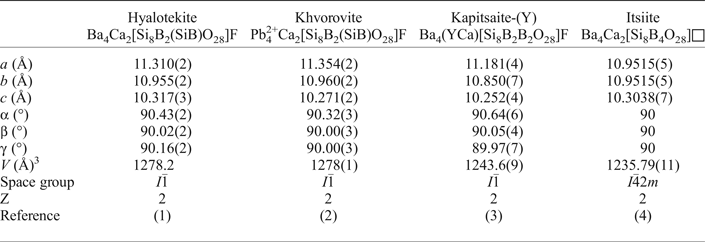
Crystallographic data for the hyalotekite-group minerals.

References: (1) Moore et al. (Reference Moore, Araki and Ghose1982); (2) Pautov et al. (Reference Pautov, Agakhanov, Sokolova, Hawthorne, Karpenko, Siidra, Garanin and Abdu2015); (3) Sokolova et al. (Reference Sokolova, Ferraris, Ivaldi, Pautov and Khvorov2000); (4) Kampf et al. (Reference Kampf, Peterson and Joy2014).
End-members and their significance
From an algebraic perspective, a ‘chemical system’ is described in terms of its components. ‘System components’ are those (components) required to describe the chemical variability of the system, and ‘phase components’ are those components required to describe the chemical variability in individual phases (Spear, Reference Spear1993). Phase components must be independently variable (Gibbs, Reference Gibbs1961), i.e. they must be additive, and for minerals, they must be conformable with the structure of that mineral. If we define our system as conforming to a specific structure type, we may define the components of this system as the smallest set of chemical formulae required to describe the composition of all minerals in the system. The definition, ‘the smallest set of chemical formulae required to describe the composition of all the phases in the system’, defines the components of the system as its set of end-member compositions, and the set of end-member compositions define the possible composition space occupied by that structure type. These components have certain constraints (Hawthorne, Reference Hawthorne2002): (1) they must be conformable with the structure type of the mineral; (2) they must be neutral (i.e. not carry an electric charge); and (3) they must be irreducible within the system considered (i.e. they cannot be expressed as two or more simpler compositions that are compatible with the crystal structure of the system).
For the majority of atomic arrangements and chemical compositions, these constraints result in end-member formulae which have a single constituent at each site [e.g. diopside: CaMgSi2O6: M(1) = Mg2+, M(2) = Ca2+, T = Si4+, O(1) = O(2) = O(3) = O2–] or group of sites (forsterite: Mg2SiO4: M(1) + M(2) = Mg2+, T = Si4+, O(1) = O(2) = O(3) = O(4) = O2–] in the structure. However, Hawthorne (Reference Hawthorne, Huminicki and Grew2002) showed that some end-members have two constituents of different valence and in a fixed ratio at one site in their structure (the remaining sites having only one constituent each). A classic example of this is milarite, K2Ca[AlBe2Si12O30](H2O), in which T(2) = Be2Al apfu (atoms per formula unit) in the end-member formula. Note that an end-member can have more than one species at only one site, and only two species at that site. If more than one cation or anion is introduced to another site in the structure, or a third species is introduced to a site, the resulting composition is reducible and may be resolved into two end-member compositions.
The hyalotekite-type structure
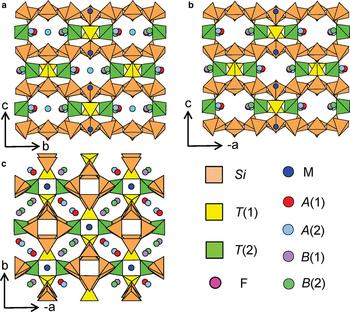
The crystal structure of hyalotekite was solved by Moore et al. (Reference Moore, Araki and Ghose1982) and refined (using the same diffraction data) by Christy et al. (Reference Christy, Grew, Mayo, Yates and Belakovskiy1998). The structure consists of layers of corner-sharing (SiO4) tetrahedra interleaved with layers of (TO4) tetrahedra and Ba2+ (Figs 1a,b), forming an interrupted framework of corner-shared Si, B and T tetrahedra with interstitial Ba2+ and Ca2+ in the channels through the framework. There are four [4]-coordinated Si sites occupied solely by Si4+, giving Si8 apfu. Previous crystal-structure work on hyalotekite-group minerals (e.g. Sokolova et al., Reference Sokolova, Ferraris, Ivaldi, Pautov and Khvorov2000; Pautov et al., Reference Pautov, Agakhanov, Sokolova, Hawthorne, Karpenko, Siidra, Garanin and Abdu2015) identified two distinct tetrahedrally coordinated sites, B occupied solely by B3+, and T occupied by B3+ and Si4+. As we shall show later, the B site in other potential hyalotekite-group minerals may be occupied by cations other than B3+, and hence we relabel the B and T sites as T(1) and T(2). In hyalotekite, T(1) is occupied by B3+ and T(2) is occupied by B3+ and Si4+, giving ideally (SiB3) apfu. The Si(1–4) tetrahedra form four-membered [Si 4O12] rings (Fig. 1c), and the T tetrahedra form four-membered [T 4O12] rings. Tetrahedra of both rings share vertices to form an interrupted [Si 8T 4O28] framework of ideal composition [Si8B2(SiB)O28] apfu in hyalotekite itself.
The crystal structure of hyalotekite; (a) viewed down a; (b) viewed down b; (c) viewed along c; the W site is concealed behind the M site in (c).

There are two interstitial sites that have been labelled A(1) and A(2) in previous work. Each of these sites splits into two subsites, ~0.5 Å apart: A(1) = A(11) +A(12) and A(2) = A(21) + A(22). We will simplify this site nomenclature by designating A(1) as A and A(2) as B; the split sites then become A(1) + A(2), with coordination numbers [8] and [9], and B(1) + B(2), with coordination numbers [8] and [10]. The A and B sites are occupied by Pb2+, Ba2+, K+ and minor Na+, and their ideal composition in hyalotekite is Ba4 apfu (Table 1). There is one interstitial [8]-coordinated M site that is occupied by Ca2+ in hyalotekite, with the ideal composition Ca2 apfu.
There are 15 anion sites in the structure. Ten O2– anions bridge tetrahedra of the interrupted framework, and three O2– anions are each bonded to one Si4+ cation atom and to three interstitial cations. There is one monovalent-anion site that is coordinated by two M (= Ca2+) and four A cations, and it is occupied by F–.
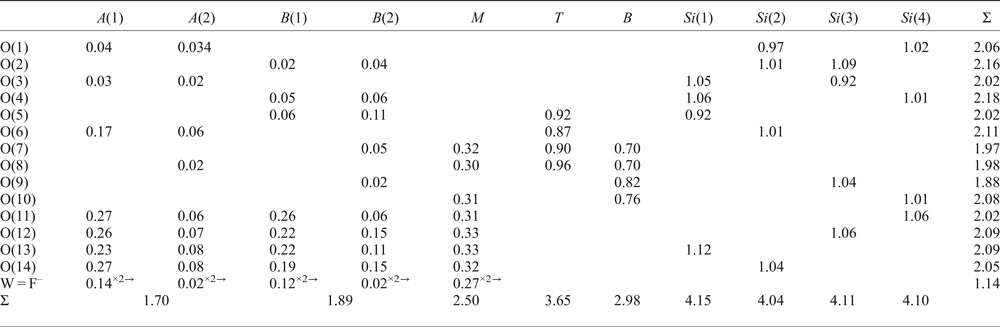
The bond-valence table for khvorovite is shown as Table 2. There are several features of interest here. First, note that the W site is surrounded by two A, two B and two M cation sites, and hence the F– ion at the W site is octahedrally coordinated by cations at the locally associated cation sites. This means that F– cannot be replaced by (OH)– where the A, B and M sites are fully occupied as there is no room for the H+ ion: it would be far too close to one or more of the surrounding cations. If there were vacancies at the locally associated A, B and/or M sites, would there be space for the H+ ion involved in replacement of F– by (OH)–? Local association of a vacancy with an (OH)– group would still result in the H+ ion being ~2.85 Å from an A, B or M cation; this distance is well within the coordination polyhedra of the A and B cations and hence is an arrangement that cannot occur. This argument accounts for the lack of significant substitution of F– by (OH)– in the hyalotekite-group minerals.
Bond-valence* table for khvorovite.

*Bond valences in vu (valence units), bond-valence parameters from Gagné and Hawthorne (Reference Gagné and Hawthorne2015), except for F– which are from Brese and O'Keefe (Reference Brese and O'Keeffe1991).
The itsiite structure
The crystal structure of itsiite was solved by Kampf et al. (Reference Kampf, Peterson and Joy2014). The structure is topologically very similar to that of hyalotekite except that it is tetragonal (Table 1) with T(1) ≡ T(2) and F = □. To make itsiite easily comparable to the triclinic minerals of the hyalotekite group, we may write the formula of itsiite with Z = 1 as Ba4Ca2[Si8B4O28]□. In the structure of itsiite, the T tetrahedra form a four-membered ring where the T tetrahedra are equivalent, conforming to tetragonal symmetry. In the structure of the hyalotekite-group minerals, where more than one type of T cation is present (in those minerals currently approved), the tetragonal symmetry of the four-membered ring of T tetrahedra is broken by ordering of the T cations into different tetrahedra, reducing the symmetry to triclinic. Moreover, the F site, occupied by F– in the known hyalotekite-group minerals, is vacant in itsiite.
A general formula
It is desirable to write a general formula for these minerals in terms of letters (in Roman font) that correspond reasonably with the site nomenclature of the hyalotekite structure. The A site of the structure is split into two sites, A(1) and A(2), with a separation sufficiently small that both sites cannot be occupied at the local scale; the B site shows the same behaviour. Thus in writing a general formula, we will ignore the splitting of these sites and consider just the A and B sites:
 $${\rm A}_2{\rm B}_2{\rm M}_2\left[ {{\rm S}{\rm i}_8{\rm T}_4{\rm O}_{28}} \right]{\rm F}$$
where
 $${\rm A} = {\rm B}{\rm a}^{2 +}, {\rm P}{\rm b}^{2 +}, {\rm K}^ + ;$$
 $${\rm B} = {\rm B}{\rm a}^{2 +}, {\rm P}{\rm b}^{2 +}, {\rm K}^ + ;$$
 $$\,\;\;\;{\rm M} = {\rm C}{\rm a}^{2 +}, {\rm Y}^{3 +}, REE^{3 +} ;$$
 $${\rm T} = {\rm S}{\rm i}^{4 +}, {\rm B}^{3 +}, {\rm B}{\rm e}^{2 +}. $$
 $$\!\!\!\!\!\!\!\!\!\!\!\!\!\!\!\!\!\!\!\!\!\!\!{\rm F} = {\rm F}^-, \, \squ $$
Observed chemical compositions
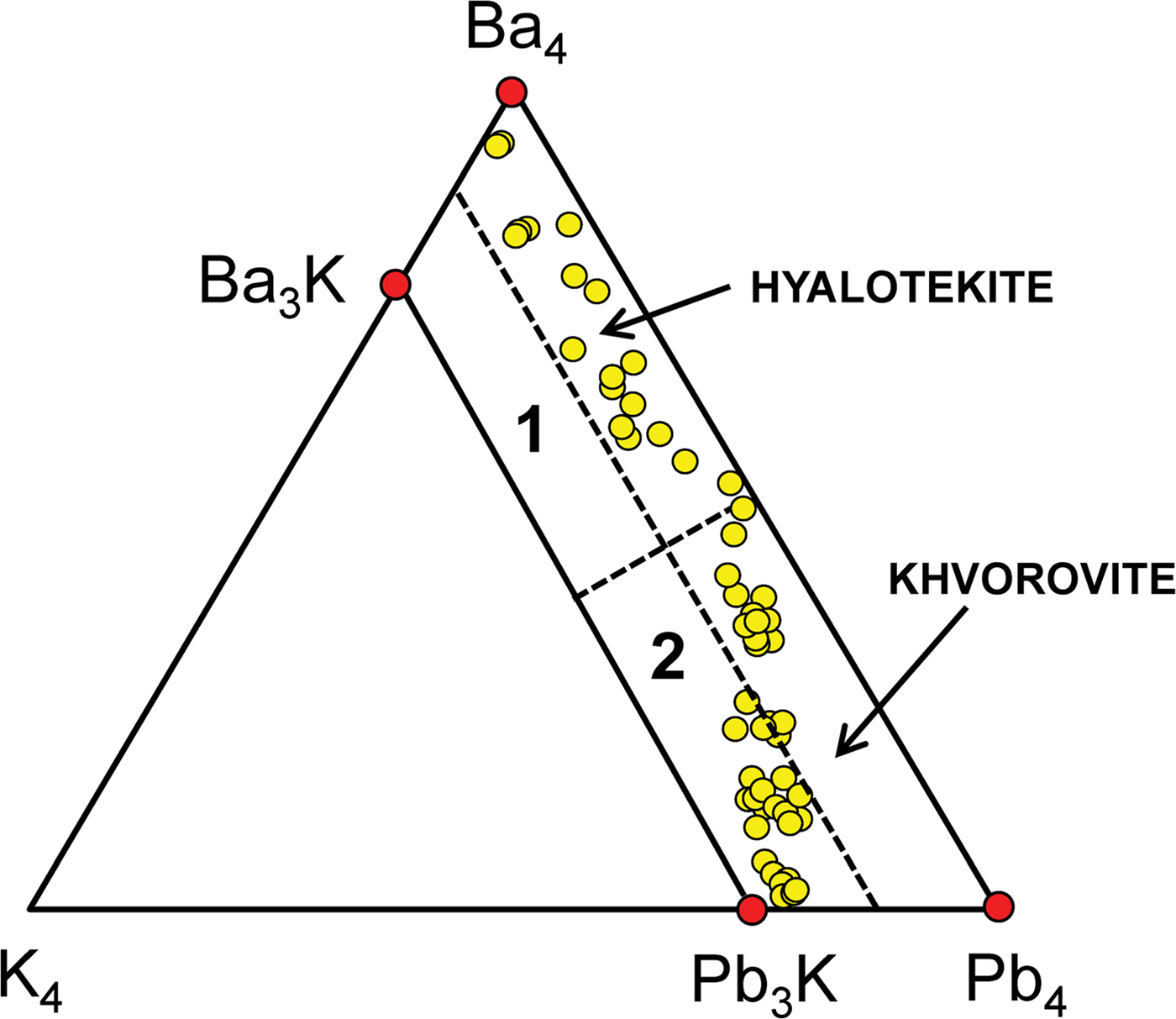
There are currently three minerals with the (triclinic) hyalotekite-type structure and one with tetragonal symmetry and the same bond-topology (Table 1). The composition of kapitsaite-(Y) is written as Ba4Y2[Si8B2B2O28]F in the current IMA list of minerals (Pasero et al., Reference Pasero2017), but this composition is not possible as it has a net charge of + 1. The only way that the structure can compensate for this charge is to replace one B3+ by one Be2+. However, Pautov et al. (Reference Pautov, Khvorov, Sokolova, Ferraris, Ivaldi and Bazhenova2000) did not report any Be2+ and the reported values for Si4+ and B3+ are not in accord with the presence of significant Be2+; moreover, Y3+ is reported as 1.00 apfu with Ca2+ = 0.78 apfu plus minor REE 3+ and Na+. The end-member formula of kapitsaite-(Y) should be written as neutral Ba4(YCa)[Si8B2B2O28]F. The difference between khvorovite and hyalotekite is the dominant occupancy of the A and B sites by Pb2+ and Ba2+, respectively. Previous chemical data for these minerals show a restricted variation in Pb2+:Ba2+ ratio with most of the data lying within the field of hyalotekite. However, analysis of these minerals from Darai-Pioz shows complete solid solution between khvorovite and hyalotekite from Ba2+-free to virtually Pb2+-free compositions (Fig. 2). Where Ba2+ is the dominant cation, the K+ content of the A sites is ~0.2 apfu. Where Pb2+ is the dominant cation, the K+ content of the A sites increases linearly from ~0.2 apfu at Pb2+ + K+ = 2.0 to ~0.9 apfu at Pb2+ + K+ = 4 apfu. Kapitsaite-(Y) differs from hyalotekite in the ideal occurrence of equal amounts of Ca2+ and Y3+ at the M site (Pautov et al., Reference Pautov, Khvorov, Sokolova, Ferraris, Ivaldi and Bazhenova2000; Sokolova et al., Reference Sokolova, Ferraris, Ivaldi, Pautov and Khvorov2000). The extensive solid-solution between khvorovite and hyalotekite at the Darai-Pioz locality suggests that a Pb2+-analogue of kapitsaite-(Y) may be possible. For the chemical data currently available, there is no sign of any correlation between K+ and Y3+ contents in these minerals.
Compositions of hyalotekite and khvorovite with the compositional fields of hyalotekite and khvorovite; end-member compositions are shown by red circles. The compositional field 1 defined by end-member A and B cations Ba3K is empty, whereas compositional field 2 defined by end-member A and B cations Pb3K contains analysed compositions. Data from Pautov et al. (Reference Pautov, Agakhanov, Sokolova, Hawthorne, Karpenko, Siidra, Garanin and Abdu2015).

Lindström (Reference Lindström1887) reported significant Be2+ in hyalotekite from Långban, Värmland, Sweden, and Grew et al. (Reference Grew, Yates, Belakovskiy, Rouse, Su and Marquez1994) showed that hyalotekite from the Darai-Pioz alkaline massif, Tajikistan, also contains significant Be2+. Thus we consider Be2+ as a significant constituent of the hyalotekite-group minerals.
Site occupancies
The tetrahedra of the framework are occupied by dominant cations Si4+ and B3+. The < Si–O > distances reported by Sokolova et al. (Reference Sokolova, Ferraris, Ivaldi, Pautov and Khvorov2000) for kapitsaite-(Y), <Si–O> = 1.617 Å, and by Pautov et al. (Reference Pautov, Agakhanov, Sokolova, Hawthorne, Karpenko, Siidra, Garanin and Abdu2015) for khvorovite, <Si–O> = 1.617 Å, indicate that the Si sites are occupied only by Si4+ and that there is negligible substitution of B3+ at the Si sites. The < T(1)–O > distances are 1.480 and 1.478 Å in these two minerals, the same within one standard deviation as the grand < B3+–O > distance of 1.476 Å reported for borate minerals by Hawthorne et al. (Reference Hawthorne, Burns, Grice, Anovitz and Grew1996), indicating that the T(1) site is fully occupied by B3+ in kapitsaite-(Y) and khvorovite. However, we will show later that Be2+ must substitute for B3+ at the T(1) site in Be-bearing hyalotekite, and hence we allow for the substitution of Be2+ at the T(1) site in these minerals. Thus we will consider the {Si8O28F} part of the structure as invariant and consider variable occupancies at the A, B, M and T sites as indicated by the general formula given above. Any future crystallographical data that indicates occupancy of the Si sites by cations other than Si4+ will require expansion of the present range of chemical formulae.
Enumeration of possible end-member compositions
The coordinations of the A and B sites are very similar and the site populations can only be determined by site-scattering refinement (Hawthorne et al., Reference Hawthorne, Ungaretti and Oberti1995) combined with chemical analysis. Thus we have two possibilities in terms of defining possible end-member compositions: (1) we may amalgamate the A and B sites and produce a scheme that works for chemical analyses; (2) we may treat the A and B sites as distinct and produce a scheme that requires crystal-structure refinement for some compositions. It is trivial to derive the formulae for possibility (2) from those of possibility (1), and we will leave possibility (2) until it is shown to be of practical use,
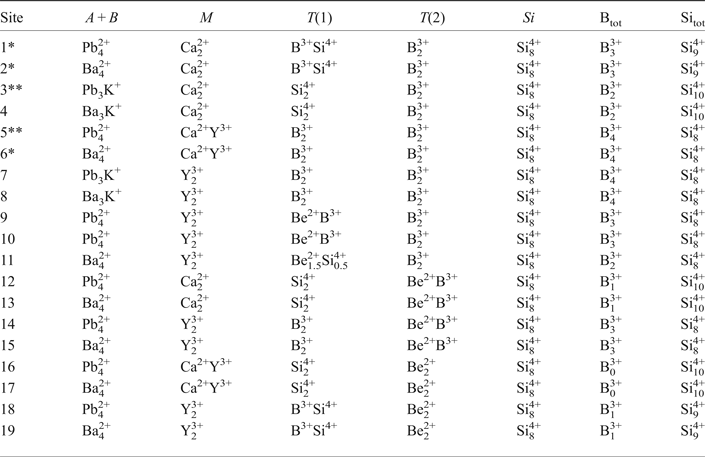
The aggregate charge of the {Si8O28F} part of the structure is 25– and hence the aggregate charge of the cations occupying the (A + B), M and T sites is 25+. Table 3 shows all end-member compositions conformable with the hyalotekite structure and having this aggregate charge. Of course, the end-member compositions of hyalotekite, khvorovite and kapitsaite-(Y) are represented here. However, there are many more possible end-member compositions, indicating the possibilities for new mineral species within this group.
End-member compositions where A and B are not considered distinct.

*Composition corresponding to a known mineral species; ** composition corresponding to a valid un-named mineral species.
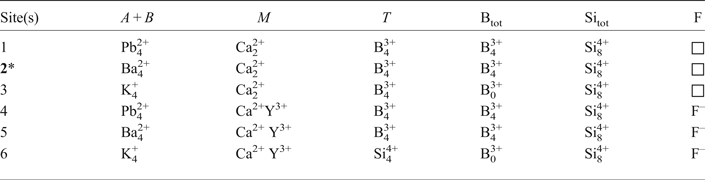
Table 4 shows all end-member compositions conformable with tetragonal symmetry and with the F site as either vacant or occupied by F–. Strict adherence to tetragonal symmetry requires that T = B4 or Si4. Composition 2 is itsiite (Table 1), and compositions 4–6 may be derived by inserting F– at the F site; however, it is not clear if these compositions are possible with tetragonal symmetry, as M = CaY and it is not clear whether Ca–Y will show long-range disorder or Ca–Y ordering will break the tetragonal symmetry. Note that compositions 4 and 5 in Table 4 are the same as compositions 5 and 6 in Table 3; only discovery of these compositions as minerals will reveal their symmetry.
End–member compositions derived from itsiite.

*Composition corresponding to a known mineral species.
Application to published compositions of hyalotekite-group minerals
The utility of this approach is immediately seen from inspection of Fig. 2 (modified from Pautov et al., Reference Pautov, Agakhanov, Sokolova, Hawthorne, Karpenko, Siidra, Garanin and Abdu2015). End-member compositions 3 and 4 are also shown on Fig. 2, and it is apparent that the compositional fields in the original figure were not correct. They have been corrected in Fig. 2 with the addition of end-member compositions 3 and 4 (Table 3). It is now apparent that several of the compositions presented by Pautov et al. (Reference Pautov, Agakhanov, Sokolova, Hawthorne, Karpenko, Siidra, Garanin and Abdu2015) fall within the compositional field defined by the end-member (Pb2+3K)Ca2[Si8B2Si2O28]F and deserve description as a new mineral.
The composition of a Pb-analogue of kapitsaite-(Y) from Darai-Pioz was given by Agakhanov et al. (Reference Agakhanov, Pautov, Karpenko and Siidra2015).
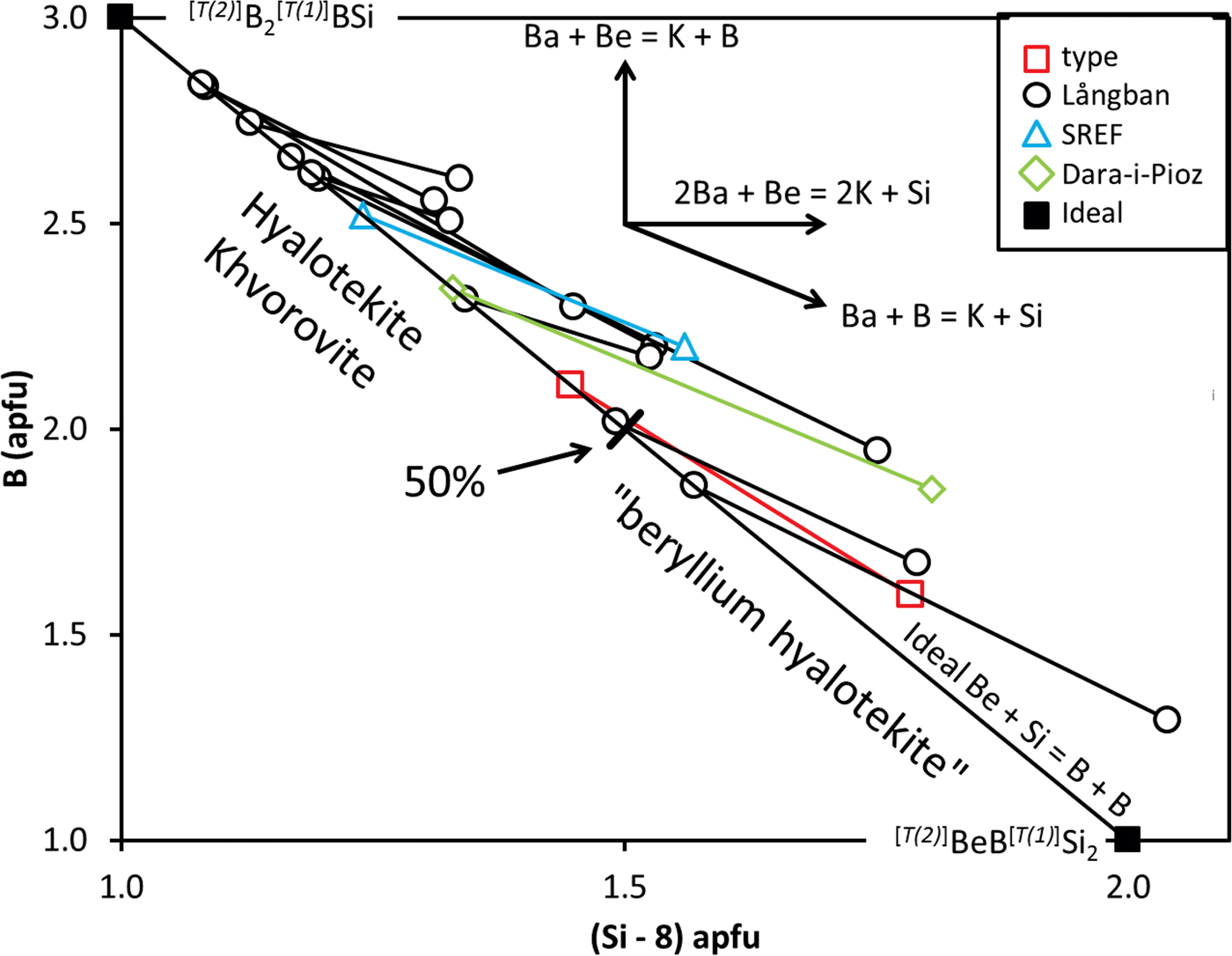
Christy et al. (Reference Christy, Grew, Mayo, Yates and Belakovskiy1998) list ten chemical analyses for hyalotekite with B and Be analyses taken from Grew et al. (Reference Grew, Yates, Belakovskiy, Rouse, Su and Marquez1994). These data were plotted by Hawthorne and Huminicki (Reference Hawthorne, Huminicki and Grew2002) and again here in Fig. 3, which shows that the main substitution for incorporation of K in hyalotekite is K + Si → Ba + B. The one analysis plotting in the field Ba4Ca2[Si8(BeB)Si2O28]F represents a new hyalotekite-type mineral with essential Be2+, that is, in which the end-member composition 13, Ba4Ca2[Si8(BeB)Si2O28]F (Table 3), is dominant.
Variation in B3+ as a function of (8 – Si4+) in atoms per formula unit for hyalotekite composition following Hawthorne (Reference Hawthorne2002, fig. 3). The ideal point [T(1)]BeB[T(1)]Si2 corresponds to Ba4Ca2[Si8(BBe)Si2O28]F, and the ideal point [T(1)]B2[T(1)]SiB corresponds to Ba4Ca2[Si8B2(SiB)O28]F. Each sample is represented by two points, one is the actual measured B and Si – 8 contents, the second is plotted on the join Be + Si = B + B and is calculated as 3 – 2*Be (y axis) vs. 1 + Be (x axis) in formula units. The line joining the two points gives the change in B and Si contents due to the substitution of Ba by K. Vectors give the three possibilities for this substitution (Hawthorne, Reference Hawthorne2002). SREF denotes a composition determined by site-scattering refinement. The field marked ‘beryllium hyalotekite’ indicates compositions in which the end-member component 13 (Table 3), Ba4Ca2[Si8(BBe)Si2O28]F, is dominant: one analysis plots in this field: sample 114716, spot 2, from Långban. Sources of data: Grew et al. (Reference Grew, Yates, Belakovskiy, Rouse, Su and Marquez1994) and Christy et al. (Reference Christy, Grew, Mayo, Yates and Belakovskiy1998).

Acknowledgements
We thank Fernando Cámara and Tony Kampf for their comments on this paper. The work was funded by a Discovery Grant from the Natural Sciences and Engineering Research Council of Canada.