In Lawrence v. Texas (2003), Justice Anthony Kennedy lit a simmering political fuse when he cited a host of foreign legal sources to strike down a Texas statute banning homosexual sodomy. Kennedy cited a committee report to the British Parliament, British legislation passed in 1967, decisions by the European Court of Human Rights, and the actions of ‘other nations.’ The decision sparked a firestorm over whether justices should or could use foreign law to interpret domestic doctrine. In various speeches and publications, Justices Kennedy, O’Connor, Breyer, and Ginsburg publicly advocated that justices at least ought to look to foreign law,Footnote 1 while Justices Scalia and Thomas rejected it as constitutionally unsound.Footnote 2 Members of Congress held hearings to renounce the practice, introduced legislation to prohibit it, and challenged Supreme Court nominees over it. Legal academics also clashed over whether judges should cite foreign sources of law.Footnote 3 Indeed, if the number of articles devoted to a Court practice highlights its salience, then surely the Court’s use of foreign law has become a contentious cause célèbre.
Our goal here is not to take a normative position on whether justices should cite foreign sources of law. Rather, we seek to examine the conditions under which justices in fact cite it. Our theoretical approach sees justices using as many tools as they can, including the use of foreign sources of law, to overcome domestic legal obstacles, to frame their policies, and to marshall support for their opinions. We expect, therefore, to observe two features. First, justices will cite foreign law when they make controversial rulings. Second, they will cite law from countries the American public and legal elites are likely to find most legitimate.
We test our account by blending judicial politics scholarship with international relations literature. More specifically, we analyze every Supreme Court majority opinion published between 1953 and 2009 to determine whether (and how) the Court cited foreign law and, then, whether the domestic conditions within those foreign countries influenced the Court’s citation practices. The data show that the Court is more likely to employ foreign law when it overrules precedent and invalidates a state or federal law. Also, majority coalitions deciding cases consistent with their members’ ideological preferences (for example, a coalition of liberals deciding a case in the liberal direction) are most likely to employ foreign law. Interestingly, and contrary to conventional political wisdom, the data show that conservative justices are as likely as liberal justices to cite foreign law, a discovery that can add to the normative debate. Finally, the data show that the Court cites law from countries the American public is likely to view as legitimate – countries that are democratic, stable, wealthy, major powers, and that speak English. Put simply, justices employ foreign law to support controversial decisions, and they invoke laws from countries that are most likely to legitimate those opinions. That is, they appear to use foreign law strategically.
The Debate Over Employing Foreign Law
In a number of controversial rulings, justices on the U.S. Supreme Court employed foreign sources of law to interpret United States’ law. For example, in Atkins v. Virginia (2002), the Court determined the U.S. Constitution prohibits states from imposing the death penalty on felons who are mentally retarded when they commit crimes. Writing for the majority, Justice Stevens held that such a punishment was cruel and unusual. And he did so by looking to practices within ‘the world community.’ Stevens observed what he concluded was a consensus against imposing the death sentence in such instances, a finding derived in part by looking to legal practices abroad.
Off the Court, some of the justices discussed their support for using foreign law. ‘Liberty isn’t for export only,’ claimed Justice Kennedy.Footnote 4 Indeed, Kennedy discussed how ‘the European courts, in particular,’ felt slighted that the Supreme Court did not cite them more often; ‘they were saying [to Kennedy], why should we cite yours if you don’t cite ours?’Footnote 5 Justice O’Connor claims that ‘there is much to learn from other distinguished jurists who have given thought to the same difficult issues that we face here.’Footnote 6 And Justice Breyer concurs, stating: ‘If I have a difficult case and a human being called a judge, though of a different country, has had to consider a similar problem, why should I not read what that judge has said? It will not bind me, but I may learn something.’Footnote 7
Of course, not everyone agrees with the practice. As O’Brien notes, the propriety of using foreign law is ‘rather hotly contested.’Footnote 8 In Atkins, Justice Scalia railed that the opinion ‘rested so obviously upon nothing but the personal views of its members.’ In Lawrence, Scalia called the reference to foreign law ‘meaningless dicta.’ In Roper v. Simmons (2005), the Court again referenced foreign law when it struck down a state statute that permitted the death penalty for juvenile defendants. The dissenters countered: ‘To invoke alien law when it agrees with one’s own thinking, and ignore it otherwise, is not reasoned decisionmaking, but sophistry.’ During his nomination hearings, Chief Justice Roberts stated: ‘Foreign law, you can find anything you want. If you don’t find it in the decisions of France or Italy, it’s in the decisions of Somalia or Japan or Indonesia or wherever …’.Footnote 9 As Justice Scalia put it: ‘When it agrees with what the justices would like the case to say, we use foreign law, and when it doesn’t agree we don’t use it.’Footnote 10
Members of Congress have also responded to the use of foreign law with hostility. Introduced in February 2005, Proposed House Resolution 97 asserted that foreign law threatened national sovereignty, forced Americans to look for guidance on how to live their lives from the decisions of foreign tribunals thousands of miles away, and violated the constitutional process for creating policy. A March 2004 resolution called the ‘Reaffirmation of American Independence’ sought to ‘remind the Supreme Court that [its] role is interpreting U.S. law, not importing foreign law.’Footnote 11 Senators took up arms during Supreme Court nomination hearings. Senator Jon Kyl (R-AZ) expressed concern during the Sotomayor hearings that ‘the factors that will influence her decisions apparently include … foreign legal concepts.’ One Representative (Tom Feeney, R-FL) even stated that justices who ‘deliberately ignore Congress’ admonishment … may subject themselves to the ultimate remedy, which would be impeachment.’Footnote 12 Simply put, the practice of citing foreign law is controversial.
Surprisingly, however, there is little empirical scholarship on the use of foreign law. Scholars of comparative courts have recently begun to examine borrowing across countries,Footnote 13 but there has been little systematic effort focused on U.S. courts. Calabresi and Zimdahl search the historical record for some of the ‘most striking’ examples in which the Court borrowed from other countries. Using an admittedly non-random sample of cases, they find that while employing foreign law is not new, the Court ‘has cited foreign law with much more frequency in far more important constitutional cases’ in recent terms.Footnote 14 Curry and Miller employ an experimental setting to determine that referencing foreign law can erode public support for the U.S. Supreme Court.Footnote 15 Zaring examines how often U.S. federal courts (district courts, circuit courts of appeals, and the Supreme Court) between 1945 and 2005 cited the decisions of a select group of foreign high courts.Footnote 16 Zaring’s data suggest that federal courts nowadays cite foreign law at roughly the same rate as in the past. As his study focuses on aggregate trends rather than individual cases, however, it is unable to answer the broader questions of the conditions under which justices cite foreign law and whom they choose to cite. O’Brien examines how often the Rehnquist Court (1986–2005) alone employed foreign law.Footnote 17 His analysis focuses on whether the Court cited foreign law in dicta, took judicial notice of foreign law, cited foreign legal decisions as precedent, or cited foreign laws to provide more support for its rulings. His findings suggest that dissents cite foreign law more than majority opinions, that conservative justices appear to cite foreign law in majority opinions more than liberal justices, but that the Court overall rarely references foreign law. Put plainly, while there is a fairly solid scholarly foundation, we still do not know the conditions under which the U.S. High Court cites foreign sources of law, nor the countries they cite. It is to those questions that we now turn.
Justices’ Decisions to Employ Foreign Law
Our theoretical starting point is that justices are strategic judicial decision makers who seek to pursue their policy goals but are constrained from so doing by a host of internal and external norms and actors. The Supreme Court lacks the power to enforce its decisions. Instead, it must rely on citizens’ and policymakers’ beliefs in its legitimacy, something it earns by writing principled and logical opinions. As Justice Frankfurter stated in Baker v. Carr (1962), the Court’s authority ‘ultimately rests on sustained public confidence in its moral sanction.’ In order to effectuate their policy goals, justices must ensure that their policies have legal and logical support.
Because they must legitimate their positions in the eyes of the public and other actors, justices will turn to as many sources of support as they can. Supposing, however, that there is little (or no) domestic legal precedent on which to rely, what is the justice to do? One option, of course, is to accept that current law fails to support the position and refuse to move forward with the legal change. While this is a possibility, extensive social science data cast doubt on it.Footnote 18 Another option is for the justice to move forward with his or her desired legal change, and offer up as much extralegal support for the position as possible. For example, a number of studies examine how justices use institutional tools to protect (or attack) Court opinions. Zink, Spriggs, and Scott find that justices can use unanimity to signal their impartiality and build legitimacy.Footnote 19 Owens, Wedeking, and Wohlfarth find that the Court will alter the language of its opinions to protect its policies from a hostile Congress.Footnote 20 Owens and Epstein highlight how justices can use amicus briefs to bolster their claims.Footnote 21 Discussing the Court’s decision in Grutter v. Bollinger (2003), they analyze how Sandra Day O’Connor ‘referenced numerous amici … to shore up her point[s]’ and ‘bolster her argument[s].’Footnote 22
Building on the logic of these studies, we believe justices will cite foreign sources of law to prop up the logic of their opinions. To be sure, while there are no studies that analyze whether justices cite foreign law to protect opinions – and the practice most certainly comes with risks – those risks may be worth it to frame the Court’s decision. Justices might utilize foreign law in these instance as ‘logical reinforcement … in which the Court looks to foreign law and practice to demonstrate that its decisions are logical and supported by reason’, so much so that other countries have made the same legal choices as those advocated in the case.Footnote 23 This type of citation method gives justices more fighting ground with other justices, Congress, and the public. In addition, citing sources of foreign law, even when sparking domestic controversy, can begin a discussion of where the United States stands in relation to peers and turn the debate away from the Court’s opinion to broader ground.Footnote 24 While there may be a number of instances in which justices employ extralegal considerations to prop up their opinions, we expect them find foreign law attractive as a supportive tool when they overturn precedent, invalidate laws, and render ideologically motivated decisions.
Overruling Precedent and Invalidating Laws
Justices may be more likely to reference foreign law when they break with precedent and when they invalidate a law. One of the key elements of legal stability – and the Court’s legitimacy – is stare decisis. The norm of stare decisis holds that judges and justices should treat similar cases similarly. When the facts of one case are similar to the facts of a previously decided case, courts should apply the holdings decided in those previous cases. Scheb and Lyons show that the public believes the Court should adhere to stare decisis.Footnote 25 Johnson, Spriggs, and Wahlbeck call stare decisis ‘the defining feature of American courts’ – a feature that ‘represents the most critical piece of American judicial infrastructure.’Footnote 26 Lindquist and Klein also argue: ‘One of the Court’s most important claims to legitimacy is the proposition that its decisions are not determined solely by the justices’ personal policy preferences but are influenced as well by their understandings of what “the law” requires in a given case.’Footnote 27
The Court’s legitimacy can suffer when justices ignore or break from precedent;Footnote 28 therefore, justices must logically explain their positions when they do so. Justices seeking to overturn precedent may need to exploit as many supporting considerations in their opinions as possible. They may even reach out and cite foreign sources of law to support those decisions. By mustering law from elsewhere, justices might make their opinions look more reasonable. They might even frame the debate so as to make their opponents appear on the wrong side of international consensus – and history. This is precisely what Justice Kennedy did in Lawrence and what Justice Stevens did in Roper. Thus, we expect that a majority opinion that overrules precedent will be more likely to reference foreign law than an opinion that does not overrule precedent.Footnote 29
For similar reasons, we believe the Court will be more likely to cite foreign law when it invalidates laws. Justices may be concerned with congressional responses to their decisions since Congress can initiate and support constitutional amendments to overturn judicial decisions, alter the Court’s composition, reduce the Court’s budget, regulate Court procedure, hold judicial salaries constant, strip the Court of jurisdiction, impeach and remove justices, and pass legislation that overrides Supreme Court decisions.Footnote 30 Presidents can refuse to enforce the Court’s decisions and order cabinet secretaries and other high-ranking officials to ignore them.Footnote 31 They can mobilize interest groups to attack and undermine the Court’s decisions,Footnote 32 use their agenda-setting power to focus public scrutiny on judicial decisions, and sign or veto override legislation.
When justices invalidate laws, they generally cut against the wishes of the elected branches. This places their decisions immediately under the microscope. And they will not tie themselves to the whipping post alone. They will expand the conflict, as Schattschneider argued long ago, and seek alliances elsewhere.Footnote 33 By citing foreign law, they can do just that. By bringing in foreign sources of law, they can show how other, presumably rational, decision makers have addressed similar problems. They can, again, try to make their opponents appear on the wrong side of international consensus and history. Accordingly, we hypothesize that a majority opinion that invalidates a law will be more likely to reference foreign law than an opinion that does not invalidate a law.
Ideological Decision Making
Conventional wisdom holds that liberal justices are more likely to employ foreign law than conservative justices.Footnote 34 After all, two of the three justices who most publicly support the use of foreign law are Breyer and Ginsburg, and they reside among the Court’s liberal bloc. Noting this feature, Bork states: ‘Perhaps it is significant that the justices who [borrow] are from the liberal wing of the Court. This trend is not surprising, given liberalism’s tendency to search for the universal and to denigrate the particular.’Footnote 35 Just looking at the breakdown among advocates and opponents of employing foreign law, one might suspect that liberals are more likely to cite foreign law than conservatives.
Yet, some evidence suggests that all justices may employ foreign law in an ideologically motivated manner. Consider Justice O’Connor’s use of foreign law. In 1995, O’Connor wrote a law review article which claimed that as the United States ‘moves toward a more international regime of dispute resolution, [its] federalist ideal of healthy dialogue and mutual trust may possibly be adapted to describe the proper relationship between domestic courts and transnational tribunals.’Footnote 36 Here, she sounds supportive of citing foreign law. Yet, in 1997, she signed on to the majority opinion in Printz which castigated Justice Breyer’s use of foreign law in his dissent. But then in Grutter v. Bollinger (2003), she relied on foreign laws and practices. Her citation inconsistency was belied, however, by her ideological consistency. Indeed, even the most conservative justices have cited foreign law when it fit with their ideological goals. For example, Chief Justice Rehnquist and Justices Scalia and Thomas have employed foreign law to support their positions.Footnote 37 In Washington v. Glucksberg (1997), Chief Justice Rehnquist’s majority opinion, which held that the Constitution observes no right to assisted suicide, cited laws in Canada, Britain, New Zealand, Australia, and Columbia.Footnote 38 In his separate opinion in Planned Parenthood v. Casey (1992), Rehnquist referred positively to abortion decisions from Canadian and German courts. Justices Thomas and Scalia joined each of these opinions.Footnote 39 So, it appears that justices may use foreign law when it suits their dispositional and ideological goals.
Indeed, the claim that all justices use foreign law accords with our theory that justices use what they can to support their decisions. Our belief is that justices, worrying about how an ultra-ideological decision will look, will search for as many supporting grounds as possible, including foreign law. So, we expect that justices who render a decision consistent with their ideological motivations, worried about how that will appear, will be more likely to cite foreign law to support their position. Accordingly, we hypothesize that justices will be more likely to employ foreign law when they render ideologically motivated decisions.
Controls
To understand more completely the effects of our independent variables on the citation of foreign law, we control for possible confounding variables that might account for alternative explanations of citing foreign law. We first control for the effect of information. When more groups file briefs, the Court may be more likely to be exposed to, and thus cite, foreign law. Accordingly, we measure the number of amicus briefs in each case. We also control for whether, in the case at hand, the Court construes a treaty or international law.Footnote 40 Cases involving the interpretation of a treaty will involve foreign law in a way that is distinct from other cases. We code treaty cases from the Supreme Court Database’s ‘lawSupp’ variable. Similarly, we control for whether a foreign litigant is a party to the case. In cases dealing with foreign litigants, the Court may simply be obligated to reference foreign law. Next, we control for whether the Court is constrained by Congress and the President when it renders its decision. Justices might cite foreign law – to bring in more supporting materials – when they are more liberal or conservative than Congress and susceptible to political attack. Thus, we control for whether the Court was more liberal or conservative than Congress when it rendered its decision. Similarly, Black and Epstein suggest that the Court may be more likely to reference foreign law as Congress becomes more liberal. As Congress becomes ‘more cosmopolitan,’ they argue, ‘transjudicial communication should increase.’Footnote 41 Conversely, as politicians become more ‘isolationist,’ the Court may be less likely to cite foreign law.Footnote 42 Given this suggestion, we control for the general ideological mood of Congress. Finally, we control for Court term to determine whether the modern Court cites foreign law more than its predecessors.
Geopolitical Context and the Court’s Selection of Foreign Law
If justices employ foreign law strategically, they should cite law from countries most likely to be deemed legitimate by the public – countries that have legal ideals similar to the United States. That is, if the Court looks to those extralegal sources to prop up their opinions, we suspect those sources will be persuasive. As Amann intimates, these will be countries with ‘norms that are grounded in the same respect for freedom from undue state interference that animates U.S. constitutional culture.’Footnote 43 So, for example, ‘Zimbabwe – a country widely criticized as a human rights violator – might not be the first to which a [U.S.] court would turn.’Footnote 44 To determine what countries are the likeliest candidates for citation, we turned to literature on the attributes of states and the conditions under which they trade and make alliances with one another. This scholarship leads us to believe that the Supreme Court will be most likely to look to countries that have experiences similar to the United States, countries with whom the United States has military alliances, and wealthy countries.
Countries with Shared Experiences
Literature on international trade finds that similar regime types trade with each other more than they trade with dissimilar regimes. Similar countries are more likely to understand how the institutions in each others’ states operate, and will observe smaller transaction costs with trade.Footnote 45 They will also believe the other states’ institutions to be more legitimate.Footnote 46 This trade dynamic is even more pronounced among democracies. Since democratic countries are more likely to protect economic actors and individual rights than non-democratic countries, they find it more profitable to trade with each other. Indeed, trading with democratic regimes is less risky because citizens of such governments are more likely to reject illegitimate nationalizations of business and other similar antics and will therefore keep their leaders honest.
The same logic might lead the Supreme Court to reference foreign law from countries that are democratic. Because democratic countries tend to reflect the desires of their citizens better than authoritarian regimes, they are perceived to be more legitimate. The Supreme Court, of course, functions because of legitimacy.Footnote 47 Looking toward more legitimate regimes is logical. If justices seek to bolster their opinions with additional logic and support, looking to the most respected foreign countries simply makes the most sense. Thus, we expect that the Supreme Court will be more likely to employ foreign law from countries that are increasingly democratic.
Justices also should be more likely to cite countries whose legal and cultural histories are similar to the United States. Countries with similar legal systems are much more likely to understand and agree with each others’ laws and history. For example, common law systems are likely to understand the importance of precedent and the importance of incremental judicial change.Footnote 48 Indeed, there is considerable evidence that common law countries tend to trade with each other much more than civil law states and other states, as common law systems tend to have more effective enforcement of contracts.Footnote 49 Given these natural complements, we expect that the Supreme Court will be much more likely to reference countries with common law traditions. And, simply because Supreme Court justices and the (majority of the) public speak English as the primary language, we expect them to be more likely to reference foreign sources of law from English speaking countries.Footnote 50
Alliances
Scholarship suggests that states with similar regime types are more likely to form military and trade alliances because of their shared interests.Footnote 51 Such states ‘identify through shared norms and political culture,’ have similar backgrounds, and often find themselves facing similar external hostile forces.Footnote 52 This is particularly true of democracies.Footnote 53 Democracies tend to have strong attachments to the rule of law, making them eager to cooperate. Additionally, because the public must largely approve of international agreements in democracies, the underlying agreements generate legitimacy and provide a credible commitment to the deal.Footnote 54 What is more, the domestic political costs suffered by democratic leaders for non-cooperation or reneging are great. That is, states have strong reasons to believe that democracies will make good on their international commitments because their leaders will suffer at the hands of their electorates if they abandon their promises. ‘If a [democratically elected] leader decides to renege on an international agreement, the leader will suffer potentially heavy domestic political costs because such action will likely be out of step with domestic political opinion….’Footnote 55 Thus, we expect that the Supreme Court will be more likely to cite foreign law from countries with whom the United States has defense alliances, and those with whom the United States trades.
Wealth and Location
The ‘gravity model’ in many trade studies suggests that distance and economic production influence the decision to trade.Footnote 56 States that are geographically closer are more likely to trade with one another. And states with larger economies are more likely to trade with each other. Similar to the logic of alliances, countries that have consistent contact and shared, economic interests are more likely to be familiar with and understand each other’s institutions, particularly political and military institutions.Footnote 57 We expect, then, that the Supreme Court will be more likely to reference foreign laws from countries that are geographically close to the United States and countries with larger economies.
Major Power Status
Finally, we examine whether the Court is more likely to cite a country defined as a major power. The appearance of ‘cherry picking’ a country is likely to be minimized when the country is a major power. With major power status comes recognition and notoriety. Additionally, major powers tend to be more stable and durable, giving them an aura of legitimacy.Footnote 58 As a consequence, alliances between major powers have been longer lasting than alliances between or among other countries.Footnote 59 And, major powers tend to engage in extensive trade, especially when they are allies.Footnote 60 As such, we expect that the Court will be more likely to cite the law of major powers than non-major powers.
Data and Measures
To determine whether justices strategically cite foreign law, we analyzed every formally decided, full opinion case, unsigned (i.e., per curiam) orally-argued case, and judgment of the Court handed down between 1953 and 2009. Unlike existing studies, we searched for references to every country, along with major international tribunals during our time period.Footnote 61 We began by searching every Supreme Court majority opinion for references to well over 200 countries and international tribunals.Footnote 62 We searched each opinion to determine whether the reference to the country was to:
-
– A foreign court decision;
-
– The procedures or practices of a foreign court;
-
– Foreign law enforcement procedures;
-
– The provisions of a foreign constitution;
-
– Laws, statutes, regulations, codes, decrees, or directives of a foreign country (legislative acts);
-
– Informal government acts of a foreign country (such as debates, speeches, or proposals)
-
– International reports or documents that mention the country searched for;Footnote 63 or
-
– The cultural, economic, political, or historical practices within a foreign country.
Our goals, again, are to determine (1) the conditions under which justices cite foreign law as well as (2) the countries whose laws they cite. Accordingly, we estimate two distinct models. The dependent variable in Model 1 examines whether the majority opinion cited a foreign source of law in support of the argument being made in the opinion (1 if yes; 0 otherwise).Footnote 64 In terms of our overall data collection, we coded all foreign material references for directionality following the general approach of Shepard’s coding practices.Footnote 65 A reference that uses a foreign source of law to support a conclusion or a point is coded as positive. Conversely, a reference that criticized, questioned, limited, or distinguished a foreign source of law (or the use of such a law) is a negative reference. Language that takes neither a positive nor negative position is deemed to be neutral, and references receiving both positive and negative treatment were coded as mixed.
Two examples highlight the positive use of foreign law. In Ferguson v. Georgia (1961), the Court had to determine whether Georgia’s Disqualification statute – which precluded a criminal defendant from testifying on his or her own behalf – was constitutional. In support of its decision, the Court pointed out that other countries abolished such laws years ago: ‘This change came in England in 1898 with the enactment of the Criminal Evidence Act. Various States of Australia had enacted competency statutes even before the mother country, as did Canada and New Zealand. Competency was extended to defendants in Northern Ireland in 1923, in the Republic of Ireland in 1924, and in India in 1955.’Footnote 66 Likewise, in Thompson v. Oklahoma (1988), when striking down the death penalty for criminals under the age of 16, the Court stated that its position was ‘consistent with the views that have been expressed by… other nations that share our Anglo-American heritage, and by the leading members of the Western European community … The death penalty has been abolished in West Germany, France, Portugal, The Netherlands, and all of the Scandinavian countries, and is available only for exceptional crimes such as treason in Canada, Italy, Spain, and Switzerland. Juvenile executions are also prohibited in the Soviet Union.’Footnote 67
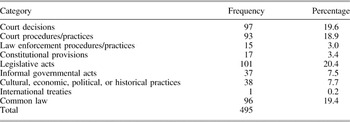
Of the 947 references to foreign law we observe in our data, 52 percent (n=495) were positive references (and thus included in our statistical models), 25 percent were negative references, 17 percent were neutral references, and the remaining 5 percent were mixed references (i.e., both positive and negative). Of the 495 positive references in our data, the category breakdown is as in Table 1.
Positive References to Foreign Law by Category

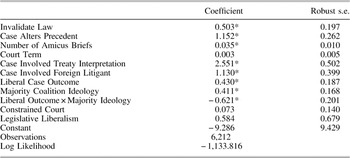
We code our independent variables in the first model as follows: Invalidate Law equals 1 if the Court majority struck down an Act of Congress or a state statute; 0 otherwise. Case Alters Precedent takes on a value of 1 when the Court majority expressly overruled an existing Supreme Court precedent; 0 otherwise. Liberal Case Outcome measures whether the Court’s decision in the case was liberal or conservative.Footnote 68 To determine Majority Coalition Ideology, we followed Carrubba et al. and examined the Martin–Quinn ideal point of the median member of the majority coalition.Footnote 69
We coded our controls as follows: Amicus Briefs counts the total number of amicus curiae briefs filed at the merits stage of the case. We obtain data for 1953–2001 from Collins.Footnote 70 Using LexisNexis, we collected amicus data from 2002 to 2009. Court Term is simply the term in which the Court rendered its decision. Case Involved Treaty Interpretation is a dummy variable coded 1 if the Supreme Court Database determines that the case interpreted a treaty or international law. We code Case Involves International Litigants as 1 if the Supreme Court Database identifies either the petitioner or the respondent as a foreign nation, a foreign non-governmental entity, an international entity, or the U.S. State Department. Constrained Court is a binary variable that takes on a value of 1 if the Court median, as determined by the Judicial Common Space, was more conservative or liberal than the median members of the House of Representatives or the Senate during the term in question; 0 otherwise.Footnote 71 And, Legislative Liberalism is simply the average of the House and Senate median Judicial Common Space scores for the term in question. Negative values represent increasing liberalism.
The dependent variable Model 2 examines whether the Court positively cited the law of a particular country. That is, our unit of analysis is the country–year dyad. If the Court positively cited the country’s laws, we code the dependent variable as 1; 0 otherwise. To examine our hypotheses about the role of shared experiences, we first code each country’s Polity Score. We rely on the Polity IV scores to determine the authority characteristics of countries around the world and over time. The Polity measures, used extensively in international relations scholarship, examine how autocratic or democratic a state is. Negative scores reflect a country that is more autocratic, while positive scores reflect a country that is increasingly democratic. We next examine the Government Longevity of each country’s regime. Government longevity simply measures the number of years in which the country has received the same Polity score. Next, we measure whether the country’s legal system was based on the common law (Common Law Country), as well as whether English was one of the country’s official languages (English Is Official Language).
To determine whether the United States had a defensive military alliance with the country, we turned to the Correlates of War (COW) database. If COW noted that the United States had a defensive alliance with the country, we coded Alliance with U.S. as 1; 0 otherwise. Following the gravity model, we measured the geographic Distance from U.S. as the number of miles between Washington, D.C. and each country’s capital. We also measured each country’s real GDP (gross domestic product, Country Wealth). We control for the yearly amount of exports from each country to the United States (Imports from Country), as well as the United States’ exports to each country (U.S. Exports to Country). And we code whether (1) or not (0) the COW asserts the Country Is a Major Power.
Methods and Results
Model 1: When Justices Cite Foreign Law
Table 2 shows the results from our first model, which addresses the conditions under which a Supreme Court majority opinion positively employs foreign law.Footnote 72 We find strong support for our hypotheses. Justices are more likely to reference foreign sources of law when they invalidate a law, when they overrule precedent, and when they decide cases in an ideological fashion.Footnote 73
Logistic Regression Model Parameter Estimates of the Conditions under which a Supreme Court Majority Opinion Positively Refers to Foreign Material

*p<0.05 (two-tailed test).
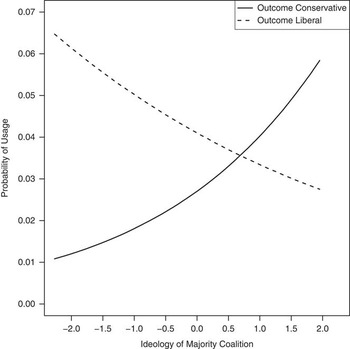
To illustrate these results, we calculate predicted probabilities. Consider, first, the conditional relationship between outcome and ideology. We hypothesized that a majority opinion would be more likely to include foreign law when reaching a decision that was ideologically consistent with the composition of the majority coalition. Figure 1 provides strong support for this hypothesis. We show majority ideology on the x-axis (with liberal values on the left and conservative values on the right) and the likelihood of citing foreign law on the y-axis. The different line types within the plot identify conservative (solid line) and liberal (dashed line) outcomes.Footnote 74
Probability a majority opinion positively references foreign material, conditional on the ideological location of the majority coalition (x-axis) and the ideological outcome of the case (lines on plot) Note: See fn. 74 for information about confidence intervals. All values were generated through stochastic simulations similar to Clarify.

Starting with a conservative decision outcome, we estimate roughly a 0.01 probability of observing a positive reference to foreign law when the majority coalition itself is very liberal. When the coalition is very conservative, however, that likelihood jumps to around 0.06 – a 500 percent change. Consider, next, a majority opinion that reaches a liberal outcome. As the plot reveals, we observe almost exactly the opposite trend: liberal coalitions are more than twice as likely to cite approvingly foreign materials in their liberal opinions than are their conservative counterparts. Along the same lines, the data reveal no significant differences between when conservatives and liberals call upon foreign law. When comparing a liberal majority/liberal outcome versus a conservative majority/conservative outcome, we find no significant difference between the two probabilities of a positive citation (p=0.72, two-tailed test). Similarly, we also find no significant difference in the probability of foreign law citation between a liberal majority/conservative outcome and a conservative majority/liberal outcome probabilities (p=0.11, two-tailed test). In short, the conventional understanding that only liberal justices employ foreign law is misplaced. When rendering ideologically motivated decisions, all justices are more likely to employ foreign sources of law to support those decisions, to frame them, and to make the Court appear to be on the ‘right’ side of a growing consensus.
Of course, one potential concern is that our results are being driven by references to English common law alone. To check this, we re-estimated our models excluding all references to common law. We observe but a single change. In the interaction between the direction of the Court’s decision and the ideology of the majority coalition, the directionality of the interactive effect remains the same for models both with and without common law references, although the exclusion of common law references has an attenuating effect on the slope of the lines. In terms of the implications for statistically significant differences between the conservative and liberal lines, we find that the range for which a difference exists changes slightly between the two sets of results, but the percentage of observations in our data for which a significant difference exists remains unchanged at around 40 percent. In other words, our results do not appear to be driven by references to common law.Footnote 75
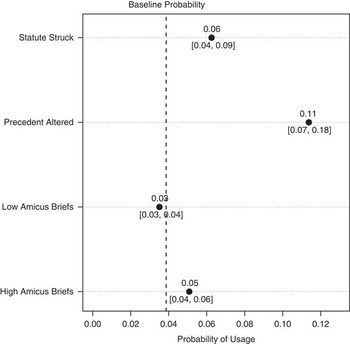
Moving beyond the ideological use of foreign law, Figure 2 shows that justices are significantly more likely to employ foreign law when they invalidate a law and overrule precedent. When the majority opinion merely upholds a statute, the Court’s probability of employing foreign materials is roughly 0.04. When, however, the Court majority strikes down a statute, that probability increases by 50 percent to approximately 0.06.Footnote 76 Next, consider the act of overruling one of its own precedents. When the Court upholds an existing precedent, it has only a 0.04 probability of employing foreign law. Yet, when it makes the important decision to overrule its precedent, the Court’s likelihood of referencing foreign law jumps to 0.11, nearly triple the baseline value. So, when the Court makes it most dramatic decisions, it is more likely to pull from foreign sources of law. No wonder the practice of citing foreign law sparks such controversy; it tends to stow away on ships headed for stormy waters.
Probability a majority opinion positively references foreign material, conditional on several hypothetical fact patterns Note: The baseline probability of a reference is denoted by the dashed vertical line. For each counterfactual, all other variables are held at their modal or mean values, as appropriate. Solid circles are point estimates and 95 percent confidence intervals (two-tailed) appear in brackets. All of these values were generated through stochastic simulations similar to Clarify.

Our controls largely perform as expected. Cases with a large number of amicus briefs are just over 40 percent more likely to observe cites to foreign law than those with a small number of briefs. Unsurprisingly, the treaty effect is also substantial, with treaty cases nearly ten times as likely to employ foreign law than non-treaty cases. Cases involving international litigants (for example, other countries) are about twice as likely to include foreign law as those that do not.
One final question relating to Model 1 is whether there is a time trend in the use of foreign law. Has the Court been using foreign law more frequently in recent years? The data here are mixed. As Table 2 shows, the coefficient on Court Term is not statistically significant. We decided to look into this further, however. We re-estimated the model while removing the Court Term variable and replacing it with dummy variables for whether the case was decided after a certain year. For example, we refit Model 1 while removing the Court Term variable and replaced it with a variable called Post-1993. We then refit the model and saved the coefficients. Then we refit Model 1 while removing the Post-1993 variable and replaced it with a variable called Post-1994. We refit the model and, again, saved the coefficients. And so on until we fit a model that controlled for whether the case was decided after 2003. Next, we performed a Wald test to see if the coefficients in the eleven subset models were significantly different from the coefficients in Table 1. In terms of our Case Alters Precedent variable, we find no significant differences between the pooled and subset model coefficients. The act of citing foreign law when altering precedent has remained stable. As for our Invalidate Law variable, from 1993 through 1998, we are unable to reject the null hypothesis that the coefficients are equal. Starting with cases decided after 1999, however, we find that the coefficient size is actually significantly larger for the subset model than it is in the pooled model – and sometimes by a fairly large margin. For example, assume a case has a 50 percent baseline probability of citing foreign law. If that opinion invalidates a law in the pooled model, the probability of citing foreign law jumps from 50 percent to 62 percent. If that case invalidated a law in the subset (i.e., later than 1999), the probability of citing foreign law jumps from 50 percent to 82 percent. Ultimately, then, the data suggest that the Court is somewhat more likely to use foreign materials in its opinions in recent years than in previous periods. Rather than shy away from using materials in controversial decisions, justices use these materials more often now than before – particularly in those cases where it invalidates laws.
Model 2: The Countries Justices Cite
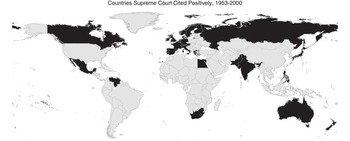
As we expected, the Court uses foreign law to support its most controversial decisions – those that are ideologically motivated, invalidate laws, and undo precedent. What about the second half of our theory? Do justices strategically cite legitimate countries? The answer is yes. Figure 3 illustrates the countries the Supreme Court cited. Countries in black are those the Supreme Court cited favorably. Among the five countries most frequently cited positively were the countries of the United Kingdom, Canada, Australia, France, and Switzerland. All of these countries share important characteristics with the United States, and all would seem to be legitimate in the eyes of the American public and legal elites.
Countries in black are those the Supreme Court cited favorably

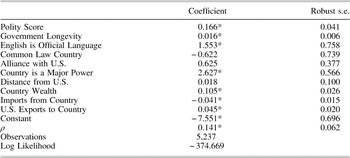
Looking more specifically at our hypotheses, Table 3 shows that justices do in fact cite those countries most likely to be deemed legitimate by the American public and by elites.Footnote 77 Consider, first, our shared experience hypothesis. We argued that justices would be most likely to cite foreign law from countries that are democratic, durable, speak English, and use the common law. The data support three of these four expectations.
Random Effects Logistic Regression Model Parameter Estimates of the Conditions under which a Supreme Court Majority Opinion Positively Refers to Foreign Material from a Given Country in a Given Year

*p<0.05 (two-tailed test).
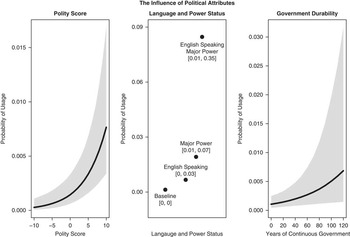
As the left panel of Figure 4 shows, fully democratic countries are more than twenty-five times more likely to be referenced positively by the Court than those that are autocratic.Footnote 78 Turning to the middle panel, if we examine a country’s English language and major power status, we observe that the Court has only a 0.001 likelihood of citing a non-English speaking country that is not a major power. However, when the country is an English-speaking major power, the Court cites that country with a 0.09 probability. A non-English speaking major power and an English speaking non-major power are cited with probabilities of 0.02 and 0.007, respectively. Finally, the durability of the country matters (right panel). Countries with a political stability of 120 years (roughly the 99th percentile in our data) are just over six times more likely to be cited than those that underwent dramatic changes (i.e., durability is zero – the sample minimum in our data). Taken together, the results suggest the Court is most likely to cite foreign countries that are highly legitimate and have characteristics similar to the United States.
Probability a majority opinion cites a foreign country Note: Based on political and economic attributes, the country’s Polity score, English language and major power status, and the longevity of the government. All of these values were generated through stochastic simulations similar to Clarify.

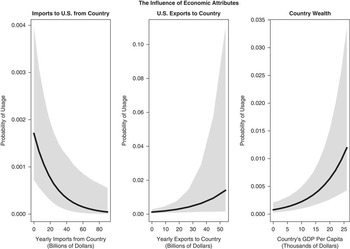
Finally, in Figure 5 we consider the role of economic variables such as trade flows and wealth. Interestingly, we find a negative relationship between the amount of physical imports that come into the United States from a country and the amount of law the Court imports from that country. The Court is more than thirty times more likely to import law from a country from which the United States draws no physical imports than from those that supply the United States with substantial imports.Footnote 79 Turning to the middle panel, which portrays U.S. exports to a country, we uncover a positive relationship, with the Court being roughly eleven times more likely to import law from a country to which the United States exports a substantial amount of physical goods.Footnote 80 Rounding out the figure, the right-hand panel shows that the Court is fifteen times more likely to cite materials from a country where per capita income is high than from one where it is low.
Probability a majority opinion cites a foreign country based on the country’s trade with the United States and its wealth Note: All of these values were generated through stochastic simulations similar to Clarify.

Discussion
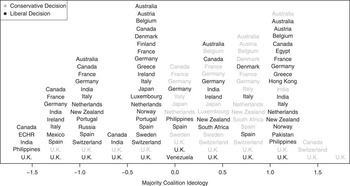
Speaking to the ongoing normative debate over whether the Court should use foreign legal sources to interpret U.S. law, the seasoned journalist Tony Mauro stated: ‘[T]his is an important debate about the Court’s role. Conservatives who believe in a limited role for judges say the Supreme Court should interpret the U.S. Constitution as written, and should ignore current fads here or abroad….’Footnote 81 But is that the case? Our data suggest not. Liberals and conservatives both employ foreign law because they are both ideologically motivated, strategic judicial actors who seek support for their ideological positions. The Court employs foreign law in the most controversial of cases – when justices strike federal and state law, when they overturn precedent, and when they render ideologically anchored decisions. The practice does not, therefore, seem to be based on an ideological divide; rather, it is a function of modern justices seeking to support their opinions and policy goals. Indeed, Figure 6 underscores the point. It displays countries cited by Supreme Court majority coalitions, with coalitions ranging from liberal (on the left) to conservative (on the right). In non-treaty cases, moderately conservative coalitions rendering liberal decisions employ a variety of foreign sources. In fact, they cite more foreign sources of law than liberal coalitions that render conservative decisions. Put plainly, the results show that a focus on ideology and foreign law is incomplete. Scholars should examine justices as they are – strategic policymakers.
Countries cited positively by the Supreme Court in non-treaty cases as a function of coalition ideology and ideological disposition

What is more, by employing data and theory from international relations scholarship, we were also able to uncover systematic patterns of borrowing. On the one hand, the data suggest that justices borrow when they need to prop up their most controversial decisions. This dynamic underscores the lengths justices will go to effectuate their policy goals and the tension between independence and accountability. On the other hand, justices appear to be at least somewhat constrained to the extent that they borrow from countries that are most like the United States in terms of government and wealth. So, to the extent that the Court does borrow, it appears to borrow from countries the public sees as most legitimate.
Whether, from a normative position, the practice of borrowing foreign sources of law is insidious or helpful is debatable. What is clear, though, is that all justices appear to borrow – and they do so in the most controversial of cases. We can only wonder how contentious the debate might become if they should ever borrow systematically from countries less legitimate. For then, the ‘real’ fireworks will explode.