





Introduction
In increasingly volatile environments characterized by limited resources and reduced government funding, nonprofit organizations (NPOs) are challenged to adapt and increase their efficiency (Walk et al., Reference Walk, Cart-Turner, Peterson and Klippel2025). In this respect, digital transformation is a crucial enabler of NPO success by supporting them in numerous ways, including through innovative fundraising approaches. One recent trend is the trial of non-fungible tokens (NFTs) for donation purposes (Schapsis et al., Reference Schapsis, Micu and Wingate2026).
Sunyaev et al. (Reference Sunyaev, Kannengießer, Beck, Treiblmaier, Lacity, Kranz, Fridgen, Spankowski and Luckow2021, p. 457) define a token as “a sequence of characters that serves as an identifier for a specific asset (e.g., personalized usage rights) or asset type (e.g., a cryptocurrency).” An NFT is a unique digital asset stored on a blockchain that represents ownership and proof of authenticity for a specific item, whether virtual or real. The first known NFT, called Quantum, was minted in May 2014 on the Namecoin blockchain (The Webby Awards, Reference Dash and McCoy2022) and featured a simple octagon-shaped animation which was later sold for $1.4 million (Di Liscia, Reference Di Liscia2021). This was the first attempt to use blockchain technology to prove the ownership and uniqueness of digital art. Subsequent NFTs included CryptoPunks (launched in 2017), algorithmically generated pixel art characters, and CryptoKitties (also launched in 2017), a game in which players could buy, sell, and breed virtual cats with unique characteristics. NFTs gained mainstream popularity in 2021 when digital artist Beeple sold an artwork entitled “Everydays: The First 5000 Days” for $69.3 million at Christie’s auction (Christie’s, 2021). Even though the market has been volatile, academic research has confirmed the potential of NFTs for commercial purposes (Kim et al., Reference Kim, Cho, Lee, Park, Kim, Jhang and Kim2025; Murtas et al., Reference Murtas, Pedeliento and Mangiò2024), and recent market reports predict that the NFT market will grow from USD 37.6 billion in 2025 to USD 820 billion by 2035, corresponding to a compound annual growth rate of 32.32% (Research and Markets, 2025).
Existing and past NFT-based fundraising initiatives illustrate both the promise and the difficulties of this emerging fundraising instrument. On the opportunity side, several cases illustrate how NFTs can generate substantial proceeds, create visibility, and address new donor groups. In 2021, one of Beeple’s NFTs sold for $6 million, and the proceeds were donated to the Open Earth Foundation, an organization focused on sustainable development (Langston, Reference Langston2023). Numerous NFT-based fundraising initiatives have been conducted since then, with varying success. When the World Wildlife Fund tried using NFTs to raise money for conservation efforts, for example, they quickly abandoned the project under heavy criticism of the energy use of their chosen blockchain (Polygon, which uses Ethereum as its base network) (Calma, Reference Calma2022). This abandoned NFT initiative reveals how reputational concerns, especially around perceived energy consumption and environmental compatibility, can quickly undermine campaigns and may even damage an organization’s reputation.
Other examples of connecting digital assets with philanthropic causes include UNICEF, which launched a special collection of tokens created by artists to connect schools (UNICEF, 2021), Médecins Sans Frontières (Doctors Without Borders), which has received a substantial donation as part of the proceeds of an NFT sale (Chipolina, Reference Chipolina2021), the Boys & Girls Clubs of America, whose NFT initiative was launched to support a more inclusive future (Sweet, 2022), and the Los Angeles County Museum of Art, which accepted a donated collection of NFTs (Hayward, Reference Hayward2023). These examples indicate that NFTs can function not only as donation instruments but also as tools for garnering public attention and community engagement, and for enabling new forms of value transfer. At the corporate level, Binance Charity was created as a philanthropic division of its parent organization, the cryptocurrency exchange Binance. One of its charitable initiatives, “NFT for Good,” aims to fund critical global initiatives, including COVID-19 relief, education, and environmental sustainability.
Given the dearth of initiatives achieving sustained success, despite NFTs’ technological potential for fundraising, the question arises: why have previous initiatives failed to see wider adoption? In this paper, we aim to answer this question by first investigating how NFTs can be used for fundraising. Next, we use findings from a qualitative study among digital natives to identify the advantages and disadvantages of using NFTs for fundraising, as well as significant barriers that have hitherto prevented their widespread application. Specifically, we answer the following research questions using an action research approach combined with a case study:
RQ1: How can NFTs be used for fundraising?
RQ2: What are the advantages of using NFTs for fundraising?
RQ3: What are the disadvantages and barriers of using NFTs for fundraising?
Literature review
Fundraising is a longstanding theme in the study of NPOs, with previous research seeking to better understand donors’ motivations (Bendapudi et al., Reference Bendapudi, Singh and Bendapudi1996) and more recent contributions examining the incorporation of digital technologies to stabilize and expand fundraising capacities. In their systematic review, Stock and Erpf (Reference Stock and Erpf2023) found that entrepreneurial orientation in nonprofits extends beyond revenue-seeking to include innovativeness, proactiveness, and risk‐taking in program design, partnership building, and fundraising instruments. Di Lauro et al. (Reference Di Lauro, Tursunbayeva and Antonelli2019) demonstrate that social media have become central fundraising instruments, as they can improve donor reach and signal trust and donation efficiency. Despite these orientations, the full potential of Information and Communication Technologies is not yet realized in many nonprofits, which Godefroid et al. (Reference Godefroid, Plattfaut and Niehaves2024) attributed to a lack of resources, leadership support, prioritization, and standardized software. Additionally, overestimating risks and data privacy concerns slows digital innovation. The bibliometric review by Cipriano and Za (Reference Cipriano and Za2025) examined the presence and uneven development of digital transformation in nonprofits, showing that they increasingly integrate data analytics, platforms, and automation into fundraising and stakeholder engagement initiatives, but often without strategic coherence. Among other recommendations, they suggest that future research investigate how NPOs can use digital channels to improve their visibility and operations.
A dedicated stream of research has investigated fundraising from a donor’s perspective, focusing on the underlying motivations for giving. For example, Millán et al. (Reference Millán, Retamosa and Carranza2024) found that donations to NPOs were primarily driven by individuals’ trust, past donation behavior, attitudes, and brand identification rather than altruism and self-esteem. Apart from intrinsic motivations for donations, including hybrid forms such as impure altruism (Andreoni, Reference Andreoni1989), important external factors must be considered, such as the project, the organization, and trust as main antecedents for online donations (Treiblmaier & Pollach, Reference Treiblmaier and Pollach2006). Sargeant and Woodliffe (Reference Sargeant and Woodliffe2007) showed that donor loyalty in nonprofit contexts is primarily driven by commitment, which is shaped by perceived service quality, shared beliefs, perceived risk, personal links, and trust. This confirms prior results from Webb et al. (Reference Webb, Green and Brashear2000), who showed that donation behavior is determined by both individuals’ attitudes toward helping others and their attitudes toward charitable organizations.
Fajardo et al. (Reference Fajardo, Townsend and Bolander2018) used four field experiments to illustrate that donor-related appeals involving the intrinsic characteristics of the donors and their self-perception primarily influence the decision to give, whereas organization-related appeals primarily influence how much is given. Arnett et al. (Reference Arnett, German and Hunt2003) found that donors’ behavior is primarily driven by identity salience rather than satisfaction, such that donations and advocacy increase when being a supporter becomes part of a person’s self-concept. Minguez and Sese (Reference Minguez and Sese2023) underscore the importance of how donation mechanisms are designed and show in their large-scale longitudinal study that higher donation frequencies lead to higher total contributions, but that this effect depends on whether donors are motivated by self-oriented or other-oriented reasons.
If donations are made over the Internet, an early study by Pollach et al. (Reference Pollach, Treiblmaier and Floh2005) underscored the relevance of past experiences with online payments, highlighting that users need to gain familiarity with a new technology before they can fully trust it. Subsequent studies have also confirmed technology’s crucial role in the donation process. More recent research underscored the need to understand user attitudes toward charitable organizations and online payment systems as important drivers for the success of charitable crowdfunding campaigns (Altarteer & Bamoallem, Reference Altarteer and Bamoallem2024). Based on the Theory of Planned Behavior, Obadă et al. (Reference Obadă, Dabija and Câmpian2024) studied predictors of social media users’ intention to donate online to international non-governmental organizations (NGOs) in the fake news era. They found that social media use and the brand reputation of international NGOs affect the sharing of fake news, risk perceptions of online donations, brand image, and attitudes toward online donations. Finally, Bilgin and Kethüda (Reference Bilgin and Kethüda2022) investigated the role of social media marketing and how it impacts donation intentions. They concluded that brand image and brand trust are crucial to promoting donation intentions through social media marketing.
A small but constantly growing stream of literature has already begun to investigate blockchain-based philanthropy, crypto-donations, and NFT-enabled fundraising. Previous studies argue that blockchain can enhance charitable giving by improving transparency, traceability, accountability, and donor trust, thereby addressing concerns about how the donated funds are collected and used (Rangone & Busolli, Reference Rangone and Busolli2021; Shin et al., Reference Shin, Kang and Bae2020). This literature is closely related to research on crypto-philanthropy, which investigates the ability of digital assets to reach new donor groups, reduce cross-border payment frictions, and create new forms of digitally mediated giving, while also raising concerns about volatility, regulation, taxation, and compliance (Keshvari Fard & Liu, Reference Keshvari Fard and Liu2024). Specifically, recent work on NFT charity fundraisers suggests that NFTs differ from conventional online donations by combining charitable giving with digital ownership, resale potential, public visibility, and potential speculative motives (Liang et al., Reference Liang, Tunc and Burtch2026; Schapsis et al., Reference Schapsis, Micu and Wingate2026). Research from a legal perspective has similarly noted that NFTs may be used for non-investment purposes, such as charitable auctions and nonprofit fundraising, but that their classification and governance need to be clarified (Heminway, Reference Heminway2023). Taken together, these studies indicate that NFT-based fundraising is not just another digital payment channel but a distinct fundraising mechanism that combines features of crypto-assets, crowdfunding, digital collectibles, and symbolic donor recognition. However, empirical evidence remains limited on how NFT-based fundraising initiatives are implemented in practice and why technically functional projects may nevertheless fail to achieve broader donor adoption.
Methodology
As outlined in the research questions, the purpose of this paper is to 1) illustrate how NFTs can be used for fundraising and 2) identify the associated advantages, disadvantages, and barriers. To answer these questions, our methodology consists of two parts. The first is an action research approach in which we create NFTs and deploy them on a blockchain to illustrate how blockchain technologies can augment donation processes. To provide a comprehensive discussion linking design choices in NFT creation and deployment processes with their merits for fundraising purposes, we follow the suggestion of Hevner et al. (Reference Hevner, March, Park and Ram2004) to provide a detailed description of the technical solution in the results section rather than in the methodology. The second methodological component is a user-informed qualitative evaluation to assess the solution’s feasibility.
In this project, we created NFTs for a children’s hospital and subsequently deployed them on a public trading platform. Contact with the hospital was initially established in January 2022, after which the persons in charge sent us eleven children’s drawings over the following weeks, along with written permission to digitize, mint, display, and offer the drawings. The drawings were digitized and minted (i.e., created on a blockchain) on the online marketplace OpenSea in March 2022. As of June 2026, the NFTs could still be bought and traded. In June 2024, we conducted a user-informed qualitative evaluation of the project by soliciting input from 24 undergraduate students who had taken a one-semester course in blockchain technologies. The course covered, among other topics, blockchain fundamentals, smart contracts, wallets, NFT marketplaces, and practical applications of NFTs. Students’ knowledge was assessed through course assignments and written submissions. The project evaluation asked the students to critically assess the advantages and disadvantages of NFTs from the perspectives of the organization and of donors. To specifically include the donor-side perspective, each student additionally solicited opinions from at least two non-expert individuals in their personal networks. These viewpoints were used as sensitizing input for the qualitative analysis, not as a separate representative donor sample.
In the spirit of qualitative, exploratory research, the goal of this study was to identify as many advantages, disadvantages, and barriers of the proposed solution as possible. By drawing on both students with specialized knowledge (purposive sampling) and a sample of non-expert informants, we were able to capture the perspectives of both the organization and donors, although we do not claim that the samples are representative of any particular group. The students completed their tasks as part of their classwork and presented their findings in writing. The findings were analyzed using qualitative content analysis with the freely available software Taguette (taguette.org).
The analysis consisted of a sequence of coding and contextual interpretation. First, the written evaluations were treated as textual units and segmented into analytically meaningful units, defined as statements that express a single evaluative idea (e.g., a perceived advantage, disadvantage, or barrier). The 24 written submissions constituted the sampling units. Within each submission, statements expressing one evaluative idea were treated as coding units. In a second step, we developed an inductive coding scheme grounded in the data. The initial codes were generated through open coding and iteratively refined, allowing categories to emerge from the text. The codes were then grouped into higher-order categories that represent conceptually coherent themes. Throughout this process, the coding decisions were repeatedly checked against the original context to ensure semantic validity and avoid decontextualized meaning (Krippendorff, Reference Krippendorff2018). To ensure the validity of the findings, the data coding was reviewed by an independent researcher not involved in this project, who validated the coding and category definitions.
Results
From a technological perspective, the project was a success (i.e., the NFT and trading platform are fully operational as a vehicle for donations), but it has so far failed to gain traction when it comes to fundraising performance. Few tokens have been sold, mainly through word of mouth, and widespread adoption has not occurred in the more than four years since their release. In the following sections, we first describe the technical functionality (i.e., our action research approach), followed by a thorough investigation of the organizational and fundraising perspectives using qualitative content analysis.
Technological solution
After the pictures were digitized, they were uploaded to OpenSea, the most popular NFT marketplace in 2022. Some of the drawings are displayed in Figure 1.
Excerpt from the NFT collection listing on OpenSea.

Fig. 1 Long description
The interface is divided into several functional zones.
At the top is the OpenSea navigation bar with a search field and links for Drops, Stats, and Create. Below this, the collection header lists statistics: 14 unique items, 113 total items, created March 2022, 10 percent creator earnings, and the Polygon chain.
A horizontal tab menu includes Items, Offers, Analytics, and Activity. Below the tabs, a search bar for names or traits sits next to a price sort dropdown menu set to Price low to high.
On the left, a sidebar contains filter categories for Status, Price, and Currency.
The main content area displays a grid of four N F T cards. Each card features a yellow banner at the top with the text St. Anna KinderSpital in red and green. A circular red logo with the letters M U is positioned in the bottom right of each drawing.
From left to right, the cards are:
1. Philipp, 9 Jahre: A drawing of a boy surrounded by Pokémon characters. Listed at 0,01 E T H.
2. Niko, 7 Jahre: A drawing of a house on a hill with flowers. Listed at 0,01 E T H.
3. Michi, 4 Jahre: A green abstract face or creature. Listed at 0,01 E T H.
4. Lisa, 4 Jahre: A drawing of figures and tall structures. Listed at 0,01 E T H.
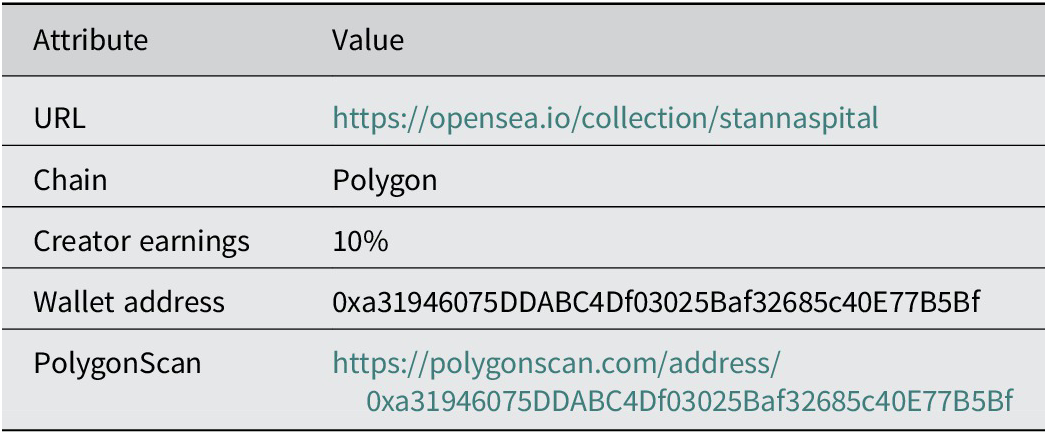
We chose Polygon, an ecosystem containing Ethereum scaling networks, to process transactions faster and at lower cost, while still anchoring security to the base chain. Polygon uses a low-energy Proof of Stake (PoS) consensus mechanism in which validators on the Polygon network are selected to validate transactions and produce blocks based on the amount of MATIC tokens (Polygon’s native cryptocurrency, now rebranded as POL) they stake, which fosters security and decentralization. Polygon PoS executes transactions on its own chain and periodically anchors checkpoints of its state to the Ethereum mainnet. This helps reduce congestion and increase transaction throughput. However, in the workflow used for this project this decision added an additional layer of complexity since the payment assets needed to be bridged from the mainnet to Polygon. In summary, the NFT offering and all observed transactions were completed successfully without any disruptions, and the tokens remain available for sale. Table 1 summarizes the core details of the project, including the URL, the blockchain used, the royalties for the creator (i.e., the amount of money that goes to the hospital after each subsequent token sale), and the publicly available wallet address (i.e., the public identifier of an account on the blockchain that can send and receive assets), along with information on how to trace it on PolygonScan, a public “block explorer” that lets anyone view transactions associated with an address.
Blockchain information

Table 1 Long description
The table consists of two columns titled Attribute and Value.
* Row 1: Attribute is U R L. Value is h t t p s colon forward slash forward slash opensea dot i o forward slash collection forward slash stannaspital.
* Row 2: Attribute is Chain. Value is Polygon.
* Row 3: Attribute is Creator earnings. Value is 10 percent.
* Row 4: Attribute is Wallet address. Value is 0 x a 3 1 9 4 6 0 7 5 D D A B C 4 D f 0 3 0 2 5 B a f 3 2 6 8 5 c 4 0 E 7 7 B 5 B f.
* Row 5: Attribute is PolygonScan. Value is h t t p s colon forward slash forward slash polygonscan dot com forward slash address forward slash 0 x a 3 1 9 4 6 0 7 5 D D A B C 4 D f 0 3 0 2 5 B a f 3 2 6 8 5 c 4 0 E 7 7 B 5 B f.
Figure 2 shows how a specific transaction can be investigated in PolygonScan since all information is public. We chose ERC-20 and ERC-1155 token transfers that occurred in our project. ERC-20 is a common technical standard for fungible (i.e., exchangeable, not unique) tokens on Ethereum-compatible blockchains. The most important details include the Transaction Hash, a unique identifier assigned to each transaction; the Status, which indicates that the transaction was a “Success”; and the Block number, which gives the block in which it was included. This is important for the trustworthiness of the transaction, as subsequent blocks or confirmations make it harder to change previous information, increasing its reliability. The Timestamp shows Mar-23-2022, the exact date and time at which this marketplace transaction was executed. Some information is provided on the sending and receiving addresses, one of which is the ZeroExFeeWrapper, a smart contract used to facilitate fee handling and transaction management. The ERC-20 Token transfers (i.e., the payment and fee flows) show the Wrapped Ether tokens (i.e., a tokenized form of Ether used to make ETH compatible with token standards and marketplace transactions) being transferred back to the organization’s address (0xa319…) with a fraction going to the OpenSea wallet. Finally, the ERC-1155 (a standard for NFTs) transfer sends the NFT from the organization’s address to the purchaser’s wallet, followed by some information about the value being transferred, the gas price (i.e., the cost of computational work on Ethereum-compatible networks), and the resulting transaction fees (i.e., gas price times gas used). Importantly, from an end user’s perspective, none of this information is necessary for buying, selling, and trading NFTs, yet it is available to anyone seeking to independently inspect the details and legitimacy of the process.
Example NFT sale transaction on PolygonScan (screenshot taken in June 2026).

Fig. 2 Long description
A digital interface screenshot displaying blockchain transaction details. At the top, the Transaction Action is listed as Transfer 1 of OpenSea Collections.
Below this, the main data fields include.
- Transaction Hash. 0 x 1 3 c c 3 8 6 b 4 5 b 9 e f 5 a 2 a c 6 9 6 8 c f 8 b f 8 a 3 5 e 9 f 1 b 8 a f 8 a e 9 0 0 e d 6 8 d 8 7 b f 0 6 1 6 d 6 c b 3.
- Status. Success in a green pill box.
- Block. 2 6 2 7 5 0 5 5 with 6 1 5 2 3 5 7 9 Block Confirmations.
- Timestamp. 1 5 3 1 days ago on March 23 2022 at 0 5 2 8 5 2 P M plus U T C.
- From. 0 x 9 B 8 1 4 2 3 3 8 9 4 C d 2 2 7 f 5 6 1 B 7 8 C c 6 5 8 9 1 A A 5 5 C 6 2 A d 2.
- Interacted With To. 0 x F 7 1 5 b E b 5 1 E C 8 F 6 3 3 1 7 d 6 6 f 4 9 1 E 3 7 e 7 B B 0 4 8 f C c 2 d (OpenSea. ZeroExFeeWrapper).
The E R C 20 Tokens Transferred section lists four transfers of Wrapped Ether (W E T H) in amounts of 0.002, 0.00025, 0.00005, and 0.0002, with corresponding U S dollar values.
The E R C 1155 Tokens Transferred section shows 1 of Token I D 7 3 7 7 1 6 4 8 8 1 6 5 3 9... from OpenSea Collections transferred from 0 x a 3 1 9 4 6 0 7... to 0 x B 3 2 9 2 1 2 2....
At the bottom, the Value is 0.0264 P O L ($0.002453) and the Transaction Fee is 0.035843544 P O L ($0.00333).
Advantages
The qualitative content analysis yielded 12 advantages, which are discussed in the following sections. At a higher level, we grouped these advantages into those that benefit donors and those that benefit the organization, with substantial overlap between them (see Figure 3).
Advantages, disadvantages, and barriers of NFTs for fundraising (brackets indicate whether a category was identified as particularly relevant to donors, organizations, or both).

Fig. 3 Long description
At the center of the diagram is a box labeled N F T Fundraising.
On the left side, under the heading Advantages, twelve boxes point toward the center. Brackets on the far left categorize these.
* Relevant to both Donor and Organization: Tradeability, Traceability / Transparency, Transaction costs, Royalties, Settlement, and Global Deployment.
* Relevant to Organization only: Platform Availability, Functional Extensibility, Advertising Potential, Community Building, Targeted campaigns, and New Target Groups.
On the right side, under the heading Disadvantages Barriers, eight boxes point toward the center. Brackets on the far right categorize these.
* Relevant to Donor only: Negative Perception and Usability.
* Relevant to both Donor and Organization: Perceived Effort, Security, and Competition.
* Relevant to Organization only: Legal Problems and Taxation, Misuse, and Anonymity / Pseudonymity.
Tradeability
Unlike traditional fundraising methods, in which transactions occur only between the donor and the organization, this model allows donors to trade their tokens to third parties on secondary markets. NFTs provide digital ownership, and token holders can sell them at prices of their choice. This makes fundraising more market-driven and introduces a speculative component, such that motivations for donating can extend beyond willingness to contribute to a worthwhile cause and encompass the prospect that the value of a specific token will appreciate over time.
Traceability/transparency
One of the prominent features of blockchain technology is the immutability of transactions and the ease with which they can be inspected in the case of public blockchains. This creates an audit trail that allows organizations to publicly showcase how many donations have been received and, in case the spending is also recorded on blockchain, how they have been used. Such visibility can support accountability and donor confidence, particularly when it is combined with reporting that links on-chain transfers to the organization’s subsequent use of funds.
Transaction costs
NFTs offer significant advantages for fundraising by reducing transaction costs. Blockchain technology facilitates the direct transfer of funds between peers, cutting out existing intermediaries and reducing processing fees. While the total costs may also include marketplace charges, fiat-conversion costs, wallet or custody fees, bridging fees, and costs incurred when the nonprofit converts digital assets into fiat currency, using NFTs can ensure that more of the funds raised go directly to the recipient. The fees charged to process transactions depend on the network’s popularity and the number of transactions to be processed. They can vary considerably, but numerous technological advancements (e.g., layer 2 solutions and sidechains that can process transactions independently, often at lower cost) have been implemented to increase transaction throughput. As of June 2026, processing a transaction on Polygon costs a fraction of a cent, although platform- or marketplace-specific fees may still apply. The implication of lower transaction fees is that a larger proportion of the donation amount reaches the charitable cause, as compared with other fundraising approaches.
Royalties
Trading NFTs on marketplaces is enabled by smart contracts: deterministic computer code that executes automatically. They allow for setting rules that require a pre-specified amount to be given to the charity if the token is traded again after the initial offering. In our project, the so-called creator earnings were set at 10%, the maximum OpenSea allowed at the time when the tokens were created. It must be noted that the amount and enforcement of royalties depend on the platform, and that OpenSea has also changed its policy on these matters. If mandatory royalties are enacted, each resale generates royalties for the nonprofit, fostering long-term financial support by enabling a continuous stream of funding even after the initial sale.
Settlement
Blockchain transactions are quickly settled using tamper-resistant cryptographic techniques. Transaction validation is performed according to deterministic protocols and by independently operating computer nodes, called validators. In this regard, it makes sense to differentiate between settlement (i.e., inclusion in a blockchain and the confirmation by validators) and finality (i.e., irreversibility), which depend on the type of blockchain and consensus mechanism, network congestion, and the number of confirmations needed. The settlement process can range from milliseconds to seconds, while finality can be achieved within minutes on most chains. In the future, it might be possible to efficiently link tax-deductible donations to government tax systems, enhancing the technology’s potential for effective fundraising.
Global deployment
Once the initial preparatory work is complete (e.g., creating the artwork), tokens can be deployed on a blockchain without any significant administrative overhead from a technical perspective. Existing platforms and marketplaces provide the infrastructure required to easily create a public listing. Once deployed, the tokens can immediately be purchased from geographically dispersed locations (subject to the restriction that use of the chosen platform is legal in a given jurisdiction). Charities can therefore address a global audience of donors and use their web presence to inform about their work while simultaneously giving individuals the opportunity to donate online and receive a token immediately.
Platform availability
Whereas global deployment refers to geographic reach, platform availability refers to the continuous accessibility of NFT-based donation opportunities. NFTs enable organizations to offer donation opportunities 24/7 by leveraging independently operated blockchains and marketplaces. Tokens can be offered simultaneously on different platforms and be listed on multiple marketplaces. So-called cross-chain NFTs can be transferred between chains and allow users to buy and trade NFTs across networks. These features mitigate the risk of losing donation opportunities due to technical failures.
Functional extensibility
Blockchain-based tokens offer greater functionality than traditional fundraising methods. For example, organizations can use them as entry tickets for dedicated charity events, which can be held online or offline, or for access to special features and exclusive insights into the organization’s work. To access NFT-gated content, users need to link their wallet to a website or application to prove they hold the relevant NFT in their wallet. Many other use cases are possible, such as automatically executing recurring donations or dynamically allocating funds based on donors’ preferences.
Advertising potential
NFTs also offer considerable potential for innovative advertising campaigns. While the concept is still considered novel, organizations can benefit from additional publicity through increased media attention, highlighting their innovation. If wider adoption is achieved, the aesthetic appeal of eye-catching pictures or animated formats promotes their collection by donors as memorabilia, as well as their presentation to others in personal or public settings. Donors may even display their NFTs on their websites, showcasing their donation and generating awareness for the charitable cause.
Community building
NFTs foster a sense of ownership among donors and can help create communities by enabling direct engagement. Even though NFTs are digital goods, donors receive a visible asset that signals they belong to a particular group and fosters a sense of solidarity between members. Sub-groups with shared interests can emerge from ownership of NFTs dedicated to a specific purpose, with the respective donors receiving extra information about that cause and potential future initiatives.
Targeted campaigns
As just mentioned, NFTs can be used for campaigns that pursue highly specific purposes under a common umbrella. In this respect, they can be used to identify and target donor groups interested in a particular goal. Given the technology’s early-stage adoption and comparatively low usability, donor groups currently skew tech-savvy, but this will likely change over time as public familiarity grows. Information regarding the interests of donors, which can be gleaned from NFT use, can enable charities to target those groups with a special interest in a given topic provided that they have consented to link their wallet addresses to personal or organizational profiles. Such targeted campaigns are not only efficient but might also reduce cannibalization across existing donation channels by ensuring consistently personalized messaging.
New target groups
Three particular features of NFT fundraising suggest that it has the potential to find donors among individuals who cannot be reached via traditional means. Transparency surrounding transactions and their use will appeal to individuals who are skeptical of how their contributions will be used. The visibility of NFTs will appeal to those keen to communicate their altruism to others, including for taxation purposes, and this is further aided by their accounting functionality. Finally, future applications with improved usability will eventually make it easier to donate online, with the possibility to buy NFTs for donations directly on websites that inform about a specific cause or campaign. This relative ease of making donations might attract more donations from individuals who are time-pressured or who tend to make spontaneous decisions.
Disadvantages and barriers
The qualitative content analysis yielded eight categories clustered into disadvantages and adoption barriers. Some of these categories relate particularly to donors or to organizations, while other categories were found relevant to both stakeholder groups.
Negative perception
Public perceptions of NFTs are often polarized, resulting from public discourse surrounding cryptocurrencies and the underlying blockchain technology. Ongoing (social) media narratives fueled by a lack of technological understanding might evoke associations with topics like money laundering or environmental pollution. Harsh criticism has been leveled, for example, at Bitcoin’s energy-intensive Proof-of-Work consensus mechanism, which requires substantial energy as computers compete to solve computational puzzles to add blocks and earn a reward. NFTs, however, are usually minted on blockchains such as Ethereum and Solana using a Proof-of-Stake consensus mechanism that requires much less energy. With public understanding of such nuance still lacking, the association between blockchain and energy use remains strong in many minds and might especially hamper fundraising campaigns with an environmental focus. Similarly, the superficial similarity to meme coins used in political campaigns can also arouse strong sentiments about NFTs, despite meme coins being fungible tokens.
Usability
Starting with the cryptocurrency Bitcoin, blockchain-based technologies were developed and used by a technology-savvy community, and user-friendliness was not the main priority in the early years. Even though this has changed considerably in recent times, installing wallets, managing private keys (i.e., a secret credential that controls a blockchain account), and other tasks required for interacting with Web3 applications (i.e., applications that interact with blockchains, where users authenticate via cryptographic wallets rather than username/password accounts) require special skills and new mindsets (e.g., being responsible for one’s private keys) among the general population. This especially pertains to those parts of the older generation that are not technologically savvy but might represent an important portion of the donor base. It can be expected that, over time, end users will gain a better understanding of Web3 technologies as changes are introduced that facilitate the handling of blockchain-based applications, such as account abstraction, which can make wallets behave more like familiar user accounts, embedded wallets that allow users to interact without leaving the application, and improved user experience (UX) design. This process is ongoing and far from completion.
(Perceived) effort
The complexity of dealing with Web3 applications, as outlined in the previous section, might deter both end users and organizations from using them and increase the perceived effort required. While organizations might be primarily concerned about potential security risks and legal issues, end users might face a steep learning curve pertaining to the usability challenges discussed above. Willingness to engage with complex technologies might be even lower in the case of fundraising projects than for speculative investments, for instance, as personal gains play a less prominent motivational role.
Security
As digital assets, NFTs for fundraising have the same security risks as other assets on a blockchain. Numerous types of cyberattacks exist, including the theft of private keys and the exploitation of smart contract vulnerabilities that allow hackers to gain access to funds. Additionally, there is the possibility of scams (i.e., impersonating a legitimate entity) or rug pulls (a scam where creators abruptly abandon a project after collecting funds). If fundraising NFTs are bought for speculative purposes, there is a risk of price volatility, even though this might be less relevant for fundraising campaigns than for traditional investment assets.
Competition
The relative ease with which NFTs can be created might lead to a proliferation of donation campaigns as NPOs begin to realize the potential of this fundraising channel and the relative ease with which tokens can be created. On the donors’ side, this might lead to confusion, especially if advertising is aggressive and numerous tokens are offered simultaneously across different channels. The option to enhance NFTs with additional functionalities and to create communities, which we outlined above, might lead to a preference for organizations with the strongest marketing capabilities (e.g., creating fancy tokens, evoking a feeling of scarcity, and including gamification elements) rather than initiatives that contribute most productively to the cause. Consequently, nonprofits that have invested substantially in building their brands over the years might be threatened by competitors that focus more on marketing than on charitable activities.
Legal problems and taxation
Due to its technological novelty, the blockchain space was largely unregulated in its early years. This evoked feelings of suspicion among many organizations and end users. Even though several regulatory frameworks have been introduced across various jurisdictions, regulatory uncertainties regarding asset classification and compliance requirements still exist. An ongoing issue is whether NFTs constitute securities, which would require compliance with financial laws. Additionally, anti-money laundering (AML) and know-your-customer (KYC) regulations may apply, requiring charities and platforms to verify donors’ identities. These complications have led users from certain jurisdictions to be excluded from using globally operating platforms such as OpenSea. Regarding taxation, donors and organizations might be unsure whether their contributions qualify for tax deductions and how to best comply with the relevant tax reporting requirements.
Misuse
As it is relatively easy to create counterfeit tokens bearing the logo of a well-respected organization, unsuspecting donors might be tricked into transferring money to fraudsters. Such concerns are especially relevant during time-sensitive fundraising campaigns for causes such as disaster relief, when unscrupulous individuals can exploit the spontaneous willingness to give. Reputable organizations, on the other hand, might encounter donors using NFTs for money laundering purposes under pseudonymous profiles that make it hard for them to identify suspicious activity and report it to the relevant platform or authorities. Additionally, they might sell their NFTs at inflated prices to claim tax deductions larger than they would have been if the trades had been legitimate.
Anonymity/pseudonymity
Ever since Bitcoin captured public attention, in the public perception, blockchain has been associated with anonymity, even though in most cases the information stored on public blockchains is, in fact, pseudonymous (i.e., the real identity is hidden by an identifier). Even though the capability to track and trace transactions and wallets is generally higher on blockchain (due to the immutability of records), organizations/NPOs may remain concerned that users can obscure the links between wallet addresses and real-world identities. If appropriate KYC/AML measures are lacking, there is a risk that sanctioned individuals, terrorist organizations, or fraudsters might use donations to bypass financial restrictions.
NFT fundraising framework
Figure 3 summarizes the identified categories, showing the advantages on the left side and the disadvantages/barriers on the right. Additionally, it shows which categories might be most relevant to the donor or the organization. In most cases, the respective categories were relevant to both groups. Even though a strict categorization is impossible since many categories simultaneously affect numerous issues, the advantages can be loosely grouped into “ownership and transparency” (Tradeability, Traceability/Transparency), “money” (transaction costs, royalties), “technology” (settlement, deployment, platform availability, functional extensibility) and “marketing” (advertising potential, community building, targeted campaigns, new target groups, global reach). The structure on the disadvantages/barriers side includes topics such as “perceptions and usability” (negative perception, usability, (perceived) effort), “technology” (security), “market” (competition), and “regulatory and governance challenges” (legal problems and taxation, misuse, anonymity/pseudonymity).
Discussion
NFTs, unique digital assets created and traded on blockchains, have experienced a short and turbulent history, with a phase of public disillusionment quickly following the initial hype. As research in the field matures, studies indicate that the NFT market has potential for selected applications, while highlighting the need to identify genuine use cases that take full advantage of the features and functionality of digital assets. In response, we posit that applying NFTs for fundraising presents one such potential use case and offers new opportunities for fundraising organizations that were previously unavailable. However, new challenges and problems arise from the idiosyncrasies of using blockchain technology for donations. In this regard, the findings from our study have important implications for academia and the industry.
Theoretical implications
In this study, we address the call from recent academic studies to scrutinize the limited utilization of digital technologies in NPOs (Cipriano & Za, Reference Cipriano and Za2025; Godefroid et al., Reference Godefroid, Plattfaut and Niehaves2024) by investigating how NFTs can help them to achieve their objectives. To better understand the manifold potentials of NFTs for fundraising from an academic perspective, their unique features must be integrated into existing theories and models and rigorously studied. Specifically, they affect all three research areas we outlined in our literature review: donors, organizations, and technology.
From a donor perspective, NFTs can influence donors’ trust levels, thereby shaping their attitudes toward online donations. They not only allow tracking and tracing the path of a specific token but can also increase overall transparency in the flow of donations, which, in turn, can foster trust as an important driver of donation behavior (Millán et al., Reference Millán, Retamosa and Carranza2024). From an end-user perspective, NFTs are currently perceived as complicated because using them requires a basic understanding of blockchain wallets. Over time, wallet usability may continue to improve, and technology savviness will increase, potentially leading to changes in perceived ease of use and self-efficacy, both of which have been identified as important antecedents of online donations (Chen et al., Reference Chen, Dai, Wang, Yang, Li and Wei2021). Apart from individual perspectives, the traceability and transparency of NFTs can also benefit an organization’s brand image, which has been identified as a core criterion for online donations (Lee & Kim, Reference Lee and Kim2023; Obadă et al., Reference Obadă, Dabija and Câmpian2024). The use of NFTs represents a further technological advancement, similar to previous crowdfunding approaches in that it enables raising funds from a large number of individuals and provides incentives for donors, but also extends previous capabilities by facilitating ownership and resale. In this regard, existing crowdfunding research can provide valuable insights into donation mechanisms (Altarteer & Bamoallem, Reference Altarteer and Bamoallem2024; Li et al., Reference Li, Yang and Sun2024; Pan & Dong, Reference Pan and Dong2023), but needs to be updated to account for the idiosyncratic features of blockchain-based tokens. Finally, future research needs to investigate how incorporating NFTs affects an organization’s social media marketing success (Bilgin & Kethüda, Reference Bilgin and Kethüda2022).
From a theoretical standpoint, various approaches can be used to better understand why individuals choose NFTs to make donations and what the consequences are for organizations. Examples of theories that investigate attitudinal and behavioral drivers and consequences (e.g., Diffusion of Innovations, Theory of Planned Behavior, Technology Acceptance Model, Unified Theory of Acceptance and Use of Technology) might serve as interesting starting points but need to be tailored to the specificity of blockchain-based tokens.
Drawing on theories of technology diffusion and acceptance, our findings suggest that NFTs exhibit a paradoxical combination of innovation attributes. While features such as traceability, programmability, and low transaction costs constitute a clear relative advantage over traditional donation mechanisms, low adoption can be explained by limited compatibility with existing procedures of charitable giving, high perceived complexity related to wallet usage and blockchain interactions, and restricted trialability for risk-averse donors. In contrast to many digital fundraising tools, the observability of NFTs is also ambivalent: although transactions are publicly visible on-chain, this transparency is largely opaque to non-expert donors, thereby diminishing its intended trust-enhancing effect. These tensions help explain why technical feasibility and the numerous advantages outlined above have not yet led to widespread adoption, suggesting that existing diffusion and adoption models require refinement when applied to blockchain-based artifacts.
From the perspective of Signaling Theory, informed actors credibly convey otherwise unobservable qualities to less-informed actors in situations of information asymmetry (Spence, Reference Spence1973). In this regard, NFTs introduce a novel form of mixed signaling for potential donors by sending signals that facilitate coordination and trust. On the one hand, immutable records and programmable royalties can act as credible signals of accountability and responsibility, and can be used to strengthen loyalty (Telli & Aydin, Reference Telli and Aydin2026). On the other hand, associations with speculation, volatility, and illicit use generate negative signals that may undermine altruistic attributions.
Our case illustrates how blockchain-enabled fundraising challenges the assumption of unidirectional signaling by producing signal ambiguity, in which the same artifact simultaneously conveys altruistic, technological, and speculative meanings. Taken together, these insights position NFTs not only as another digital fundraising tool but as an innovation that suggests boundary conditions for existing theories and calls for more nuanced conceptualizations of adoption and signaling in technology-mediated philanthropy. In summary, NFTs are a complex and multifaceted topic whose potential applications have not yet been fully realized (Alshater et al., Reference Alshater, Nasrallah, Khoury and Joshipura2024).
Managerial implications
The findings of this study yield several actionable managerial implications for NPOs considering using NFTs as a fundraising instrument. Specifically, our results demonstrate that the successful technical deployment of NFTs does not automatically lead to successful fundraising campaigns. Instead, the fundraising success ultimately depends on how well organizations align NFT-specific affordances with donor expectations, organizational and technological capabilities, and regulatory constraints. Specifically, we derived five recommendations for nonprofits:
First, NFTs are currently suitable as a complementary rather than a substitute fundraising channel. The low adoption observed in our case suggests that NFTs are ready for targeted, experimental campaigns aimed at digitally savvy donor segments, but not yet suited to mass fundraising. Managers should therefore consider integrating NFTs into a broader fundraising portfolio, particularly for campaigns that benefit from visibility, innovation signaling, or community-building effects, which aligns with NFTs’ strengths in niche engagement rather than volume generation.
Second, organizations must actively manage the complexity and perceived effort of acquiring and trading NFTs, which emerged as important barriers to adoption from the donor perspective. While blockchain-based fundraising offers advantages such as transparency, traceability, and low transaction costs, these benefits remain largely latent unless donors can easily use the tokens. Managers should therefore invest in usability-enhancing measures, such as simplified onboarding, step-by-step donation guides, or wallet solutions that are easy to use. Without such measures, the relative advantage of NFTs will be outweighed by perceived complexity, particularly among less technology-savvy donors.
Third, the results highlight the importance of strategic communication management. NFTs simultaneously evoke positive associations (innovation, transparency, ownership) and negative perceptions (speculation, environmental concerns, misuse). Managers must therefore proactively design NFT-based fundraising initiatives to emphasize their charitable purpose, legal compliance, environmental compatibility, and concrete social impact. This includes clearly communicating how proceeds are used, how royalties support long-term funding, and why the chosen blockchain infrastructure aligns with sustainability considerations. Failure to do so may allow misinformed yet prevalent negative perceptions to deter potential donors.
Fourth, governance and compliance capabilities are an important prerequisite for an NFT fundraising campaign. Legal uncertainty, tax issues, and the risk of misuse were among the identified organizational barriers. Managers, therefore, need to assess regulatory compliance early on, including tax deductibility, AML/KYC requirements, and cross-jurisdictional restrictions imposed by NFT platforms. To reduce legal and reputational risk, they may consider partnering with compliant marketplaces, limiting geographic access, and thoroughly documenting governance procedures.
Fifth, NFTs offer strategic value beyond immediate fundraising outcomes, particularly for organizational learning and signaling innovativeness. Even NFT initiatives yielding limited immediate financial success can help organizations develop digital competencies, explore new engagement mechanisms, and test novel value-generating initiatives. Managers should therefore evaluate NFT projects not solely on short-term revenue metrics but also on their contribution to long-term organizational learning and to digital transformation more broadly.
Taken together, these implications suggest that NFTs are neither a panacea nor a passing fad for nonprofit fundraising. Rather, they represent a potentially useful but operationally demanding instrument whose managerial value depends on careful positioning, donor-centric design, and robust governance structures.
Conclusion, limitations, and future research
In this paper, we illustrate how NFTs can be applied to charitable fundraising. While most of the advantages, disadvantages, and barriers we identified also play an important role in commercial settings, it is the idiosyncratic properties of blockchain technology that enable features such as transparency and low transaction costs, which make the technology especially useful for nonprofit operations. Although the NFT market experienced significant volatility caused by hype and speculation, this does not necessarily impede future market growth. The decline of hype-driven projects may trigger a gradual shift toward applications that emphasize utility, although the market’s future scale and direction remain uncertain. In such projects, NFTs gain value not from speculation but from their ability to enable functions such as donor engagement, community building, access to exclusive content, transparency, and fundraising. For NPOs, NFTs may serve less as speculative assets and more as sophisticated digital tools to facilitate fundraising.
We created and deployed NFTs for a children’s hospital that can be acquired by the general public. From a technological perspective, the project succeeded and illustrates the relative ease with which NFTs can be created and traded on a publicly accessible platform with a global reach. Yet from a practical perspective, adoption has been low. In this paper, we list the perceived advantages, disadvantages, and barriers identified through the qualitative evaluation, based on a careful analysis of feedback gathered from digital natives (i.e., 24 blockchain-trained undergraduate students) and individuals with no specific blockchain knowledge. In doing so, we developed answers to our three research questions. RQ1 was about how NFTs can be used for fundraising. This was illustrated using an action research approach, in which we created and deployed donation tokens, some of which were subsequently purchased or traded. Our results outline the steps involved and explain the suitability for the purpose of the various design choices made. RQ2 and RQ3, pertaining to the advantages and disadvantages/barriers of NFTs in fundraising, were addressed through a user-informed qualitative evaluation in which the case was thoroughly investigated by 24 students who had taken a university-level blockchain course and possessed knowledge in the subject area, with additional input from non-expert users who represent the viewpoint of potential donors.
Beyond their technical characteristics, NFTs can be interpreted as a technological innovation in nonprofit fundraising. Similar to earlier digital fundraising tools that experienced rapid uptake followed by disillusionment, NFTs benefited from substantial initial attention driven by novelty, media discourse, and associations with innovation, rather than by a clear alignment with well-established donation practices. Our findings suggest that their current limited adoption is not a singular failure of NFTs but rather reflects a recurring pattern in which emerging technologies are introduced into nonprofit contexts without sufficient consideration of donor behavior and expectations, usability thresholds, as well as institutional, technological, and knowledge constraints. In this regard, NFTs illustrate how hype-driven innovations may generate visibility and experimentation while simultaneously obscuring fundamental adoption barriers, such as perceived complexity, reputational risk, and regulatory complexity. To succeed, fundraising technologies that rely primarily on novelty effects need to be embedded in familiar donation practices, clearly communicate value beyond novelty, and reduce cognitive and organizational effort for both donors and nonprofits.
This exploratory research has some limitations. In this paper, we report the findings from a specific case, operating for a specific cause in a specific location. Even though we found that other projects have suffered a similar fate (i.e., lack of adoption), this does not mean that our findings can be easily generalized to other charitable causes and scenarios, nor that the outcomes for future initiatives are likely to be the same. We note in particular that environmentally focused nonprofits might face an even greater challenge in overcoming common misconceptions about the sustainability impacts of NFTs, and their application in such fundraising contexts deserves specialized investigation in light of our findings. Beyond differences between causes, differences between donor groups also merit further study. While we found the current complexity and perceived usability of the technology to be an important barrier limiting its adoption within the general population, this will not hold for all groups and will likely change in the future, which is why we did not report specific coding frequencies to avoid the impression that some categories are more important than others. In this regard, further research is encouraged across different communities to identify appropriate applications and target groups for niche fundraising campaigns. Additionally, direct interviews with donors and hospital managers are needed, and comparisons with conventional donation channels will help generate insights into their relative advantages.
Given that fundraising is a value-laden topic and researchers will generally be interested in seeing certain outcomes, design science or action research approaches are recommended to develop solutions to the problems we experienced. On the basis of our findings, such approaches should primarily target end users (potential donors) and either educate them on new technologies or, more likely, make solutions more user-friendly and easily accessible.
Funding statement
This research received no funding.
Competing interests
The author declares no competing interests.



 Open access

