INTRODUCTION
Patients with head and neck cancer (HNC) have experienced being diagnosed with a life-threatening illness, undergone morphological changes (i.e., changes in appearance), received various kinds of cancer treatment (e.g., surgery, chemotherapy, and radiation therapy), and suffer from functional impairment (e.g., speaking, breathing, chewing, swallowing, tasting, and hearing) (Breitbart & Holland, Reference Breitbart and Holland1988). Of all the various types of cancer, HNC particularly degrades a patient's quality of life (QoL), especially due to functional impairments in eating and communicating, activities directly connected to daily activities (Terrell et al., Reference Terrell, Ronis and Fowler2004). Furthermore, it is well demonstrated in the literature that patients with tumors in the head and neck area experience anxiety and depression before and after treatment, and that their suicide rate is higher than that of patients with cancers in other parts of the body (Chen et al., Reference Chen, Daly and Vazquez2013; Haman, Reference Haman2008; Mackenzie et al., Reference Mackenzie, Carey and Sanson-Fisher2013; Mochizuki et al., Reference Mochizuki, Matsushima and Omura2009; Zabora & Brintzenhofeszoc, Reference Zabora and Brintzenhofeszoc2001; Zeller, Reference Zeller2006). Self-assessment of QoL has become an important tool for evaluating the health status of patients with HNC, in addition to such objective assessments as diagnosis of tumor site or clinical stage (Shimozuma, Reference Shimozuma2002).
There are some questionnaires that evaluate the QoL of patients with HNC, including a general cancer scale and an additional subscale especially for HNC—the European Organization for Research and Treatment of Cancer Quality of Life Questionnaire–Head and Neck Cancer (EORTC QoL–H&N35; Bjordal et al., Reference Bjordal, de Graeff and Fayers2000) and the Functional Assessment of Cancer Therapy Scale–Head and Neck (FACT–H&N; Cella, Reference Cella1997; List et al., Reference List, D'Antonio and Cella1996)—as well as scales specifically developed for HNC—for example, the University of Washington's Quality of Life Questionnaire (UW–QoL; Weymuller et al., Reference Weymuller, Alsarraf and Yueh2001). Although a failure to recognize the importance of the two components of function and attitude may inaccurately bias the reporting of outcomes, no existing HNC-specific instrument contains multiple functional and attitudinal items that can be analyzed separately. Most of these instruments are composed solely of functional items, though a few have only attitudinal items or have a small number of items that contain a mixture of attitudinal and functional responses to a single query (Funk et al., Reference Funk, Karnell and Christensen2003).
The purpose of the present study was to develop a Japanese version of the Head and Neck Cancer Inventory (HNCI) (Japanese HNCI). The HNCI is a scale that measures QoL specific to patients with HNC and includes questions related to four domains (speech, eating, aesthetics, and social disruption). The HNCI was developed thorough investigation of previous scales from a clinical perspective, and careful consideration was given to reliability, validity, and ease of answering questions (Funk et al., Reference Funk, Karnell and Christensen2003). The HNCI also evaluates attitudes about function (satisfaction with capabilities). It was constructed to include the fundamental characteristics of self-reported health status within a single HNC-specific instrument (Funk et al., Reference Funk, Karnell and Christensen2003). Such a scale did not exist in Japan until now. Development of a Japanese version of this measure will serve to assist in construction of a follow-up support system in Japan for HNC patients and survivors.
MATERIALS AND METHODS
Translation of the Scale
We first obtained the permission of Gerry F. Funk, M.D., the person who developed the HNCI (Funk et al., Reference Funk, Karnell and Christensen2003). Three native Japanese speakers translated the English version. A professional bilingual (English/Japanese) translator then back-translated the Japanese version into English. There were only a few minor changes in the back-translated Japanese version. We then conducted a pilot test and asked patients whether they understood the questions, and we encountered no significant problems.
Study Population
This was a cross-sectional investigational study, where we interviewed all the patients who received either inpatient or outpatient treatment at the Department of Otorhinolaryngology at the Medical Hospital of Tokyo Medical and Dental University from October of 2011 to March of 2013. Patients were included in the study if: (1) they had been notified of their cancer diagnosis, (2) they were aged 20 or older, (3) their condition was not so severe that they could not complete the questionnaire, and (4) they had no severe mental disorder or dementia. We handed out a questionnaire to patients who fit the criteria chosen by the attending physician. We also obtained informed consent from all individuals diagnosed with HNC. Out of the original 184 patients, 7 declined to participate and 12 could not complete the survey, leaving 165 patients to participate in the study. The reasons given for not completing the survey included complaints about the small size of the lettering and others having strong side effects from their treatments.
Ethical Considerations
The study was approved by the institutional review board at Tokyo Medical and Dental University consistent with the Helsinki Declaration.
Procedure and Measurement
Study participants were required to provide written consent for the following measures:
The Head and Neck Cancer Inventory
The HNCI includes 30 items that assess head and neck cancer–specific HRQoL in four domains—speech (10 items), eating (10 items), aesthetics (2 items), and social disruption (7 items)—and another item evaluating general QoL. The inventory captures both functional (how well the patient is functioning) and attitudinal (the patient's satisfaction with their level of function) aspects utilizing a 5-point Likert-type scale. While the aesthetics domain consists of items related only to attitudinal aspects, the other three domains contain items related to both perceived functional and attitudinal aspects. How well the patient is functioning is asked in functional items, and whether the patient is satisfied with the level of their function is asked in attitudinal items. The 10 items in the speech domain consist of 5 functional and 5 attitudinal items; the 10 in the eating domain comprise 7 functional and 3 attitudinal items; and the 7 in the social disruption domain contain 3 functional and 4 attitudinal items. The survey does not have a summary score (representing all items). Four separate domain scores can be calculated. First, we sum the responses within a domain or functional/attitudinal subdomain. We then divide by the number of items that received an appropriate response to calculate the mean score. The higher the score, the better the QoL.
The Functional Assessment of Cancer Therapy–Head and Neck Cancer
The 38-item Functional Assessment of Cancer Therapy–Head and Neck (FACT–H&N) (List et al., Reference List, D'Antonio and Cella1996) consists of a FACT–G plus a 9-item HNC-specific subscale. The FACT–G includes 27 questions in four domains: physical (7 items), social (7 items), emotional (6 items), and functional (7 items). Each response is rated by the patient from 0 to 4 on a Likert-type scale (0 = “not at all” to 4 = “very much”). Scores are calculated separately for each domain, and an unweighted summary score is calculated for the FACT–G and total FACT–H&N. The higher the score, the better the QoL.
Test–Retest Reliability
The group of participants who were asked to provide test–retest data was limited to outpatients, because the measure had not been confirmed for reliability in patients where QoL changes were obvious. Their first reply was given in the outpatient department after agreeing to reply again two weeks later. The questionnaires were mailed and returned within several days. We asked 50 participants and got a reply from 48 (96%).
Statistical Analysis
Factor analysis was performed to confirm the structural soundness of the 29 items of the Japanese HNCI. The last item was excluded from factor analysis, since it evaluates general QoL. Reliability was determined by internal consistency using Cronbach's alpha and test–retest reliability and employing the intraclass correlation coefficient (ICC). Cronbach's alpha was calculated per subscale, and a score above α = 0.70 was taken as an indication of sufficient homogeneity of items. Test–retest ICC should be ≥0.70 for all subscales. Criterion-related validity was assessed by Spearman's correlation coefficient between the HNCI and FACT–H&N scales. We also formulated a hypothesis that the HNCI score would be lower at posttreatment. Each factor mean was compared by a one-way ANOVA with respect to time.
Statistical analyses were conducted using SPSS (v. 19, Windows) (SPSS Inc., Chicago), and the significance level was set at p < 0.05.
RESULTS
Subject Characteristics
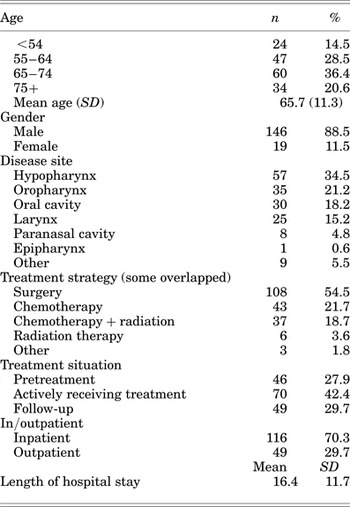
The clinical characteristics and demographic data are presented in Table 1. The average age of participants was 65.7 (SD ± 11.3) years, and the percentage of males was approximately 90%. The most common cancer site was the hypopharynx (34.5%), followed by the oropharynx (21.2%) and oral cavity (18.2%). Though some treatment strategies overlapped, surgery was most frequently performed.
Patient characteristics (N = 165)

SD=standard deviation.
Structure of the HNCI
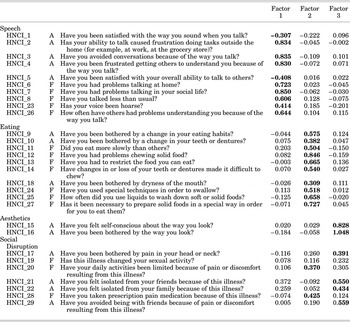
To confirm the scale structure of the Japanese HNCI, factor analysis was conducted using the 29 items. Exploratory factor analysis was conducted using the maximum likelihood technique with promax rotation. We employed a scree plot to identify factor number. The factor analysis results (factor loadings) are shown in Table 2. The minimum value of factor loading employed to select items was 0.3. The original version of the HNCI consists of four domains: speech (10 items), eating (10 items), aesthetics (2 items), and social disruption (7 items). After factor analysis of the Japanese version, the speech domain items of the original version were categorized together as factor 1, and the eating domain items of the original version were also grouped together (as factor 2), indicating a classification nearly identical to the original version. However, in the Japanese HNCI, the social disruption domain loaded onto two separate factors: most of the pain items were combined into the eating domain (factor 2), whereas the social items loaded into aesthetics (factor 3). The result: the Japanese HNCI is divided into three domains. In addition, item 19 (HNCI_19, sexual activity) of the original version had a factor loading £0.3 and was therefore not merged into any factor.
Factor analysis results for the Japanese version of the HNCI (N = 165)

HNCI_# is the original HNCI number. HNCI = Head and Neck Cancer Inventory; F = functional items; A: attitudinal items.
Reliability
We calculated Cronbach's α coefficients to assess the internal consistency of the Japanese HNCI: 0.865 for factor 1, 0.858 for factor 2, and 0.836 for factor 3, all greater than 0.8. The HNCI was administered twice in 48 patients. The ICC scores were 0.702 for factor 1, 0.798 for factor 2, and 0.629 for factor 3 (all p values <0.001), indicating that the test–retest reliability of the individual domains was substantial, in conformity with the standard (Landis & Koch, Reference Landis and Koch1977), which assumes 0.61 ~ 0.80 to be substantial.
Validity
Spearman correlation coefficients between the FACT–H&N and HNCI were calculated to assess criterion-related validity (see Table 3). A total of 107 were calculated after removing all the missing FACT–H&N values. All three factors showed moderate to high correlations with the FACT–H&N scales (r = 0.47–0.63) and moderate correlations with the FACT Physical Well-Being Scale (r = 0.34–0.54). Factor 3 also showed a moderate correlation with social/family well-being and emotional well-being (r = 0.36 and 0.39, respectively).
Correlation between the HNCI and the FACT–H&N (N=107)

**≤ 0.001.
HNCI = Head and Neck Cancer Inventory; FACT–H&N = Functional Assessment of Cancer Therapy–Head and Neck Scale.
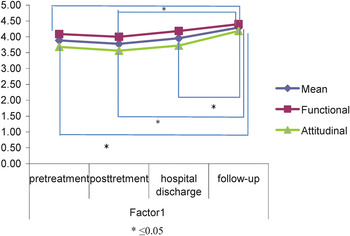
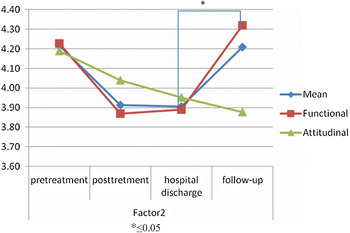
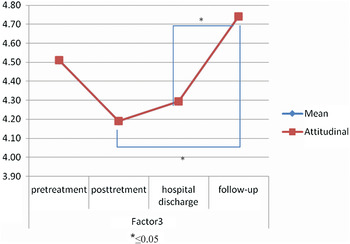
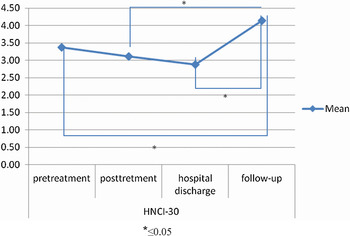
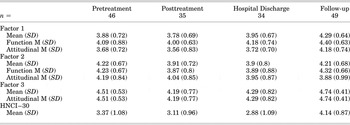
Figures 1–4 compare mean scores for factors 1–3 and the HNCI–30 (general QoL) (see also Table 4). Quality of life tended to be good at follow-up, the mean of factor 1 was significantly higher than at pretreatment and posttreatment, and the attitudinal score for factor 1 was significantly higher than at any other point. The mean functional score for factor 2 was higher than at posttreatment. Scores for factor 3 (only attitudinal items) were significantly higher than at posttreatment or hospital discharge. General QoL at follow-up was significantly higher than at any other point.
Mean and Functioal, Attitudinal scores of HNCI-Factor 1.

Mean and Functioal, Attitudinal scores of HNCI-Factor 2.

Mean and Attitudinal scores of HNCI-Factor 3.

Mean of HNCI-30 (general QOL) scores.

Mean HNCI factor scores at pretreatment and posttreatment, hospital discharge, and follow-up points (see Figs. 1–4)

DISCUSSION
The domain classifications obtained from the results of our factor analysis were different from those of the original version.
Factor 1, which was categorized exactly as in the original version, where it was labeled “speech.” This category is composed of items related to speaking and includes items on the functional evaluation of speech and whether the patient is satisfied with the way he/she speaks (attitudinal).
The functional aspect of social disruption (HNCI_20, 28) was combined with the eating domain in factor 2. One possible explanation is that the act of “eating” not only entails such functional aspects as chewing, swallowing, and smelling, but also such other aspects of eating as it being indispensable for living and enjoyment. Items of social disruption primarily dealt with “pain,” and we believe that the act of eating is closely related to pain. Disruption of the enjoyment of eating caused by pain is commonly observed in patients with HNC (Barber et al., Reference Barber, Powell and Ellis2007; Epstein et al., Reference Epstein, Hong and Logan2010), and our result was that eating and social disruption (two pain items) were classified together in the factor analysis. Based on these results, we are inclined to label factor 2 as “eating and pain.”
The reasons why aesthetics (HNCI_15, 16) and the attitudinal aspects of social disruption were combined into one factor require consideration. Questions related to “looks,” subsumed under aesthetics, are perceived differently by people in Japan and the United States. It has been reported that Western Europeans and North Americans gravitate strongly toward individualism, while Africans and Asians are said to have tendencies toward collectivism (Hofstede et al., Reference Hofstede, Hofstede and Minkov2010). The low self-evaluation commonly observed in Asia can lead to friction in interpersonal relationships (Rhee et al., Reference Rhee, Chang and Rhee2003). It seems that the interpersonal approach may be closely related with aesthetics in Japan. For the aforementioned reasons, perhaps these items were combined into aesthetics, since they are strongly involved in interpersonal relationships. Based on this result and the fact that factor 3 was moderately correlated with the social and emotional items of the FACT–H&N, factor 3 may be considered as “appearance and social interactions.”
We must also consider the low ICC scores obtained for factor 3. This factor has been established only as an attitudinal item. The HRQoL is a measure of an individual's attitude regarding their functional level, and not a measure of their functional level (Funk et al., Reference Funk, Karnell and Christensen2003). Attitudinal items might be more likely to be somewhat affected by a patient's mood when questions were asked. Further, participants who underwent surgery were more likely to feel social distress, whereas neither the experience of chemotherapy nor radiotherapy was significantly associated with social distress (Deno et al., Reference Deno, Tashiro and Miyashita2011). In other words, there may be some effect from differences in treatment.
The distribution of cancer disease sites may affect factors 2 and 3. The most common cancer sites were the hypopharynx, followed by the oropharynx, and the oral cavity. The order of cancer site distributions when the original version was developed was oral cavity, larynx, and oropharynx.
One item in the domain of social disruption (HNCI_19: “Has this illness changed your sexual activity?”) demonstrated decreased factor loading in the present study. All participants had to respond, so the floor effect might have caused the low values. In addition, it is well known that Japan is a traditionally sexually restrictive society (Abramson, Reference Abramson1986; Sprecher & Hatfield, Reference Sprecher and Hatfield1996). This could reflect a difference between Japan and the United States, and such characteristics of the Japanese people may be reflected in their responses to the questionnaire. These circumstances may have led to this item not fitting into any of the domains. Nevertheless, since sexuality is an important issue for patients, we plan to include this item as an option in the Japanese version, and not complete eliminate it. When these types of surveys are created, they typically include an assessment of whether questions are “difficult to answer,” but this was not something we investigated in the present study.
We confirmed changes in QoL comparing mean scores at each point. Quality of life tended to decrease after cancer treatments, which is common in clinical presentation or HNC (Maxwell et al., Reference Maxwell, Mehta and Wang2013), as it was true for Funk and colleagues (Reference Funk, Karnell and Christensen2003). Interestingly, there was no significant difference, but there were some changes in the attitudinal aspect of factor 2. QoL was recovered by the time of follow-up but was reduced at pretreatment, posttreatment, and hospital discharge. Measured HRQoL reflects the “gap” between an individual's actual and desired performance status (Calman, Reference Calman1984; Funk et al., Reference Funk, Karnell and Christensen2003).
Based on the above, we find that the HNCI can assess QoL for patients who have tumors in the head and neck area. Utilization of such measures as the Japanese HNCI might help clarify the needs of patients with HNC. It is possible that this tool might help patients better communicate with medical professionals about matters that they were previously reluctant to discuss.
The current study provides initial support for the psychometric adequacy of the HNCI among Japanese HNC patients. This measure may be helpful in gauging the quality of life of patients with HNC if pain is indeed alleviated in patients with tumors in the head and neck area. There is perhaps some social significance related to the HNCI as well.
LIMITATIONS AND PERSPECTIVE
Our study has several limitations. The first is that we did not examine the acceptability of this questionnaire. The second limitation is that we did not measure QoL with respect to treatment differences due to the small number of participants in the radiation therapy group and others. We were also unable to examine how QoL can change within the same patient.
We believe it will be important to determine the correlation between the functional and attitudinal aspects of each factor, and to longitudinally assess variance in the functional and attitudinal aspects for each patient using the Japanese version of the Head and Neck Cancer Inventory.
CONCLUSIONS
The results of the present study showed evidence for the reliability and validity of the Japanese version of the HNCI. Although its classification is different from the original U.S. version, the Japanese HNCI is a self-administered questionnaire that can assess quality of life specific to patients with head and neck cancer. So we judge it to be an effective multidimensional instrument for measuring quality of life among head and neck cancer patients and survivors.
ACKNOWLEDGMENTS
The authors wish to thank all the patients, consultants, and nurses involved in our study. We specifically would like to thank all the patients and staff at the Department of Otorhinolaryngology at the Medical Hospital of Tokyo Medical and Dental University for their participation and cooperation. We would also like to thank the developers of the HNCI, Gerry F. Funk, M.D., Ph.D., and Lucy H. Karnell, Ph.D., for permitting us to translate their original version into Japanese.