Introduction
The titanium implant used in the bone-anchored hearing aid (BAHA) system remained basically unchanged since the first BAHA installation in 1977, until 2001. The 3 or 4 mm implant used in the BAHA system is made of commercial grade, pure titanium and manufactured using the lathe technique (i.e. machined). Apart from a change in the design of the implant in 2001, to allow self-tapping, the implant manufacturing technique, geometry and surface have remained unchanged.Reference Tjellström, Granström and Odersjö1
The principle of titanium implant osseointegration was first applied with the introduction of oral implants. These implants have since been modified as regards their surface treatments, flanges, length and distance between threads. These changes have been shown to increase the survival rate of oral implants.Reference Rasmusson, Roos and Bystedt2, Reference Albrektsson and Wennerberg3
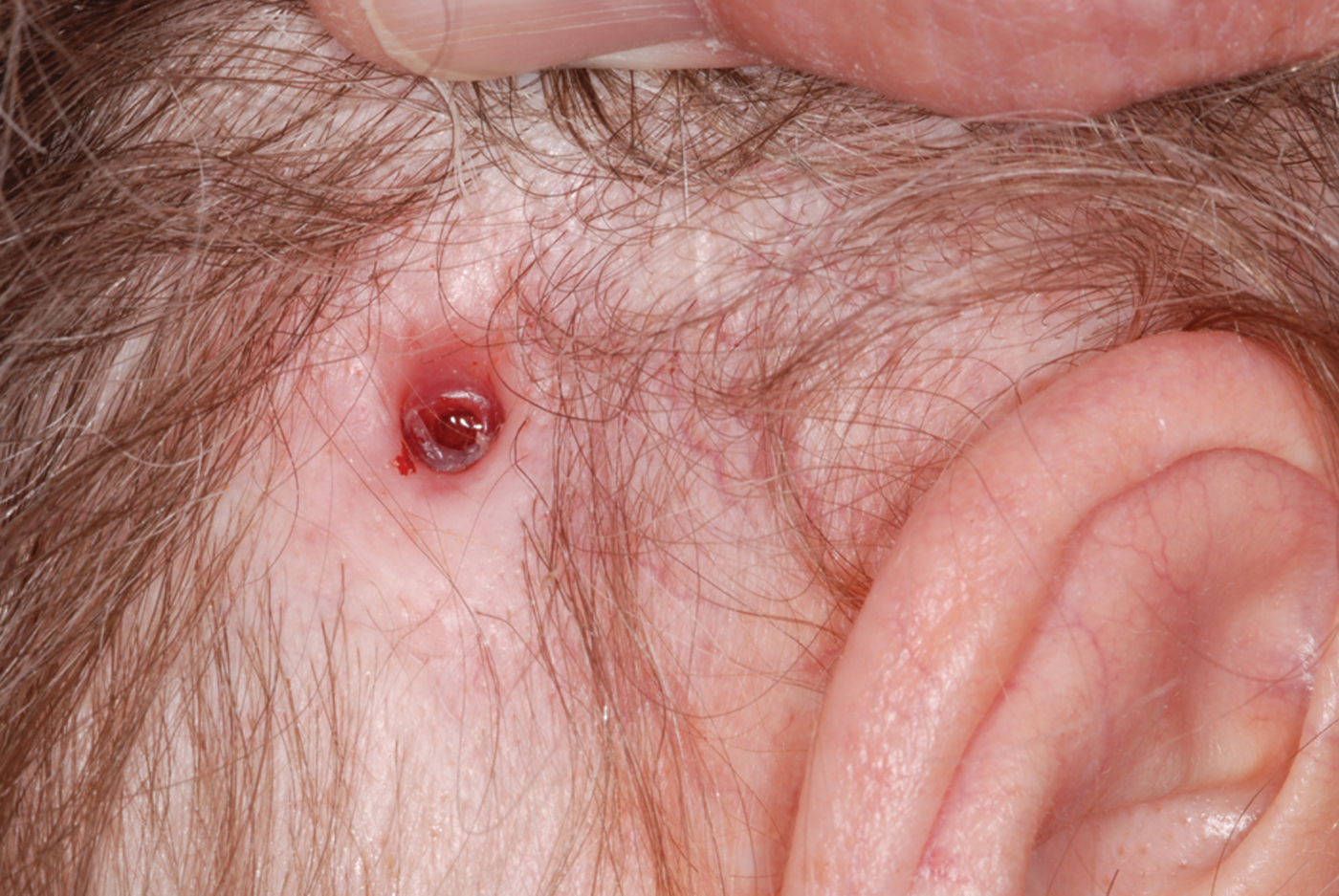
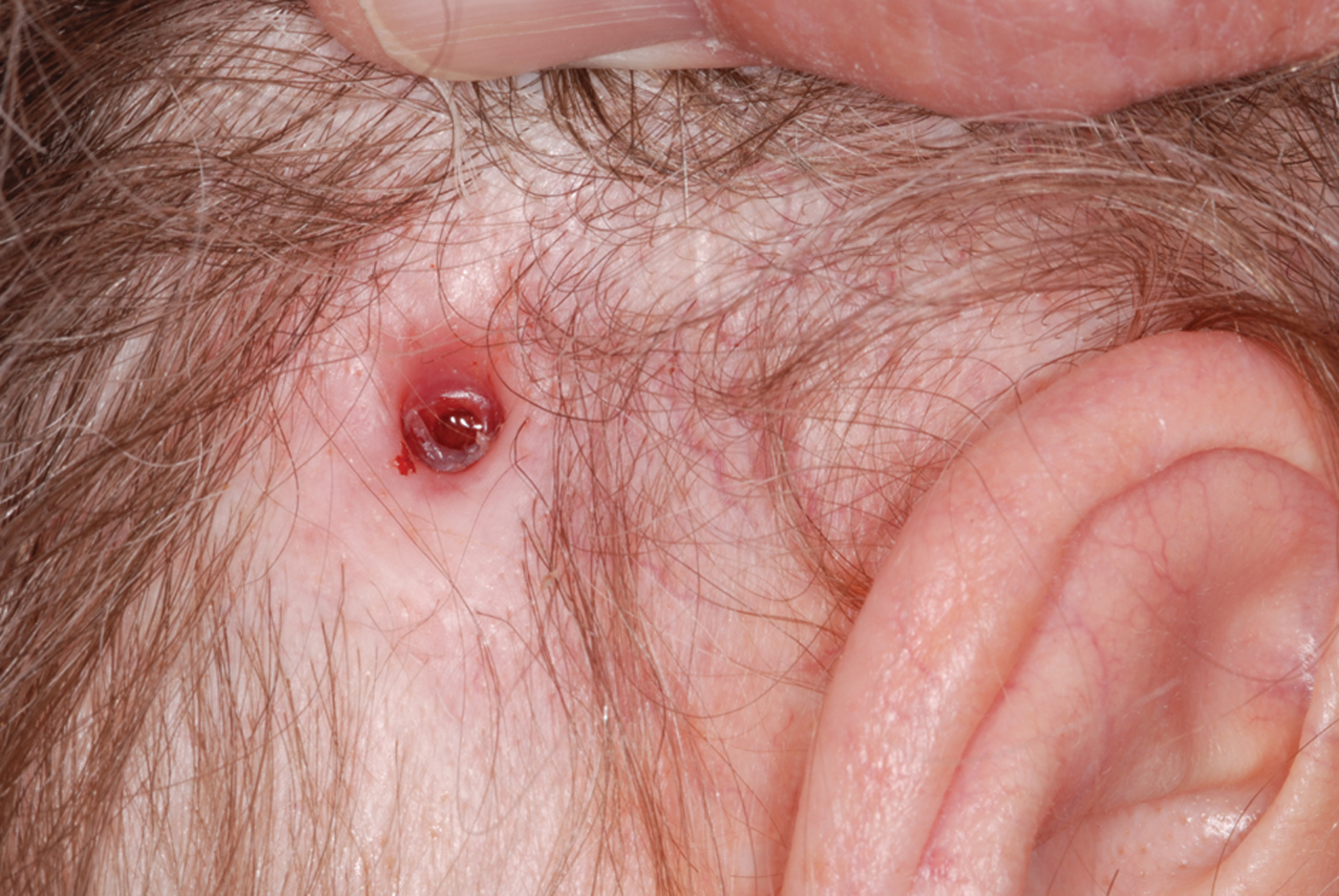
Osseointegration can be lost due to overload, torsion forces or direct trauma to the implant. Shorter implants have been shown to have a higher frequency of failure.Reference Tjellstrom and Granstrom4, Reference Granstrom, Bergstrom, Odersjo and Tjellstrom5 The aetiology of osseointegration loss is not fully understood, but known risk factors for implant failure include irradiation, chemotherapy, osteoporosis, steroid medication and diabetes mellitus.Reference Granstrom6 Skin reactions and increasing age also appear to affect the failure rate (Figure 1).Reference Albrektsson and Wennerberg3, Reference Larsson, Stalfors and Granstrom7 The quality and quantity of bone determine the forces necessary to disrupt an implant.
Patient with a retro-auricular defect, shown immediately after losing an implant due to failure of osseointegration.
The present study assessed the first 10 years of BAHA surgery at our department. The first BAHAs were fitted in 1977 by the senior author (AT), in three patients. Another 10 patients received a BAHA in 1978. During the next four years, only five patients were fitted with a BAHA. When the results proved to be both safe and audiologically satisfactory, 24 patients were fitted with a BAHA in 1983 and 38 were fitted in 1984.
This study aimed to investigate the long-term survival rate of BAHA implants. The study also investigated the incidence of patients ceasing to use their BAHA over the follow-up period.
Materials and methods
Patients who underwent BAHA surgery from September 1977 to December 1986 at Sahlgrenska University Hospital were identified using a consecutive, prospective surgical database kept by the senior author (AT). This time period was chosen to allow the maximum possible BAHA follow-up time. Patient medical records were retrieved from the hospital archives.
The following data were collected retrospectively: gender; number of implants installed and used for the BAHA; number of implants installed and left un-activated (i.e. ‘sleepers’); age at implantation; surgical indication; length of the titanium implant; whether surgery was performed as a one- or two-stage procedure; selected ear (right or left); implant failure and its cause; survival time of failed implants; and number of patients still using their BAHA at the end of the follow-up period.
The surgical method used during the study period was a two-stage procedure with a semi-circular incision, with the exception of one patient who underwent a one-stage procedure.Reference Tjellstrom, Lindstrom, Hallen, Albrektsson and Branemark8 When using the two-stage procedure, the titanium implant was placed in the bone and left to integrate for three to four months. In the second stage, a soft tissue resection was performed and the implant was equipped with an abutment.
Statistics
Kaplan–Meier analysis was used to estimate the long-term survival rate of the titanium implants and the frequency of continuous BAHA use.
Results and analysis
A total of 143 patients were fitted with a BAHA during the study period. Of these, medical records were available for 132 patients (60 male and 72 female), enabling inclusion in the study.
The follow-up time ranged from four to 349 months (i.e. 29 years), with a mean of 110 months (9.2 years) and a median of 80 months (6.7 years).
A total of 150 implants were installed and used for a BAHA. A further 23 implants were installed and left unactivated, as sleepers. One of the sleepers was subsequently activated.
Patient age at first implantation ranged from five to 81 years (mean 50 years, median 55 years). Eight of the patients were children (i.e. aged less than 16 years).
The indication for BAHA was chronic otitis media in 92 (70 per cent) patients, congenital malformations of the ear in 22 (17 per cent), otosclerosis in nine (7 per cent), external otitis in four (3 per cent) and other indications in five (4 per cent).
Of the 150 implants used for a BAHA, 16 (11 per cent) were 3 mm long and 115 (77 per cent) were 4 mm long; data were not found for the remaining 19 (13 per cent).
In 149/150 (99 per cent) of the cases, a two-stage procedure was performed. One patient underwent a one-stage procedure, performed in August 1986 as a pilot case. This implant osseointegrated successfully, but 16 months later it was removed due to unsatisfactory hearing improvement.
Of the 150 functional implants, 87 (58 per cent) were installed on the right side and 63 (42 per cent) on the left.
Forty-one implants (27 per cent) were lost during follow up. Seventeen (11 per cent) implants underwent loss of osseointegration, 16 (11 per cent) were removed and another eight (5 per cent) were lost due to direct trauma. Of the documented 3 mm implants, six of 16 (37.5 per cent) were lost; of the 4 mm implants, 30 of 115 (26 per cent) were lost.
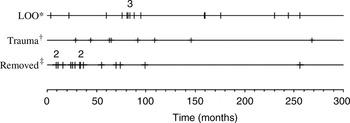
The time from implantation to implant loss for any reason ranged from 4.2 to 268 months (22.3 years), with a mean of 82.7 months (6.9 years) and a median of 65 months (5.4 years). Time to implant loss was further subdivided by cause of loss, as follows (Figure 2). For loss due to failure of osseointegration, the range for time to implant loss was 4.2–244 months (20.3 years), with a mean of 109 months (9.1 years) and a median of 85 months (7.1 years). For loss due to trauma, the range was 29–268 months (22.3 years), with a mean of 102 months (8.5 years) and a median of 78.5 months (6.5 years). For loss due to removal, the range was four to 256 months (21.3 years), with a mean of 44 months (3.7 years) and a median of 33 months (2.8 years). Of the 16 implants removed, seven (44 per cent) were removed due to unsatisfactory hearing improvement, three (19 per cent) due to skin reactions and five (31 per cent) due to a combination of both these factors. In one case, the reason for removal was not documented.
Implant loss over time, by aetiology: loss of osseointegration (LOO; 17 patients), trauma (eight patients) and removal (16 patients).

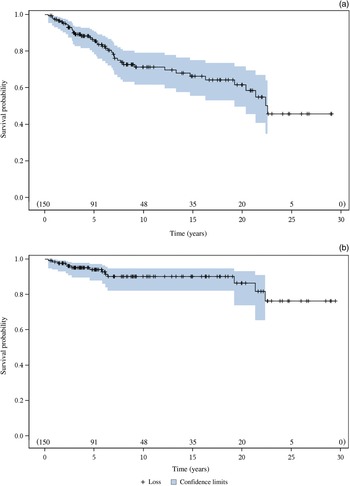
At the end of the follow-up period, 119/132 (90 per cent) patients were still using their BAHA. After 19 years, Kaplan–Meier analysis indicated that the implant survival rate was 62 per cent (95 per cent confidence interval (CI) 0.50–0.72) and the prevalence of patients still using their BAHA was 86 per cent (95 per cent CI 0.74–0.93) (Figure 3).
Survival times by Kaplan–Meier analysis, for (a) total implant survival and (b) patients with continuing bone-anchored hearing aid (BAHA) use. Data in parentheses indicate numbers with a functioning BAHA at each time point.

One patient had a sleeper implant activated (a woman aged 42 years at the time of first surgery). The indication was external otitis. Two 4 mm implants were placed on the patient's right side. The implant first in use was removed nine months after the operation due to loss of osseointegration. During the same procedure, the sleeper implant was activated.
Eight of the 150 patients were children (i.e. aged less than 16 years). Eight implants were fitted in this age group. The surgical indications for these procedures were chronic otitis media (one patient) and congenital malformation of the ear (seven patients). Of these eight implants, four were 3 mm in length and two were 4 mm; data were not found for the remaining two. In all cases, a two-stage procedure was performed. Three of the eight implants were installed on the right side and five on the left. Two implants (both 3 mm) were lost during follow up due to loss of integration, at four and 244 months, variously; both these children underwent further surgery, and were BAHA users at the end of the follow-up period.
Discussion
In our series, 41 of our 150 BAHA implants (27 per cent) were lost, a higher percentage than that reported elsewhere.Reference Proops9–Reference Mylanus, Cremers, Snik and van den Berge11 One reason for this finding may be our study's long follow-up period. Other reasons could be the impact of early, pioneering work undertaken when developing the BAHA system at our clinic, and the wide definition of implant loss used in the study.
Implant loss was caused by failed osseointegration in 16/150 cases (11 per cent). This finding is consistent with the long follow-up period of the study, as compared with other studies.
In another study conducted in our department, Reyes et al. studied a cohort of 149 patients fitted with a BAHA between 1989 and 1993.Reference Reyes, Tjellstrom and Granstrom12 Twenty-six (17 per cent) implants were lost during the zero to eight year follow-up period. Nine (6.4 per cent) implants were lost due to loss of osseointegration, 13 (8.7 per cent) were removed, and another four were lost due to trauma.
In a study by Proops, 188 patients were fitted with a BAHA from 1988 to 1996.Reference Proops9 Nineteen patients (10 per cent) lost their implants, two due to trauma and three as a result of poor hygiene. Five were primary osseointegration failures and nine were late failures.
Badran et al. assessed 165 patients undergoing 177 BAHA procedures.Reference Badran, Arya, Bunstone and Mackinnon13 The follow-up period ranged from three to 161 months (mean 50 months, median 36 months). Thirty-one implants were lost (18 per cent); 24 (13.7 per cent) losses were spontaneous and seven (4 per cent) were due to trauma.
Hobson et al. recently reported long-term follow-up results for 499 patients, showing that 23.9 per cent had suffered some kind of complication; however, only four implants were lost due to failure to osseointegrate. These figures are low compared with other studies; the reason for this was not clear in this article.Reference Hobson, Roper, Andrew, Rothera, Hill and Green14
In the present study, medical records could not be found for 11 of our 143 (8 per cent) patients. When our department's patient records were computerised in 2005, all the old paper charts were transported to a centralised archive in another town, where the charts were scanned into a computerised database on request. For our purposes, however, this system proved disadvantageous as regards chart accessibility. In the course of the present study, the process of chart identification took more than a year, after which we were still unable to locate all our patients' records. However, despite our struggle to locate our patients' medical records, our proportion of retrieved charts was still fairly high, compared with other studies.
In our patient series, 23 sleeper implants were installed, but only one was activated. Sleepers are generally used for children or patients with impaired bone quality (e.g. irradiated bone). Our study findings do not support the general use of sleeper implants. If 4 mm implants had been used instead of 3 mm ones, a better survival rate would probably have resulted, as our findings confirm earlier reports that the highest prevalence of implant loss occurs among patients fitted with 3 mm implants.Reference Granstrom15 Nowadays, 3 mm implants are rarely used; in our department, we prefer to install a 4 mm implant with bone dust between the flange and the cortical bone. An alternative method is to facilitate augmentation using a Gore-Tex® membrane.
Our study results do not elucidate why some patients lose their implants due to failed osseointegration. Whatever the reason, we observed that loss of osseointegration could, and did, occur at any point over the entire follow-up period. Holme has reported contradictory results: all this author's patients' implant losses occurred during the first nine years of a 19-year follow-up period.Reference Holme16 However, despite the high prevalence of implant loss, these patients continued as BAHA users, probably because they experienced better hearing. In a study by Ovegard and Ramstrom, the majority of BAHA users used their aid for more than eight hours a day; in contrast, the majority of patients wearing conventional hearing aids used their aids for fewer than four hours a day.Reference Ovegard and Ramstrom17 Bone-anchored hearing aid re-installation is often a relatively fast and simple procedure, as the soft tissues have already been removed and the new implant can be installed just a few millimetres from the old implant site.
The present study did not assess risk factors for implant failure, such as irradiation, chemotherapy, osteoporosis, steroid medication, diabetes mellitus and skin reactions. However, as a high frequency of implant loss was found, we believe further investigation is necessary in order to better understand the aetiology of such loss.
• The reported frequency of implant loss in bone-anchored hearing aid (BAHA) users varies from a few per cent to 18 per cent
• This study of 132 BAHA patients presents the longest follow-up time yet reported (range four months to 29 years, median 6.7 years)
• The implant loss rate was 27 per cent over the whole follow-up period; the implant survival rate after 19 years (Kaplan–Meier analysis) was 62 per cent
• At the end of follow up, 90 per cent of patients were still BAHA users
• This series' incidence of implant loss was higher than previously reported, but patients largely remained BAHA users at completion of follow-up; practical implications are discussed
In 2010, the Cochlear company introduced a new implant with properties probably more conducive to osseointegration.Reference Sennerby, Gottlow, Rosengren and Flynn18 Despite this advance, the present study raises the question of how to monitor implants with regard to osseointegration. Today, radiofrequency analysis is able to measure implant stability, but this is not a sensitive method for measuring osseointegration. In oral implants, cone beam computed tomography has been used to visualise the bone around the implant. This method can also be used for implants in the temporal bone.
We still lack techniques for restoring lost osseointegration. Both medical therapy and local therapy with regenerative medicine may be the solution when it comes to restoring osseointegration.
Acknowledgement
The authors wish to thank statistician Nils Gunnar Pehrson for assistance with the statistical analysis, and the Göteborg Medical Society and Acta Oto-Laryngologica for funding.