


1. Introduction and motivation
Variable annuity (VA) contracts are widely used accumulation and decumulation insurance products that embed living and death guarantees while preserving exposure to equity markets, thereby combining features of mutual funds and traditional life insurance. These guarantees, collectively referred to as guaranteed minimum benefits (GMBs), are typically classified into guaranteed minimum living benefits (GMLBs) and guaranteed minimum death benefits (GMDBs). This paper focuses on a prominent GMLB, the guaranteed minimum accumulation benefit (GMAB), which protects policyholders against adverse market performance by guaranteeing a minimum payoff at a prespecified maturity date. We analyze a hybrid VA contract embedded with GMAB and GMDB riders, the latter providing a guaranteed benefit in the event death occurring prior to maturity.Footnote 1 The policyholder may surrender the contract at any time before maturity, receiving the value of the underlying fund net of surrender charges designed to discourage early termination. Upon surrender, all embedded guarantees are forfeited. From a mathematical perspective, GMAB and GMDB riders resemble American-style put options.Footnote 2
Unlike traditional insurance contracts, which are typically financed upfront through lump-sum premiums or regular contributions, classical VAs are funded through proportional fees deducted from the policyholder’s investment account, which is itself linked to the underlying fund determining the moneyness of the guarantees. When the fund performs well, the insurer’s fee income increases; when it performs poorly, fee income declines. However, higher fee deductions slow the growth of the fund, increasing the likelihood that the embedded guarantees end up in-the-money. This feedback mechanism generates incentives for early surrender (Milevsky and Salisbury Reference Milevsky and Salisbury2001). A substantial body of literature shows that rational policyholders optimally surrender once the account value exceeds a critical threshold (Bernard et al. Reference Bernard, MacKay and Muehlbeyer2014b; Shen et al. Reference Shen, Sherris and Ziveyi2016; Kang and Ziveyi Reference Kang and Ziveyi2018), forcing insurers to charge higher fees to compensate for the surrender option. These higher fees further suppress fund growth, exacerbating guarantee moneyness and reinforcing surrender incentives. Such dynamics undermine the attractiveness of classical VA pricing frameworks from the policyholder’s perspective.
This paper proposes a novel two-account valuation framework that embeds traditional insurance pricing principles into VA contracts and explicitly breaks the feedback loop between fee levying and guarantee moneyness. This approach parallels equity-linked insurance, where policyholders pay a premium akin to the value of a put option required to finance the guarantee (Brennan and Schwartz Reference Brennan and Schwartz1976). Unlike traditional equity-linked insurance, our framework enables recovery of this premium upon early surrender or death, and under taxation, it is an instrument for enhancing capital gains incentives. The framework is motivated by real-world product design and mirrors contract specifications observed in the Australian market, most notably AMP’s MyNorth Investment Guarantee (North 2024).Footnote 3 Under the proposed framework, the policyholder holds two distinct accounts. Management fees linked to the underlying mutual fund are deducted from an investment account, whose performance detects the moneyness of the GMAB and GMDB riders. In contrast, insurance fees used to finance the two riders are deducted from a separate cash account, also owned by the policyholder. This separation ensures that financing of guarantees does not mechanically erode the investment account or distort its growth dynamics.Footnote 4
We show that the proposed two-account framework naturally delivers lower fair insurance fees compared to the classical framework without modifying the functional form of the fee structure, while still generating higher total fees than standalone rider offerings, which is beneficial for providers. Importantly, guarantee fees levied from the cash account are prespecified at inception and do not depend on the stochastic performance of the underlying fund. As a result, fee income becomes more predictable for insurers and less distortionary for policyholders.
Understanding lapse risk, where policyholder exits the contract before the prespecified maturity date, is critical, as unexpected surrender behavior can lead to substantial write-downs and earnings volatility for insurers (Loisel and Milhaud Reference Loisel and Milhaud2011; Moody’s Investor Service Reference Investor Service2013). Consequently, a bulk of existing studies seeks to discourage surrender through alternative contract designs. A seminal approach involves exponentially decaying surrender charges, which reduce early lapses during the initial contract years (Bernard et al. Reference Bernard, MacKay and Muehlbeyer2014b; Shen et al. Reference Shen, Sherris and Ziveyi2016; Kang and Ziveyi Reference Kang and Ziveyi2018). Despite their effectiveness, these charges still result in high fees and high surrender rates for GMAB riders (Alonso-García et al. Reference Alonso-García, Sherris, Thirurajah and Ziveyi2024).
Other approaches introduce state-dependent fees, where charges apply only when the account value falls below (or above) a specified threshold (Bernard et al. Reference Bernard, Hardy and MacKay2014a; MacKay et al. Reference MacKay, Augustyniak, Bernard and Hardy2017). While such structures can reduce surrender, they make insurer income contingent on barrier events, complicating hedging strategies (Delong Reference Delong2014). Moreover, under adverse market conditions, policyholders may never benefit from fee reductions, potentially creating incentives for insurers to maintain low fund values and raising concerns about fund manipulation (Bernard and Moenig Reference Bernard and Moenig2019). More recently, Feng et al. (Reference Feng, Jing and Ng2025) refine this idea by levying state-dependent fees only when the account value exceeds a barrier, mitigating some of these drawbacks and aligning with the optimal fee structure proposed in Wang and Zou (Reference Wang and Zou2021).
Time-dependent fee structures have also been proposed, whereby proportional fees decline after a contractually specified duration to deter surrender (Moenig and Zhu Reference Moenig and Zhu2018; Bernard and Moenig Reference Bernard and Moenig2019). Mackay and Vachon (Reference Mackay and Vachon2023) provide a unified characterization of surrender boundaries under general fee and penalty functions. Notably, all of these approaches—state-dependent, time-dependent, or general—retain the classical assumption that fees are deducted from the underlying investment account. In contrast, the two-account framework we introduce fundamentally departs from this paradigm by separating investment performance from guarantee financing. To the best of our knowledge, this represents the only alternative fee structure currently implemented in practice.Footnote 5
Mitigating the sharp fee increases caused by surrender can be achieved by incorporating taxation into VA valuation, a friction known to materially affect financial decision-making (Milevsky and Panyagometh Reference Milevsky and Panyagometh2001; Brown and Poterba Reference Brown and Poterba2006; Souleles Reference Souleles1999). Tax incentives have been shown to increase insurance demand (Gruber and Poterba Reference Gruber and Poterba1994; Gentry and Rothschild Reference Gentry and Rothschild2010) and, depending on design, improve welfare (Chen et al. Reference Chen, Hieber and Nguyen2019). In the VA context, accounting for taxation reconciles discrepancies between empirical and theoretical fair fees (Moenig and Bauer 2015). Subsequent studies examine tax timing (Ulm Reference Ulm2018), stochastic interest rates (Molent Reference Molent2020), and alternative tax regimes (Alonso-García et al. 2024). We extend this literature by analyzing taxation in a setting where capital losses can offset gains. Taxation applies upon surrender or maturity but not to death benefits (DBs), and proceeds become tax-free beyond a preservation age, as in jurisdictions such as Australia and Belgium (Australian Taxation Office 2024; Belgian Finance Federal Service 2024). We show that taxation interacts strongly with surrender incentives under the two-account framework.
We analyze pricing from the policyholder’s perspectiveFootnote 6 and demonstrate that the fair fees depend crucially on the valuation framework. The two-account framework yields substantially lower fair fees than the classical framework, primarily because guarantee fees are no longer linked to the stochastic performance of the underlying fund. While surrender substantially increases fees under both frameworks, the effect is markedly weaker under the two-account structure. When taxation is present, fee increases are further attenuated, as taxation reduces the net value of surrender and maturity payoffs. We find that surrender boundaries remain largely unchanged when taxation is unavoidable (i.e., when all proceeds are received before the preservation age). In contrast, when proceeds can be accessed tax-free after the preservation age, surrender is strongly discouraged prior to that point.
This paper studies fair fees and policyholder behavior under both the classical and the two-account valuation frameworks for bundled and standalone riders. The contract guarantees the return of the initial premium or a rolled-up value either at maturity or upon the policyholder’s death. The existing literature predominantly focuses on standalone GMxB riders, with notable exceptions such as Milevsky and Salisbury (Reference Milevsky and Salisbury2001) and Bacinello et al. (Reference Bacinello, Millossovich, Olivieri and Pitacco2011), who study bundled GMAB–GMDB products, and MacKay et al. (Reference MacKay, Augustyniak, Bernard and Hardy2017), who study bundled arrangements with state-dependent fees. Bauer and Moenig (Reference Bauer and Moenig2023) examine the bundling of guaranteed minimum withdrawal benefits (GMWBs) with GMDB riders and show that attaching a DB can disincentivize early surrender when taxation is considered. In the spirit of Bacinello et al. (Reference Bacinello, Millossovich, Olivieri and Pitacco2011), we analyze both bundled and standalone GMAB and GMDB products within a novel framework that jointly incorporates a two-account fee structure and taxation.
Our numerical analysis, aided by the method of lines algorithm (Meyer and Van der Hoek Reference Meyer and Van der Hoek1997; Kang and Ziveyi Reference Kang and Ziveyi2018), reveals several key findings. First, hybrid GMAB–GMDB contracts deliver substantially higher DB value than standalone designs—up to 2.5–5 times (6–33 times) greater without (with) surrender options. This premium reflects natural mortality hedging: as death probability increases, GMDB value rises while GMAB value falls, stabilizing total contract value. Second, the two-account framework exhibits remarkable robustness to mortality misspecification. While doubling the force of mortality from 2.5% to 4.5% doubles and quadruples standalone GMDB fees in classical and two-account cases, respectively, hybrid fees increase by only 10%. Each 50-bp mortality increase raises two-account hybrid fees by merely 5 bp versus 20 bp in classical designs. This stability arises from separating investment performance from guarantee financing, making the contract less sensitive to mortality dynamics. Third, hybridization consistently yields higher total fees than the sum of standalone riders across both frameworks, though this non-additivity is more pronounced in classical designs where fees erode the guarantee base. Together, these findings demonstrate that the two-account hybrid structure provides a more resilient contract design—one that balances policyholder value with insurer stability under realistic surrender and taxation scenarios.
The remainder of the paper is structured as follows. Section 2 introduces the proposed two-account valuation framework for hybrid VA contracts with accumulation benefit (AB) and DB and compares it with the classical framework. Section 3 presents numerical experiments assessing fair fees and policyholder behavior under both frameworks for bundled and standalone products. Concluding remarks are presented in Section 4.
2. VA embedded with GMAB and GMDB riders
This section presents the basic two-account architecture through a toy example and a detailed valuation framework for the hybrid VA contract embedding an AB and DB. This section also presents details on the valuation for the standalone GMAB and GMDB for comparison purposes.
2.1. Two-account setting
In this paper, we consider a hybrid VA contract embedded with GMAB and GMDB riders. Policyholder’s proceeds are subject to taxation only if surrender or maturity payments are received before a prespecified age denoted here as the preservation age.Footnote 7 This VA contract promises the return of the premium paid by the policyholder, or a higher rolled-up value, at the end of the investment period or upon policyholder’s death.
The pricing architecture is novel as it considers a two-account setting where the policyholder opens an investment account and a cash account as part of the VA contract. Management fees associated with being invested in the underlying mutual fund and transactional and operational costs are deducted from the investment account through
 $q_m$
, while guarantee fees
 $q_g$
which the insurers uses for financing the embedded GMAB and GMDB riders are deducted from the cash account. We denote this a two-account framework. However, as discussed in the introduction, majority of existing literature considers valuation frameworks where all such fees are deducted from the investment account.Footnote
8
We denote this the classical framework.Footnote
9
In particular, the classical framework is a special case of our two-account framework when
 $q_g=0$
and the proportional
 $q_m$
serves to finance both the management and guarantee fees.
We consider a policyholder investing an initial amount x(0) into a mutual fund and promised the greater of the minimum guarantee
 $G(\delta) = Ge^{\delta T}$
, where G is equal to x(0) in our setting, and the fund value. To be consistent with reality, we also assume that the policyholder can surrender the contract any time prior to maturity. In the event of early surrender, a penalty fee will be levied to the investment account as presented in the next subsection. We are interested in exploring how this novel pricing framework affects valuation and policyholder behavior. We are also interested in assessing the incentive to delay surrender through reduced taxation beyond preservation age for both valuation schemes.
Let
 $(\Omega,\mathcal{F},\mathbb{Q})$
be a complete probability space representing an arbitrage-free financial market where
 $\mathcal{F}$
is the
 $\sigma$
-algebra generated by the Brownian motion driving the dynamics of the underlying fund. Let
 $F(\nu)$
be the underlying fund whose risk-neutral dynamics are detected by the geometric Brownian motion (GBM) as
 \begin{align} dF(\nu) = rF(\nu) d\nu + \sigma F(\nu) dW(\nu),\end{align}
where
 $r\gt0$
is the risk-free rate and
 $\sigma\gt0$
is the volatility of the fund with dW(t) being increments of a Brownian motion process.Footnote
10
The investment component of the VA,
 $x(\nu)$
, can be expressed as
 \begin{align}x(\nu) = e^{-q_m \nu}F(\nu),\end{align}
where
 $q_m$
is the continuously compounded management fee rate. Applying Ito’s Lemma to the process
 $x(\nu)$
yields the following fund dynamics:
 \begin{equation} dx(\nu) = (r-q_m)x(\nu) d\nu + \sigma x(\nu) dW(\nu).\end{equation}
The embedded GMAB and GMDB are financed through
 $q_g$
from a separate cash account. The cash account earns interest at the continuously compounded risk-free rate r and funds a continuously paid fee of
 $q_g G e^{\delta \nu}$
. This of course corresponds to fees being proportional to the benefit base, which in this case is a rolled-up maturity benefit. Since the guarantee and the risk-free rate r are deterministic, the same applies to the cash account.
The cash account, c(0), needs to be set aside at inception, since it represents the present value of the fees for the entire duration of the contract. In other words, the policyholder at inception pays c(0) on top of the initial amount x(0) which is invested in the underlying. This structure resembles a lump-sum insurance premium paid at underwriting. However, contrary to classic lump-sum insurance, the policyholder does not “lose” the full value of the premium but receives the unused cash balance upon early surrender or death. Hence, the policyholder only pays in practice the guarantee fees for the period they are invested in the contract. Given the above-mentioned dynamics, it is obvious that c(0), for
 $\delta\neq r$
, is simply represented by the present value of future fees as follows:
 \begin{align} c(0)&=\int_0^T e^{-rs}q_g G e^{\delta s} ds=q_g G\frac{e^{(\delta -r)T}-1}{\delta -r}.\end{align}
After
 $\nu$
years, the initial value of the cash account is reduced by the accumulated fees paid between 0 and
 $\nu$
, yielding the following cash account evolution:
 \begin{align} c(\nu)&=c(0)e^{r\nu}-\int_0^\nu e^{r(\nu-s)}q_g G e^{\delta s} ds=e^{r \nu }\int_\nu^T q_g G e^{ (\delta - r) s} ds \nonumber \\[3pt]&= q_g G e^{ \delta \nu} \frac{ e^{ (\delta - r)(T-\nu )} - 1}{ \delta - r}=q_g G e^{\delta \nu}\frac{ e^{ (\delta - r)(T-\nu )} - 1}{ \delta - r}.\end{align}
If
 $\delta=r$
, the expressions of c(0) and
 $c(\nu)$
simplify to:
 \begin{align} c(\nu)&=\left\{\begin{array}{ll} \int_0^T q_g Gds=q_g\cdot G\cdot T & \mbox{if } \nu=0\\ &\\ c(0)e^{r\nu}-\int_0^\nu e^{r(\nu-s)}q_g G e^{\delta s}ds=e^{r \nu }q_g\cdot G \cdot(T-\nu)& \mbox{if } \nu \lt T. \end{array}\right.\end{align}
Obviously,
 $c(T)=0$
as all guarantee fees have been paid as expected. Finally, the dynamics of the cash account yield the following ordinary differential equation (ODE):
 \begin{equation}dc(\nu) = rc(\nu) d\nu - q_g G e^{\delta \nu}d\nu,\end{equation}
with terminal condition
 $c(T)=0$
. The total value of the VA contract to the policyholder at any instant can then be represented as the sum of the cash account and the two GMB riders.
Illutrative evolution of the cash account.

Example 2.1
(Toy example of a account structure in presence of taxation). To aid in understanding the framework, we present an illustrative example below. Assume an initial investment
 $ x(0) = G = 100$
, a guaranteed growth rate
 $ \delta = 0$
, a guarantee fee rate
 $ q_g = 0.005$
, and a typical contract maturing in
 $ T = 10$
years. The policyholder sets up a cash account with an initial value of
 $ c(0) = 4.32$
. At maturity,
 $ c(T) = 0$
.
This cash account decreases at a rate of
 $ q_g G$
per year while earning risk-free interest at a rate r, as described in Equation (2.5). Figure 1 shows the evolution of the cash account for
 $\nu\in[0,T]$
, while Table 1 illustrates the cash flows associated with the cash account.
We analyze two scenarios: one in which the policyholder remains until maturity and another involving early surrender. In the event of early surrender, the policyholder receives the remaining balance in the cash account and can claim the reduction as a tax loss [Item (f)]. Item (i) in the table represents the surrender boundary value for the investment account x.
It is important to note that, in the classical case, there would be no cash account (d) and therefore no associated capital loss (f). Consequently, the total payout (j) would equal the investment account payout (i). Specifically, assuming the same fund value, Footnote 11 our toy example under the classical pricing framework would yield total payouts (j) of 114.00 and 106.30 for the maturity and surrender cases, respectively.
Illustrative example with cash flows associated with the cash account. We consider a VA contract with maturing in 10 years,
 $\delta = 0$
,
 $g_q=0.005$
,
 $r=3\%$
, and
 $c(0)=4.32$
corresponding to the initial investment in the cash account.

Table 1 Long description
A table comparing financial values and payouts for a variable annuity contract under two scenarios: held until maturity and surrendered at t=7.5. The table has 10 rows and 3 columns. Column headers are 'Item', 'Held until maturity', and 'Surrender at t=7.5'. Row labels include 'Fund value at commencement (a)', 'Fund value at termination (b)', 'Surrender penalty (c)', 'Cash account payout (d)', 'Capital gain on inv acc [b-c-a=e]', 'Capital loss on cash acc [c(0)-d=f]', 'Net taxable income [e-f=g]', 'Tax paid [0.30*g=h]', 'Inv account payout [b-c-h=i]', and 'Total payout [i+d=j]'. Each row provides specific values for both scenarios. Notable trends include higher values in the 'Held until maturity' column compared to the 'Surrender at t=7.5' column, indicating better financial outcomes for holding the contract until maturity.
Notes: *An arbitrary surrender penalty is used for illustrative purposes.
2.2. Valuation framework: hybrid VA contract
In this section, we present the valuation framework for a VA embedded with GMAB and GMDB riders where taxes on the surrender or maturity value are due before reaching the preservation age of 60 years.Footnote
12
Adapting MacKay et al. (Reference MacKay, Augustyniak, Bernard and Hardy2017), the VA contract for a policyholder aged
 $\alpha$
at inception of the contract is denoted as
 $V(\nu,x)$
with
 $\nu$
being the current time and x being the value of the underlying.
We assume that the force of mortality is deterministic but age- and time-dependent as in Milevsky and Posner (Reference Milevsky and Posner2001) and MacKay et al. (Reference MacKay, Augustyniak, Bernard and Hardy2017). Examples of such models are exponential or the well-known Gompertz and Makeham model (Carriere Reference Carriere1992). We denote the force of mortality for someone aged
 $\alpha+s$
at time s by
 $\lambda(s)$
which corresponds to the actuarial notation
 $\mu_{\alpha+s}(s)$
.Footnote
13
Similarly to Ignatieva et al. (Reference Ignatieva, Song and Ziveyi2016), we assume that
 $\lambda(s)=\lambda^{\mathbb{P}}(s)=\lambda^{\mathbb{Q}}(s)$
, where
 $\lambda^{\mathbb{P}}(s)$
and
 $\lambda^{\mathbb{Q}}(s)$
are the force of mortality for an individual aged s.Footnote
14
With this in mind, we can then express the full value of the contract, including the cash account, as:
 \begin{align}\nonumber V(\nu, x(\nu)) =\sup_{\nu\leq\epsilon^{*}\leq T}\mathbb{E}_{\mathbb{Q}}\Bigg[& e^{-\int_{\nu}^{\epsilon ^{*}} (r+ \lambda (s)) ds} g(\epsilon^{*},x(\epsilon^{*})) \\ &+\int_\nu ^{\epsilon ^*} \lambda(s) e^{-\int_\nu ^s (r + \lambda(s')) ds'} \big( \mathcal{D}(s,x(s))+ c(s)\big)ds | \mathcal{F}_{\nu} \Bigg], \end{align}
where
 $\mathcal{D}(s,x(s))$
denotes the DB and
 $g(\cdot,\cdot)$
represents the life contingent cash flows liable upon surrender or maturity:
 \begin{equation} g(\nu,x(\nu)) = c(\nu) + \begin{cases} \mathcal{S}(\nu,x(\nu)) & \nu \lt T, \\ \mathcal{M}(T,x(T)) & \nu=T, \end{cases}\end{equation}
with
 $\mathcal{S}(\nu,x(\nu))$
and
 $\mathcal{M}(T,x(T))$
denoting the surrender and maturity benefits, respectively. In particular, the maturity, surrender and DBs in our framework are given by:
 \begin{align} \mathcal{M}(T,x(T)) &= \max\left(G\cdot e^{\delta T},x(T)\right)-\tau\unicode{x1D7D9}_{\alpha+T \lt60} \big(\!\max\left(G\cdot e^{\delta T},x(T)\right) - x(0) - c(0)\big), \end{align}
 \begin{align} \mathcal{S}(\nu,x(\nu)) &= x(\nu)e^{-\kappa (T-\nu)} -\tau\unicode{x1D7D9}_{\alpha+\nu \lt60} \big(x(\nu)+ c(\nu) - x(0) - c(0)\big), \end{align}
 \begin{align} \mathcal{D}(\nu,x(\nu)) &= \max(G\cdot e^{\delta \nu},x(\nu)),\end{align}
where
 $ \kappa$
corresponds to the surrender penalty on the underlying, implying an exponentially decreasing surrender fee structure as in Kang and Ziveyi (Reference Kang and Ziveyi2018). In other words,
 $(1-e^{-\kappa (T-\nu)})$
represents the proportional surrender charge often depicted in retail products. In Equations (2.10) and (2.11),
 $\tau$
is the taxation rate which is applied conditional on the policyholder being below the preservation age.Footnote
15
For illustrative purposes, we adopt this to be 60 in this paper.
It is worth emphasizing that, while the cash account has a nominal face value of
 $ c(\nu)$
at time
 $ \nu$
, this does not represent its fair value to the policyholder. This discrepancy arises because fees are continuously deducted from the cash account, and it cannot be withdrawn by the policyholder without surrendering the entire contract. Thus, although the cash account is still payable in full (without any direct surrender penalty) upon surrender or death, there is an indirect surrender penalty in the sense that the main fund must also be surrendered to access the auxiliary cash account.
Using arguments akin to Jacka (Reference Jacka1991) or considering the drift of the stochastic process
 $V(\nu,x(\nu))$
as presented in Supplementary Material S.1, it can be shown that in the continuation region, V satisfies the following partial differential equation (PDE):Footnote
16
 \begin{equation}V_{\nu} + x(r-q_m)V_x+\frac{1}{2}V_{xx}\sigma ^2 x^2 -(\lambda(\nu) + r)V + \lambda(\nu )[D(\nu, x(\nu)) + c(\nu)] = 0,\end{equation}
subject to the boundary conditions
 \begin{align}V(T,x(T)) &= g(T,x(T)) = \mathcal{M}(T,x(T)), \end{align}
 \begin{align}V(\nu,s(\nu)) &= g(\nu,s(\nu)) = \mathcal{S}(\nu,s(\nu)) + c(\nu), \end{align}
 \begin{align}V_x(\nu,s(\nu)) &= g_x(\nu,s(\nu)) = \mathcal{S}_x(\nu,s(\nu)), \end{align}
 \begin{align}V(\nu,0) &=\mathcal{T}(\nu)\end{align}
 \begin{align}\,:&\!=\, \sup_{\nu\leq\epsilon^{*}\leq T} \left[ e^{-\int_{\nu}^{\epsilon^{*}} (r+ \lambda (s)) ds} g(\epsilon^{*},0) + \int_{\nu} ^{\epsilon^{*}}\lambda(s) e^{-\int_\nu ^s (r + \lambda (s')) ds'} \big( \mathcal{D}(s,0)+ c(s)\big)ds \right]\!,\end{align}
where s(t) is the early exercise boundary such that the contact is surrendered if and only if
 $x(t) \geq s(t)$
. Boundary condition (2.14) specifies the condition at maturity T, whereas Equations (2.15) specifies the surrender value. Equation (2.16) enforces the continuity of
 $V_x$
at the boundary. Finally, Equation (2.18) indicates the value of the product when the underlying becomes 0.Footnote
17
We note that both
 $q_m$
and
 $q_g$
appear in Equations (2.13) through
 $x(\nu)$
and
 $c(\nu)$
. For the combined rider, the fair fees
 $q_g$
and
 $q_m$
are determined by setting the total expected value of the insurance product equal to the initial premium
 $x(0)+c(0)$
. As there are two free parameters, the pricing problem is underdetermined. In other words, there are an infinite set of combinations of
 $q_g$
and
 $q_m$
that could deliver a fair contract. Thus, to compute these fees in the two-account case, one would first need to fix an arbitrary value of
 $q_m$
and then back-solve to determine
 $q_g$
as follows:
 \begin{align}q^*_g=\min\left\{q\,:\,x(0)+c(0)=V(0,x(0))\right\}.\end{align}
This process is then repeated for different values of
 $q_m$
to assess its sensitivity. Obviously, since we are pricing from the policyholder’s perspective, the policyholder will look to minimize their fair fee to enter the contract.
We further note that the fair fees are determined from the policyholder’s (risk-neutral) perspective rather than the insurer’s perspective, as in Alonso-García et al. (Reference Alonso-García, Sherris, Thirurajah and Ziveyi2024) and Bauer et al. (Reference Bauer, Gao, Moenig, Ulm and Zhu2017).Footnote 18 In short, the policyholder’s valuation is a free-boundary exercise, whereas the liability from the insurer’s perspective is defined by a fixed surrender boundary and is not netted by tax. The policyholder is assumed to evaluate the attractiveness of the contract on a standalone basis rather than relative to other existing life or savings products in the market.
In the two-account case, setting
 $q_m = 0\%$
means that the policyholder pays
 $x(0) + c(0)$
at inception to invest x(0) in the investment account, which has an average growth rate of r in the risk-neutral world, with the promise of receiving unused fees through
 $c(\nu)$
upon surrender. This can be compared to the classical case, where
 $q_g = 0\%$
and the policyholder pays x(0) to invest x(0) in the investment account, which then grows at a much slower pace (
 $r - q_m$
) as
 $q_m$
fees are continuously deducted. In both cases, the same initial amount x(0) is invested in the risky asset, and the same death and maturity guarantees are provided, as
 $G(\delta)$
depends solely on x(0). The major difference in valuation arises from the varying growth rates of the underlying due to
 $q_m$
, making the guarantee more or less attractive and consequently affecting
 $q_g$
in the two-account case.
Finally, let us focus on the case when early exercise is not permitted. Then, the value of the contract can be expressed as:
 \begin{align} \nonumber V^{\text{NE}}(\nu, x(\nu)) &=\mathbb{E}_{\mathbb{Q}}\Big[ e^{-\int_{\nu}^{T} (r+ \lambda (s)) ds} \mathcal{M}(T,x(T)) \\ &\quad \quad \quad \quad +\int_\nu ^{T} \lambda(s) e^{-\int_\nu ^s (r + \lambda(s')) ds'} \big( \mathcal{D}(s,x(s))+ c(s)\big)ds | \mathcal{F}_{\nu} \Big],\end{align}
where
 $V^{\text{NE}}$
obeys the same PDE as V in the continuation region (i.e., Equation (2.13)). Likewise, the terminal condition Equation (2.14) also applies since it is not dependent on the option to surrender. Equation (2.18) in this case is rewritten without the supremum.Footnote
19
2.3. Valuation framework: standalone accumulation and death riders
Whenever standalone riders are considered, few adjustments to benefit Equations (2.10)–(2.12) have to be made. In this case, we simply take particular cases of the general framework removing the guarantee floors on the maturity benefit
 $\mathcal{M}$
(Equation (2.10)) and DB
 $\mathcal{D}$
(Equation (2.12)) payouts where applicable. In other words, Equations (2.10) and (2.12) become
 \begin{align}\small \mathcal{M}(T,x(T)) &= \begin{cases} \max\left(G\cdot e^{\delta T},x(T)\right)-\tau\unicode{x1D7D9}_{\alpha+T \lt60} \big(\max\left(G\cdot e^{\delta T},x(T)\right) - x(0) - c(0)\big) & \text{GMAB,} \\ x(T) - \tau\unicode{x1D7D9}_{\alpha+\nu \lt60}\big( x(T) - x(0) - c(0)\big) & \text{no GMAB,} \end{cases}\end{align}
 \begin{align} \mathcal{D}(\nu,x(\nu)) &= \begin{cases} \max(G\cdot e^{\delta \nu},x(\nu)) & \text{GMDB,} \\ x(\nu ) & \text{no GMDB.} \\ \end{cases}\end{align}
Hence, for a pure GMAB, we have the general valuation Equation (2.8) with a maturity benefit as in (2.10), surrender value (2.11), and payment of
 $c(\nu)+x(\nu)$
upon death. The pure GMDB follows the value function in Equation (2.8) with a maturity benefit equal to x(T), surrender value (2.11), and a payment of
 $\max(G\cdot e^{\delta \nu},x(\nu))+c(\nu)$
upon death. Hence, the underlying is always recovered, albeit without guarantees upon death or maturity for the GMAB and GMDB standalone riders, respectively. This aligns with Bacinello et al. (Reference Bacinello, Millossovich, Olivieri and Pitacco2011) and Bauer et al. (Reference Bauer, Kling and Russ2008), among others. Standalone fees will be compared to the general hybrid case in Subsection 3.4.
2.4. Discounted value of the continuous insurance fee
Akin to Milevsky and Salisbury (Reference Milevsky and Salisbury2001), we are interested in calculating the discounted value of the continuous insurance fees under the classical and two-account frameworks to determine a framework in which policyholders are liable to paying higher fees in expectation. Recall that fees are levied differently in the classical framework compared to the two-account setting. In the former, a fee
 $q^*_m$
covering administrative and guarantee fees is levied continuously from the underlying x, whereas in the two-account a chosen administrative fee
 $q_m$
is charged on the underlying, whereas the fee
 $q_g$
is deducted from an external cash account. Propositions 2.2 and 2.3 provide the expressions of the present value of the fees collected from inception until time t under the classical and two-account framework, respectively. Corollary 2.4 show the conditions under which the classical case is more expensive than the two-account case.
Proposition 2.2
(Fees in the case). In the classical case, the present value of fees collected from inception until time
 $\nu$
can be expressed as:
 \begin{align} I^{\text{c}}(\nu)&=x(0)-e^{-r\nu}x(\nu)+\int_{0}^{\nu}e^{-rs}\sigma x(s) dW(s), \end{align}
and the associated expected value under the risk-neutral measure is given by:
 \begin{align} \mathbb{E}_{\mathbb{Q}}[I^{\text{c}}(\nu)]=x(0)\left(1-e^{-q^*_m\nu}\right)\!,\end{align}
with
 $q^*_m$
being the fair fee obtained under the classical framework.
Proof. Refer to Appendix A.1.
Proposition 2.3
(Fees in the account case). In the two-account case, the present value of fees collected from inception until time
 $\nu$
when
 $\delta\neq r$
can be expressed as:
 \begin{align} I^{\text{ta}}(\nu)&=q^*_g G\frac{e^{(\delta -r)\nu}-1}{\delta -r}+I^{\text{c}}(\nu), \end{align}
with
 $I^{\text{c}}(\nu)$
given by Equation (2.23) for a chosen
 $q_m$
and the associated expected value under the risk-neutral measure is given by:
 \begin{align} \mathbb{E}_{\mathbb{Q}}[I^{\text{ta}}(\nu)]=x(0)\left(q^*_g\frac{e^{(\delta -r)\nu}-1}{\delta -r}+1-e^{-q_m\nu}\right)\!, \end{align}
with
 $q^*_g$
being the policyholder optimal fair fee obtained under the two-account framework and
 $q_m$
a chosen administrative fee levied from the underlying.
Proof. Refer to Appendix A.2.
Corollary 2.4. The expected value under the risk-neutral measure of total value of fees levied until
 $\nu$
is greater in the classical case, compared to the two-account case if
 \begin{align} q^*_m&\geq q^*_g+q_m. \end{align}
where
 $q^*_m$
is the classical framework optimal fair fee,
 $q^*_g$
is the two-account framework optimal fair fee and
 $q_m$
is a chosen administrative fee charged under the two-account framework.
Proof. Refer to Appendix A.3.
Hence, if the optimal fair fee
 $q^*_m$
under the classical case is greater than the sum of the optimal guarantee fair fee
 $q^*_g$
, charged through the cash account, and the fixed administrative fee
 $ q_m $
, levied continuously on the underlying in the two-account case, we can conclude that the classical framework will be more expensive in expectation.Footnote
20
3. Numerical results
This section presents a series of numerical experiments aimed at providing insights into the valuation and policyholder behavior under the classical and two-account frameworks. First, we provide details on the base case parameters used in the numerical illustration in Subsection 3.1. Next, we discuss the interplay between management fees
 $q_m$
, which are levied from the investment account, and guarantee fees
 $q_g$
, which are deducted from the cash account, in Subsection 3.2. Through this analysis, we establish optimal fee structures from the policyholder’s perspective that render the contracts profitable.
Subsequently, in Subsection 3.3, we explore how optimal surrender boundaries behave in both the classical and two-account settings for the base case with bundled riders. Finally, Subsection 3.4 compares the fair fees for standalone GMAB, GMDB, and bundled contracts, showing that, while the GMDB is not as attractive on a standalone basis, it offers significant value when bundled with a GMAB. We also examine the optimal surrender boundaries in the classical and two-account settings when riders are unbundled.
3.1. Numerical implementation of the valuation framework
In solving Equation (2.13), we employ the numerical method of lines algorithm which is known for its efficiency in terms of computational speed and accuracy (Meyer and Van der Hoek Reference Meyer and Van der Hoek1997; Chiarella et al. Reference Chiarella, Kang, Meyer and Ziogas2009; Kang and Ziveyi Reference Kang and Ziveyi2018). A numerical solution is accomplished by first truncating to the computational domain of x to [0,X] where X is chosen sufficiently large to cover all feasible fund values and then discretizing the t domain, with continuity maintained in x as is usual for the method of lines. The time domain is discretized into equally spaced subintervals from inception to maturity, T. A description of the procedure for implementing the method of lines algorithm has been relegated to Supplementary Material S.2. For all numerical experiments which follow, we will use the base parameters in Table 2 for the hybrid (GMAB+GMDB benefit) unless stated otherwise.
Base case parameters for numerical illustrations. All figures presented use these parameters unless otherwise stated. Here,
 $q_g$
is omitted since it is uniquely determined as part of the valuation exercise.

Table 2 Long description
A table with two columns and twelve rows. The first column lists parameters and the second column lists their corresponding values. The parameters include x0, sigma, r, delta, qg, T, kappa, tau, qm, and lambda. The values are 1, 0.20, 0.03, 0.015, n.a., 5, 10, 15, 0.001, 0.225, 0.005, and 0.01 (alpha = 55), 0.02 (alpha = 60).
For Australia, we select r based on the historical average of the cash rate in Australia, from 2009 to 2018, and
 $\sigma$
based on ASX200 VIX, from 2009 to 2018.Footnote
21
The marginal tax rate
 $\tau$
is calculated based on the
 $0.45$
marginal income tax rate, multiplied by the discount of
 $0.50$
for capital gains (before the preservation age).Footnote
22
This is the case for such investments in the Australian tax system (Australian Taxation Office 2018). We choose
 $\kappa=0.1\%$
which aligns with the literature where this value is typically considered between 0 and 0.5% (Bernard et al. Reference Bernard, MacKay and Muehlbeyer2014b; Kang and Ziveyi Reference Kang and Ziveyi2018; Alonso-García et al. 2024).Footnote
23
The roll-up rate is based on the assumption that
 $\delta \leq r $
to avoid arbitrage.Footnote
24
The particular value of 1.5% has been chosen as the average of the return-on-premium
 $\delta=0\%$
and the risk-free rate
 $r=3\%$
. Sensitivities to r,
 $\sigma$
, and
 $\kappa$
are discussed in Appendix B.
For the method of lines algorithm, spacing in the x grid is chosen as
 $\Delta x = 10^{-4}$
and each subinterval in the t grid is
 $\Delta t = 10^{-3}$
. The upper limits of the x grids are set to be four times the strike, that is,
 $X = 4G$
. Justification of grid selection is provided in Alonso-García et al. (Reference Alonso-García, Sherris, Thirurajah and Ziveyi2024). We consider an exponential mortality model from Carriere (Reference Carriere1992) with a constant mortality rate which is lower policyholders aged
 $x=55$
than those aged
 $x=60$
.
3.2. Interplay of management and guarantee fees
Our two-account framework includes two fees charged by the insurer. The first is the management fee,
 $ q_m$
, which covers administrative and investment expenses and is proportional to the underlying. The second is the guarantee fee,
 $ q_g$
, charged from a separate cash account to fund the guarantee at maturity or as a DB. Intuitively, as
 $ q_m$
increases, the policyholder’s fair
 $ q_g$
should decrease, since policyholders are paying more for the product through administrative fees deducted from the investment account. However, higher
 $ q_m$
also increases the guarantee’s value due to lower investment returns net of the fee. Thus, examining the interplay between management and guarantee fees is crucial.
Scenarios considered for analyzing the interplay of management and guarantee fees in the numerical experiments.

Table 3 Long description
A table comparing scenarios for analyzing the interplay of management and guarantee fees. The table has two rows and six columns. Column headers are Scenario, Valuation, Surrender, Tax, Scenario, Valuation, Surrender, Tax. Row 1: 1a, Classical, No, No, 1b, Two-account, No, No. Row 2: 2a, Classical, Yes, No, 2b, Two-account, Yes, No. Row 3: 3a, Classical, No, Yes, 3b, Two-account, No, Yes. Row 4: 4a, Classical, Yes, Yes, 4b, Two-account, Yes, Yes.
To assess the impact of surrender, taxation, and the novel two-account framework, we investigate the scenarios in Table 3. Under classical valuation, where
 $ q_g = 0$
, all guarantee financing costs are covered by fair fee
 $q^*_m$
, which is proportional to the stochastic underlying fund. In the two-account setting, as outlined in Subsection 2.1, fair fee
 $q^*_g$
is paid from the cash account, which earns a deterministic risk-free rate, while
 $q_m$
is a chosen parameter proportional to the underlying. If
 $q_m = 0$
, the fair fee depends solely on
 $q^*_g$
and the cash account. For the two-account case, we assume
 $ q_m = 0.5\%$
.Footnote
25
We calculate the fees for a policyholder aged either 55 or 60. For the former, taxation will affect their gains since their contract starts before the preservation age of 60. For a policyholder aged 60, no taxation will apply, as they are within the preservation age. Table 4 presents the fair fees for all scenarios from Table 3. We observe that
 $q^*_m$
in the classical case is much higher than in the two-account case. The observed fair fee reduction in all scenarios is associated with the guarantee moneyness under the two-account setting. As guarantee fees are levied outside the investment account, the two-account pricing architecture increases the expected accumulation of the underlying investment fund, making the guarantees being deep-out-of-the-money and therefore cheaper under risk-neutral valuation. For instance, for
 $T = 15$
,
 $q^*_m = 5.60\%$
in the classical setting, whereas in the two-account setting,
 $q^*_g = 1.48\%$
and
 $q_m = 0.5\%$
for a policyholder aged 55 with no tax and when surrender is allowed. This is further exacerbated by the guarantee level
 $\delta$
, with fair fee increases being greater for higher levels of guarantee attractiveness, proxied by the roll-up rate
 $\delta$
(Table 5).Footnote
26
Fair fees (in
 $\%$
):
 $q^*_m$
for Scenarios 1a–4a and
 $q^*_g$
for an assumed
 $q_m=0.5\%$
for Scenarios 1b–4b.

Table 4 Long description
A table comparing fair fees for different scenarios and ages at inception. The table has 8 rows and 10 columns. The columns are labeled 'Scenario', 'Surr.', 'Tax', and 'Age at inception' with sub-columns '55' and '60'. Under each age, there are sub-columns for 'Maturity' with values '5', '10', and '15'. The row labels include scenarios 1a to 4b with combinations of 'Surr.' (Surrender) and 'Tax' (Tax) as 'Y' (Yes) or 'N' (No). Row 1: Scenario 1a, Surr. N, Tax N, Age 55 Maturity 5 6.09, 10 3.25, 15 2.16, Age 60 Maturity 5 6.19, 10 3.35, 15 2.29. Row 2: Scenario 2a, Surr. Y, Tax N, Age 55 Maturity 5 18.50, 10 8.84, 15 5.60, Age 60 Maturity 5 18.90, 10 9.24, 15 6.00. Row 3: Scenario 3a, Surr. N, Tax Y, Age 55 Maturity 5 3.82, 10 3.25, 15 2.16, Age 60 Maturity 5 6.19, 10 3.35, 15 2.29. Row 4: Scenario 4a, Surr. Y, Tax Y, Age 55 Maturity 5 11.10, 10 6.23, 15 3.93, Age 60 Maturity 5 18.90, 10 9.24, 15 6.00. Row 5: Scenario 1b, Surr. N, Tax N, Age 55 Maturity 5 2.54, 10 1.49, 15 1.01, Age 60 Maturity 5 2.57, 10 1.53, 15 1.07. Row 6: Scenario 2b, Surr. Y, Tax N, Age 55 Maturity 5 3.62, 10 2.12, 15 1.48, Age 60 Maturity 5 3.68, 10 2.19, 15 1.57. Row 7: Scenario 3b, Surr. N, Tax Y, Age 55 Maturity 5 1.67, 10 1.49, 15 1.01, Age 60 Maturity 5 2.57, 10 1.53, 15 1.07. Row 8: Scenario 4b, Surr. Y, Tax Y, Age 55 Maturity 5 2.66, 10 1.77, 15 1.31, Age 60 Maturity 5 3.68, 10 2.19, 15 1.57.
Fair fees (in
 $\%$
):
 $q^*_m$
for Scenarios 2a and 4a and
 $q^*_g$
for an assumed
 $q_m=0.5\%$
for Scenarios 2b and 4b for varying roll-up rates
 $\delta$
(in
 $\%$
).

Table 5 Long description
A table comparing fair fees for different scenarios and roll-up rates. The table has 6 columns and 6 rows, including headers. Columns are labeled Scenario, Maturity, and delta values (0, 0.50, 1.00, 1.50). Row labels include Scenario 2a and 2b with Maturity values 5, 10, and 15. Row 1: Scenario 2a, Maturity 5, 9.28, 11.3, 14.1, 18.5, 5.82, 7.12, 8.80, 11.1, Scenario 4a. Row 2: Scenario 2a, Maturity 10, 3.94, 5.02, 6.53, 8.85, 2.42, 3.19, 4.37, 6.23, Scenario 4a. Row 3: Scenario 2a, Maturity 15, 2.22, 2.95, 3.99, 5.60, 1.61, 2.07, 2.75, 3.93, Scenario 4a. Row 4: Scenario 2b, Maturity 5, 2.86, 3.10, 3.36, 3.62, 1.91, 2.15, 2.41, 2.67, Scenario 4b. Row 5: Scenario 2b, Maturity 10, 1.42, 1.64, 1.87, 2.12, 1.13, 1.33, 1.54, 1.77, Scenario 4b. Row 6: Scenario 2b, Maturity 15, 0.82, 1.02, 1.24, 1.48, 0.69, 0.88, 1.08, 1.31, Scenario 4b.
Now, let us analyze the various layers of complexity. First, we study the impact of allowing surrender. Disallowing surrender requires treating the guarantee as a European put, while allowing surrender requires treating it as an American put (with a surrender penalty).Footnote 27 Comparing Scenarios 1a with 2a and 1b with 2b, we observe that incorporating surrender substantially increases the fair fees, especially for the classical case. Indeed, fees with the option to surrender are at least double those in the absence of surrender. However, this difference is much less pronounced in the two-account case, where the increase is around 40%. Thus, the option to surrender early is cheaper in relative terms for the policyholder under the two-account framework. This is due to the higher early exercise boundaries observed in the two-account case (see Subsection 3.3), making surrender less likely.
Next, we observe that the effect of taxation depends on whether surrender is allowed. Comparing Scenarios 1a with 3a and 1b with 3b, we find that when surrender is not allowed, and all policyholders remain invested until maturity, tax only matters for shorter maturities (
 $T = 5$
) and is negligible for longer maturities. This is expected, as for
 $T = 10$
and
 $T = 15$
, the maturity payment occurs after the preservation age, and surrender after
 $\nu=5$
is tax-exempt. For
 $T = 5$
, where proceeds cannot be tax-exempt, we observe a reduction in fees by about one-third for both the classical and two-account products. Policyholders receive a lower payment due to taxation and, therefore, require a lower fee to enter the contract. This reduction, compared to the no-tax case, aligns with the findings of Moenig and Bauer (2015) and Alonso-García et al. (Reference Alonso-García, Sherris, Thirurajah and Ziveyi2024). When proceeds are taxed and surrender is allowed (compare Scenarios 2a with 4a and 2b with 4b), fees decrease regardless of the contract term, indicating that surrender occurs before the preservation age with a non-negligible risk-neutral probability. The effect is more pronounced for the classical case than for the two-account case, with a reduction of 40% to 30% in the former and 25% to 10% in the latter.
Age at inception and its relationship with the preservation age matters as expected. Fair fees increase slightly with age due to the increasing value of the DB as survival probabilities decrease. For age 60, as expected, taxation has no effect on fair fees because withdrawals are always tax-exempt after age 60. Hence, for this age at inception, fair fees under Scenarios 1a and 3a, as well as 2a and 4a, coincide. It is worth noting that for a policyholder aged 55 with
 $T = 5$
, all proceeds are taxed, as the insured is assumed to cash out the maturity guarantee just before reaching the preservation age of 60. Consequently, the insured is fully liable for taxes throughout the entire duration of the contract.
We now focus on the interplay between
 $q_m$
and
 $q^*_g$
. Tables 4 and 5 show the guarantee fees
 $q^*_g$
for a fixed
 $q_m = 0.5\%$
. Figure 2 illustrates the interaction between
 $q^*_g$
and
 $q_m$
for various roll-up rates, ranging from
 $\delta = 0\%$
(representing a return on premium) to
 $\delta = 1.5\%$
(base case analysis), with results presented for
 $T = 5$
to highlight the impact of tax. As in Table 4, fair fees with surrender are always higher than without, reflecting the value of the early exercise option, for all values of
 $\delta$
.


Table 5 shows that higher roll-up rates
 $\delta$
justify higher guarantee fees
 $q^*_g$
for a fixed
 $q_m$
, since they provide larger maturity benefit and DB. Conversely, for fixed
 $\delta$
, the guarantee fee
 $q^*_g$
decreases as the management fee
 $q_m$
rises—policyholders require compensation for higher costs. However, higher
 $q_m$
also reduces the underlying value, increasing the probability the guarantee becomes in-the-money. This second-order effect explains why
 $q_m$
must increase more than
 $q^*_g$
decreases.
As highlighted earlier in Table 4, taxation significantly impacts fair fees in the short term (compare Scenarios 1b to 3b or 2b to 4b), shifting the curves down for all
 $\delta$
and
 $q_m$
as reflected in Figure 3 which shows the marginal effect of increasing tax.Footnote
28


When
 $q_m = 0\%$
, no management fees are deducted from the underlying, and the guarantee is paid solely through
 $q^*_g$
from the cash account. This reflects how single-premium insurance products are structured, as opposed to the variable annuities priced with fees proportional to the underlying. Comparing
 $q^*_g$
when
 $q_m = 0\%$
with the classical case (Table 4) shows lower fair fees, and as discussed in Subsection 2.4, a cheaper product in expectation. This is because a fixed-rate fee
 $q_g$
for the guarantee offers more certainty for both insurers and policyholders since
 $q_g$
is paid from a deterministically evolving cash account, whereas in the classical case such fees are proportional to a stochastic underlying fund.
For longer maturities, as reflected in Figure C.1 (Supplementary Material S.3), the same tendencies hold, except for the tax impact, as expected since Table 4 shows that fair fees are less sensitive to taxation over the long term. We also observe that high
 $q_m$
values (close to 1% for the return-on-premium case) yield nearly zero guarantee fees
 $q^*_g$
in no-surrender cases (Scenarios 1b and 3b). This suggests that when policyholders cannot surrender and stay until maturity, high deductions from the fund through
 $q_m$
render the guarantee of return-on-premium nearly worthless.
Remark 3.1. In general, situations where
 $q_m^* \approx q_g^* + q_m$
do not occur in our empirical studies, since
 $q_m^*$
is always much larger than
 $q_g^*$
. Let, for instance,
 $x = 55$
and
 $T = 10$
for the surrender and taxed case (Scenario 4a in the classical model and Scenario 4b in the two-account model). Then Table 4 shows that
 $q_m^* = 6.23\%$
for the former, and
 $q_g^* = 1.77\%$
and
 $q_m = 0.5\%$
for the latter. The present value of the total fees paid then becomes
 $0.46$
for the classical case and
 $0.21$
for the two-account case.
3.3. Early surrender boundaries
Earlier sections have revealed that surrender impacts the fair fee calculation. We now analyze trends for various maturities and valuation frameworks. Since we focus on surrender, this section addresses Scenarios 2a and 4a for the classical valuation framework, and Scenarios 2b and 4b for the two-account case exclusively. We depict
 $s(\nu )$
which corresponds to the expression provided in Equation (2.15), allowing comparisons between the two frameworks.
Figures 4 and 5 show that while the surrender boundaries share a similar general shape, there are key differences. The boundaries are consistently lower in the classical case compared to the two-account case, suggesting policyholders may surrender more frequently in the classical case.Footnote
29
We identify two reasons, first being the level of
 $q_m$
. Since
 $q_m^{*,i} \geq 0.5\%$
for Scenarios
 $i = $
1a, 2a, 3a, 4a in the classical caseFootnote
30
, the underlying will accumulate faster and be larger in the two-account case. Second, the surrender boundary at time
 $\nu$
corresponds to the underlying net of penalties, plus the cash account
 $c(\nu)$
, as reflected in Equation (2.15). The higher
 $q^*_g$
is, the higher
 $c(\nu)$
will be, increasing the payout in the two-account case. In contrast, a high
 $q^*_m$
in the classical case reduces both the boundary and payout.
Optimal surrender boundaries for varying roll-up rates
 $\delta$
. The first row presents the no tax case for the classical and two-account case (Scenarios 2a and 2b), and the second the classical and two-account case in presence of tax (Scenarios 4a and 4b).
Notes: Other parameters are as in Table 2.

Surrender boundary sensitivity to tax for the classical (left) and two-account (right) case. The first, second, and third rows correspond to
 $T=5, \, 10,\, 15$
, respectively.
Notes: Other parameters are as in Table 2. Surrender boundaries for
 $\tau=0$
(
 $\tau=0.175,\, 0.225$
) correspond to Scenario 2 and 6 (Scenarios 4 and 8) for the classical and two-account framework, respectively.

Next, we examine the effects of roll-up
 $\delta$
, taxation rate
 $\tau$
, and time to maturity T. Figure 4 compares surrender boundaries for varying roll-up rates
 $\delta$
(0% to 1.5%) for
 $T = 5$
. Figures D.2 and D.3 in the supplementary material show results for
 $T = 10$
and
 $T = 15$
, respectively. Ignoring tax, we find that early exercise boundaries decrease with
 $\delta$
until a cutoff point, after which they increase in both the classical and two-account cases.Footnote
31
As in Bernard et al. (Reference Bernard, MacKay and Muehlbeyer2014b), who price a GMAB-only rider, higher guarantees lower the initial exercise boundary. This follows from increasing fees with
 $\delta$
(Table 5), corresponding to lower surrender boundaries as in classical American option pricing.
However, in our hybrid product, both death and living benefits roll up, increasing their value over time, especially for high
 $\delta$
. Before the cutoff point, high guarantee fees make surrender attractive. At inception, the DB is unlikely to pay out due to high survival probability. As maturity approaches, increased death or maturity likelihood raises the surrender boundary despite higher fees than a pure GMAB (Table 6). The cutoff point occurs earlier in the two-account setting, likely due to lower fees and the ability to recover
 $c(\nu)$
upon surrender. With taxation, the cutoff point shifts slightly earlier, suggesting guarantee moneyness becomes relevant sooner. However, the effect is stronger in the classical case, where fair fees are more tax-sensitive.
Fair fees (in
 $\%$
):
 $q^*_m$
for Scenarios 1a–4a and
 $q^*_g$
for an assumed
 $q_m=0.5\%$
for Scenarios 1b–4b.

Table 6 Long description
The table presents data on benefit values and fees for various scenarios at two different ages at inception: 55 and 60. It includes columns for scenarios, survival, tax, maturity, GMAB, GMDB, Hybrid, Implicit DB value, and DB/Hybrid percentage. The table is divided into two main sections based on the age at inception: 55 with λ=1% and 60 with λ=2%. Each section contains multiple rows with specific values for each scenario. The rows are grouped by different combinations of survival, tax, and maturity conditions. The values in the columns represent the benefit values and fees for each scenario. Notable trends include variations in benefit values and fees across different scenarios and ages at inception.
Notes: Other parameters are as in Table 2. GMAB and GMDB represent the fair fees for a VA that offers the riders separately. Hybrid is the bundled rider scheme presented under Section 2. Implicit DB value corresponds to the fair fee of the hybrid minus the GMAB offering only. DB/Hybrid (%) corresponds to implicit DB value divided by the hybrid fee.
With taxation, surrender boundaries are slightly higher than without tax, with a stronger effect in the classical case, aligning with Alonso-García et al. (Reference Alonso-García, Sherris, Thirurajah and Ziveyi2024). This reflects reduced willingness to surrender due to lower fees and less volatile payouts when proceeds are partially transferred to the state. However, in the two-account case, surrender boundaries with and without taxation (Figures 4(b) and (d)) appear nearly identical, with minimal differences (Figure 5(b)). Since
 $q_m = 0.5\%$
is deducted from the underlying account for all
 $\tau$
, underlying dynamics remain similar regardless of tax. Tax affects early exercise boundaries, reducing
 $q^*_g$
. However, since the policyholder cannot delay surrender to avoid tax and recovers the cash account
 $c(\nu)$
upon lapsing, the two effects compensate each other and surrender boundaries remain largely unchanged. This suggests policyholder behavior is unaffected when taxation is unavoidable. Note that the actual payout
 $\mathcal{S}(\nu, x(\nu))$
in Equation (2.11) still differs with
 $\tau$
, as higher
 $\tau$
reduces both
 $q_g$
and
 $c(\nu)$
, impacting post-tax income.
Surrender boundaries for longer maturities are more impacted by tax, particularly before the preservation age, which corresponds to
 $\nu = 5$
for
 $T = 10$
and 15. Figure 5(c)–(f), along with Figures D.2 and D.3, show that surrender is strongly disincentivizedFootnote
32
before age 60, even for low tax rates (Figure D.4). After the preservation age, surrender boundaries increase with
 $\delta$
for the two-account case. In the classical case, the same moneyness argument applies, with a delayed cutoff point compared to the tax-free case.
A final feature of the
 $T = 10$
and
 $T = 15$
surrender boundaries that begs an explanation is the fact that the surrender boundary does not always equal the maximum
 $x_{\text{max}} = 4G$
for
 $\nu \leq 5$
. One would expect that reducing the tax rate to zero beyond the preservation age would disincentivize surrender completely before this point. However, our analysis shows that, during the early contract periods, the policyholder may rationally ignore distant tax reductions and choose to surrender due to higher fees. After the preservation age, boundaries do not align with the tax-free case because fair fees are smaller in the presence of tax (compare Scenarios 4a and 4b with 2a and 2b). Finally, as in Bernard et al. (Reference Bernard, MacKay and Muehlbeyer2014b) and Alonso-García et al. (Reference Alonso-García, Sherris, Thirurajah and Ziveyi2024), Figure D.5 shows that surrender boundaries increase with T, as fair fees decrease with maturity, even with a roll-up rate
 $\delta$
, due to the insurer’s longer period to finance the guarantee.
3.4. Standalone versus bundled riders
3.4.1. Fair fees and implicit DB
This section analyzes offering two riders simultaneously (hybrid) versus separately. We denote fair fees as
 $q^{*,i}_m$
and
 $q^{*,i}_g$
, where
 $i = A, D, H$
represents GMAB only, GMDB only, and hybrid (GMAB + GMDB), respectively. To highlight the DB’s value in the hybrid product, we present the nominal difference
 $q^{*,H}_j - q^{*,A}_j$
and the relative difference
 $( \frac{q^{*,H}_j - q^{*,A}_j}{q^{*,H}_j} )$
for
 $j = m, g$
.
We first validate Section 3.2 findings. Considering surrender (Scenario 2a vs. Scenario 1a, Scenario 4a vs. Scenario 3a, Scenario 2b vs. Scenario 1b, Scenario 4b vs. Scenario 3b) substantially increases the fees, especially for benefits embedding an accumulation rider in the classical case. On the other hand, incorporating taxation (Scenario 3a vs. Scenario 1a, Scenario 4a vs. Scenario 2a, Scenario 3b vs. Scenario 1b, Scenario 4b vs. Scenario 2b) significantly decreases the fees, as surrender (for the accumulation standalone or accumulation component in the hybrid case) and maturity events are taxed if
 $T\leq5$
. In the standalone DB rider, the surrender and taxation effects are reduced, indicating that virtually no surrender occurs, especially for shorter maturities. With respect to taxation, these are levied under a standalone DB rider only upon surrender through the surrender benefit and capital loss on the cash account. Since the surrender option is not often exercised, the associated taxation effect is also reduced. Finally, the combined effect of tax and surrender increases the fees relative to the tax-free scenario without surrender, but the increase is less sharp.
For hybrid versus standalone riders, the hybrid fee always exceeds the sum of separate GMAB and GMDB fees, aligning with Bacinello et al. (Reference Bacinello, Millossovich, Olivieri and Pitacco2011) for the classical case. In that case, fees charged as
 $q^*_m$
decrease the fund value underlying the guarantees. Thus, charging fees for both riders yields a lower fund value than charging separately, increasing the likelihood of being in-the-money and raising the bundled fee.
In the two-account setting, we charge fixed
 $q_m = 0.5\%$
and use
 $q^*_g$
through the cash fund to finance guarantees. The underlying is equal on expectation across GMAB, GMDB, and hybrid cases. The guarantee premium is paid as initial investment c(0), financing
 $q^*_g$
. Upon surrender, the cash account is recovered, and with taxation, capital losses are deductible. Offering two guarantees yields a higher premium since insurance covers the entire contract duration, not just maturity, hence,
 $q^{*,H}_g \geq q^{*,A}_g$
. However,
 $q^{*,H}_g = q^{*,A}_g + q^{*,D}_g$
does not hold, as policyholder behavior differs between bundled and unbundled cases (Bauer and Moenig Reference Bauer and Moenig2023).
For Scenarios 1a–4a,
 $q^{*,D}_m$
values are low, especially for younger policyholders and shorter maturities (Gaillardetz Reference Gaillardetz2008; Bacinello et al. Reference Bacinello, Millossovich, Olivieri and Pitacco2011; Ignatieva et al. Reference Ignatieva, Song and Ziveyi2016; Da Fonseca and Ziveyi Reference Da Fonseca and Ziveyi2017; Deelstra and Hieber Reference Deelstra and Hieber2023), ranging from 0.11 (
 $x = 55,\, T = 5$
) to 0.48 (
 $x = 60,\, T = 15$
). In some scenarios (young policyholders with taxes), no fair fee exists. However, the implicit DB value is always positive and 2.5–5 times (6–33 times) more valuable without (with) surrender when the fair fee exists. This aligns with Bauer et al. (Reference Bauer, Kling and Russ2008), where a free DB within a GMWB influences policyholder behavior, increasing insurer value. Our findings suggest that policyholders pay more than the standalone DB value for a bundled contract. In other words, a hybrid contract is significantly more appealing than the sum of standalone riders.
Interestingly,
 $q^{*,D}_g = 0$
for Scenarios 1b–4b, indicating policyholders are unwilling to pay additional
 $q^*_g$
beyond
 $q_m = 0.5\%$
for a standalone GMDB, despite roll-up and tax-free death payments. This stems from low death probability and low likelihood of being in-the-money, since the underlying’s expected net return is
 $r - q^*_m + \frac{\sigma^2}{2} = 0.03 - 0.005 + \frac{0.2^2}{2} = 0.045$
, greatly outperforming
 $\delta = 0.015$
. Thus,
 $q_m = 0.5\%$
may suffice to finance the DB. Comparing fixed
 $q_m = 0.5\%$
under the two-account scheme to
 $q^{*,D}_m$
under Scenarios 1a–4a, we observe that
 $q^{*,D}_m \leq 0.5\%$
. If the fixed management fee exceeds the classical fair fee, no additional
 $q^*_g$
is needed. The insured might prefer investing c(0) in a savings account earning r or risky assets for heirs. If
 $q_m = 0$
in the two-account framework, a fair fee likely exists for the standalone DB.
3.4.2. Early exercise boundaries and robustness to
 $\lambda$

We now compare early exercise boundaries for standalone riders with the hybrid case. Standalone GMDB fair fees do not exist under our two-account case, as
 $q_m=0.5\%$
exceeds the classical fair fee. We compare hybrid and GMAB riders for the base case (Table 2) and later examine surrender boundaries for the three designs when
 $\lambda\gt0.01$
, where standalone GMDB fair fees exist.
Figure 6 presents optimal surrender boundaries with taxation for
 $T=15$
.Footnote
33
Unlike the DB case, surrender boundaries always exist for GMAB and hybrid cases under both frameworks. Higher hybrid fees compared to standalone GMAB reduce surrender boundaries accordingly, with greater effects for longer maturities given larger fee differences representing implicit DB value. Similar disincentives to surrender before preservation age for
 $T=10,\, 15$
appear in the standalone GMAB case, albeit with higher boundaries.
To compare GMDB boundaries, we use
 $\lambda$
ranging from 2.5% to 4% instead of 1% to ensure standalone GMDB fair fees exist. This choice also examines high-impact, low-frequency mortality stresses rather than best estimates. Table 7 validates our findings of Table 6 for higher
 $\lambda$
, namely that the hybrid fair fee exceeds the sum of standalone fees in both classical and two-account cases and highlights the higher implicit value of the DB as
 $\lambda$
increases, as expected.Footnote
34
Notably, both surrender profiles and fair fees of the hybrid product are relatively insensitive to mortality rates (Figure 7,Footnote
35
Table 6), even for
 $T=15$
. This justifies our simplifying assumption of constant mortality. While increasing
 $\lambda$
from 2.5% to 4.5% doubles and quadruples standalone GMDB fees in classical and two-account cases, respectively, hybrid fees increase only 10%. The hybrid product naturally hedges mortality risk: GMDB value increases, while GMAB value decreases with
 $\lambda$
.
Fair fees (in %) for
 $T=15$
for varying
 $\lambda$
:
 $q_m$
for the classical case (Scenario 2a) and
 $q_g$
for an assummed
 $q_0=0.5\%$
for the two-account case (Scenario 2b). Tax-free in the first two blocks (S2a & S2b) and in presence of tax in the bottom two blocks (S4a & S4b).

Table 7 Long description
A table with 8 rows and 6 columns comparing fair fees for different account types and scenarios. The columns are labeled Account type, λ, GMAB, GMDB, Hybrid, Implicit DB value, and DB/Hybrid (%). The rows are grouped into four scenarios: Classical (S2a), Two-account (S2b), Classical (S4a), and Two-account (S4b). Each row lists values for λ ranging from 2.5 to 4.5, and the corresponding fair fees for GMAB, GMDB, Hybrid, Implicit DB value, and DB/Hybrid (%). Notable trends include increasing DB/Hybrid percentages with higher λ values and higher implicit DB values for classical cases compared to two-account cases.
Optimal surrender boundaries for GMAB and hybrid contracts in the presence of tax for different maturities for the classical (S4a) [left] and two-account (S4b) [right] case for
 $T=15$
.
Notes: Other parameters are as in Table 2.

Moreover, the classical design exhibits greater fee sensitivity than in the two-account case. Each 50-bp increase in
 $\lambda$
raises two-account hybrid fees by only 5 bp versus 20 bp in classical. Thus, the two-account design is less prone to mortality misspecification risk. With taxation, fees often vanish for standalone GMAB (high mortality) or standalone GMDB (low mortality). However, hybrid fair fees always exist, albeit lower reflecting reduced post-tax policyholder value.
Surrender boundary sensitivity to force of mortality,
 $\lambda$
, for the hybrid (first row), GMAB standalone (second row) and GMDB standalone (third row) contract for
 $T=15$
,
 $\tau = 0$
for the classical (S2a) [left] and two-account (S2b) [right] case.
Notes: Other parameters are as in Table 2. Associated fees are shown in Table 7.

Figure 7
Footnote
36
shows that hybrid surrender boundaries are lower than standalone GMAB for both frameworks under higher mortality, consistent with the base case (Figure 7). Furthermore,
 $\lambda$
affects boundaries differently by rider. For standalone cases, surrender boundaries increase (decrease) with
 $\lambda$
for GMAB (GMDB) as fair fees decrease (increase) with higher mortality. Combined, increasing mortality raises hybrid fair fees, translating to lower surrender boundaries (Figures 7(a)–(b)).
4. Conclusion
This paper explores a novel valuation framework for hybrid VA contracts embedded with both GMAB and GMDB riders, with a particular focus on the impact of surrender and taxation. Our two-account framework, where management fees are deducted from the investment account and guarantee fees from a separate cash account, offers a more predictable approach to fee structure that disincentivizes policyholder surrender behavior compared to the classical framework.
Our findings highlight policyholder fair fees are significantly influenced by the choice of a valuation framework, with the two-account method resulting in lower fees. Considering surrender markedly increases fees, particularly in the classical framework. However, incorporating taxation and surrender options mitigate the fee increase, as the tax liability reduces the net value of proceeds for policyholders.
We observe that the option to access funds tax-free after the preservation age substantially disincentivizes early surrender, whereas surrender boundaries remain stable when all proceeds are received before this age. Additionally, the hybrid architecture embedding GMAB and GMDB benefits proves to be more valuable than standalone riders, especially in scenarios involving longer maturities and realistic market conditions. This stems from the possibility of this product in providing an offsetting hedge between its GMAB and GMDB components. In particular, we show that since the GMDB increases in value and the GMAB decreases when mortality is higher, pricing as well as policyholder behavior are more stable compared to the standalone cases, implying appetite for bundled products from the provider and policyholder perspectives.
These insights provide a comprehensive understanding of how management and guarantee fees interact under different valuation frameworks and the influence of taxation policies on policyholder behavior. This study contributes to the literature by presenting an innovative approach to VA valuation which better aligns with practical considerations and policyholder incentives. We find that, despite higher fees, surrender becomes less likely for high guarantees, indicating the need to analyze more sophisticated guarantee structures such as ratcheting mechanisms and how they interact with fair fee valuation and policyholder behavior. Future research may further investigate the implications of bundling benefits, as suggested in Bauer and Moenig (Reference Bauer and Moenig2023) findings on the cost-effectiveness of bundled guarantees.
Supplementary material
The supplementary material for this article can be found at https://doi.org/10.1017/asb.2026.10098
Acknowledgements
We thank attendees at the following conferences for comments and discussion: Seminar at University of Copenhagen (Copenhagen, Denmark), European Actuarial Journal 2022 (Tartu, Estonia), 11th Conference in Actuarial Science & Finance on Samos (Samos, Greece) and Actuarial Science and Financial Mathematics seminar series – University of Waterloo (Waterloo, Canada-online). The authors are responsible for any errors.
Financial support
This project has received funding from the ARC Centre of Excellence in Population Ageing Research (grant CE110001029 and grant CE17010005) and the ARC Discovery Grant Project: DP210101195). Earlier drafts of this paper were circulated under the title: “A hybrid variable annuity contract embedded with living and death benefit riders.”
Appendix
A. Subsection 2.4: proofs
A.1. Proof of Proposition 2.2
The present value of the fees collected from inception until time
 $\nu$
in the classical case,
 $I^{\text{c}}(\nu)$
, is given as follows:
 \begin{align*} dI^{\text{c}}(\nu)=e^{-r\nu}q^*_mx(\nu)d\nu.\end{align*}
Applying a simple chain rule yields the following dynamics for
 $e^{-r\nu}x(\nu)$
:
 \begin{align*} d(e^{-r\nu}x(\nu))&=-re^{-r\nu}x(\nu)d\nu+e^{-r\nu}\left((r-q^*_m)x(\nu) d\nu + \sigma x(\nu) dW(\nu)\right)\\ &=e^{-r\nu}\{-rx(\nu)d\nu+(r-q^*_m)x(\nu) d\nu + \sigma x(\nu) dW(\nu)\}\\ &=e^{-r\nu}\{-q^*_mx(\nu)+\sigma x(\nu) dW(\nu)\}\\ &=-dI^{\text{c}}(\nu)+e^{-r\nu}\sigma x(\nu) dW(\nu)\end{align*}
which yields
 \begin{align} dI^{\text{c}}(\nu)=-d(e^{-r\nu}x(\nu))+e^{-r\nu}\sigma x(\nu) dW(\nu).\end{align}
Obviously, the integral expression of
 $I^{\text{c}}(\nu)$
is given by
 \begin{align*} I^{\text{c}}(t)&=-\int_{0}^{t}d(e^{-rs}x(s))+\int_{0}^{t}e^{-rs}\sigma x(s) dW(s),\\ I^{\text{c}}(\nu)&=x(0)-e^{-r\nu}x(\nu)+\int_{0}^{\nu}e^{-rs}\sigma x(s) dW(s).\end{align*}
It is well known that the outstanding integral has zero expectation, which implies
 \begin{align*} \mathbb{E}_{\mathbb{Q}}[I^{\text{c}}(\nu)]&=x(0)-\mathbb{E}_{\mathbb{Q}}[e^{-r\nu}x(\nu)]=x(0)-e^{-r\nu}\mathbb{E}_{\mathbb{Q}}[x(\nu)]\\ &=x(0)-e^{-r\nu}\mathbb{E}_{\mathbb{Q}}[x(0)e^{(r-q^*_m-\frac{\sigma^2}{2})\nu+\sigma W(\nu)}]=x(0)-x(0)e^{-r\nu}e^{(r-q^*_m)\nu}\\ &=x(0)\left(1-e^{-q^*_m\nu}\right)\!.\end{align*}
A.2. Proof of Proposition 2.3
On the other hand, in the two-account case the total fees paid between 0 and
 $\nu$
to finance the guarantee, following the rationale of (2.4) is given by
 \begin{align*} I^{\text{ta}(g)}(\nu)=\int_0^\nu e^{-rs}q^*_g Ge^{\delta s} ds=q^*_g G\frac{e^{(\delta -r)\nu}-1}{\delta -r}.\end{align*}
Obviously, if a fixed level of administrative fees
 $q_m$
is also charged, the expected value of the total fees in the two-account case becomes
 \begin{align*} \mathbb{E}_{\mathbb{Q}}[I^{\text{ta}}(\nu)]=q^*_g G\frac{e^{(\delta -r)\nu}-1}{\delta -r}+x(0)\left(1-e^{-q_m\nu}\right)\!.\end{align*}
Since
 $G=x(0)$
, this yields
 \begin{align*} I^{\text{ta}}(\nu)&=q^*_g x(0)\frac{e^{(\delta -r)\nu}-1}{\delta -r}+x(0)\left(1-e^{-q_m\nu}\right)\\ &=x(0)\left(q^*_g\frac{e^{(\delta -r)\nu}-1}{\delta -r}+1-e^{-q_m\nu}\right)\!.\end{align*}
A.3. Proof of Corollary 2.4
We can immediately infer the fees structures under the two settings as follows:
 \begin{align*} x(0)\left(1-e^{-q^*_m\nu}\right)&\geq x(0)\left(q^*_g\frac{e^{(\delta -r)\nu}-1}{\delta -r}+1-e^{-q_m\nu}\right)\!,\\ 1-e^{-q^*_m\nu}&\geq q^*_g\frac{e^{(\delta -r)\nu}-1}{\delta -r}+1-e^{-q_m\nu},\\ -e^{-q^*_m\nu}&\geq q^*_g\frac{e^{(\delta -r)\nu}-1}{\delta -r}-e^{-q_m\nu}.\end{align*}
Using the Taylor expansion
 $e^s\approx 1+s$
, a reasonable approximation for small s, we further obtain
 \begin{align*} -(1-q^*_m\nu)&\geq q^*_g\frac{1+(\delta -r)\nu-1}{\delta -r}-(1-q_m\nu),\\ -(1-q^*_m\nu)&\geq q^*_g\frac{(\delta -r)\nu}{\delta -r}-(1-q_m\nu),\\ -(1-q^*_m\nu)&\geq q^*_g\nu-(1-q_m\nu),\\ -1+q^*_m\nu&\geq q^*_g\nu-1+q_m\nu,\\ q^*_m\nu&\geq q^*_g\nu+q_m\nu,\\ q^*_m&\geq q^*_g+q_m.\end{align*}
B. Fair fee sensitivities
This section presents the fair fee sensitivities to alternative financial market and contract parameter specifications in three environments: tax-free, classical taxed, and two-account tax. We show the impact of the risk-free rate r, volatility
 $\sigma$
, and surrender penalty
 $\kappa$
while keeping other parameters as in Table 2 when
 $T=15$
.
Table B.1a shows the sensitivity to financial market parameters r and
 $\sigma$
. As expected, a higher risk-free rate r yields a lower fair fee, stemming from the fact that higher riskless return can be obtained in the market, diluting the value of the guarantee. The decrease is greatest for low volatility
 $\sigma$
. This insight aligns with options theory, whereby higher r implies a cheaper put option. On the other hand, greater
 $\sigma$
increases prices of put options, and in our setting, increases fair fees accordingly. Intuitively, a greater outcome uncertainty will increase the value of the guarantee, increasing its price accordingly.
Amending the surrender penalty, combined with taxation (Table B.1b), greatly affects fair fees. A higher
 $\tau$
further decreases fees as policyholders see their post-tax value reduced. A higher
 $\kappa$
decreases the fair fee globally, as the insurer is able to collect more fees upon surrender and substantially increases the surrender boundaries (Figures D.6 and D.7). While it significantly lowers fees for the classical case, the resulting fees are still twice as high compared to the two-account case. Notably, for very high penalty rates like
 $\kappa=1\%$
(corresponding to a surrender schedule declining from 14% to 0% between inception and
 $T=15$
Footnote
37
), the severe disincentive to surrender produces numerical instability in the determination of the boundaries. This occurs in the tax-free case for
 $T = 15$
(Figure D.6) and in the taxation case for
 $T = 10$
and
 $T = 15$
(Figure D.7).
Furthermore, we observe in Figures D.6 and D.7 that the increase in
 $\kappa$
translates to higher surrender boundaries and that the surrender boundary levels between the classical and two-account cases do not converge as
 $\kappa$
increases. While high surrender penalties are common in the classical case, the product that inspires our two-account framework has
 $\kappa=0\%$
, justifying our choice of a low penalty level of
 $\kappa=0.1\%$
as the base case.
Sensitivity analysis of fair fees (% p.a.): analysis of the impact of r,
 $\sigma$
, and
 $\kappa$
on policyholder fair fees for
 $T=15$
. The rest of the parameters are given in Table 2.

Table B.1 Long description
The table is divided into two main sections: financial market sensitivity and surrender penalty sensitivity. The financial market sensitivity section has three columns for different types of markets (Tax-free, Classical, Two-account) and three rows for different values of r (0.025, 0.030, 0.035). Each cell contains a value representing the fair fee percentage. The surrender penalty sensitivity section has two columns for different types of markets (Classical, Two-account) and four rows for different values of tau (0, 0.175, 0.225, 0.275). Each cell contains a value representing the fair fee percentage. The table provides a detailed comparison of how different parameters impact the fair fees for policyholders.
Notes: “n.a.” implies that a fair fee does not exist.
Akin to the relationship between
 $q_m$
and
 $q_g$
if the policyholder is charged too much contingent on surrender, they will be less willing to pay a high global fair fee. We observe that the greatest effect is on the extensive margin, that is,
 $\kappa=0$
versus
 $\kappa\gt0$
. Obviously, if no surrender penalties are levied upon lapse, then the insurance company will have to compensate this loss of income by charging substantially higher fair fees. The effect is greatest, as expected, in the classical case as the fair fees reduce the value of the underlying. Globally, the results in Table B.1 confirm our findings in the base case, highlighting even more the stable nature of the two-account pricing framework compared to the classical case.


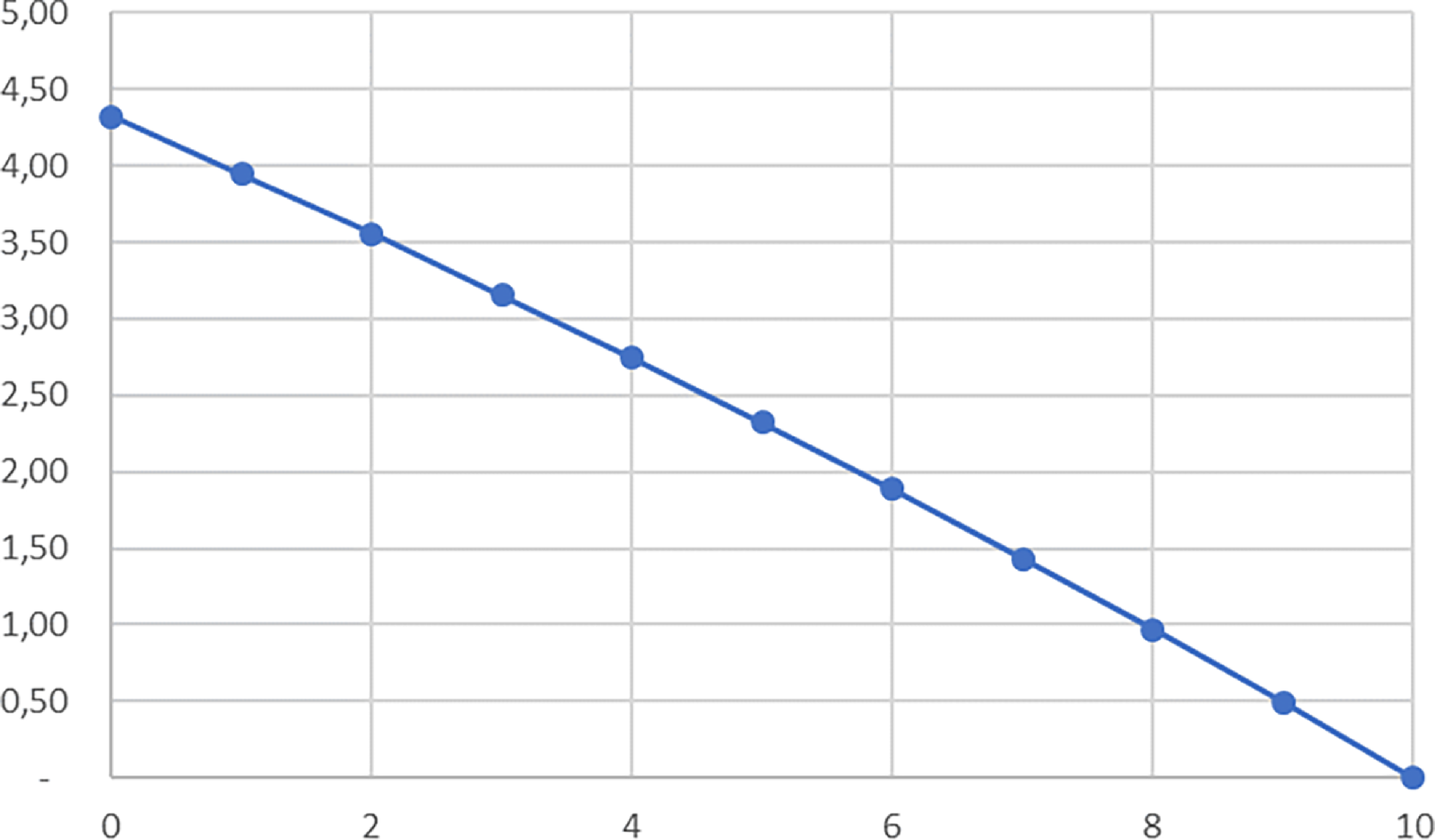
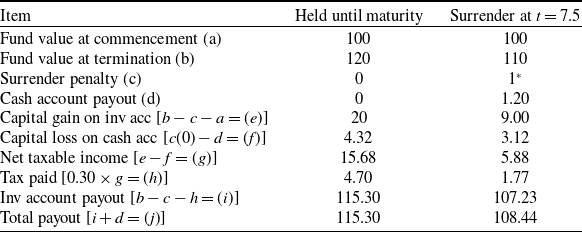
 δ=0
 gq=0.005
 r=3%
 c(0)=4.32
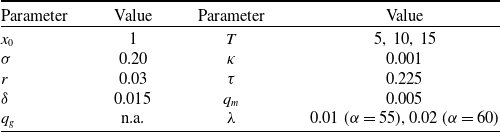
 qg

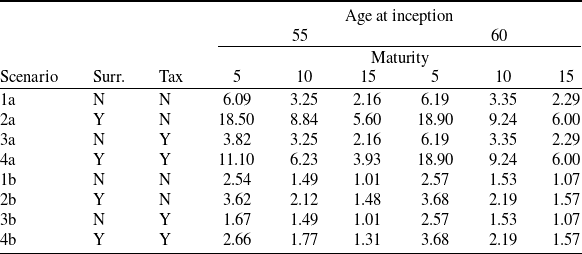
 %
 qm∗
 qg∗
 qm=0.5%
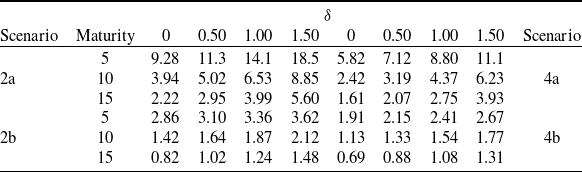
 %
 qm∗
 qg∗
 qm=0.5%
 δ
 %
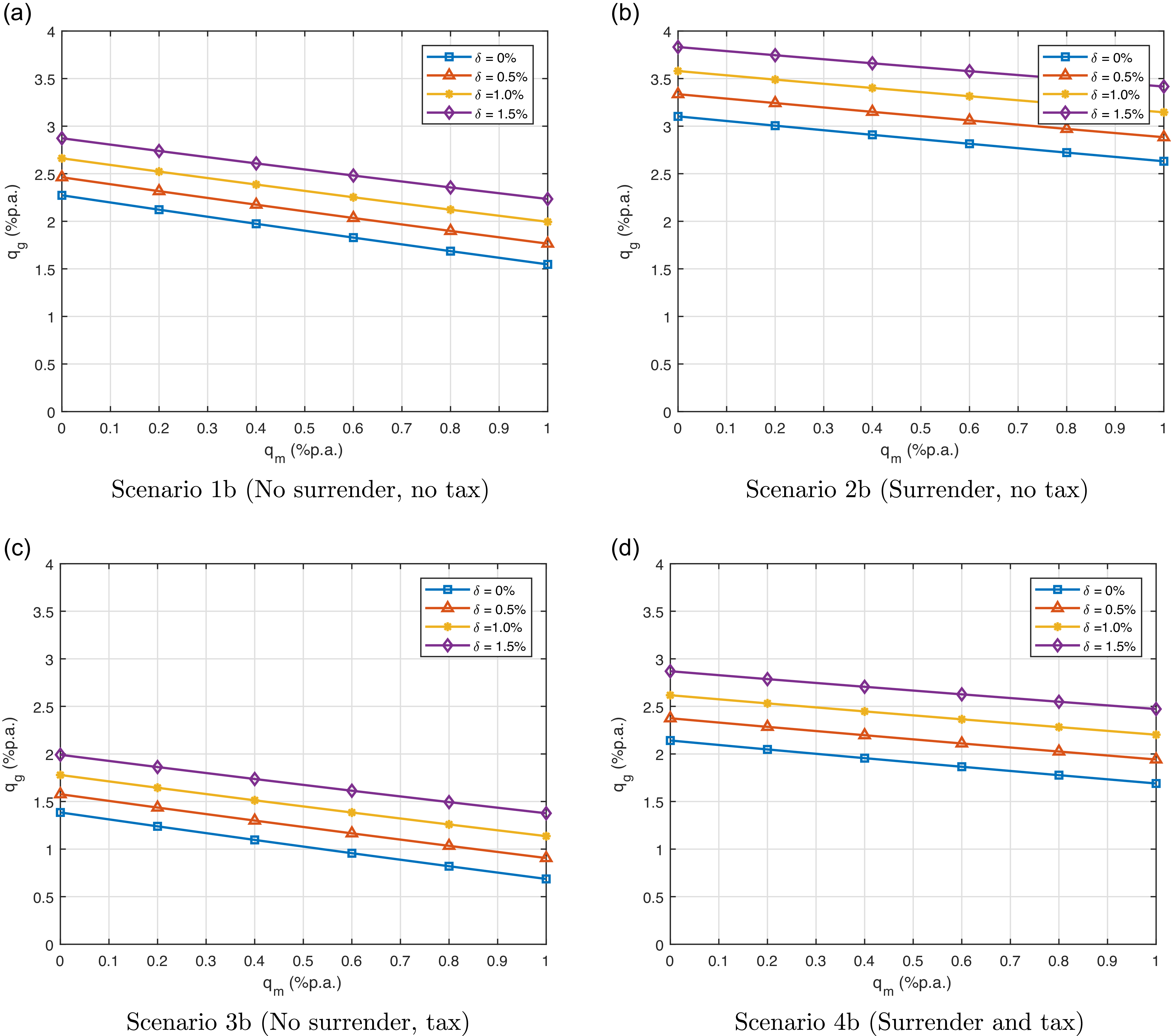
 qg∗
 qm
 T=5
 T=5
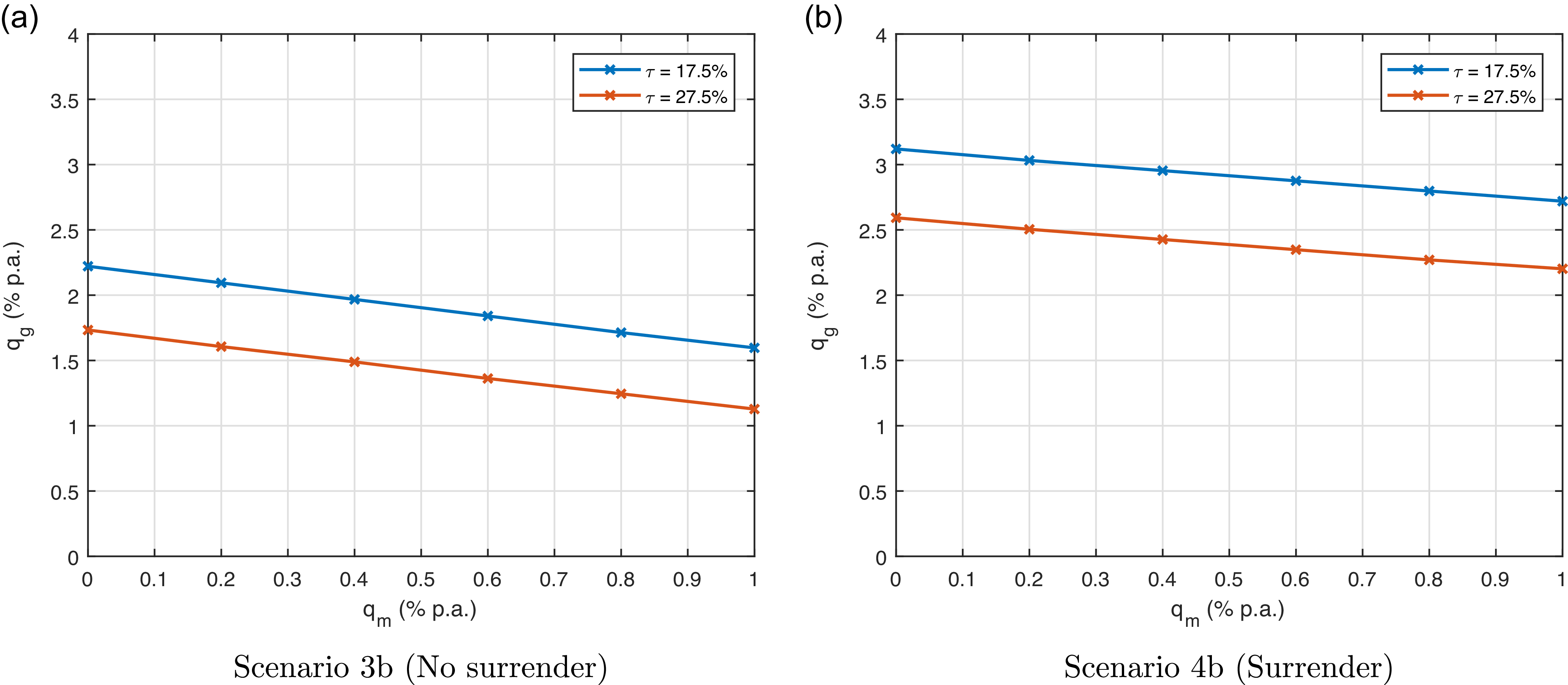
 qg∗
 qm
 T=5
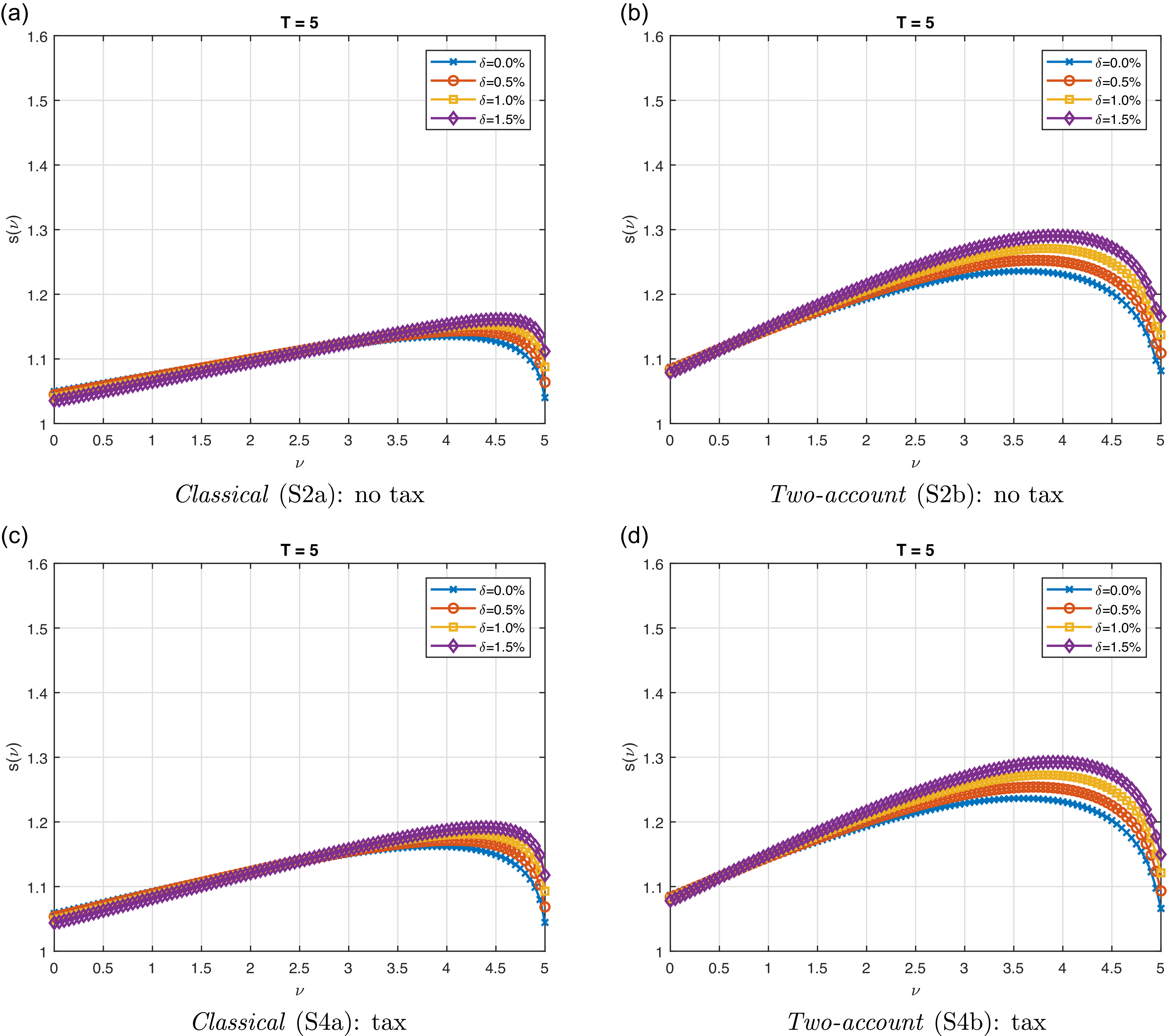
 δ
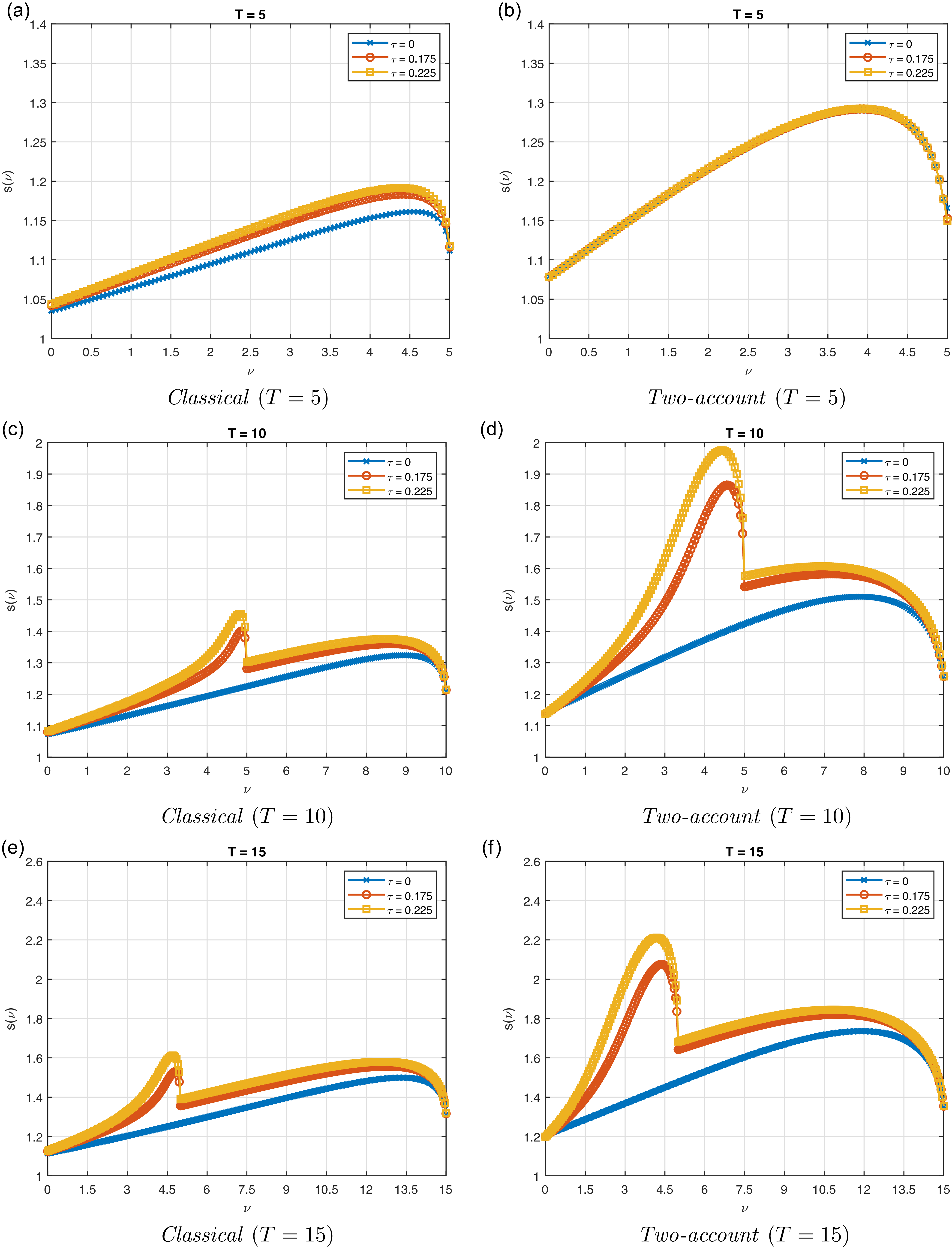
 T=5,10,15
 τ=0
 τ=0.175,0.225
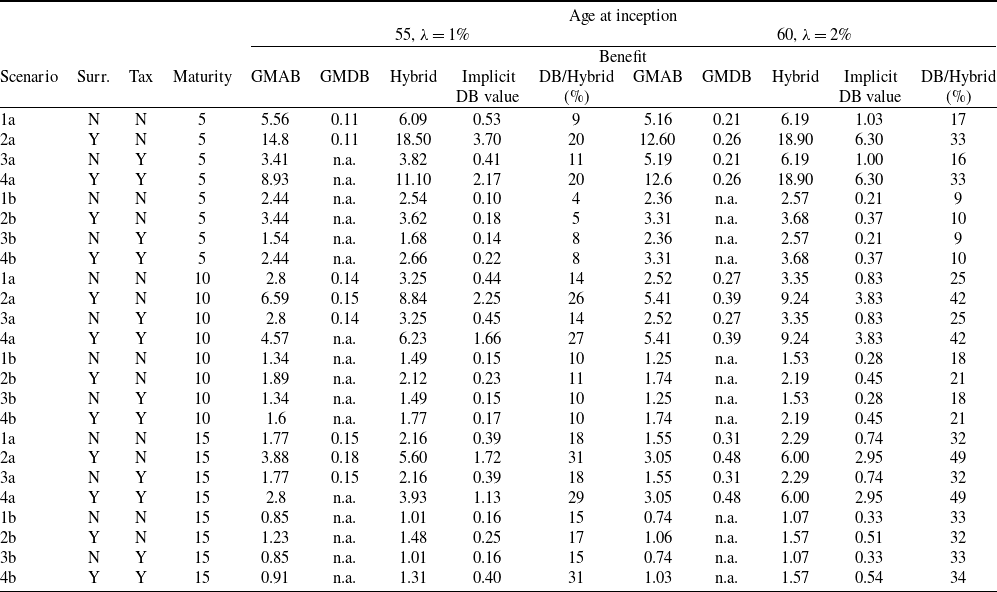
 %
 qm∗
 qg∗
 qm=0.5%
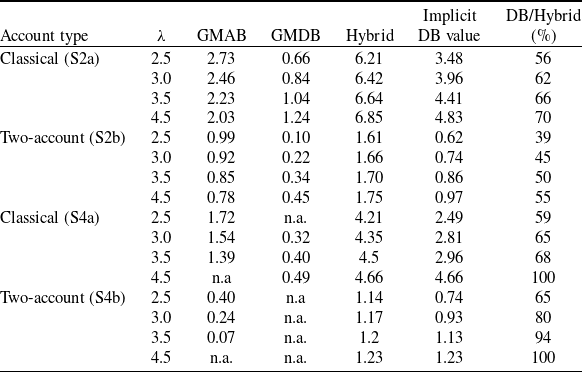
 T=15
 λ
 qm
 qg
 q0=0.5%
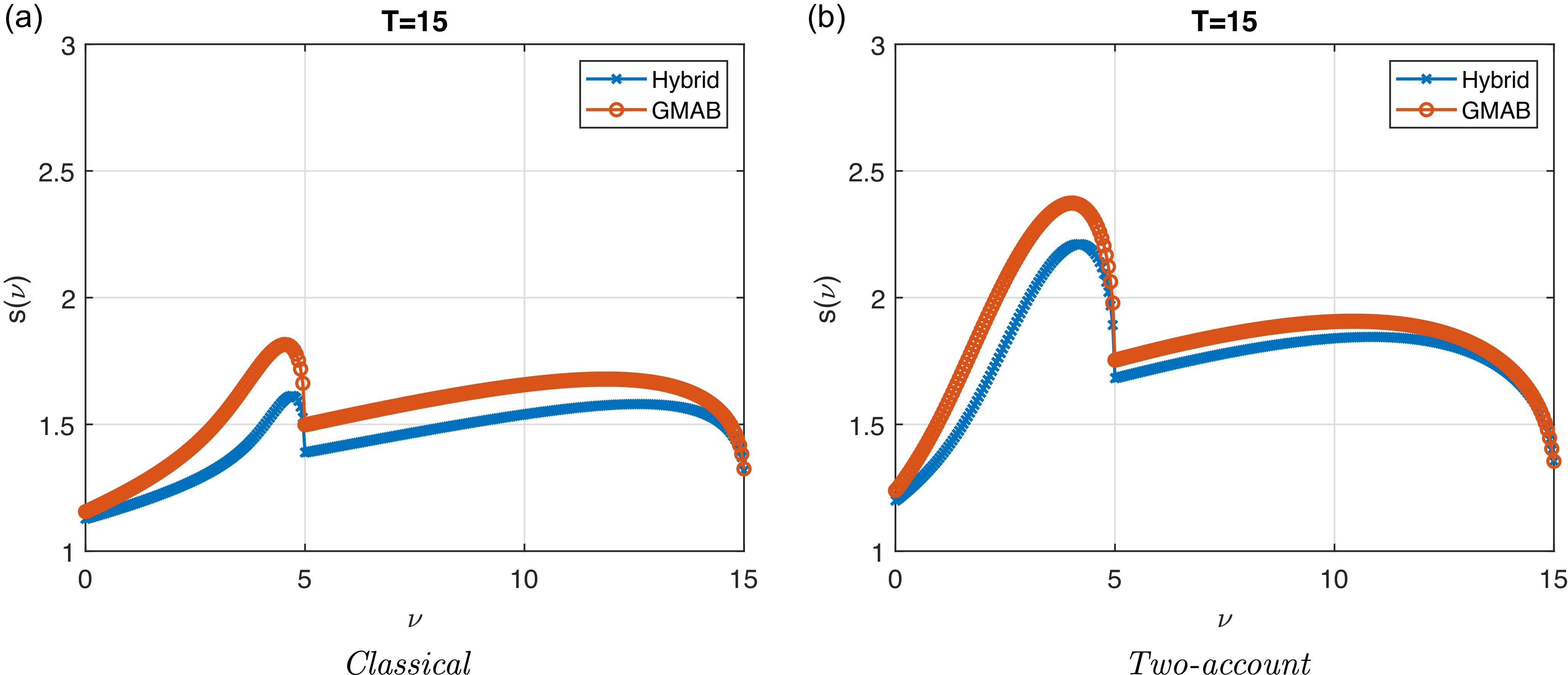
 T=15
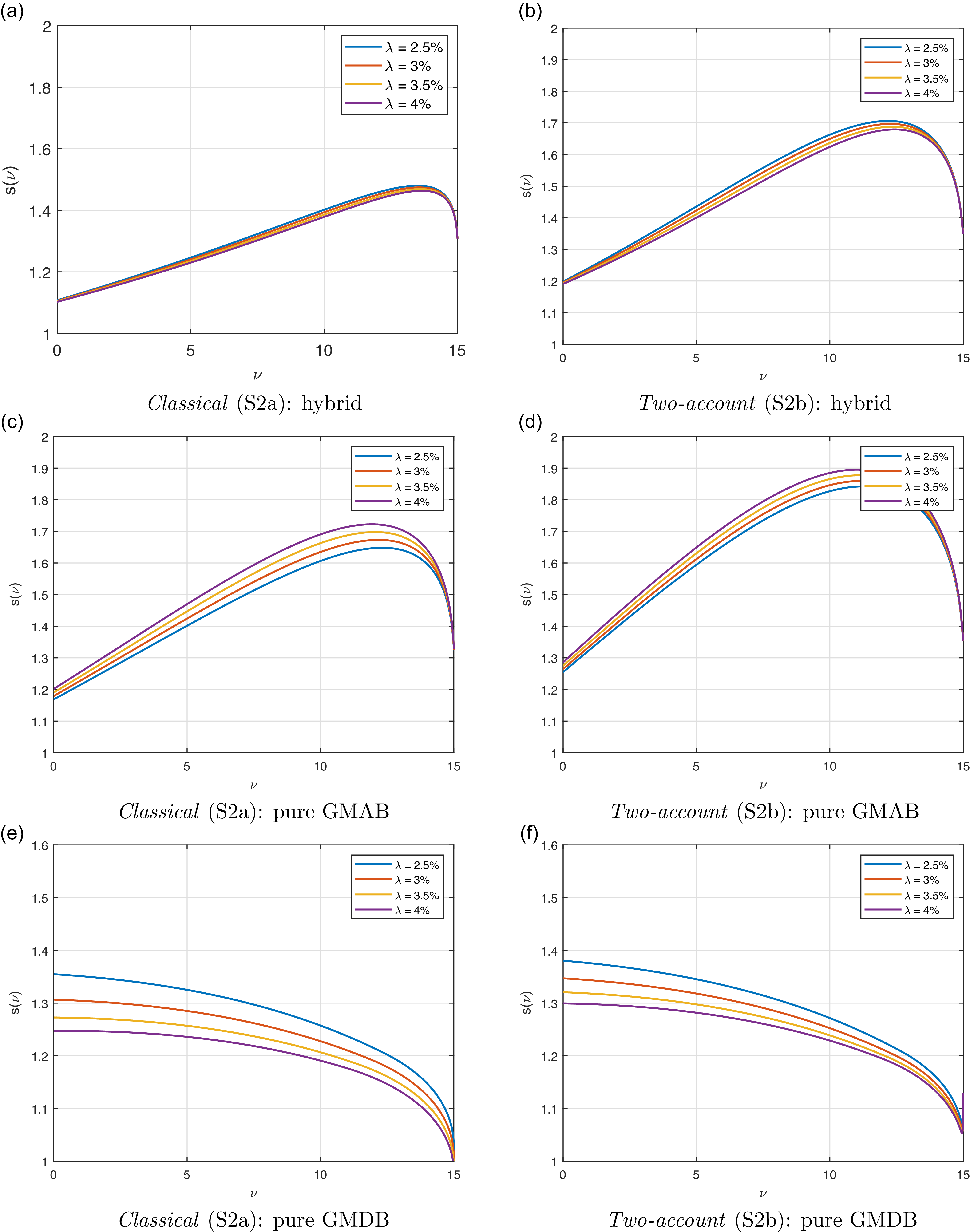
 λ
 T=15
 τ=0



