Since at least the mid-1980s, bioarchaeologists worldwide have discussed the evidence of stress and disease patterns in ancient hunter-gatherers. This research has mainly focused on (1) the changes produced by the adoption of agriculture and (2) the impact of contact and colonization in the Americas and other regions of the world. It has recognized stress and disease as complex phenomena, derived from wider interpretations of the association between human health and subsistence strategies, migration processes, demography, and ecological interaction with other species, all of which are affected by cultural and biological contexts (Cohen Reference Cohen2009; Roberts Reference Roberts2016). In this biocultural and evolutionary framework, the knowledge of stress and disease in past societies constitutes a necessary step to understanding human evolution.
Concerning the replacement of the hunting-gathering lifestyle, researchers commonly argue for a decline in health, evidenced by less varied diet, reduced stature, more frequent malnutrition, and increasing frequencies of infectious and oral diseases (Cohen Reference Cohen2009; Cohen and Armelagos Reference Cohen and Armelagos1984; Cohen and Crane-Kramer Reference Cohen, Crane-Kramer, Cohen and Crane-Kramer2007; Pinhasi and Stock Reference Ron and Stock2011; Roberts Reference Roberts, Barker and Goucher2015). Nevertheless, some hunter-gatherer groups have shown more prevalent stress and a greater frequency of disease than agriculturalist societies (e.g., Cohen and Crane-Kramer Reference Cohen, Crane-Kramer, Cohen and Crane-Kramer2007; Domett and Tayles Reference Domett, Tayles, Cohen and Crane-Kramer2007; Jackes et al. Reference Jackes, Lubell and Meiklejohn1997; Toomay Douglas and Pietrusewsky Reference Toomay Douglas, Pietrusewsky, Cohen and Crane-Kramer2007). In a similar way, it was commonly assumed that the health of hunter-gatherer populations was probably better before the arrival of Europeans to the Americas than after colonization. Nevertheless, paleopathological and bioarchaeological research produced since the 1990s has shown a much more complex biocultural phenomenon (Murphy and Klaus Reference Murphy, Klaus, Murphy and Klaus2017), based on temporal and spatial variability in disease patterns from pre- to postcontact times not only in America (e.g., Klaus and Alvarez-Calderón Reference Klaus, Alvarez-Calderón, Murphy and Klaus2017; Larsen Reference Larsen2001; Larsen and Milner Reference Larsen and Milner1994; Stojanowski Reference Stojanowski2013; Verano and Ubelaker Reference Verano and Ubelaker1992) but also in other regions, including South Africa (Ribot et al. Reference Ribot Isabelle, Renschler, Murphy and Klaus2017) and Australia (Webb Reference Webb1995). Therefore, stress and disease patterns in hunter-gatherers were probably not universal (Cohen Reference Cohen2009), and new data are necessary to understand the possible variability related to their economic strategies, their cultural lifestyles, and the changes produced by both the adoption of agriculture and contact with European colonizers.
Southern South America is one of the few places around the world that was inhabited by numerous hunter-gatherer populations in a wide range of cultural and ecological contexts at the moment of Native–European contact and later. For that reason, information regarding stress and disease in these populations and the association of these conditions with different ecological and cultural contexts could offer valuable insights for the interpretation of other hunter-gatherers worldwide. Indeed, a great amount of paleopathological data in skeletal remains of hunter-gatherer populations from Argentina has been produced in the last two decades (see Luna and Suby Reference Luna and Suby2014 for a review).
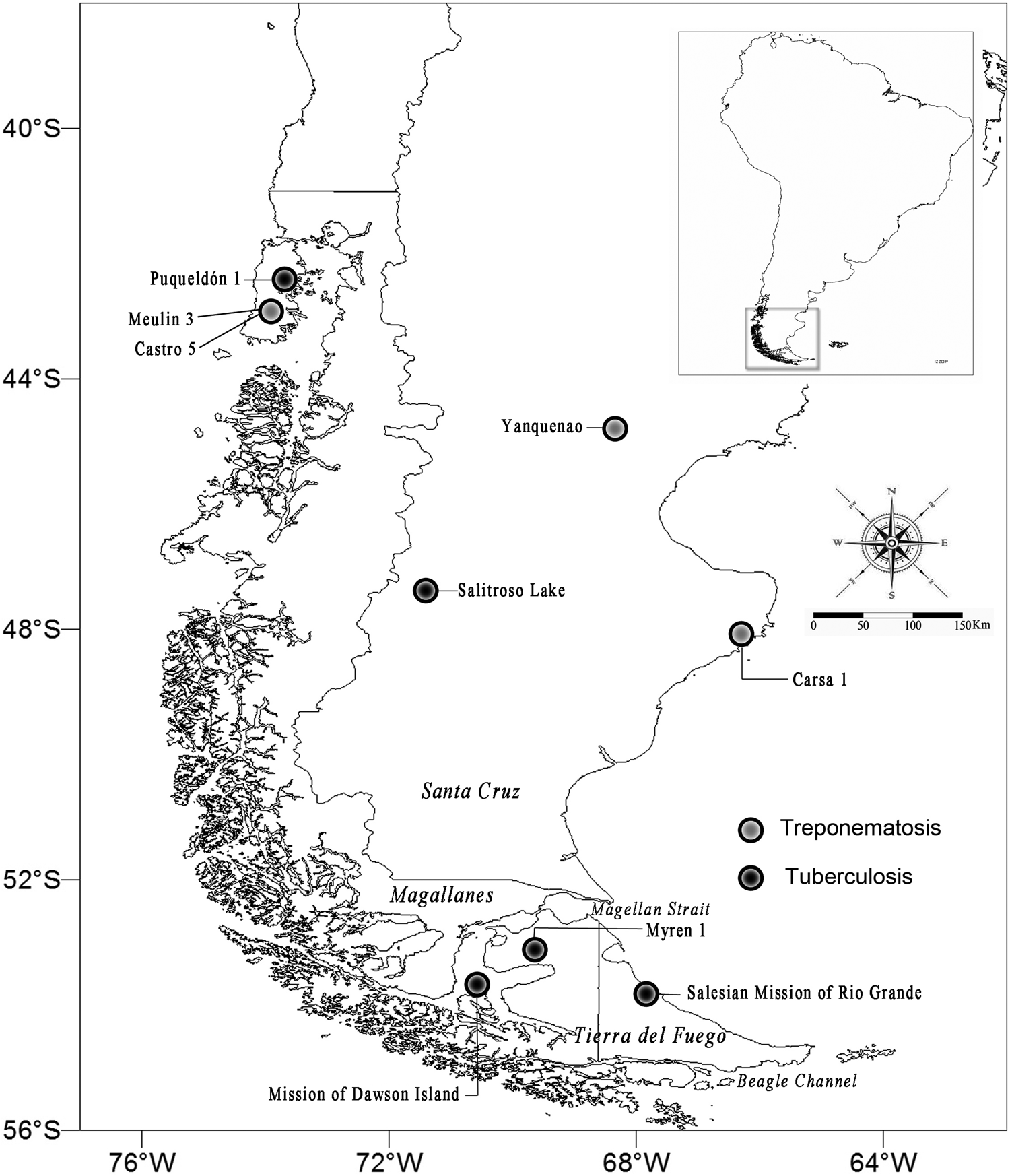
Within this body of research, the study of ancient marine and terrestrial hunter-gatherer populations who lived during the Holocene in Southern Patagonia (Figure 1), the continental and insular territory below latitude 50°S, has increasingly received attention. Most of the studies produced during the 1990s focused on oral disease, degenerative joint disease, and some stress markers such as cribra orbitalia, porotic hyperostosis, and lineal hypoplasia of the dental enamel (e.g., Aspillaga and Ocampo Reference Aspillaga and Ocampo1996; Aspillaga et al. Reference Aspillaga, Ocampo and Rivas1999; Constantinescu Reference Constantinescu1997, Reference Constantinescu1999). These results were frequently descriptive and were assumed to be indicators of adaptation of human societies to the cold and harsh environment in which they lived; only a few authors offered quantitative data of disease patterns from skeletal samples (e.g., Castro and Aspillaga Reference Castro and Aspillaga1991; Guichón Reference Guichón1994; Pérez-Pérez and Lalueza-Fox Reference Pérez-Pérez and Lalueza-Fox1992). In contrast, during the two first decades of the twenty-first century, researchers focused on the study of the spatial and temporal distribution of bone and oral diseases and skeletal lesions, the association of these phenomena with economic and dietary patterns, and the possible health changes produced as a consequence of Native–European contact. Most of these studies were based on quantitative data interpreted through paleopathological and bioarchaeological approaches (e.g., Alfonso-Durruty et al. Reference Alfonso-Durruty, Calás and Morello2011; García Guraieb Reference García Guraieb2006; Guichón et al. Reference Guichón, Buikstra, Stone, Harkins, Suby, Massone, Prieto, Wilbur, Constantinescu and Martín2015; L'Heureux and Amorosi Reference L'Heureux and Amorosi2009, Reference L'Heureux and Amorosi2010; Sáez Reference Sáez2008; Santiago et al. Reference Santiago, Salemme, Suby and Guichón2011; Schinder and Guichón Reference Schinder and Guichón2003; Suby Reference Suby2014a, Reference Suby2014b; Suby et al. Reference Suby, Guichón and Zangrando2009; Zúñiga Thayer et al. Reference Zúñiga Thayer, Suby, Flensborg and Luna2018).
Location of archaeological sites in which skeletons diagnosed with TB and treponematosis were recovered.

Despite the large amount of paleopathological data produced during that time, no integrative analysis of the available information from skeletal remains of hunter-gatherers from Southern Patagonia has been presented to date. Consequently, the aim of this article is to review the most relevant paleopathological results reported during the last two decades from these populations, which may be useful in understanding the stress and disease patterns related to hunter-gatherer lifestyles. Taking into account the current knowledge, I then propose future directions for research. Moreover, I present the ethnographic and archaeological information about the lifestyle of these hunter-gather populations that is most relevant to the interpretation of paleopathological results (Supplemental Text 1).
Recent Paleopathological Researches
Infectious Diseases
Infectious diseases in skeletons from Southern Patagonia have been little researched. Most case studies are of tuberculosis, osteomyelitis, and periosteal reactions, the latter of which are usually interpreted to be bone infections, despite the fact that other metabolic, traumatic, and vascular diseases could be involved (e.g., Roberts Reference Roberts and Buikstra2019; Weston Reference Weston and Grauer2012). Moreover, many paleoparasitological results were published during the last decade. The most relevant results are briefly described in this section.
Tuberculosis and Treponematosis
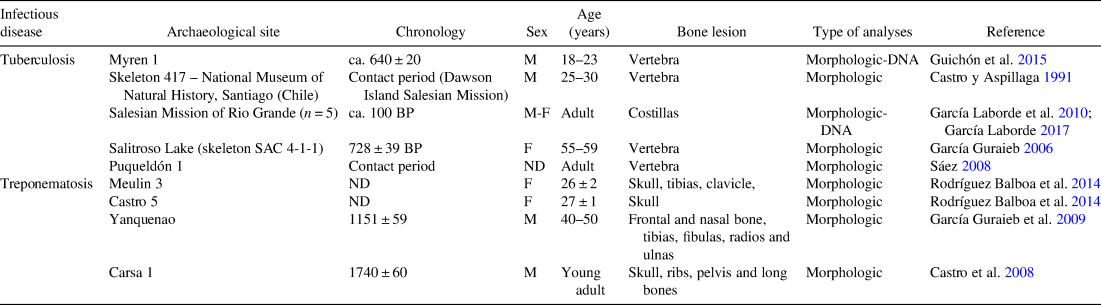
The study of tuberculosis (TB) in past populations from South America gained importance in the last decade. Nine skeletons recovered from five archaeological sites in Patagonia were suggested to be potentially affected by TB (Table 1; Figure 1). García Guraieb (Reference García Guraieb2006) presented a morphological description of vertebral lesions attributed to TB in the skeleton SAC 4-1-1, a female adult individual dated to 728 ± 39 years BP (Goñi et al. Reference Goñi, Bosio and Guraieb2003–2005) from Salitroso Lake, a mortuary area of about 200 km2 in the northwest Santa Cruz province (Argentina) with numerous burials dated from about 2600 to 350 BP (García Guraieb et al. Reference García Guraieb, Goñi and Tessone2015). In this study, bone lesions were presented as compatible with suffering from Pott's disease. Molecular analyses, which could help support the diagnosis of TB in this skeleton, were not reported. More recently, Guichón and colleagues (Reference Guichón, Buikstra, Stone, Harkins, Suby, Massone, Prieto, Wilbur, Constantinescu and Martín2015) analyzed a possible case of TB in a skeleton from the precontact site of Myren 1 (n = 1; 640 ± 20 years BP, Northern Tierra del Fuego, Chile), which was previously diagnosed as TB by Constantinescu (Reference Constantinescu1999). Nevertheless, molecular and new osteological data did not conclusively demonstrate that TB was the origin of the vertebral hypervascularization identified in this skeleton (Guichón et al. Reference Guichón, Buikstra, Stone, Harkins, Suby, Massone, Prieto, Wilbur, Constantinescu and Martín2015).
Skeletal Remains Suspected to Be Possible Cases of TB and Treponematosis in Southern Patagonia.

From a postcontact archaeological context, Castro and Aspillaga (Reference Castro and Aspillaga1991) reported on a Halakwalup skeleton (skeleton 417, housed at the National Museum of Natural History in Santiago, Chile), recovered from the cemetery of the Dawson Island Salesian Mission (Chile), with osteolytic lesions in the L5–S1 vertebrae and in one of the tibias, diagnosed as TB and osteomyelitis. The authors offered no detailed description, and no other analyses have been conducted on this skeleton. In Tierra del Fuego, García Laborde and colleagues (Reference García Laborde, Suby, Guichón and Casali2010) and García Laborde (Reference García Laborde2017) reported the presence of periosteal reactions in the vertebral end of the ribs in 5 of the 33 skeletons recovered in the cemetery of the Salesian Mission “La Candelaria” (Rio Grande, Argentina), which were attributed to TB or other pulmonary infectious disease. Studies of historical sources (Casali et al. Reference Casali, Fugassa and Guichón2006) showed a high mortality from pulmonary diseases, including TB, among native individuals who lived in that mission. Although the authors recognized problems in the diagnosis of TB during the nineteenth century (García Laborde Reference García Laborde2017), historical data could support that diagnosis in these skeletons. Finally, Sáez (Reference Sáez2008) described lytic lesions in a vertebra, a sacrum, and a sternum in the postcontact commingled skeletal remains from Puqueldón 1 site (Región de los Lagos, Chile), which the author suggested were caused by TB.
Treponematosis was also suggested in four cases from Patagonia (Figure 1), although from a region farther north than I discuss here. Castro and others (Reference Castro, Susana Salceda, Desántolo, Salemme, Santiago, Álvarez, Piana, Vázquez and Mansur2008) described bone lesions in a male young adult skeleton from the site of Carsa 1 (Santa Cruz, Argentina), dated to 1740 ± 60 BP (Moreno et al. Reference Moreno, Zangrando, Tessone, Castro and Panarello2011). The skull, ribs, pelvis, and long bones were affected by osteolytic lesions. García Guraieb and colleagues (Reference García Guraieb, Bernal, González, Bosio and Aguerre2009) reported a possible case of treponematosis in a 40- to 50-year-old male from the Cerro Yanquenao site (Chubut, Argentina), dated to 1151 ± 59 BP, with active osteolytic lesions in the frontal and nasal bones and in the long bones including the tibias, fibulas, radiuses, and ulnas. Finally, Rodríguez Balboa and colleagues (Reference Rodríguez Balboa, Aspillaga, Arensburg, Luna, Aranda and Suby2014) presented lesions compatible with treponematosis in two uncontextualized skeletons recovered in the Meulin 3 and Castro 5 archaeological sites, in the big island of Chiloé (Chile). The first case presented saber tibiae and caries sicca, whereas the second one is an isolated skull with caries sicca-like lesions (Table 1).
Periosteal Reactions and Osteomyelitis
Although periosteal reactions have been reported on many occasions (e.g., Constantinescu Reference Constantinescu1999; Guichón and Suby Reference Guichón and Suby2011; L'Heureux et al. Reference L'Heureux, Guichón, Barberena and Borrero2003; Santiago et al. Reference Santiago, Salemme, Suby and Guichón2011), only two studies are specifically centered on this condition, both of which regarding skulls. Guichón (Reference Guichón1994) studied 54 skulls and mandibles from Tierra del Fuego and southern continental Patagonia, most of them undated. In this sample, 12.9% of individuals exhibited periosteal reactions in their crania. Unfortunately, no details about the localization, extension, or degree of the lesions were mentioned in that research. More recently, Ponce and colleagues (Reference Ponce, Ghidini and González-José2008) presented a study of external auditory exostosis in 108 skulls from Tierra del Fuego without including details about the studied sample or the possible association of these traits with diving in cold water. The results showed a prevalence of 9.1% in individuals associated with marine economies, in contrast to a prevalence in individuals with terrestrial habits of 1.9%. However, Pandiani and others (Reference Pandiani, Suby and Santos2018) studied external auditory exostosis in a sample of 24 pre- and postcontact skulls from Southern Patagonia following the method suggested by Standen and colleagues (Reference Standen, Arriaza and Santoro1997). The results showed that 79.2% of studied individuals were affected by auditory exostosis of a small size in most of the individuals (63.2%); this condition was not related to economic strategies or chronology.
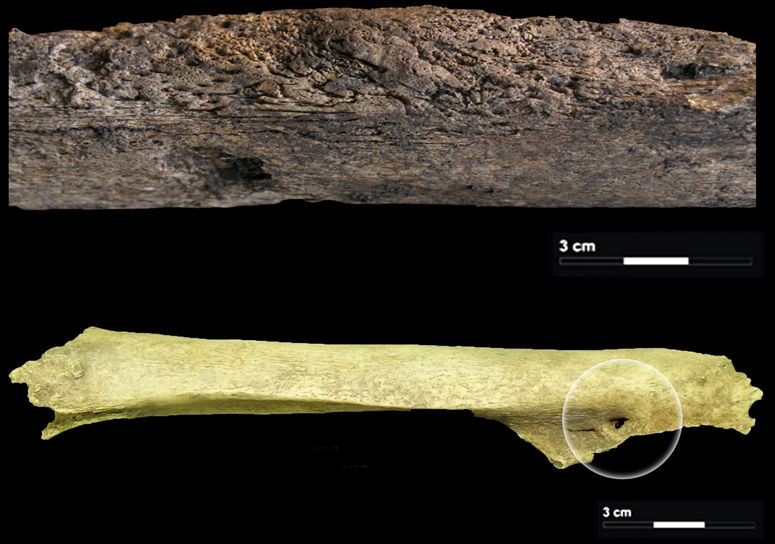
Regarding osteomyelitis, a recent analysis published by Suby (Reference Suby, Luna, Aranda and Suby2014c) showed that 10 of 25 adult skeletons from Southern Patagonia presented slight striated new bone formation on long bones, mainly in the tibias, without any other lesions presumably caused by unspecific infections. Only two cases (8%) could be assumed to be produced by osteomyelitis, as indicated by the presence of woven and sclerotic new bone formation and cloacae. In one case it affected a left tibia of the skeleton recovered in the Shamakush entierro 6 site from Southern Tierra del Fuego, dated to 1536 ± 46 years BP (Suby et al. Reference Suby, Zangrando and Piana2011). The other case was present in a right tibia of the undated skeleton recovered from the site of Palermo Aike, Santa Cruz, Argentina, probably related to a distal bone fracture (Figure 2).
Cases of osteomyelitis suggested in skeletal remains from Southern Patagonia. Top: Left tibia of the skeleton recovered in Shamakush burial No. 6 (Southern Tierra del Fuego), with a possible cloaca on the diaphysis. Bottom: right tibia of the skeleton recovered in the archaeological site Palermo Aike (southern continental Patagonia), in which a displaced remodeled fracture and a cloaca were identified (Color online).

Paleoparasitological Analyses
Numerous paleoparasitological studies have been conducted on sediments associated with human skeletons, the remains of clothes, and human and nonhuman coprolites. The most commonly identified specimens were eggs of Ascaris lumbricoides and Trichuris trichiura (e.g., Fugassa Reference Fugassa2015; Fugassa et al. Reference Fugassa, Sardella, Guichón, Denegri and Araújo2008), parasites probably related to the ecological interaction of humans with terrestrial vectors (Araújo et al. Reference Araújo, Reinhard, Leles, Sianto, Iñiguez, Fugassa, Arriaza, Orellana and Ferreira2011). According to Fugassa (Reference Fugassa2006), these parasites are particularly abundant in remains from the postcontact period. Many species were further identified in animal coprolites, especially canids, rodents, and camelids. Capillaria sp., Uncinaria sp., Toxascaris sp., Physaloptera sp., and Moniezia sp. were reported, although it is not clear if they would affect human health (Fugassa et al. Reference Fugassa, Denegri, Sardella, Araújo, Guichón, Martínez, Civalero and Aschero2006; Taglioretti et al. Reference Taglioretti, Fugassa, Rindel and Sardella2017). Ectoparasites like Demodex sp. were also recorded in remains of Selk'nam clothes made using guanaco furs (Fugassa et al. Reference Fugassa, Cicchino, Sardella, Guichón, Denegri and Araújo2007; Taglioretti et al. Reference Taglioretti, Fugassa, Rindel and Sardella2017).
Oral Diseases
Studies of oral pathologies included analyses of caries, antemortem and postmortem tooth loss, dental attrition, and periapical lesions. The methods of analysis were not clearly described by some authors, and others used different criteria for the same studies. For that reason, full comparison between results is challenging and will probably require new insights.
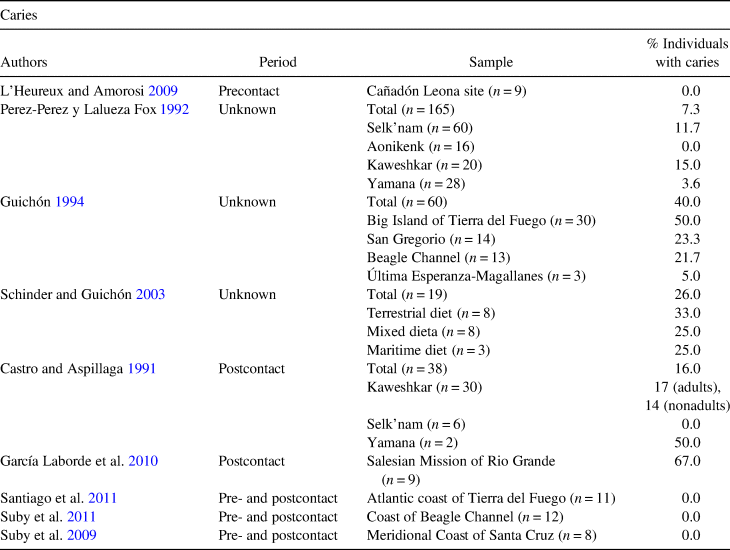
The main results pertaining to caries are summarized in Table 2. Most of the studied skeletons have not been dated, and for that reason, temporal changes cannot be described. For the most part, authors found a low prevalence of skeletons with caries, with the exception of Guichón (Reference Guichón1994). Pérez-Pérez and Lalueza Fox (Reference Pérez-Pérez and Lalueza-Fox1992) studied 165 crania housed in museums from Chile and Argentina, ethnographically classified as Aonikenk, Selk'nam, Kaweshkar, and Yámana (Supplemental Text 1), reporting only 7.3% of the individuals as having caries. In contrast, Guichón (Reference Guichón1994) analyzed 60 crania, mostly from numerous archaeological sites in Tierra del Fuego that lacked chronological data: 40% showed at least one caries and 11% between three and six caries. The same study reported higher frequency of caries in individuals from Northern Tierra del Fuego and the Última Esperanza region in continental Chile than in Southern Tierra del Fuego. Later, Schinder and Guichón (Reference Schinder and Guichón2003) studied the presence of caries in a small sample of 20 crania, principally from Northern Tierra del Fuego, and the relationship between this dental pathology and diet, which was identified through stable isotopes of carbon and nitrogen. The results showed higher frequency of caries in individuals with maritime diets (33%) than in those with terrestrial (25%) or mixed diets (25%). More recently, L'Heureux and Amorosi (Reference L'Heureux and Amorosi2009) and Suby and colleagues in Santa Cruz (Reference Suby, Guichón and Zangrando2009) and in Southern Tierra del Fuego (Suby et al. Reference Suby, Zangrando and Piana2011), as well as Santiago and colleagues (Reference Santiago, Salemme, Suby and Guichón2011) in the Atlantic coast of Tierra del Fuego, did not find individuals with caries (Table 2).
Frequency of Caries Recorded in Skeletal Human Samples from Southern Patagonia.
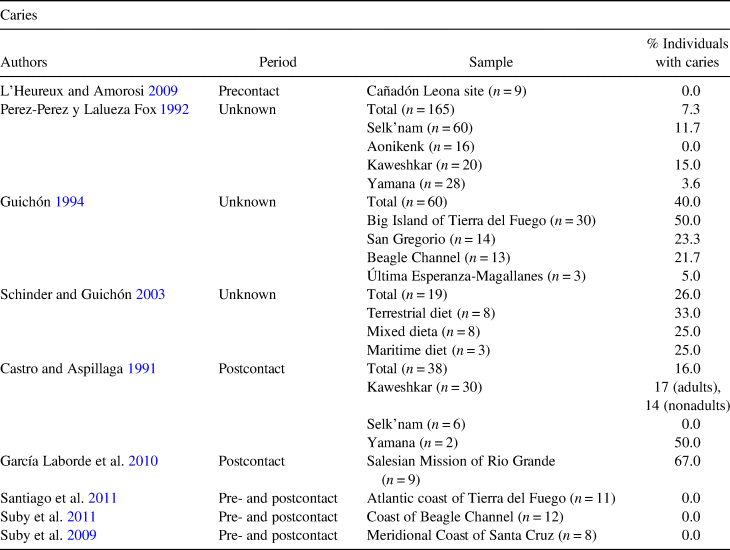
Among skeletons from the postcontact period, Castro and Aspillaga (Reference Castro and Aspillaga1991) studied 30 skulls from the cemetery of the mission on Isla Dawson. Only the Kaweshkar' skeletons showed caries, with a frequency of 17% in adults and 14% in subadults. In a similar historical context, García Laborde and colleagues (Reference García Laborde, Suby, Guichón and Casali2010) analyzed human remains from the Salesian Mission of Rio Grande. Sixty-seven percent of the studied individuals exhibited at least one caries. These results suggest a higher frequency of caries in the postcontact period than observed in skeletal collections without chronological references or from the precontact period.
A low frequency of antemortem tooth loss (AMTL) has been typically reported, with some exceptions and differences among groups. Pérez-Pérez and Lalueza Fox (Reference Pérez-Pérez and Lalueza-Fox1992) reported a higher prevalence in Selk'nam (2.6%) and Aonikenk (5.7%) than in Kaweshkar (0.2%) and Yamanas (1.7%), whereas Guichón (Reference Guichón1994) identified a prevalence of 17.9% in the complete analyzed sample. Moreover, Schinder and Guichón (Reference Schinder and Guichón2003) showed a higher prevalence in individuals with terrestrial (33%) and mixed (20%) diets than in those with marine (2%) diets. L'Heureux and Amorosi (Reference L'Heureux and Amorosi2009) described 43% of the individuals in a sample of nine from the site Cañadón Leona 5 as exhibiting AMTL. In a sample from the postcontact period, García Laborde and others (Reference García Laborde, Suby, Guichón and Casali2010) observed 33.3% of the individuals as exhibiting AMTL.
Most results relating to dental attrition are consistent, showing high attritional wear. Guichón (Reference Guichón1994) studied a sample of 639 teeth from 52 individuals following the categories proposed by Molnar (Reference Molnar1971). Their results show that 54% of teeth correspond to categories 5, 6, and 7, with canines and incisors the most affected by attrition. Moreover, Pérez-Pérez and Lalueza Fox (Reference Pérez-Pérez and Lalueza-Fox1992) reported a higher rate of dental attrition in Aonikenk individuals, especially in posterior dentition. In the same way, L'Heureux and Amorosi (Reference L'Heureux and Amorosi2009, Reference L'Heureux and Amorosi2010) found a high degree of dental wear, in this case following the Scott (Reference Scott1979) and Smith (Reference Smith1984) methods. Other analyses (e.g., Kozameh and Benitez Reference Kozameh and Benítez2005) show similar results in individuals from the southeastern extreme of Tierra del Fuego.
Pérez-Pérez and Lalueza Fox (Reference Pérez-Pérez and Lalueza-Fox1992) also studied the presence of dental abscesses, reporting a lower frequency in Kaweshkar than in other groups from Tierra del Fuego. Schinder and Guichón (Reference Schinder and Guichón2003) reported that 25% of the skeletons associated with terrestrial and mixed diets were affected by abscesses, whereas each of the three analyzed individuals with a marine diet showed this trait. In contrast, Castro and Aspillaga (Reference Castro and Aspillaga1991) found a higher prevalence of abscesses in Selk'nam (57%) than in Kaweshkar (8.7%) during the contact period. None of these analyses distinguished between abscesses, cysts, and granulomas.
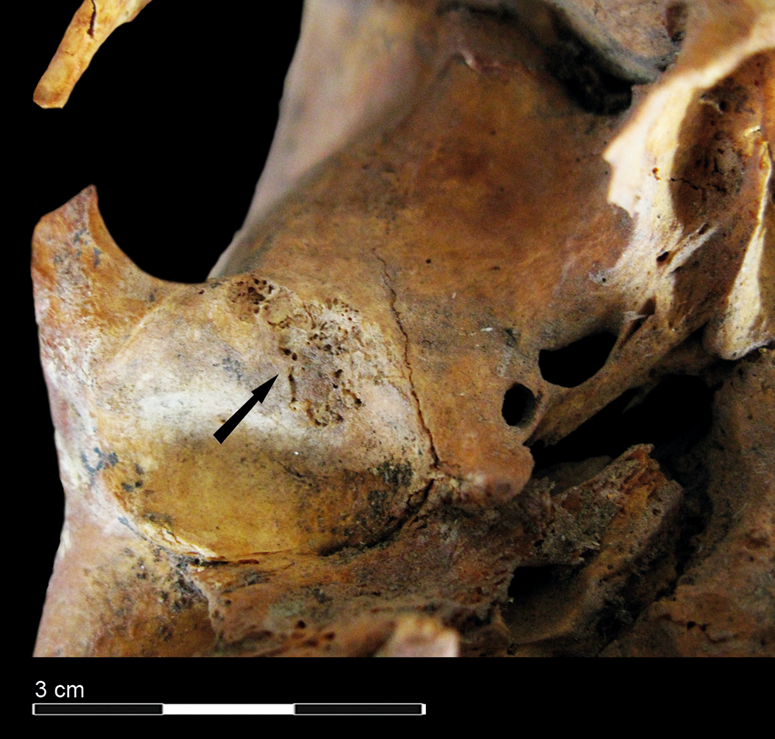
Temporomandibular joint (TMJ) diseases seem to have been a recurring health issue among the sampled populations. From a sample of skeletons from Tierra del Fuego, Constantinescu (Reference Constantinescu1999) mentioned a high frequency of TMJ surfaces, although without offering quantitative data. In an earlier paper, Castro and Aspillaga (Reference Castro and Aspillaga1991) show a similar prevalence of osteoarthritis of TMJ in Kaweshkar (17%) and Selk'nam (14%) individuals from the mission on Isla Dawson. In a more recent study, Suby and Giberto (Reference Suby and Giberto2018) analyzed 25 skulls from pre- and postcontact periods from Southern Patagonia following current criteria (Rando and Waldron Reference Rando and Waldron2012). The authors found a frequency of 28% of slight osteoarthritis of TMJ (Figure 3), mostly related to AMTL and older age. Consumption of terrestrial resources in the diet was not excluded as a possible related factor. No condylarchanges were identified in this particular study.
Temporomandibular joint osteoarthritis in Skeleton 2 from the site of Orejas de Burro (Color online).

Systemic Stress and Metabolic Diseases
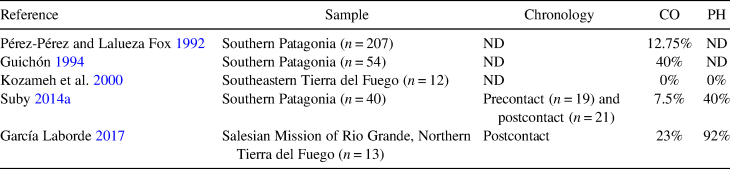
Most studies of systemic stress were designed to analyze the presence of cribra orbitalia, porotic hyperostosis, and dental enamel hypoplasia; they exhibited variable results. In most cases, the authors did not report their diagnostic methods. Among the most important studies, Pérez-Pérez and Lalueza Fox (Reference Pérez-Pérez and Lalueza-Fox1992) identified a frequency of the occurrence of cribra orbitalia of 12.75% in a total of 207 skulls, all slight and without significant differences between ethnic groups, sex, or age. Guichón (Reference Guichón1994) analyzed cribra orbitalia in 54 skulls mainly from Tierra del Fuego (Table 3). In that sample, 40% showed at least one orbit affected. Moreover, all nonadults presented lesions. In 12 skeletons from Bahía Valentín (the southeastern extreme of Tierra del Fuego), Kozameh and colleagues (Reference Kozameh Livia, Vidal and Espinosa2000) reported the absence of porotic hyperostosis and cribra orbitalia.
Prevalence of Cribra Orbitalia (CO) and Porotic Hyperostosis (PH) in Skeletal Samples from Southern Patagonia.
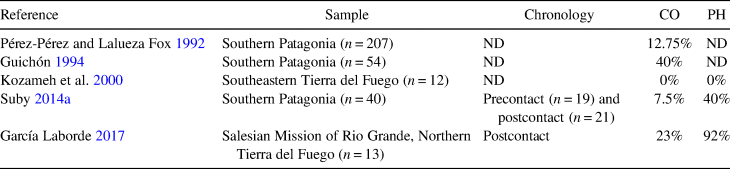
Later, Schinder and Guichón (Reference Schinder and Guichón2003) analyzed porotic syndrome in skulls from Tierra del Fuego. Five of six individuals (83%) with terrestrial diets and all of the three skeletons with marine diet exhibited cribra orbitalia. They found no relationship between porotic syndrome and the dietary patterns described for populations from Tierra del Fuego, although these results could be biased by the small size of the sample. In their study of skeletal remains from Isla Navarino (Chile), Aspillaga and others (Reference Aspillaga, Ocampo and Rivas1999) mentioned a high frequency of porotic hyperostosis in individuals with maritime economies, but once again, no quantitative data were reported. The authors suggested that porotic syndrome could be caused by parasites associated with the consumption of fish and marine mammals; they urged caution when interpreting porotic syndrome as being caused by anemia (e.g., McIlvaine Reference McIlvaine2015; Walker et al. Reference Walker, Bathurst, Richman, Gjerdrum and Andrushko2009).
More recently, Suby (Reference Suby2014a) identified a frequency of 40% of porotic hyperostosis and 7.5% of cribra orbitalia in 40 skeletons from Southern Patagonia; most cases were of low severity, following the diagnostic criteria proposed by Stuart-Macadam (Reference Stuart-Macadam1985). Porotic hyperostosis was more prevalent in individuals with marine and mixed diets (66.7% and 62.5%, respectively) than in those with a terrestrial diet (15%). On the contrary, cribra orbitalia affected 3 of the 12 (25%) individuals with marine diets and none of those with terrestrial or mixed diets. A recent study of skeletons buried at the cemetery of the “La Candelaria” mission (Rio Grande, Tierra del Fuego), showed a prevalence of 92% of porotic hyperostosis and 23% of cribra orbitalia in adult individuals (García Laborde Reference García Laborde2017). These frequencies are higher than those found by Guichón (Reference Guichón1994) and Suby (Reference Suby2014a) in samples from Northern Tierra del Fuego. Suby (Reference Suby2014a) suggested that Native–European contact in Southern Patagonia could have had a more important impact on the health of individuals who lived in missions than on those who did not. In a similar way, Suby and others (Reference Suby, Costantino, Capiel, Lucarini and Etchepare2013) reported that females older than 25 years old from the La Candelaria mission showed bone loss in the hips and lumbar vertebrae that could be interpreted to be osteopenia, which could be related to nutritional deficits in that historical context.
Finally, studies of dental enamel hypoplasia presented by Pérez-Pérez and Lalueza Fox (Reference Pérez-Pérez and Lalueza-Fox1992) showed a prevalence of 55% of individuals affected, without significant differences between sexes and ages. Guichón (Reference Guichón1994) also found a prevalence of 42% in 26 skeletons from Tierra del Fuego, without a difference between the sexes. In contrast, Kozameh and colleagues (Reference Kozameh Livia, Vidal and Espinosa2000) did not find this condition in skeletons from Bahia Valentín, in the oriental extreme of Tierra del Fuego.
Degenerative Joint Disease, Enthesic Changes, and Bone Cortical Geometry
Only a few detailed studies on degenerative joint disease and enthesic changes have been conducted from skeletal samples of Southern Patagonia. Contantinescu (Reference Constantinescu1997, Reference Constantinescu1999) found enthesic changes in the superior limbs of Selk'nam caused by flexion, extension, and rotation of the arms related to archery for hunting, and in lower limbs probably associated with walking. Moreover, Constantinescu (Reference Constantinescu1999) studied 32 skeletons from Tierra del Fuego, most of which were incomplete, describing the highly developed entheses of limbs possibly associated with rowing and transport of heavy loads. These studies neither quantified the results nor mentioned the methods used to identify and record entheseal changes. The most detailed study of enthesic changes in Southern Patagonia was conducted by Zúñiga Thayer (Reference Zúñiga Thayer2016), who studied a sample of 26 skeletons from Southern Tierra del Fuego using the method proposed by Villotte and Knüsel (Reference Villotte and Knüsel2013). This study also showed more highly developed enthesic changes in the upper limbs of female skeletons, interpreted as evidence of repeated rowing during the lifetime of these individuals.
Regarding the geometry of long bones, Pearson and Millones (Reference Pearson and Millones2005) reported high robusticity in lower and upper limbs in Selk'nam and Yamana individuals, without differences between the populations and at similar rates to other populations adapted to high latitudes. In contrast, Suby (Reference Suby2007), Suby and Guichón (Reference Suby and Guichón2009), and Suby and Novellino (Reference Suby and Novellino2017) showed that individuals with marine lifestyles from Tierra del Fuego have a higher cross-sectional geometry of tibias and femoral robusticity than those with terrestrial and mixed lifestyles. Nevertheless, the small sample sizes of these studies need to be considered when comparing these results to studies using a larger sample of skeletons.
Regarding degenerative joint disease, Suby (Reference Suby2014b) showed that adult individuals from the Santa Cruz/Magallanes region presented a higher prevalence of Schmorl's nodes (62.5%) than the skeletons from Northern (12.5%) and Southern (0%) Tierra del Fuego. The frequency of Schmorl's nodes was higher in the precontact sample (36.4%; n = 4/11) than in the postcontact sample (18.2%; n = 2/11). Nevertheless, no statistical difference was found between the chronological samples. In contrast, skeletons from individuals with a terrestrial diet exhibited a statistically higher prevalence of Schmorl's nodes (50%) than individuals with mixed (16.6%) and marine (0%) diets. The differences were associated with greater mechanical stress on the lower vertebrae, although congenital morphological differences are also a possibility. That same study found no relationship between vertebral osteophytes and Schmorl's nodes (Suby Reference Suby2014b). Likewise, D'Angelo and colleagues (Reference D'Angelo del Campo, Suby, Laborde and Guichón2017) showed that spondylolysis was present in 7 of 35 (20%) skeletons in a sample from Southern Patagonia. A lower frequency was identified in the precontact sample (11.1%; n = 1/9) than in the contact-period sample (23.1%; n = 6/26), which the authors suggested was due to be the negative effects of European contact on the lifestyle of native populations. Finally, Zúñiga Thayer and others (Reference Zúñiga Thayer, Suby, Flensborg and Luna2018) studied the prevalence of osteochondritis dissecans in 26 skeletons from Southern Patagonia: 42.3%—mostly those from individuals with terrestrial diets—exhibited at least one lesion. Moreover, 66.6% of the lesions were identified in the glenoid cavity of the scapulae, more frequently of the right arm, probably related to mechanical stress.
Trauma and Violence
Trauma and interpersonal violence are scarcely reported in skeletal remains from Southern Patagonia, but no systematic research has been carried out so far (Prieto and Cardenas Reference Prieto, Cárdenas, Chacon and Mendoza2007). Among the clearest cases of violence was a nonradiocarbon-dated skull of an Aonikenk male from Santiago Bay in the northern coast of the Strait of Magellan (Chile), with a green obsidian projectile fragment encrusted in the right temporal bone (Constantinescu Reference Constantinescu2003). Considering the new bone formation described, the individual could have survived the episode. Also in Southern continental Patagonia, L'Heureux and Amorosi (Reference L'Heureux and Amorosi2009) described cranial traumatic lesions in skeletons CL.2.1 and CL.3 recovered from the site Cañadón Leona 5 (Magellan Region, Chile), assigned to about 1740–2280 years BP from vegetal charcoal; these lesions were interpreted as evidence of interpersonal violence. The first individual, a young/middle-aged adult male, presented a circular hole of about 15 mm in the left parietal bone. The second skeleton, a middle-aged adult female, exhibited a large traumatic lesion in the left temporal and parietal bones, assumed by the authors to be the cause of death (L'Heureux and Amorosi Reference L'Heureux and Amorosi2009).
In Tierra del Fuego, Suby and others (Reference Suby, Salemme and Santiago2008) identified three circular traumatic lesions without new bone formation in the skull of a skeleton recovered from the Puesto Pescador 1 site (Atlantic coast of Tierra del Fuego), dated to 335 ± 35 years BP; these lesions were attributed to a violent episode. Finally, Suby and Guichón (Reference Suby and Guichón2010) reported two cases of interpersonal violence in remains of the skeletal commingled collection housed in the Salesian Mission La Candelaria (Rio Grande, Tierra del Fuego). One of them is an adult male pelvis with two lithic projectile fragments encrusted in both iliac bones, one of which probably compromised the abdominal organs. The absence of bone remodeling suggested that it is a perimortem lesion. The second case is a skull with a lithic projectile of 15 mm of length in the right parietal, also assumed to be perimortem due to lack of new bone formation surrounding the projectile. Unfortunately, neither of these two skeletons have detailed archaeological and chronological information.
Trauma was reported mainly in the ribs, with fractures reported in the skeletons recovered from Rincón del Buque (Suby et al. Reference Suby, Guichón and Zangrando2009) and Orejas de Burro (L'Heureux and Barberena Reference L'Heureux and Barberena2008), both in Southern continental Patagonia. Kozameh and colleagues (Reference Kozameh Livia, Vidal and Espinosa2000) also described a humeral fracture in a skeleton from the Bahia Valentín site (Southern Tierra del Fuego). Suby (Reference Suby, Luna, Aranda and Suby2014c) showed that among 25 adult skeletons, 9 (36%) exhibited bone fractures, equally distributed among the ribs, vertebrae, and long bones. Only three cases of vertebral fractures were described. Among them, a Jefferson's fracture of the atlas was diagnosed in a prehistoric skeleton from the Shamakush Entierro archaeological site from the Beagle Channel (Suby et al. Reference Suby, Zangrando and Piana2011). Nevertheless, no specific studies were conducted on this type of fracture. Recently, Flensborg and Suby (Reference Flensborg and Suby2020) reviewed and analyzed the reported traumas in skeletal human remains from Southern Patagonia. Of a total sample of 126 skeletons, 15 (11.9%) adult individuals were affected by trauma. Most lesions were antemortem, produced by accidents or violence, and were more frequent in Santa Cruz/Magallanes and the north of Tierra del Fuego than in the south of Tierra del Fuego.
Discussion
The paleopathological analyses of human skeletal remains from Southern Patagonia have remarkably advanced during the last two decades. The studies have evolved from a descriptive to an analytic approach, based on some of the most recent theoretical and methodological advances. Nevertheless, paleopathological research still follows the same pattern observed in other countries, in which case studies still dominate (Hens and Godde Reference Hens and Godde2008). In spite of the increase in available information, there are few integrative studies of stress and disease patterns. Here I attempt to fill that gap, offering a review of the most relevant results to make them more widely available to biarchaeological and archaeological discussions.
Some patterns in disease and stress can be identified in available data, but evidence of infectious diseases is still too scarce to propose a clear pattern. Relatively few bone lesions associated with infections have been reported. Nevertheless, this lack of data cannot be assumed to be evidence of the low prevalence of infectious diseases in past populations, considering that many of them could not be observed in the skeleton because of their biological characteristics, their acute time of evolution, the immune resistance of the host, or their interpretation from skeletal material. Recent reports of molecular, historical and osteological data suggest the presence of tuberculosis (Casali et al. Reference Casali, Fugassa and Guichón2006; García Laborde et al. Reference García Laborde, Suby, Guichón and Casali2010) and treponematosis (Castro and Aspillaga Reference Castro and Aspillaga1991) in prehistoric times, but more frequently in the postcontact period. Nevertheless, more convincing evidence is needed in most of the cases, particularly in skeletons from precolumbian times. Future research needs to focus on potential zoonotic sources of tuberculosis, particularly from seals and sea lions, as suggested by Bos and others (Reference Bos, Harkins, Herbig, Coscolla, Weber, Comas, Forrest, Bryant, Harris, Schuenemann, Campbell, Majander, Wilbur, Guichón, Wolfe Steadman, Cook, Niemann, Behr, Zumarraga, Bastida, Huson, Nieselt, Young, Parkhill, Buikstra, Gagneux, Stone and Krause2014) and Bastida and colleagues (Reference Bastida, Quse and Guichón2011).
The interpretation of infectious diseases also has to integrate other independent lines of evidence, such as those related to mobility and demography of human populations. The archaeological record suggests not only that populations were small in size and limited by biogeographic barriers but also recognizes corridors of exchange of individuals, information, and tools (Martin and Borrero Reference Martin and Borrero2017). The isolation restricted the dispersion of infections outside the affected populations, but contact between some groups could widen the geographic distribution of infectious agents. No evidence is yet available regarding these hypothetical epidemiological scenarios. Further research must be conducted.
Paleopathological information about infectious diseases, including research into ancient pathogens using new molecular methods, could offer valuable information on the social dynamics of the archaeological record. As an example, multiple burials were interpreted to be indicators of population growth in southern continental Patagonia (Barberena Reference Barberena2008). Nevertheless, these burial sites could also be the result of local increasing mortality. More paleopathological and paleodemographic research would allow archaeologists to discuss the dynamics of change in human populations.
All studies of oral disease showed high degrees of dental wear and a low prevalence of caries and antemortem tooth loss, particularly in precontact remains. Terrestrial dietary patterns, especially in the continent and in Northern Tierra del Fuego, probably led to higher mechanical masticatory forces than diets based in marine resources, as is suggested in studies of TMJ osteoarthritis. Food processing could be a relevant factor in the development of oral diseases in precontact times and possibly of other diseases, such as parasitic zoonosis. Lifestyles changes produced in the postcontact period, particularly but not exclusively for those who lived in missions and farms, could be major sources of change in diet and corresponding oral diseases. None of these factors have been extensively studied and should be the focus of further research. Studies of some of the biggest samples did not include the most recent methods and criteria for studying oral pathology, such as caries, enamel hypoplasia, periodontal disease, and periapical infections. Analyses of chronological, sexual, and age-related variability are also needed and should be explored.
Evidence of porotic syndrome seems to be more frequent in individuals with marine and mixed economies from Southern and Northern Tierra del Fuego; perhaps it is more closely associated with nutritional effects and parasitic infectious diseases than with dietary iron deficiency (Suby Reference Suby2014a). Porotic syndrome was possibly more prevalent in populations that inhabited the missions and may be attributed to changes in dietary patterns and lifestyle, such as low consumption of proteins and high consumption of carbohydrates (Castro and Aspillaga Reference Castro and Aspillaga1991; García Laborde et al. Reference García Laborde, Suby, Guichón and Casali2010). In most of the studies, porotic syndrome was assumed to be caused by iron-deficiency anemia, even though the link between both conditions has recently been criticized and remains unclear (McIlvaine Reference McIlvaine2015; Walker et al. Reference Walker, Bathurst, Richman, Gjerdrum and Andrushko2009). Thus, the interpretation of porotic syndrome needs to be more cautious, and new insights have to be considered.
Osteopenia was also observed in the skeletons recovered from a mission, although the studied samples were very small; more such studies will allow for more critical evaluation of these results. Studies of pathological fractures in vertebrae, caused by osteoporosis, will help us understand the possible impact of lifestyle change during the contact period. Other metabolic diseases, such as osteomalacia, rickets, and scurvy, remain unexplored in skeletal remains from Southern Patagonia.
Data also suggest that individuals living in terrestrial economies from southern continental Patagonia probably experienced higher mechanical skeletal stress on the spine, producing degenerative joint disease in vertebrae, particularly Schmorl's nodes and vertebral osteophytosis, than did individuals from Tierra del Fuego. Nevertheless, more information is required to evaluate the possible association between degenerative joint disease and age, stature, and body mass. Research into degenerative joint disease in the appendicular skeleton has to be developed, considering that it has only been studied in some skeletons. These analyses will offer additional insight to clarify whether degenerative joint disease could be related to activity in these societies. Similarly, enthesic changes were rarely considered. A recent review of this topic, including the data reported in Argentina, was published by Zúñiga Thayer and Suby (Reference Zúñiga Thayer and Suby2019). The results reported in Southern Patagonia need to be revisited with recent methods, given that those previously used were criticized for their lack of correlation with clinical and biological data (Henderson et al. Reference Henderson, Mariotti, Pany-Kucera, Villotte and Wilczak2016).
Evidence of violence and trauma is scarce and exclusively derived from individual case studies. Research into traumatic injuries of large samples associated with violence will be helpful in interpreting the possible paleodemographic changes produced during the Late Holocene and in responses to changes in climate and the availability of resources. Although violent episodes seem to be more common in the continent and in Northern Tierra del Fuego than in Southern Tierra del Fuego, attributed by some authors to population increase (e.g., L'Heureux and Amorosi Reference L'Heureux and Amorosi2009), the geographical distribution of trauma and its interpretation need more extended study.
Conclusion and Future Directions
Taking into account all these results, stress and disease probably did not affect human societies throughout Southern Patagonia in the same way. Different geographic and cultural human groups exhibited different patterns of degenerative, systemic, and traumatic stress; populations from the continent and from Northern and Southern Tierra del Fuego differed from each other, and these differences were possibly related to their cultural and economic systems. Even though most of the results are incomplete and new research is necessary, all the data obtained so far seem to be consistent with the main pattern observed in other hunter-gatherers (Cohen and Crane-Kramer Reference Cohen, Crane-Kramer, Cohen and Crane-Kramer2007): a low frequency of oral pathologies and little evidence of infectious diseases. Moreover, Native–European contact could have produced the increase in stress and disease, particularly in those contexts related to missions, although again, more data are needed in this respect.
From this analysis, three main concerns relating to paleopathological information from Southern Patagonia can be identified.
First, larger samples are needed in almost all lines of research. Because of the absence of cemeteries from precontact periods and the circumstances in which collections were formed (Supplemental Text 1), only a small number of skeletons with archaeologically controlled information are available for bioarchaeological and paleopathological research. Thus, only a few skeletons have chronological data associated with them (Suby et al. Reference Suby, Luna, Aranda and Flensborg2017). The osteological collections housed in museums have not yet been fully examined, and there remains much information that could be obtained from them; some of these data were included in recent studies. Thus, further analyses are needed to produce more paleodietary, chronological, and paleopathological data from these collections.
Second, paleopathological research studies use different methodological approaches, which makes comparisons between results particularly challenging. Data from the 1990s obviously are not compatible with the methods for registration and diagnosis of oral and bone diseases available today. Much of these data need to be reexamined with more current methods. For that reason, some of the patterns derived from comparisons among studies suggested here need to be taken with extreme caution and are likely to be adjusted in the future.
Finally, many bone and oral diseases were scarcely explored in skeletons from Southern Patagonia, whereas many others were not evaluated at all. For example, degenerative joint disease was studied only in small samples, particularly in the spine and the appendicular skeleton in some preliminary research. Traumatic, infectious, and congenital diseases were mostly treated in descriptive case studies and need to be specifically studied in skeletal samples. Moreover, metabolic disease such as osteopenia and osteoporosis was only studied in a few skeletons and needs to be more widely analyzed. Neoplastic diseases were not reported, but neither were they the aim of any particular research. New methods, such as the investigation of ancient pathogen genomics by next-generation sequencing, are mostly unexplored in skeletal remains from Patagonia and need to be included in future paleopathological research.
Human stress and disease are strongly influenced by behavior, socioeconomic organization, demography, and environmental resources. Bearing in mind the complex relationship among these multiple factors, future paleopathological researches of hunter-gatherers from Southern Patagonia must include a wider range of information than skeletal data. Archaeological and paleoenvironmental studies produced high amounts of information from this region that are waiting to be analyzed undera paleopathological approach. Only paleopathology is capable of providing information on the effects of peopling, adaptation, and mobility on the health of hunter-gatherer human populations from Southern Patagonia. The integration of this knowledge will be one of the major challenges for the future.
Acknowledgments
I would like to express my gratitude to Luis Borrero, Leandro Luna, and Claudia Aranda for their kind comments on a previous version of this article. Thank you to the editors and the three anonymous reviewers who helped improve this article through their comments. This research was founded by Grant PICT 0358-2008 and PICT 0191-2016 (National Agency for Scientific and Technological Research, Argentina) and CONICET-PIP 2015-11220150100016CO. Also thanks to Sandra Baliño for her linguistic assistance.
Data Availability Statement
All data analyzed during this study are included in this published article and in the articles detailed in the references.
Supplemental Material
For supplementary material accompanying this article, visit https://doi.org/10.1017/laq.2020.5.
Supplemental Text 1. Environmental, Ethnographic, and Archaeological Context.