Introduction
The family Syllidae Grube, Reference Grube1850, is composed of relatively common annelids, frequently found in many marine environments, especially in shallow depths. Currently comprising ~700 species in 74 genera (San Martín & Aguado, Reference San Martín, Aguado and Schmidt-Rhaesa2014), the diversity and abundance of the family usually decreases below 1000 m depth, then represented by just a few genera and species. Particularly due to all the difficulties involved in obtaining samples from these depths, the diversity of syllids – as that of life in general – from these environments is poorly known.
Anguillosyllis Day, Reference Day1963 is a deep-water genus, with representatives most commonly found below ~200 m depth. The genus is composed of four species and is distributed worldwide, but its reproductive mode, a class of information considered useful in classification schemes of the family, has been considered unknown (Aguado & San Martín, Reference Aguado and San Martín2008; Aguado et al., Reference Aguado, San Martín and Siddall2012).
In this study we present the finding of one specimen with dorsally attached egg capsules, the first known report of brooding in the genus.
Materials and methods
Material herein studied was obtained in the scope of the ‘MARSEAL Project – Environmental Characterization of Sergipe and Alagoas Basin’, a partnership among PETROBRAS/CENPES, the Federal Universities of Sergipe (UFS), Alagoas (UFAL) and Pernambuco (UFPE) and the Sergipe Research Foundation (FAPESE), which sampled off Sergipe and Alagoas, in NE Brazil. The sample in which the specimen was found was collected in a transect close to the San Francisco canyon (10°39′59.184″S 35°55′58.001″W; 1900 m depth; bottom temperature: 3.7 °C; salinity 34.9; sediment composition: 18% clay, 72% silt, 10% sand) in March 2013, by the team of the RV ‘Seward Johnson’. Collections were done with van Veen grabs, sediment was sieved with 0.5 mm mesh; animals were sorted, fixed in 10% formalin and, a few weeks later, transferred to ethanol 70%. The material herein analysed is deposited in the Annelid collection of the Zoology Museum (MZUSP), University of São Paulo (São Paulo, Brazil).
Results and discussion
Anguillosyllis lanai Barroso, Paiva, Nogueira & Fukuda, Reference Barroso, Paiva, Nogueira and Fukuda2017 is a species recently described based on specimens from Campos and Espirito Santo basins, south-eastern Brazil (Barroso et al., Reference Barroso, Paiva, Nogueira and Fukuda2017).
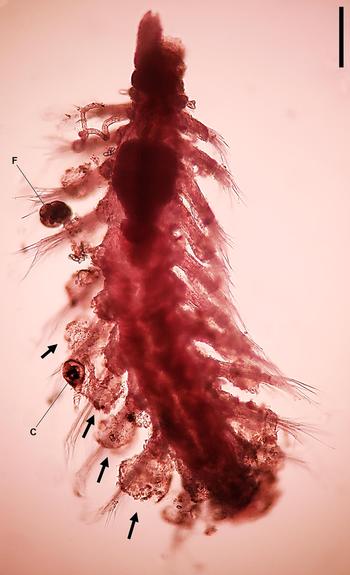
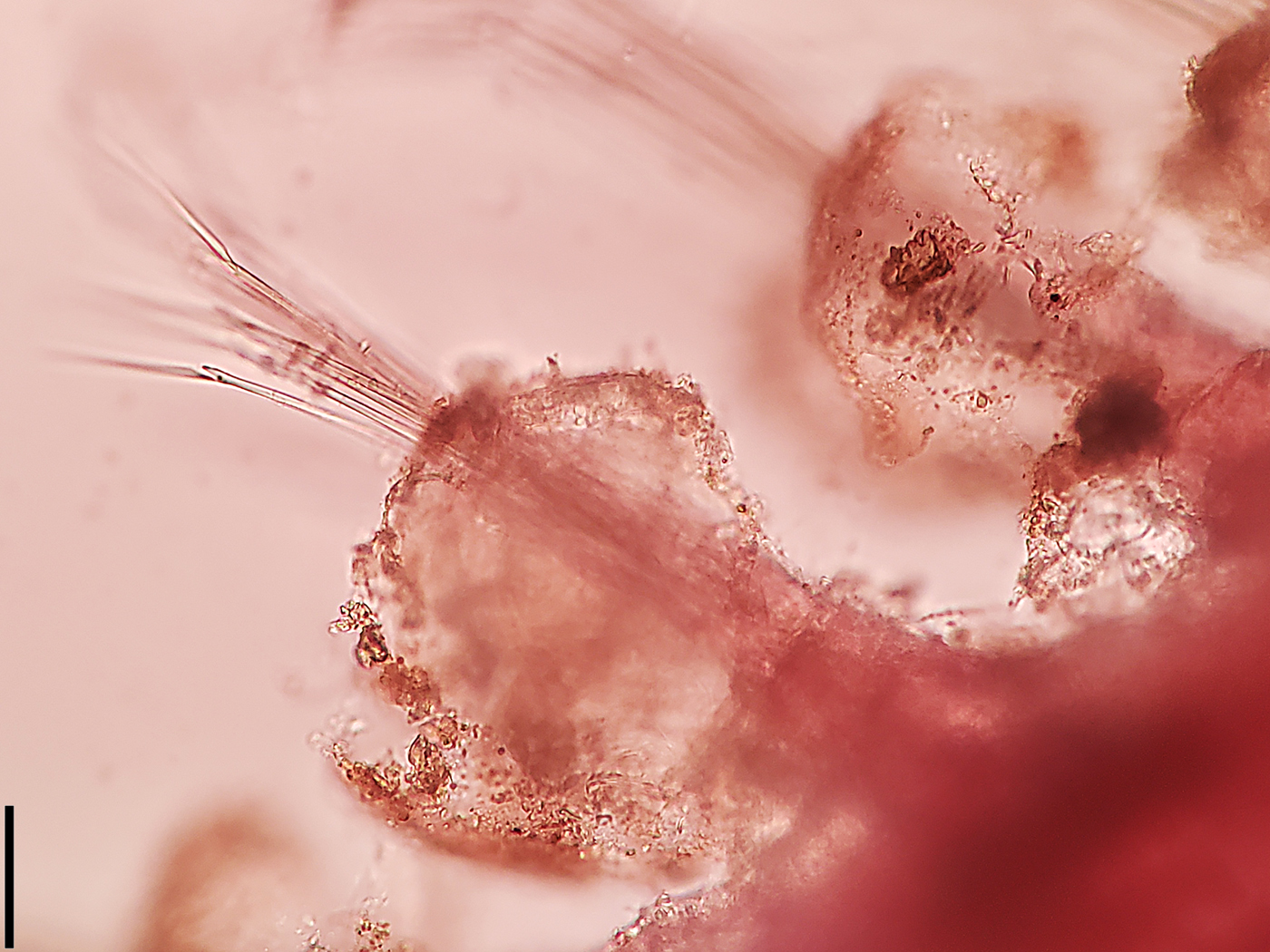
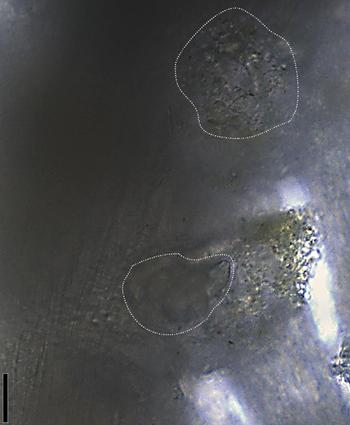
The specimen on which this report is focused (MZUSP 3531) was found with egg capsules dorsally attached to some parapodial lobes, from chaetigers 5–9, perhaps also with fragments of capsules on chaetigers 3–4 and 10 (Figure 1) – adults of A. lanai present a fixed number of 10 chaetigers. The nature of the attachment could not be verified with certainty (Figure 2); we could not observe capillary chaetae (as is the case of some genera in the subfamily Exononinae Langerhans, Reference Langerhans1879, such as Erinaceusyllis San Martín, Reference San Martín, Ramos, Alba, Bellés i Ros, Gosálbez i Noguera, Guerra, Macpherson, Martín, Serrano and Templado2003), nor were the capsules attached to dorsal cirri (as occurs in Nudisyllis Knox & Cameron, Reference Knox and Cameron1970), since most cirri of the specimen were lost. One possibility is that the capsules may be attached to glandular areas of unknown nature frequently seen with fibrillar or granular material, located dorsally, distally, in parapodial lobes of at least some species of the genus, such as A. palpata (Hartman, Reference Hartman1967) and A. lanai (Figure 3; see Barroso et al., Reference Barroso, Paiva, Nogueira and Fukuda2017, Figures 13H and 14A, F–G).
Anguillosyllis lanai (MZUSP 3531) with dorsally attached egg capsules, entire body, dorsal view. Arrows pointing to empty capsules from chaetigers 6–9; C, copepod; F, foraminiferan shell. Scale bar: 170 µm.

Anguillosyllis lanai (MZUSP 3531), detail of egg capsules, chaetigers 8–9, dorsal view. Scale bar: 30 µm.

Anguillosyllis lanai (MZUSP 3531), detail of parapodial glands (delimited by dashed lines), chaetigers 4–5, dorsal view. Scale bar: 25 µm.

Specimens of other genera that encompass animals with dorsal brooding of eggs, such as Erinaceusyllis, are occasionally found with egg capsules attached, with the same appearance as those found in the specimen here reported, however, these findings are not a particularly common event, since apparently the capsule easily detaches from the animal once the larva hatches. It is noteworthy that, despite one of us (MVF) having analysed more than 600 specimens of Anguillosyllis from the Brazilian coast, the present was the only one found with these attached egg capsules, which at least in part may be explained by the methodology used to collect the material (collections using Van Veen grabs from deep waters and sediments sieved to obtain the animals), which are perhaps too aggressive for the fragile nature of the attachment of the egg capsules.
Animals belonging to this genus posit a bit of a puzzle to the traditional division of the syllids in subfamilies according to morphological features, as Anguillosyllis presents a mixture of characters: absence of pharyngeal armature (trepan or tooth), as in the Anoplosyllinae Aguado & San Martín, Reference Aguado and San Martín2009; smooth and long dorsal cirri, as in the Eusyllinae Malaquin, Reference Malaquin1893; and only one pair of peristomial cirri, and ovate to papilliform antennae, as in the Exogoninae. Despite this, the genus was placed in the Exogoninae upon its original description and in some later works (Day, Reference Day1963; Böggemann & Purschke, Reference Böggemann and Purschke2005). More recently, however, cladistic analyses of the family based on morphological characters (Aguado & San Martín, Reference Aguado and San Martín2009) could not find a positioning of Anguillosyllis within any of the traditional subfamilies and, in fact, the genus was recovered as the sister-group of all the syllids in combined morphological and molecular analyses, thus being considered one of the Incertae Sedis genera of the Syllidae by Aguado et al. (Reference Aguado, San Martín and Siddall2012).
Our finding represents another affinity of Anguillosyllis with the Exogoninae – where the genus was originally allocated, since this latter subfamily is composed, basically, of two groups of genera, both presenting brooding of eggs: in one group via ventral brooding of eggs and juveniles, and in the other, via dorsal brooding of eggs only, in a similar manner as that shown here. Nonetheless, brooding of eggs is not exclusive of the Exogoninae, as other genera (such as the eusylline Nudisyllis and the anoplosylline Syllides Örsted, Reference Örsted1845) also present this kind of phenomenon. In this way, considering the aforementioned positioning of Anguillosyllis as sister to the remaining Syllidae, the observation herein reported might indicate that this parental care, represented by the brooding of eggs, could also have emerged very early during the evolution of the family, as was already proposed to be the case of the epigamy (Aguado et al., Reference Aguado, San Martín and Siddall2012).
Acknowledgements
We thank the Brazilian energy company Petrobras and the Sergipe research foundation FAPESE for the execution of the project MARSEAL, and the collection and triage teams involved in obtaining the material where the specimens were found. Special thanks are due to the staff of the Coastal Benthos Lab of the Federal University of Sergipe, namely its coordinator, Professor Dr Carmen R. Parisotto Guimaraes, for providing the facilities for the study and donating the animal here reported.