Introduction
Over the past few decades there have been significant developments in the understanding of brain function and cognitive performance (Albright et al. Reference Albright, Kandel and Posner2000). Well-established factors associated with differences in cognitive function include age (Helmuth, Reference Helmuth2002), sex (Caplan, Reference Caplan1997), educational attainment (Brayne et al. Reference Brayne, Ince, Keage, McKeith, Matthews, Polvikoski and Sulkava2010) and genetic factors such as the apolipoprotein E (APOE) genotype (Deary et al. Reference Deary, Whiteman, Pattie, Starr, Hayward, Wright, Carothers and Whalley2002). A relationship between stress and cognition has also been explored (McEwen & Sapolsky, Reference McEwen and Sapolsky1995; Stawski et al. Reference Stawski, Sliwinski and Smyth2006; Sandi & Pinelo-Nava, Reference Sandi and Pinelo-Nava2007). It is thought that stress influences cognitive function by the activation of the hypothalamic–pituitary–adrenal (HPA) axis and the subsequent secretion of catecholamines and glucocorticoids. These glucocorticoids can cross the blood–brain barrier, thereby binding to receptors localized in brain areas, including the hippocampus, amygdala and frontal lobes (Lupien et al. Reference Lupien, Maheu, Tu, Fiocco and Schramek2007). These areas are then actively involved in thought processes including memory and executive function. However, despite this well-recognized hormone-related physiological mechanism, the precise effects of social stress on human cognition, particularly in middle- to older-aged samples, remain uncertain.
Social stress is a broad term encompassing both external emotion-provoking stressors (stressful life events) and internal responses (perception and adaptation) to a given stimulus (Burke & Goodkin, Reference Burke and Goodkin1997). Frequently, the measurement of internal responses in epidemiological studies is subjective, and thus reporting of stressful life events has been widely used for objectively quantifying social stress. However, it may be the meaning of life events for individuals, rather than the events themselves, that accounts for the subsequent effect (Brown, Reference Brown, Dohrenwend and Dohrenwend1974). Therefore, some researchers have suggested that the study of life events alone might be a limited approach (Price et al. Reference Price, Tennant, Butow, Smith, Kennedy, Kossoff and Dunn2001), and have argued that the perceived stress level and its interaction with other vulnerability factors (e.g. social support, coping style and emotional patterns) should be considered.
Animal (Shors et al. Reference Shors, Weiss and Thompson1992; Jeong et al. Reference Jeong, Park, Yoo, Shin, Ahn, Kim, Lee, Emson and Suh2006) and human (Lupien et al. Reference Lupien, Gaudreau, Tchiteya, Maheu, Sharma, Nair, Hauger, McEwen and Meaney1997; Kuhlmann et al. Reference Kuhlmann, Piel and Wolf2005; Merz et al. Reference Merz, Wolf and Hennig2010) studies have shown that stress can exert both positive and negative effects on cognition. Although an ongoing high-stress level may impair working memory (Lupien et al. Reference Lupien, Gaudreau, Tchiteya, Maheu, Sharma, Nair, Hauger, McEwen and Meaney1997; Kuhlmann et al. Reference Kuhlmann, Piel and Wolf2005), moderate stress and especially acute stress have been related to enhanced memory and cognitive function (Yuen et al. Reference Yuen, Liu, Karatsoreos, Feng, McEwen and Yan2009). The direction of the association between stress and cognition is thus left undetermined.
Based on findings from laboratory studies, several observational studies (VonDras et al. Reference VonDras, Powless, Olson, Wheeler and Snudden2005; Rosnick et al. Reference Rosnick, Small, McEvoy, Borenstein and Mortimer2007; Johansson et al. Reference Johansson, Guo, Waern, Ostling, Gustafson, Bengtsson and Skoog2010; Comijs et al. Reference Comijs, van den Kommer, Minnaar, Penninx and Deeg2011) have been conducted to examine the stress–cognition relationship in real settings. Most have focused separately on self-perceived chronic stress (Johansson et al. Reference Johansson, Guo, Waern, Ostling, Gustafson, Bengtsson and Skoog2010), susceptibility to distress (Wilson et al. Reference Wilson, Barnes, Bennett, Li, Bienias, Mendes de Leon and Evans2005, Reference Wilson, Arnold, Schneider, Li and Bennett2007a) or exposure to life event stressors (Persson & Skoog, Reference Persson and Skoog1996; Rosnick et al. Reference Rosnick, Small, McEvoy, Borenstein and Mortimer2007; Tsolaki et al. Reference Tsolaki, Papaliagkas, Kounti, Messini, Boziki, Anogianakis and Vlaikidis2010) rather than a combination of the three. In a French study by Charles et al. (Reference Charles, Bouby-Serieys, Thomas and Clement2006), that investigated stress among dementia patients, 79% of the responders related their disease to one or several life events. Rosnick et al. (Reference Rosnick, Small, McEvoy, Borenstein and Mortimer2007) examined the cross-sectional association between negative events experience over the past year and cognitive performance in an American sample aged 60–84 years. They found that individuals who had experienced the injury or illness of a friend performed better in all three cognitive tasks (episodic memory, attention and psychomotor speed tasks). However, having less money was associated with poor performance in psychomotor speed tasks. By contrast, a Swedish study in an older population (Grimby & Berg, Reference Grimby and Berg1995) revealed that cognitive decline occurred regardless of stressful life experiences. Inconsistent results might be explained by the diverse cultural backgrounds in which the studies were conducted. Furthermore, studies have adopted different stress measures and have addressed the confounding issues differently. Most studies have adopted a cross-sectional design (VonDras et al. Reference VonDras, Powless, Olson, Wheeler and Snudden2005; Ward et al. Reference Ward, Mathias and Hitchings2007), where stress and cognitive function are measured at the same time, and a few longitudinal studies are available but focused on objectively reported life events (Peavy et al. Reference Peavy, Salmon, Jacobson, Hervey, Gamst, Wolfson, Patterson, Goldman, Mills, Khandrika and Galasko2009; Comijs et al. Reference Comijs, van den Kommer, Minnaar, Penninx and Deeg2011). Few studies have examined the effects of individuals' internal responses to stressful events (e.g. coping skills) and perceived stress level in relation to stressful events. In addition, little is known about how sociodemographic factors or social support moderate the stress–cognition association, although sociodemographic factors have been suggested to account for individuals' differences in cognitive function (Lee et al. Reference Lee, Kawachi, Berkman and Grodstein2003; Brayne et al. Reference Brayne, Ince, Keage, McKeith, Matthews, Polvikoski and Sulkava2010) and social support may buffer the detrimental effects of stressful experiences (Price et al. Reference Price, Tennant, Butow, Smith, Kennedy, Kossoff and Dunn2001).
The aim of the present study was to investigate the association between both objective and subjective measures of social stress and cognitive function in a middle- to older-aged English sample using data from the European Prospective Investigation of Cancer (EPIC)-Norfolk prospective cohort study. Interactions between social stress and sociodemographic factors or social support were also explored.
Method
Study sample
Data were drawn from the EPIC-Norfolk study; the design and methods have been described previously (Day et al. Reference Day, Oakes, Luben, Khaw, Bingham, Welch and Wareham1999). In brief, a total of 77 630 residents in Norwich were sent an invitation to participate during 1993–1997, of whom 30 445 men and women aged 40–74 years were recruited using General Practice (GP) age–sex registers (Day et al. Reference Day, Oakes, Luben, Khaw, Bingham, Welch and Wareham1999). These participants were then followed prospectively for different health outcomes in 1993–1997 (1st Health Check) and again in 1997–2000 (2nd Health Check). The 3rd Health Check (3HC) started in 2006 and participants were invited and followed by GP practices in a random order. New cognitive tests including the 11-item shortened form of the Mini Mental State Examination (SF-MMSE; Matthews et al. Reference Matthews, Stephan, Khaw, Hayat, Luben, Bhaniani, Moore and Brayne2011) were added to the study. As at June 2011, 7998 of 17 633 eligible participants had completed 3HC. Of these, 5129 (aged 50–89 years) had completed both the Health and Life Experiences Questionnaire (HLEQ) and the SF-MMSE. The Norwich District Ethics Committee approved the study and all participants gave signed informed consent.
Social stress
From 1996 to 2000, 20 921 participants completed the HLEQ (Surtees et al. Reference Surtees, Wainwright and Brayne2000, Reference Surtees, Wainwright, Khaw and Day2003), a comprehensive assessment of social and psychological circumstances. The assessment of social stress included questions regarding experience of eight traumatic events before age 17 (childhood adversity, such as parental problems or separation from home), lifetime occurrence of 16 stressful adverse events (adulthood adversity, such as work events, relationship problems and loss experience) and a chart approach designed to aid the evaluation of prolonged personal difficulties (see Surtees & Wainwright, Reference Surtees and Wainwright2007 for full details). For each adverse event reported, the participants were asked how much this event had upset them and how much they had recovered from its effects. These questions allowed the construction of event impact and adaptation indexes, with a higher score representing greater impact of, and slower adaptation to, event experiences respectively (Surtees & Wainwright, Reference Surtees and Wainwright2007). The Personal Life Chart asked participants to record and describe up to six prolonged difficulties in their lifetimes. This provided a summary of long-term difficulties. In addition, there was a single question concerning self-perceived stress (‘All things considered, how stressful do you believe that your life has been over the past 10 years?), with five response categories: not at all stressful, rarely stressful, moderately stressful, markedly stressful and extremely stressful (Surtees et al. Reference Surtees, Wainwright, Luben, Khaw and Bingham2010).
Global cognitive function
The 11-item SF-MMSE was used to evaluate global cognitive function to improve acceptability and reduce the response burden of the standard MMSE. This abbreviated form (see Appendix) excluded items designed for identifying severe cognitive impairment and items that lack the capacity to discriminate between impaired and non-impaired individuals (Klein et al. Reference Klein, Roca, McArthur, Vogelsang, Klein, Kirby and Folstein1985). Full MMSE scale scores can be generated (ranging from 20 to 29) by assuming near-ceiling performance on excluded items allowing comparability of the SF-MMSE to other studies (Matthews et al. Reference Matthews, Stephan, Khaw, Hayat, Luben, Bhaniani, Moore and Brayne2011).
Demographics and health
Information on sociodemographic characteristics was measured using the HLEQ and included: (1) social class (five categories: professionals, managerial and technical occupations, skilled workers subdivided into non-manual and manual, partly skilled workers and unskilled manual workers), (2) educational level (four groups: <O-level or no qualifications, O-level or equivalent, A-level or equivalent and degree or higher) (Park et al. Reference Park, Mitrou, Keogh, Luben, Wareham and Khaw2011). Pre-existing health problems (self-report: yes/no) including diabetes, cancer, stroke or myocardial infarction were evaluated at the baseline interview.
Functional health was assessed using the 36-item Short Form Health Survey (SF-36; Brazier et al. Reference Brazier, Harper, Jones, O'Cathain, Thomas, Usherwood and Westlake1992; Ware & Sherbourne, Reference Ware and Sherbourne1992; McHorney et al. Reference McHorney, Ware and Raczek1993). The SF-36 comprises eight health dimensions and is summarized into physical functioning and mental health subscales. The Close Persons Questionnaire (CPQ; Stansfeld et al. Reference Stansfeld, Bosma, Hemingway and Marmot1998) allowed an assessment of the social support that the participants received. Social support was defined as the following: availability of a close confidant (yes/no), confidant support quality (low/high) and the perceived inadequacy (negative aspects) of the relationship (low/high) (see Surtees et al. Reference Surtees, Wainwright and Khaw2004 for full details]. Mood was evaluated using a structured self-assessment approach to psychiatric symptoms embodying restricted DSM-IV (APA, 1994) criteria for major depressive disorder (MDD) (Surtees et al. Reference Surtees, Wainwright and Brayne2000, Reference Surtees, Wainwright, Luben, Wareham, Bingham and Khaw2008). These psychosocial evaluations were all assessed through the HLEQ.
Analysis
Life event experience was summarized as the total number of life events experienced in the 5 years preceding stress assessment, along with the number of loss-related events (through deaths of first-degree relatives) and non-loss events (all other events, with the exclusion of events involving participant illness, non-specific events and relatively low-impact retirement events) (Surtees & Wainwright, Reference Surtees and Wainwright2007). These three event-related exposures, along with the number of childhood difficult circumstances, were reported and analysed as ordinal variables. The impact index and the adaptation index were retained as continuous variables (score range −5 to 5). Long-term difficulty was defined as at least one period of prolonged difficulty reported to have ended within the past 5 years (yes/no). Self-perceived stress was included as an ordinal variable with the five levels of stress response recorded in the HLEQ. The MMSE scores (score range 20–29) were dichotomized using the 75th percentile to represent lower (20–26) and higher cognitive function (27–29).
The characteristics of the 5129 participants in our study sample were first compared against the other subjects from the baseline sample. Sociodemographic characteristics and stress experience were explored according to different levels of MMSE performance. Student's t tests and the Wilcoxon rank-sum test were used for normally distributed and ordinal exposure variables respectively, and Pearson's χ2 test was used for categorical variables. The association between social stress and MMSE performance was tested using logistic regression adjusting for covariates. Four models were constructed for each stress measure: (A) adjusted for age and sex; (B) further adjusted for socio-economic variables: educational level and social class; (C) additional adjustments for physical health status: the SF-36 physical component (PC) summary score (as a continuous variable) and pre-existing health problems (yes/no); and (D) additional adjustments for emotional health status: the SF-36 mental component (MC) summary score (as a continuous variable) and the presence of MDD (yes/no). For the stress measures that were found to be independently associated with MMSE performance in the fully adjusted model, we examined dose–response relationships and associations stratified by age, sex, social class (non-manual/manual), education (lower than A-level/A-level or higher), social support (for confiding and negative support respectively: no support, low, high). In addition, and to investigate how associations varied in terms of the proximity of the psychosocial and cognitive assessments, associations were stratified according to the time elapsed between stress and MMSE assessments (<10/ ⩾ 10 years). Interactions between stress measures and the above factors were examined with Wald tests of the interaction terms added to the models. These secondary analyses were conducted using model B, which adjusted for age, sex, educational level and social class. The results are presented as odds ratios (ORs) with 95% confidence intervals (CIs) of lower (MMSE score 20–26) versus higher MMSE performance (MMSE score 27–29). All statistical tests were two-sided, and a p value <0.05 was considered statistically significant. Analyses were implemented in Stata 10.0 (Stata Corporation, USA).
Results
Completed MMSE scores and stress measures were available for 5129 EPIC-Norfolk study participants aged 48–90 years (at the time of 3HC), including 2248 men (44%) and 2881 women. Of these, 3385 (66%) were engaged in non-manual occupations and 3180 (62%) had completed A-level or higher-degree education. Compared to the other participants in the EPIC-Norfolk cohort, the people in our study were in general 4 years younger (p < 0.01) and more likely to have engaged in non-manual occupations and have achieved higher educational levels.
In the 5 years preceding assessment, 2377 (46%) of the participants reported no life events, 1327 (26%) reported one event and 1425 (28%) reported two or more events. A total of 3898 childhood adverse events were reported (mean 0.76 event per person). In addition, 945 (18%) of the participants reported at least one period of long-term difficulty in the preceding 5 years and 796 (16%) rated their life as markedly or extremely stressful over the preceding 10 years. The event impact and adaptation indexes ranged from −5 to 5, with a mean impact score of 0.02 (s.d. = 0.98) and a mean adaptation score of −0.02 (s.d. = 0.98). In general, men compared to women and older compared to younger individuals tended to report fewer life events (both total, loss and non-loss events), fewer long-term difficulties, lower perceived stress levels and better adaptation to events. Those who have achieved lower educational levels reported significantly higher stress levels and more long-term difficulties. In addition, these people have considered a greater impact from these events and a slower adaptation to the events.
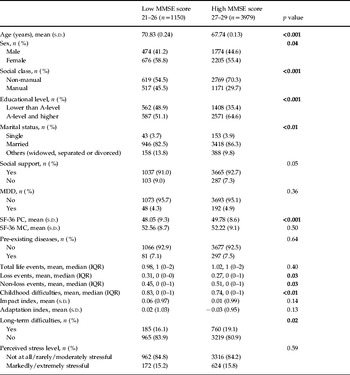
The estimated MMSE scores ranged from 20 to 29, with a median score of 28 [interquartile range (IQR) 27–29]. Table 1 shows the baseline characteristics of participants stratified by MMSE score level (high or low). Participants with low MMSE scores were older, more likely to be women and to have come from a lower social class, and to have achieved a lower educational level. Higher MMSE scores were associated with a slightly higher summary score in the physical component of SF-36, indicating better general physical health. Compared to the low MMSE group, the high MMSE group reported fewer loss events and childhood difficulties but more non-loss events. Moreover, a greater proportion of participants in the high MMSE group reported the presence of long-term difficulties. There were 149 (3.78%) participants in the high MMSE group and 63 (5.56%) in the low MMSE group who reported being extremely stressed in the preceding 10 years.
Characteristics of demographic and other factors by MMSE performance

MMSE, Mini Mental State Examination; IQR, interquartile range; s.d., standard deviation; MDD, major depressive disorder; SF-36 PC/SF-36 MC, physical/mental component summary score of the 36-item Short Form questionnaire.
Bold values indicate p < 0.05.
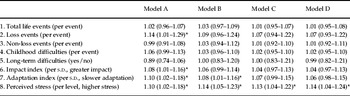
Table 2 shows the associations between measures of social stress and cognitive performance for each model tested. After adjusting for age and sex, MMSE scores were associated with the number of loss events, impact and adaptation index, and long-term self-perceived stress level. Of all the stress measures, only the adaptation index and self-perceived stress remained associated with MMSE scores after adjusting for sociodemographic factors. A 1 s.d. increase in the adaptation index (slower adaptation) was associated with an OR of 1.08 (95% CI 1.01–1.16) for scoring 20–26 in the MMSE, and a 1 unit increase in perceived stress was associated with an OR of 1.14 (95% CI 1.05–1.23). The association between the adaptation index and cognitive function was attenuated with further adjustment for general physical health variables. The association for perceived stress remained (and was little changed) after adjustment for sociodemographic factors, physical health and emotional health.
Associations between social stress and MMSE performance

MMSE, Mini Mental State Examination; s.d., standard deviation.
Values are odds ratios (95% confidence intervals) of scoring lower (20–26) in the MMSE: (A) adjusted for age (as continuous variable) and sex; (B) further adjusted for socio-economic variables: educational level (<O-level or no qualifications, O-level or equivalent, A-level or equivalent, degree or higher) and social class (I, II, III non-manual, III manual, IV, V); (C) with additional adjustment for physical health conditions: Short Form 36 (SF-36) physical component (PC) summary score (as continuous variable) and pre-existing health problems (yes/no); (D) with additional adjustment for emotional health: SF-36 mental component (MC) summary score (as continuous variable) and the presence of major depression disorder (MDD) (yes/no).
Time frame: 1–7 summarize stress experience in the 5 years preceding stress assessment; 8 indicates perceived stress level over the preceding 10 years.
Sample size: because of missing data for individual measures, the sample size available for analysis varied between 4578 (7D) and 5129 (1A–5A).
* p < 0.05.
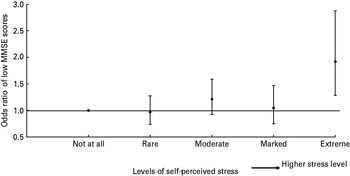
Figure 1 shows the relationship between self-perceived stress and MMSE scores after adjusting for age, sex, social class and educational level. The association between perceived stress and cognitive function was found to be restricted to those who reported extreme levels of stress (OR 1.91, 95% CI 1.28–2.86), for participants who reported their life as being extremely stressful versus those who reported no stress at all.
The dose–response relationship between self-perceived stress and Mini Mental State Examination (MMSE) performance. Odds ratios (95% confidence intervals) of scoring lower (20–26) in the MMSE test: adjusted for age, sex, educational level (<O-level or no qualifications, O-level or equivalent, A-level or equivalent, degree or higher) and social class (I, II, III non-manual, III manual, IV, V).

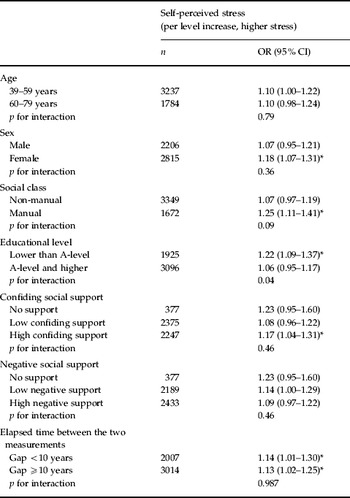
Table 3 presents the stratified associations between self-perceived stress and cognitive function. These data show that the association was more pronounced for participants who had a lower education level [OR 1.22 (95% CI 1.09–1.37) and OR 1.06 (95% CI 0.95–1.17) for those who were educated to a lower and higher level respectively; p = 0.04 for test of interaction]. Associations were similar for younger and older participants and there was an indication that associations were more pronounced for participants who were women and who were of lower social class (although these differences were not statistically significant).
Associations between self-perceived stress and MMSE performance by subgroup

MMSE, Mini Mental State Examination; OR, odds ratio; CI, confidence interval.
ORs (95% CI) of scoring lower (20–26) in the MMSE: adjusted for age, sex, educational level (<O-level or no qualifications, O-level or equivalent, A-level or equivalent, degree or higher) and social class (I, II, III non-manual, III manual, IV, V).
* p < 0.05.
Notably, the associations between perceived stress and MMSE scores did not vary by the elapsed time between HLEQ and MMSE assessments (<10 years or ⩾10 years) and, in particular, there was no evidence that the associations were stronger for participants whose psychosocial and cognitive assessments were closer in time.
Discussion
In this large population-based sample of middle- to older-aged adults, an index of adaptation constructed from questions relating to stressful life event experiences and self-perceived stress level was associated with MMSE scores, independently of sociodemographic factors. Participants who reported slower adaptation to life events were more likely to have lower cognitive function, but the association was attenuated after adjustment for general physical health conditions. The association between higher perceived stress and lower cognitive function remained significant after adjustment for age, sex, social class, educational level, pre-existing chronic diseases, MDD and the physical and mental components of SF-36. These differences in cognitive function seemed to be restricted to individuals who reported extreme levels of stress, with 1.9 times as many of these participants scoring worse on the MMSE compared to those who reported no stress. These data suggest that level of education level modifies this association, such that it is stronger among those who are educated to a lower level. There was no evidence of an association between global cognitive function and objective reports of life events and difficulties.
This study was derived from a prospective cohort study, the EPIC-Norfolk study, with an assessment of social stress completed some 10 years before a subsequent assessment of cognitive function. To our knowledge, this is the largest study on the association between stress and cognitive function and the study sample covers an age range of 40–74 years at the baseline. We used a comprehensive measure to address social stress, covering objective evaluation of stressful life events and also subjective reports of self-perceived stress and the perceived impact and adaptation to the events. Compared to previous studies, the additional measures of event impacts and individuals' adaptive capacity allowed more individual variation to be taken into account and may help to reveal a more generalizable picture of the association between social stress and cognitive function.
There are several limitations. First, among the 77 630 Norfolk residents who were sent initial invitations, 30 445 agreed to participate and were thereby recruited to the cohort. This cohort has been shown to be representative of the population studied in the Health Survey of England 1993 in terms of anthropometric variables, blood pressure and serum lipids (Day et al. Reference Day, Oakes, Luben, Khaw, Bingham, Welch and Wareham1999) and functional health (Surtees et al. Reference Surtees, Wainwright and Khaw2004), and includes subjects with a wide range of socio-economic circumstances (Wainwright & Surtees, Reference Wainwright and Surtees2004). Our current study sample comprised 5129 participants who had both the measures of social stress and SF-MMSE. Compared to the other participants in the EPIC-Norfolk cohort, the people in our study were significantly younger and more likely to have engaged in non-manual occupations and to have achieved higher educational levels. As educational level is a strong predictor of cognitive function, it is likely that those not included in our analysis also had worse cognitive performance. No differences in social stress were detected among those with and without the MMSE measure. Second, although the assessment of psychosocial factors preceded the cognitive assessments by a median of 10.5 years (range 5–14 years), baseline cognitive function was not measured and there is no information on changes in cognitive performance over time. We were therefore unable to distinguish between stress as a risk factor for, or as an early marker of, cognitive impairment. However, we found no evidence that the association between perceived stress and cognitive function was attenuated, with increasing elapsed time between psychosocial and cognitive assessments, perhaps suggestive that this association is unlikely to be due to confounding by cognitive state at the time of completion of the social stress assessment. Third, a shortened form of the MMSE was adopted to reduce the response burden and increase acceptability. Yet some of the inherent limitations in the MMSE, such as a lack of sensitivity for detecting mild cognitive impairment and limited capacity to assess domain-specific function (Hodges, Reference Hodges2007), still exist. There is also concern about the reliability of categorizing individuals' cognitive states based only on MMSE scores, although researchers have recently identified a moderate to good reliability of this state-based approach (Marioni et al. Reference Marioni, Chatfield, Brayne and Matthews2011). Furthermore, the present study suggests that subjective measures of social stress seem to be a stronger predictor for global cognitive function than objective measures. Although the effect of stress is in essence a psychological response and the main variations are expected to lie in people's notions, it is also possible that a much larger sample size is required to detect the subtle indirect association between objective occurrences of life events and cognitive function. Meanwhile, as we only found independent associations in one of the eight stress measures, our findings need to be replicated to allow for further interpretation.
The findings are consistent with observational epidemiological studies (VonDras et al. Reference VonDras, Powless, Olson, Wheeler and Snudden2005; Johansson et al. Reference Johansson, Guo, Waern, Ostling, Gustafson, Bengtsson and Skoog2010), where self-perceived stress was found to be associated with cognitive impairment. A recent prospective study (Johansson et al. Reference Johansson, Guo, Waern, Ostling, Gustafson, Bengtsson and Skoog2010) followed a sample of middle-aged females for 35 years and revealed that the risk of developing dementia increased by about 60% for those reporting frequent/constant stress compared with those reporting no stress. Unlike the present study, this longitudinal study used a single question to address stress, and only females were examined. The effects of aggregate measures of life events seem to be more pronounced among cross-sectional (VonDras et al. Reference VonDras, Powless, Olson, Wheeler and Snudden2005; Rosnick et al. Reference Rosnick, Small, McEvoy, Borenstein and Mortimer2007) or case–control studies (Tsolaki et al. Reference Tsolaki, Papaliagkas, Kounti, Messini, Boziki, Anogianakis and Vlaikidis2010). No association was found between the occurrence of total life events and cognitive function in our study, a finding similar to those from longitudinal studies (Persson & Skoog, Reference Persson and Skoog1996; Peavy et al. Reference Peavy, Salmon, Jacobson, Hervey, Gamst, Wolfson, Patterson, Goldman, Mills, Khandrika and Galasko2009; Comijs et al. Reference Comijs, van den Kommer, Minnaar, Penninx and Deeg2011). These three longitudinal studies all focused on elderly populations, and sample sizes were relatively small except for one study (Comijs et al. Reference Comijs, van den Kommer, Minnaar, Penninx and Deeg2011). The large sample size in our study has provided more statistical power, and our measure of stress has enabled examination of subjective reports of stress. However, it is noteworthy that the EPIC-Norfolk cohort is a middle- to older-aged population and, based on their range of MMSE scores, generally high functioning. As such, variations in the levels of cognitive function among participants are subtle, leading to a more modest effect size compared to those reported by previous studies. Despite this, our study identified a statistically significant association between perceived stress and cognitive function, indicating a potentially stronger effect if there had been a wider spread of cognitive performance.
To the best of our knowledge, no previous studies on the association between social stress and cognitive function have been conducted among the English population. None of the objective measures of stress in our study were associated with cognitive function, whereas the effect of a subjective measure of the length of time taken to recover from the adverse effects of life event experience was observed. Participants who reported faster adaptation to life event experience generally scored higher in the MMSE after adjusting for sociodemographic factors. This is in line with previous evidence on the significant role of coping strategies in the development of breast cancer. We are unaware of existing studies on the cognitive effects of individuals' adaptive capacity to stress, although a series of longitudinal studies on the association between neuroticism and cognitive decline (Wilson et al. Reference Wilson, Evans, Bienias, Mendes de Leon, Schneider and Bennett2003, Reference Wilson, Arnold, Schneider, Kelly, Tang and Bennett2006, Reference Wilson, Schneider, Boyle, Arnold, Tang and Bennett2007b) help to support our findings. Given the close link between perceived stress and neuroticism (Schlotz et al. Reference Schlotz, Yim, Zoccola, Jansen and Schulz2011), further studies that explore the inter-relationship among stress, neuroticism and the risk of cognitive decline might be of interest.
Of note, our study found that the association between stress and cognitive function was stronger among those with lower educational levels whereas the differences of associations by other sociodemographic factors or availability of social support were not statistically significant. In this study sample, those who had achieved a lower educational level were suggested to have reported higher stress levels and slower adaptation to stressful events. This is consistent with other studies that indicated negative associations between educational attainments and perceived stress levels (de Rooij et al. Reference de Rooij, Veenendaal, Raikkonen and Roseboom2012) or neuroticism (Denissen et al. Reference Denissen, Geenen, van Aken, Gosling and Potter2008). Individuals' different responses to stress may have influenced the association between self-perceived stress levels and cognitive function. Meanwhile, educational level has been suggested to be an important indicator of cognitive function (Cagney & Lauderdale, Reference Cagney and Lauderdale2002; Brayne et al. Reference Brayne, Ince, Keage, McKeith, Matthews, Polvikoski and Sulkava2010), which makes the moderating effect of education more plausible. We also found similar stress–cognition associations between age groups. Although it is difficult to explain the lack of an age–stress interaction given the suggested neurodegenerative process among the elderly, few studies have examined this interaction, making it difficult to conduct cross-study comparisons. Further longitudinal studies are therefore warranted to determine whether the effects of stress on cognition differ by age.
The significance of individuals' interpretations of and responses to stressors can be understood using physiological mechanisms. As stated by Lupien et al. (Reference Lupien, Maheu, Tu, Fiocco and Schramek2007), it is the body's response to stress that forms the foundation of research on the effect of stress on cognitive function. When a situation is deemed stressful by an individual, the body triggers the activation of the HPA axis, which results in the subsequent release of the adrenocorticotrophin hormone (ACTH). ACTH travels in the blood and reaches the adrenal glands, leading to the secretion of glucocorticoids and catecholamines. These two so-called stress hormones, in particular glucocorticoids, are then actively involved in the alteration of cognitive function. In animal studies (Sapolsky et al. Reference Sapolsky, Krey and McEwen1985; Uno et al. Reference Uno, Tarara, Else, Suleman and Sapolsky1989; Mizoguchi et al. Reference Mizoguchi, Kunishita, Chui and Tabira1992) exposure to glucocorticoids or stress over a long period of time can cause hippocampal pyramidal neuron loss and atrophy of the hippocampus. Depending on the duration of the stress exposure, the loss of neurons can be reversible. Although it might be extremely difficult to mimic stress exposure over 10 years in animal studies, our findings on the effect of self-perceived stress over 10 years can be illustrated by the cumulative irreversible loss of neurons, which may ultimately lead to cognitive impairment.
Conclusions
Individuals' interpretations and responses to stressful events, rather than the events themselves, were associated with cognitive function in this generally high-functioning population. Higher perceived stress levels were significantly associated with lower cognitive function, especially among less educated individuals. Repeated measures of cognitive function in the future would allow an examination of the association between social stress and change in cognitive function over time. More comprehensive cognitive assessments may also help to construct the diagnosis of Alzheimer's disease or dementia in this cohort, which would provide more insight into the role of social stress in the development of clinically diagnosed cognitive impairment.
Appendix Items included and excluded from the shortened MMSE used in EPIC-Norfolk study (Matthews et al. Reference Marioni, Chatfield, Brayne and Matthews2011)

Acknowledgements
The EPIC-Norfolk study is supported by programme grants from the Medical Research Council (MRC) UK (G9502233, G0300128) and Cancer Research UK (C865/A2883) with additional support from Research into Ageing. We acknowledge the contribution of J. Sherwin, whose input on revising the draft was invaluable. Y. Leng is supported by the Cambridge Overseas Trust. B. C. M. Stephan is supported by the European Research Area in Ageing (ERA-Age) Future Leaders of Ageing Postdoctoral Fellowship. F. E. Matthews is funded by the MRC.
Declaration of Interest
None.