Introduction
Over recent decades, Western child-care practices have shifted towards more focused, intensive involvement (Ehrenreich and English Reference Ehrenreich and English2005; Furedi Reference Furedi2001; Hays Reference Hays1998; Wall Reference Wall2010). There is broad consensus that the time parents devote to their children is vital to their development and contemporary ideals of good parenting encompass significant time investments in children (Quirke Reference Quirke2006; Sayer, Bianchi and Robinson Reference Sayer, Bianchi and Robinson2004). Much of the discourse on intensive parenting has focused on motherhood (Hays Reference Hays1998), but the growing expectation of heightened time investments now also includes fathers (Flouri and Buchanan Reference Flouri and Buchanan2003). Research suggests that today's fathers are, like mothers, doing more child care than previous generations (see e.g. Sayer, Bianchi and Robinson Reference Sayer, Bianchi and Robinson2004; Craig and Mullan Reference Craig and Mullan2009; Yeung, Hill and Duncan Reference Yeung, Hill and Duncan2000).
More often overlooked is that raising children also involves the time inputs of other family members. The nuclear family has never existed in social isolation, and parents have historically called on members of extended kinship networks for support in the care endeavour (Coontz Reference Coontz1992; Finch and Mason Reference Finch and Mason1993; Uhlmann Reference Uhlmann2006; Williams Reference Williams2004). Grandparent care is important to children's wellbeing and sense of belonging (Goodfellow and Laverty Reference Goodfellow and Laverty2003; Mitchell Reference Mitchell2007; Ochiltree Reference Ochiltree2006; Timonen and Arber Reference Timonen, Arber, Arber and Timonen2012; Wheelock and Jones Reference Wheelock and Jones2002). Grandparents can also be essential in assisting parents manage time demands. They have long been important ancillary carers, and recent research suggests they are playing an increasingly active role in helping care for children while parents do paid work (Condon et al. Reference Condon, Corkindale, Luszcz and Gamble2013; Goodfellow and Laverty Reference Goodfellow and Laverty2003; Jappens and van Bavel Reference Jappens and van Bavel2012; Whelan Reference Whelan2012).
Despite its ubiquity and importance, there has been little direct enquiry into what grandparents do when they are caring for children. Thus little is known about the composition of their child care, or how it compares to that of mothers or fathers. Furthermore, little is known about how gendered care patterns compare at the lifecourse stages of parent- and grandparenthood. Addressing these gaps in knowledge would not only give new insight into the content of the contributions grandparents make to raising children, but also evidence as to whether gendered child care practices persist or alter at different stages of the lifecourse.
To date, however, the literature has focused not on the content of grandparent care, but on identifying which grandparents are most likely to perform care, and to provide larger amounts of care. The central predictor of grandparent child care is gender. Grandmothers spend longer caring for children than grandfathers (Condon et al. Reference Condon, Corkindale, Luszcz and Gamble2013; Horsfall and Dempsey Reference Horsfall and Dempsey2013; Whelan Reference Whelan2012), echoing well-known disparities in amount of parental care (see Bianchi and Milkie Reference Bianchi and Milkie2010). Age, partnership status, education, socio-economic status (SES) and workforce participation are also associated with grandparents' care, but in some cases differentially for grandmothers and grandfathers. For example, being partnered predicts grandfathers' child care, but grandmothers tend to provide care independent of partnership status (Hank and Buber Reference Hank and Buber2009; Horsfall and Dempsey Reference Horsfall and Dempsey2013). Higher educated and higher SES parents have been found to spend more time in child care than other parents (Lareau Reference Lareau2000), and a recent study of first-time grandparents found that grandfathers with more education and income are more likely to provide higher hours (10+) of care (Condon et al. Reference Condon, Corkindale, Luszcz and Gamble2013). In contrast, grandmothers appear equally likely to care, and to perform similar amounts of care, regardless of education and SES (Condon et al. Reference Condon, Corkindale, Luszcz and Gamble2013). Grandparents provide more care if they are retired or semi-retired (Goodfellow and Laverty Reference Goodfellow and Laverty2003; Horsfall and Dempsey Reference Horsfall and Dempsey2013), indicating that time availability is associated with grandparental child care, as it is with parental care (Craig Reference Craig2007).
The literature thus suggests that for both parents and grandparents gender is the dominant influence on amount of care, resulting in substantial gender gaps within generations. We expect there would be wide differences in amount of care between generations also, because parents are generally the primary care-givers and grandparents are usually not co-resident. What is less obvious is how the gendered composition of child-care time – that is, its content and the way it is spent in relative terms – might differ for parents and grandparents. This paper investigates for the first time how the detailed content of grandparent child-care time compares with parents', by gender, along three critical dimensions, detailed below.
Composition of child care
Activities
Child care consists of a range of quite different tasks, some of which are more arduous than others. A body of literature has established that fathers spend more of their child-care time talking, reading, teaching, listening and playing with children than doing physical care tasks such as bathing, dressing, feeding, changing and putting children to bed (Baxter and Smart Reference Baxter and Smart2011; Craig Reference Craig2006b; Hook and Wolfe Reference Hook and Wolfe2012). In couple families this means mothers are usually more responsible for the routine physical child-care activities, which generally need to be done at certain times of day. In contrast, fathers' predominantly talk-based child care is less time-critical, so can be fitted around their other time commitments. Recent research suggests fathers are becoming more hands-on carers, and expanding their repertoire of care activities, but notwithstanding, a greater proportion of mothers' than of fathers' care involves the more laborious and regular routine care activities (Craig, Powell and Smyth Reference Craig, Powell and Smyth2014). As a result, on average mother- and father-care still differ in relative as well as absolute terms.
Research comparing grandmothers and grandfathers' time in specific care activities by gender is sparse, and largely consists of qualitative studies. These studies suggest that grandfathers largely leave the routine physical care to grandmothers, and that the bulk of their care consists of play activities (Horsfall and Dempsey Reference Horsfall and Dempsey2013; Wearing and Wearing Reference Wearing and Wearing1996). This suggests that there are gender differences in care activities within both generations. However, no research has yet looked at whether these gender differences are less wide for grandparents than for parents, and it is not clear what to expect in this regard.
On the one hand, it may be that gender differences are highly entrenched in the older generation, as a result of traditional attitudes about male and female roles and differing care and employment trajectories across the lifecourse (Martinengo, Jacob and Hill Reference Martinengo, Jacob and Hill2010). Specialisation over the course of a marriage may mean couples have established different sets of skills, experiences and interests, ultimately precluding grandfathers from involved participation in routine and physical child-care tasks. Also, within social contexts which value intensive mothering, grandmother care may be seen as ‘next best’ to mother care (Wheelock and Jones Reference Wheelock and Jones2002). Thus, grandmothers may ‘scrutinise themselves through the lens of a maternalist culture’ (Horsfall and Dempsey Reference Horsfall and Dempsey2013: 3) and perform the more hands-on tasks of caring, with grandfathers not expected to be closely involved (Mann Reference Mann2007; Wheelock and Jones Reference Wheelock and Jones2002).
It is conversely possible that being at a later stage of the lifecourse could weaken gender barriers, and facilitate more similarity in care activities for grandparents than for parents. Differences in workforce participation are cited as causal mechanisms underpinning differences in parental care composition, as well as in amount of care (see Bianchi and Milkie Reference Bianchi and Milkie2010), but may not be as salient to grandparents. In particular, retired or semi-retired men who were unable to be closely involved in caring for their own children over their working lives may use their greater time availability to be more involved in the care of their grandchildren (Ghysels Reference Ghysels2011; Tarrant Reference Tarrant, Arber and Timonen2012). They may also be willing to change from stereotyped masculine care behaviour (Emslie, Hunt and O'Brien Reference Emslie, Hunt and O'Brien2004; Tarrant Reference Tarrant, Arber and Timonen2012). Thus, particularly post-retirement, gender differences in care activities may be less pronounced for grandparents than they are for parents.
Furthermore, gender differences in care activities could be narrower for grandparents than for parents as a result of generational differences in women's care. Both the practical demands of raising young children, and differences between normative conceptions of mothering and grandmothering, could mean that even if more of grandmothers' than of grandfathers' child care is hands-on and routine, grandmothers nonetheless do relatively less of this type of care than mothers. If mothers are the primary family carers, responsible for ensuring routine care activities are performed and done to schedule, fathers, grandfathers and grandmothers are likely to spend a higher proportion of their child care in non-routine activities (such as talking, listening and play) than mothers do.
Multi-tasking
Another important dimension of child-care time is double activity. Child care, particularly supervising or minding children, is often done at the same time as other tasks. Double activity changes the experience of care-giving: doing child care and nothing else at the same time, or pairing it with leisure or socialising, is qualitatively different from doing it simultaneously with (for example) unpaid work activities such as housework. This is another point of difference between fathers and mothers. Mothers multi-task child care to a much greater extent than fathers do, and research suggests that as a result their time with children is more time pressured and stressful (Craig Reference Craig2006a; Offer and Schneider Reference Offer and Schneider2011).
There are reasons to expect that this aspect of care time, too, would be more gendered for parents than for grandparents. Sullivan and Gershuny (Reference Sullivan and Gershuny2013) argue (in relation to domestic labour and care combined) that the proportion of domestic time that is multi-tasked is similar by gender, and that the wide gender differences in amount arise because women have more opportunity to multi-task by virtue of spending more time at home than men. If this were so, we could expect less gender difference in grandparents' proportion of child care that is multi-tasked, particularly if they are no longer in the paid workforce. Also, narrower gender differences for grandparents could again be driven by women's behaviour as well as by men's. Most grandmothers spend less overall time with children than mothers. In order to focus attention on their grandchildren while they are together, they may multi-task child care less than mothers do.
We investigate multi-tasking child care for the first time by both gender and generation. In doing so, we refine Sullivan and Gershuny's (2013) approach. They did not differentiate domestic multi-tasking by whether it was paired with leisure or with other productive activities. In this paper we do make this distinction, because doing child care at the same time as housework, paid work or other child care is demanding in ways that doing it at the same time as leisure, such as television watching or chatting with friends, for instance, is not.
Co-presence
Mothers are more likely than fathers to care for children on their own, rather than with their partner also present (Craig Reference Craig2006b; Craig and Mullan Reference Craig and Mullan2011). If men's care is performed mainly when women are there too, it is an indicator that they are less likely to be in charge of the experience, but rather to be adjunct carers to women (Sullivan Reference Sullivan1997). The low proportion of solo father care implies that much of their child care is facilitated by mothers; that the default responsibility falls to mothers, with fathers helping out rather than fully sharing the job. This is reflected in mothers' attitudes; fathers caring for children solo is associated with higher female perceptions of shared care; that is, ‘taking over’ is seen as more meaningful sharing than ‘joining in’ (Fuligni and Brooks-Gunn Reference Fuligni and Brooks-Gunn2004).
As with care activities and multi-tasking, differences in co-presence may arise from difference in parents' workforce participation. Fathers of young children usually work full time, and their work hours limit their opportunity to be alone with children (Pocock, Skinner and Williams Reference Pocock, Skinner and Williams2012). They would generally be with children in the evening or at weekends, when mothers are likely to be there too (Craig and Powell Reference Craig and Powell2011). If men's employment is the major explanation for their low solo care, we could expect gender differences in this dimension of care to be less for grandparents than for parents, especially if they are retired or semi-retired. If both members of a grandparent couple are not working or are employed part time, they are likely to have more opportunities than couple parents to care together and as a result grandmothers may do less of their care solo than do mothers. Also, grandfathers may do more solo care than fathers.
However, there are countervailing reasons why grandfathers may not do much of their care solo. Although co-presence has not been explicitly explored in relation to grandparents' care, as noted above it is known that grandfathers (but not grandmothers) are much more likely to provide child care if they are partnered (Condon et al. Reference Condon, Corkindale, Luszcz and Gamble2013; Hank and Buber Reference Hank and Buber2009; Horsfall and Dempsey Reference Horsfall and Dempsey2013). This suggests that many grandfathers' contact with children is facilitated by their partners, and makes it likely that they rarely care solo. Caring alongside a female partner may also reflect ambivalence about grandfathers' caring abilities, reinforced by the diverging lifetime employment/care trajectories of men and women (Martinengo, Jacob and Hill Reference Martinengo, Jacob and Hill2010; Jenkins Reference Jenkins2013). That is, gendered work-care practices established over a marital lifetime could mean grandfathers rarely take sole responsibility for children, even if less constrained than fathers are by current work obligations. Also, fathers report being viewed by others as lacking in care competence (Areni and Holden Reference Areni and Holden2014). It is possible that grandfathers are even more subject to this perception, and perhaps more likely than fathers to lack confidence and thus to share the perception themselves.
Care context
It is recognised that patterns in parental and grandparental child care differ across social context (Ghysels Reference Ghysels2011; Hook and Wolfe Reference Hook and Wolfe2012; Arber and Timonen Reference Arber, Timonen, Arber and Timonen2012a). Beliefs regarding the proper care of children, including father and grandparent involvement, are situated in time and place; they are informed by cultural norms and values, and influenced by workplace structures and economic and family policy (Duncan and Edwards Reference Duncan, Edwards, Kollind and Peterson2003; Gornick and Meyers Reference Gornick and Meyers2003). Institutional structures reflexively intersect with ideology, making practices seem ‘right’ and ingraining them over time (Lewis Reference Lewis2009). This study is situated in Australia, which like all countries has developed a particular social organisation of child care.
Australia is usually classified along with the United States of America (USA), the United Kingdom (UK), Canada and New Zealand as a liberal welfare state with a relative lack of institutional supports for full-time working parents (Craig and Mullan Reference Craig and Mullan2010). Raising children is seen as a private responsibility rather than a public shared concern, as is the case in the Nordic social democracies (e.g. Orloff Reference Orloff2009; Pfau-Effinger Reference Pfau-Effinger2004). A national paid parental leave scheme was introduced in 2011, women's workforce participation has risen over time and there are partial child-care tax subsidies, however (Australian Bureau of Statistics (ABS) 2012; Cassells et al. Reference Cassells, McNamara, Lloyd and Harding2005; Pocock, Skinner and Williams Reference Pocock, Skinner and Williams2012). Notwithstanding, long hours in formal non-parental child care is not the norm, and the majority of Australian children in formal care attend for less than 20 hours per week (ABS 2012). Part-time work is the ‘family-friendly’ measure most frequently provided by Australian employers, and most families with young children have a full-time employed father and a part-time working mother (Craig and Mullan Reference Craig and Mullan2009). Average full-time working hours are long (Pocock, Skinner and Williams Reference Pocock, Skinner and Williams2012), meaning that there is wide divergence between primary (full-time) earners and secondary (part-time) earners' time availability for unpaid work. Reflecting the gendered employment patterns, average differences between mothers and fathers' time inputs to children are wide (Craig Reference Craig2006a, 2006b).
At the same time, evidence suggests that Australian families subscribe strongly to contemporary ideas that intensive attention is essential to children (Gray, Baxter and Alexander Reference Gray, Baxter and Alexander2008). Australian parents spend the most daily time caring for children of all Organisation for Economic Co-operation and Development countries (Fisher and Robinson Reference Fisher and Robinson2010). This applies to both genders. Australian fathers of young children match or outstrip the child-care time of their counterparts in other countries, including the Nordic social democracies, in which social supports include generous paid parental leave and universal subsidised day care, and average paid working hours are much shorter. Australian child-rearing practices thus simultaneously involve concerted cultivation, high time inputs and wide gender disparity (Craig and Mullan Reference Craig and Mullan2010; Craig, Powell and Smyth Reference Craig, Powell and Smyth2014).
The normative valorising of family care means that many Australian grandparents are also actively involved in supporting parents raise children. Grandparents account for half of all regular weekly child-care arrangements in Australia, caring for 937,000 children aged 12 and under in 2011 (ABS 2012). Despite its prevalence, however, there is a dearth of quantitative research into the content and composition of grandparental care, and how it compares to parental care.
Research focus
This paper aims to contribute new insight into family care through an original detailed analysis of how parents' and grandparents' child-care time is comprised. We calculate the amount of child-care time, but are particularly interested in its proportional composition, as this indicates how child-caring roles vary between fathers, grandfathers, mothers and grandmothers. It will show the kind of attention children receive from each, and how the experience of care-giving compares by gender and generation. We investigate three dimensions of child care: the activities performed, care multi-tasked with other activities, and care performed solo versus together with a spouse. We investigate whether and how the composition of parenting diverges from that of grandparenting, and whether child-care composition is more gender-similar for grandparents than for parents.
Data and method
We use the most recent (2006) ABS Time Use Survey (TUS). A nationally representative survey, the TUS gathers information on the time allocation of all members of sampled households over the age of 15. In a time-diary, respondents record the activities they undertake on each of two days, to a detail level of five minutes. Respondents record their main activities, any simultaneous (‘secondary’) activities, who they are with and where they are each day. We identify grandparents through the survey question ‘do you have a grandchild under 15?’ and parents by whether they have children aged 0–15. The ABS TUS collects data from all adult members of co-resident households, so we have data on both members of couples. Sample details are below.
Dependent variables
We compute total time in child care subdivided along the three dimensions discussed above: (a) the child-care activities that comprise it, (b) whether (and what) activities are done at the same time, and (c) whether it is done with or without a partner present; and also calculate the proportion of each respondents' total child-care time that is spent in the sub-components of each dimension.
Child care is comprised of talk-based care including reading, teaching, talking, listening and playing games with children; physical care, including feeding, bathing, dressing, putting children to bed; accompanying and transporting children, waiting or meeting children, ensuring their safety and handing them over to substitute carers; minding children, caring for children without active involvement, monitoring children, being an adult presence for children to turn to, supervising. Physical care and accompanying care must be done regularly, often at certain times of the day, and are referred to jointly as routine child-care activities. Playing, talking, listening, teaching and minding are non-routine child-care activities. Together the activities comprise total child care as a main (primary) activity.
In addition, in answer to the question ‘what were you doing at the same time?’, respondents record when they do child care as a secondary activity, and whether they are doing other activities when child care is their primary activity. Drawing on these data we capture multi-tasking by calculating minutes per day in child care (recorded as either a primary or secondary activity) simultaneous with other activities (recorded as either a primary or secondary activity). We differentiate child care done as a single activity (i.e. not multi-tasked) from child care combined with (a) productive activities (paid work, domestic work, shopping) or (b) non-work activities (personal care, voluntary activities, social and community interaction, recreation/leisure). Each time period is counted once only, to avoid double counting, and time spent sleeping is excluded.
Third, using the information given in answer to the question ‘who were you with [while doing the activity]?’, we calculate minutes per day (mpd) in child care done (a) with or (b) without the respondents’ partner also present. Time spent sleeping is excluded and the analyses on this dimension of care are conducted only on those respondents who are partnered (either married or co-habiting).
Analysis plan
Our main dependent variables are the proportions of respondents' care time allocated to the sub-components of each dimension – activity, multi-tasking and co-presence – described above. Because so little is known about how grandparents' care is comprised, we begin with a detailed descriptive overview of time in child care by mothers and fathers, grandfathers and grandmothers, and the proportional composition of that time along each of the three dimensions. We then run linear regression analyses on (a) the proportion of respondents' primary care time that is spent in routine child-care activities, (b) the proportion of respondents' total primary or secondary child-care time that is multi-tasked with other productive activities, and (c) the proportion of respondents' total primary or secondary child-care time that is performed without a partner present. For the multivariate analyses, we select only those who recorded some child care on the diary days. For modelling proportion (ratios), the Fractional Logit model is a potential strategy because the dependent variable is constrained to take values between 0 and 1 (Buis Reference Buis2006; Papke and Wooldridge Reference Papke and Wooldridge1996). However, linear regressions yield substantively similar results and are preferred here because the results are easier to interpret.
The independent variables of interest are gender (male = 0, female = 1) and generation (parent = 0, grandparent = 1), and to see if the associations with gender differ for parents and grandparents, interactions between them (gender × generation). We control for factors that the literature discussed above found to be associated with grandparents' propensity to care: education (no college degree (omitted), college degree), partnership status (partnered (omitted), unpartnered), employment status (full time (omitted), part time, not employed), and index of relative socio-economic disadvantage of the geographical area (Socio-Economic Indices for Areas (SEIFA); Australian Bureau of Statistics 2006) (lowest 60 per cent (omitted), highest 40 per cent = 1). We prefer this indicator to household income because retired grandparents may have current income that does not accurately reflect their wealth or SES. We test interaction terms between generation and workforce status, to see if time availability has the same relationships with care composition for parents and grandparents. There are a number of variables we wished to include in the models, but which our data did not supply. We were unable to know if the grandparents were paternal or maternal, how many grandchildren under 15 were cared for or their exact age.
For all independent variables, missing data rates were low (<10%). As SEIFA is an area-level characteristic, respondents with missing data (<2%) were deleted from the analysis. In order to remove the potentially complicating effect of co-residence, we excluded grandparents who live with their grandchildren (N = 47). These exclusions yielded an analytic sample of 1,685 grandparents (3,051 diaries; 1,375 male, 1,676 female) and 1,901 parents (3,507 diaries; 1,556 male, 1,951 female). As appropriate, analyses accounted for clustering of persons within households and diaries within persons and were weighted to ensure an equal distribution of days of the week. All multivariate analyses were executed using the survey command (Stata version 11.2).
Results
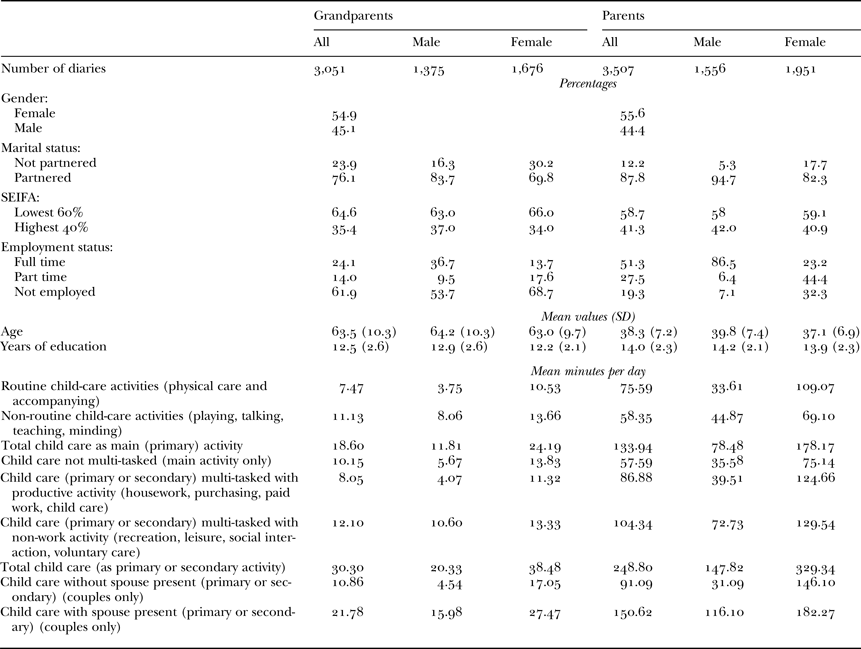
Table 1 shows descriptive statistics on the sample of grandparents and parents of children up to age 15. The mean age of grandparents was 64 years and of parents was 38 years, with men slightly older than women in both generations. In both generations, about 55 per cent of respondents were women. Predictably, there were gender and generational differences in demographic characteristics. More women than men were single. For parents, 18 per cent of mothers and 5 per cent of fathers were unpartnered, the large difference likely because mothers more often have custody of children following separation. For grandparents, the figures were 30 and 16 per cent, respectively, probably reflecting the likelihood of widowhood in that generation, and the relative longevity of women. In both generations, a higher proportion of women than men lived in the lowest ranking socio-economic areas. Men were much more likely to be employed full time than women (37% versus 14% for grandparents; 87% versus 23% for parents), while women were much more likely to be employed part time than men (18% versus 10% for grandparents; 44% versus 6% for parents). Sixty-two per cent of grandparents (54% of men and 69% of women) were not employed, compared to 19 per cent of parents (7% of men and 32% of women).
Descriptive statistics

Note: SEIFA: Socio-Economic Indices for Areas.
Table 1 also shows mean daily minutes child care spent in each of the dimensions described above. Routine child care (physical care and accompanying) and non-routine child care (playing, talking, teaching and minding) together sum to total child care performed as a main activity. Within each generation, men average less than half the daily child-care time of women. As expected, differences between the generations are also wide. On average, mothers' total child-care time as a main activity (178 mpd) is seven times that of grandmothers (25 mpd), and fathers' total child-care time as a main activity (78 mpd) is 6.6 times that of grandfathers (12 mpd).
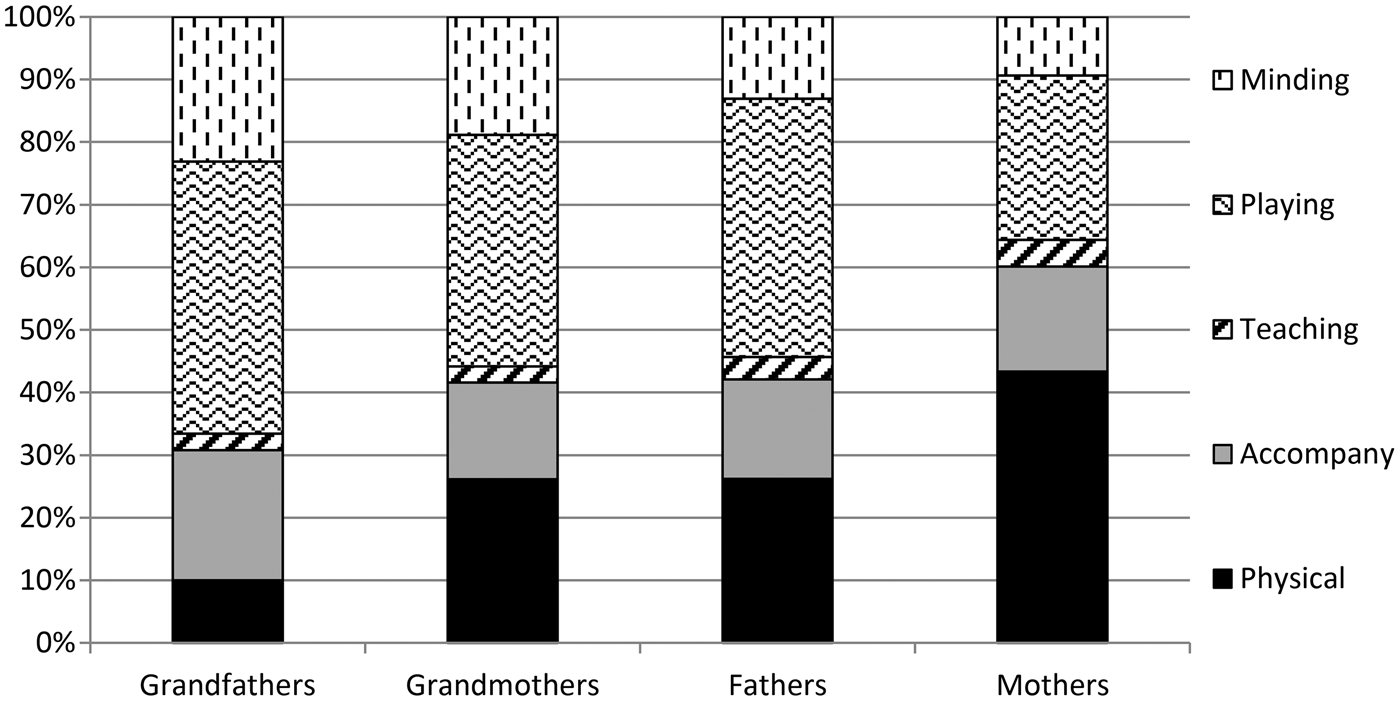
Figure 1 shows how child-care activity time is proportionally distributed by gender and generation. In relative terms, grandmothers and fathers have a similar composition of child care. They each spend about 40 per cent of their main activity child care in the routine activities of physical and accompanying care (the solid black and grey parts of the bars) and about 60 per cent in the non-routine activities of playing, talking, teaching and minding (the patterned parts of the bars). They differ somewhat in the relative proportion of play versus minding, with fathers doing a slightly higher proportion of the former and grandmothers a slightly higher proportion of the latter, but broadly speaking their child care is similarly comprised. In contrast, mothers average much more, and grandfathers average much less, of their child-care time in routine activities (physical and accompanying). The results indicate a clear differentiation in the relative composition of mothers' care from that of the other three groups. They further indicate that in relative terms, fathers and grandmothers are both more hands-on carers than are grandfathers.
Relative composition of daily child-care activities by grandparents and parents, by gender.
Table 1 also shows mean daily minutes in total child care as a primary or secondary activity. This measure captures the extent of daily care more fully than primary activity only, because it includes supervising children while doing something else at the same time. As with primary activity child care, there are wide absolute differences by both gender and generation. Within each generation, men average about half the daily child-care time of women; mothers' total child care as a primary or secondary activity (329 mpd) is 8.5 times that of grandmothers (38 mpd), and fathers' total child-care time as a primary or secondary activity (147 mpd) is seven times that of grandfathers (20 mpd).
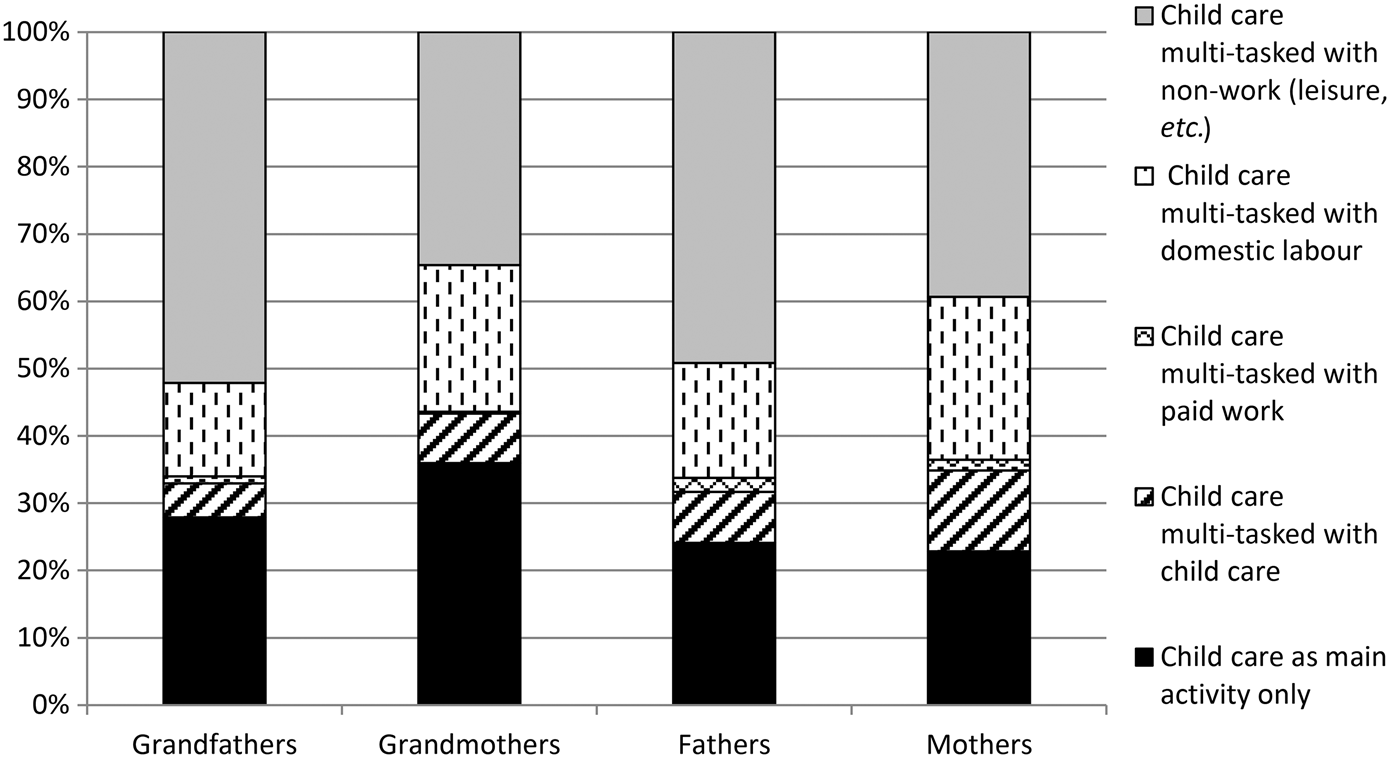
Figure 2 shows the proportional distribution of this total child-care time by whether it is multi-tasked with paid or unpaid work (productive activity, shown in the patterned parts of the bars), multi-tasked with non-work activity (the solid grey parts of the bars) or done as a main activity only (not multi-tasked, the solid black part of the bars). On this dimension of care there are both gender and generational contrasts.
Relative composition of child care as multi-tasked or non-multi-tasked activity by grandparents and parents, by gender.
There are within-generation similarities in that both mothers and fathers spend only around 23 per cent of their child-care time not multi-tasking, compared to nearly 30 per cent for grandfathers and 35 per cent for grandmothers. The proportionally greater direct attention to children may reflect grandparents making the most of their comparatively low overall time with children. However, the composition of child-care time that is multi-tasked shows more gender than generational similarities. Both fathers and grandfathers multi-task much more (about 50%) of their child-care time with non-work (leisure) activities than do grandmothers (35%) or mothers (40%). The implication is that male child-care time is more relaxed than female in both generations. However, the female generations differ in that on average mothers multi-task child care with other productive activities more than do grandmothers, with nearly 40 per cent of the child-care time paired with paid work, domestic work or other child care, compared to less than 30 per cent for grandmothers. Grandmothers nearly match mothers' proportion of domestic labour multi-tasked with child care, however, and overall the results suggest that in both generations child care involves more simultaneous work activity for women than for men.
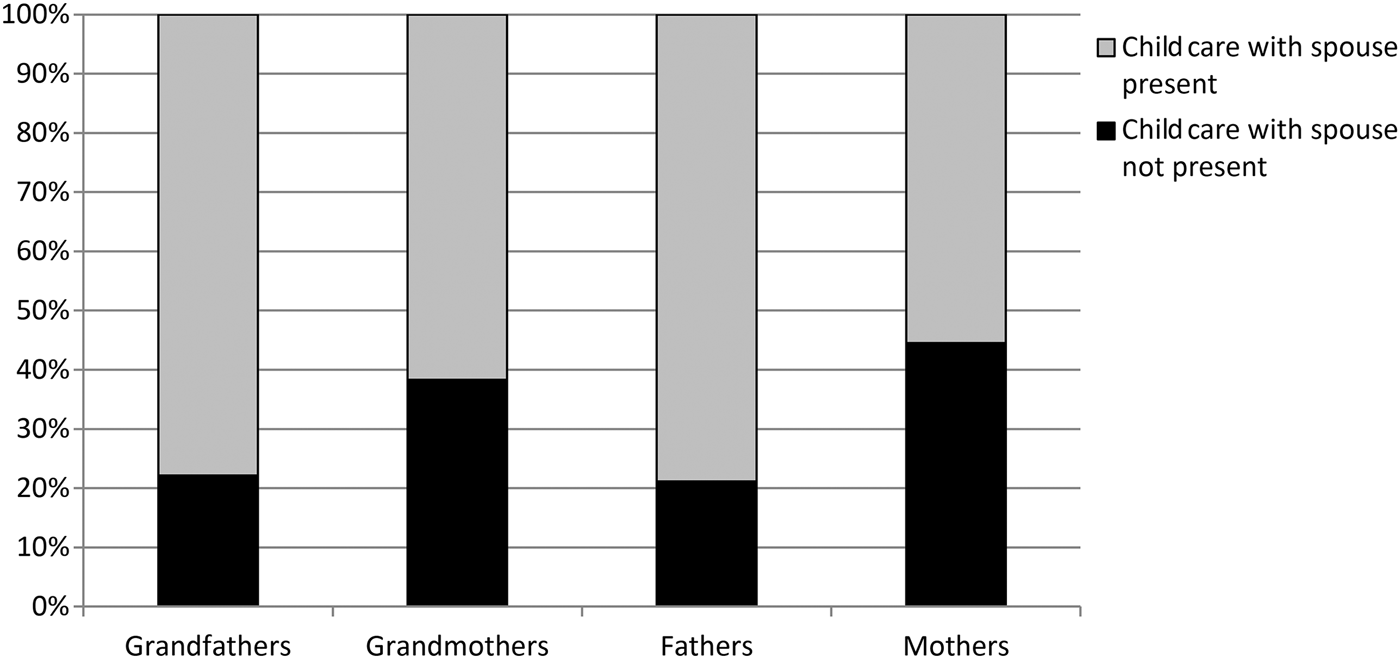
Figure 3 also draws on data in Table 1, in this case to show proportional distribution of child care (as either a primary or secondary activity) by whether it is done with or without a partner also present. (Recall analyses on these measures are limited to those in couples only.) On this dimension, gender differences clearly outweigh generational differences. Both fathers and grandfathers spend only about 20 per cent of their child-care time without their partner present also, compared to about 40 per cent for mothers and grandmothers. This suggests that responsibility for managing care resides with women, and that men are in this regard ancillary to women in both generations.
Relative composition of child care by whether or not partner is present, by grandparents and parents (couples only).
The descriptive results thus show that gender and generation patterns differ across each of the child-care dimensions. To test directly gender, generation and the interaction between them, we now turn to multivariate analysis. We model the proportion of routine care activities, child care multi-tasked with productive activities or child care performed without a partner present because, as discussed above, the literature suggests these are the more onerous aspects of each dimension of care.
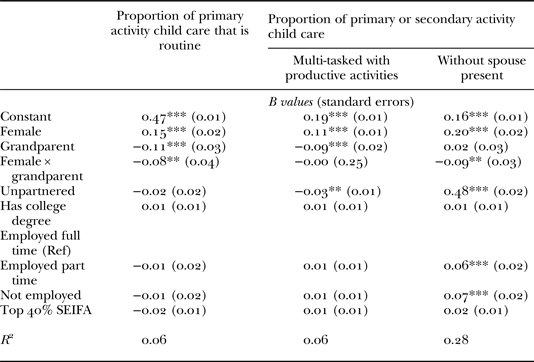
Results are shown in Table 2. The constant terms in the models represent the time of fathers who are partnered, have no college degree, are employed full time and are in the lowest 60 per cent of SEIFA. Men in this category are predicted to spend 47 per cent of their child-care time in routine activities. Women average 15 percentage points more (to a total of 62%), and grandparents average 11 percentage points less (to a male total of 36%), of their child-care time in routine activities. The interaction term in this model is significant, so grandmothers' predicted higher proportion of routine care as women is partly negated (by eight percentage points, to a total of 43%). The results therefore suggest that the proportion of child care that is comprised of the regular, routine hands-on care tasks, generally thought to be more laborious and less flexible than talk-based care activities such as reading, talking and playing, are more gender-equal for grandparents (a 7 percentage point gap) than for parents (a 15 percentage point gap). The interaction results are illustrated in Figure 4a.
Regression results: interaction terms gender × grandparent. Proportion of (a) primary activity child care that is routine; (b) primary or secondary activity child care that is multi-tasked with productive activities; (c) primary or secondary activity child care that is without spouse present.
Linear regression models of proportion of child care that is routine activities, child care multi-tasked with productive activities or child care without their spouse present
Note: SEIFA: Socio-Economic Indices for Areas.
Significance levels: **p < 0.01, ***p < 0.001.
Reference category men average 19 per cent of their child-care time multi-tasking with other productive activities (see Table 2). Women average 11 percentage points more (to a total of 30%) and grandparents nine percentage points less (to a male total of 10% and female total of 21%). In this model, the interaction term is not significant, so the gender gap of 11 percentage points is the same for both generations. The null interaction results are illustrated in Figure 4b. They confirm the descriptive analysis suggesting both that female care involves more simultaneous work than male, and that mother care involves more simultaneous work than grandmother care.
Reference category men average 16 per cent of their child-care time without their spouse present (see Table 2). Women average 20 percentage points more (to a total of 36%). There is no statistically significant association with generation as a main effect, but in this model the interaction term is significant, indicating that while grandfathers and fathers' proportion of child-care time in sole charge is statistically identical, grandmothers' proportion of child-care time in sole charge is 9 percentage points lower than mothers'. Therefore, as with routine care, the proportion of child care that is done without a spouse also present is more gender-equal for grandparents (an 11 percentage point gap) than for parents (a 20 percentage point gap). The interaction results are illustrated in Figure 4c.
Across all three models, only a few control variables were significant. Unsurprisingly, being unpartnered was associated with a much higher proportion of child-care time in sole charge. It was also associated with a slightly lower proportion (three percentage points) of child-care time spent multi-tasking with productive activities, perhaps because single people do less housework than partnered (Craig Reference Craig2006c). Compared to being employed full time, the proportion of child care without a spouse present was lower for part-time workers (six percentage points less) and for those who were not employed (seven percentage points less). This likely arises because these workers are more often at home while their spouse is at work, than is the case for full-time employees. In preliminary analyses (not shown), we entered interaction terms testing whether this finding applied to both generations. We found there was no significant difference, suggesting that paid work hours reduce child-care time in sole charge to the same extent for both parents and grandparents.
Discussion and conclusion
Nuclear families do not live in isolation but within relational networks and, importantly, family care is not provided only by parents. Yet research into the inputs of extended family, including grandparents, particularly grandfathers, is very sparse (Arber and Timonen Reference Arber and Timonen2012b). To provide new empirical knowledge and insight into caring roles at different stages of the lifecourse, this paper explored whether the composition of parenting diverges from that of grandparenting, and whether gender differences in care composition are as pronounced for grandparents as for parents. Using detailed time-diary data, it investigated parents' and grandparents' relative time in child care divided along the dimensions of task (routine versus non-routine activities), multi-tasking child care with other activities and co-presence (caring for children together with a spouse versus caring in sole charge).
Results showed that gender differences in multi-tasking productive activities were the same for both generations but that gender differences in routine and solo care were smaller for grandparents. Notably, these gaps were narrower because grandmothers spent a lower proportion of their care time in routine care and care in sole charge than mothers, not because grandfathers spent a higher proportion of their care time in these ways than fathers. Therefore, the possibility that men may take the opportunity grandparenthood offers to adjust their care composition to include more hands-on, independent care was not supported. Rather, grandfathers matched fathers' low proportion of solo care (showing that neither generation of men takes much sole responsibility for child care), and also spent a substantially lower proportion of their child-care time doing routine care activities than did fathers. This suggests that they are only peripherally involved in the day-to-day care of children. The descriptive results in Figure 1, which differentiated between the sub-components of routine care, indicated that most of grandfathers' routine care was accompanying children, with a very small proportion devoted to physical care activities. It seems likely that grandfathers' routine care is largely comprised of accompanying children to school or day care.
The differences in care composition across generations could arise because, due to the practical demands of raising young children, parents are more central to child care than grandparents. Supporting this possibility, we found that there were also substantial generational differences for women. Compared to mothers, grandmothers spent a much lower proportion of their care time in routine activities. Indeed they were similar to fathers on this measure. As a result, on proportion of care that is routine, mothers diverged markedly from both grandmothers and fathers, and even more from grandfathers. Mothers also do a much larger amount of routine care than either fathers or grandparents (see Table 1). Therefore, our findings underscore mothers' central role as primary family carers, providing day-to-day routine and regular care. This study's encompassing view of family care thus indicates the extent to which fathers, grandmothers and (especially) grandfathers are auxiliary care providers, not only in that they do much less overall, but also in that more of their child care consists of time-flexible activities such as talking, reading, listening and play.
One clear generational difference for both genders was the much lower proportion of grandparents' care that was multi-tasked. Compared to both mothers and fathers, a higher proportion of grandparents' child-care time was spent doing only child care, suggesting they focus more directly on children during the time they are together. This proportionally greater direct attention may arise through grandparents making the most of their comparatively low overall time with children. It could also be that, as ancillary carers, they feel responsible to parents to perform care to a good standard and are thus highly attentive.
Notwithstanding the generational difference in child care as a sole activity, however, there was an important gender distinction in multi-tasking that pertained in both generations. Multi-tasking child care with other productive activities (housework, paid work or other child care) constituted a much higher proportion of both mothers' and grandmothers' child-care time, than it did of their male counterparts' child-care time. For men, multi-tasking most often meant combining child care with leisure. Doing child care at the same time as other work activities is an important indicator of the quality of the experience, and in this regard we found the same gender differences for both parents and grandparents. Thus, across generations, child care involves simultaneous work activity more for women than for men, which perhaps is why they find it more time pressured (Craig and Mullan Reference Craig and Mullan2009; Craig and Powell Reference Craig and Powell2013). The predominant male combination of child care with leisure is conversely likely to make it more relaxing and pleasurable (Mattingly and Sayer Reference Mattingly and Sayer2006).
We noted above that contrasting care composition across generations could arise from differences between the demands and normative expectations of parenthood and grandparenthood. It could also reflect cohort-related generational shifts in conceptions of what constitutes appropriate child care and/or gender divisions of care. Studies show that across the Western world, the amount of parental time with children has risen (Sayer, Bianchi and Robinson Reference Sayer, Bianchi and Robinson2004; Yeung, Hill and Duncan Reference Yeung, Hill and Duncan2000), and scholars argue that it has also become more intensive (Ehrenreich and English Reference Ehrenreich and English2005; Furedi Reference Furedi2001; Hays Reference Hays1998; Wall Reference Wall2010). An Australian study found that increases in fathers' overall child-care time occurred across the range of care activities, including hands-on routine care (Craig, Powell and Smyth Reference Craig, Powell and Smyth2014). Our finding here that more of fathers' care is spent in routine activities than is the case for grandfathers is consistent with this. However, we also found that other aspects of the care experience (taking sole responsibility, combining it with leisure) showed little difference between fathers and grandfathers. For example, there was no evidence that younger men are doing a higher proportion of their care solo than grandfathers are, or conversely that grandfathers take the opportunity older age offers to be more independent care providers. A possible implication of our results is that gender patterns in the contextual dimensions of caring are less amenable to change than are care activities.
This study is subject to a number of limitations. We cannot isolate causality, but can draw inferences only. Our cross-sectional data cannot follow individuals from one lifecourse stage to another, but only give a snapshot of parental and grandparental child care at a point in time. We cannot account for selection effects or be definitive about the extent to which the generational differences we note are due to contrasting expectations of parents and grandparents, or because caring norms and practices have changed over time. Unfortunately, while some longitudinal studies collect summary measures of amount of child-care time (Ghysels Reference Ghysels2011; Whelan Reference Whelan2012), they cannot be used to address the issues explored here because no time-diary panel data showing the detail of care composition is currently available. Further limitations are that we do not know how many grandchildren are cared for, and that to ensure comparability between parents and grandparents we look only at the broad category of children under 15. Also, although the ABS TUS collects data from all adult members of co-resident households, so we have data on both members of couples, we were not able to match grandparents and parents who do not co-reside. Inter alia this means we do not know how far away they lived, or whether the grandparents were paternal or maternal, both factors which can impact on amount of child care (Condon et al. Reference Condon, Corkindale, Luszcz and Gamble2013; Ghysels Reference Ghysels2011).
Notwithstanding these caveats, this study offers new insight into how caring roles differ by gender at two important stages of the lifecourse. It takes an encompassing approach to family care, filling an important gap in the literature by drawing on a large-scale nationally representative time-use survey to give the first detailed comparison of the child care composition of mothers, fathers, grandfathers and grandmothers. The grandparent care literature has to date concentrated on identifying factors associated with their propensity to care, and with the amount they do (see e.g. Condon et al. Reference Condon, Corkindale, Luszcz and Gamble2013; Ghysels Reference Ghysels2011; Hank and Buber Reference Hank and Buber2009; Horsfall and Dempsey Reference Horsfall and Dempsey2013). In exploring three separate dimensions of care, this paper offers a rich multi-layered description that contributes new knowledge on gender divisions and provides a basis for further enquiry into characteristics and patterns of grandparent child care.
Acknowledgement
This research was supported by Australian Research Council Discovery Grant 1093311.