People often make risky decisions for others in their capacity as professionals, significant others, or friends. For example, in the context of health and medicine, doctors frequently make risky treatment decisions for their patients, and family members often decide about prognostic risks that pertain to the well-being of relatives. Research has shown that when making decisions for other people, we often use our own preferences as an anchor (Epley, Keysar, Van Boven, & Gilovich, Reference Epley, Keysar, Van Boven and Gilovich2004; Marks & Arkes, Reference Marks and Arkes2008). To illustrate, surrogates’ predictions of patients’ decisions more strongly resemble surrogate’s own preferences rather than preferences of patients (Fagerlin, Ditto, Danks, & Houts, Reference Fagerlin, Ditto, Danks and Houts2001). Consistent with this finding, several studies have documented important mispredictions and self-other discrepancies between the wishes of patients and decisions of next of kin surrogates (Shalowitz, Garrett-Mayer, & Wendler, Reference Shalowitz, Garrett-Mayer and Wendler2006), doctors (Garcia-Retamero & Galesic, Reference Garcia-Retamero and Galesic2012, Reference Garcia-Retamero and Galesic2014), and parents (Brody, Annett, Scherer, Perryman, & Cofrin, Reference Brody, Annett, Scherer, Perryman and Cofrin2005). Knowledge of what factors influence decisions for oneself and others can help facilitate the decision making process and achieve optimal outcomes. Surprisingly, empirical work on how people make decisions for others in comparison to decisions for themselves is relatively scant (Stone & Allgaier, Reference Stone and Allgaier2008). We extend this research by investigating the differences in risky decisions made for oneself and another person (i.e., self-other discrepancies), depending on the preferences of the other person and the characteristics of the surrogate.
Two empirically-supported theories have informed our research. The first is the theory of the empathy gap (or risk-as-feelings, Hsee & Weber, Reference Hsee and Weber1997; Loewenstein, Reference Loewenstein2005), mainly based on research investigating predictions of others’ decisions. This research showed that people often expect others to have relatively muted emotional reactions toward risks, resulting in regressive predictions of others’ decisions (Faro & Rottenstreich, Reference Faro and Rottenstreich2006; Loewenstein, Reference Loewenstein2005). To illustrate, individuals who predicted that others would experience less worry than themselves when faced with a risky health decision (i.e., showed an empathy gap) also predicted that others would make less risk-averse decisions than themselves (i.e., made a regressive prediction) (Garcia-Retamero, Okan, & Maldonado, Reference Garcia-Retamero, Okan and Maldonado2015). More support for the empathy gap comes from research showing that when empathy is facilitated, self-other discrepancies disappear (Hsee & Weber, Reference Hsee and Weber1997). Self–other discrepancies in predictions of decisions primarily occurred when the target of the prediction was unfamiliar and/or abstract (i.e., when the other is unknown), but not when the target was vivid (i.e., a person sitting next to us; Hsee & Weber, Reference Hsee and Weber1997) or familiar (i.e., a close friend; Faro & Rottenstreich, Reference Faro and Rottenstreich2006).
Another theory is social values theory, which is based on research investigating whether people are more or less risk-averse in decisions for others than for themselves (Beisswanger, Stone, Hupp, & Allgaier, Reference Beisswanger, Stone, Hupp and Allgaier2003; Dore, Stone, & Buchanan, Reference Dore, Stone and Buchanan2014; Stone & Allgaier, Reference Stone and Allgaier2008; Stone, Choi, de Bruin, & Mandel, Reference Stone, Choi, de Bruin and Mandel2013; Wray & Stone, Reference Wray and Stone2005). This research showed that people decide for others in accordance with the perceived social value of the risk in a given domain (Stone & Allgaier, Reference Stone and Allgaier2008; Stone et al., Reference Stone, Choi, de Bruin and Mandel2013). In domains where risk-taking is valued (e.g., casual romantic relationships), people make more risk-seeking decisions for others than for themselves. However, in domains where risk-taking is not valued (e.g., situations involving health and safety), people make more risk-averse decisions for others than for themselves. These findings are in accordance with research showing that decision makers consider various aspects of the decision situation when they make decisions for themselves but tend to focus on the most important aspect (e.g., the social norm) when they make decisions for others (Kray, Reference Kray2000; Kray & Gonzalez, Reference Kray and Gonzalez1999). Finally, the above mentioned self-other discrepancies are not due to a failure to predict what others would decide but rather reflect what is perceived as the normative behavior in a given context (Stone et al., Reference Stone, Choi, de Bruin and Mandel2013).
These findings show that when we do not know the wishes of other people, we may use the social norm as a cue to make decisions for them. However, on many occasions we know what the other person would prefer because they explicitly told us or we know them well. In addition, the other person’s preferences may or may not coincide with the social value of risk in a given domain. It is not yet clear to what extent social values theory can predict decisions when preferences and norms are at odds. To the best of our knowledge, no research has investigated how information about the target’s (pro- or contra-normative) preferences affects self-other discrepancies in decisions. In this research we aimed to fill this gap in the literature and expand research on social values theory. In particular, we investigated how information about preferences, and several other cognitive and emotional factors moderated self-other discrepancies in a health decision context.
In an experiment, young adults made decisions about health—a context where risk-aversion and safety are valued (Stone et al., Reference Stone, Choi, de Bruin and Mandel2013). In particular, participants decided about purchasing a vaccine against a sexually-transmitted virus for themselves and for another person. We manipulated the information participants received about the vaccination preferences of the other person. We expected this information to influence participants’ decisions for the other person, thereby producing self-other discrepancies. In one condition, participants received information that the other person had risk-averse preferences (e.g., would rather vaccinate). In a second condition, they received information that the other person had risk-seeking preferences (e.g., would rather avoid the hassle of vaccination). In a third condition, participants received no information. Social values theory predicts that people would make more risk-averse decisions (e.g., would be willing to pay more for vaccination) for the other person than for themselves when they have no information. In contrast, participants may be more risk seeking when they make decisions for others than for themselves in the risk-seeking condition, suggesting that the predictive power of the social norm would be diminished when people’s preferences are known to be at odds with the social norm (H 1a ). Alternatively, if self-other discrepancies are not reversed in the risk-seeking condition, this would mean that under certain conditions the social value of risk is pervasively predictive of self-other discrepancies even when preferences are at odds with the social norm (H 1b ). In the current research, we tested these two alternative hypotheses.
There is also a lack of research investigating the role of cognitive and emotional individual differences, which could potentially moderate self-other discrepancies. In the current research, we examined the role of individual differences in numeracy, empathic concern, and domain-specific risk taking. Numeracy is the ability to understand and use numerical expressions of probability and has been shown to affect decision making about health risks (Cokely, Galesic, Schulz, Ghazal, & Garcia-Retamero, Reference Cokely, Galesic, Schulz, Ghazal and Garcia-Retamero2012; Galesic & Garcia-Retamero, Reference Galesic and Garcia-Retamero2011; Peters, Reference Peters2012). For example, compared to people with high numeracy, people with low numeracy are more influenced by general factors like mood (Västfjäll, Peters, & Starmer, Reference Västfjäll, Peters and Starmer2011), the credibility of the story narrative (Dieckmann, Slovic, & Peters, Reference Dieckmann, Slovic and Peters2009), or how the options are framed (Garcia-Retamero & Cokely, Reference Garcia-Retamero and Cokely2013; Garcia-Retamero & Galesic, Reference Garcia-Retamero and Galesic2010, Reference Garcia-Retamero and Galesic2011). Individuals with higher numeracy, on the other hand, deliberate longer (Ghazal, Cokely, & Garcia-Retamero, Reference Ghazal, Cokely and Garcia-Retamero2014), and show more precise affective reactions to risks (Peters, Reference Peters2012; Petrova, van der Pligt, & Garcia-Retamero, Reference Petrova, van der Pligt and Garcia-Retamero2014). This suggests that, in decisions about health risks, people with high numeracy may show smaller self-other discrepancies by focusing their judgments on objective factors like probabilities, thereby diminishing differences between decisions for themselves and others. People with lower numeracy, on the other hand, may use more general information like the preferences of others to guide decisions for them. Lower numeracy may thus be related to more substantial self-other discrepancies by influencing decisions for others (H 2 ).
We also measured participants’ tendency for empathic concern or more specifically “other-oriented” feelings of sympathy and concern for unfortunate others (Davis, Reference Davis1980). Previous research has shown that greater tendencies towards feeling empathy for others is associated with smaller self-other discrepancies in predictions of decisions (Faro & Rottenstreich, Reference Faro and Rottenstreich2006; Garcia-Retamero, Andrade, Sharit, & Ruiz, Reference Garcia-Retamero, Andrade, Sharit and Ruiz2015). However, it is not yet clear to what extent empathic concern determines discrepancies between actual decisions for oneself and for others, especially when the wishes of the others are known. People higher in empathy may be more likely to consider the preferences of others when making a decision for them, while people lower in empathy may be less likely to do so. This could results in larger self-other discrepancies for people high in empathy (H 3 ).
Finally, we recorded participants’ risk taking propensity in the domain of health (Blais & Weber, Reference Blais and Weber2006). Social value theory posits that people will decide for others based on the perceived social value of risk. This implies that when perceptions of people’s own risk behavior match the perceived social value of risk, self-other discrepancies may not exist (i.e., people will decide for themselves and for the other person according to what they perceive to be the social norm). However, the more people’s own attitudes and decisions are different from the perceived social norms, the larger self-other discrepancies would be. In this research, we tested to what extent one’s own propensity towards risk taking affects self-other discrepancies. Greater risk taking propensity may be related to greater self-other discrepancies by influencing decisions for oneself. In particular, when participants are themselves risk-averse, they will make a risk-averse decision for themselves and a risk-averse decision for the other, resulting in little discrepancy between self and other decisions. However, when participants themselves are risk takers, they will make a risk seeking decision for themselves and a risk-averse decision for the other (consistent with social norms), resulting in larger discrepancy between self and other decisions (H 4 ).
In sum, in an experiment we tested the moderating role of information about the preferences of the target, as well as numeracy, empathy, and risk taking propensity of the decision maker on self-other discrepancies in decisions about health. We measured participants’ decisions for themselves and for another person. In particular, we asked participants, given various risks of contracting a virus, how likely it was that they opted for vaccination and how much they would be willing to pay for a vaccine. We also asked participants to what extent they thought they would be worried (when making decisions for themselves) and to what extent the other person would be worried (when they made decisions for the other). Worry is a strong predictor of vaccination decisions (Chapman & Coups, Reference Chapman and Coups2006) and can play an important role in self-other discrepancies (Faro & Rottenstreich, Reference Faro and Rottenstreich2006; Garcia-Retamero et al., 2015; Loewenstein, Reference Loewenstein2005). Our aim was to test under what conditions self-other discrepancies in decisions were informed by predicted feelings of worry (e.g., I predict that the other person would be less worried than I would be, so I make a more risky decision for her than I would do for myself, consistent with her preferences), or were incongruent with predicted feelings of worry (e.g., I predict that the other person would be less worried than I would be, but despite that I make a more risk-averse decision for her as I would do for myself, consistent with social values theory).
Method
Participants
Participants were 144 young adults (17% male, mean age = 21, SD = 5) who completed an online survey in return for course credit or 7€. The experiment was part of a larger online research session administered by the research participation platform of the University of Amsterdam, the Netherlands in 2012.
Design
The experiment employed a mixed 2 (decision target) by 7 (probability) by 3 (information type) by 2 (order of targets) design. Decision target and probability were manipulated within-subjects; information type and order were manipulated between-subjects.
Participants decided whether they would purchase a vaccine against a sexually-transmitted virus after receiving information about the risk of contracting the virus. They made these decisions for themselves or for a dependent significant other (i.e., a younger sister they were responsible for). The order in which they made decisions for themselves and for their sister was randomized. Participants completed some unrelated filler questions after the first set of decisions.
For every decision target (themselves or their sister), participants read seven analogous scenarios describing different probabilities of contracting the virus. These probabilities were presented as frequencies (i.e., 1, 7, 20, 50, 80, 93, and 99 out of 100 people would get the virus if they do not get vaccinated, respectively) in a semi-randomized order. In particular, participants first received the 1 and 99 out 100 scenarios (order randomized), followed by the remaining scenarios, which were presented in a random order.
In addition, participants were randomly assigned to one of three information type conditions. These conditions differed in the information that participants received about their sister’s risk attitude and her vaccination preferences. In the risk-averse condition, the sister was described as a person interested in health and someone who would most likely participate in a vaccination program. In the risk-seeking condition, the sister was described as a person not interested in health and someone who would rather avoid the hassle of vaccination even if that would entail a somewhat higher risk later in life. Finally, in the no information condition, participants did not receive information about their sister’s attitudes toward health or the vaccine. A more detailed description of the materials and measures is provided in the online appendix.
Measures
Self-other discrepancies measures
For each decision target and probability, participants answered three questions. On scales ranging from 1 (“not at all”) to 100 (“very much”), participants indicated (1) how likely it was that they would get vaccinated/have their sister vaccinated, and (2) how worried they/their sister would be about contracting the virus. The order of these questions was randomized. Finally, participants also estimated (3) how much they would be willing to pay (WTP) for their/their sister’s vaccination. They provided an amount in Euros. We used this measure of WTP as a measure of risk-aversion with potentially high sensitivity (i.e., the more a participant was willing to pay, the more risk-averse).
Individual differences
Numeracy
We measured participants’ numeracy with the adaptive version of the Berlin Numeracy Test (Cokely et al., Reference Cokely, Galesic, Schulz, Ghazal and Garcia-Retamero2012). The test consists of four math-type questions about risks and probabilities and is among the strongest predictors of risk literacy (see RiskLiteracy.org for examples). The test showed good discriminability in this sample with a mean of 2.70 (SD = 1.07).
Empathy
We measured empathy with the empathic concern subscale from the Interpersonal Reactivity Index (Davis, Reference Davis1980). On scales from 1 (absolutely disagree) to 7 (absolutely agree) participants indicated to what extent each of 7 statements described them (e.g., “I often have tender, concerned feelings for people less fortunate than me.”). The items showed acceptable internal consistency (α = .67). The scale had a mean of 3.74 (SD = .54), where a higher score indicated more empathic concern for others.
Risk taking in health
We measured participants’ propensity towards risk in the domain of health with two subscales from the Domain-Specific Risk Taking Scale (DOSPERT). In particular, we administered the health and safety (Blais & Weber, Reference Blais and Weber2006) and medical subscales (Butler et al., Reference Butler, Rosman, Seleski, Garcia, Lee, Barnes and Schwartz2012), each consisting of six items. On scales from 1 (very unlikely) to 7 (very likely) participants indicated to what extent they were likely to perform a certain activity if chance presented itself (e.g., donate blood, have unprotected sex). The health and safety subscale showed acceptable internal consistency with Cronbach’s alpha = .66. The medical subscale, however, had a Cronbach’s alpha of .52. An examination of the item-total correlations showed that no particular item was responsible for the poor internal consistency. To deal with the low internal consistency and obtain one composite measure of risk taking in the domain of health we combined all 12 items in one scale (α = .61) with a mean of 3.87 (SD = .79).
Procedure
Participants were asked to imagine that infections with a new sexually transmitted virus were detected in Europe. We chose this topic because it is a relevant problem for young adults. To make our experiment ecologically valid, the description of the virus was largely based on the human papillomavirus. In order to avoid that participants’ previous knowledge and attitudes affected their decisions, the name of the virus was omitted. The virus was described as mostly harmless, but it could also cause cancer with unspecified probability. Participants were told that using condoms or other methods of protection could not provide complete protection against the virus. They were also informed about the recent discovery of a vaccine against the virus. Unfortunately, recent budget cuts in health care precluded a vaccination program paid by the Ministry of Health, and insurance companies also decided not to cover the cost of the vaccine. Thus, the vaccination program was voluntary and participants would have to pay for the vaccine themselves.
Participants received additional information when the target of the decisions was their sister. In particular, they had to imagine that their parents had moved to another country, while they and their sister stayed in Holland to finish their studies. Participants were told that their sister was 17 years old and therefore they were legally responsible for her. Hence, they had to decide whether their sister would participate in the vaccination program.
After completing the vaccination task, participants completed the individual differences measures.
Results
To test H 1 , we first investigated if there were any self-other discrepancies (indicated by an effect of target) and how they depended on the preferences of the other person (indicated by an interaction between target and information type). Next, to test H 2 to H 4 , we investigated how the individual difference measures (H 2 : numeracy, H 3 : empathy, H 4 : risk taking in health) moderated these effects. We conducted analyses separately for each of the dependent variables (worry, likelihood to vaccinate, and WTP). Analyses were conducted with SPSS 20.
Because we did not set an upper limit on the WTP measure, some individuals indicated extremely large values that were influential outliers (e.g., mean WTP > 1000 Euros where the median WTP was 115). To correct for this, we winsorized the data by replacing values above the 95th percentile of the sample data with the value of the 95th percentile. Footnote 1
Self-other discrepancies
To investigate self-other discrepancies and how they varied depending on type of information (H 1 ), we used a repeated measures general linear model (GLM). For each dependent variable (worry, likelihood to vaccinate, and WTP), we tested a model with target and probability as repeated factors, and information type as between-subjects factors, controlling for the effect of order. To clarify interactions and test simple effects we used t-tests or post hoc comparisons, where applicable. All significant multivariate effects in the main analyses are reported (p < .05). Finally, we investigated whether self-other discrepancies were due to changes in participants’ decisions for themselves or for the other. To do that, we followed up with repeated measures models separately for each target controlling for order.
Self-other discrepancies in worry
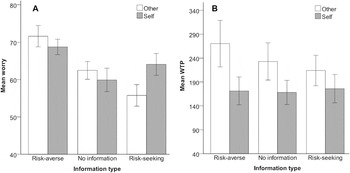
Overall, the higher the probability of infection with the virus, the more worry participants reported, F(6, 135) = 103.88, p < .001, η p 2 = .82. An interaction between target and information type indicated that the direction of self-other discrepancies depended on the type of information participants received, F(2, 140) = 5.34, p = .006, η p 2 = .07. Figure 1a shows that when participants received no information about the other person’s preferences or received information that she was risk-averse, they predicted similar worry for the other person and themselves (no information: M other-self = 2.56, t(48) = .99, p = .325; risk-averse: M other-self = 2.87, t(44) = 1.29, p = .205). In contrast, when the other person was described as risk-seeking, they predicted that she would be less worried than they would be, M other-self = −8.31, t(49) = −2.43, p = .019. Follow-up analyses for each target separately revealed that information type had no significant effect on how worried participants predicted themselves to be, F(2, 140) = 2.45, p = .090, η p 2 = .03. Instead, information type had an effect on how much worry participants predicted for the other person, F(2, 140) = 8.98, p < .001, η p 2 = .11. When the other person was described as risk-averse, participants predicted that she would be more worried compared to when she was described as risk seeking (p < .001, see Figure 1a) or there was no information (p = .018). When the other person was described as risk seeking, participants predicted that she would be less worried than when there was no information but this difference was not significant (p = .073). In sum, participants showed self-other discrepancies in predicted worry in line with the information provided about the other person, and these discrepancies were produced by changes in the prediction for the other person as a function of the information provided.
Mean predicted worry (Panel A) and mean willingness to pay (WTP, Panel B) as a function of target (self or other) and information type. Error bars are ± 1 standard error of the mean.

Self-other discrepancies in likelihood to vaccinate
Overall, the higher the probability of infection with the virus, the more likely participants were to opt for vaccination, F(6, 135) = 59.78, p < .001, η p 2 = .73. Moreover, participants were more likely to have their sister vaccinated (M = 77, SD = 18) than they were to vaccinate themselves (M = 72, SD = 20), F(1, 140) = 12.56, p = .001, η p 2 = .08. However, this discrepancy did not vary significantly as a function of the information participants received, F(2, 140) = .49, p = .612, η p 2 = .01. Means in all three conditions pointed towards a more risk-averse decisions for the sister: M other-self = 5.40, t(44) = 2.73, p = .009 for risk-averse vs. M other-self = 6.52, t(48) = 2.94, p = .005 for no information, and M other-self = 3.18, t(49) = 1.08, p = .284 for risk seeking. In sum, participants were more likely to have their sister vaccinated than have themselves vaccinated, and, consistent with H 1b , this effect did not vary significantly as a function of the preferences of the sister.
Self-other discrepancies in WTP
Overall, the higher the probability of infection with the virus, the more participants were willing to pay for vaccination, F(6, 135) = 16.41, p < .001, η p 2 = .42. There was a significant effect of target indicating self-other discrepancies in WTP, F(1, 140) = 21.45, p < .001, η p 2 = .13. On average, participants were willing to pay around €66 more for the vaccination of the other person (M = €238, SD = 275) than for their own (M = €172, SD = 193) (see Figure 1b). This effect varied as a function of the probability of contracting the virus, F(6, 135) = 2.54, p = .023, η p 2 = .10, such that the size of the self-other discrepancy was larger for larger probabilities (≥ 50%) M other-self = 89, SD = 232, than for smaller probabilities (< 50%) M other-self = 37, SD = 112, t(143) = −3.90, p < .001. The self-other discrepancy did not vary as a function of information type, F(2, 140) = 1.45, p = .239, η p 2 = .02 (Figure 1b). Means in all three conditions pointed towards more risk-averse decisions for the sister: M other-self = 99, t(44) = 2.99, p = .004 for risk-averse vs. M other-self = 65, t(48) = 2.58, p = .013 for no information, and M other-self = 38, t(49) = 2.46, p = .018 for risk seeking. In sum, consistent with H 1b , participants were willing to pay more to have their sister vaccinated than have themselves vaccinated, regardless of her preferences. This discrepancy was larger when the probability of contracting the virus was larger.
Individual differences
To investigate how individual differences moderated self-other discrepancies (H 2 to H 4 ), we conducted similar GLMs as in the previous section by adding the three individual difference variables to the models (as continuous variables). In these analyses we controlled for the effect of gender of the participant. We thus conducted three analyses (on worry, likelihood, and WTP), with information type, numeracy, empathy, risk taking in health, order, and gender as independent variables. In particular, we investigated if the individual difference variables moderated the effects of target and the interactions between target and information type reported above. The model hence tested for two-way interactions between decision target and each of the individual difference measures, as well as for three-way interactions between target, information type, and each of the individual difference measures. In order to clarify significant interactions, we divided participants into high and low groups based on median splits of the individual difference variables and examined with follow-up t-tests how the effects differed between these groups.
In addition, we investigated whether self-other discrepancies were due to changes in participants’ decisions for themselves or for the other. In particular, like in the previous section we ran analyses separately for each target and investigated if there were significant between-subjects effects of the individual difference variable, or a significant interaction between the individual difference variable and information type.
Individual differences in self-other discrepancies in worry
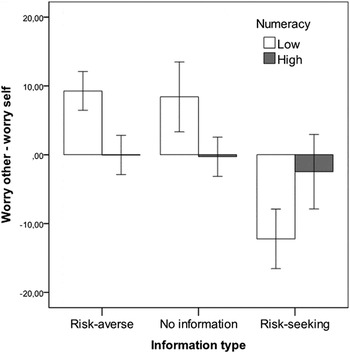
Numeracy moderated the effect of information type on self-other discrepancies, i.e., there was an interaction between numeracy, information type, and target, F(2, 128) = 3.44, p = .035, η p 2 = .05. Figure 2 shows that participants with high numeracy did not show self-other discrepancies in predicted worry: they tended to predict similar worry for themselves and for the other person regardless of the information they received (M other-self = −.03, t(30) = −.01, p = .992, for risk-averse; M other-self = −.28, t(32) = −.10, p = .923, for no information; M other-self = −2.45, t(19) = −.45, p = .656, for risk seeking). In contrast, participants with low numeracy showed large discrepancies, which were in line with the information they received about the other person (M other-self = 9.28, t(13) = 3.30, p = .006, for risk-averse; M other-self = 8.41, t(15) = 1.66, p = .118, for no information; M other-self = −12.21, t(29) = −2.82, p = .009, for risk seeking). Follow-up analyses for each target separately revealed that numeracy had no significant effect on worry for the self, F(1, 128) = 1.18, p = .280, η p 2 = .01, and it did not interact with information type, F(2, 128) = 1.04, p = .356, η p 2 = .02. Numeracy had no significant effect on worry for the other, F(1, 128) = 1.36, p = .246, η p 2 = .01, and did not interact with information type, F(2, 128) = .96, p = .388, η p 2 = .02.
Mean self-other discrepancy in predicted worry as a function of information type and numeracy. Mean discrepancy is worry other−worry self, where a score > 0 indicates more predicted worry for the other person than for oneself. Low numeracy is indicated by a score < 3 and high numeracy by a score ≥ 3 on the adaptive Berlin Numeracy Test. Error bars are ± 1 standard error of the mean.

Risk taking propensity and empathy had no significant effects on self-other discrepancies in worry, p > .1.
In sum, consistent with H 2 applied to predictions of feelings, participants with low numeracy showed self-other discrepancies in predicted worry that reflected the other person’s preferences, while participants with high numeracy predicted similar worry for themselves and the other person regardless of the information they received about her. However, numeracy had no direct effect on predicted worry for the other suggesting that these self-other discrepancies were likely produced by relative adjustment of predictions for both targets.
Individual differences in self-other discrepancies in likelihood
There were no significant effects of any of the individual measures, p > .1.
Individual differences in self-other discrepancies in WTP
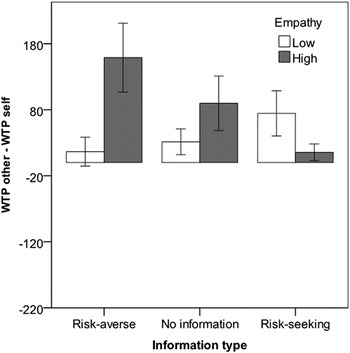
Empathy moderated the effect of information type on self-other discrepancies, F(2, 128) = 3.72, p = .027, η p 2 = .06. Figure 3 shows that participants who were high in empathy tended to show self-other discrepancies more in line with the wishes of the other person. In contrast, relative to decisions for themselves, the WTP responses of participants low in empathy followed the other person’s wishes to a lesser extent. To illustrate, when the other person was described as risk-averse, self-other discrepancies were larger for participants high vs. low in empathy (M other-self = 159 vs. M other-self = 17, t(33) = −2.52, p = .017). When the other person was described as risk-seeking, self-other discrepancies were smaller for participants high vs. low in empathy, although this difference was not significant (M other-self = 16 vs. M other-self = 75, t(23) = 1.62, p = .120). Follow-up analyses separately for each target showed that empathy had no effect on WTP for the self, F(1, 128) = 1.03, p = .312, η p 2 = .01, and did not moderate the effect of information type on WTP for the self, F(2, 128) = .30, p = .744, η p 2 = .01. Further, empathy did not influence WTP for the other, F(1, 128) = 2.53, p = .114, η p 2 = .02, nor moderated the effect of information type, F(2, 128) = 2.23, p = .111, η p 2 = .03.
Mean self-other discrepancy in willingness to pay (WTP) as a function of information type and empathy. Mean discrepancy is WTP other−WTP self, where a score > 0 indicates more willingness to pay for the other person than for oneself. Low vs. high empathy groups are based on median split. Error bars are ± 1 standard error of the mean.

Numeracy showed no significant effects, p > 1.
Self-reported risk taking in the domain of health also moderated self-other discrepancies, F(1, 128) = 5.38, p = .022, η p 2 = .04. Participants who were risk takers (divided based on median split) showed larger self-other discrepancies, with a mean discrepancy score of M other-self =102 (SD = 209), than participants who tended to avoid risks, with a mean discrepancy score of M other-self = 30 (SD = 121), t(114) = −2.56, p = .012. Follow-up analyses separately for each target showed that self-reported risk taking in the domain of health had no effect on WTP for the self, F(1, 128) = 1.26, p = .264, η p 2 = .01. However, self-reported risk taking in the domain of health had an effect on WTP for the other, F(1, 128) = 5.07, p = .026, η p 2 = .04, such that participants who reported being risk-takers themselves were especially likely to pay more for the vaccination of the other person (M = 282, SD = 308) compared to participants who were risk-averse (M = 194, SD = 232).
In sum, consistent with H 3 , participants high in empathy were more likely to take into account the preferences of the other person relative to their own decisions, which resulted in a different extent of self-other discrepancies in WTP as a function of the surrogate’s empathy. However, empathy had no direct effect on decisions for the other, suggesting that these self-other discrepancies were likely produced by relative adjustment of decisions for both targets. In addition, partially consistent with H 4 , participants who were risk takers themselves showed larger self-other discrepancies than participants who were not risk takers. However, these discrepancies did not stem from decisions for oneself but from decisions for the other person: risk takers were willing to pay more for vaccination of the other person compared to participants who avoided risks.
Discussion
Generally, our results supported social values theory. When participants had to make a health decision for themselves and for another person, they made more risk-averse decisions for the other person than for themselves. This was the case both when they had no information about what the other person might potentially prefer (no information condition), and when the preferences of the other person were in line with the presumed social norm (i.e., avoiding risks in the health domain) − a result that replicates findings from previous studies (Dore et al., Reference Dore, Stone and Buchanan2014; Stone & Allgaier, Reference Stone and Allgaier2008; Stone et al., Reference Stone, Choi, de Bruin and Mandel2013). Interestingly, when the preferences of the other person were counter-normative (i.e., risk-seeking), participants still showed self-other discrepancies in line with the social norm of risk-aversion: They were willing to pay more for the other person’s vaccination than for their own. Our analysis of participants’ feelings and their predicted feelings for the other person showed that these results could not be explained by self-other discrepancies in predictions (see also Stone et al., Reference Stone, Choi, de Bruin and Mandel2013). In particular, participants in the risk-seeking condition predicted that the other person would be less worried than themselves; however, they did not incorporate this prediction in their decisions.
These findings show that the perceived social value of risk predicts self-other discrepancies in risky decisions, even when the preferences of the other person are at odds with the social norm. This was the case regardless of what the other person preferred and even though the assumed responsibility of decision makers was fictitious. Research shows that regret concerns and desire to minimize blame lead to increased risk avoidance in decisions for other people (Atanasov, Reference Atanasov2015; Stone, Yates, & Caruthers, Reference Stone, Yates and Caruthers2002). Outside of the laboratory, where responsibility and consequences of decisions are real, the social or legal norms for decisions where risk is entailed can have an even stronger influence. For example, doctors tend to make more conservative decisions for their patients than they do for themselves and they often do so out of fear of legal prosecution (Garcia-Retamero & Galesic, Reference Garcia-Retamero and Galesic2012, Reference Garcia-Retamero and Galesic2014). Future research should investigate if this “norm-over-preferences” effect exists also in other domains, especially those where risk-seeking is valued (e.g., for example some social domains or casual romantic relationships, Beisswanger et al., Reference Beisswanger, Stone, Hupp and Allgaier2003; Stone & Allgaier, Reference Stone and Allgaier2008).
Previous research has established that factors like anxiety (Wray & Stone, Reference Wray and Stone2005) or depression (Garcia-Retamero et al., 2015) moderate self-other discrepancies. To the best of our knowledge, our study is the first that shows how cognitive abilities, empathic concern for others, and risk taking propensity influence the extent to which people make different predictions or decisions for others and for themselves. In particular, this study examined the role of numeracy in self-other discrepancies. Numeracy is an important component of risk literacy: the ability to make good decisions based on numerical estimates of risk (Cokely et al., Reference Cokely, Galesic, Schulz, Ghazal and Garcia-Retamero2012; Galesic & Garcia-Retamero, Reference Galesic and Garcia-Retamero2010), and numerical risk information is more common than ever in health decision making (Garcia-Retamero et al., 2015). In our study, people with lower numeracy showed self-other discrepancies in emotions, while people with high numeracy predicted similar emotions for themselves and the other person. The self-other discrepancies in emotions in the predictions of participants with low numeracy were actually in line with the preferences of the other person, showing that low numeracy individuals were more likely to incorporate these into their predictions. High numeracy individuals, on the other hand, tend to base their feeling on the exact risk estimates or number comparisons (Peters, Reference Peters2012; Petrova et al., Reference Petrova, van der Pligt and Garcia-Retamero2014) rather than on more general factors of the situation (Garcia-Retamero & Galesic, Reference Garcia-Retamero and Galesic2010; Peters et al., Reference Peters, Västfjäll, Slovic, Mertz, Mazzocco and Dickert2006; Västfjäll et al., Reference Västfjäll, Peters and Starmer2011). This might have eliminated self-other discrepancies in the predictions of high numeracy individuals, as they may have been more focused on the numerical risks, which were analogous in predictions for themselves and predictions for the other person. We should also note that this difference in predicted emotions did not translate into different decisions, suggesting that low and high numeracy individuals used the social norm and preferences to a similar extent.
Although self-other discrepancies were generally consistent with the social value of risk, the extent of the discrepancy varied as a function of participants’ empathy. Participants who reported high tendencies for empathic concern for others tended to make decisions for others that were more consistent with what others wanted, relative to decisions for themselves. To illustrate, when the other person had risk-averse preferences, individuals high on empathy were willing to pay a lot more for the vaccination of the other person than for their own, thus in a way incorporating the other’s preferences. When the other person was risk-seeking, individuals high on empathy showed smaller self-other discrepancies compared to individuals low on empathy; those low on empathy on average seemed to follow the social norm and would pay more for the other person’s vaccination (see Figure 3). In other words, relative to their own decisions, participants high on empathy were more likely to incorporate the target’s preferences than participants low on empathy, even when these preferences were at odds with the social norm. Previous research has demonstrated that when empathy is facilitated people predict that others will make decisions similar to their own (Faro & Rottenstreich, Reference Faro and Rottenstreich2006; Garcia-Retamero et al., 2015; Hsee & Weber, Reference Hsee and Weber1997). Our research, in turn, shows that empathy can also lead to larger self-other discrepancies in decisions, and that these discrepancies may stem from trying to fulfill the wishes of the other person. Overall, people high in empathy may be more likely to follow both social norms and the person’s wishes when they make decisions for others relative to decisions for themselves.
Participants who were themselves risk takers in the domain of health showed larger self-other discrepancies than participants who were not risk takers. However, surprisingly, participants’ self-reported risk taking was not significantly related to their willingness to pay for their own vaccination. It is possible that vaccination is a behavior that shows little variance between individuals, such that the vast majority of individuals vaccinate, as opposed to other risky behaviors captured by the DOSPERT scale in which individuals may be more likely to vary (e.g., drinking at a social function, not applying sunscreen). This could explain why self-reported risk takers were not willing to pay less for their own vaccination compared to those who were less likely to engage in health and safety risks in general. Instead, risk taking had an effect on decisions for the other. Consistent with social values theory, when people perceive that their decisions for themselves coincide with the social norm (i.e., they report to be risk averse), they make similar decision for other people, thereby diminishing self-other discrepancies. For instance, the large discrepancies in decisions of participants who were risk takers could result from counter-projection (Fagerlin et al., Reference Fagerlin, Ditto, Danks and Houts2001). The decisions these participants made for themselves were similar to the decisions of people who were risk averse. However, risk takers may be aware of their frequently counter-normative risky decisions, and hence might have been motivated to make a decision for the other person that they perceived as consistent with social norms, thereby resulting in even more risk-averse decisions for others, resulting in larger self-other discrepancies.
One limitation of the current research is that there were no effects of numeracy or empathy on decisions for others, as we predicted. Follow up analyses on the self-other discrepancies that were a function of numeracy and empathy showed no significant effects neither on decisions for the self, nor on decisions for the other. It is possible that these discrepancies were produced by some relative adjustment of judgments (i.e., anchoring), for example depending on the order in which participants decided for themselves and for the other person. However, we did not discover any informative patterns or significant effects, possibly due to low power to detect such differences. Alternatively, these self-other discrepancies may be due to Type I error. Future research should try to replicate our findings and investigate when self-other discrepancies in decisions result from changes in decisions for the other or changes in decisions for oneself.
Finally, we should note that we did not directly assess the perceived social value of risk in the domain of health. However, previous research in similar populations using similar scenarios (e.g., vaccination and flu outbreaks) has established that in domains where health and physical safety are involved, risk-aversion is the more socially acceptable option (Dore et al., Reference Dore, Stone and Buchanan2014; Stone et al., Reference Stone, Choi, de Bruin and Mandel2013), providing support to our assumption. Nevertheless, the possibility remains that not the perceived social norm per se but more specifically people’s desire to avoid possible poor outcomes associated with the decision drive the observed effects. For example, one could speculate that a diminishing responsibility for the decision target could be related to a smaller influence of the social norm (because of a smaller likelihood of punishment or blame in the case of a poor outcome) and thus potentially more influence of the preferences of the target. It is also possible that social norms evolve at least partially as a result of people’s desire to avoid such poor outcomes, resulting in a possible overlap between the two notions. It remains for future research to disentangle the exact motivations behind people’s decisions for others and the resulting discrepancies with decisions they make for themselves in the domain of health.
Given the number of situation− and person−based factors that play a role in self-other discrepancies, it is no wonder that the literature has shown some mixed results (see Garcia-Retamero et al., 2015). However, recent theoretical and empirical advances have started shedding light on the processes behind self-other discrepancies (Garcia-Retamero et al., 2015; Stone et al., Reference Stone, Choi, de Bruin and Mandel2013). Ultimately, one of the goals of this line of research is to inform surrogate decision making and increase accuracy. However, what is considered an accurate surrogate decision can vary depending on the standard that is adopted: advance directive, substituted judgment or best interest (Lawrence & Brauner, Reference Lawrence and Brauner2009). For example, the advance directive requires that surrogates follow the preferences stated by the decision target, while the substituted judgment requires surrogates to make a decision that the decision target would have made if able. Thus, accurately predicting the target’s feelings towards risks and options and the ability to incorporate these into decisions are potentially essential in surrogate decision making. Our results show that individual characteristics of surrogates like numeracy, empathic concern or propensity towards risk taking, and the willingness to follow contra-normative preferences can potentially influence the accuracy of surrogate decisions. For instance, intuitively, a more empathic family member may be a better surrogate decision maker than a less empathic one if substituted judgment is to be followed. Research in a more ecological setting can investigate to what extent relevant individual differences influence surrogate accuracy and what implications these have for stakeholders.
This research showed how a host of factors (informational, cognitive, and emotional) influence to what extent our own decisions about risk are different from the decisions we make for other people, and to what extent these differences are based on social norms. Overall, results confirmed that self-other discrepancies at least partially result from following social norms when deciding for others. In this experiment, this effect persisted even when the wishes of the other person were known to be different from what social norms dictated and was larger when decision makers were less empathic.
Supplementary material
For supplementary material accompanying this paper visit http://dx.doi.org/10.1017/S1138741616000500
Financial support for this research was partially provided by the Ministerio de Economía y Competitividad (Spain) (PSI2011-22954 and PSI2014-51842-R to RGR).