Introduction
Human growth and development are particularly sensitive to environmental factors, and therefore to socioeconomic modifiers such as parents’ educational and professional status, financial position, family structure, level of medical care and diet (Eveleth & Tanner, Reference Eveleth and Tanner1976; Komlos & Baten, Reference Komlos and Baten2004, Perkins et al., Reference Perkins, Supramanian, Smith and Özaltin2016). Changes in these factors are reflected in body proportions, size and tissue composition in children and adolescents in subsequent generations. They are therefore also visible in the form of secular trends in body mass index (BMI) and adiposity (Marques-Vidal et al., Reference Marques-Vidal, Madeleine, Romain, Gabriel and Bovet2008; Kryst et al., Reference Kryst, Kowal, Woronkowicz, Sobiecki and Cichocka2012; Kowal et al., Reference Kowal, Kryst, Sobiecki and Woronkowicz2013).
Improvement in living conditions, however, is unfortunately also a major cause of the growing prevalence of overweight and obesity (Kalies et al., Reference Kalies, Lenz and von Kries2002; Wedderkopp et al., Reference Wedderkopp, Froberg, Hansen and Andersen2004; Skinner et al., Reference Skinner, Perrin and Skelton2016; Hales et al., Reference Hales, Carroll, Fryar and Ogden2017; WHO, 2017; Vijayakumar et al., Reference Vijayakumar, Wheelock, Kobes, Nelson, Hanson, Knowler and Sinha2018). This is of particular concern in Poland which, compared with other European countries, is characterized by a moderate to high level of overweight and obesity among children and adolescents (Kułaga et al., Reference Kułaga, Grajda, Gurzkowska, Wojtyło, Góźdź and Litwin2016). This phenomenon has been observed in the last decade even among the youngest children (Olds, Reference Olds2009; Sedlak et al., Reference Sedlak, Pařízková, Daniš, Dvořáková and Vignerová2015). A study conducted in 2010 showed that worldwide there were up to 43 million overweight or obese pre-school children. Moreover, this number has been gradually increasing in the subsequent decade. In 1990, the percentage of pre-schoolers with excess body weight was 4.2%, while in 2010, it was already 6.7% and is expected to reach as much as 9.1% by 2020 (de Onis et al., Reference de Onis, Blössner and Borghi2010). According to the World Health Organization, 41 million children under the age of 5 years had excessive body weight in 2016. It is also worth noting that in 2004 the number was 22 million (Obuchowicz, Reference Obuchowicz2005; WHO, 2017). This is a particularly important problem because the risk of health problems associated with excessive BMI, such as cardiovascular diseases, hypertension and elevated glucose and insulin levels, may affect even 6- to 7-year-olds (Hansen et al., Reference Hansen, Hasselstrom, Gronfeldt, Froberg and Andersen2005). In addition, overweight or obesity during childhood may result not only in similar problems later in life but also in an increased risk of premature illness and death (Dietz, Reference Dietz1998; de Onis et al., Reference de Onis, Blössner and Borghi2010). For this reason, the pre-school age is seen as a critical time for the development of overweight and obesity (Dietz, Reference Dietz1994; Schrempft et al., Reference Schrempft, Van Jaarsveld, Fisher and Wardle2015).
At the same time, there is a second, equally significant problem: the increasing proportion of fat tissue in the body composition, which in recent years has become one of the most important health issues worldwide. According to estimates from 2017, 62–76% of the world’s population is reaching a health-threatening level of adiposity (Maffetone et al., Reference Maffetone, Rivera-Dominguez and Laursen2017). Unfavourable changes towards increasing body fat in children and adolescents have been noted in studies among the Krakow population, as well as among pre-schoolers from the Czech Republic and other European countries (Cattaneo et al., Reference Cattaneo, Monasta, Stamatakis, Lioret, Castetbon and Frenken2010; Kowal et al., Reference Kowal, Kryst, Woronkowicz and Sobiecki2014; Sedlak et al., Reference Sedlak, Pařízková, Daniš, Dvořáková and Vignerová2015). The observed positive secular trend in adiposity often coincides with a reduction in the development of lean mass and bone density (Sedlak et al., Reference Sedlak, Pařízková, Daniš, Dvořáková and Vignerová2015). As in the case of excessive BMI, an increased fat tissue content of the body is associated, even at a young age, with an increased risk of various health issues: for instance, metabolic syndrome, which in recent years has been observed in increasingly younger age groups (Steinberger et al., Reference Steinberger, Daniels, Eckel, Hayman, Lustig, McCrindle and Mietus-Snyder2009; Graversen et al., Reference Graversen, Sørensen, Petersen, Sovio, Kaakinen and Sandbaek2014). Moreover, unfavourable changes in body composition, even at an early age, can also result in a significant decrease in cardiorespiratory fitness (Sedlak et al., Reference Sedlak, Pařízková, Procházková, Cvrčková and Dvořáková2017). In addition, the increase in adiposity occurring over time is often associated with the phenomenon of so-called ‘latent obesity’ (sarcopenic obesity). This is observed when an increased in body fat coincides with a decrease in muscle mass. This happens most often as a consequence of the hypokinesia (low level of physical activity) (Sedlak et al., Reference Sedlak, Pařízková, Daniš, Dvořáková and Vignerová2015, Reference Sedlak, Pařízková, Procházková, Cvrčková and Dvořáková2017). These changes, however, are not always accompanied by analogous secular trends in BMI, because this does not take into account the tissue composition of the body. Therefore, studies on both of these measures are crucial, and allow not only the prevalence of abnormal body weight and composition among children to be assessed, but also their changes in subsequent generations and associated causes and health risks.
It is also important to assess the effectiveness of prevention and intervention programmes that have been widely applied in many countries over recent years, to combat or prevent overweight and obesity among children (Salanave et al., Reference Salanave, Peneau, Rolland-Cachera, Hercberg and Castetbon2009; Shirasawa et al., Reference Shirasawa, Ochiai, Nanri, Nishimura, Ohtsu, Hoshino, Tajima and Kokaze2015; Xiao et al., Reference Xiao, Qiao, Pan, Liu, Zhang and Li2015). One such programme was introduced in Poland by the Ministry of Health. This National Health Program was introduced in 2016 and was planned to last until 2020 (Ministry of Health, 2015). Its main goal was to address the problem of child overweight and obesity by focusing mainly on the promotion of physical activity.
The aim of this study was to assess the changes in the prevalence of overweight and obesity, as well as high adiposity, in pre-school children aged 3–7 years from Krakow, Poland, between the years 2008 and 2018.
Methods
Study sample
The study sample consisted of children included in two cross-sectional surveys carried out in 2008 and 2018 by a team of researchers from the Department of Anthropology, University of Physical Education, Kraków. The two surveys were conducted in 20 randomly selected kindergartens in Krakow, Poland. The studied cohorts came from different facilities, and were representative of the four traditional residential districts: Śródmieście, Podgórze, Krowodrza and Nowa Huta.
The calendar age of the subjects ranged from 2.50 to 7.49 years. This was calculated as the difference between the date of the survey and the birth date, expressed as a decimal fraction. The children were classified into five age groups: 3-year-olds: 2.50–3.49; 4-year-olds: 3.50–4.49; 5-year-olds: 4.50–5.49; 6-year-olds: 5.50–6.49; 7-year-olds: 6.50–7.49.
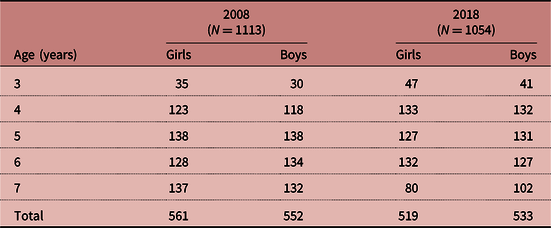
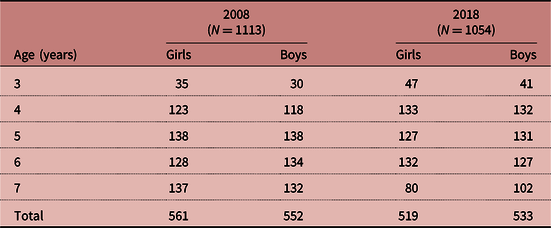
The results of the 2018 study were compared with those from that of 2008 (Kowal et al., Reference Kowal, Kryst, Sobiecki and Woronkowicz2013, Reference Kowal, Kryst, Woronkowicz and Sobiecki2014). The 2008 cohort consisted of 1113 children (552 boys and 561 girls) and the 2018 survey included 1054 children (534 boys and 520 girls) (Table 1).
Distribution of pre-school children by age group for the 2008 and 2018 cohorts
Measurements
Body height and body weight were measured using an anthropometer (accuracy 1 mm) manufactured by GPM (Switzerland) and an electronic scale by Tanita (Japan) (accuracy 0.01 kg), respectively. The BMI was calculated as: BMI = body weight [kg]/body height [m]2). Children were then categorized as underweight, normal weight, overweight or obese according to Cole’s cut-off points (Cole et al., Reference Cole, Bellizzi, Flegal and Dietz2000, Reference Cole, Flegal, Nicholls and Jackson2007).
Triceps and subscapular skinfolds were measured using a Harpenden skinfold calliper GPM (Switzerland) with a constant spring pressure of 10 g/mm2. Triceps skinfold (TRC) was measured, with the arm muscles relaxed, in the middle part of the posterior surface of the upper arm, over the triceps muscle. Subscapular skinfold (SSC) was measured below the inferior angle of the scapula, at 45° to the vertical, along the natural crease lines of the skin. From that, the percentage body fat (%BF) (i.e. adiposity) was calculated according to Slaughter’s equations (Slaughter et al., Reference Slaughter, Lohman, Boileau, Horswill, Stillman, Van Loan and Bemben1988). For boys:
 $${\rm \% BF} = \left[ {1.21\left( {\rm TRC + SSC} \right)} \right] - [0.008^*{\left( {\rm TRC + SSC} \right)^2}]- 1.7$$
if the sum of triceps (TRC) and subscapular (SSC) skinfolds was below 35 mm and
 $${\rm \% BF} = \left[ {0.783\left( {\rm TRC + SSC} \right)} \right] + 1.6$$
if the sum of TRC and SSC skinfolds was above 35 mm.
For girls:
 $${\rm \% BF} = \left[ {1.33\left( {\rm TRC + SSC} \right)} \right] - \left[ {0.013{{\left( {\rm TRC + SSC} \right)}^2}} \right] - 2.5$$
if the sum TRC and SSC skinfolds was below 35 mm and:
 $${\rm \% BF} = \left[ {0.546\left( {\rm TRC{\mkern 1mu} + {\mkern 1mu} SSC} \right)} \right] + 9.7$$
if the sum TRC SSC skinfolds was above 35 mm.
These versions of the equations were prepared for use in children of prepubertal age and have previously been successfully applied in earlier studies of boys and girls of pre-school age (Slaughter et al., Reference Slaughter, Lohman, Boileau, Horswill, Stillman, Van Loan and Bemben1988; Kowal et al., Reference Kowal, Kryst, Sobiecki and Woronkowicz2013, Reference Kowal, Kryst, Woronkowicz and Sobiecki2014).
The subjects were then categorized according to their level of adiposity, based on z-scores, as low (z-score ≤−1), normal (z-score −1 to 1) or high body fat (z-score ≥1). Changes in the prevalence of each body weight and adiposity category by age group were analysed using the chi-squared test. All the statistical analyses were performed using Statistica Version 13.0.
Results
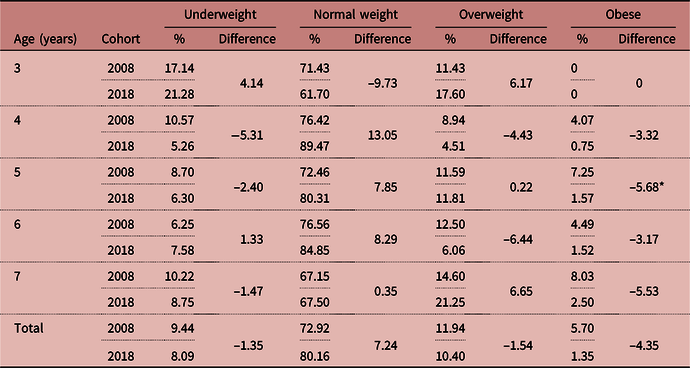
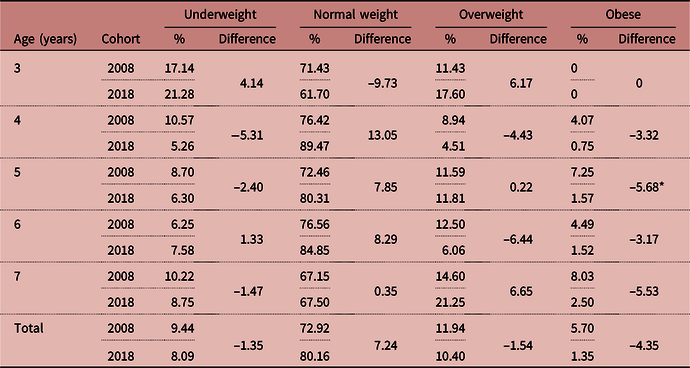
Among the girls, decreases in the prevalences of underweight, overweight and obesity were observed for most age groups, as well as for the study population as a whole, from 2008 to 2018. Clear increases in prevalence of underweight and overweight were observed for 3-year-old girls, and an increase in prevalence of overweight in 7-year-old girls. However, the differences between the cohorts were only statistically significant for 5-year-old, overweight girls (Table 2).
Percentages of underweight, overweight and obese girls and differences between the 2008 and 2018 cohorts
* p ≤ 0.05.
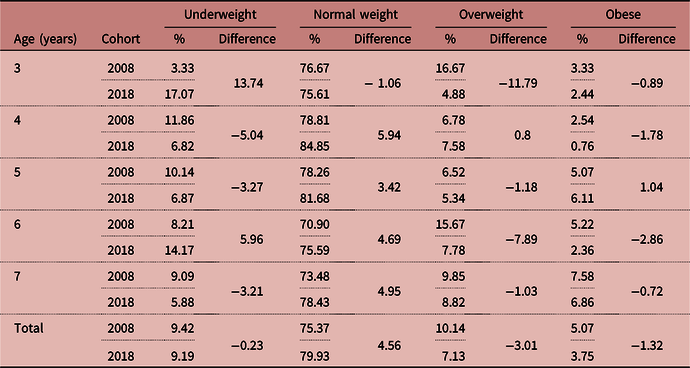
Similarly to girls, among boys, for the majority of age groups as well as the whole study group, there was a decrease in prevalence of underweight, overweight and obesity. However, 3- and 6-year-old boys in the 2018 cohort had a notably higher prevalence of underweight than those examined in 2008. However, the differences between cohorts were not statistically significant (Table 3).
Percentages of underweight, overweight and obese boys and differences between the 2008 and 2018 cohorts
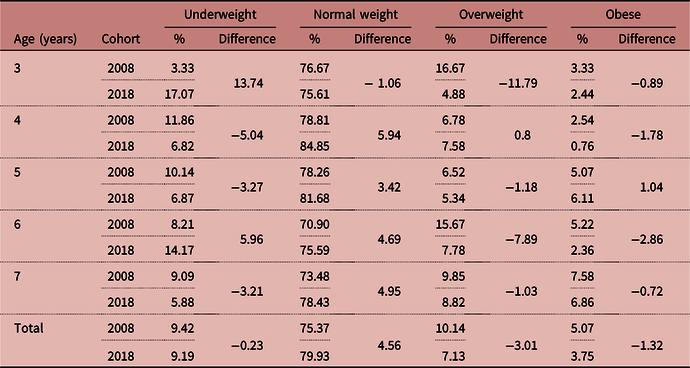
Decreases in the prevalence of underweight, overweight as well as obesity were observed for both sexes over the study period. These were also mirrored by increases in the prevalence of normal BMI in all of the age groups, with the exception of 3-year-olds (Tables 2 and 3).
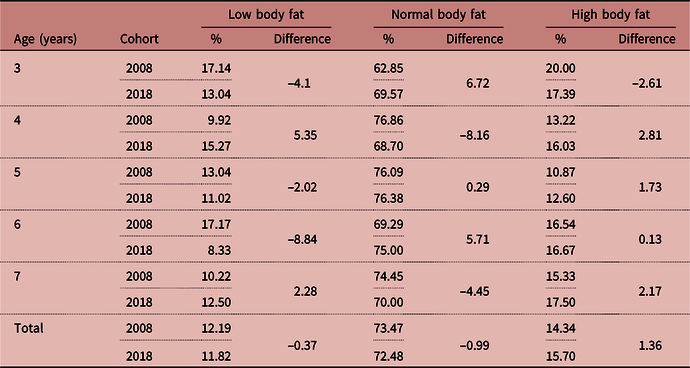
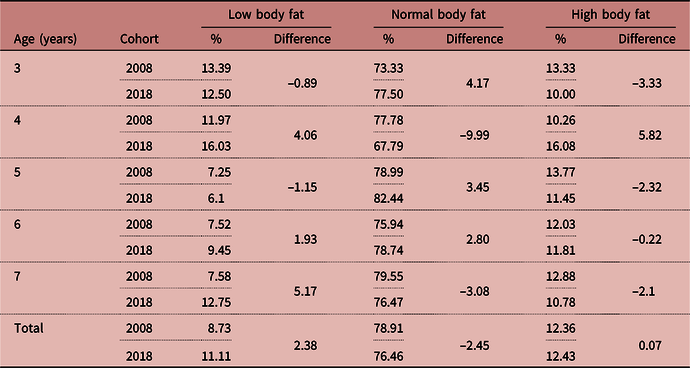
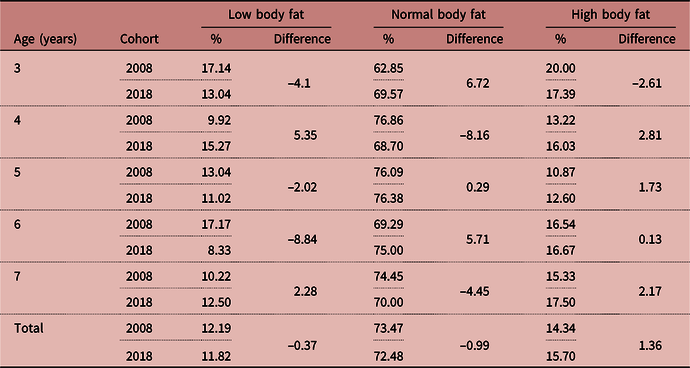
Changes in the prevalence of high or low adiposity were also observed. In girls, in most age groups, as well as in the whole study group, a decrease in prevalence of low adiposity was recorded. Only among 4- and 7-year-olds was the percentage of children with low adiposity higher in the 2018 cohort. At the same time, the prevalence of high body fat was visibly higher in all of the 2018 cohort girls, apart from the 3-year-olds. However, the differences between the two cohorts were not statistically significant (Table 4).
Percentages of girls with low and high levels of body fat and differences between the 2008 and 2018 cohorts
Among boys, in all age groups except 3- and 5-year-olds, there was an increase in the prevalence of low body fat for all age category. Decreases were also recorded in the prevalence of high adiposity for all age groups, except for 4-year-old boys. At the same time, the percentage of boys with high adiposity was almost identical in both cohorts, regardless of the age category. The differences between the cohorts were not statistically significant (Table 5).
Percentages of boys with low and high levels of body fat and differences between the 2008 and 2018
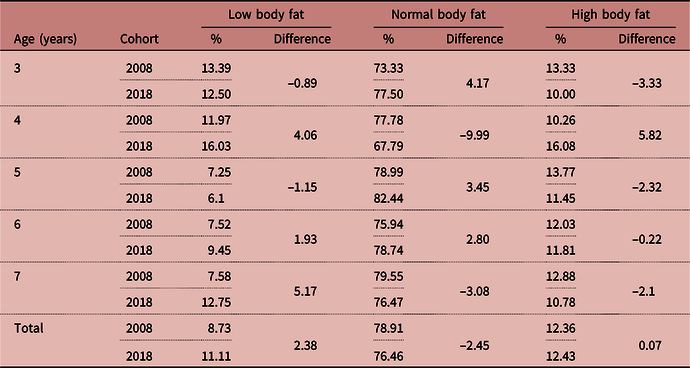
The observed changes in the analysed adiposity abnormalities were present in both sexes. This suggests that in girls in 2018 there was an increase in the prevalence of high body fat. However, the girls from the 2018 cohort were also characterized by a higher prevalence of normal adiposity at 4, 5 and 6 years of age (Table 4). At the same time, a larger percentage of boys than in previous years was characterized by low body fat. However, there was also a decrease in the prevalence of a normal body fat ratio among 3-, 5- and 6-years old boys examined in 2018 (Table 5).
Discussion
The study found that in the 2018 sample of pre-school children from Kraków, Poland, a higher percentage of children were characterized by a normal BMI than in recent years. This is a consequence of the decreasing prevalence of overweight/obesity, as well as underweight, in the cohort examined in 2018. Similar results were obtained in a study carried out among 4-year-olds in New Zealand, where the overall prevalence of obesity declined slightly between 2013 and 2017 (Rush et al., Reference Rush, Kirk, Parmar, Young and Obolonkin2018). Moreover, research conducted in southern California has also shown a decrease in the percentage of obese children and adolescents between 2008 and 2013 (Koebnick et al., Reference Koebnick, Mohan, Li and Young2015). However, in the American study, the decrease was stronger in boys than in girls, while in the present research the decrease was 4.35% for girls and 1.32% for boys. This difference may be associated with the fact that the Californian study group was characterized by a wider age range. However, it is particularly important to mention that in Koebnick et al. (Reference Koebnick, Mohan, Li and Young2015) study the greatest decrease in prevalence of obesity was seen for 2- to 5-year-olds.
It is widely known that the birth weight of a child can have a significant influence on their BMI, as well as fat tissue ratio, in later years. For example, as suggested by Curhan et al. (Reference Curhan, Chertow, Willett, Spiegelman, Colditz and Manson1996a, b), a high birth weight is associated, among other thing, with a greater BMI and increased risk of obesity in adulthood. On the other hand, children at the lower end of the birth weight spectrum may also have increased abdominal adiposity and reduced lean BMI in later life (Rogers, Reference Rogers2003). Therefore, in the light of the results obtained in the present study, the birth weights of the children included in the examined cohorts were compared. However, the observed discrepancies were not significant.
The tendencies observed in the present study, although clearly visible, were not found to be statistically significant. Such results may suggest a stabilization of previously observed positive secular trends in the prevalence of overweight and obesity among Polish children. A similar phenomenon was seen by Mazur et al. (Reference Mazur, Klimek, Telega, Filip and Małecka-Tendera2014) who found that, depending on the sex, the prevalence of obesity either decreased or remained the same as in previous years. Furthermore, in a study conducted in the Polish population, no secular change in the prevalence of overweight and obesity was observed among children examined in 1992 and 2012 (Brzeziński et al., Reference Brzeziński, Jankowski, Jankowska, Niedzielska and Kamińska2018). Moreover, analogous results were obtained in a study in a French population carried out between 2000 and 2007 (Salanave et al., Reference Salanave, Peneau, Rolland-Cachera, Hercberg and Castetbon2009). Therefore, it is possible that there is a progressive tendency towards stabilization of positive inter-generational changes in childhood overweight and obesity in early childhood, which may currently be present in southern Poland. However, it is also important to stress that it is impossible to be entirely certain about this stabilization trend until the later years, as the observed changes may indeed be the start of a slow secular trend that currently shows significance.
The favourable change in prevalence of abnormal body weight may be associated with the improvement in the economic situation of the study children’s families. It has been demonstrated that in industrialized countries, excessive BMI more often affects children from families with lower incomes (Lobstein & Jackson-Leach, Reference Lobstein and Jackson-Leach2006; Mazur et al., Reference Mazur, Klimek, Telega, Filip and Małecka-Tendera2014). Therefore, the observed results might be associated with the fact that, between 2008 and 2018, there was a decrease in the unemployment rate in Poland (from around 9% to about 6%), and average salaries, as well as GDP (Gross Domestic Product), increased and the at-risk-of-poverty rate was reduced from 20.5% in 2005 to 17.3% in 2016 (GUS, 2018). The observed changes may also be associated with the increase in the general education rate in society. While in 2002, 9.9% of Poles had tertiary education, in 2016 the level was 25.3%. Moreover, between the years 2008 and 2018 the number of young people who did not pursue further education after primary school decreased. Additionally, there has been continuous progress in dietary habits. Compared with 1990, in 2016 Poles ate slightly less animal fat, butter and white sugar annually, while eating almost twice as much fruit (GUS, 2018).
According to the literature, the decrease in the prevalence of body weight abnormalities among children, or stabilization in this rate, may also be correlated with media campaigns, interventions and educational programmes promoting a healthy lifestyle (Brzeziński et al., Reference Brzeziński, Jankowski, Jankowska, Niedzielska and Kamińska2018). In France, the successful implementation of such intervention programmes has led to a stabilization of the secular trends in the prevalence of overweight and obesity among children (Salanave et al., Reference Salanave, Peneau, Rolland-Cachera, Hercberg and Castetbon2009). Comparable effects of a similar programme have also been observed in Japan (Shirasawa et al., Reference Shirasawa, Ochiai, Nanri, Nishimura, Ohtsu, Hoshino, Tajima and Kokaze2015). Moreover, such campaigns are associated with an increase in childhood obesity awareness among parents, kindergarten teachers as well as society as a whole (Xiao et al., Reference Xiao, Qiao, Pan, Liu, Zhang and Li2015). In 2016, a similar programme, the National Health Program, was introduced in Poland by the Ministry of Health. Its main focus was the popularization of various forms of physical activity among Polish children (Ministry of Health, 2015). It is due to end in 2020, but it is quite possible that some of its benefits may already be present.
The changes, although statistically insignificant, were clearly noticeable, and were also observed for adiposity abnormalities. They suggest that in the girls examined in 2018 there was an increase in the prevalence of high body fat, while a larger percentage of boys than in previous years had low body fat. These observations are partially in line with the results of Sedlak et al. (Reference Sedlak, Pařízková, Daniš, Dvořáková and Vignerová2015), who noted an increase in total adiposity in 5- and 6-year-olds in the Czech Republic. Moreover, in a later study, the same team noted increased adiposity among pre-school children, which co-existed with an unchanged BMI (Sedlak et al., Reference Sedlak, Pařízková, Procházková, Cvrčková and Dvořáková2017). As suggested by Sedlak et al. (Reference Sedlak, Pařízková, Procházková, Cvrčková and Dvořáková2017), the increase in body fat happens at the expense of lean (muscle) mass. Such a phenomenon may be currently affecting pre-school girls in Kraków. Observed gender discrepancies are especially interesting in the context of the examined population because in previous studies carried out among the children in Kraków, the highest adiposity usually occurred in boys (Kowal et al., Reference Kowal, Kryst, Sobiecki and Woronkowicz2013, Reference Kowal, Woronkowicz, Kryst, Sobiecki and Pilecki2016). This, however, may be due to the fact that these studies were concerned with a much wider age range and were not particularly focused on pre-school children.
According to the Czech authors, the unfavourable changes in children’s adiposity can be related to their sedentary lifestyle and therefore lower energy expenditure (Sedlak et al., Reference Sedlak, Pařízková, Daniš, Dvořáková and Vignerová2015). This, in turn, suggests that in the studied population boys were more likely to engage in physical activity than girls. This is in line with the findings of a plethora of studies carried out among pre-schoolers in a variety of countries (Finn et al., Reference Finn, Johannsen and Specker2002; Pate et al., Reference Pate, Pfeiffer, Trost, Ziegler and Dowda2004, Reference Pate, McIver, Dowda, Brown and Addy2008; Nicaise et al., Reference Nicaise, Kahan and Sallis2011; Soini, Reference Soini2015). Moreover, in the present study, it was observed that among the youngest girls the prevalence of high body fat was lower in 2018 than in 2010. Over the same time period, in the older age groups from 2018, there were more girls characterized by high adiposity than in the previous years. This also may have been due to the fact that among the pre-schoolers, especially girls, the pattern of physical activity varies depending on age. According to Yamamoto et al. (Reference Yamamoto, Becker, Fischer and De Bock2011), younger girls are more willing to engage in play-based physical activity, than older ones. The pattern of physical activity during early childhood is also particularly important in the context of body fat ratio because it has been shown in longitudinal research that both TV watching time as well as outdoor playtime can significantly affect subsequent adiposity in both boys and girls (Saldanha-Gomes et al., Reference Saldanha-Gomes, Heude, Charles, de Lauzon-Guillain, Botton and Carles2017).
As has previously been stated, the observed changes in adiposity were clearly visible, but not statistically significant. Once again, their relatively low level may be due to the previously described effects of the National Health Program. It has been demonstrated that well-planned exercise programmes and regimes can effectively prevent negative changes in body composition (Sigmund et al., Reference Sigmund, Sigmundová and Ansari2009; España-Romero et al., Reference España-Romero, Mitchell, Dowda, O’Neill and Pate2013).
The observed trend toward an increasing prevalence of high adiposity among girls is also interesting in the light of the declining age of menarche that has recently noted in the Polish population (Saczuk et al., Reference Saczuk, Wasiluk and Wilczewski2018; Durda-Masny et al., Reference Durda-Masny, Hanć, Czapla and Szwed2019). It has been reported by a plethora of studies that girls characterized by relatively higher adiposity tend to experience an earlier menarche than their leaner counterparts (Osteria, Reference Osteria1983; Chowdhury et al., Reference Chowdhury, Shahabuddin, Seal, Talukder, Hassan and Begum2000; Khatoon et al., Reference Khatoon, Kumar Verma, Kumari, Rupani, Singh and Rizvi2011). It has also been suggested that if the excessive adiposity is present during childhood, even as early as pre-school age, there will be an increased likelihood of its persistence later in life (Baranowska & Krzyżanowska-Świniarska, Reference Baranowska, Krzyżanowska-Świniarska and Szczeklik2005; Perenc et al., Reference Perenc, Radochońska and Błajda2016). Therefore, the tendencies observed in the present study may be contributing to the trend in declining age at menarche.
The findings of this study are especially important as they suggest that, while obesity can still be relatively easily reversed during such a young age, it is much more difficult in older childhood, adolescence or adulthood (Barlow & Dietz, Reference Barlow and Dietz1998; Barlow, Reference Barlow2007; Skouteris et al., Reference Skouteris, Hartley-Clark, McCabe, Milgrom, Kent, Herring and Gale2010; Xiao et al., Reference Xiao, Qiao, Pan, Liu, Zhang and Li2015). Therefore, detailed knowledge of the prevalence of overweight/obesity in early childhood is crucial for children’s future health. It has been demonstrated that overweight/obesity present in early childhood significantly increases the risk of developing disorders related to excessive weight in adulthood. Such health problems include, but are not limited to, coronary heart disease, chronic hypertension, type II diabetes, and even some types of cancer (Dietz, Reference Dietz1998; Freedman et al., Reference Freedman, Mei, Srinivasan, Berenson and Dietz2007; Jodkowska et al., Reference Jodkowska, Woynarowska and Oblacińska2007; de Onis et al., Reference de Onis, Blössner and Borghi2010; Kendzor et al., Reference Kendzor, Caughy and Owen2012; Piekorz et al., Reference Piekorz, Lewandowski, Goch, Radzimińska, Strojek and Bułatowicz2016). It should also be noted that childhood obesity increases the likelihood of excessive weight later in life (Epstein, Reference Epstein1996; Nader et al., Reference Nader, O’Brien, Houts, Bradley, Belsky and Crosnoe2006; Litwin, Reference Litwin2014; WHO, 2017). Moreover, it is also very important to know how it changes in subsequent generations, and to investigate its relationship with body tissue composition. Further studies should also take into account the levels of physical fitness and activity of children. It should be pointed out that the socioeconomic and nutritional status of the subjects in the present study, as well as their levels of physical activity, were based on the available literature and not directly assessed in this study.
Funding
This study was sponsored by the University of Physical Education in Kraków, grant number 137/BS/INB/2017.
Conflicts of Interest
The authors have no conflicts of interest to declare.
Ethical Approval
The study was conducted with the consent of the Bioethics Committee of the Regional Medical Association in Kraków (No. 2/KBL/OIL/2018) and with the written consent of the parents or legal guardians, as well as verbal assent from the children themselves. The authors assert that all procedures contributing to this work comply with the ethical standards of the relevant national and institutional committees on human experimentation and with the Helsinki Declaration of 1975, as revised in 2008.