Introduction
Depression is a common and disabling mental health disorder that affects people of all ages (Kessler et al., Reference Kessler2003; Prince et al., Reference Prince2007; Heo et al., Reference Heo, Murphy, Fontaine, Bruce and Alexopoulos2008), and about 1 in every 10 persons older than 60 years (Beekman et al., Reference Beekman, Copeland and Prince1999; McDougall et al., Reference McDougall2007; Pirkis et al., Reference Pirkis2009). Pharmacological and psychological interventions have established efficacy in the treatment of depression (Cuijpers et al., Reference Cuijpers, van Straten and Smit2006; Mottram et al., Reference Mottram, Wilson and Strobl2006), but remission of symptoms may fail to occur in as many as 50% of patients (Kirsch et al., Reference Kirsch, Deacon, Huedo-Medina, Scoboria, Moore and Johnson2008; Turner et al., Reference Turner, Matthews, Linardatos, Tell and Rosenthal2008). In addition, existing evidence from observational studies indicates that most cases of depression in the community remain undiagnosed and that only a small proportion of those who are depressed gain access to adequate antidepressant treatment (Goldberg et al., Reference Goldberg, Privett, Ustun, Simon and Linden1998; Pfaff and Almeida, Reference Pfaff and Almeida2005). Not surprisingly, systematic attempts are now being made to improve case-finding strategies and to prevent the onset of symptoms amongst those at risk. Numerous scales have been designed to identify cases of depression in general practice as well as in specialist settings (Arroll et al., Reference Arroll, Khin and Kerse2003; Gunn et al., Reference Gunn2008; Thombs et al., Reference Thombs2008), although their widespread availability is yet to be translated into health gains for patients (Goldberg et al., Reference Goldberg, Privett, Ustun, Simon and Linden1998; Thombs et al., Reference Thombs2008; Baas et al., Reference Baas2009).
More recently, the identification of potentially modifiable risk factors for depression has attracted the interest of researchers and clinicians alike. The rationale, in this case, is that response to antidepressant treatment may be enhanced and the onset of clinically significant depressive symptoms averted if relevant risk factors are adequately managed. Schoevers and colleagues (Reference Schoevers2006) described a stepwise approach for the prevention of depression in later life based on data from the Amsterdam Study of the Elderly. Their model targeted older people with subclinical depression and estimated the risk of illness based on the progressive accumulation of risk factors, such as widowhood, disability, physical comorbidity, loneliness and gender. Such a model served as the basis for the design of stepped-care indicated interventions to reduce the incidence of depression amongst older adults living in the U.S.A. (Sriwattanakomen et al., Reference Sriwattanakomen2008) and Europe (van't Veer-Tazelaar et al., Reference van't Veer-Tazelaar2009). Results from the Prevention Intervention for Frail Elderly (PIKO) project showed that the intervention was associated with 12.2% absolute risk reduction in the 12-month incidence of depression and anxiety compared with usual care (10/86 vs 20/84, respectively) (van't Veer-Tazelaar et al., Reference van't Veer-Tazelaar2009), which confirms the feasibility and potential clinical usefulness of well-targeted interventions.
Ideally, one would want to select people at high risk and deliver targeted interventions that address existing needs. For example, smoking, high cholesterol, hypertension, diabetes, male gender and increasing age are all associated with increased risk of cardiovascular events (Pearson et al., Reference Pearson2002), but in a 65-year old hypertensive man who smokes but has normal lipid profile, a greater reduction in cardiovascular risk is likely to be obtained from smoking cessation and appropriate treatment of hypertension than from treatment with statins. Likewise, an intervention designed to prevent depression should aim to target risk factors that are causally related to depression in people at risk.
Numerous psychosocial and biological risk factors have been associated with depression in older age (Cole and Dendukuri, Reference Cole and Dendukuri2003). Some proximal factors, like bereavement (Brilman and Ormel, Reference Brilman and Ormel2001), may have a close temporal relationship with the onset of depressive symptoms, whereas remote factors, such as childhood abuse (Bradley et al., Reference Bradley2008; Draper et al., Reference Draper2008) and limited formal education (Almeida et al., Reference Almeida, Norman, Hankey, Jamrozik and Flicker2006; Ladin, Reference Ladin2008), may confer vulnerability even later in life. Lifestyle may also play a role: both past and current smoking have been associated with greater odds of depression (Almeida and Pfaff, Reference Almeida and Pfaff2005), and so have physical inactivity (Kritz-Silverstein et al., Reference Kritz-Silverstein, Barrett-Connor and Corbeau2001; Strawbridge et al., Reference Strawbridge, Deleger, Roberts and Kaplan2002), obesity (Almeida et al., Reference Almeida, Calver, Jamrozik, Hankey and Flicker2009a) and heavy alcohol use (Bolton et al., Reference Bolton, Robinson and Sareen2009; Hamalainen et al., Reference Hamalainen2001). Other factors that have been consistently associated with depression in later life include loneliness (Cohen, Reference Cohen2000; Stek et al., Reference Stek, Vinkers, Gussekloo, Beekman, Van Der Mast and Westendorp2005), poor social support (Bruce, Reference Bruce2002; Beard et al., Reference Beard, Tracy, Vlahov and Galea2008), financial hardship (Chi et al., Reference Chi2005; Samuelsson et al., Reference Samuelsson, McCamish-Svensson, Hagberg, Sundstrom and Dehlin2005) and poor physical health (Koster et al., Reference Koster2006), falls and others (Alexopoulos et al., Reference Alexopoulos, Meyers, Young, Campbell, Silbersweig and Charlson1997; Soares et al., Reference Soares, Almeida, Joffe and Cohen2001; Almeida et al., Reference Almeida, Burton, Ferrier, McKeith and O'Brien2003; Reference Almeida2007; Reference Almeida, McCaul, Hankey, Norman, Jamrozik and Flicker2008a; Reference Almeida, Yeap, Hankey, Jamrozik and Flicker2008b; Reference Almeida2009b). Such a multitude of associations offers many opportunities (Smit et al., Reference Smit, Ederveen, Cuijpers, Deeg and Beekman2006), but exposes at the same time the difficulties that we face when attempting to develop a coherent approach to treat and prevent depression in later life.
This study aimed to investigate the association between depression in older age and a wide range of risk factors distributed along the lifespan. We were particularly interested in determining how the accumulation of exposures combined to modulate the probability of depression in a large sample of community-dwelling older men and women. This project also aimed to develop a practical model that would allow health professionals and patients to assess the probability of depression and would guide the rational introduction of preventative strategies.
Methods
Study design and participants
The present analyses are based on data originating from a cross-sectional survey of community-dwelling older primary care patients aged 60 years or over attending general practitioners participating in the Depression and Early Prevention of Suicide in General Practice (DEPS-GP) project. Details regarding the recruitment of general practitioners and their patients have been reported elsewhere (Williamson et al., Reference Williamson2007). Between May and December 2005 each patient on the practice list was sent a self-completion questionnaire, a personalized cover letter from their general practitioner, project information, a consent form and a reply-paid envelope addressed to the project office. We asked all potential participants to return the questionnaires (blank in the case of non-consenting subjects) so that we could estimate the true denominator of the target population. Recruitment of patients was limited to the initial mail-out. We received 22,258 questionnaires with written informed consent. Another 9,087 questionnaires were returned not completed, 2,934 were returned to the sender because the person named on the envelope was not known at the address, and 820 failed to be posted (total number of questionnaires tracked: 35,099). A small number of older adults who consented were found to be ineligible because they were under 60 years of age (n = 120) or did not reside in the community (nursing home n = 54), while a further 243 had incomplete data on basic demographic characteristics (age and gender) and were excluded from the analysis, leaving a sample of 21,841 older people, of whom 20,677 reported information on depressive symptoms.
Outcomes of interest
We used the Patient Health Questionnaire (PHQ-9) to assess depressive symptoms (Kroenke et al., Reference Kroenke, Spitzer and Williams2001). The PHQ-9 consists of nine questions about how often the respondent has been bothered by depressive symptoms during the past two weeks, each of which is scored 0 (“not at all”), 1 (“several days”), 2 (“a week or more”) or 3 (“nearly every day”). To meet criteria for a major depressive episode, the respondent had to score at least 2 on one of the first two questions of the PHQ-9, indicating that he or she had experienced “little pleasure in doing things” and/or had been “feeling down, depressed or hopeless” for a week or more during the previous two weeks. In addition, he or she had to have experienced at least five of the nine symptoms described in the PHQ-9 for most days during the same two-week period. The nine PHQ-9 symptoms are: (a) decreased interest or pleasure; (b) low mood; (c) sleep disturbance; (d) lack of energy; (e) disturbed appetite; (f) feelings of failure or guilt; (g) poor concentration; (h) psychomotor disturbance; and (i) suicidal thoughts. If he or she met both of these conditions, and indicated that these problems made working, taking care of things at home or getting along with other people “somewhat difficult” or “extremely difficult”, this was taken as evidence of a “major depressive episode”, as per DSM-IV criteria (American Psychiatric Association, 1994). Participants who did not meet criteria for a major depressive episode were classified as having “minor depression” if they rated (a) or (b) as present most days and questions (b), (c) or (d) as present for more than half of the days during previous two weeks.
Exposures
Participants provided information on gender, place of birth, marital status, highest educational achievement and date of birth, which we used to calculate their age at the time of assessment. We also asked participants if they were younger than 15 years at the time of death of their mother or father (yes/no), and if they had been victims of physical or sexual abuse before they were 15 years old (yes/no). In addition, they rated their concern about their finances as “not at all”, “only slightly”, “distinctly” and “very much” in answer to the question ‘How much have financial burdens been a part of your life over the past three months (e.g. difficulty paying bills, or buying groceries or medications)?’ We used the Duke Social Support Index (DSSI) as a measure of perceived social support (Koenig et al., Reference Koenig, Westlund, George, Hughes, Blazer and Hybels1993), and asked participants if, as a rule, they did at least half an hour of moderate or vigorous exercise on five or more days of the week (yes/no) (Elley et al., Reference Elley, Kerse and Arroll2003), if they were current smokers (yes/no), how often they consumed alcoholic beverages (never, less than monthly, monthly, weekly, almost daily), and how many drinks they normally had on a typical day (1–2, 3–4, 5–6, 7–9, 10 or more). People who reported consuming seven or more drinks on any one day or had five or more drinks almost every day were classified as risk drinkers (NHMRC, 2001).
We used self-reported height and weight to calculate the body mass index (BMI) in kg/m2, and classified as obese those participants with a BMI ≥ 30. Finally, subjects were asked to indicate whether a doctor had told them that they had diabetes, hypertension, asthma, chronic bronchitis or emphysema, angina or had received a diagnosis of heart attack, stroke, or cancer (excluding skin cancer).
Statistical analysis
Data were managed and analyzed with Stata software version 10.1 (StataCorp, College Station, TX). We used descriptive statistics to summarize the data and cross-tabulation to determine their distribution according to depression status. We used Cronbach's α to estimate the reliability of the PHQ-9 questionnaire in this sample. We calculated the unadjusted odds ratio of minor and major depression relative to no depression for relevant exposures and subsequently used logistic regression to model their association with the outcomes. We employed a forward stepwise approach to enter variables into the model, starting with early life exposures (schooling, early loss of parents and childhood abuse), social circumstances and lifestyle (marital status, financial stress, social support, smoking, risky alcohol use and physical inactivity), intermediate health outcomes (obesity, hypertension and diabetes), and health outcomes (cardiovascular disease, chronic respiratory diseases and cancer). The risk ratio of these associations is expressed as the odds ratio (OR) and its respective 95% confidence interval (95% CI). As we recruited participants via general practitioners, we determined the intra-class correlation of the models to take into account the effect of clustering.
Finally, we created ordinal scores for early adversity (EA), adverse lifestyle (AL) and intermediate health hazards (IHH). These consisted of primary school education or less + loss of father or mother before age 15 years + sexual or physical abuse before age 15 years for EA (range 0–3); prevalent smoking + risk alcohol use + physical inactivity for AL (range 0–3); and prevalent obesity + diabetes + hypertension for IHH (range 0–3). Participants were further stratified into groups according to the presence/absence of clinical comorbidities (any of the following: myocardial infarction, angina, stroke, asthma, emphysema, chronic obstructive pulmonary disease and any cancer that was not limited to the skin), age lower or greater/equal 75 years, and presence/absence of social stress (distinct or significant financial concerns, or a DSSI score of 12 or less). We used the nonlinear combinations command of Stata (nlcom) and the respective coefficients obtained from the full logistic regression model to estimate the probability of depression (minor or major) for each individual stratum. All analyses were adjusted for gender and for clustering. Two principles guided the layout of the stratification matrix: presumed temporal relationship between the exposure and depression (in this order: early adverse experiences, lifestyle, intermediate health hazard, comorbidities, age group and social stress), and whether or not the exposure was modifiable. We then alternated non-modifiable and modifiable exposures. Following these two guiding principles, we built a probabilistic matrix that enabled us to examine the combined effect of modifiable and non-modifiable factors for every possible combination of risk factors (i.e. probability of depression for each cell in the matrix). Finally, we used bootstrapping methodology to increase the precision of the probability estimates of depression according to the various combinations of exposures (Steyerberg et al., Reference Steyerberg, Harrell, Borsboom, Eijkemans, Vergouwe and Habbema2001). This was accomplished by running the analyses in 200 random subsamples that included 75% of the total population available for the study, with the final probability estimate representing the average probability associated with the 200 replications. The confidence limits of these estimates were all lower than 2%.
Results
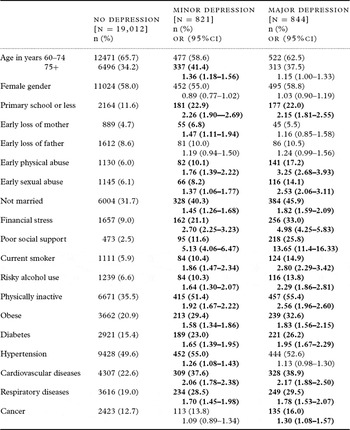
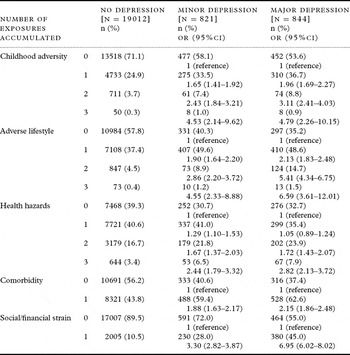
The age of our 20,677 participants ranged from 60 to 101 years (mean = 71.7, standard deviation = 7.6). There were 821 (4.0%) people with minor and 844 (4.1%) with major depression, as assessed by the PHQ-9. The estimated reliability of the PHQ-9 using Cronbach's α was 0.84. The participants' characteristics are summarized in Table 1. The overall effect of clustering by GP was negligible (ρ = 0.009, 95% CI = 0.002–0.035). People with minor depression were on average 1.3 and 1.0 years older than participants without depression or with major depression respectively (p < 0.001 and p = 0.027 respectively, after Scheffé adjustment for multiple comparisons). The groups did not differ in relation to their gender distribution, but most of the remaining exposures were more frequent amongst older people with depression than without. Table 2 shows the cumulative distribution of exposures according to depression status.
Association between life exposures and prevalent minor and major depression in later life

OR = odds ratio
95% CI = 95% confidence interval of the odds ratio
Cumulative distribution of exposures according to depression status

Major and minor depression were defined according to symptoms reported in the Patient Health Questionnaire (PHQ-9).
OR = odds ratio; 95% CI = 95% confidence interval of the odds ratio.
Childhood adversity includes early loss of father or mother, physical or sexual abuse, and no more than primary school education (range 0–3).
Adverse lifestyle includes smoking, risk alcohol use and physical inactivity (range 0–3).
Health hazards include obesity, diabetes and hypertension (range 0–3).
Comorbidities include any of the following: myocardial infarction or angina or stroke; asthma, emphysema or chronic obstructive pulmonary disease; cancers (excluding skin cancers).
Social or financial strain includes distinct or significant financial concerns, or social isolation as determined by the Duke Social Support Inventory.
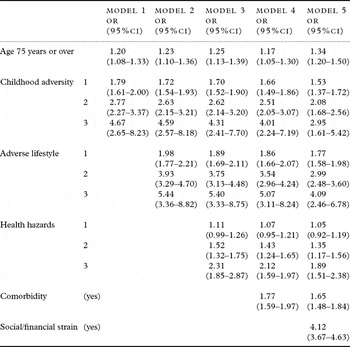
As the differences in the distribution of exposures of participants with minor and major depression were small, we grouped them into a single clinical depression group for subsequent analyses. We then used a forward stepwise approach to introduce exposure scores (as outlined in the statistical analysis section) into the logistic regression models (Table 3). Older adults aged 75 years or over had greater odds of depression than their younger counterparts, and this association did not change substantially with the progressive inclusion of other variables in the models. The odds of depression increased with the accumulation of adverse experiences during childhood and lifestyle practices (smoking, risky alcohol use and physical inactivity), as well as intermediate health hazards (diabetes, hypertension and obesity), comorbid illnesses (cardiovascular disease, chronic respiratory diseases or cancer) and psychosocial stress (financial hardship or poor social support).
Logistic regression models examining the independent contribution of individual exposures to the odds of depression (minor or major) compared with no depression

Major and minor depression were defined according to symptoms reported in the Patient Health Questionnaire (PHQ-9).
OR = odds ratio; these were calculated using age <75 years, no childhood adversity, no adverse lifestyle, no health hazards, no comorbidity and no social or financial strain as the reference groups.
95%CI = 95% confidence interval of the odds ratio.
Childhood adversity includes early loss of father or mother, physical or sexual abuse, and no more than primary school education (range 0–3).
Adverse lifestyle includes smoking, risk alcohol use and physical inactivity (range 0–3).
Health hazards include obesity, diabetes and hypertension (range 0–3).
Comorbidities include any of the following: myocardial infarction or angina or stroke; asthma, emphysema or chronic obstructive pulmonary disease; cancers (excluding skin cancers).
Social or financial strain includes distinct or significant financial concerns, or social isolation as determined by the Duke Social Support Inventory.
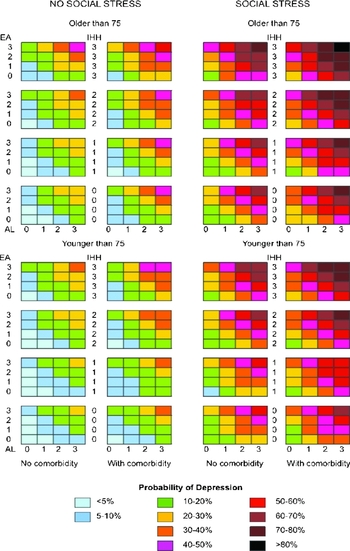
Figure 1 shows the cumulative probability of prevalent depression (major or minor) according to the distribution of exposures. The probability of depression increased progressively from less than 3% to a maximum of 84% according to the accumulation of all measured exposures (no adverse exposures to all adverse exposures present, respectively).
The figure shows the color coded probability of depression (major or minor) according to the cumulative distribution of risk factors. The first two columns of boxes illustrate the probability of depression amongst participants who denied “social stress”, whereas columns 3 and 4 illustrate the probability of depression amongst participants who were experiencing significant “social stress” (distinct or significant financial concerns, or social isolation as determined by the Duke Social Support Inventory). The top four rows of boxes illustrate the probability of depression in people older than 75 years, and the bottom four in those younger than 75 years (aged 60–74 years). Further stratification was based on the presence of comorbidities, as illustrated by each column of boxes (yes/no – myocardial infarction or angina or stroke; asthma, emphysema or chronic obstructive pulmonary disease; cancers – excluding skin cancers), intermediate health hazards in each row of boxes (IHH)(includes obesity, diabetes and hypertension; range 0 to 3 = none to all present), adverse lifestyle factors in each individual column (AL)(smoking, risky alcohol use and physical inactivity; range 0–3 = none to all present), and early childhood adverse events in each individual row (EA)(includes loss of father or mother, physical or sexual abuse, and no more than primary school education; range 0–3 = none to all present). For example, Mr Smith, 78, had two years of primary school education and lost his father at the age of 9 years (two early adverse exposures). He is married and is an active member of his local church. He is physically inactive, smokes, and has type II diabetes and a BMI of 31 (two negative lifestyles and two intermediate health hazards). Our matrix indicates that 20–30% of older adults with this profile will display clinically significant depressive symptoms.

Discussion
Our findings confirm that various factors contribute to modulating the odds of depression in later life, from adverse childhood experiences to lifestyle and socioeconomic circumstances, as well as prevalent obesity, diabetes, hypertension and concomitant medical morbidities. Moreover, our results show that a large proportion of the cases of depression in later life can be accounted for when a sufficiently large number of exposures is included in the explanatory models and that the probability of depression increases as the number of risk factors accumulates.
This study had access to a large sample of community-dwelling older adults that was broadly representative of the Australian community (Pirkis et al., Reference Pirkis2009), although the response rate to invitations was not optimal. We also had access to information about relevant exposures and used a well-accepted and valid approach to assess and diagnose depression amongst participants (Kroenke et al., Reference Kroenke, Spitzer and Williams2001). However, the interpretation of our results should take into account the cross-sectional nature of the study and the underlying assumption that the association between the exposures and depression is causal. Although we are unable to dismiss the possibility of reverse causality and residual confounding, the existence of prospective and experimental data from other sources linking depression to most of the risk factors explored in this study suggests that the approach that we used is on the whole sound (Schoevers et al., Reference Schoevers, Beekman, Deeg, Geerlings, Jonker and Van Tilburg2000; Kritz-Silverstein et al., Reference Kritz-Silverstein, Barrett-Connor and Corbeau2001; Barkow et al., Reference Barkow, Maier, Ustun, Gansicke, Wittchen and Heun2003; Roberts et al., Reference Roberts, Deleger, Strawbridge and Kaplan2003; Holley et al., Reference Holley, Murrell and Mast2006; Smit et al., Reference Smit, Ederveen, Cuijpers, Deeg and Beekman2006; Klungsoyr et al., Reference Klungsoyr, Nygard, Sorensen and Sandanger2006; Koster et al., Reference Koster2006; Lorant et al., Reference Lorant, Croux, Weich, Deliege, Mackenbach and Ansseau2007; Beard et al., Reference Beard, Tracy, Vlahov and Galea2008; King et al., Reference King2008; Pasco et al., Reference Pasco2008; Almeida et al., Reference Almeida, Calver, Jamrozik, Hankey and Flicker2009a). We accept, however, that some of our probability estimates might have been inflated (for example, by reverse causality and the presence of chronic prevalent cases) and that data from cohort and experimental studies are needed to enhance their accuracy and to develop accurate estimate risk prediction over time. There is also the possibility of recall bias, as people with depression may report life circumstances in a more negative way than people who are not depressed. This could contribute to some imprecision in the ascertainment of the exposures and inflation of their association with depression. We also acknowledge that our probabilistic model did not include all, or perhaps even the most relevant (e.g. past history of depression), risk factors for depression in later life and that ongoing refinement in the ascertainment/classification of the exposures and of depression will be required to improve the usefulness of the approach described in this paper. The diagnosis of major and minor depression in this study was based on PHQ-9 self-rated questions and may not represent the true prevalence of these conditions in later life (Byers et al., Reference Byers, Yaffe, Covinsky, Friedman and Bruce2010). Finally, we acknowledge that the combining of major and minor depression was necessary because of the low numbers in the extreme cells of the probabilistic matrix (i.e. the models became unstable when we attempted to analyze major and minor depression separately), but would argue that this approach makes clinical sense as both types of depression cause significant morbidity and mortality (Gallo et al., Reference Gallo, Rabins, Lyketsos, Tien and Anthony1997; Lenze et al., Reference Lenze2000).
Other studies have employed different strategies to assess the risk of depression and to guide the implementation of preventative measures in later life. Smit and colleagues (Reference Smit, Smits, Schoevers, Deeg, Beekman and Cuijpers2008) used data from the first two waves of the Longitudinal Aging Study Amsterdam (LASA, N = 2,200) to identify factors associated with high risk of depression, which was defined by a Center for Epidemiological Studies Depression scale score of 16 or more. They included in their classification and regression trees (CART) analyses sociodemographic (gender, age over 65 years, low education, widowhood, lack of a partner, small social network and urban environment) and clinical variables (anxiety, two or more concomitant illnesses, low mastery). They found that depression was more prevalent amongst those with concomitant anxiety, functional impairments, two or more chronic illnesses, low educational attainment and mastery, and lack of a partner. Similarly, King and colleagues (Reference King2008) pooled general practice data from six European countries and Chile as part of the development and validation of an algorithm to predict major depression (N = 6,948). Their model included country of origin, age, gender, education, past history of depression, family history of psychological difficulties, difficulties at work, experience of discrimination, and the physical and mental health composite scores of the SF-12. The use of relative operating characteristic curves (ROC) produced an average C-index of 0.79, confirming that these variables were robust predictors of depression in this sample. Whilst the use of CART and ROC curves is epidemiologically informative, they lack the intuitive and practical clinical appeal provided by the stratification and accumulation of simple exposures that we attempted to achieve in this study.
The approach that we used to estimate the probability of depression according to the distribution of risk factors is similar to the evidence-based practice guidelines that have been successfully implemented in many parts of the world to assess and manage cardiovascular risk (New Zealand Guidelines Group, NZGG, 2003; D'Agostino et al., Reference D'Agostino2008). These guidelines have enabled clinicians to ascertain the probability of cardiovascular events over a five-year period according to the accumulation of relevant risk factors (such as hypertension, diabetes, hyperlipidemia, smoking, age, etc.) and to engage patients actively in the adoption of meaningful risk reduction strategies. We based our assessment of the relevant exposures for depression on best available evidence from existing observational and experimental studies, and used a mixture of non-modifiable and modifiable factors to estimate the probability distribution of depression per stratum. This strategy has the advantage of highlighting some of the key factors that should be assessed when ascertaining the probability of depression for a given individual (even though some may not be amenable to change) and of offering a clear indication on how to implement relevant risk reduction strategies. For example, take Mr Smith, 78 years old, who had two years of primary school education and lost his father at the age of 9 years (two early adverse exposures). He is married and is an active member of his local church. He is physically inactive, smokes, and has type II diabetes and a BMI of 31 (two negative lifestyles and two intermediate health hazards). Our results indicate that 20–30% of older adults with this profile experience clinically significant depressive symptoms. If Mr Smith were to give up smoking, become more physically active and reduce his BMI to 28, the probability of depression could potentially drop to 5–10% (as stated before, these estimates are only tentative and require prospective refinement and validation). The availability of such information offers clear incentives to the patient and the clinician to consider and address relevant factors that are amenable to change and that are likely to produce the greatest reduction in the risk of depression. Incidentally, this approach may lead to health gains that extend beyond mental health (e.g. cancer and cardiovascular events).
In summary, our results show that the stratification of risk factors for depression produces a matrix that can be used to estimate the probability of depression and to guide the introduction of risk reduction strategies. Future longitudinal studies should now aim to validate such an approach and to determine how these risk factors interact with various “stress genes” to increase the risk of depression (Almeida et al., Reference Almeida2009b; El Hage et al., Reference El Hage, Powell and Surguladze2009). The use of a well-validated probabilistic matrix will contribute to guide the design of effective preventive measures to decrease the prevalence and incidence of depression in later life.
Conflict of interest
None.
Description of authors' roles
O. P. Almeida conceived and designed the study. He had full access to all data and takes responsibility for the integrity of the data and the accuracy of the data analysis. O. P. Almeida, J. Pfaff, J. Pirkis, N. Kerse, M. Sim, B. Draper, J. Snowdon, R. Goldney, L. Flicker, N. T. Lautenschlager and N. Stocks acquired the data. H. Alfonso and O. P. Almeida performed all analyses. O. P Almeida drafted the manuscript, which was critically revised by all authors for important intellectual content.
Acknowledgments
The investigators thank participants and research staff for their generous contribution. This project was supported by a competitive project grant from the National Health and Medical Research Council of Australia (NHMRC, number 353569) to O. P. Almeida, J. Pfaff, N. Kerse, J. Pirkis, R. Goldney and J. Snowdon.