





Obesity represents a major public health concern in Latin America, with nearly 30 % living with obesity(1). Related to these conditions is the increased prevalence of non-communicable diseases (NCD) in the region, such as hypertension and diabetes, both of which are risk factors for CVD(Reference Hruby, Manson and Qi2). These issues are also prevalent in Peru, where the prevalence of obesity is 25·7 %, and 40·1 % have at least one cardiometabolic condition (obesity, diabetes or hypertension)(3). Given that many of these conditions involve modifiable risk factors such as nutrition and physical activity, there is a need to implement public health policies that promote healthier habits.
Specifically aimed at addressing unhealthy diets, the WHO has listed nutrition labelling policies, such as front-of-pack labelling (FOPL), as a ‘best buy’ to help reduce the burden of NCD(4). FOPL is meant to serve as an easy way to improve understanding of the product, enabling informed purchasing and consumption decisions(5). In Peru, FOPL is part of the Law for the Promotion of Healthy Eating for Children and Adolescents (Law No. 30021). The law also included other components such as the establishment of an overweight and obesity nutrition research observatory, healthy kiosks in schools, nutrition education and physical activity promotion(6). FOPL is presented on all processed foods and beverages as black octagonal warning labels with white letters indicating products’ excessive amounts of sugar, sodium, saturated fat according to thresholds or containing trans-fat. Processed foods are defined as industrially manufactured foods that undergo physical, chemical or biological processing before reaching the consumer, including ultra-processed foods (UPF), but excluding minimally processed or artisanal foods(6). FOPL was first implemented in 2019, followed by a second phase in 2021 with stricter thresholds for nutrients of concern (e.g. the excess sugar threshold for beverages was ≥6 g/100 ml during the first phase but was reduced to ≥5 g/100 ml during the second phase)(6,Reference Crosbie, Gomes and Olvera7) . These warning labels must also be displayed across all product marketing and advertising materials(8).
Since FOPL implementation in Peru, evidence has emerged regarding its effects on outcomes such as perception, knowledge, reformulation and purchase intention(Reference Saavedra-Garcia, Meza-Hernández and Diez-Canseco9–Reference Mamani-Urrutia, Dominguez-Curi and Sosa-Macalupu13). However, a deeper exploration of stakeholder perceptions to identify barriers and facilitators can be particularly useful to improve its implementation, evaluation and impact. Although previous stakeholder FOPL explorations have been done, they were focused on its path for approval rather than its implementation and evaluation, especially since many years have passed since its final implementation(Reference Diez-Canseco, Cavero and Alvarez Cano14). In addition, given the documented challenges surrounding FOPL approval, including the opposition from government entities with ties linked to the economic or food industry, which ultimately led to a weakened policy prior to its approval(Reference Diez-Canseco, Cavero and Alvarez Cano14), it is important to assess whether some of these barriers remain and how they may impact implementation and evaluation.
An approach to investigating the implementation and effectiveness of policies(Reference Chu15) is to use an implementation science framework, such as the RE-AIM (reach, effectiveness, adoption, implementation, and maintenance) model(16). The RE-AIM framework allows assessment at both individual and institutional levels by examining reach and effectiveness at the individual level, adoption and implementation at the institutional level, and maintenance factors affecting both levels(16). Therefore, this framework can be used to capture perspectives from various stakeholders involved in FOPL implementation and evaluation, including barriers, facilitators and suggestions for sustainability(Reference D’Lima, Soukup and Hull17). Using the RE-AIM framework, the current study aimed to determine stakeholder perceptions at various levels (individual, organisational and governmental) related to the implementation of the final phase of FOPL in Peru.
Methods
Study design, researcher position and reflexivity
To address FOPL implementation and evaluation, key informant interviews were conducted using a semi-structured interview guide, organised around the RE-AIM framework. This framework has previously been applied to evaluate FOPL in Australia and New Zealand(Reference Jones, Thow and Ni Mhurchu18). It also lends itself to qualitative methods and can be adapted to study objectives(Reference Holtrop, Estabrooks and Gaglio19).
All authors involved in the project planning, implementation and analysis are nutrition, health or public health professionals with experience either in qualitative research methodology or expertise on FOPL research in Peru. The core study team, which contributed to the research ideation and finalising the protocol, was comprised of two female native Spanish speakers researchers from the U.S. with experience conducting nutrition research in Latin America (GVP, CP), three female native Spanish speakers researchers from Peru with experience in qualitative methods and with previous experience conducting FOPL-related research in Peru (MMH, LSG and KYS) and a female researcher from the U.S. with extensive qualitative research experience (JH).
The core team met several times during the planning, implementation, and interpretation phases to ensure appropriate cultural contexts were considered.
Participant recruitment
To recruit study participants, stakeholder mapping(Reference Skarlatidou, Suškevičs and Göbel20) was first conducted to ensure that a range of perspectives (implementers and decision-makers) and stakeholders involved in FOPL implementation, monitoring or evaluation were included. Eligible representatives from government, industry, civil society and academia were invited (n 32) to a project launch event at the Universidad San Ignacio de Loyola in Lima, Peru, in February 2025 to introduce the study team and describe the rationale for conducting this research. Stakeholders were invited to participate in the interviews if they were ≥18 years old and currently or recently involved in the implementation and evaluation of FOPL in Peru.
Aligned with other FOPL qualitative research(Reference Diez-Canseco, Cavero and Alvarez Cano14,Reference Yin, Ye and Xin21) , an initial purposeful sample was identified based on stakeholder mapping results. We also utilised a snowball sampling method(Reference Van Horn and Beto22), in which participants were asked, as appropriate, to identify others in the sample until data saturation was reached. Similar qualitative research studies found that data saturation was reached with as few as eight participants and as many as thirty participants(Reference Diez-Canseco, Cavero and Alvarez Cano14,Reference Yin, Ye and Xin21,Reference Fialon, Nabec and Julia23,Reference Fialon, Nabec and Julia24) ; therefore, our sample size goal for this study was 15–20, with participation from 3–5 representatives for each stakeholder group (government, industry, civil society and academia).
Participants received an informational letter describing the research procedures, confidentiality considerations and contact information, and verbal informed consent was confirmed at the start of the interview. Before moving through the interview guide, researchers briefly discussed their experience with researching obesity prevention strategies in Latin America and answered questions or concerns. No financial incentive was provided to participants.
Data collection procedures
The semi-structured interview guide was initially developed by GVP and reviewed by the study team. It was also piloted with three stakeholders (government and academia) from Peru who met the inclusion criteria. Although their data were not included in the final analysis, their feedback improved the final interview guide (Supplementary Table 1). Potential stakeholders were invited to the interview via letter (required for government representatives), email, phone or direct communication by local researchers. Interviews were conducted in Spanish (in person or virtually) by two moderators (GVP and CP), with no previous connections with participants. Whenever possible, a Peruvian team member attended the interviews to take field notes on relevant aspects of the interviews or discussion highlights, and to add any additional probing questions as appropriate. The interview guide allowed participants to discuss their perceptions of the FOPL RE-AIM components and to offer open suggestions for improving FOPL or other relevant policy interventions.
Consistent study team discussions were held after interviews to ensure data saturation by stakeholder categories was reached. Interviews took place between February and March 2025, lasted approximately 20–90 min and were recorded. In-person interviews were conducted in a quiet office at Universidad San Ignacio de Loyola, and virtual interviews were held through Zoom or Microsoft Teams. No repeat interviews were conducted, but follow-up communication was sent to stakeholders who either provided a relevant resource or recommended that another stakeholder be interviewed. While no member checking was conducted to confirm the transcripts, all interviews were transcribed verbatim in Spanish using the Sonix platform and reviewed and edited by a Peruvian team member (KYS). They were then returned to one of the interview moderators (GVP) for final review before analysis.
Data analysis
Thematic analysis was conducted using a blended inductive and deductive coding approach(Reference Braun and Clarke25). Coding was done using Dedoose software(26) by two members (GVP and KYS); discrepancies were resolved by another member (CP). Transcripts remained in Spanish for coding to ensure appropriate contexts, and participants’ meanings were captured. An initial codebook was developed a priori based on the RE-AIM constructs and then revised after an initial review of the interviews. The codebook was then piloted through two interviews, during which the two coders discussed gaps and reached a coding consensus. The codebook was also updated after discussion and review from the study team. Blinded coding then occurred in three iterations, where two different interviews were coded, coding discrepancies were discussed, and iterative updates were made to the codebook. After the third blinded coding iteration of six interviews, Cohen’s Kappa was calculated to determine interrater reliability. Cohen’s kappa was calculated as +0·83, which indicated a strong level of agreement among coders(Reference McHugh27). The remaining interviews were then divided between the two coders. The final codebook (Supplementary Table 2) included topics such as national reach, use and consumer reception (reach), FOPL impact on people with obesity, and evaluation barriers (effectiveness), factors contributing to use, unintended impact and barriers (adoption and implementation), and lessons learned, FOPL-specific and general recommendations, and perceptions regarding long-lasting impact (maintenance). Codes were then tallied and clustered by meaning, leading to the development of themes and subthemes. Then, using a contextualist theoretical framework in line with our blended coding approach and an iterative approach as indicated by Braun and Clarke(Reference Braun and Clarke25), which included several consensus meetings with study team members and reviews of the data (study participants not included in this step), themes and subthemes were defined and finalised. These were summarised by RE-AIM category and prominent coding categories. Relevant quotes were included to highlight subthemes.
Results
Participant characteristics
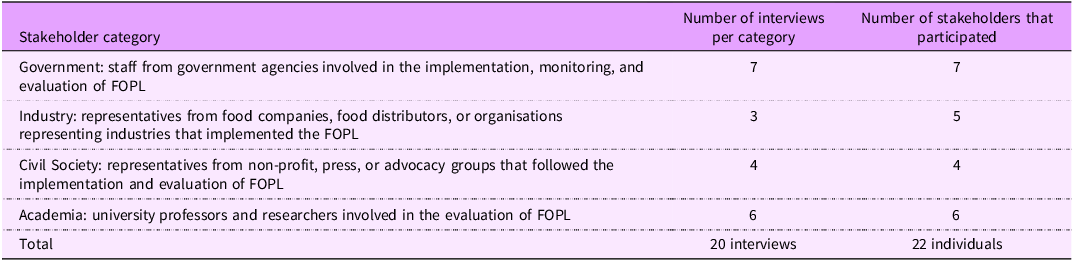
Thirty-five stakeholders were contacted (twelve from government, seven from civil society, eight from industry and eight from academia), and twenty-two agreed to participate in twenty stakeholder interviews (two industry interviews had two representatives). Table 1 shows the distribution of stakeholders by category, with 59 % women and 41 % men. Individuals who did not participate either did not respond to our invitation (n 8), referred another individual within their organisation (n 4) or stated that their availability could not accommodate participation (n 2).
Stakeholder interview participation for front-of-pack labelling (FOPL) perceptions

Table 1. Long description
A table showing stakeholder participation in front-of-pack labeling perceptions. The table has three columns: Stakeholder category, Number of interviews per category, and Number of stakeholders that participated. It has four rows for different stakeholder categories and a total row. Row 1: Government: staff from government agencies involved in the implementation, monitoring, and evaluation of FOPL, 7 interviews, 7 participants. Row 2: Industry: representatives from food companies, food distributors, or organizations representing industries that implemented the FOPL, 3 interviews, 5 participants. Row 3: Civil Society: representatives from non-profit, press, or advocacy groups that followed the implementation and evaluation of FOPL, 4 interviews, 4 participants. Row 4: Academia: university professors and researchers involved in the evaluation of FOPL, 6 interviews, 6 participants. Row 5: Total, 20 interviews, 22 individuals.
Themes
Four major themes were developed from the data, which are organised below by RE-AIM constructs. Regarding reach, stakeholders reported that FOPL’s reach across specific populations and products remained varied despite the national law. Secondly, while comprehensive impact evaluations should be prioritised, a lack of implementation across all aspects of Law No. 30021 can undermine FOPL effectiveness. Regarding adoption and implementation, stakeholders emphasised that low acceptance and unsupportive environments can impede effective FOPL implementation. Finally, perceptions regarding maintenance highlighted the need for healthier environments to support effective obesity prevention, as well as additional FOPL education, research and regulatory updates to support sustainability.
Key results, code counts and specifics within stakeholder groups can be found in Table 2.
Theme and code summary for stakeholder perceptions using the RE-AIM framework

Table 2. Long description
A table summarizing code summaries for stakeholder interview perceptions using the RE-AIM framework. The table has 4 themes and 25 rows and 4 columns. Column headers are Theme, Code, Count, and Description. Theme 1 includes 5 codes: Code 1: Stakeholder perception, Count: 12, Description: Stakeholder perception of the intervention. Code 2: Stakeholder satisfaction, Count: 10, Description: Stakeholder satisfaction with the intervention. Code 3: Stakeholder knowledge, Count: 8, Description: Stakeholder knowledge of the intervention. Code 4: Stakeholder acceptance, Count: 6, Description: Stakeholder acceptance of the intervention. Code 5: Stakeholder preference, Count: 4, Description: Stakeholder preference for the intervention. Theme 2 includes 5 codes: Code 1: Stakeholder attitude, Count: 14, Description: Stakeholder attitude towards the intervention. Code 2: Stakeholder belief, Count: 12, Description: Stakeholder belief about the intervention. Code 3: Stakeholder opinion, Count: 10, Description: Stakeholder opinion of the intervention. Code 4: Stakeholder view, Count: 8, Description: Stakeholder view of the intervention. Code 5: Stakeholder perspective, Count: 6, Description: Stakeholder perspective on the intervention. Theme 3 includes 5 codes: Code 1: Stakeholder experience, Count: 16, Description: Stakeholder experience with the intervention. Code 2: Stakeholder feedback, Count: 14, Description: Stakeholder feedback on the intervention. Code 3: Stakeholder suggestion, Count: 12, Description: Stakeholder suggestion for the intervention. Code 4: Stakeholder comment, Count: 10, Description: Stakeholder comment about the intervention. Code 5: Stakeholder input, Count: 8, Description: Stakeholder input on the intervention. Theme 4 includes 5 codes: Code 1: Stakeholder support, Count: 18, Description: Stakeholder support for the intervention. Code 2: Stakeholder engagement, Count: 16, Description: Stakeholder engagement with the intervention. Code 3: Stakeholder involvement, Count: 14, Description: Stakeholder involvement in the intervention. Code 4: Stakeholder participation, Count: 12, Description: Stakeholder participation in the intervention. Code 5: Stakeholder collaboration, Count: 10, Description: Stakeholder collaboration on the intervention.
RE-AIM, reach, effectiveness, adoption, implementation, and maintenance; FOPL, front-of-pack labelling; UPF, ultra-processed foods; INDECOPI, National Institute for the Defense of Competition and the Protection of Intellectual Property; CENAN, National Center for Food, Nutrition, and Healthy Living; NCD, non-communicable diseases.
Reach
Theme 1: Reach and use of FOPL remained constrained by certain products and locations despite national law.
The first theme centred on the fact that there are populations (rural, indigenous) and products (informal, artisanal) that are not fully reached and on situations where there may be a lack of understanding or poor use of FOPL.
Sub-theme: Some segments of the population are not reached. Stakeholders also mentioned that although this is part of a national law that should have reached all places and populations with UPF access, there are contexts, such as rural areas or indigenous populations, where some of these foods with FOPL might not reach or might not be a part of the commonly consumed foods. There are also specific products, such as artisanal (foods produced predominantly through manual or traditional methods by small-scale food manufacturers) or more ‘natural’, which do not require FOPL, even if they are high in sugar, sodium or fat. This is illustrated by a quote below:
‘What happens is that in Peru, we have certain products…These are more artisanal that in a way, they can be seen as not falling under the rubric to show that they have a high amount of fats, sodium, or sugar…we also have cities that are further away, rural zones, where there can be more trade in products developed locally that can escape this control…’ [Academia stakeholder interview #14]
Sub-theme: Differing reception depending on the consumer. A neutral reception was described by stakeholders as certain segments of the population (such as young people or the elderly) who may not think that FOPL applies to them or may not understand its significance. Some government stakeholders acknowledged that some consumers might understand the purpose of FOPL but choose not to use it. Even if FOPL products reach populations with low literacy, they may not fully understand their meaning. Some consumers may have a positive reception to FOPL, but with mixed results: concerns about avoiding some foods that may not be inherently unhealthy can lead to consuming some foods simply because they do not have FOPL, without considering their overall nutritional value. This sentiment is described below:
‘A zero-sugar soda is water, coloring, and flavoring, probably a highly toxic preservative, and one or more sweeteners, and doesn’t have an octagonal warning label. So, since it does not have an octagonal warning label, and I am not very knowledgeable about nutrition, I am going to drink my [diet soda] instead of a juice that has an octagonal warning label, a fruit juice that has sugar but is a little more natural…’ [Industry stakeholder interview #10]
Effectiveness
Theme 2: FOPL effects on obesity are complex and need better evaluation; limited consumer FOPL knowledge and use and incomplete implementation of Law No. 30021 may hinder effectiveness.
Theme 2 centred around sentiments that determining FOPL’s impact on persons with obesity is complex and more funding and priority should be given to comprehensive impact FOPL evaluations (e.g. sales, intake of healthy v. unhealthy foods) rather than process evaluations which may have mixed results; however, this can be difficult when there may be poor consumer knowledge and use of FOPL or lack of implementation of all components within the overall law.
Sub-theme: Lack of funding and access to data. Stakeholders perceived FOPL as an obesity prevention strategy but acknowledged challenges in evaluating its effectiveness due to the complex nature of obesity and the fact that FOPL has been part of a national policy implemented for years. While some indirect process evaluations exist (mostly conducted by government or industry), adequate funding and access to government data are needed to ensure reliable impact evaluations. An academia stakeholder perceived that there is pressure from the Ministry of Economy to show proof that FOPL has an impact, but the Ministry of Health was not provided enough funds to evaluate it. This lack of prioritisation for these evaluations is exemplified in the following quote:
‘In fact, the lack of impact studies and the lack of studies to understand this topic are also seen in funding cuts. At the public level, for example, research funds have been reduced. And at the level of awards, grants, or external funds, they are directed towards other things’ [Government stakeholder interview #17]
Sub-theme: Available scientific studies have produced mixed results. Some stakeholders reported being involved in or aware of evaluation research on perceptions and use, with mixed results depending on the population. For example, one study reported that girls pay more attention to FOPL than boys, while other studies found that as children get older and gain purchasing power, considerations beyond FOPL (such as taste) influence their purchases. Two academia stakeholders also mentioned that while parents may know about FOPL, it can depend on their region or economic level (e.g. rural), whether they actually understand and use it. An example of a study conducted by a stakeholder like this is described below.
‘We conducted studies at one point with parents of primary-school-aged children—specifically in a district in Lima characterized by, let’s say, lower-middle income levels—and they weren’t very familiar with the octagon [FOPL] labeling system. I mean, they knew it existed, but they didn’t really understand the why and for what, so it didn’t influence their purchasing decisions’. [Academia stakeholder interview #16]
Sub-theme: Comprehensive effectiveness indicators are needed. It was perceived that effective indicators for purchasing and dietary changes are needed, such as whether the intake of healthier foods (e.g. fruits and vegetables) is increased with the use of FOPL. Also, indicators that examine the trade-offs involved are needed, such as reformulation. Comprehensive knowledge changes and an examination of how the industry might have ‘evaded’ the regulation were all encouraged. Since many years have passed since the FOPL implementation, there was also a mention of using the evaluation results to update the FOPL implementation to improve effectiveness. Example indicators are depicted below:
‘Measuring the effectiveness of [octagonal warning labels] is quite complex, isn’t it? Because we’d like to say, okay, mothers or fathers decide to eat fewer ultra-processed foods, they read labels more, and therefore their children are healthier. But we know it’s not that straightforward…parents decide to increase their consumption of fruits and vegetables and decrease their consumption of ultra-processed foods by reading labels. So, indirectly, if I see that fruit and vegetable consumption has improved, I could say they’re making better choices’. [Government stakeholder interview #13]
Sub-theme: Difficult to determine impact of FOPL in obesity due to its complex nature. It was perceived that assessing FOPL impact on obesity is complex to tease out and can vary by the individual and situation. For example, consumers with higher socioeconomic status and education, or those with NCD (more health-conscious), may have a better understanding of and use of FOPL, which may change their FOPL purchases and, in turn, lead to a greater impact on obesity. Also, FOPL was perceived to have an impact when properly implemented to include other aspects of the law (healthy kiosks/cafeterias, FOPL publicity, physical activity promotion), which were perceived as not fully implemented. Lastly, there is a need to include other complementary interventions to promote healthier environments, as described in the quote below:
‘I think that the whole world knows that the octagonal warning label is not the piece that is going to transform obesity in the world…I think we are all in agreement that this is another piece of the puzzle…I understand that policies are only effective when combined with complementary policies’. [Academia stakeholder interview #15]
Adoption and implementation
Theme 3: Unsupportive environments and consumer-related barriers can impede effective FOPL implementation.
The third theme focused on how unsupportive environments can impede the effective and intended implementation of FOPL (e.g. industry and political resistance, poor FOPL implementation and monitoring, lack of consumer understanding and limited healthier food alternatives).
Sub-theme: Adoption improved by incorporating strategies into the consumer environment. Effective strategies to promote FOPL adoption were mentioned as including strong integration within consumers’ environments, for example, incorporating not only the child but also the parents, teachers and administrators in FOPL education interventions.
On the other hand, stakeholders identified many significant barriers to effective FOPL implementation, which are depicted using a Sankey diagram and presented by code count and theme in Figure 1.
Sankey diagram barriers for front-of-pack label (FOPL) implementation.

Sub-theme: Implementation barriers related to changes from industry. The most common barrier reported by stakeholders was changes by industry, with common workarounds including reducing the size of the package, as smaller packages are exempt from FOPL, reformulation of products without making them healthier, incorrectly registering their product to avoid FOPL designations and using FOPL stickers, which can lead to them getting lost during product transport. Other examples include classifying a liquid yogurt as a solid to have more relaxed sugar cut-offs, and industry making all sides look like the front to display the product, showing the non-FOPL side. These were seen as changes done by industry to ‘evade’ FOPL on their products and reduce its impact, as shown in the quote below:
‘The regulation establishes that if the front of the label is less than 50 square centimeters, it is exempt from displaying the octagonal warning label. This was due to enormous pressure from industry, and it’s contrary to the law… Companies began to shrink their labels to be less than 50 centimeters to avoid displaying the octagonal warning labels’. [Civil Society interview #09]
Sub-theme: Implementation barriers related to lack of political will and FOPL detractors: A lack of political will to prioritize funding to monitor FOPL due to other competing issues, as well as instances of government agencies or officials backing industry interests, were other commonly mentioned barriers. Industry was identified as the biggest detractor to FOPL implementation in 70 % of interviews with stakeholders from all sectors (academia, civil society, government and industry). These politically related barriers are mentioned in the quote below:
‘…there have been moments, for example, where we have a change in government, right? And those changes in the government have generated moments in which this does not matter… Yes, even to allocate funding to the health sector for this issue. If you ask if they have a budget for a campaign around healthy eating or the use of the octagonal warning labels, they probably don’t have it’. [Civil Society stakeholder interview #03]
Sub-theme: Implementation barriers related to monitoring. The lack of proper monitoring with economic consequences (sanctions) was seen as a vital part of FOPL implementation that was missing. The importance of doing this in school dining environments (e.g. kiosks and cafeterias) was frequently mentioned. This lack of sanctions was thought to lead to poor industry compliance. For example, a civil society stakeholder mentioned an instance in which they sent a product without an FOPL to a lab and found that it exceeded the sugar threshold, yet it was not sanctioned.
Sub-theme: Implementation barriers due to consumer difficulties with knowledge and food access. A lack of access to healthy food or food insecurity was seen primarily by academia stakeholders as a major reason why FOPL implementation may not be successful. Improving food access and fostering healthier environments were also mentioned as being paired with comprehensive nutrition education to address limited understanding of FOPL, which may negatively impact FOPL use. There were sentiments that this needs to include a deeper understanding of how foods with FOPL will impact your health. Addressing this lack of awareness and knowledge barrier, and the importance of conveying this to children, is exemplified in the quote below:
‘I think it’s also important in the children’s education itself, right? Raising awareness so they can make better decisions, especially at the school level, better awareness in this aspect… What does the octagonal warning label mean? What does it mean when a food is high in sugar, high in fat? What does this mean for my health?’ [Academia stakeholder interview #14]
Sub-theme: Changes during implementation led to unintended impacts. Stakeholders’ perceptions centred on how the overall law became weaker over time before implementation and how concessions were made (e.g. stickers, smaller packages, more relaxed nutrient cut-offs not aligned with the Pan American Health Organization (PAHO) and certain products being exempt, such as infant formulas – something that is being actively contested in Peru). These issues may lead to unintended impacts, such as products high in sugar, sodium and fat still being sold, or the industry reducing sugar content and increasing the use of non-nutritive sweeteners. Industry stakeholders also mentioned some negative impacts on FOPL, such as the cost for international food manufacturers (which led to stickers), and how any increased cost would be passed on to consumers and may reduce their purchasing power. This sentiment is illustrated below:
‘At every moment, they want to change and put new things in the FOPL. What does this mean? More costs for implementation, for a label to add. And who suffers the higher costs? Who does this pass on to? The consumer. So, what world are we living in?’ [Industry stakeholder interview #04]
Maintenance
Theme 4: Healthier environments and FOPL advancements should be strengthened to support FOPL sustainability.
The fourth and final theme emphasised that while overall healthier environments should be strengthened (e.g. complementary nutrition and physical activity interventions), future FOPL education, research and regulation clarity should continue to support the sustainability and impact of FOPL.
Stakeholder perceptions of factors impacting FOPL maintenance are shown in Figure 2.
Sankey diagram for factors important for front-of-pack label (FOPL) maintenance.

Sub-theme: FOPL-specific efforts (e.g. more research, better education, more regulation clarity) needed to support FOPL sustainability. The need for additional evidence was identified as a priority for FOPL sustainability, particularly regarding consumption, as mentioned by academia and government stakeholders. Stakeholders also suggested edits to the FOPL regulation to reduce ambiguity, such as including infant formulas within the FOPL regulation, considering a label for artificial sweeteners and aligning with PAHO parameters. There were also discussions about the overall health contributions and the processing of certain foods (e.g. cheese and cacao), which may have FOPL and are considered unhealthy. More education and comprehensive communication campaigns were also commonly mentioned to permeate consumer understanding among children and people living in diverse contexts. Other stakeholders mentioned that education must also emphasise healthy foods and what they can eat, rather than focusing solely on what is ‘prohibited’. This is exemplified in the quote below.
‘…a lesson we’ve learned, but we need to have greater dissemination so that this whole issue can have more visibility and that the general population has better awareness about this…And make it increasingly accessible to people, to the population, in their own language, in their way of speaking, right? We’ve included “high in sugar,” but perhaps people don’t quite understand what “high in sugar” means’.[Government stakeholder interview #02]
Sub-theme: Complementary policies and changes to the environment are needed before determining long-term impact. Potential gaps in the law (outside of FOPL) and how its implementation might need to be improved also need to be explored. There needs to be existing complementary policies, aimed primarily at physical activity and nutrition education, which are necessary to improve FOPL’s impact and address obesity. Specific suggestions included improving the environments by offering healthier options (e.g. healthy kiosks) and labelling healthy products to incentivise their selection. Also, FOPL’s long-lasting impact was mostly neutral, with some perceiving that it might be too early to say, and longer-term impact evaluation should be done after gaps in FOPL implementation are addressed, which require sufficient infrastructure and funding, as highlighted below:
‘Many people and public figures in Peru have focused on defending the octagonal warning labels to create an image of caring about consumers, about people, but they haven’t entered in the really important debate on changing structures at the level of the educational curriculum, the education of the population, and the promotion of physical activity…’ [Academia stakeholder interview #16]
Discussion
FOPL was implemented nationally; however, there are perceptions that certain populations (rural, indigenous), informal sales and artisanal products (not required to have FOPL under current policy) are not fully reached, and that there is poor understanding and use of FOPL. Stakeholders expressed that, while FOPL has potential as an obesity and NCD prevention strategy, more funding and priority should be given to conducting comprehensive FOPL evaluations and implementing the other components of the law (Law No. 30 021) to be more effective in preventing obesity. While the need for more funding and lack of available data was often mentioned by government stakeholders, there were differences among other stakeholder groups regarding how to successfully conduct and improve evaluations, with an industry stakeholder citing they tried to collaborate with government entities for evaluations but were not taken seriously and an academia stakeholder stating that while industry has the data available for more robust evaluations (e.g. sales data), they would not want to share. Key barriers identified included limited governmental prioritisation and industry opposition (mentioned by several academia, civil society and government stakeholders), a lack of compliance monitoring/sanctions and unhealthy environments that influence consumer dietary choices (e.g. food insecurity and poor nutrition education). Finally, to ensure a sustainable and meaningful impact on obesity prevention, further investment in FOPL education and research and in FOPL regulatory clarity (e.g. infant formulas, artificial sweeteners, artisanal foods) is needed, while incorporating complementary policies.
Differences in FOPL reach were also reported in a qualitative study in Australia and New Zealand using the RE-AIM framework to evaluate FOPL implementation (Health Star Rating)(Reference Jones, Thow and Ni Mhurchu18). They found greater FOPL awareness among females, younger individuals, higher-income groups and normal-weight consumers. In Peru, mothers reported paying less attention to octagons when buying familiar, highly liked or ‘essential’ products(Reference Diez-Canseco, Najarro and Cavero28). In contrast, some stakeholders in our study perceived that young people may not use FOPL, whereas individuals with existing NCD might be more likely to adopt FOPL.
Similar barriers related to industry resistance have been documented in another FOPL evaluation in Portugal(Reference Fialon, Nabec and Julia24), which identified resistance from the agricultural sector, where formal adoption of FOPL has not yet occurred. Likewise, stakeholder interviews in China reported industry concerns about costs, which may negatively affect smaller food manufacturers(Reference Yin, Ye and Xin21). These concerns were reflected in our findings, with industry stakeholders noting that FOPL imposes additional costs that can be passed on to consumers. Similar to our study, a lack of political will for FOPL or competing priorities was also noted as a barrier to implementation in the study in China(Reference Yin, Ye and Xin21), potentially leading to insufficient resource allocation for adequate implementation and evaluation.
Industry workarounds were another prominent barrier identified during our stakeholder interviews (e.g. stickers, reduced package sizes). Some of these strategies may have unintended consequences, such as increased use of non-nutritive sweeteners, which some stakeholders believe can have adverse health effects. This formulation shift has been confirmed not only by previous FOPL research in Peru(Reference Saavedra-Garcia, Meza-Hernández and Diez-Canseco9) but also in Chile(Reference Zancheta Ricardo, Corvalán and Smith Taillie29), where reformulation evaluations after FOPL implementation demonstrated that reductions in beverage sugar content were accompanied by increased use of non-nutritive sweeteners. Other industry workarounds were also reported in Mexico post-FOPL implementation, including double-front packaging on products with FOPL, so that one of the fronts with the label can be hidden when displayed in stores(Reference Crosbie, Otero Alvarez and Cao30).
Lack of monitoring, particularly regarding financial consequences, was another commonly identified barrier that can lead to poor industry implementation and compliance, as was also reported in a policy cycle evaluation of Mexico’s General Health Law, which includes FOPL(Reference Crosbie, Otero Alvarez and Cao30). Combined with the lack of mandatory nutrient labels in Peru, this contributes to limited transparency and poor consumer understanding of product nutrient composition. A cross-sectional study conducted in a supermarket chain in Lima in 2022(Reference Meza-Hernández, Yabiku-Soto and Saavedra-Garcia31) found that nearly 30 % of products did not include nutritional information; among those that did, only 56 % complied with FOPL criteria for nutrient declaration(Reference Meza-Hernández, Yabiku-Soto and Saavedra-Garcia31).
Recommendations to improve FOPL impact and efficacy have been noted by other researchers to include more comprehensive evaluations, the incorporation of evidence-based improvements and the implementation of complementary government-led nutrition and health policies(Reference Jones, Thow and Ni Mhurchu18). Similarly, qualitative research in Peru identified the need for FOPL research evidence and additional education(Reference Diez-Canseco, Cavero and Alvarez Cano14,Reference Diez-Canseco, Najarro and Cavero28) . These recommendations aligned with stakeholder perceptions in our study regarding FOPL maintenance, emphasising continued research, education and updates to FOPL to address current gaps and adequately assess long-term impact. Stakeholders also expressed that all aspects of Law No. 30021 must be implemented to ensure its potential for obesity and NCD prevention is realised.
Strengths and limitations
One strength of this study was that the Peruvian researchers conducted stakeholder mapping, ensuring a comprehensive and appropriate list of stakeholders. In addition, the use of RE-AIM enabled a comprehensive discussion of intervention implementation, barriers and sustainability, with perspectives at multiple levels.
Among the limitations, there were challenges in recruiting industry stakeholders. In our study, we were only able to recruit three industry stakeholders representing a food company, an advocacy group and a grocery store owner, with our requests for other industry stakeholder participation going unanswered or declined. While our industry stakeholder participants offered important perspectives and were open with their ideas, future research should consider including perspectives from other industry representatives including smaller food retailers (kiosks, ‘bodegas’ or convenience stores) as they may be more willing to participate and foods sold in these settings may include some of the ‘workarounds’ identified by stakeholders, including informal products and smaller package sizes that may not display FOPL despite high sugar, sodium or fat content. Additionally, most interviews (n 17) were also conducted virtually, which limited opportunities for in-person engagement. While virtual interviews facilitated participation, in-person interviews may have allowed for stronger rapport(Reference de Villiers, Farooq and Molinari32) and improved observation of non-verbal cues.
Policy implications
This study addressed an important gap by examining stakeholder perceptions regarding FOPL implementation and evaluation, including barriers to effective implementation. Stakeholders provided recommendations to improve FOPL’s impact on obesity and NCD, emphasising the need for supportive and healthier food environments and adequate compliance monitoring to strengthen implementation, which requires commitment from major stakeholders, including the government. Specifically, findings from this study on industry workarounds, which have also been reported in other countries with similar FOPL, such as Chile and Mexico, and have resulted in potential evading of the label through reformulation(Reference Zancheta Ricardo, Corvalán and Smith Taillie29) or packaging changes(Reference Crosbie, Otero Alvarez and Cao30), should be addressed through future iterations of the FOPL regulation and Law No. 30 021. Additionally, intentional investments in FOPL evaluation and research are necessary to assess FOPL’s effect on public health.
Conclusion
Stakeholders from government, industry, civil society and academia perceived FOPL as having the potential to contribute to obesity and NCD prevention; however, it was consistently viewed as only one component of a broader law addressing a complex public health issue. Key barriers identified included resistance from certain stakeholders, a lack of governmental support for adequate monitoring and evaluation, and consumer deterrents (e.g. poor understanding and a lack of healthier food alternatives). Other components of Law No. 30021 were perceived as not being implemented as intended. Strengthening FOPL education, research and regulatory clarity, alongside the implementation of complementary nutrition and health policies, will be essential to support sustainable, long-term health impacts.
Supplementary material
For supplementary material accompanying this paper visit https://doi.org/10.1017/S136898002610384X
Acknowledgements
We would like to thank all the participants who shared their important insights during the stakeholder interviews, including but not limited to Beatriz Quispe Quille, Master’s degree in Social Management, Nutritionist (no institution provided); Dr. Christiam Méndez-Lazarte (Universidad de Lima); Claudia Marcela Sáenz Hostos, Psychologist (Ministry of Education); Crisólogo Cáceres, Master’s degree in Civil and Commercial Law, Lawyer (Peruvian Association of Consumers and Users (ASPEC)); Eileen Wong (Flora & Fauna); Francisco Diez Canseco, MPH (Center of Excellence for Chronic Disease from Universidad Peruana Cayetano Heredia (CRONICAS)); Jaime Delgado Zegarra, MPH, Lawyer, author of Law for the Promotion of Healthy Eating for Children and Adolescents (Healthy Life and Environment Association); Juan Pablo Aparco, PhD (National Center for Food, Nutrition, and Healthy Living (CENAN), National Institute of Health (INS)); Julie Mariaca Oblitas, Nutritionist (Ministry of Health); Maria del Carmen Libano Martinez, Nutritionist (Flora & Fauna); Mariana Valverde-Aguilar, Nutritionist (no institution provided); Patricia Velarde Delgado, MPH (National Center for Food, Nutrition, and Healthy Living (CENAN), National Institute of Health (INS)); Dr.(c) Percy Freyre Suarez (Universidad San Ignacio de Loyola); and Xilena Pinedo Cabello (Independent science journalist).
Authorship
The authors’ responsibilities were as follows – G.V.P., L.S.G., M.M.H., J.H. and C.P.: conceived the study and designed the research plan; G.V.P., L.S.G., M.M.H. and C.P.: performed the data collection; G.V.P. and K.Y.S.: performed data analysis; G.V.P., L.S.G., M.M.H., J.H. and C.P.: contributed to data interpretation; G.V.P.: wrote the paper with contributions from L.S.G., M.M.H., J.H. and C.P.; C.P.: had primary responsibility for final content; and all authors: read and approved the final version of the paper.
Financial support
Academy of Nutrition and Dietetics Foundation 2024 Commission on Dietetics Registration Doctoral Scholarship, Florida International University Delores Auzenne Fellowship.
Competing interests
The authors have no conflicts of interest to report.
Ethical standards
This study was conducted according to the guidelines laid down in the Declaration of Helsinki, and all procedures involving research study participants were approved by the Florida International University Institutional Review Board (IRB) (# IRB-24-0499) and by the Universidad San Ignacio de Loyola IRB (Protocol # 2025001). Verbal informed consent was obtained from all subjects.


 Open access

