

How worried should governments be if they get sued for violating their bilateral investment treaties (BITs)? BITs are interstate treaties that define a set of rights for foreign investors. Many of these agreements feature enforcement mechanisms that grant investors the right to sue governments over breaches through a process known as investor–state dispute settlement (ISDS). In an effort to improve the investment environment for foreign firms, most countries have signed several BITs; over 2,300 BITs are currently in force worldwide.
If BITs increase foreign investment, it is likely because the threat of being sued is costly enough to dissuade host-state governments from violating them. The implied costs of BIT violations are thus central to their appeal. Not only may governments be required to pay an award in a given case,Footnote 1 but the publicity of the suit also threatens countries' reputation as a secure investment destination (Kerner Reference Kerner2009). Governments have reason to fear that the spillover effects on their reputations may harm overall investment (Aisbett, Busse and Nunnenkamp Reference Aisbett, Busse and Nunnenkamp2018; Wellhausen Reference Wellhausen2015). Such fears have helped to fuel the growing controversy over ISDS, as well as the recent retreat from international investment treaties by countries as diverse as Poland, India and Ecuador in the face of ISDS claims.Footnote 2 Scholars have shown that a single ISDS claim is enough to significantly reduce the odds that a country will sign subsequent investment treaties (Poulsen and Aisbett Reference Poulsen and Aisbett2013; Thompson, Broude and Haftel Reference Thompson, Broude and Haftel2019). In fact, 2017 was the first year in which the number of treaty terminations outpaced the number of new treaties signed, which was the lowest since 1983 (UNCTAD 2018). In this article, we ask whether these concerns are warranted: to what extent are states actually punished by markets when they are sued under ISDS?
In the leading empirical study on the subject, Allee and Peinhardt (Reference Allee and Peinhardt2011) find that states that are hit by an ISDS claim experience a decrease in foreign direct investment (FDI) inflows that undoes any benefit of signing a BIT in the first place – even if the state ends up winning the claim. That finding has risen to the level of conventional wisdom, and for good reason. It is intuitive, and in tune with credible commitment theory (Simmons Reference Simmons2014). It is precisely because violations are costly that state commitments are credible in the first place. Promises are only valuable if they are seen to be kept; otherwise, they can backfire. Claims under an investment agreement thus highlight governments' breaches. In this telling, allegations of expropriation in a country should lead other investors to update their expectations about the treatment they may receive there. International organizations like the United Nations Conference on Trade and Development (UNCTAD) take this effect as given. As one UNCTAD (2009) report reads, ‘it is understandable that numerous or lingering [ISDS] cases… can have a negative impact on the host country's investment climate and reputation’. Scholars also share this premise: Parish, Newlson and Rosenberg (Reference Parish, Newlson and Rosenberg2011) argue that ‘publicity surrounding the expropriation of assets may cause prospective investors to think twice about a territory, or to channel their investment funds elsewhere’. Tellingly, governments have sought compensation for what they allege is the tarnishing of their reputation vis-à-vis investors because of ISDS claims. For instance, Turkey sought monetary compensation during an ICSID case for the ‘damage it has suffered to its reputation and international standing through the bringing of a claim that is baseless’.Footnote 3 Ukraine did the same in a different case.Footnote 4 Scholars have begun endorsing the notion of such compensation for respondent governments, observing that ‘publicity surrounding the expropriation of assets may cause prospective investors to think twice about a territory, or to channel their investment funds elsewhere’.Footnote 5 In sum, the harmful effect of ISDS on investment that Allee and Peinhardt found evidence of is taken as a given by scholars, international organizations and governments alike.
However, ISDS has evolved in three important ways since Allee and Peinhardt's findings. First, the number of ISDS cases has exploded: over 70 per cent of ISDS cases to date were filed since 2007, when Allee and Peinhardt's data series ends. Secondly, the nature of ISDS claims has shifted. Typical claims now challenge regulatory moves by governments that investors claim have affected the value of their assets. These often take the form of claims on ‘fair and equitable treatment’ (FET) or indirect expropriation. Thirdly, ISDS cases have seen a dip in the success rate of investor claimants. At least some of this trend appears to be due to low-merit claims that are principally designed to deter ambitious regulation by governments, rather than obtain compensation for government actions (Pelc Reference Pelc2017).
We argue that these changes in ISDS – the explosion of claims, especially FET and indirect expropriation claims, many of which prove unsuccessful – should affect the informational value of the average ISDS case downward. If so, then the previously estimated relationship between ISDS cases and FDI should be less valid today than it used to be. Moreover, the shifting composition of ISDS cases serves to remind us that the ISDS caseload has always included a mix of claims, some of which are more likely than others to lead to the sort of reputational consequences associated with breaches of treaty commitments. Those nuances remain unexplored. Our primary purpose here is to establish more precisely the relationship between ISDS cases and FDI by considering such cases according to the type of legal claim they bring. Specifically, we argue that claims alleging violations of FET and indirect expropriation should have less of an effect on foreign investment into the host state than claims of direct expropriation.
Our analysis also reflects new debates about how to use quantitative data to capture evidence of investor responses to ISDS (or any other political shock). Previous studies on this topic rely on analyses of FDI flow data, either through a monadic approach (as in Allee and Peinhardt Reference Allee and Peinhardt2011) or a dyadic one (as in Aisbett, Busse and Nunnenkamp Reference Aisbett, Busse and Nunnenkamp2018). There is a debate over the applicability of these data to questions concerning political risk (see, for example, Beugelsdijk et al. Reference Beugelsdijk2010; Kerner Reference Kerner2014; Kerner and Lawrence Reference Kerner and Lawrence2014). Aspects of that debate are especially relevant to our question, which is arguably better answered by patterns in the allocation of risk-generating investment in productive processes than in the distribution of capital per se. We take an open-minded approach to measurement, and describe reactions to these shifts in the ISDS caseload as they pertain to investment flows overall, as well as to investments in fixed capital by American multinational corporations (MNCs). The consistent results across the two measures offer an especially convincing account of the consequences of ISDS on FDI flows.
Our analysis of global FDI flow data finds that ISDS cases claiming direct expropriation do correlate with slowdowns in FDI, albeit to a diminishing degree over time. By contrast, FET claims, or claims of indirect expropriation, appear not to affect the distribution of foreign investment – neither in the past nor in recent years, as FET cases have proliferated. When we look specifically at American firms' investment in fixed capital, we observe a similar dynamic. ISDS claims made by American firms are followed by a fixed capital investment slowdown (an effect that once again declines over time), but this appears to be driven by direct expropriation claims; FET or indirect expropriation claims have no comparable effect. These findings support the need for a re-evaluation of the spillover effects of ISDS. Not all investor–state challenges send the same signal. And these effects have decreased significantly over time.
Next, we distinguish between different types of claims, and how these might lead to different investor reactions, which leads to our main hypothesis. We then describe our data, empirical strategies and the results of our analysis. We conclude by situating the findings more broadly within the current context.
Change in ISDS Over Time
The investor-protection regime has recently changed in several ways. First, the number of cases has exploded. States signed 316 treaties protecting foreign investment in the 33 years between 1957 to 1990, but over 2,332 such treaties in the 25 years that followed.Footnote 6 The number of legal claims brought for breaches of these treaties has experienced a similarly dramatic increase. Since Allee and Peinhardt's Reference Allee and Peinhardt2007 data, the caseload has more than tripled. The increased number of foreign investment treaties and ISDS disputes and the greater transparency of ISDS proceedings (Hafner-Burton, Puig and Victor Reference Hafner-Burton, Puig and Victor2017) have also directed more attention to the ways in which government actions can affect investors' fortunes. Political risk analysis firms that help multinational firms decide where to invest have proliferated, as have law firms that help investors seek damages from governments over alleged breaches of treaties. All this activity has meant that the media has increasingly focused on ISDS disputes, raising its political salience. Another reason for the increased attention has been the rising size of investors’ claims: all awards exceeding a billion dollars have occurred after Allee and Peinhardt's data series ends. As a result, there is now more information on the treatment of foreign investment than ever before.
Secondly, the type of claim being brought has changed. Investment treaties were once especially concerned with deterring ‘sovereign theft’ by capital-importing countries. Most ISDS challenges today concern regulatory changes by host governments. These claims usually allege a breach of FET standard, or some form of indirect expropriation, variously called tantamount expropriation, creeping expropriation or regulatory takings.Footnote 7
This recent wave of claims challenging regulatory moves by host governments is distinctive in two main ways. First, most of the regulatory measures being challenged do not provide the host state with windfall revenue: when Germany implemented a phase-out of nuclear energy, when Australia imposed a plain packaging requirement on cigarettes, or when Indonesia sought to ban open-pit mining in protected forests, they did not gain revenue at the expense of investors – in fact, in all three cases, governments were giving up revenue. These regulatory moves did affect investors' profits, in ways that these investors argued gave them grounds to claim a breach of treaty. But the absence of clear opportunism on the part of governments suggests greater case specificity than instances of sovereign theft, in ways that should affect the conclusions investors draw from observing the case. A government's ‘plain packaging’ tobacco regulation holds lessons for a narrower swath of investors than the announcement of a factory's nationalization, or the breaking of a contract out of political convenience. More investors are likely to update their priors about the security of their own investment in the latter case than in the former.Footnote 8 That is because predatory behavior by governments seeking to increase their revenues at the expense of investors affects all investors, whereas a government's decision to regulate tobacco packaging, or phase out nuclear energy, may carry limited information for investors in other sectors. In other words, claims that challenge regulatory reforms, rather than outright takings, carry less information about a country's ‘type’.
The other distinctive aspect of these cases now comprising the majority of all ISDS claims is that they tend to be of poorer merit, as revealed by a low success rate at the ruling stage. This rate of success has also been declining, just as the caseload has been increasing, whereas one might have expected that claimants would get progressively better at recognizing meritorious cases. Looking at the data Allee and Peinhardt (Reference Allee and Peinhardt2011) had access to, investors were winning an average of 47 per cent of cases that included indirect expropriation claims. In the period since, that rate has dropped to 36 per cent.Footnote 9 One explanation for this decline in success is that due to a lack of cumulative jurisprudence, the greater ambiguity associated with indirect expropriation claims means that investors testing their odds will file more low-merit claims (Fortier and Drymer Reference Fortier and Drymer2004). Another potential explanation is that investors may be pursuing a side objective in these cases in an attempt to deter governments from implementing ambitious regulation by threatening costly arbitration. In the same vein, claims that challenge regulatory moves could also be the result of unsuccessful threats in cases where governments did not back down from proposed regulation.Footnote 10 Alternatively, these patterns may be driven by selection, where fewer indirect expropriation claims are done away with during pre-litigation bargaining, which affects the pool of cases that are ruled on (Busch and Reinhardt Reference Busch and Reinhardt2000; Strezhnev Reference Strezhnev2017). Governments are significantly less likely to settle cases that challenge regulatory actions: the average rate of settlement is 12 per cent for disputes alleging indirect expropriation or FET, compared to 22 per cent for direct expropriation cases.Footnote 11 The settlement rate for such cases has decreased over time, from 18 per cent at the time of Allee and Peinhardt's writing to 6 per cent since then.
Regardless of the cause, the low merit of the fastest-growing type of ISDS claim, challenging regulatory moves under the FET standard or indirect expropriation, also qualifies the lessons investors should be drawing from observing such cases. The logic behind the spillover effects of legal challenges is that if a claimant is sufficiently mistreated to file a costly legal claim, then other investors should take note, since it says something about the likelihood that they will be similarly mistreated. But if challenges are filed to test the bounds of the FET standard, or the interpretation of ‘indirect expropriation’, or to send a signal to other governments that may be considering a similar policy move, then the emergence of these claims has less to say to investors about the odds of being mistreated in turn. Insofar as these are test cases of one sort or another, they provide little new information to investors about likely government behavior in the future. Moreover, arbitrations are lengthy affairs: the average ICSID case takes 3.8 years on average, and often far longer, to reach a conclusion (Flores Reference Flores2018). These claims may tell investors something about the likely interpretation of legal provisions in the future,Footnote 12 but legal challenges that have a small chance of succeeding also carry less information for other investors about how they will subsequently be treated by the host government.
Legal challenges generate reputational effects when they are responses to perceived harm. If they correspond to claimants capitalizing on a newly emerged legal opportunity, such cases have less to say to other investors about the likely fate of their investments. Stretching this logic, one might go as far as to say that if such cases signal broader grounds for legal challenge, then their occurrence should reassure investors, rather than scare them away. Investors may not update their views about the government's likely behavior, but they may expand their idea of what constitutes a violation: a tax reform that was not seen as grounds for a challenge now becomes just that. We do not expect such a reassurance effect to be observable in the data on average; ‘test cases,’ insofar as they exist, would remain a small part of the overall caseload. Yet in light of the increase in FET and indirect expropriation claims, it is useful to think through the range of marginal effects these might have on investor perceptions.
Taking a step back, and looking at the evolution of the entire caseload, it is unlikely that the sudden increase in FET claims and indirect expropriation claims in the 2000s, concentrated as it is on wealthier countries with a strong rule of law, denotes an increase in predatory behavior on the part of these governments. What is more likely is that the threshold for filing these claims has decreased over time. As a stylized illustration, consider how the relationship between the Worldwide Governance Indicators' Political Stability Index and the number of ISDS claims against a country has evolved over time. Investment disputes are negatively associated with political stability in the pre-2007 period covered by Allee and Peinhardt, but that relationship loses all significance post-2007. The shift is even more apparent for the FET cases that we focus on: prior to 2007, these cases are related to political instability. After 2007, the relationship flips, and becomes significantly positive: more politically stable regimes actually attract more FET claims. Our point is that this shift in the volume and makeup of ISDS claims should affect the lessons investors draw when observing a new ISDS challenge.Footnote 13
Our claim that multinationals react differently to different types of cases is not to say that they necessarily pay close attention to ICSID case logs, or to the type of legal claims being filed. We do not assume that market actors are perfectly informed about the full universe of cases. Rather, our premise is that if the stakes are sufficiently high, market actors will expend resources to gather the information that is relevant to their decision. The literature offers support for this view of strategic information seeking. Laboratory experiments support the same intuition in controlled settings: raising the stakes of an experiment leads subjects to gather more information, which incidentally decreases the effect of their experience on performance (Hau et al. Reference Hau2008).Footnote 14
Since few business decisions are more important than where to locate production, our premise is that firms will seek the information relevant to their decisions when they make these. They may hire a political risk analysis firm, or refer to political risk indices, or even to mass media for reports of government behavior. The question is then, what constitutes relevant information? Our central argument is that ISDS disputes are less informative about firms' prospects than they once were, and that this is especially true for the recently proliferating FET and indirect expropriation cases. As a result, these cases are less likely to rise to the surface and come to the attention of multinationals, because the average ISDS case now has less to say than it once did about governments’ expected treatment of foreign assets.
This reasoning leads to our main empirical expectations. The effects of investor–state disputes on FDI should depend on the type of claim made: direct expropriation claims should have a greater effect on FDI than those challenging regulatory moves. The increase in the overall caseload, and the relative proportion made up of challenges to government regulation, should also decrease the informational value of the average claim. As a result, we also expect an overall decrease in the financial consequences of ISDS cases over time.
How to Measure Investor Reactions
The data most commonly used to measure effects on foreign investment are FDI flow data made available by UNCTAD, the Organisation for Economic Co-operation and Development (OECD) and other sources. These are the data used by Allee and Peinhardt (Reference Allee and Peinhardt2011) and Aisbett, Busse and Nunnenkamp (Reference Aisbett, Busse and Nunnenkamp2018). They are easily accessible and show FDI trends across many countries and years. However, these data capture foreign-owned firms' influence on the host country's capital account,Footnote 15 which only indirectly indicates the extent to which MNCs deploy capital in the productive processes that are thought to be most sensitive to political risk. Indeed, much of what is considered FDI behaves more like portfolio flows than physical or working capital.Footnote 16 A substantial portion – Damgard, Elkjaer and Johannesen (Reference Damgaard and Elkjær2019) suggest roughly 40 per cent – is ‘phantom’ capital that ‘passes through corporate shells’ with ‘no real business activity’, serving primarily to minimize corporate tax bills. This complicates the use of traditional FDI statistics as descriptors of global business trends.Footnote 17
An alternative is to focus instead on the global distribution of MNCs' physical capital (see Tørsløv, Wier and Zucman Reference Tørsløv, Wier and Zucman2018, 18). These data also represent tradeoffs. While they are less sensitive to being skewed by ‘phantom FDI’, they typically have worse temporal and spatial coverage. Country-year aggregates of these measures also over-weight the presence of fixed-capital-intensive industries such as resource extraction, construction and energy. Moreover, not all fixed capital is equally immobile, and even liquid forms of capital are subject to transfer risk when firms try to transport these across borders.Footnote 18 The choice between FDI flow measures and fixed-capital-based measures may thus depend on the research question being asked. Focusing on fixed capital allocation is appropriate if the goal is to examine how ISDS affects firms' willingness to deploy capital in risk-sensitive ways. Flow measures are appropriate if the question being asked is whether new signals about political risk have consequences for the balance of payments. The former may be better at establishing causal effects; the latter may be better at establishing macroeconomic relevance (notwithstanding the aforementioned critiques regarding measurement error).
Given these tradeoffs, our analysis relies on both traditional FDI data and measures of fixed capital expenditures. We find that the choice of measurement has little effect on our findings, as both measures lead to similar conclusions. In this way, one set of regressions functions as a useful robustness check for the other.
Empirical Tests
Dependent Variable
Our two dependent variables are the annual FDI flows taken from UNCTAD, and the affiliate expenditures on fixed capital expenditures (CAPEX) by American-owned affiliates, using data collected by the US Bureau of Economic Analysis (BEA). CAPEX measures annual expenditures made by a foreign affiliate to acquire, add to or improve property, plant and equipment. It includes land, timber, mineral and like-rights owned; structures, machinery, equipment, special tools and other depreciable property; construction in progress; and tangible and intangible exploration and development costs. These data are made available for majority-owned affiliates of American MNCs, which constitute the vast majority of foreign affiliates in which American MNCs maintain a controlling interest. Beyond the benefits noted above, these data also allow us to adopt a dyadic approach – linking cases involving the United States to the behavior of US firms – rather than the monadic research design that we use for our FDI flow data and which has dominated the literature (see the discussion in Aisbett, Busse and Nunnenkamp Reference Aisbett, Busse and Nunnenkamp2018). We model both these dependent variables using OLS estimations with country and year fixed effects.
Independent Variables
Our explanatory variables code ISDS cases taken from UNCTAD's Investment Dispute Settlement Navigator by the type of legal claim they raise.Footnote 19 These data document all publicly known ISDS cases launched as the product of an international investment agreement, excluding disputes that arise out of commercial contracts or domestic investment legislation.
The simplest version of this variable treats all ISDS cases alike, as a count of the total number of outstanding ISDS cases against a host state in a year. In models that refer to global FDI flows, we include all cases. In models that refer to capital expenditures by American firms, we compare the effect of cases brought by American firms to those brought by non-American firms, following Wellhausen's (Reference Wellhausen2015) work highlighting the importance of shared nationality to the transmission of perceptions of political risk.Footnote 20
We then classify ISDS cases according to the legal claims being made – direct expropriation, FET violations and indirect expropriation.Footnote 21 In each case, we contrast a given type of claim with all other types of claims pending for that year. The coefficient on, for example, direct expropriation claims thus indicates the effect on FDI of a pending claim of direct expropriation, relative to the absence of such a claim, controlling for any other types of claims made. We expect that the number of cases claiming direct expropriation should reduce capital expenditures by MNCs (and/or the FDI inflow), while the number of pending FET and indirect expropriation claims should not.
Control Variables
We estimate our models using four different sets of control variables, beyond the country and year fixed effects that we include in every model. Our most sparse specification includes only our measures of ISDS cases (included at a one-year lag) and a lagged indicator of the number of BITs in force (for the global regressions) and whether or not a country has a BIT in force with the United States (for the US-specific regressions).
Our additional controls include: a lagged measure of capital account openness (taken from Karcher and Steinberg Reference Karcher and Steinberg2013), GDP growth (taken from the World Development Indicators), Polity scores and perceptions of property rights protection in a country as captured by the International Country Risk Guide's (ICRG) ‘law and order’ rating.Footnote 22 In unreported model estimates we included controls for GDP per capita, population and, in the US-specific models, the cumulative sum of a country's BITs. All models produce essentially identical results.
Sample
The analysis relies on several different samples. Our main sample includes all non-OECD countries for which data are available. Using the FDI data, this represents 150 countries in the most parsimonious regression, which is then reduced to 105 countries when we add a battery of control variables. Similarly, our regressions using CAPEX data include 149 countries in the most parsimonious regression, and 100 once control variables are included. The period covered by the FDI flow data spans from 1985 to 2016. Due to a break in the methodology used to generate CAPEX data in 2009, we estimate the relevant models twice, first using data from the ten years between 1997 and 2008, and then again using data from the period between 2009 and 2015.Footnote 23
Our focus on non-OECD countries reflects the practice in studies assessing the reputational effects of ISDS, including Allee and Peinhardt, and is thus meant to allow comparison to those prior studies. Non-OECD countries were the traditional targets of ISDS. But with the explosion of BITs, including agreements between developed countries, ISDS challenges against OECD countries have recently grown more frequent, to the point where OECD countries are now the defendant state in most new claims, and in the majority of the overall sample. They are especially common targets for FET and indirect expropriation claims, the focus of our argument. It is therefore important that the reputational effects to OECD countries be assessed rather than assumed. Thus, in addition to our estimations of non-OECD countries, we include models that estimate ISDS’ effects on capital flows globally, and specifically within the OECD.
Results Using FDI Flow Data
Our first set of models uses a monadic, global sample and UNCTAD FDI flow data. These models hew closely to the original Allee and Peinhardt estimations. They differ in the time span – our sample covers 1985 to 2016, whereas their sample ended in 2005 – and in our smaller set of control variables, which does affect our results but minimizes listwise deletion.
Model 1 in Table 1 estimates FDI inflows as a function of the number of pending ISDS cases against a country in a country-year, and the number of BITs that country has signed.Footnote 24 It operationalizes pending ISDS cases as the sum of all such pending cases, without regard for the type of legal claim made. Model 1 suggests little evidence that ISDS challenges are associated with a slowdown in FDI inflows. The coefficient on the ISDS variable is negative, but does not approach statistical significance.
Effect of ISDS cases on subsequent FDI flows in non-OECD countries, 1985–2016

Note: all models estimated with country and year fixed effects and clustered robust standard errors. + 0.10 * 0.05 ** 0.01
Models 2, 3 and 4 replicate Model 1, but separate ISDS cases according to whether the case claimed FET violations (Model 1), direct expropriation (Model 2) or indirect expropriation (Model 3). These models control for the number of other ISDS cases in each instance. For example, the other category in Model 1 counts all ISDS cases that did not include a FET claim. The baseline value is thus the absence of ISDS challenges. The results suggest that the type of claim, rather than the fact of a claim, matters. First, neither FET-based claims nor claims of indirect expropriation affect subsequent FDI flows. In both cases we estimate negative coefficients, but in neither case do they approach statistical significance. Our indicator of direct expropriations, however, is negative and statistically significant. Models 5–8 replicate Models 1–4, but include our control variables, with similar results to Models 1–4. There is no evidence that ISDS cases depress capital flows, except when they make claims of direct expropriation.
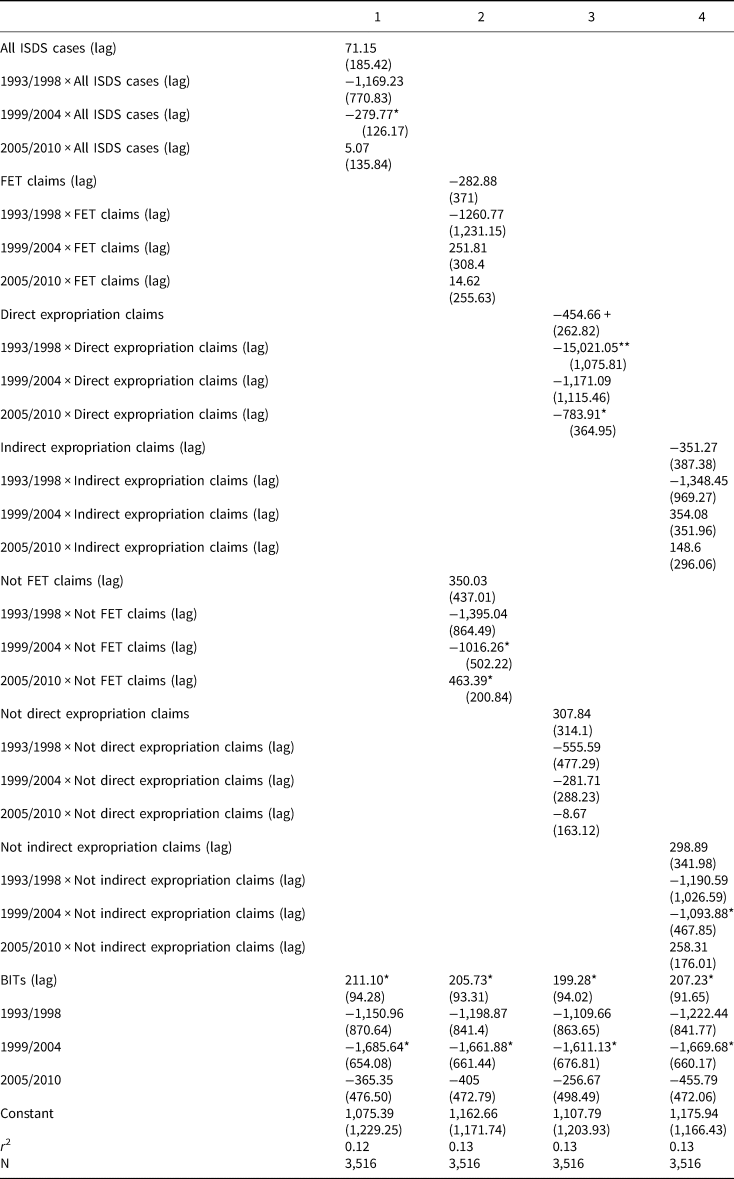
These results qualify existing views about the financial consequences of ISDS challenges. Negative effects are only observable for the claims of ‘sovereign theft’ that used to represent a greater proportion of the caseload in the past. By comparison, legal challenges of regulation that have grown in frequency over the last decade appear to have no significant effect. A primary reason for the lack of observed effect in our sample thus appears to be the inclusion of more recent data. To get a better sense of how the relationship described in Table 1 has evolved over time, Table 2 replicates Models 1 and 4 from Table 1,Footnote 25 but interacts our indicators of ISDS cases with period dummies. Since this setup requires that all periods have some ISDS activity to be included in the sample, we use evenly spaced periods between 1993–1998, 1999–2004, 2005–2010 and 2011–2016. The regressions in Table 2 use the most recent period, 2011–2016, as the reference category. Therefore the constituent term for the number of claims represents those effects in the most recent period, and a negative interaction term would represent the extent to which ISDS depressed FDI flows to a greater degree in earlier time periods. Model 1 in Table 2 shows our period-specific findings with respect to ISDS cases overall. Models 2, 3 and 4 show findings with respect to FET claims, direct expropriation claims and indirect expropriation other than FET claims, respectively.
Effect of ISDS cases on subsequent FDI flows in non-OECD countries across, multiple time periods

Note: all models estimated with country and year fixed effects and clustered robust standard errors. + 0.10 * 0.05 ** 0.01
The interaction terms suggest that ISDS’ effects were, in fact, larger in earlier periods. The results are best seen in the conditional coefficient plots in Figure 1. The figure shows the conditional coefficient for each type of claim, evaluated at each time period. The four panels correspond to the results of Models 1–4.
Effect of ISDS cases on FDI flows by claim type and time period. Circles represent the point estimates and the lines represent a 95% Confidence interval.

The results for Model 1, which includes all ISDS cases regardless of the legal claim made, show that earlier periods experienced a negative impact on FDI flows, while more recent periods saw no such effect. While the estimates from earlier periods are statistically insignificant at conventional levels (t-statistics in the first and second periods are −1.49 and −1.34, respectively), even that suggestive evidence vanishes as time passes. Point estimates for FET claims and indirect expropriation claims are most negative in the earliest period, but statistically insignificant throughout. Direct expropriation claims, however, were associated with a large and statistically significant drop in FDI in the earliest period, and with progressively smaller and less precisely estimated effects over time – though even in the most recent period, these negative effects remain significant at the 0.1 level.Footnote 26
In sum, the evidence suggests that not all ISDS cases are alike, from the standpoint of investors. Cases involving claims of direct expropriation depress FDI flows, but there is little evidence that any other type of ISDS challenge has a comparable effect. The signal sent by ISDS challenges also varies over time, even when looking within claim type. Even estimates of the impact of direct expropriation claims on capital flows are smaller and less certain today than they were in the past.
Why the shift over time? ISDS’ declining financial impact could stem from the increasing volume of cases. There were, on average, 16.6 outstanding claims of direct expropriation among the non-OECD countries in our sample between 2010 and 2016, and only 3.8 such claims between 1998 and 2003. Each case's marginal impact may thus be lower in the more recent period. It is also possible that investors' incentives to file cases have shifted; the average case may thus represent a less clear instance of state malfeasance. We leave a more definitive statement about the drivers of this reduction in ISDS’ efficacy over time to future work, but note that what was true about ISDS’ signaling capacities in the 1990s and early 2000s, which is roughly the period captured by Allee and Peinhardt, no longer holds.
Next, we examine how the results above are affected by including OECD countries in the sample. We re-estimate our models from Table 1 (for brevity, we only report models that include control variables) using a sample that includes OECD and non-OECD countries (Models 1–4) and again using an OECD-only sample (Models 5–8). Table 3 reports these results.
Effect of ISDS cases on subsequent FDI flows, 1985–2016

Note: all models estimated with country and year fixed effects and clustered robust standard errors. + 0.10 * 0.05 ** 0.01
Cases involving claims of direct expropriation correlate with subsequently reduced FDI flows in both the full sample and the OECD-only sample, though the estimates are less precise than in the analogous models for the non-OECD sample (Table 1, Model 7), and are only statistically significant at the 0.1 level. Moreover, the results pertaining to the OECD-only sample (Model 7) should be qualified by the rarity of direct expropriation claims for OECD countries: the statistical significance of that estimate appears to be driven by Turkey, which faced claims of direct expropriation in 2006 (Libananco vs. Turkey) and again in 2011 (Tulip Real Estate vs. Turkey).Footnote 27 By contrast, looking at FET and indirect expropriations claims, which are more often brought against OECD defendants, there is no evidence in these models that these ISDS challenges have any effect on FDI flows. In fact, there is even some counter-intuitive evidence that claims of indirect expropriation lead to more FDI in OECD countries. Finally, given the lack of evidence in Models 5–8 that OECD countries gain capital imports by ratifying BITs,Footnote 28 the findings also suggest that the recent move away from BITs in reaction to these cases should do little to harm investment flows.
Extensions
Table 4 considers two sets of theoretical extensions. Models 1–4 ask whether it matters whether the claim is awarded in favor of investors or the government. We have argued that claims of direct expropriation act as a proxy for the unobservable merits of the case and its implications for a broader swath of investors. It is possible, however, that MNCs have additional insight into whether a tribunal will back an investor's specific claims and that it is this insight, not the claim type, that guides their updating. To ensure this is not biasing our results, we included a measure of pending cases that were ultimately awarded in favor of investors. We find no evidence that such successful cases have an additional negative effect on investment. We also find no evidence (in Model 3 of Table 4) that including a count of ultimately successful cases in our regressions impacts the estimated relationship between direct claims and FDI flows, which remains negative, statistically significant and of similar magnitude to what we estimated in previously reported models.
Effect of ISDS cases on subsequent FDI flows, 1985–2016, extensions

Note: all models estimated with country and year fixed effects and clustered robust standard errors. + 0.10 * 0.05 ** 0.01
Models 5–8 in Table 4 examine the role of transparency in the occurrence of cases. Though this is changing, many ISDS cases are never made public. To proxy for transparency, we limited our measure of ISDS cases to those that are adjudicated through ICSID, which requires significantly greater transparency than other arbitration rules (Hafner-Burton, Puig and Victor Reference Hafner-Burton, Puig and Victor2017). In our sample, 64 per cent of ISDS cases, and 68 per cent of those alleging direct expropriation, fall under ICSID rules or ICSID's Additional Facility. We expect our findings to hold in this sample; indeed, the effect size may actually be larger. That is indeed what we find. As shown in Model 7, investors react negatively to ICSID cases alleging direct expropriation, and the estimated effect size is nearly double that of the full sample, and more precisely estimated. As expected, our theory, which relies on investors' awareness of disputes, finds most support for those cases that investors would be most likely to be aware of.
Results Using CAPEX Data
Our second set of models uses capital expenditure data from the BEA, and thus relies on a US-only sample. As we explained above, we believe CAPEX data better approximates MNCs' risk acceptance, and the dyadic setup of the data allows us to focus on American firms' reactions to claims made by co-national firms. The cost of that added precision is the narrower focus on American MNCs.
Table 5 shows the first of these models, which replicate Models 1–8 in Table 1, but with the CAPEX dependent variable.Footnote 29 Models 1–4 exclude controls (other than the number of BITs); Models 5–8 include them. The sample used in Table 5 is limited to the period between 1987 and 2006, which, based on the results noted in Table 2, should produce relatively large estimates of ISDS’ effects on MNC investments. As before, we begin with a sample of non-OECD countries.
Effect of ISDS cases on subsequent CAPEX by American MNC flows in non-OECD countries, 1987–2006

Note: all models estimated with country and year fixed effects and clustered robust standard errors. + 0.10 * 0.05 ** 0.01
The results of these models are consistent with those described above. ISDS cases brought during this period that include a claim of direct expropriation are associated with a slowdown in fixed capital investments by American MNCs. Other claims show no comparable effect. Looking at all types of legal claims, the average ISDS case shows no effect on investment. The primary difference between these and prior estimates is that the evidence linking claims of direct expropriation to MNC behavior is more precise, and statistically significant at the 0.01 level. There is some indication in Models 3 and 7 that ISDS cases with claims other than direct expropriation have actually increased investments in fixed capital, but these results run counter to expectations, and are hard to reconcile with the lack of evidence for FET cases (Models 2 and 6) or non-FET-based claims of indirect expropriation (Models 4 and 8) having a similar effect. Lacking a plausible post hoc explanation, we assume this association is spurious.
Table 6 replicates Table 5 but includes measures of ISDS cases for which the claimant is an American firm or individual. Those cases may be especially relevant to American firms' investment behaviors (Wellhausen Reference Wellhausen2015). The results suggest just that.
Effect of ISDS cases on subsequent CAPEX by American MNC flows in non-OECD countries, 1987–2006

Note: all models estimated with country and year fixed effects and clustered robust standard errors. + 0.10 * 0.05 ** 0.01
Model 3 shows that American firms react to direct expropriation claims made by their co-nationals by reducing their capital expenditures, and this effect is statistically significant. Model 6, which replicates Model 3 but introduces a measure of direct expropriation claims brought by non-US investors, suggests no evidence that such claims have any additional impact. Unlike prior regressions, Model 2 suggests that FET claims made by US firms dissuade subsequent investment in fixed capital, though the estimated effects are much smaller (1/18 the size, comparing coefficients in Models 2 and 3) and are only marginally statistically significant once a measure of FET claims from countries other than the United States is included in the regression (Model 5). Overall, our estimates suggest that American firms are substantially more attuned to signals sent by other American firms, which suggests that information flows may be denser within national networks.
Tables 7 and 8 replicate Tables 5 and 6 but use the more recent BEA data covering the years 2009–2015. As with the corollary regression noted in Table 2, we find no evidence in these regressions of a relationship between ISDS cases and investment patterns during this time; the coefficients fall short of statistical significance. Whatever led American investors to alter their behavior following ISDS cases in prior periods is no longer observable in these estimates. The lack of a reputational effect may be explained in a number of ways, but its replication using the CAPEX data suggests that measurement error in the FDI flow data owing to MNCs' increasing use of offshore tax havens is not one of them.
Effect of ISDS cases on subsequent CAPEX by American MNCs in non-OECD countries, 2007–2015

Note: all models estimated with country and year fixed effects and clustered robust standard errors. + 0.10 * 0.05 ** 0.01
Effect of ISDS cases on subsequent CAPEX by American MNCs in non-OECD countries, 2007–2015

Note: all models estimated with country and year fixed effects and clustered robust standard errors. + 0.10 * 0.05 ** 0.01
Conclusion
The political science literature places considerable weight on how international institutions provide information about state behavior, both to their respective domestic audiences and to other states. Scholars alternatively argue that countries can credibly signal their ‘good’ type by joining international institutions, or that institutions can provide information about countries' ‘bad’ type by defining and publicizing their failures to live up to their commitments (Allee and Peinhardt Reference Allee and Peinhardt2011; Schwartz and Sykes Reference Schwartz and Sykes2002; Sharman Reference Sharman2009; Simmons and Danner Reference Simmons and Danner2010; von Borzyskowski and Vabulas Reference von Borzyskowski and Vabulas2017). International institutions have long been presented as a solution to an information-extraction problem: audiences are unable to reliably observe state behavior in agricultural trade policy, the treatment of foreign mining companies or the handling of prisoners, but they do observe the signal sent by institutions once a specific commitment in any of these issue areas is flouted (Mansfield, Milner and Rosendorff Reference Mansfield, Milner and Rosendorff2002). In this telling, the announcement of a claim of violation should lead audiences to update their beliefs.
Yet we also know that institutions evolve over time. Their membership changes, new actors emerge to exploit the opportunities provided by the institution's existence, and as a result, the meaning of the signals institutions send about state behavior change as well (Gray Reference Gray2018). Combined with a growing understanding of the strengths and limitations of the data that prior studies rely on, such change suggests the need for testing and retesting our prior beliefs. Our examination of the effect of institutions, in turn, can inform our understanding of what their actual function has become.
In this article, we take a second look at the foregone conclusion about the effect of investor–state disputes on FDI flows. Being sued in an international tribunal has long been thought to send a negative signal to the investment community, resulting in decreased FDI inflows. For many years, the empirical record supported that belief, and governments behaved accordingly: they signed innumerable investment treaties, but when these attracted too much litigation, they were quick to backtrack. Since the initial empirical findings that generated these beliefs, however, the total volume of ISDS litigation has more than tripled, and the nature of the legal claims has changed – as has the financial context in which those events take place. Among other effects, this has led to a decline in the success rate of the modal claim. We take those shifts in the nature of ISDS cases as a reason to verify whether widespread beliefs about the reputational impact of ISDS cases are still current.
Specifically, we posit that claims of FET violations and indirect expropriation reveal less about state ‘type’ than do claims of direct expropriation, and that the effects on FDI of these disputes should reflect this difference. That is just what we find: while direct expropriation claims continue to be associated with declines in investment, the more frequent claims over FET and indirect expropriation do not. We also find that as ISDS litigation expands, even the effects of direct expropriation cases on investment have dropped, with little observable effect after 2010, using either of our two data sources.
One of the most heated ongoing debates in global governance is whether countries should be committing to BITs at all. Indeed, while some countries continue to enter into BITs, developed countries are now more likely to renounce them, or to limit the scope of ISDS clauses within those agreements if they do sign them (de Mestral Reference De Mestral2017). Is this recent skepticism of BITs warranted? Governments making credible commitments is a favorite selling point in the scholarship on international agreements, but in this case, the cost that would render these commitments credible appears to be lacking for the largest subset of claims. This is not to say that other justifications for BITs do not continue to apply. Pauwelyn (Reference Pauwelyn2014) describes how investor–state arbitration was originally designed to avoid having commercial disputes spill into geopolitical conflicts (though Gertz (Reference Gertz2018) questions this for the more recent period). And after all, a number of investment agreements do not even include ISDS provisions. But the case for justifying BITs through their capacity to discipline states through ISDS appears to be weaker than previously thought.
In sum, as the investment regime has evolved, so too have its effects on investor behavior. This matters insofar as it calls into question the presumed function of the investment regime as providing information about governments' ‘type’. Countries facing ISDS challenges to regulatory moves may fear the legal costs of fighting off these claims, but the evidence suggests that they need not fear their reputational effects.
Acknowledgements
We thank Julia Gray, Todd Allee, Clint Peinhardt, the participants of the 2018 Southern Political Science Association Annual Meeting, and the two anonymous referees for most helpful comments. Sean Nossek provided excellent research assistance. All remaining errors are our own.
Data availability statement
Data replication files are available in Harvard Dataverse at: https://doi.org/10.7910/DVN/DHL5UR