Louis Bieral was a politician, gambler, pimp, and gangster who was also a celebrated sportsman, boxer, driver, and Civil War officer, memorialized in poems and popular histories. Born amid the Chilean revolutions of the 1810s, he was kidnapped by a whaling captain and brought to New York City. In his youth, during the 1830s, he fought pirates with the US Navy off the coast of China. In 1850, he sought his fortune in the California Gold Rush. Though Bieral may have himself possessed African ancestors, he helped render Black fugitive Anthony Burns to slavery in 1854. He befriended infamous rowdies such as “Butcher” Bill Poole, John “Old Smoke” Morrissey, and “Captain” Isaiah Rynders. He assaulted famous men such as abolitionist Richard Henry Dana, Jr. He served as a bodyguard for William “Boss” Tweed, the most notorious machine politician of the nineteenth century. Bieral was a person of interest in the “Crime of the Century,” the murder of financier Jim Fisk. In his dotage, in 1886, he attempted to assassinate the surveyor of the Port of New York. And he continued making news until his death in 1900.
His is the story of an illustrious bully, with all the contradictions that implies. The central theme of his life was violence, both in war and in peace. And yet, until his old age, he never suffered official punishment for his acts. Though reformers detested him, and his peers feared him, many others viewed him with awe and even gratitude. In part this was because his courage, strength, and skill with gun and knife became useful during the US Civil War. But this reverence also shows that many nineteenth-century Americans celebrated brutality. In a society governed through mundane corporal punishments, a talent for bullying was valued.
Historians usually prefer more sympathetic protagonists. They write about activists who risked their lives to battle injustice, or ordinary people who struggled to resist their own subjugation.1 When scholars do write biographies of villains, they usually choose legendary ones, such as perfidious founder Aaron Burr, grotesque Southern politician James Henry Hammond, or virulent South Carolina bigot Ben Tillman.2 Louis Bieral worked on a smaller canvas. Few of his writings remain. Despite a long political career, he held no high office. A constant competitor at the nation’s racetracks and boxing rings, he never owned a famous horse or won a championship title. And though Louis committed countless assaults, he may not have murdered anyone. In his life, he was celebrated in poems for his heroism during an early Civil War battle, but his bravery has long since been forgotten.
Perhaps the best comparison are biographies of criminals, such as prostitute Helen Jewett and pickpocket George Appo. These characters broke the law, but mostly to sustain themselves under difficult circumstances, including violence, bigotry, orphanhood, and addiction. Louis Bieral certainly faced similar obstacles, but his response was far more pugnacious. He turned himself into something fearsome. He made himself a brute, useful both to oppressors and to those fighting for freedom. And as such, he generates less sympathy than awe or disgust.3
Yet Bieral’s personal story was extraordinary. He was involved in a series of legendary events, stretching from ships on the Atlantic and Pacific oceans to the gold fields of California to the streets of Boston and New York City to the racetracks and boxing rings all over the nation. His participation in these diverse episodes seemed impossible even to his contemporaries, and yet they constituted a mere fraction of the incidents that dot his biography. Bieral knew many of the most important politicians of the nineteenth century personally, including Abraham Lincoln, William M. Tweed, William Seward, Benjamin Butler, Fernando Wood, Daniel Sickles, Thurlow Weed, and Edward D. Baker.
The evidence of his significance is in the thousands of newspaper articles that form the backbone of this biography. The digitization of historical evidence has opened up a new world for social historians, enabling them to learn more about individual lives and behaviors once thought uncommon. But while ordinary denizens of the nineteenth century might have appeared in the news just a few times, and local politicians fewer than a hundred, Louis Bieral was featured in the press repeatedly for sixty years. Though his violence inspired surprisingly little opprobrium, it did attract substantial attention, making him much more famous (or notorious) in his time than historical figures better known today.4
Bieral’s life also uncovers several significant aspects of American history. An immigrant from the new republic of Chile, his experience illustrates how a tan-skinned Hispanic man navigated a society where citizenship itself depended upon one’s whiteness. Observers tried to place Louis, some calling him “Spanish Lewy,” others thinking him Italian, Portuguese, or French. Some perceived him to be a Black man, an assumption that may have been true. Bieral denied such claims, but he fraternized with Blacks and, later in life, married a woman of African descent.5
His career offers us a picture of organized crime prior to the twentieth century. Quite early in American history, rough men joined together to sell liquor, sex, and gambling to an eager public. But these bands were never as structured, principled, or tribal as depicted in works such as Herbert Asbury’s The Gangs of New York. Rather, urban vice was controlled by a shambolic set of bruisers, drawn from the city’s population of sailors, blacksmiths, butchers, apprentices, and laborers. These men were gathered into legitimate associations, such as fire companies and militias, which performed public functions but also offered them a structure for socializing and advancement. Unlike modern crime families, which exist to earn money from illegal activities, these groups focused on winning elections and then used public office to protect their clubs, casinos, saloons, and brothels.6
Bieral’s ability to avoid prison demonstrates his era’s tolerance for and even celebration of everyday violence. Nostalgia predisposes us to believe that people today are somehow worse than people in the past. We are also distracted by homicide rates, which rose dramatically in the twentieth century due to gang warfare and the easy availability of mass-produced handguns and ammunition. But nonlethal forms of violence, such as punching, kicking, clubbing, and whipping, were more common in the nineteenth century than they are today. This should be no surprise, as before the Civil War the leaders of the nation were enslavers, military officers, duelists, and patriarchs. Conversely, most Americans belonged to populations lawfully subject to various forms of corporal punishment: slaves, servants, apprentices, sailors, children, and wives. The frequency and severity of such abuse varied, but the average nineteenth-century person did not share our attitude toward physical coercion. Nor did they see violence as the sole prerogative of the police or military. Pain was a routine tool for controlling subordinate populations.
Even among free men, nonlethal violence was common in the urban North. In 1858, when New York City had approximately 800,000 residents, the Metropolitan Police arrested over 9,000 people each year for assault and battery or fighting in the street. By comparison, in 2017, the NYPD arrested approximately 15,600 people for assault in a city of 8.6 million. In other words, the number of assaults resulting in some sort of legal action was six times greater in the 1850s than it is today.7
Lest one think that these numbers reflected tighter policing of assault, one need only look at how lightly the courts punished batterers. Even when the perpetrator used a deadly weapon, nineteenth-century judges sentenced them to fines or very short stints in jail. In April 1856, one Brooklyn judge sentenced a burglar to three years. In the same session, three men were convicted of separate assaults, one of them with a knife and the other with an axe. One received a $20 fine (or thirty days in prison), a second got thirty days, and a third was handed a sentence of $25 or twenty days. Murder and rape were considered capital crimes, resulting in execution or long prison sentences, but intentionally injuring another person seldom resulted in any serious punishment unless they died.8
The penitentiaries generally held robbers, burglars, and horse thieves, not assailants. In 1832, only five out of fifty-seven prisoners admitted to Connecticut’s Newgate Prison were there for felonious assault. In the same year, only thirteen out of 192 convicts entering New York State’s Auburn Prison entered for any nonlethal assault, including rape. The number was two of eighty-nine for Charlestown State Prison in what is now Boston. The numbers barely grew in the ensuing decades. For instance, in 1851, out of 169 convicts admitted to Charlestown, fewer were there for simple assaults (two) than for forgery (four) or adultery (three).9
America celebrated men capable of physically mastering their rivals. At its best, this veneration of force rewarded men who protected their families, friends, and countrymen. The revolutionary republican idea of independence assumed the patriarch’s ability to defend his home. But people defined the right to self-defense far more broadly than we do today. They assumed that behaviors ranging from adultery to mere insult justified violent retaliation. And for many, aggressiveness and intimidation, in and of themselves, were masculine virtues. Men found it easy to justify attacks on anyone who threatened their reputation or interests.
Though scholars of slavery certainly appreciate the role of private violence in maintaining the Southern social order, few historians discuss how bullying organized life among lawfully free people in the North. Having the legal right to speak, work, pray, or travel did not guarantee the ability to do these things in fact. People held their tongues, knowing that uttering certain words could result in a duel, an assault, or a riot. Mobs attacked abolitionists and sexual reformers. Servants feared their masters, children their parents, and wives their husbands. Neighborhoods formally open to all were informally forbidden to some. Most critically, few cities had even the most basic forms of law enforcement until the 1840s. As a result, most disputes were settled privately, with victory being awarded to the stronger party.10
This helps explain why antebellum Northerners tolerated and even defended slavery in the South long after their own states had ended bondage. As many have noted, racism made it impossible for most whites to imagine Blacks becoming free and fully enfranchised US citizens. But Bieral’s immunity to punishment suggests another answer: The sections of the United States shared a common acceptance of nonlethal violence on the body. In a patriarchal society run by bullies, slavery was merely the most vicious form of lawful brutality. Viewing corporal punishment as mundane, too many Northerners yawned at whippings that horrify us today. Tracts depicting the torture of enslaved Blacks turned some Northerners into abolitionists but titillated others aroused by pain and violence.11
This continuing respect for brawlers, rowdies, and bullies colors the society portrayed by French philosopher Michel Foucault. His book Discipline and Punish documented how reformers such as Benjamin Rush, John Howard, and Jeremy Bentham pushed for the transformation of criminal punishments, shifting away from those focusing on the body, such as whipping, to those seeking to shape the mind, such as incarceration. But Foucault both exaggerated the success of such initiatives and understated the scope of the activists’ agendas. This research demonstrates that reformers were just as concerned with forms of private brutality, such as slavery; the flogging of sailors; cruelty to children, wives, and animals; and mobbing. Their attempts to replace violence with consensual agreements proved even more difficult than their efforts to transform criminal justice.12
The remarkable toleration of bullying constituted a major problem for democracy in the United States. Electoral violence may have been un-American in principle, but it was hardly unusual in practice. The republic began with a revolution, and militias remained a major force in American politics for a century thereafter. Throughout the 1800s, men like Louis Bieral terrorized rival partisans in cities such as New York and Boston. Politicians fought duels. Caucuses, meetings, and conventions turned into brawls. Assassins murdered presidents. People’s thirst for victory (and capacity for rationalization) overcame the principle of free and peaceful elections. Electoral violence certainly grew worse as the nation edged toward an apocalyptic war over slavery in 1861, but brawls, duels, riots, and assaults were common in the North and South, East and West, as early as the 1820s, when universal white male suffrage opened politics to heated competition. These battles hinged on issues besides slavery, including religion, banking policy, tariffs, and regional pride.13
What made the North distinct from the South was the strength of its movements to reduce the brutality of politics, work, and the home. Beginning in the seventeenth century, members of the Society of Friends (i.e., the Quakers) began criticizing war, slavery, and hierarchy more broadly. Witnessing the mass death of the French Revolution, Americans began proposing peaceful reform as an alternative to radicalism. Evangelical Protestants began envisioning a society ruled by love and morality. These groups joined with Black abolitionists to call for the immediate emancipation of enslaved people. Judges sought to turn the hierarchical relationship of master and servant into the system of wage labor, under which workers consented to legally enforceable contracts. Women petitioned for marriage to become an equal agreement between two independent persons rather than a form of subordination. These groups saw the rough politics of the city as both immoral and impeding their goals.14
Though these activists struggled to disarm American politics, their principled opposition to violence proved a short-term liability. In the North, Democrats like Bieral mobbed their lectures, disrupted their meetings, and terrorized their voters. In the South, slaveholders abandoned civil discourse itself, suppressing newspapers and lynching editors. Northern reformers felt superior when South Carolina Congressman Preston Brooks caned anti-slavery Massachusetts Senator Charles Sumner in 1856, but the Yankee statesman’s wounds took over two years to heal. By 1859, Southerners had exploited the reformers’ nonviolence so fully that abolitionists abandoned pacifism and looked longingly to avengers such as John Brown. In 1860, Republicans recruited men for their own political defense force, the Wide Awakes, to physically protect their voters from Democratic rowdies.15
Once the Civil War had started, and the possibility of a peaceable politics had evaporated, anti-slavery officials ironically recruited men like Louis Bieral to fight against the Confederacy. And after Appomattox, Republicans such as President Ulysses S. Grant co-opted them to defeat those who wanted to end the Reconstruction experiment in interracial democracy. Though reformers chafed at Bieral’s continued employment in the customhouse, Republican candidates for office preferred he stay where he was. When advocates of a professional civil service finally forced Louis out of government in 1886, his dramatic response illustrated that the heroes of the war would not peacefully relinquish their power.
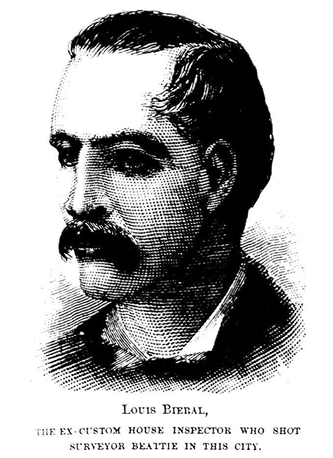
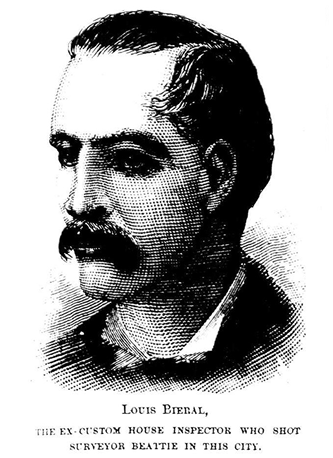
In his time, Bieral’s ruthless courage made him a popular figure. Strangers sent his wife money when he was in prison, as well as after his death. In part, people simply respected him for his Civil War heroism. But this was not the whole story. Newspapers related his biography in awestruck tones. They revered him because he represented an archetype of masculine violence that they believed was disappearing. They boggled at the duration of his career, as well as his remarkable presence at so many key moments in the nation’s history. Even those who hated him saw him as something superhuman, akin to a demon or a prince of the underworld (Figure 0.1).
Louis Bieral in 1886.
Louis’s trajectory from the docks of Valparaíso to the splendid dining rooms of Delmonico’s, then to prison, poverty, and death, made him a familiar sort of antihero. Americans have long enjoyed the stories of fictional characters, such as Tony Montana, Vito Corleone, and Youngblood Priest, who resist the established power structure while providing audiences with a fantasy of freedom from ethics, rules, and inhibitions. In the real world, as well, Americans celebrated gunmen such as Lee “Stagolee” Shelton, Jesse James, and Bonnie Parker for defying an oppressive society, even though their actions often worsened conditions for ordinary people. The public’s fascination with violent resistance overwhelmed their belief in its illegitimacy.16
For nearly a century, readers have eagerly consumed Herbert Asbury’s The Gangs of New York, a heavily fictionalized history of New York City’s underworld. And hundreds of millions worldwide have seen Martin Scorsese’s film based on the book, making the “Dead Rabbits” and “Bowery B’hoys” well known. Asbury exaggerated and even fabricated some stories, but they were based upon some real events. To a shocking extent, the fate of the nation rested upon gangs of rowdies battling for control over politics, crime, and vice. This volume explores the life of a prominent figure in that world. The goal is to use Louis Bieral’s career to illuminate the dimly lit parts of nineteenth-century America.