1. INTRODUCTION
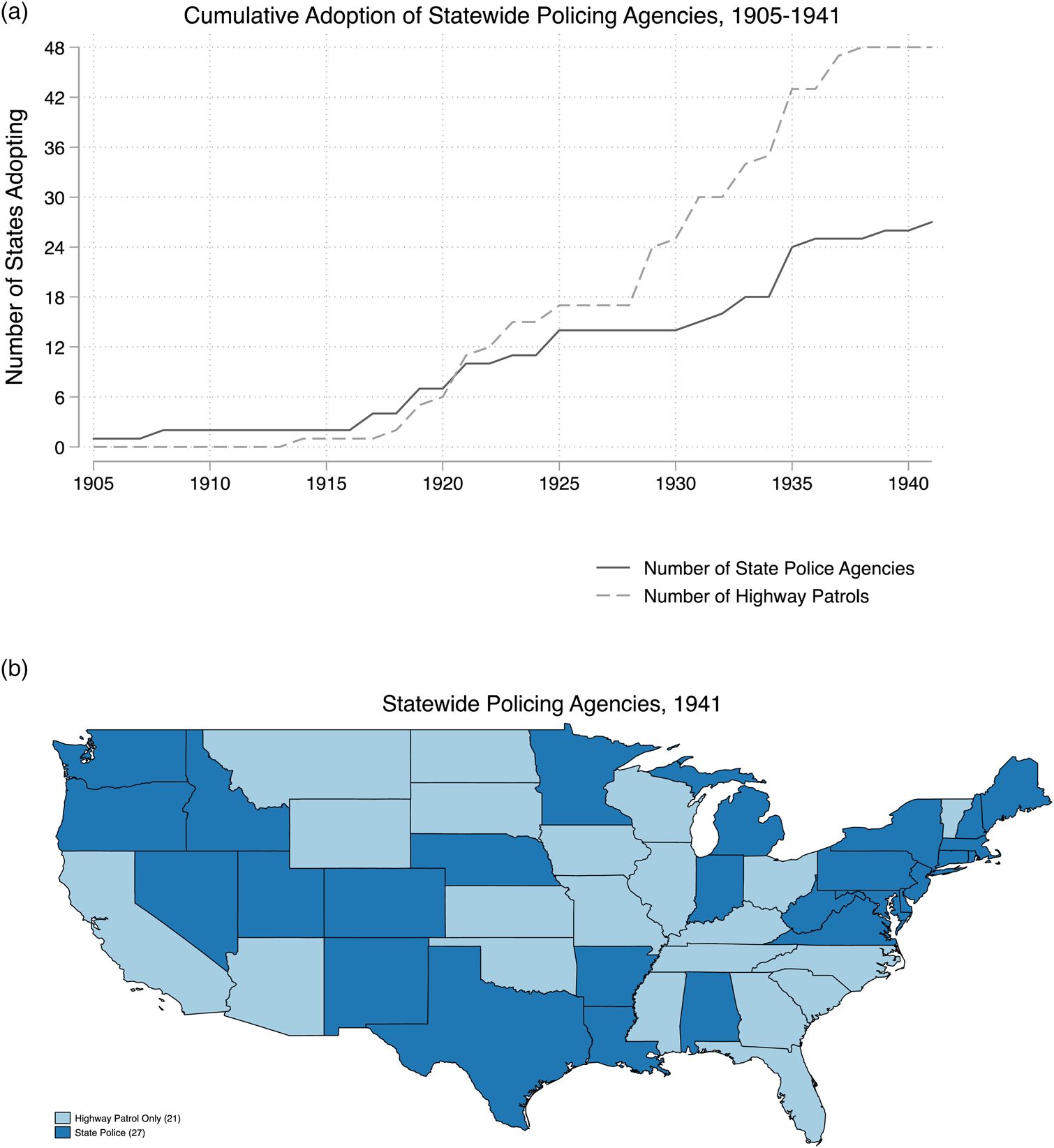
The early twentieth century saw a burst of innovation in American policing agencies. Between 1905 and 1941, all forty-eight states adopted at least one new type of statewide policing agency, either a state police force or a state highway patrol.Footnote 1 These new agencies supplemented the traditional local forms of law enforcement, such as municipal police forces and county sheriffs. Yet not all of these agencies were created equally. Some, like the Pennsylvania State Police, were intended from their beginning to have full police powers. Others, like the Florida Highway Patrol, were originally limited to enforcing state laws regarding traffic and safety on the roads. Each form was adopted at different rates. By 1941, only twenty-seven states had adopted state police forces, but state highway patrols had become universal. Even though these decisions were made long ago, a division persists between states that adopted full-service agencies and those that created agencies that focus (or still exclusively operate) on highways. Investigating why this split developed sheds light on the processes affecting how American states came to exercise their police power, a fundamental part of state sovereignty. Why did states end up differing so much on this issue?
Over the succeeding decades, statewide policing agencies have become familiar, unexceptional, even dull through their ubiquity on the roads. Today, they rarely attract scholarly interest. Yet the advent of these agencies once attracted substantial controversy. Pitched battles were fought over whether they were necessary and how they would be used. Reformers saw the new agencies as bringing needed professionalization to policing, arguing that they constituted a progressive response to new forms of criminality and the new social landscape created by the automobile. Their bureaucratization and removal from local politics augured a more sweeping reform of the tangled jurisdictions of constables, sheriffs, and municipal forces that had accumulated by the early twentieth century. Opponents viewed the advent of the new agencies as tools for repressing labor unions, a publicly funded substitute for the private security forces, like the Pinkertons, which were long used to break strikes and regulate workers. Others conjectured that regions like the South were slower to adopt the new agencies because they posed too great a threat to local social hierarchies, especially racial ones.
Why did statewide policing agencies emerge, and why did the adoption of state police forces eventually peter out while state highway patrols became universal? These questions touch on core themes in political science, especially the exercise of governments’ monopoly on the legitimate use of force and why some governments adopt some policy innovations but not others. Recent work investigating the carceral state has placed related questions about policies generating mass incarceration at the core of American political development.Footnote 2 Yet political scientists have rarely investigated the evolution of statewide policing agencies themselves. Indeed, for decades, standard diffusion data sets have lumped “state police” and “highway patrol” agencies together in a single category, despite the marked differences between them. Historians and criminologists have done little better in addressing these questions.Footnote 3 Existing scholarship is mostly confined to accounts of individual forces’ development or generalizations about state police forces’ character and superiority to local law enforcement in terms of professionalism and lack of susceptibility to politicization. Although more recent studies have improved on prior generations’ work, no study has yet employed a theoretically informed perspective or research design to assess the explanatory power of competing hypotheses.Footnote 4
In this article, I employ quantitative evidence, supplemented by narrative history, to provide a comprehensive test of rival explanations for why statewide policing agencies diffused.Footnote 5 My findings suggest, first, that the adoption of state police forces and state highway patrols resulted from different mechanisms. State police forces appear to have diffused regionally, while state highway patrol adoption shows no clear spatial pattern. Second, I confirm the conjecture of labor historians and show that the reformers’ hopeful story was wrong. States’ decisions to adopt state police forces were driven far more by contests between labor and capital than by a technocratic desire to better regulate crime or traffic. Capital supported, and labor opposed, state police forces because they changed the bargaining dynamics of industrial disputes, lowering the cost of state intervention and making it easier to disrupt strikes. The adoption of state highway patrols, by contrast, broadly followed a process driven more by technocratic logics.
These findings matter for students of American political development, politics and criminal justice, and diffusion processes. They add to evidence about how different mechanisms can be triggered even when the policy innovations under study are superficially similar. In the case of statewide policing agencies’ diffusion, the degree to which an innovation was perceived as having the potential to transform state-society relations triggered different mechanisms of political contestation. Moreover, by restoring the conflict between capital and labor to the story of policing's development, this article offers an additional dimension to the expansion and maintenance of policing, which has understandably focused on how race affected the development of legal and administrative structures related to the carceral state. Finally, demonstrating how such differences emerged and affected policy outcomes may inform us about the likelihood that reforms will succeed in today's U.S. policing structures.
2. ESTABLISHING THE PUZZLE
At the beginning of the twentieth century, no state had a statewide policing agency in a sense that we would recognize today. By the beginning of the Second World War, all U.S. states had at least a highway patrol, and many had adopted a full-fledged state police force. Figure 1 summarizes the adoption of each type of agency before 1941. Figure 1a establishes that even though highway patrols were created later than state police forces, they were adopted far more widely and rapidly than the earlier institution. Figure 1b establishes that there was a strong regional flavor to adoption, with the Deep South being much less likely to adopt, the Northeast and New England more likely to adopt, and the Midwest and other regions split.
Adoption of State Police Forces and State Highway Patrols.

Why did states vary in the timing and content of their adoption of statewide policing agencies? This puzzle matters for scholars working in several related areas. The development of statewide policing forces occupies an unusual niche in the study of American political development, as most law enforcement is carried out by tens of thousands of state and local police agencies, from big-city forces like the New York City Police Department to rural sheriffs’ departments. Those factors continue to matter even today, when community-by-community police practices may vary with factors like the attitudes of elected local officials and the training and recruitment of officers.Footnote 6 A century ago, advocates of the state police movement aimed to rationalize this complex structure, eventually displacing or subsuming local agencies as part of a program of professionalizing police work to smooth out such rough edges. Today, however, statewide policing agencies occupy a more nebulous space within American policing, remaining layered atop the thousands of primary policing agencies at the local level.
Studying why states diverged in their treatment of policing offers a way for students of state politics and American political development to reintegrate a core function of the Weberian state—the exercise of the legitimate monopoly on violence—into the study of U.S. politics. In some states, institutional drift and layering has effaced what was once a stark distinction between state police forces and state highway patrols, but the division still lingers: The California Highway Patrol, the country's largest statewide policing agency, is still principally an agency that regulates traffic violations, while the New York State Police, the country's second largest, has a much wider jurisdiction.Footnote 7 The similarity of these goals to these agencies’ founding mandates suggests that founding moments decades ago continue to influence contemporary practices.Footnote 8 Establishing how and why these states diverged in their approach to exercising police power reveals perspectives on how similar units might nevertheless vary in their outcomes.
Finally, these developments represent a chance to apply diffusion theory to a substantive area and to an era in which it has rarely been used. In part because of the lack of data (discussed below), few diffusion studies look at the earliest parts of the twentieth century, and even fewer examine in detail the dynamics of policy diffusion in that era.Footnote 9 This means that diffusion scholars are not only missing the chance to apply their theories to an important part of American political development, but they may also be neglecting important contextual variations that affect how diffusion works in the United States. Conversely, students of American political development may benefit from applying theories of diffusion to better understand comparative U.S. political developments. This case offers a chance to remedy that empirical and theoretical error. Studying the different paths of these almost-parallel policy innovations, especially given that one of them stalled in its adoption trajectory, allows for a better appreciation and engagement with these factors.Footnote 10 As a bonus, such an approach also offers a more accurate evaluation of causal factors than the idiographic approaches carried out by those who have compiled histories of individual agencies.
3. THEORY
This article examines the emergence of the two major types of statewide policing agencies as instances of policy diffusion. Rogers defines diffusion as “the process in which an innovation is communicated through certain channels over time among the members of a social system,” as “a special type of communication in which the messages are about a new idea,” and “a kind of social change … by which alteration occurs in the structure and function of a social system.”Footnote 11 Karch refines “political innovation” in the context of diffusion as concepts or practices that may include governmental forms, institutions, or specific policies.Footnote 12 Diffusion may take place through different mechanisms: learning, emulation, adaptation, competition, imitation, coercion, and so on.Footnote 13 Many factors can affect the spread of a policy innovation: the capacity or willingness of actors to adopt new policies, policymakers’ engagement in social networks, elected officials’ incentives, the visibility of policy successes, attributes of policies, and so on.Footnote 14
I apply these concepts and insights from the policy diffusion literature to test existing conjectures about the factors that promoted or hindered the spread of statewide policing agencies. These fall into two principal categories. First, a reformist narrative holds that these agencies represented a technocratic fix to a public-policy problem, whether defined in terms of crime or public safety. Second, a labor-capital conflict narrative holds that the creation of statewide policing forces was driven by capitalists’ demands to regulate labor unions. These rival hypotheses point toward different hypotheses about which factors drove or slowed the diffusion of state policing agencies. The policy diffusion literature supplies the framework and tools within which the implications of these hypotheses can be compared.
3.1. Statewide Policing and the Reformist Narrative
In the early twentieth century, perhaps the most commonly promoted theory explaining the spread of statewide policing agencies took the form of a technocratic reformist narrative. This argument held that statewide policing agencies were a response to the weaknesses and inefficiencies of traditional and local law-enforcement agencies as they confronted a new set of criminal challenges. Such arguments aligned with the ambitions of reformers, whether they identified as progressives or merely as specialists in criminology and policing.
These arguments took different shapes for state police forces and for highway patrols. Many reformers ardently desired a unified statewide police force, responsible to the governor (or, even better, a nonpartisan official responsible to the governor, to even further insulate the force from politics). Barring that, a more limited but still ambitious set of proposals sought to supplant or buttress traditional law enforcement with a professionalized state police force. Bruce Smith, August Vollmer, and other leading criminologists argued zealously for using state police systems to eliminate allegedly outmoded local police forces.Footnote 15 Although such reformers’ observations could be withering about the state of municipal police forces, these reformers more often focused on the disadvantages of rural law enforcement compared to idealized, centralized state police forces. Raymond Moley wrote that “the office of the sheriff has slowly approximated a profitable but worthless sinecure … [that] has lived only because it is a rich prize for a powerful party system” and urged that the position be all but abolished in favor of state police agencies.Footnote 16 Such arguments blended with less scientific claims. Activists championed the state police's advantages to rural communities, occasionally even portraying the state police as upstanding “Anglo-Saxons” who could corral the immigrant-heavy workforces in mines and factories. In a typical statement in this vein, Katherine Mayo, a tireless advocate of the state police, approvingly recorded the words of the Pennsylvania State Police's first superintendent: “One State Policeman should be able to handle one hundred foreigners.”Footnote 17
State highway patrols originated a little later, in response to the specific administrative, legal, and social contexts of mass adoption of the automobile. The construction of myriad new roadways and highways for motor vehicles created a demand for traffic regulation.Footnote 18 Moreover, cars and trucks themselves represented pieces of real property to be taxed, regulated, and protected against theft. As automobile usage became more widespread, contemporary observers argued that the rapid and flexible transportation of the automobile confounded traditional law-enforcement jurisdictions and practices. Not only could criminals drive across jurisdictional boundaries to avoid apprehension, the advent of the automobile itself challenged (literal) horse-and-buggy concepts about how to enforce laws against grand theft, drunken driving, and speeding tickets.
Consequently, the etiology of highway patrol adoption differs from that of state police forces. Some state police forces added highway patrol functions; in other states, highway patrols were created as stand-alone agencies limited either administratively (by the deployment of resources to traffic enforcement) or by statute to enforcing the laws on roadways.Footnote 19 In either case, whereas state police forces were sold on the basis of their superior ability to deal with all crime, contemporaries viewed state highway patrols as a narrowly defined response to growing automobile ownership.Footnote 20
3.2. Statewide Policing and the Labor-Capital Conflict
The reformist narrative proves understandably attractive to official historians and chroniclers of individual state police force agencies, since it portrays those agencies as a value-neutral response to a pressing public-policy problem. Social historians and others, however, have long argued in favor of a rival hypothesis that the principal aim of these agencies was managing and preventing strikes by workers in mines and factories. Contemporaneous labor spokesmen deprecated state police officers as “Cossacks” who incited striking crowds to violence and arrested picketers without warrants.Footnote 21 Even without those problems, unions’ resistance to state police forces was entirely rational.Footnote 22 Calling on a standing force meant that a mayor or governor would no longer lose face by calling out the militia; moreover, policemen would likely be better at controlling strikes than soldiers or militiamen. Since violence formed part of unions’ repertoire to deter and to punish strikebreakers, the state's more effective exercise of its putative monopoly on the legitimate use of force gravely weakened strikes as a weapon.Footnote 23
This hypothesis has more than a little face validity because the earliest state police forces arose in areas that had either just suffered or were at high risk of experiencing labor unrest, such as the mining regions of Pennsylvania, West Virginia, and Nevada. Labor leaders were consistently rated by contemporaneous observers as among the most persistent and effective opponents of the state police movement. Many advocates of the state police system emphatically argued that replacing the militia or private police forces, like the Pinkertons, would be a valuable reform in itself because it would lead to more orderly and democratic resolution of strikes than forces accountable only to industrialists.Footnote 24 Before the 1902 anthracite strike in Pennsylvania, the use of government forces to mediate strikes (rather than simply allowing or directly supporting the interests of industrialists) was rare.Footnote 25 The establishment of the Pennsylvania State Police in 1905 directly derived from the abuses of the Coal & Iron Police (paid for by industry) and local law enforcement's inability to cope with that dispute. Theodore Roosevelt, who as president had helped mediate that strike, urged other states to adopt state police forces because of its paradoxical promise of restraining industrialists' violence: “the labor leader who attacks the Pennsylvania State Police because it enforces the law would, if successful in the long run, merely succeed in reëntrenching in power the lawless capitalists” who employed violent strikebreakers.Footnote 26 Even this endorsement, however, suggests that the state police might weaken the hand of unions in some ways.
The explanation points to a different set of predictions than the reformist narrative. The factors that would drive demand for a state's adopting the innovation of a state police force would no longer be crime rates but rather traits related to a state's concentration and types of industry (and workers). This differs from the technocratic narrative, in which labor and capital would not necessarily have conflicting interests because both could benefit from the provision of policing. In labor-capital conflict theory, clashes between labor and capital should be pitched and at the center of the battles within units and at the systemic level. We should therefore expect to see factors related to labor-capital disputes driving—or opposing—the establishment of state police forces.
4. HYPOTHESES
For the reformist theory, “pull” factors such as crime rates should generate demand for state police forces, summarized by the following hypotheses:
Crime-control hypothesis: Higher crime rates spur reform for more professional and effective police, leading to increased demand for state police forces.
Rural demand hypothesis:: The extent of a state's rural population leads to calls for centralizing police powers or implementing innovations that could disrupt traditional law-enforcement bodies.
Vehicle regulation hypothesis: Increasing numbers of motor vehicles leads to increased demand for statewide policing agencies, especially state highway patrols.
The labor-capital hypothesis, however, points to the key factors being not crime control but the management of labor relations. This is compatible with two different hypotheses:
Labor resistance hypothesis: States with more unionized (or potentially unionized) industries resist the creation of state police forces because of the influence of labor unions.
Capitalist police hypothesis: States with more unionized (or potentially unionized) industries promote the creation of state police forces because of the demand of employers and others.
These hypotheses deal with the outcome of interest—the adoption of a statewide policing agency—and not with the presence or absence of conflict. The labor resistance hypothesis would be best understood as one in which labor's fears about the possible use of statewide policing agencies succeeded in retarding the adoption of a reformist state police agency; by contrast, the capitalist police hypothesis points to an interpretation in which the reformist narrative was just window dressing for the real drivers of the state police movement and the interests of capital overcame other considerations. (This could emerge if, for instance, capital wanted to shift the burdens of paying for police onto the state, or if they found existing agencies insufficiently competent at the task.) The predictions from these two hypotheses are oppositely signed: If the relationship between share of mining and manufacturing workers and adoption of innovation is positively signed, that would falsify the labor resistance hypothesis; the reverse would falsify the capitalist police hypothesis.
5. DATA AND METHODOLOGY
To evaluate these hypotheses, I employ pooled logit analyses of agency adoption. I use the state-policy-year as the unit of analysis: A year in which a state adopts a given innovation is coded as a 1 and a year in which it does not is coded as a 0. Once states have adopted an innovation, they are removed from the risk pool. Thus, Pennsylvania enters and exits the risk pool for state police adoption in the same year, 1905, while California, which never adopted a state police force, remains in the state police risk pool for the duration of the data set.
5.1. Dependent Variables
My dependent variables measure the year a state adopted a statewide police agency (a state police force, a state highway patrol, or either). Although specialists in the history of American policing institutions have long distinguished between the two varieties of statewide policing agencies, there exists no universally accepted taxonomy or chronology of statewide policing agencies.Footnote 27 Standard political science data sets on policy adoption lump these two concepts together, apparently because of conceptual confusion (possibly because ordinary language lumps these distinct agencies together as “state police” or “state patrols”).Footnote 28 I operationalize this distinction throughout the period in my coding decisions. Writers generally concur that the first modern state police force was created by Pennsylvania in 1905.Footnote 29 There had been some statewide policing forces in the nineteenth century, but they represented distinct, often short-lived types compared to those that arose in the twentieth century.Footnote 30
State police adoption scores 1 if a state has adopted a state police force in that year and 0 otherwise; state highway patrol adoption scores 1 if a state adopts a state highway patrol in that year and 0 otherwise. Each state is coded as making two separate decisions: whether to adopt a state highway patrol and whether to adopt a state police force. Thus, one state could score 1 on state highway patrol and 0 on state police, while another could score 1 on state police and 0 on state highway patrol depending on when each function was established. Although today many states have combined these agencies (e.g., into a department of public safety), they were often established as stand-alone agencies. Pennsylvania's State Highway Patrol was part of the Department of Revenue when it was created in 1923, separate from the independent State Police.Footnote 31 When a state highway patrol was added to an existing state police force (e.g., as a separate troop or other subagency division), I use the establishment date of that patrol unit. In general, my coding follows Torres's reference work on state police and highway patrols, supplemented with additional sources such as scholarly articles, state historical societies’ references, and state government websites and publications to arrive at the best possible coding of each state's decisions.Footnote 32
My coding of adoption years differs, sometimes substantially, from standard policy diffusion data sets. In part, the errors are simply factual. Walker codes Pennsylvania as adopting a state police/patrol in 1937. That year, however, does not mark the establishment of either of the Keystone State's statewide policing agencies. Rather, in that year, two separate agencies were merged into the new Pennsylvania Motor Police (renamed the Pennsylvania State Police in 1943).Footnote 33 The larger problem is conceptual. To demonstrate the need for the distinction, I use a composite variable, statewide policing agency, which records whether a state has adopted any form of statewide policing agency; it scores 1 for the year that the state first adopted either a patrol or a police force (that is, Pennsylvania scores 1 in 1905 and Maryland in 1914). This mimics the standard (confused) practice in political science data sets dealing with police agency diffusion, although it uses more accurate data. This variable allows me to conduct analyses demonstrating why disambiguating these institutional forms is necessary.
5.2. Explanatory Variables
My chief empirical challenge concerns measurement. Many variables that researchers rely upon for studies of politics after the Second World War do not exist, or exist only as partial series, before 1941. Unemployment rates, for instance, were not routinely calculated until the very end of the 1930s.Footnote 34 The Uniform Crime Reporting system was created during the 1930s.Footnote 35 Perhaps more surprising is that some variables did not exist even in policymakers’ imagination: The intellectual framework that produced measures such as gross domestic product (GDP) only emerged in response to the Great Depression and were not widely available until the late 1940s.Footnote 36 Even the reference series The Book of the States, a frequent starting point for state-level data collection, began publication only in 1933. Mitigating or overcoming these challenges proves possible, but requires paying close attention to context, allowing that second-best measurements may be the best available and employing techniques that provide reasonable interpolations or imputations when data series have gaps.
5.3. Explanatory Variables Related to the Reformist Theory
To test the crime-control hypothesis, I employ homicide rate. This variable is constructed by using data from the Vital Statistics of the United States and Mortality Statistics, published by the U.S. Census Bureau. I turn to homicide rate to measure criminality for several reasons. First, the Uniform Crime Reports are not available for the complete period, making it impossible to collect consistent data on other felonies (rape, manslaughter, burglary, robbery, and so on). Second, other proxies, like prison population, were derided even at the time as poor measures of a population's latent criminality.Footnote 37 Third, homicide is the easiest, and perhaps the least controversial, crime to detect because it leaves a body, which is likelier to be observed and prompt some form of state interest.
Despite these defenses, I recognize that homicide rate is imperfect. One major conceptual problem comes from the imbrication of White supremacy and data collection, especially the absence of data about homicides of Blacks conducted by Whites through extralegal forms of violence such as lynching. For many Whites, stunning as it may sound today, lynching was viewed as a legitimate form of extrajudicial killing. An 1899 article by a future U.S. attorney general deplored the frequency of lynching but argued that lynchers intended “not to violate, but to vindicate, the law.” So widely sanctioned was the practice that Mark Twain left his 1901 essay against it, “The United States of Lyncherdom,” unpublished because he feared a massive backlash in the South should his condemnation of the practice become known.Footnote 38 (Over the course of decades, publicity and economic linkages would make lynching more generally condemned, but throughout the bulk of the period being studied these dynamics had not yet fully kicked in.Footnote 39) Although Blacks were not the only victims of lynching (Whites, Hispanics, Native Americans, and Asians were also lynched), the role of lynching in maintaining racial hierarchy meant that many Whites simply did not regard lynchings as homicides.Footnote 40 Even official records would sometimes not record lynchings as homicides.Footnote 41
Homicide rate, then, should not be regarded as measuring “total number of humans killed in a state” but rather “total number of acts regarded as homicides by the government of a state.” To measure lynching's frequency, I employ lynching rate, which is calculated as the number of lynchings per year per 100,000 population. This variable draws on the work of Tolnay and Beck and Sequin and Rigby, which combined produce a national database of documented, known lynchings.Footnote 42 Incorporating lynching into the data set is important because both supporters and opponents of White-dominated racial hierarchies saw statewide policing agencies as threatening existing local enforcement of racial norms and strictures. Local law-enforcement agencies were generally understood to be complicit in protecting, or even carrying out, such extrajudicial killings. To the extent that such behavior flowed from local law enforcement agencies' ties to local elites or lack of professionalization, reformers and conservatives alike expected statewide policing agencies to follow a different path. Gunnar Myrdal wrote in An American Dilemma, for instance, that “Lynching is a local community affair. The state authorities usually do not side with the lynchers…. While the state police can be used to prevent lynching, the local police often support [it].”Footnote 43
A more technical problem arises from how homicide rate and other mortality statistics were collected. Birth and death rates were reported voluntarily by states and local governments, but not all states and localities collected them throughout the period. This “registration area” did not become universal until Texas joined in 1933.Footnote 44 Because states did not join at random, the population of early-registration states differs systematically from that of later ones, meaning that naïve computations of national homicide rates before 1933 are biased downward.Footnote 45 Dropping states through listwise deletion would be an improper strategy leading to biased estimates—not least because relative levels of state homicides are generally quite stable (that is, North Carolina is generally a more homicide-prone state than Vermont).
To account for these technical problems, I follow Eckberg, who constructed a likely more accurate (and substantially higher) set of homicide-rate estimates using linear regression to retrodict national homicide rates before 1933.Footnote 46 I used ordinary least squares (OLS) regression to retrodict state-level homicide rates for the missing years as a function of the observed homicide rate for the ten states that participated in the registration area throughout the period (to capture national trends) and the homicide rate for the other states participating in the registration area in a given year (assuming such states may be more like nonparticipating states than the ten states that participated for the entire period). The resulting state-specific coefficient estimates are then used to generate the missing data values. Reassuringly, when summed across all states, the resulting imputed data set returns national homicide-rate estimates close to those of Eckberg's. Note that this procedure is more complex than the simple arithmetic linear interpretation I use for other variables, but it is also one that employs a different sort of underlying data to cope with the fact that the data are not missing at random.
To test the rural demand hypothesis, I use two variables. The first is counties, a simple count of the number of counties in each state at the 1920 Census. The reformers’ argument hinged on the idea that smaller (in population) counties could not sustain an adequate police presence, and that a state police force would be especially appropriate there. All else being equal, a greater number of counties implies a larger demand for replacing outmoded agencies with more centralized ones. Second, to compute a crude measure of urban-rural population balance, I include urban population percentage, taken from census figures, that captures the share of people in each state residing in an incorporated area with a population greater than 2,500. More urbanized states should have been (by the reformers’ logic) less likely to want state police forces than more rural ones.
To capture the demand for automobile-related laws suggested by the vehicle regulation hypothesis, I use motor vehicle registration per capita. Data for 1913 and afterward come from the annual editions of the Statistical Abstract of the United States; Flink supplies values for states in 1905 and 1910.Footnote 47 Linear interpolation fills in missing values for 1906–1909 and 1911–1912.
5.4. Measuring Factors Related to the Labor-Capital Hypothesis
To test the labor resistance hypothesis and the capitalist police hypothesis, I measure the share of each state's workforce in nonagricultural, nonservice jobs using percent employed in mining and percent employed in manufacturing, based on work by Fishback and Kantor.Footnote 48 The variables for employment shares represent a simple division of census figures for sectoral employment divided by total numbers employed, with straight-line interpolation filling in missing years. Data for 1900–1930 come from Fishback and Kantor; data from 1930–1940 were calculated using their procedure from the original census figures for that period.
Why not use a more direct measure of labor militancy, such as the number of strikes or the number of man-days lost to industrial action per state? No such data appear to be available. The comprehensive 1937 Labor Department report Strikes in the United States, 1880–1936, written by statistician Florence Peterson, reviews inter alia the history of collecting statistics on strikes during the period:
The history of statistics on strikes and lockouts in the United States can be divided into six periods: (1) the years previous to 1880, for which no statistics are available, but for which some summarized accounts of individual strikes have been compiled; (2) the year 1880, when data on strikes and lock-outs were gathered at the time the Tenth Census was taken; (3) 1881–1905, during which time four periodic surveys providing a continuous count of the strikes and lockouts were made by the Commissioner of Labor; (4) 1906–13, when no studies were made and for which no information is available (5) 1914–26, when the Bureau of Labor Statistics maintained a fairly adequate reporting service on the number of strikes; in only a limited number of cases, however, were data obtained on number of persons involved, man-days idle, and other items; (6) 1927 to the present [1937], during which time the Bureau of Labor Statistics has collected and published monthly data on the number of strikes, workers involved, man-days idle, and other pertinent information.Footnote 49
Even using the data available from Bureau of Labor Statistics (BLS) reports for 1914–1941 and 1881–1905 presents two obstacles. First, the count for the earliest period takes the form of a summary of the twenty-five-year period's number of strikes, meaning that it is impossible to distinguish state-level trends of labor militancy close to the period of interest; we would not know if a high score in that twenty-five-year period reflected the discontent of the 1880s or the 1900s. Second, the count for 1914–1941 is only the simplest measure of militancy one could conceive of and would treat (say) the 1936–37 Flint sit-down strike at the General Motors factory involving thousands of workers over months as though it were equivalent to a one-day strike for higher wages at a single small manufacturer. The statistics available for 1927 and onward include data indicating the size of those lockouts, but just under half of the states that adopted a state police force did so after 1921, leaving a sizable chunk of states unaccounted for, including the key early-adopting states. In these circumstances, it seems more reasonable to use measures of the underlying traits associated with militancy (namely, the spread of mining and manufacturing sectors) as measurements of the potential tensions between labor and capital.
5.5. Control Variables
In addition to variables that help directly test the factors suggested by the hypotheses laid out above, I include additional control variables.
5.5.1. Fiscal Capacity
Standard diffusion theory posits that units that can afford to adopt an innovation will tend to do so before others, regardless of other factors. In this context, I operationalize this factor as fiscal capacity, which I define as a state's ability to extract resources from its society.Footnote 50 This factor reflects both the amount of wealth that can be appropriated by the state through taxation and the levels of taxation that a state's political forces will allow to be appropriated. The distinction matters, as fiscal capacity does not strictly increase with wealth: New York State and Wyoming today, for instance, have similar per-capita incomes but vastly different state and local tax burdens. The variable fiscal capacity ratio serves as my measurement of this factor. To construct it, I took census data on states’ tax revenue receipts per capita (available for the years 1902, 1913, 1915–1919, 1921 for many states, 1922–1932, and 1937 onward) available in various editions of the Statistical Abstract of the United States, the National and State Revenues and Expenditures 1913 and 1903, and Financial Statistics of States. I used these data to construct a ratio of each state's per-capita revenue compared to the average of all states’ per-capita revenue excepting that state for a given year. That is, Alabama's fiscal capacity in 1917 is calculated by dividing Alabama's per-capita revenue by the average per-capita revenue of the other forty-seven states in that year. A score of 150 would mean that the state had a per-capita revenue 50 percent higher than the average of the rest of the states; a score of 75 would mean that the state had a per-capita revenue only 75 percent of the average of the other states. Missing values are interpolated.
Some might question why I used interpolation rather than a procedure such as multiple imputation (MI) to deal with missing data. My answer is simple: the data are not even close to missing at random, as the missing years emerge from gaps in data collection that affect the entire sample (or close to it). Using imputation to fill these gaps would therefore violate the assumptions of MI procedures. Fortunately, the variables with which we are dealing are slow moving and rarely subject to profound variations on a year-to-year basis. This is easiest to understand with variables such as state population, which is unlikely to fluctuate substantially above or beyond a trend line. Given that this analysis is interested in such variables merely to establish their levels, the resulting measurement error is unlikely to be substantial. Variables such as fiscal capacity might display more movement from year to year, but conversely there exist many more observations for this variable than for population. Using linear interpolation therefore seems likely to offer a reasonable solution to this missing data problem, given that the observations were collected regularly enough that there is more than a few years’ gaps between observations.
5.5.2. Regional Factors
States’ populations and government officials are often assumed to be influenced by the experiences of nearby states.Footnote 51 Because each region is different, I used dummy variables as fixed effects for each state's census region. During the early twentieth century, as national media were beginning to take root and transcontinental travel was rare, these factors may have been even more pronounced. In the main analyses, I used regional pressure, which records the fraction of other states in a given state's home region (based on census regional definitions) that have adopted the relevant agency prior to the adoption. I conjectured that this operationalization captures an important dimension of how regional policy adoption functioned in the early twentieth century. In 2018, Massachusetts may have been more swayed by policy adoptions in California or New York State than by adoptions in Rhode Island or New Hampshire, for example. Indeed, it is likely that “the overwhelming majority of diffusion ties connect states that are not geographic neighbors.”Footnote 52 But in the late nineteenth century and early twentieth century, regions played probably an even more important role in shaping identity and political culture than they do today.Footnote 53 The adoption of an innovation in the same region should therefore be more important in this era than an adoption in a different region. This measure is a regionally defined analog to Mooney's “average proportion of adjacent adopters.”Footnote 54
In many ways, this represents a return to earlier generations’ ways of theorizing diffusion patterns, as with Walker's belief that there were strong regional effects in the adoption of policy innovation, and a turn away from the contiguity measures of Berry and Berry that have predominated since. I adopted this method in part because I lacked the data that would have allowed me to adopt a superior method, such as the latent diffusion network approach of Desmarais et al. But I prefer this method to the alternatives available to me for other reasons, as well. The Berry and Berry justification for their use of contiguity to measure “regional” diffusion pressures hinged not only on their criticism of ex ante specified regional groups as “arbitrary,” but also more crucially on their specific substantive issue area: the adoption of state lotteries. As they argued, “people living near the border in the neighboring state [lacking a lottery] can cross the border to purchase tickets. This places pressure on state officials to adopt a lottery to try to keep a state's own ‘tax base’ from being taxed by a neighbor.”Footnote 55 But these dynamics do not seem to hold quite as keenly in the realm of statewide policing, especially given that their preferred solution—counting only immediate neighbors—implies that Vermont and Massachusetts learned nothing from Maine (and vice versa), or that New Jersey and Connecticut (or Michigan and Minnesota) similarly are not connected via other pathways.Footnote 56 And indeed political scientists talked at the time of different regional groupings, including nonneighboring but same-regional states, as acting with a shared sense of learning and observation when deciding whether to adopt or reject state police forces.Footnote 57 As Gilardi notes, contiguity is not the only or even the best way to measure spatial diffusion.Footnote 58
5.5.3. Racial Relations and Policing
Given the importance of policing to the maintenance or disruption of existing local hierarchies, discussed above, I control for each state's African American population percentage. These figures are calculated decennially by the U.S. Census; I use linear interpolation to fill in values for intercensal years. An alternative measurement, one that considers a state's historical legacy of racial regulation, comes from slave population percentage (1860), which counts the number of people in each state who were held as slaves just before the Civil War (0 for states that were territories before the war).
5.5.4. Readiness to Adopt Anti-Crime Measures
To control for states’ preferences for harsher punishment of criminals, I used capital punishment, which records the number of prisoners executed by state governments in a given year expressed a rate per 100,000.Footnote 59 Because some states banned capital punishment, I gave the variable capital punishment ban a score of 1 for those states (Maine, Michigan, Wisconsin, Minnesota, Rhode Island, North Dakota before 1915, and Kansas between 1907 and 1935) and 0 otherwise.
5.5.5. State Government Control
To control for factors that may have affected the adoption of policies, I began with measures relating to partisan control of state government. The first version is unified, which is 1 if the same party or faction controlled the legislature and governor's chair and 0 otherwise. A variant is unified Democratic control, 1 if Democrats (or factions affiliated with the national Democratic Party) controlled both the legislature and governor's chair and 0 otherwise, and its pair unified Republican control. Both measure the party of the governor based on the party of the incumbent governor who held office during a majority of the given year.
Constructing this variable required care. Dubin records partisan strength in each chamber of every state government.Footnote 60 In some cases, a movement for nonpartisan legislatures or the rise of factions or parties not affiliated with the two major national parties complicates matters. Wisconsin, for instance, had an unusually powerful Progressive Party and a Socialist Party; North Dakota politics were dominated by fights between the Republican-NPL and the Republican-IVA parties; and Minnesota and Nebraska adopted an officially nonpartisan legislature for at least part of the period. I follow local historical sources to make sense of these practices. At times (as with Minnesota), it is possible to loosely reconstruct partisan balances of power that correspond to national two-party labels; when this is not possible, these states are treated as though they were held by third parties (that is, they may be coded as “unified” but not show up under Republican or Democratic measures). The variable nonpartisan legislature takes a 1 if the state has an officially nonpartisan legislature and 0 otherwise.
5.5.6. Prohibition
Prohibition is a dummy variable coded 1 for any year in which a state experienced a national or state prohibition policy against the sale or consumption of hard liquor. This includes all states during national Prohibition (1920–1933) and many states that had local dry acts before and after that period. Prohibition practices are associated in the popular mind with increased organized crime and criminal behavior, and some academics similarly argue that Prohibition led to increased homicides, which may have separately increased demand for state police forces.Footnote 61
5.5.7. Time
Temporal effects are controlled for by the inclusion of time, time 2, and time 3, starting from 1905 and coded as 1, 2, and 3: In 1905, time = 1, time 2 = 1, time 3= 1, while in 1906 time = 2, time 2 = 4, time 3 = 9.Footnote 62
6. QUANTITATIVE RESULTS
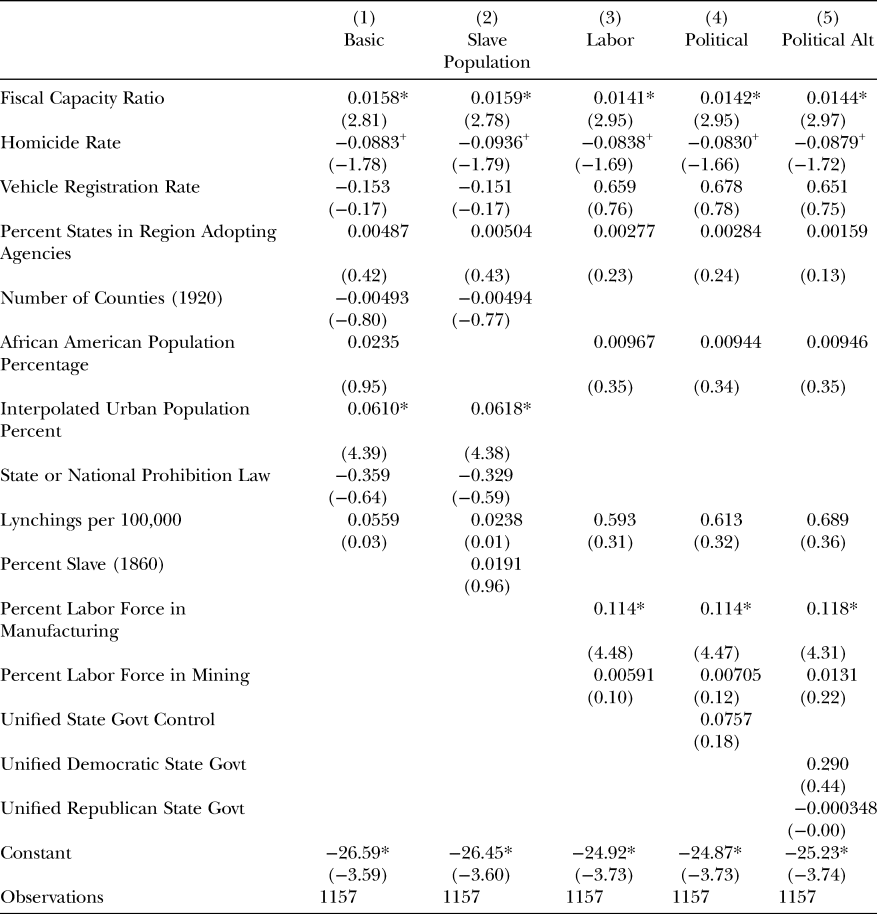
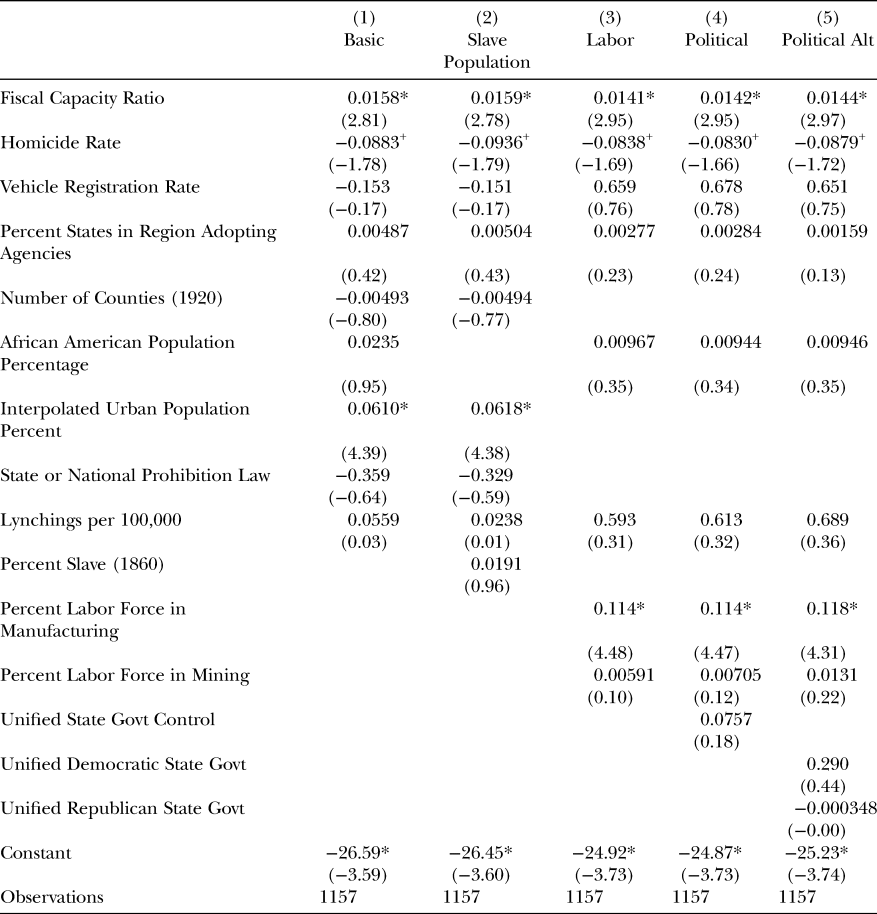
As mentioned before, authors in the state policy diffusion literature from Walker (1969) onward have collapsed the categories of state police forces and state highway patrols into one. Table 1 displays the results of several models using a combined measure (statewide policing agency) to establish a baseline mimicking the results of this procedure. The models I employ all include base variables related to the core hypotheses while including different sets of control variables to establish robustness. The basic model, for instance, is a test of the reformist hypothesis along with the key diffusion measurements. The rural models include a greater number of factors related to the rural-urban divide and different measures of African American populations to explore whether the historical legacy of slavery or contemporaneous Black populations better captured these dynamics. The labor model introduces the measurements of workforce-specific populations; if both urban population and manufacturing share are included in the same equations, variable inflation tests suggest that multicollinearity affects the results, and so I exclude urban population in models that include manufacturing share. Finally, the political models introduce different measurements of state-level politics to tap whether unified government or unified partisan control affected the adoption of any statewide policing agencies.
Determinants of States' Adoption of Any Agency (Combined DV)
Notes. t statistics in parentheses; +p < 0.10, * p < 0.05; regional and temporal dummies hidden.
Using this conceptually erroneous measure leads to the conclusion that diffusion did not play much of a role in helping to spread statewide policing agencies, as diffusion measures never even approach conventional levels of significance in these models. We would likely rule out a rural demand hypothesis, and indeed would probably diagnose an urban demand for improved policing, given that a higher fraction of urban populations was associated with increased likelihood of adopting a statewide policing agency. More surprising, we would probably reject both the reformist and the labor-capital theories as explaining statewide policing agency adoption. Homicide rates are, if anything, a negative predictor of propensity to adopt a statewide policing agency. And even though manufacturing share of workforce is a significant predictor of adoption, mining share of workforce is not. Given the prominence of mining workers’ strikes in most accounts of the labor-capital theory, especially in Pennsylvania and West Virginia, and the econometric observation that manufacturing share and urbanization are so highly correlated, we would likely conclude that the apparent relationship between manufacturing share and police agency adoption is a statistical artifact—that it was urbanization, not industrialization directly, driving these changes.
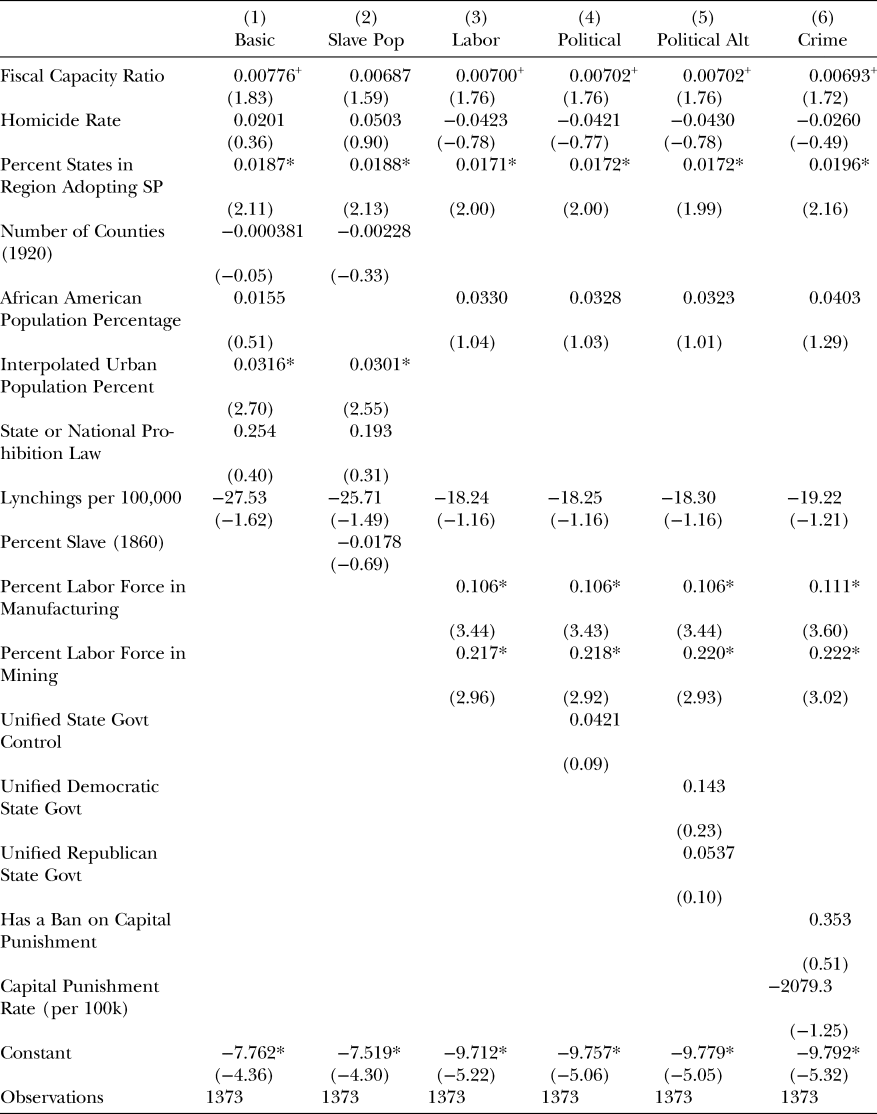
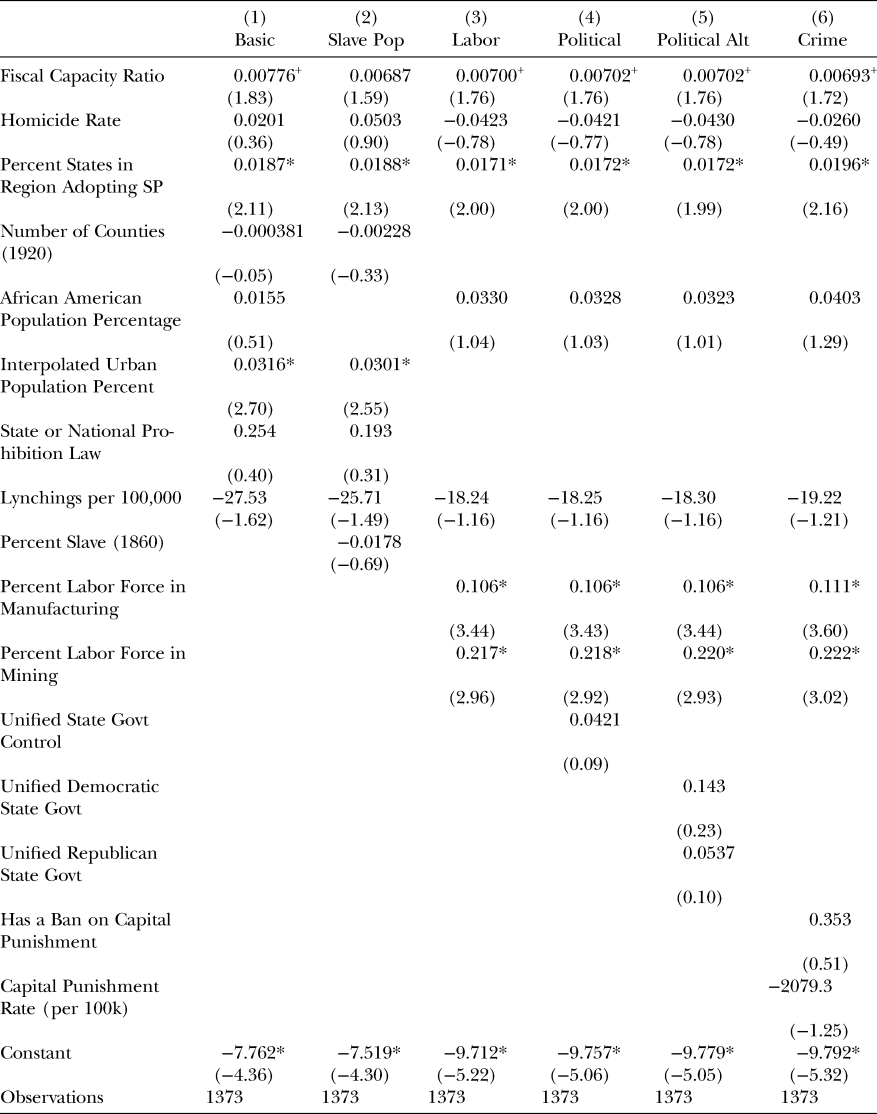
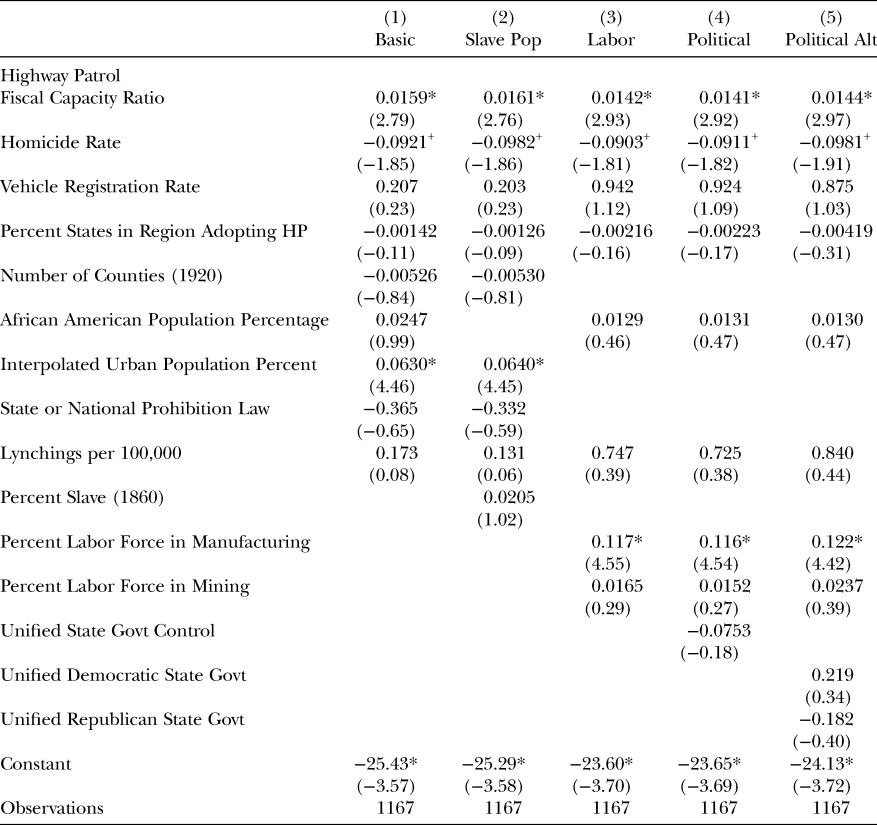
Can we trust these results? I argue not, or at least not without further refinement. This study takes as its departure from earlier political science investigations the idea that highway patrols and state police forces emerged from different processes. If that idea is right, then each pattern of adoption should follow a different logic. Consequently, I address each process of adoption separately in Table 2 and Table 3. As we will see, state police force adoption and state highway patrol adoptions are different not only to each other but also to the pooled understanding of statewide policing agencies.
Determinants of States’ Adoption of State Police Forces
Notes. t statistics in parentheses; +p < 0.10, * p < 0.05; regional and temporal dummies hidden.
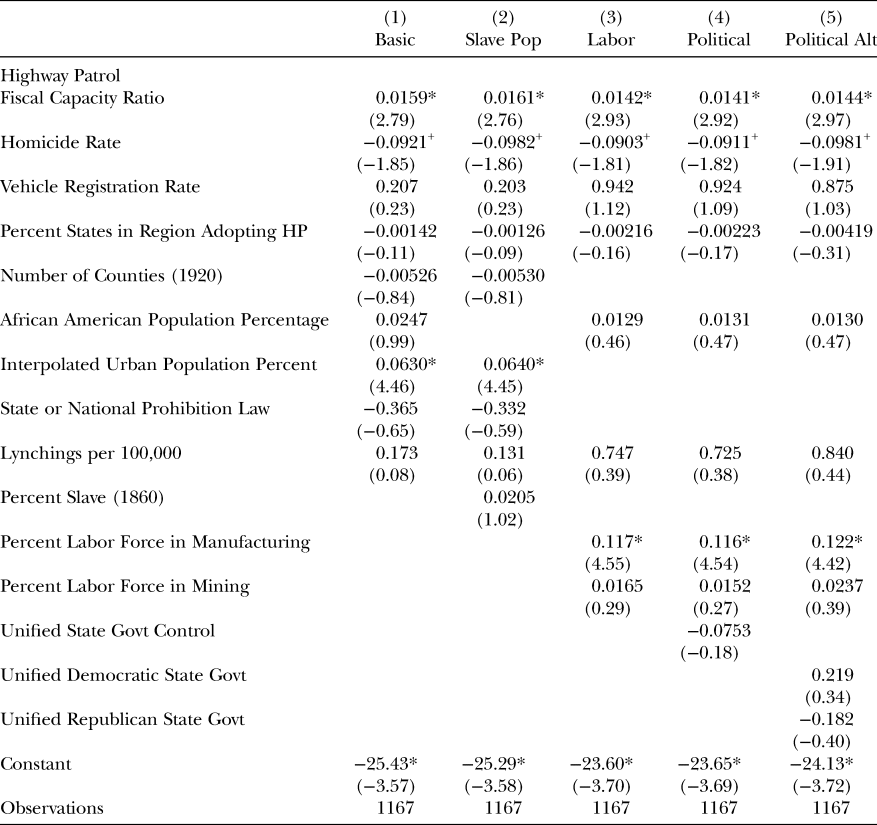
Determinants of State Adoption of State Highway Patrols
Notes. t statistics in parentheses; +p < 0.10, * p < 0.05; regional and temporal dummies hidden.
Table 2 presents results for models of the adoption of state police forces. The pattern displayed in this model is different from Table 1. Fiscal capacity falls below conventional significance levels once controls are added, although it remains likely substantively significant and positively signed. As in Table 1, urbanization remains a positive predictor, but now the regional diffusion variable's coefficient is also positive and significant at conventional levels. Furthermore, when urbanization is replaced by the mining and manufacturing variables (as multicollinearity continues to make it impossible to include both urbanization with manufacturing), both labor-force variables are now significant and positively signed. Homicide rate, by contrast, remains negatively signed (as in Table 1) and is not a significant predictor. Those results are inconsistent with the reformist hypothesis, as is the positive sign on urbanization (more urbanization equals greater likelihood of adoption).
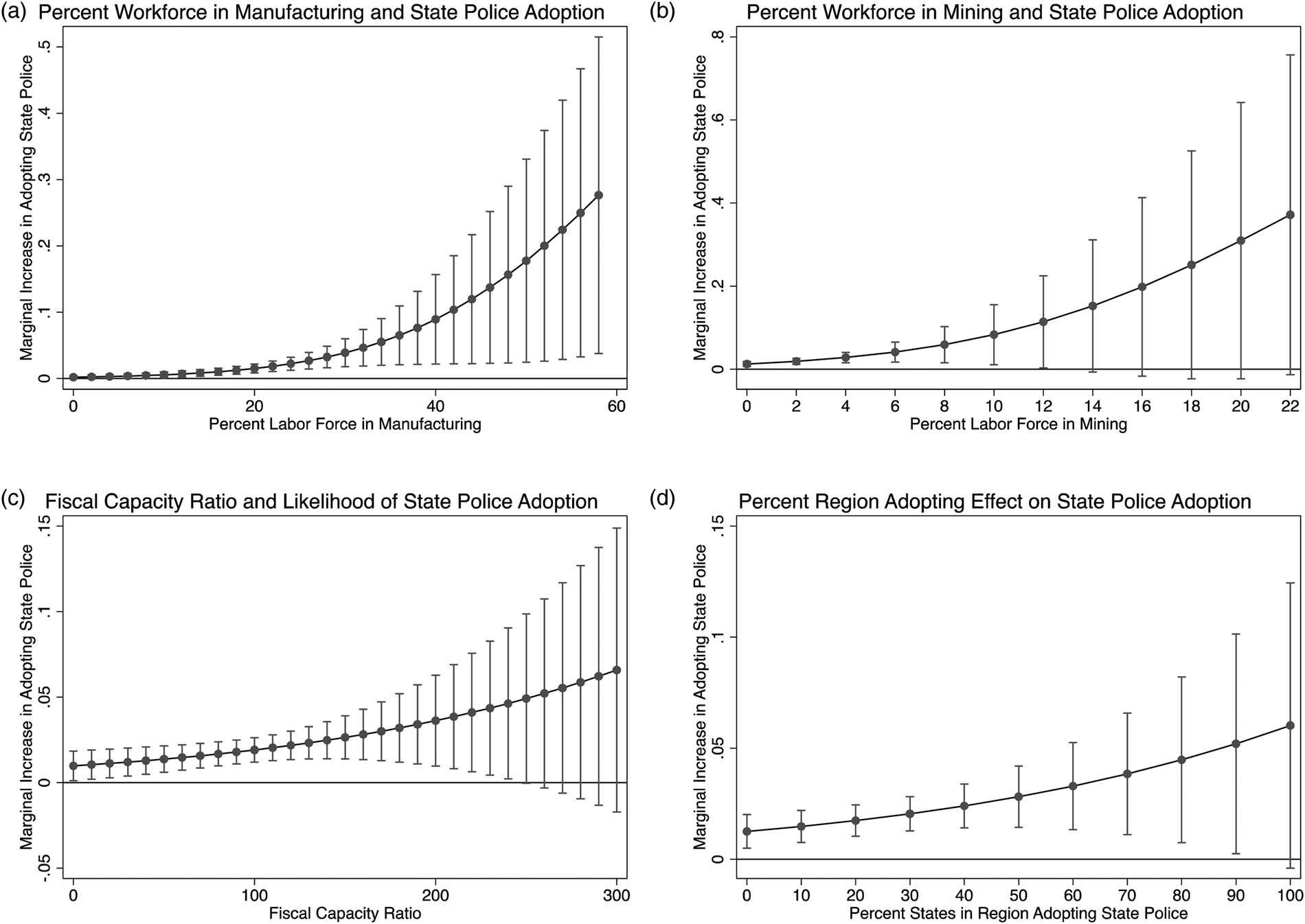
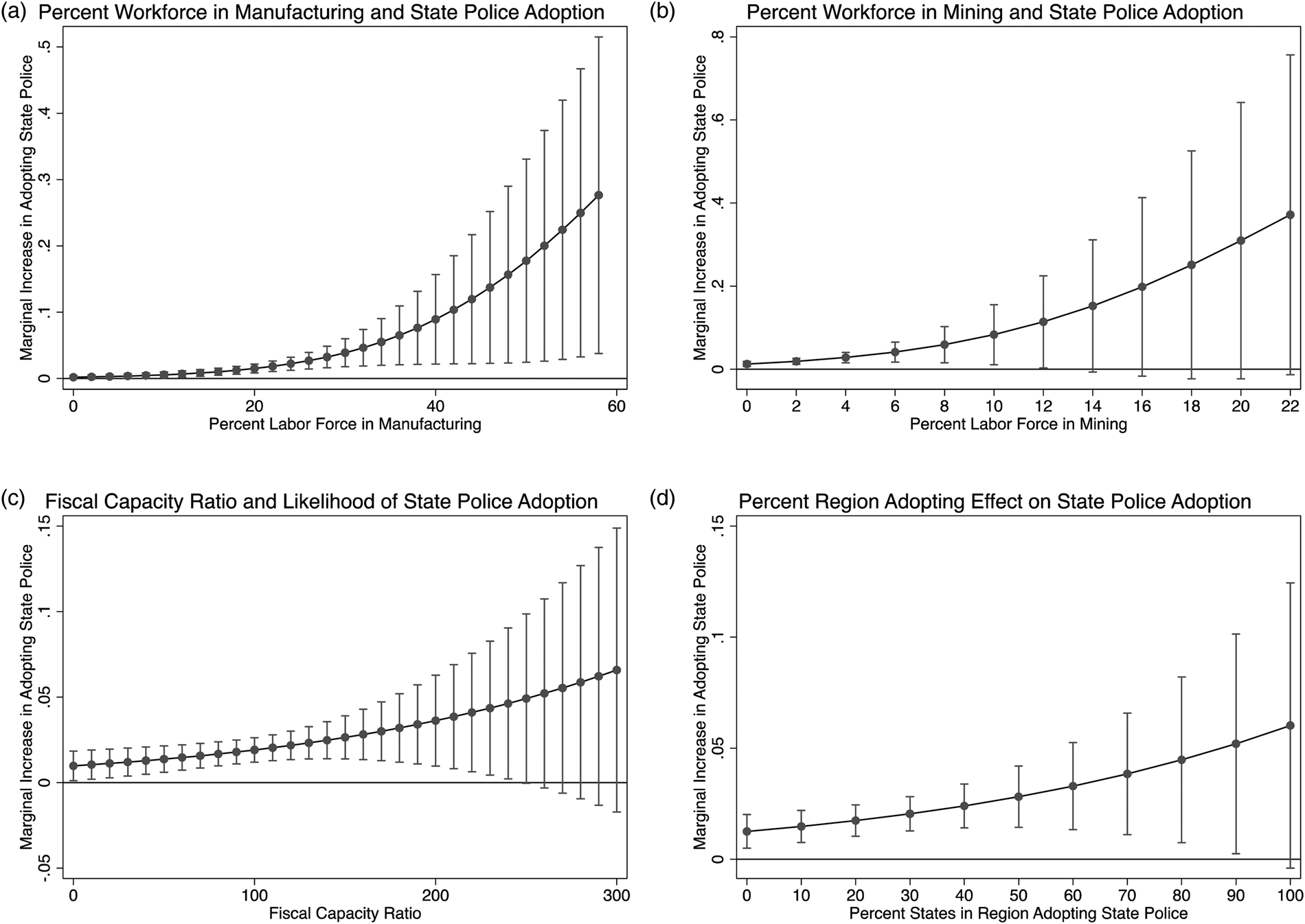
To better illustrate the substantive significance of these results, I turn to a graphical presentation of results, based upon model 5 (although any model including the labor-force variables would have returned similar predictions). Figure 2 clarifies the interpretation of the coefficients and demonstrates that mechanisms related to the labor-capital conflict drove adoption of state police forces. Figures 2a and 2b show that the share of a state's workforce employed in potentially unionized industries is predicted to have a substantial effect on the likelihood of adopting a state police force. As Figure 2c suggests, even a major swing in a state's fiscal capacity would be unlikely to have as important an influence as a change in its sectoral effect; Figure 2d also suggests that regional influences were a strong predictor of a state's decision, especially when more than about 50 percent of states in a given region had adopted.
Predicted Probabilities of State Police Adoption.
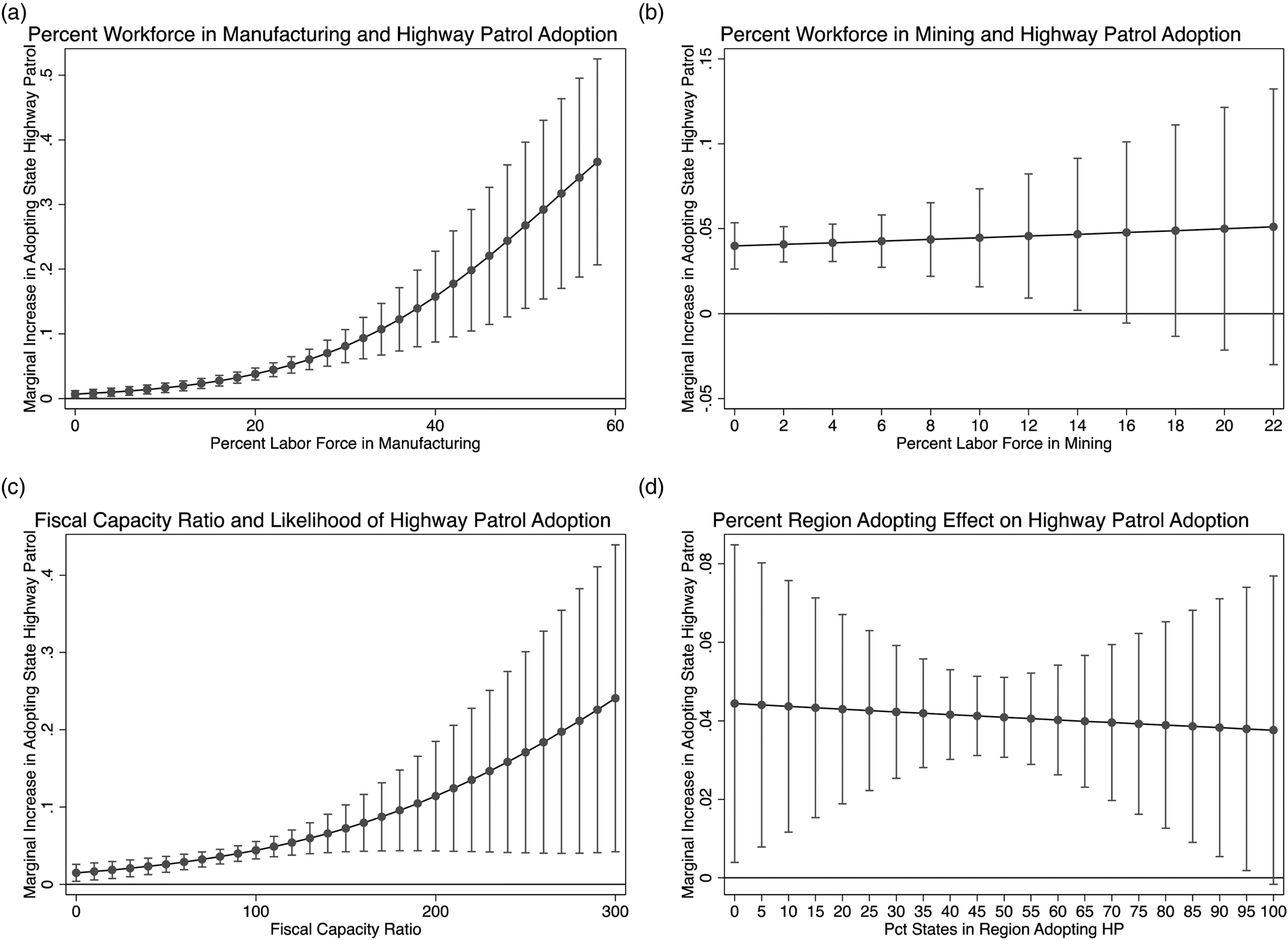
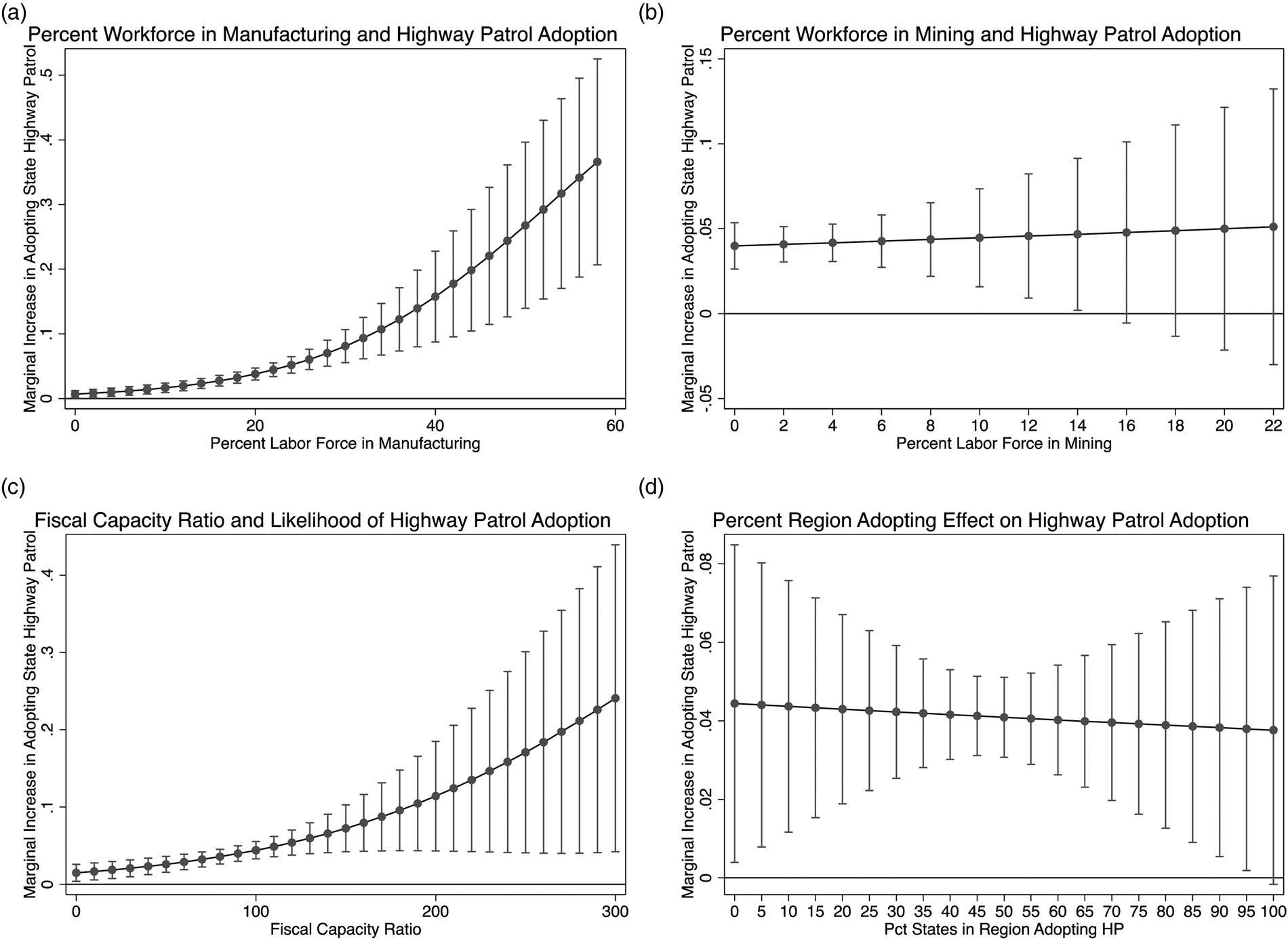
A different pattern is revealed when we turn to the analysis of the adoption of state highway patrols. As Table 3 shows and Figure 3d illustrates, regional diffusion effects seem to have been minimally related to a state's adoption of state highway patrols. Neither did the mining sector's presence in a state strongly predict adoption (Figure 3b). Homicide rates were a negative predictor of adopting a highway patrol, albeit outside of conventional levels of significance. Vehicle registration rates do not predict adoption, either. Fiscal capacity (Figure 3c), however, is a strong predictor of adopting a highway patrol. So too is urbanization (models 2 and 3) and manufacturing share of workforce (models 4–6, Figure 3a). Taken together, these findings show striking differences between the state police force and the state highway patrol adoption mechanisms. Neither crime control generally nor the specific problems of highway regulation seem to have affected the spread of highway patrols.
Predicted Probabilities of Highway Patrol Adoption.
6.1. Robustness Checks
The appendix presents several robustness checks, which I summarize here. The first set of robustness checks involves using different measures of regional diffusion, each constructed using code developed by Boehmke.Footnote 63 The first is a set of propinquity measures. Each takes a value of 1 if any state sharing a land border has adopted a policy matching the policy being tested (that is, there is a state police propinquity measure in the models for state police and a highway patrol measure for models for highway patrol adoption) and 0 otherwise to capture traditional notions of contagion through contiguity. I use this measurement in part because the policy diffusion literature has long operationalized this concept through measuring adoptions by states’ neighbors.Footnote 64 The second is a count of states sharing land borders that have adopted the relevant policy (referred to as Boehmke count). And the third is the percentage of the states that have adopted a given policy and that share a land border with a given state (Boehmke percentage). (That is, if one of the four states bordering state A has adopted a highway patrol, Boehmke percentage patrol would take a value of 25 percent for that state-year.)
Varying the measurement of regional diffusion changes the results for the state police force models, but mostly for the question of whether and how spatial diffusion operated. Neither propinquity nor Boehmke count nor Boehmke percentage reach significance in any of these models, unlike regional pressure in the main models (which is significant and positively signed). However, varying these measurements does not change the substantive results regarding urban percentage, percentage of workers in manufacturing and mining, or fiscal capacity. With regard to highway patrol, varying the measures similarly does not affect the substantive results regarding fiscal capacity, homicide rate, or percent labor force in manufacturing. In labor and political models employing percentage, however, count is negatively and significantly associated with highway patrol adoption, consonant with the idea that labor unions stiffened their resistance as they learned more about statewide policing agencies.
A second set of robustness measures concerns measurements for labor militancy. Strike rate is the only measure available for anything closer to the entire period. I employ this in two ways: first, by using the actual strike rate and, second, by turning it into a decile measure. I use each measure in models covering only 1914–1941 including the measures for percentage of workforce in manufacturing and mining and in models that exclude those measures. For both state police and highway patrol models, both measures of labor militancy prove significant (or just below conventional significance) and positively signed in models without the percentage of workforce; in models including mining and manufacturing percent, neither strike rate measure approaches significance. Other factors remain substantively unchanged.
6.2. Discussion
The evidence demonstrates at best very limited support for the reformist theory and more likely no support at all. Interpreting what these results mean for the labor-capital thesis, however, requires some careful thought. In both Tables 2 and 3, an increasing share of a state's workforce employed in manufacturing predicts adoption of the relevant innovation. What does this mean?
One straightforward—but I think misguided—approach is to see these results as evidence in favor of the labor-capital hypothesis in both cases. In other words, one might think that the positive sign on manufacturing share of labor in Table 3 should have the same interpretation as in Table 2. I think, however, that a subtler interpretation is warranted. We should remember that manufacturing share and urbanization are so correlated as to be multicollinear, probably because manufacturing implies urbanization (especially given the Census's low contemporaneous threshold for defining a town or city as “urban”). In other words, some part of these measurements is tapping the same factor. Given the balance of the other evidence, then, these findings are likely to result from different mechanisms, or at least different combinations of mechanisms, in ways that should affect our interpretation of these findings. For one, the relative magnitudes of the coefficients are different: Urban population is twice as strong a predictor of adopting a highway patrol as it is a state police force, and manufacturing share is a weaker predictor of adoption of highway patrols than it is of state police forces. Moreover, the share of workers employed in mines and quarries is a strong predictor of state police adoption—but not of highway patrols. This provides more convincing evidence that state police forces were welcomed by capital, given that mining workers seem to have been even more querulous than factory workers.
Furthermore, although we have ample historical evidence about how the capital-labor dispute affected state police forces, the record of labor and state highway patrols follows a different path. Evidence from multiple state police forces’ histories suggests that labor unions worked to fight the adoption of state police forces. The origins of the Pennsylvania State Police in the policing of strikes in coal country, and their early and brutal employment in the Bethlehem Steel Strike of 1910, warned labor unionists that the government-run police would be only mildly preferable to the Pinkertons.Footnote 65 The record of the state police forces tended to mitigate the reformers’ optimistic claims that if the public controlled the policing of strikes, strikes would be much less violent and fairer than management's use of private security forces. Contrary to the cheery views of former president Roosevelt and other boosters, for instance, a 1916 congressional report concluded that “the Pennsylvania State Constabulary … is an extremely efficient force for crushing strikes, but it is not successful in preventing violence in connection with strikes, in maintaining the legal and civil rights of the parties to the dispute.”Footnote 66
Labor unions turned this opposition into effective resistance to state police forces. In Idaho, for instance, opposition to the state “constabulary” in 1919 deflected the original proposal. Legislators met “objections from trade unions and the Idaho Nonpartisan League, which feared that the governor could use such a police force to suppress strikes and the League itself.”Footnote 67 A 1917 American Political Science Review news capsule reported that the only effective opposition to the New York State constabulary was “precipitated by the trade unions.”Footnote 68 A New York socialist newspaper claimed that the Pennsylvania force hired “a brutal type of armed mercenaries” and crowed that “wherever [the] constabulary has been proposed, it has met with opposition by the organized working class.”Footnote 69 Similar reports of labor opposition to successful state police force adoptions were made in West Virginia during the 1919 struggle over establishing its state police force and in Colorado at approximately the same time.Footnote 70 The Illinois General Assembly debated state police measures in each session from 1917 to 1929, but never established a state police force, which Bechtel attributes to labor's influence.Footnote 71 Similarly, Falcone claims that organized labor long frustrated efforts to establish either a state police force or a state highway patrol in Missouri.Footnote 72 And by 1923, labor unions had even secured the repeal of both the Idaho and Colorado forces.Footnote 73
The record of unions and state police forces, then, is one of almost unremitting skepticism and hostility. By contrast, labor unions took an increasingly different view of state highway patrols over time. In the beginning, labor's fear that any statewide policing agency could be used against unions influenced even the development of highway patrols: In two states in the South, the highway police was explicitly banned from policing labor disputes.Footnote 74 Over time, a process of learning and adaptation made labor more amenable to highway patrols and patrols more acceptable to labor. Increasing highway deaths were given as the reason for Missouri unions’ switch from opposing to supporting a state highway patrol, for instance.Footnote 75 In many cases, observers reported that the highway patrol form was preferred because it was the only one acceptable to labor: “Many of our state highway patrol forces, with powers restricted to traffic regulation and control, have been set up as a means of overcoming the objections of organized labor.”Footnote 76 Indeed, this observation seems consonant with the secondary puzzle of why there are two different forms of statewide police agencies to begin with. Labor unions’ influence may help explain why such a relatively toothless organization both emerged and eventually became ubiquitous.
Given these factors, then, the balance of evidence sustains the contention that different mechanisms were at play in the diffusion of these distinct innovations. It seems more likely that the process of state highway patrol adoption resulted from technocratic factors, such as highway patrols’ usefulness as a traffic amenity—providing roadside assistance, curbing poor drivers, and so on. This fits with the fact that richer, more fiscally sound states adopted them sooner, and that they were more common in urbanized and industrialized environments than in rural, agrarian communities. This is different from the process of anti-union agitation that seems to have been key to the adoption of state police forces.
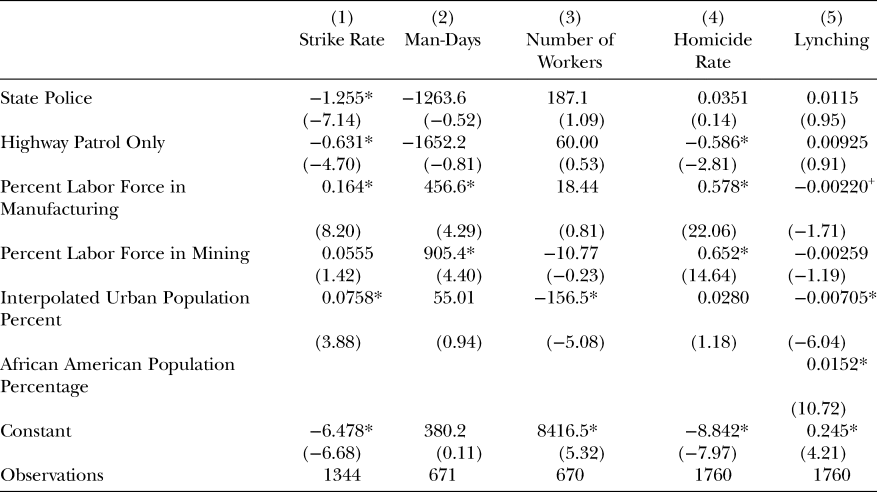
Viewed in retrospect, the energies invested by unions, advocates, and legislators in these fights seems to have been expended somewhat in vain. Table 4 presents panel estimates of five dependent variables with two-way fixed effects measuring different hypothesized effects of statewide policing agencies. Three variables—strike rate, man-days, and number of workers— capture data about the rate and severity of strikes, taken from the BLS reports mentioned earlier. Strike rate is the number of strikes per year per 100,000 people in each state, 1914–1941. Man-days and number of workers capture the number of employee-days idle in strikes and the number of workers involved in strikes. Both of these variables are available for 1927–1941 and are also expressed per 100,000 people in each state. The other two variables, homicide rate and lynching rate, are the same variables as earlier, as are percent labor force in manufacturing and mining and measures of African American and urban population share. The explanatory dummy variable state police records whether a state police force exists in the state in that year; given that many highway patrol forces coexisted (or formed part of) state police forces, the explanatory dummy variable highway patrol takes a value of 1 for those years in which a highway patrol alone exists in a state.
Effects of Statewide Policing Agencies on Quantities of Interest
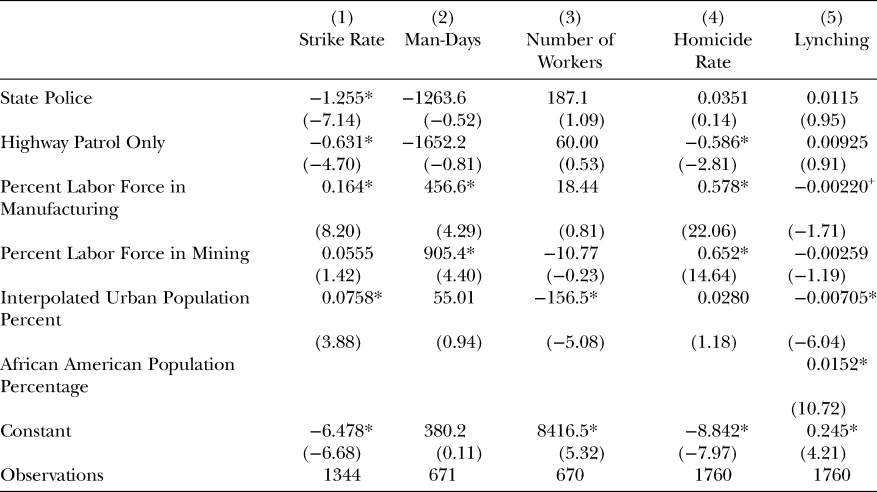
t statistics in parentheses, fixed effects variables hidden, +p < 0.10, * p < 0.05
The results demonstrate that there is little reason to think that these agencies succeeded in transforming state-society relations on anything like the scale their advocates hoped or opponents feared. True, state police and highway police forces have sizable and significant negative coefficients showing that the predicted rate of strikes was lower in states that adopted either type of force. The effect is meaningful: A state with a state police force (and highway patrol) is predicted to have about 1.2 fewer strikes per 100,000 residents compared to a state that has neither type of force. That is a large amount: The mean of strike rate is 1.6. The size of the coefficient of this magnitude should suggest some caution, since it may be that states with lower militancy adopted statewide policing agencies, rather than these agencies exerting such a dramatic effect. Yet neither form of statewide policing agency affected the scale of strikes, measured by either number of employee-days lost or number of workers involved. This makes sense: The types of strikes most readily deterred by a modest-scale police force would be smaller ones, as larger strikes (like the GM strike at Flint) would probably involve calling out private security, the National Guard, or both—responses unaffected by the presence or absence of a state police force. At most, statewide policing agencies deterred a few, smaller strikes from breaking out from 1914 onward. Nor can we say that such agencies had much of an effect on either homicide, as defined at the time, or the variety of homicide and extrajudicial killing known as lynching. (Certainly, it seems unlikely that highway patrols, with their limited jurisdiction, reduced the murder rate by such a huge amount, about 7.5 percent, while state police forces, with more extensive jurisdiction, had no effect.) Explaining the relative lack of effect of statewide policing agencies should provide a promising research agenda.
7. CONCLUSION
From the standpoint of 2019, debates about whether and how to fundamentally remake policing under federalism have mostly retreated to the background. Like the flat land left behind by long-vanished glaciers, the effects of earlier struggles about policing institutions shape the American policing landscape today. Disputes between labor and capital shaped efforts to reform policing agencies in the United States during the early twentieth century. At some places and times, especially early on, capital won; over the longer term, labor's efforts blocked or tamed efforts to ease the use the state's power against union activities. The different roles of statewide policing agencies in New York and California today, or the regional differences between the South and the Northeast, reflect in large part the balance of influence between labor and capital a decade or a century ago. The less ambitious, more restrained form of statewide policing agency that did become ubiquitous, state highway patrols, threatened fewer organized interests, and so were largely adopted as states could afford to.
The implications of these findings for students of American political development and of the relationship between police and society are clear. The role of labor-capital relations in shaping police reform has long been speculated, but the research design in this article puts that conjecture on a far firmer footing. Although labor-capital disputes may not have been the only or the pivotal factor in all disputes, the quantitative findings here support historians’ and other scholars’ idiographic arguments that labor-capital relations proved the essence of debates over policing. This article also casts doubt on the hypothesis that the influence of policy experts and reformers proved decisive in establishing state police forces, a standard story commonplace in official histories of individual agencies and of the state police movement in general. Moreover, these findings suggest the need for reinterpreting what drove the adoption of state highway patrols, since their spread appears less influenced by the sorts of factors that standard stories about traffic or policy entrepreneurship would imply. Experts may have done much to shape the distinctive character of statewide policing agencies—especially in valorizing and systematizing their distinctively paramilitary aspect, from the name of “troopers” to their adoption of barracks systems, military ranks, and discipline—but that is a distinct role from whether such policy entrepreneurs persuaded states to adopt these reforms.
For students of diffusion theory, these findings provide greater evidence for the role of policy characteristics in adoption and, more important, suggestive evidence about the role of policy-relevant networks in opposing or transforming policy innovations. More work could be done to extend the point about how resistance to state police forces spurred the creation of state highway patrols as a substitute or alternate form. This reinvention might have served governments’ technocratic need for a new form of police suited to the challenges of the highway Gesellschaft; at any rate, it is worth investigating whether experts and others invested in professionalizing and reforming police forces generally found that promoting the less ambitious highway patrols advanced their interests much more successfully than insisting on the original state police form. On a methodological level, moreover, this article demonstrates that lumping together the spread of state highway patrols with that of the state police forces proves misguided; given how widespread this approach has been in the coding of data sets dealing with statewide policing agencies as instances of interstate policy diffusion for decades, one wonders whether other issues are ripe for recoding as well.
Perhaps even more consequential implications derive from this article's lessons for contemporary policing reforms. The article suggests that the current, multifaceted police system may be robust and enduring. In the early decades of the twentieth century, during a moment of intellectual fermentation when progressive reformers shaped political contests, even profoundly powerful actors in U.S. society could obtain their desired changes in policing only at great effort and over a long span of time. In the absence of such concentrated and profound stakes, it is unlikely that the system can be reformed now. Policy innovations proposed today that aim at transforming the police-society relationship at a fundamental level will likely meet similar degrees of resistance as their counterparts in the early twentieth century did—but may fail to find natural allies among actors who occupy the commanding heights of the economy and politics. As such, the institutional jumble of American policing will likely prove difficult to rationalize, reform, or tame.
SUPPLEMENTARY MATERIAL
To view the supplementary material for this article can be found at https://doi.org/10.1017/S0898588X20000036.