In early modern overseas trade information was a valuable and scarce commodity. Prices and supply conditions fluctuated rapidly, and political environment and attitudes towards foreign merchants could shift dramatically, changing the potential for profit in overseas ports. In sixteenth century England, a market for information on overseas trade arose in the form of travelogues, almanacs, and geographical texts (Withers Reference Withers1996). Publications such as these, however, were inevitably outdated relative to overseas market conditions, price levels, availability, and quality of goods. The direct exchange of information between market participants about the location, price, and quality of goods benefited the market as a whole but that benefit could come at a cost to individuals who gave up privileged information about potential sites for profitable exchange, while those on the receiving end assumed risks when acting on this information by devoting significant time and resources to travel to unfamiliar, potentially dangerous or unprofitable locations. We identify the conditions that promoted the informal exchange of valuable market information in the competitive environment of English overseas trade in Asia in the seventeenth and eighteenth centuries. The result contributes to existing knowledge on early-modern economic expansion as well as intra-organizational processes of information exchange.
If formal markets for valuable information do not exist, relational-based contract enforcement, also known as network governance (Bernstein Reference Bernstein2015), can encourage the cooperative transfer of information within small groups. In such settings small groups norms enforce continued cooperation, increasing the likelihood that exchange will be reciprocated, thereby increasing the value of transmitting valuable information. In modern settings, formal legal institutions appear to encourage decentralized cooperation by reducing potential risks through the threat of third-party enforcement (Dixit Reference Dixit2004; North Reference North1991). When exchange relations expand beyond small, local settings to larger, more diverse populations, legal institutions encourage cooperation by altering incentive structures so as to mitigate risk (Dixit Reference Dixit2004; Greif Reference Greif2006; Zucker Reference Zucker1986). Thus, a strong institutional framework may encourage diverse forms of cooperation, such as the transfer of valuable information, by enforcing other types of transactions in a type of spillover effect.
Drawing on data from English East India Company trade from 1601 to 1835, we assess whether third-party enforcement or small-group processes encouraged informal exchange of commercially valuable information between captains of company ships. We find that increasing institutional enforcement capacity decreased the flow of information between captains. Thus, contrary to expectations, we observe higher rates of exchange in a weak rather than strong institutional setting. We also find that the exchange that took place prior to the increase in formal institutional strength was not characterized by small-groups or reciprocity. Rather information exchange increased in situations of heightened uncertainty, where uncertainty is defined as a lack of relevant information and a corresponding inability to assign a risk probability. In times of war, military actions and movements made different ports dangerous at different times. The lack of information about which ports were safe caused uncertainty for captains. When captains set out on their first voyage, their lack of experience in eastern ports translated into a lack of knowledge of profitable opportunities at different ports, thus increasing their uncertainty. In both contexts, we find evidence of increased information exchange between captains.
Research has linked uncertainty to network interactions (DiMaggio and Louch Reference DiMaggio and Louch1998; Mizruchi and Stearns Reference Mizruchi and Stearns2001; Podolny Reference Podolny1994), emphasizing the importance of trust and repeated exchange in driving this relationship. Recent studies, however, place less emphasis on the importance of social embeddedness in guiding informal information-seeking behaviors (Reagans and McEvily Reference Reagans and McEvily2003; Saint-Charles and Mongeau Reference Saint-Charles and Mongeau2009). In our case, we find that uncertainty led individuals to seek knowledge from newly encountered contacts—rather than past exchange partners. Together, the results suggest that the increased demand caused by uncertainty played a greater role in the exchange of information in this early modern context than emerging governance systems, trust, or reciprocity.
Characteristics of and Opportunities for Information Exchange
The English East India Company (hereafter, Company) was one of several large-scale chartered organizations created in Europe in the seventeenth century. It was established on 31 December 1600, and granted monopoly privileges to the overseas trade to East Africa, the Middle East, and Asia. It existed as a monopoly until 1833, when it withdrew from trade and focused on the governance of its colonial possessions in India, which it had acquired with few exceptions after 1757. The Company was a major force in overseas trade and one of the largest organizations in Britain. In 1801, the Company was employing 145 ships, docking at more than 96 ports, and delivering total exports valued at £2,515,817 (Bowen Reference Bowen2005; Erikson Reference Erikson2014).
Although the Company provided routine information to their captains about the formal destination of the voyages, all employees of the Company were permitted to engage in a significant private trade. Thus, captains were both employees of the same firm and competitors in an external market for private trade that included the company itself, company employees, and Asian merchants.Footnote 1
Captains often engaged in the private trade by taking the ships they commanded (but did not own) to ports while en route to and from the formal destinations to which they were ordered to travel by the Company (Erikson Reference Erikson2014), but there was no official source of information for them to draw upon when deciding whether or not to visit a port in order to engage in private trade. Thus, informal sources of information about these ports were of great value. Additionally, conditions fluctuated in ports, prices and quality rose and fell, and different types of goods (e.g., different varieties of chintzes) were available at different times—all of which greatly affected the potential for profits and increased the value of current information.
Incorrect information, of course, could be costly. Captains following the advice of others entrusted significant capital, including the cost of supplying their crew and maintaining their ship while traveling to various ports and often risked financial ruin if they were ultimately unable to turn a profit during their voyages. There was also an incentive to deceive or hoard information, as smaller markets, which were often private trade destinations, were extremely sensitive to demand. Additional English ships meant increased prices in overseas locations and potentially decreasing sale prices in England.
The Company provided a physical infrastructure that created opportunities for information exchange between captains. A system of factories was created in the ports to which the Company sailedFootnote 2 to reduce the costs of purchasing goods by spacing out English demand—not to increase communication between captains. Nevertheless they provided an opportunity for social interaction. The factories served as warehouses, business offices, living quarters, and mess halls (Cotton Reference Cotton1949). With the exception of the minimal crew needed to safeguard the ship in harbor and captains affluent enough to have retained private lodgings, all company employees resided in the factory, which served as the social center of company life abroad. All employees were required to take meals at the factory, and religious services on premises were obligatory though avoided when possible. Factories were largely closed to the rest of the population of the port, and thus concentrated captains’ exposure to relevant information from other Company ships that had been engaged in similar travels. The close quarters of life in the factories provided an opportunity for Company captains to exchange information in a face-to-face context with each other. They served as network foci with low external overlap (Feld Reference Feld1981).
This context made the private transfer of valuable information about ports between captains possible. When a ship arrived in port, the country of origin was visible in its flag—but no indicator existed to broadcast the location of its more recent travels. Although spectacular news about recently visited ports, war, plague, or famine, for example, might percolate widely through the port, more detailed information about the terms of trade, market conditions, or navigational considerations at different ports was specialized knowledge that would have been transmitted in more intimate conversational settings.
Consider, for example, the detail of the information received by Nicholas Buckeridge in a chance encounter at an overseas port between 1651 and 1654 that led him to change the course of his ship: “A friend of mine tould me that A little after I went last from Mosambiq hee made A voyage for ye late governer Alvora de Sousa into ye Bay of Larenzo Marques in 25 ½ degrees So. And brought thence: 90 Bahars Ivory, importing by estimacion Starling 8460 - 300, ounces Amber grece – 600, lb: 9060 [sic]” (Buckeridge Reference Buckeridge1973, p. 54) Buckeridge then attempted to travel to the Bay of Larenzo Marques, but was prevented from doing so by weather conditions (Buckeridge Reference Buckeridge1973, p. 63). Similarly while in Anjengo, William Larkin of the Durrington “learned what price he would get in ports up the coast for his fine Bengal silks, what Anjengo pepper and fine cloth and betelnut would fetch at Surat and the rate of exchange of the great variety of coins used in the trade” (Sutton Reference Sutton2010, p. 59). And Thomas Garland, captain of Rose Galley, heard from a ship that had just arrived from Kedah, while docked in Aceh, that opium was in great demand there. He immediately abandoned his previous plans and set course for Kedah once a good wind was raised (Chaudhuri Reference Chaudhuri1978, p. 204).
Changes in Institutional Context
While overseas, agents of the Company operated outside of the reach of British sovereign authority and were largely exempt from local jurisdictional authorities. Thus, the Company itself was the strongest institutional environment to which employees were exposed; however, its ability to control the behavior of its employees was constrained until the late eighteenth century. We define a strong institutional setting as one in which some governance structure has the capacity effectively to monitor behavior, punish deviations, and thereby enforce rules and regulations.
In the Company, agents operated thousands of miles from principals, who could neither directly observe agents nor distribute punishments until the voluntary return of agents years later. The Company was itself troubled by an uncertain and shifting policy environment (Bogart Reference Bogart2016) that impacted control efforts. Similar conditions plagued the other great chartered companies of the seventeenth century (Adams Reference Adams1996; Carlos and Nicholas Reference Carlos and Nicholas1990; Carlos Reference Carlos1992; Norton Reference Norton2015), but these companies were eventually able to create systems capable of effectively bringing agents behavior in line with the interests of the firm (Carlos Reference Carlos1994; Carlos and Hejeebu Reference Carlos and Hejeebu2007; Carlos and Nicholas Reference Carlos and Nicholas1993).
Company operations changed in the late eighteenth century, employees’ autonomy decreased and the company’s ability to monitor and sanction employee behavior increased. In 1757 the Company took possession of Bengal, beginning a process of colonial expansion that ultimately resulted in the British Raj. As colonial rulers, the Company gained access to an alternative and vast stream of revenue in the form of land taxes, and as a result the Company became less dependent on trade, and, therefore, the activity of their ships, for profits (Marshall Reference Marshall1968). The institutional infrastructure of the Company’s overseas locations were built up and the British government became directly involved in the monitoring of company activities overseas (Bowen Reference Bowen2005, pp. 182–218). By 1776 internal company legislation was enacted restricting the autonomy of captains (Cartwright Reference Cartwright1788). This legislation, backed by the increasing strength of the Company, delegitimized the practice of traveling to additional ports while en route to formal destinations. Although captains took less obvious liberties in adding private destinations to their voyages, the practice persisted at a smaller scale. The total volume of voyages increased greatly, such that even though individual captains had restricted (but not eliminated) trade, it is likely that the total volume of private trading activities went up.Footnote 3 In our statistical analysis, we will use the year 1776 as the dividing line between a weak and strong institutional environment.Footnote 4
Governance Systems
Opportunities to interact, such as those provided by the factories, are necessary to information exchange. It has also been compellingly argued that some mode of governance is necessary for cooperative exchange, where the threat of sanctions is required to reduce the risk of costly defections that reduce the benefit of cooperation (Williamson Reference Williamson1998). Transaction cost theory and the new institutional economics, which have advanced this perspective, explicitly extend this argument to the exchange of valuable information, particularly when there is the potential for defection. Indeed, the problem of information transfer, the value of information, and the agency problems related to its exchange are central to the transaction-cost framework (Arrow Reference Arrow1962; Williamson Reference Williamson1979).
A state-sponsored impersonal legal system found in most advanced economies is one form of governance. A central advantage of a modern legal system is that the third-party enforcement by the government allows individuals to trust and engage in contractual and commercial relations with a wider range and variety of other individuals (Coase Reference Coase1960; Zucker Reference Zucker1986). Thus, there is theoretical reason to believe that information exchange between people who are not closely tied to each other should occur with greater frequency in environments that offer a strong institutional framework backed by the threat of third-party enforcement. It is also true, however, that formal institutions have at times increased the threat of sanctions in such a way that reduces cooperation between individuals (Gellner Reference Gellner1988; Ingram and Lifschitz Reference Ingram and Lifschitz2006).
Because many pre-modern and developing economies lack a strong legal infrastructure, it is reasonable to expect some other form of governance must account for the evident commercial growth and expansion that occurred in many of these cases. Private enforcement of property and contract rights, such as hiring mercenaries to violently enforce sanctions, is one possibility. Another is the creation of private, for-profit means of distributing information about the quality of actors and goods (Dixit Reference Dixit2004). The major non-violent alternative to modern legal infrastructures, however, is network governance or relationally enforced contracting. Network governance has played an important role in moments of commercial expansion in pre-modern and developing economies (Opper and Nee Reference Opper and Nee2015; Hillmann and Aven Reference Hillmann and Aven2011; Landa Reference Landa1981; Greif Reference Greif2006). Network governance operates through small, stable groups that monitor and sanction individual behavior (Dixit Reference Dixit2004, p. 65; Bernstein Reference Bernstein2015). Individuals within the group monitor and sanction behavior through the threat of excluding malfeasant actors from future transactions with the group or its constituent members. A large part of the value of belonging to the group is having access to the closed circuit of information flowing within the group. Thus, both commercial transactions and information exchange should be contained within the group in order for it to provide a benefit to the participating individuals.
Because the system encourages repeated interactions and transactions with a small pool of highly connected individuals, reciprocity, and group stability should be evident in both patterns of information exchange if network governance is operating.Footnote 5 Network governance discourages one-shot interactions because transient exchange with a socially-distant other decreases both the value of information and group membership. Therefore unreciprocated exchange with newly encountered contacts should be less evident in systems of network governance.
Uncertainty, Exchange, and Institutions
In the social network literature, uncertainty has been shown to affect patterns of exchange. A number of experimental and empirical studies have found that uncertainty leads individuals both to form and increasingly to rely upon already existing exchange relationships (DiMaggio and Louch Reference DiMaggio and Louch1998; Mizruchi and Stearns Reference Mizruchi and Stearns2001; Podolny Reference Podolny1994). These findings extend to information exchange, where trust and emotional attachment have played an important role in determining to whom individuals within a firm will turn for valuable information.
Recent research has, however, added complexity to these results. Uncertainty can lead individuals to seek out information from socially distant others. Ray Reagans and Bill McEvily (Reference Reagans and McEvily2003) showed that individuals in a firm characterized by a flat hierarchy sought information not only from individuals with whom they had strong ties and individuals bound within the same cohesive social group, but also from more distant co-workers who had access to different pools of knowledge. Johanne Saint-Charles and Pierre Mongeau (Reference Saint-Charles and Mongeau2009) found that uncertainty prompted individuals working within a medium-sized public organization to prefer information from outside experts rather than internal friends. These studies suggest that, under some circumstances, individuals will forgo relying on past exchange partners or socially proximate actors in their search for a larger pool of useful information.
Transaction cost analysis and the new institutional economics suggest that formal and informal governance are central to cooperative exchange. However, network-based research has shown that exchange between individuals undertaken without institutional support is associated with the production of trust that can diffuse to a large and diverse pool of potential partners, thereby facilitating socially-distant, transient or one-shot patterns of exchange (Yamagishi and Yamagishi Reference Yamagishi and Yamagishi1994; Molm, Takahashi, and Peterson Reference Molm, Takahashi and Peterson2000; Macy and Skvoretz Reference Macy and Skvoretz1998). Indeed, it has been shown empirically that strong governance systems can reduce trust (Ingram and Lifschitz Reference Ingram and Lifschitz2006; Gellner Reference Gellner1988).
We anticipate that given a context in which individuals had the opportunities to interact with a large population, a weak institutional context would have increased the likelihood that informal information exchange took place. Further we expect that in a weakly institutionalized context that nevertheless provides equal opportunities to interact with new and known actors, uncertainty will lead actors to look beyond previous exchange partners for a broader range of information. In other words, the combination of autonomy and uncertainty experienced by captains in the pre-colonial period of British trade increased their willingness to cooperate and exchange information with individuals outside of small groups and repeated transactions.
Data
The Company is an exemplary case study for considering processes of information exchange for market expansion. The data is both detailed and systematic. These characteristics allow for the reconstruction of processes of information transmission and provide a rare opportunity for examining informal information exchange in pre-modern commerce.
The voyage data used here was compiled by Erikson from the ships’ logs and books stored by the Company and preserved in the British Library and National Maritime Museum using the record of the 4,725 commercial voyages and assembled in the volume, A Catalogue of the East India Company Ships’ Journals and Logs, 1600–1834 (Farrington Reference Farrington1999a). This volume includes a systematic record of the ship, captain, ports, and travel dates (to the day of arrival at each port) for each listed voyage.Footnote 6 A stratified sample of 107 of the original ships’ logs confirmed the accuracy of the Catalogue record of ports and dates.Footnote 7 No inconsistencies were found between the original logs and the data recorded in the Farrington catalogue. The data generally only report arrival dates but a sample of trips had complete information. We used this information to estimate the time it took to travel between ports and the average stay in ports, which we then used to estimate the departure times from ports. The names and identities of all captains were extensively crosschecked using A Biographical Index of East India Company Maritime Service Officers: 1600–1834 (Farrington Reference Farrington1999b). Additional supplementary data was introduced from the Great Powers Wars Dataset (Levy Reference Levy1994).Footnote 8 Ports were located geographically using a combination of historical atlases and online data repositories.
We used this voyage data to construct a network dataset of information exchange between ship captains. Previous research has considered person-to-person interactions of captains (Erikson Reference Erikson2014; Erikson and Samila Reference Erikson and Samila2015a, Reference Erikson and Samila2015b), but no other previous work has used or analyzed the full network data of the structure of observable informal information exchange between East India captains.
Structural Analysis
Our first objective is to establish whether the exchange of information between captains was constrained to reciprocal relations or small groups with the capacity to monitor each other over time. If group sanctioning, reputation mechanisms, and peer monitoring were acting as information substitutes for a strong institutional setting, we should see evidence in the presence of reciprocity (repeated exchange between a pair of captains), social closure (exchange within a well-defined group), and group stability. We evaluate social closure through structural measures of transitivity, triadic closure, and generalized exchange patterns. Transitivity measures the likelihood that the mutual friends of a target actor will also be friends with each other. Triadic closure is closely related and captures the number of closed groups of three individuals that exist within the larger network (Holland and Leinhardt Reference Holland and Leinhardt1976). And generalized exchange patterns indicate what is now known colloquially as paying-it-forward processes, when information or favors are circulated through a group without the need for a return in kind to the same individual (Bearman Reference Bearman1997). We measure group stability through the longevity of closed triads, groups of three captains that exchanged information with each other. To assess the existence of such social patterns, we constructed a network that represents the exchange of information about ports between captains, where captains are the nodes of the network.
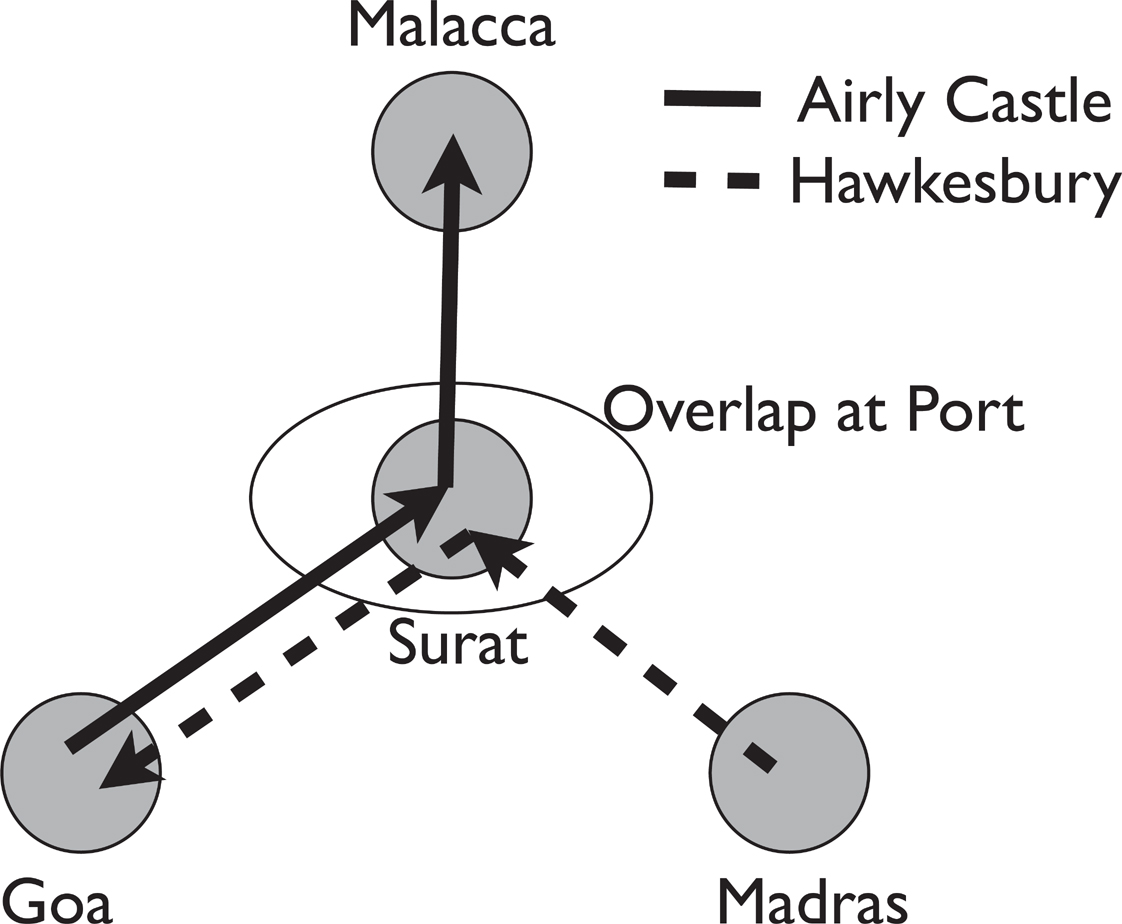
In order to construct the network we first have to define and identify when a tie between captains occurs. Interactions between captains were constrained by the paths of their ships. Captains could move to new ships after the conclusion of a voyage, and we track these movements to capture captain-to-captain interaction histories. The only other avenue for communication was written correspondence, which rarely reached individuals traveling on ships in a timely fashion because of the unpredictability involved in overseas travel of the time (Sood Reference Sood2007). An illustration of how we operationalized a network tie representing the transfer of information between captains about a port is presented in Figure 1. Here two ships, the Airly Castle and the Hawkesbury, are represented in the port of Surat.Footnote 9 The paths of the ships are represented as arrows connecting the ports, with the solid arrow indicating the path of the Airly Castle and the dotted arrow indicating the path of the Hawkesbury. The Airly Castle traveled from Goa to Surat to Malacca. The Hawkesbury traveled from Madras to Surat to Goa. At Surat the captains, officers, and crew interacted with each other at the Company factory and various social events. Our network thus has a tie from the captain of the Airly Castle to the captain of the Hawkesbury because the Hawkesbury was exposed to the Airly Castle at Surat and then immediately travels to a port (Goa) recently visited by the Airly Castle. This is a directed tie, since there is no tie in the opposite direction, from the captain of the Hawkesbury to the captain of the Airly Castle, since Airly Castle did not go to a port recently visited by the Hawkesbury.
Possibility for Information Transfer at Port with Paths of Ship Differentiated by Line Type

This method shows only the transfer of positive information about a port, that is, information that might lead a captain to travel to a port. Negative information is harder to observe given that ships are always choosing not to travel to multiple ports. The mere rumor of war, famine, disease, or dearth at a port may have both spread quickly among a large population and have served to dissuade actors from travel to that location. Captains weighed their options. At the moment of decision captains were likely to be actively deciding between roughly 20 ports; if they estimated an equal likelihood of profit at each unknown destination, then the cost of deciding to travel to a port was 19 times greater than the cost of not traveling to a port. Without positive information about those ports, it would have been difficult to factor in specific opportunity costs. Thus, because we are interested in information exchange rather than rumor propagation, we focus here on positive information.
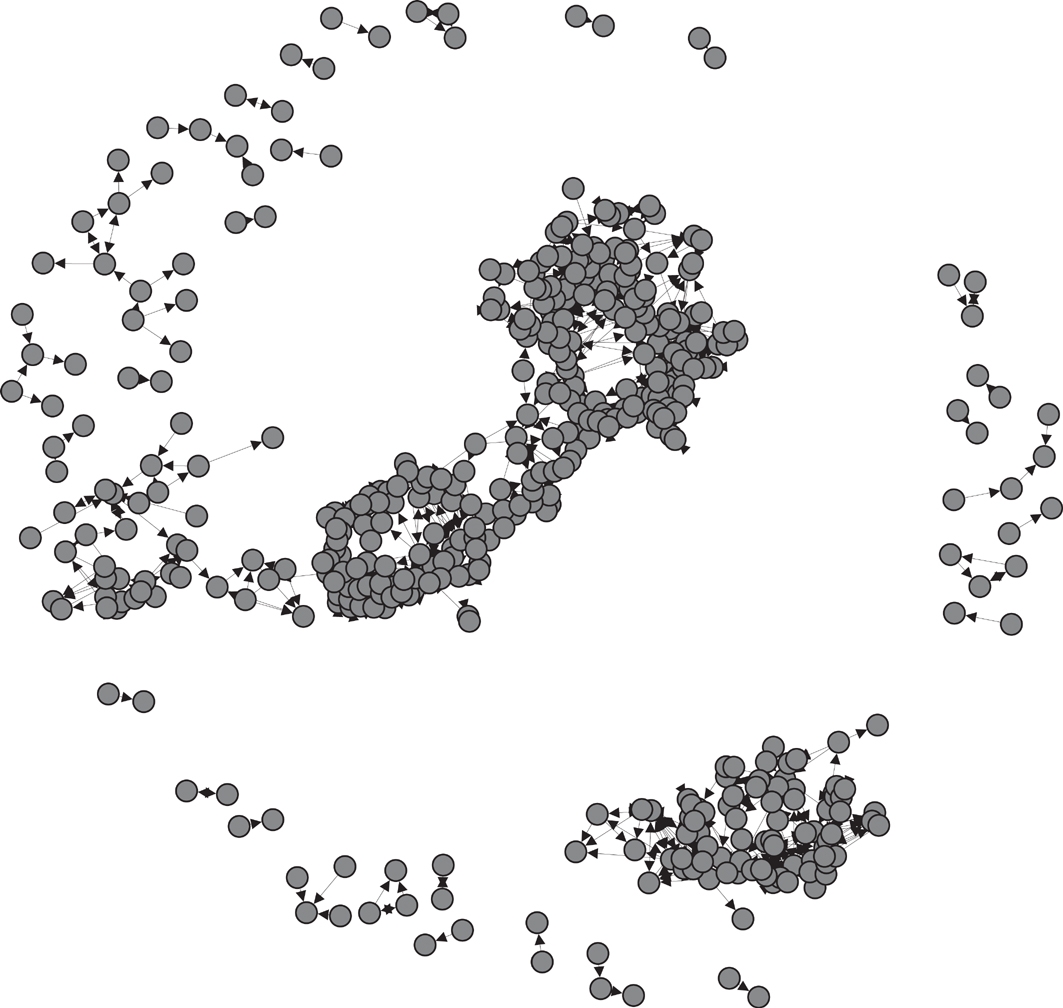
Figure 2 represents the captain-to-captain network of interactions that occurred in the pre-1776 period, commercial era of Company (1601–1775). Nodes represent captains, and ties represent instances, described earlier, in which exposure to recent information about a port via another captain and ship resulted in travel to that port. Ties are directed by the flow of information, indicated by arrows. Instances in which captains also received formal orders to travel to a destination port or had previously visited that port themselves are not included in this network as captains had alternative sources of information in those instances. In order to control for fixed traffic patterns, the networks also exclude any network ties associated with trips between ports in which the destination port is chosen 80 percent or more of the time from the current port location and, therefore, may have appeared in the data whether or not information was available about the destination port. Figure 2 represents all the interactions and is laid out using a spring algorithm that pulls more densely connected nodes closer together and pushes apart those with few connections in common. The image provides a physical representation of the structure of captain interactions. Clustering is evident but a number of tree-like branches also appear, indicating a possible lack of social closure mechanisms.
Network of Captain-To-Captain Ties

To assess rates of reciprocity, social closure, and group stability, we compare the actual network to a baseline network. A simple random graph is not an adequate comparison because it does not consider the opportunities for information transfer built into the pattern of ship traffic. We take a simulation approach that uses the existing structure of interactions to constrain the construction of network simulations, which then serves as our baseline comparison.Footnote 10 In the observed network, represented in Figure 2, many captains interact, but those interactions result in a tie (when a captain actually travels to a port from which they received recent information about via another captain) in only a minority of instances. The interactions that occur between captains in ports represent an even smaller minority of the total possible number of interactions that could have occurred between all captains—that is, a complete network. In a random network, ties are redrawn from the set of all possible pairs of individuals (i.e., dyads).
In the simulated network, we randomly choose ties between captains but restrict the pool from which they are chosen to those captain pairs that actually do interact, that is, sit at harbor together in a port. The simulation ties are drawn randomly from the set of captain-to-captain interactions that do occur, on an annual basis, at the same rate as they occur in the observed network. We then use these randomly constructed networks to evaluate the properties of the observed network. Thus, the artefactual structural properties of the network created by patterns of ship traffic—the properties that affect the quantity and location of information to which captains are exposed—are held constant across the observed and constructed networks.
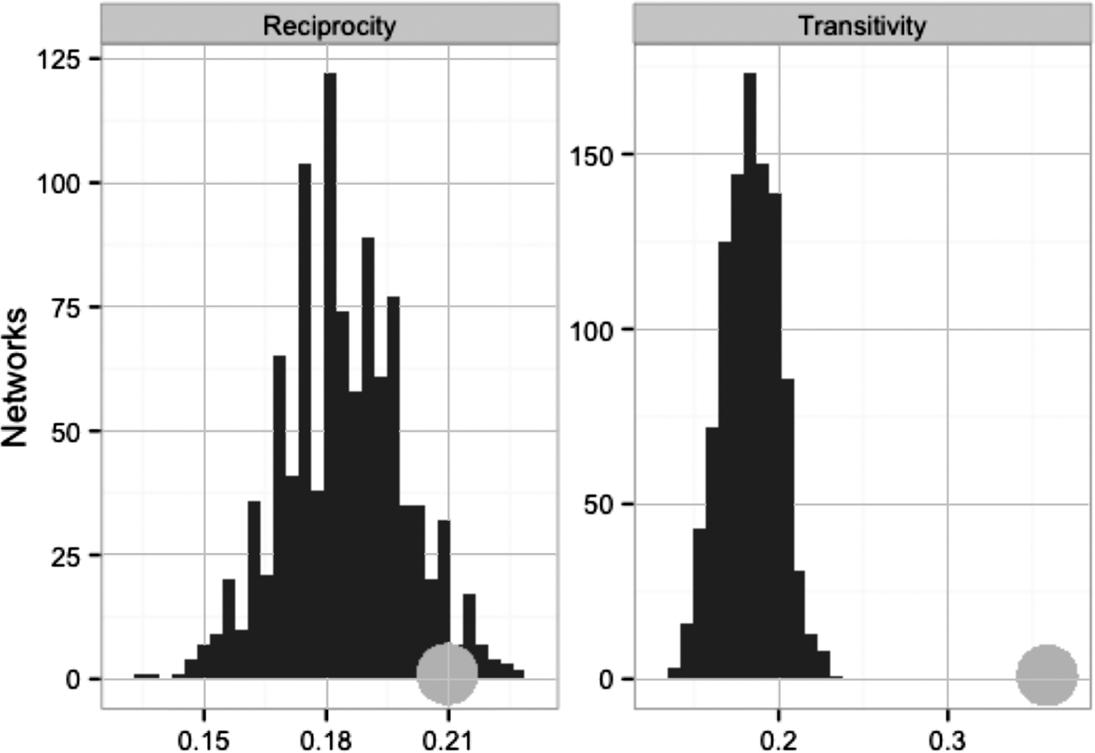
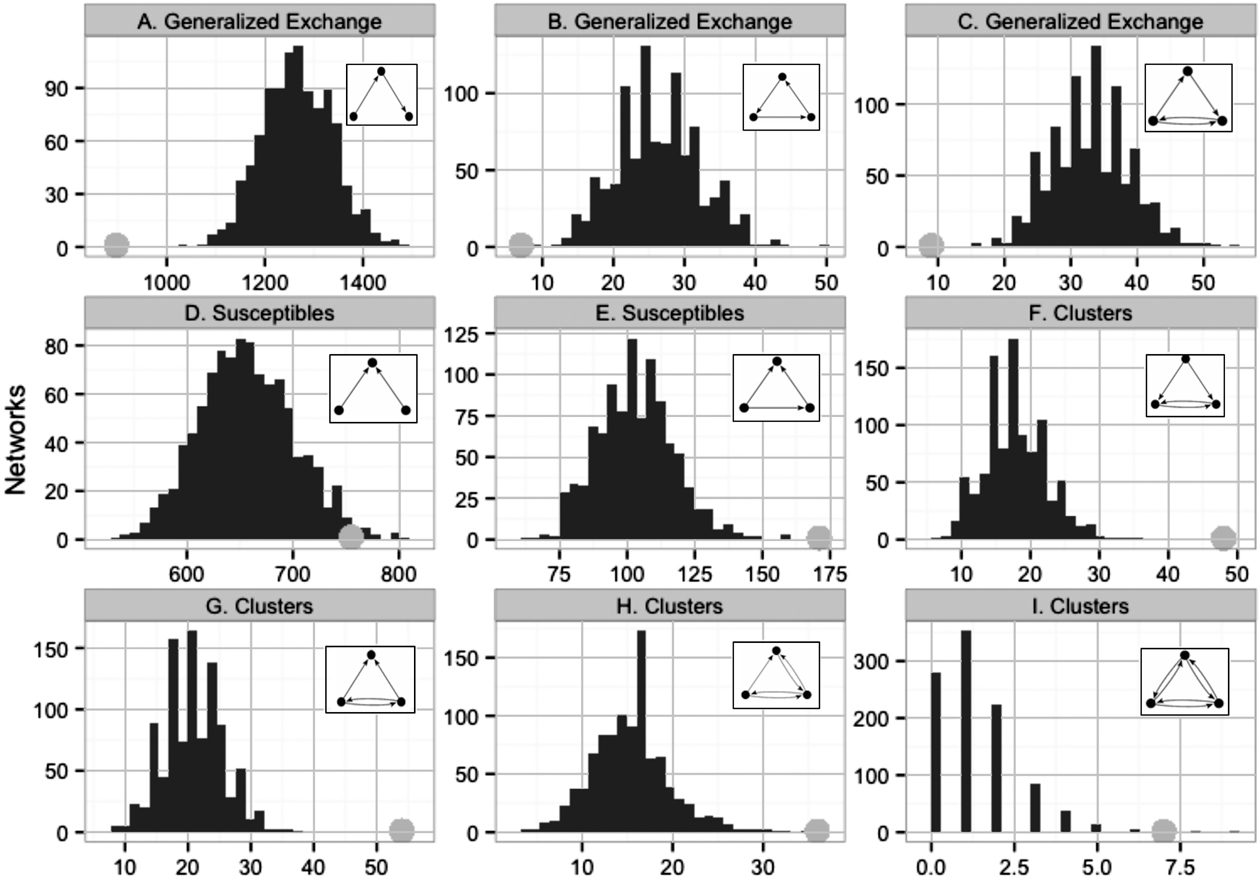
Figure 3 represents the results of comparing measures of reciprocity and transitivity across the observed captain-to-captain network and the binned distribution of results for 1,000 simulated networks. In Figures 3 and 4 the large gray circle represents the observed value, and the black bars represent the simulated values (which may be interpreted similarly to expected values). The x-axis gives the value of the statistic, and the y-axis represents the number of observations that returned that value. The observed value is one on the y-axis because there is only one observed network.
Observed and Simulated Measures of Reciprocal and Transitive Relationships

Observed and Simulated Measures of Triadic Configurations

Reciprocity is a measure of the proportion of ties that are reciprocated or the probability that when a tie from A to B is present, a tie from B to A will also be present. Reciprocity in the observed network, represented by the large gray dot, is 0.2097, meaning that, when there is a tie from A to B, in roughly 21 percent of the cases there is also a tie from B to A. As is evident in the first panel of Figure 3, the observed network shows little tendency towards greater reciprocity relative to that present in the simulated networks. In other words, the actual interactions between captains do not show more reciprocal exchange of information than what we would observe in a random network with the same physical constraints as the actual network. Panel 2 of Figure 3 presents average local transitivity, similar to the global clustering coefficient (Watts and Strogatz Reference Watts and Strogatz1998). Transitivity, which is one of our measures of social closure, calculates the probability that two neighbors of a node are connected and treats ties as undirected. The observed value is 0.3587, meaning that, when captain A has had an information exchange in either direction with captains B and C, in 36 percent of the cases there has been information exchange also between B and C in either direction. This second panel indicates that the observed network has higher rates of transitivity (or clustering) than would occur by chance.
Although Figure 3 implies a preliminary indication that small groups may be driving network transmission in Company’s trade, further investigation of the micro-structural properties reveals a different story. A triadic census provides a more detailed means by which to consider the micro properties of the network. A triadic census enumerates the number of different types of possible structural patterns between all groups of three nodes in a given network. It is particularly useful because the triad is the smallest level at which patterns of group interaction may be observed. In a directed network, there are 16 different possible patterns between nodes, ranging from a complete absence of ties between nodes to the fully connected triad in which all nodes are connected to each other node via reciprocated ties. Figure 4 displays the relevant results from the triadic census.
A typical marker of group cohesion and solidarity is a pattern of generalized exchange, where one individual takes information from another and passes information, possibly different information, along to another in the group (Bearman Reference Bearman1997). This type of exchange reduces the importance of pairs of individuals while simultaneously reinforcing group solidarity. Acts are reciprocated, but by the group rather than a specific individual—thus the pattern indicates a strong group presence and the likelihood that individuals are tied to the group rather than the individuals that compose it. Evidence of generalized exchange patterns within groups of three (triads) would indicate that small merchant groups were a significant factor in the informal transmission of information in this period; however, we find that triads with a pattern of generalized exchange have an unusually low rate of occurrence in the observed network as shown as a gray dot in Figure 4, panels A–C. Panels A though C present three different triad types that contain this generalized pattern of exchange. The small window near the top of each subfigure is a schematic of each structural type. As can be seen, directed arrows lead to and away from the top node in each instance, but not back and forth between the top node and either of the two other nodes. These are generalized exchange patterns measured for the target node, which is the node that occurs at the top of the triad; the measure is calculated so that each node in the network is evaluated as the target node relative to all possible pairs of other nodes that are in the network. Please note that the scale of the x-axis varies considerably across the different graphs as more densely connected triads occur at lower rates in both the observed and simulated networks.
In the observed network it is more common for a node to draw information from more than one source than to participate in a generalized exchange pattern. Figure 4, panels D and E present the results for triads where one captain had a high in-degree, that is, received information from a large number of other captains. These results indicate that a significant micro-level factor contributing to the density of the total network is an individual-level property. Triads in which one individual has taken information from more than one other individual occur in the observed network at nearly double the rate they occur in the simulated networks. This pattern suggests that individuals who received information from many other individuals, termed susceptibles, account for a large proportion of the density and cohesion of the observed network—as they connect otherwise disjointed actors.Footnote 11
Figure 4, panels F–I represent four out of seven triad configurations in which at least one connection occurs between each node pair. These are connected triads; they measure triadic closure, which refers to the fully-connected patterns of ties between nodes. Triadic closure, along with transitivity and generalized exchange patterns, is an important indicator of social closure and small-group cohesion at the micro-level. Unless patterns of generalized exchange are the norm (which we do not find), densely-embedded groups operating according to principles of social closure should contain large numbers of connected triads.Footnote 12 Panels F though I reinforce the finding that there is non-random propensity toward triadic closure, indicating small-group cohesion and potentially reputational processes that depend on social closure and dense groups. However, the number of connected triads is low overall—across both simulated and the observed networks. For example, the number of fully connected triads with strong reciprocal ties between all nodes that occurs in the observed network is only six more than the mean value of the random networks. Less frequent patterns have a relatively small cumulative impact on the network. Thus, there is not strong evidence of widespread prevalence of small-groups or patterns of social closure.
These patterns, of course, also have a temporal dimension, in particular the elapsed duration of time between the ties within triads. If densely connected small groups represent a coercive, sanctioning group process where individuals form and maintain reputations that enable long-term access to valued information, connected triads should arise over time and contain ties to others that occur over the span of careers—as individuals dip back into the pool of their trusted others. This pattern, however, is not evident in the fully connected triads, where it would be most likely to occur. There are four separate fully connected triads in the observed network (each is enumerated more than once in the census). Four connected triads contain 24 relations. Only four of these relations occur in a different year than the other ties within the triad, and these were in the year immediately prior to or following the year in which the other ties were formed. There are no cases in which additional ties between the involved nodes occurred before or after the relations that compose the observed triad. This finding suggests that the clusters neither represent nor translate into sustained cooperation between individuals over time.
In sum, our analysis of the network structure shows a limited tendency toward small group formation but does not indicate that reciprocity, generalized exchange, social closure, or other small-group processes encouraged the transmission of information between captains. Instead the most pronounced micro-structural pattern is one in which one captain takes information from more than one source. Generalized exchange patterns were extremely low, indicating that group processes were not paramount and reinforcing the finding that takers of information were more likely to take from another source rather than to give to another source.Footnote 13 The patches of high density information transfer that occur are not the result of long-term cooperation unfolding over time, but are instead a product of transient acts of collaboration. Thus, a historical narrative that posits a developmental period in which small merchant coalitions, reputational mechanisms, and network governance stabilize market operations prior to the development of more formal institutions does not seem to apply to information exchange in this period of early-modern trade.
Statistical Model
This structural analysis allowed us to evaluate the patterns of exchange. We are also interested in evaluating the importance of the strength of connections between a pair of captains, the strength of the formal institutions in enforcing norms of exchange, and uncertainty regarding the likelihood of a captain traveling to a particular port after getting access to information about that port via another captain. In order to capture these effects, we use a conditional logit discrete choice model.
Daniel McFadden (Reference McFadden1974) originally proposed the conditional logit to analyze the factors driving a decision made from a discrete set of alternatives. The conditional logit discrete-choice model allows us to consider the impact of exposure to information gathered through network interactions on travel to a port, as well as the factors that interact with exposure to information gathered through network interactions that make travel to a port more likely. The model centers its comparison on the decision made versus the decisions that could have been made. In this case, the model compares the port to which the captain chose to travel against the set of ports that were not chosen.
The conditional logit has a relatively straightforward structure. Given a set of M alternatives, a vector x ij of variables related to the jth alternative in the ith decision moment, and a vector β of coefficients, the probability of choosing alternative j is as follows:
 ${p_{ij}} = {{{e^{{x_{ij}}\beta }}} \over {\Sigma _{l = 1}^M{e^{{x_{ij}}\beta }}}}$
The estimation is maximum likelihood, that is, choosing the vector of coefficients to maximize the probability of the observed choices.
Variables
Travel to a Port
The outcome variable is travel to a port. We estimate the likelihood that certain conditions will encourage travel to a particular port out of a set of alternative ports. When a captain was on a voyage from England to Asia and back, they made multiple stops on each voyage. At each port, there was considerable flexibility in choosing the next port.Footnote 14 We model this choice. The model requires the specification of a set of ports that were potential destinations. Beginning with the full set of ports east of the Cape of Good Hope recorded in the Company ship logs, we exclude ports based on two criteria. First, we exclude any ports that were never visited from the current port, whether due to distance, currents, winds, or other reasons. For example, if Aden never appeared as the next port following Hong Kong in the ship logs, we exclude Aden from any choice set involving a captain in Hong Kong. Second, we exclude each port not visited more than five years prior to the first recorded visit to that port and more than five years after the last recorded visit to that port. These ports may not yet have been established, may not have been known to the British, or may have been commercially uninteresting. Each observation within the case (a choice of next port made at an intermediate port) then is a potential next port that the captain could have chosen and the dichotomous dependent variable indicates which port was chosen.
Information through Peer Interactions
To assess conditions that encouraged the transfer of information between captains, we must first establish a method for measuring information exchange between captains. For that purpose, we constructed the variable information through peer interaction (peer information), which is a voyage and port-specific dummy that captures an interaction between captains that provided an opportunity for the information transfer between the two. Let k indicate the focal captain’s ship on its current voyage, i indicate the port where the ship is currently docked, and J indicate the set of possible next ports. Then, the variable peer informationijk for each j ∈ J is one if k encountered another ship in port i that had traveled to port j earlier in its current voyage. If there was no information available about the possible destination port via other ships co-located at the current port, the variable is given a value of zero. The variable is dichotomous, so additional or repeated information about a particular port does not increase its value over one.Footnote 15
To refer back to the example of the Hawkesbury and the Airly Castle, once at Surat the Hawkesbury may travel Surat-to-Malacca, Surat-to-Goa, or Surat-to-Madras. The peer information variable for the Hawkesbury’s potential Surat-to-Malacca and Surat-to-Madras trips would be zero since no information was available about these ports from the Airly Castle. The peer information variable for Surat-to-Goa would be coded one as the Hawkesbury was exposed to information about Goa via the Airly Castle. The peer information variable for the Airly Castle’s potential trip of Surat-to-Madras would also be coded one because the variable captures the potential for captains to act on information; however, in this case the dependent variable, travel to a port, would be coded zero.
We further break down peer interactions into three different types: information through peer encounter interaction (encounter information), information through activated peer interaction (activated peer information), and information through experienced peer interaction (experienced peer information). Encounter information captures the potential for information transfer about a port from a captain on whose information the focal captain has never acted. Activated peer information captures instances in which the focal captain had previously chosen to go to a port about which the other captain had brought information; in these cases, the data indicates that information exchange had already occurred between the two focal captains.
Activated peer information and encounter information are mutually exclusive categories on a per interaction basis, where encounters are instances in which a captain was exposed to information via another captain and had not previously acted on information provided by that captain. Captains, however, can encounter more than one captain at a port. Thus, the variables can both take the value one at the same decision moment if the focal captain received information about a port from a captain with whom he had a prior information exchange and, at the same time, received information about the same port from another captain from whom he had not had a prior exchange.
Experienced peer information is a dichotomous variable indicating the experience level of the other captain in a network exchange. Since reputation takes time to develop via repeated interactions or demonstrations of responsible behavior, this is a possible indicator of the salience of reputation. We also expect status to increase with experience. Although the results hold for a continuous measure of experience, we use a binary measure to increase comparability with the other central variables of interest. We considered captains on their third or later voyage as experienced, but the results were substantively similar if we used the second or fourth voyage as the cutoff.
Uncertainty
We capture uncertainty with two variables: war and first voyage. In times of war, the movement of enemy ships and potential capture of friendly ports introduced an even more pronounced element of dynamism of overseas trade. There was a greater need for updated information on safe passages and ports. There were several wars between European powers during the period, as well as wars with Asian powers. The dummy variable, war, indicates whether Britain was at war with France, Holland, or both and excludes confrontations with Asian powers, which were confined to land battles and, therefore, had limited impact on the passage of ships. The data was gathered from the Great Powers Wars Dataset (Levy Reference Levy1994). The variable war has a single value in any given year and is the same across all captains and ports.
Captains without prior experience in the Eastern trade would also have lacked important information produced through first-hand knowledge and thus been subject to greater uncertainty. First voyage is a dummy variable that takes the value one if this was the first voyage for that particular captain. Captain experience is likely to accumulate non-linearly over careers with the first completed voyage being the most important. Hence, we measured captain experience by comparing those captains on their first voyage with captains on later voyages.
Control Variables
Additionally we control for a set of variables that could have been driving the choice by a captain to go to particular port and potentially confound our estimates. There are two main concerns: First, some ports were simply more accessible, more important, and better known than other ports, and hence we could conflate a captain’s choice to go to one of those ports with our network information measure. Second, while sources of information outside of peer networks were limited, they were not absent. In particular, the London head office frequently directed the captains to specific ports. The captains also developed their own knowledge of ports through travel, and knowledge of some target ports may have been common knowledge in the current port.
We use target port fixed effects to control for the fact that some ports may have been more easily navigable or better trading ports. These are fixed effects for each port in the choice set. We control for the distance between ports (measured in kilometers) from the current port to each of the alternative ports, as captains were both more likely to go to a port that was closer and also to receive information from that port.Footnote 16 The conditional logit is based around choice contexts. Fixed effects for each choice context are included in the model that control for the time period, the current port i, and the captain. These effects capture, for example, the season in which the trip takes place. We cannot estimate separate coefficients for captain, season, and current port as they are fully collinear with the fixed effect included for the choice context. The fixed effects we do include capture more than these separately estimated effects would capture in any case.
The variable formal orders captures whether the captain received orders from the principals in London to travel to a destination port or not. This is a dichotomous variable. Personal experience controls for the likelihood that captains preferred to travel to ports to which they themselves had already traveled, either because of their increased knowledge of the ports, business contacts, or other issues. This variable is also dichotomous and indicates whether a captain had previously been to the potential destination port.
Some ports were more easily accessible from the current port due to winds and currents but also may have been better known in the current port at the particular time. We control for this by measuring the traffic between the current port and the target port in question in a ten-year interval, lagged by one year. That is, we count the total traffic from the current port P1 to each alternative P2 in the choice set from t-1 years to t-10 years. This is represented by port-to-port traffic. The focal captain could have also learned about the ports from other captains in London prior to his departure or during his visit to other ports prior to the current one. We control for this by measuring the total number of visits to each target port in a ten-year interval, lagged by two years, that is, from t-2 to t-11. This is represented in target-port traffic. The lag of two years was chosen to measure the information transmission back in London prior to departure or in other ports earlier on the same voyage. Information about more recent visits by other captains to the target port was most likely to come through meeting those captains in the current port. The duration of ten years for both variables was chosen as the best fit to the data after trying 5, 7, 10, 12, and 15-year durations. The results were substantively similar across the durations.
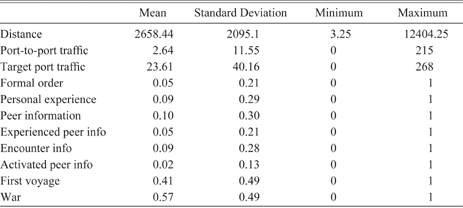
Table 1 presents the descriptive statistics for all variables. There are a few things to note. First, the average distance between ports is quite high and also has a high standard deviation. Trips were made across a wide range of distances. The high standard deviations for the traffic variables indicate that a few ports were far more popular than the others, a fact controlled for by these variables in our regressions. In the raw data, it also appears that acting on peer information was in fact more common than acting on formal orders or prior personal experience, but a full regression analysis presented later tells a more nuanced story. It was also more common, in the raw data, to act on information from new encounters than from prior encounters or very experienced peers. It should also be noted that careers of the captains indeed were short and a full 41 percent of the port-to-port trips were taken by captains on their first voyage out of the United Kingdom to the East. War between the United Kingdom on one hand with either France or Holland was very common. Fifty-seven percent of port-to-port trips were taken during war time (not that 57 percent of the time there was war).
Descriptive Statistics

Source: Authors’ calculations based on dataset described in Statistical Model section.
Results
Institutional Analysis
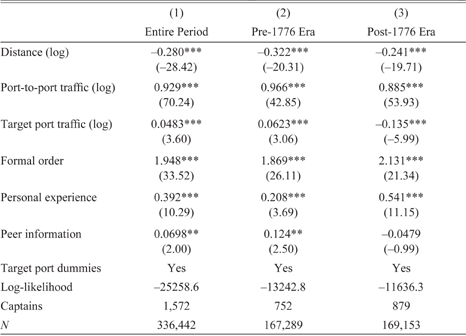
In Table 2, we present the first set of results in which we consider the effect of increasing institutional strength. Model 1 uses the entire sample. As might be expected, captains were more likely to go to nearby ports, currently popular ports, ports to which they were ordered to go, and ports to which they had been in the past. There is also a network effect: captains were more likely to go to a port if they encountered another captain who had earlier on the same voyage been to that port. The estimated coefficient for peer information is 0.0698. Since this is a dichotomous variable, it indicates approximately a 7.2 percent increase in the odds of travel to a port (e 0.0698 ~ 1.072) when exposed to information via another ship versus not being exposed to information via another ship. The effect appears small relative to the effects of formal orders and personal experience, but we have to remember that this is the net effect after controlling for all other factors. The information from peers effectively led captains to go to ports that they were not ordered to go to and where they had not been before and that were not the most popular routes or the closest alternatives. Given this, the effect size appears quite large to us.
Conditional Logit Regressions to Compare Eras

* p < 0.10
** p < 0.05
*** p < 0.01
The figures in parentheses are t-statistics, based on robust standard errors clustered by captain. These are the results of conditional logit estimations where each case is a captain leaving a port and choosing to which port to go next. The control variables cover distance between the current port and each alternative, the recent ship traffic from this port to each alternative, the overall traffic at each alternative port, for each alternative port a dummy indicating whether the focal captain was ordered to go to that port and a dummy indicating whether the same captain had been in the port in the past. The key variable peer information indicates for each alternative port whether the focal captain in the current port encountered another captain who had recently visited that port.
Source: Authors’ calculations based on dataset described in Statistical Model section.
As indicated earlier, the institutional control in the Company changed with the acquisition of the colonial possessions. These allowed the principals in London a different source of income, namely taxation of those possessions, and thus changed the bargaining power between the captains and the principals. In 1776 the directors forbade the captains to deviate from their routes. Model 2 considers the era before 1776 when the institutional control was weaker and captains had greater freedom to legitimately craft their voyages. The results are similar except the peer information coefficient is larger. The estimation now suggests a 13.2 percent increase in the odds of travel to a port when meeting another captain who had recently visited that port. Model 3 presents the results for era from 1776 and shows increasing institutional strength. Captains were less likely to go to nearby ports or to popular ports and more likely to go where they were ordered and to other ports they had been to in the past. Notably, the coefficient of personal experience of a port nearly triples in size relative to the pre-1776 model, suggesting that captains were significantly more likely to visit ports they knew well and less likely to explore new ports. The peer information coefficient, in contrast, becomes insignificant and mildly negative, suggesting that captains were not acting on current information carried by other captains. When traveling to ports other than their formal destination, captains still desired to make informed choices; however, they were less likely to seek that information through informal peer interactions or hearsay about popular ports. This shift is particularly interesting because the increased volume of traffic would have also resulted in an increased flow of information about ports.Footnote 17
Combined, these results suggest that the weak institutional environment of the Company during the pre-1776 era encouraged information exchange between captains, whereas the greater institutional control during the colonial era discouraged that exchange, perhaps by reducing the captains’ ability to act on the information supplied by other captains. This shift cannot be due to the accumulation of knowledge over time as we are considering information about recent market conditions.
Uncertainty and Tie Strength
In additional models we consider the impact of uncertainty (war and first voyage) and use the disaggregated measure of social network interactions to further evaluate the role of repeated interactions. We want to evaluate whether uncertainty affected information exchange, using interaction terms. That is, to see if first voyage influenced the use of peer information, the product peer information x first voyage is estimated. When interpreting the table readers will note that the main effects for war and first voyage are not included even though interactions with these variables are present. The conditional logit model conditions on the characteristics that are common across all choices and only alternative-specific variables can directly enter the regression as there is a fixed effect for each choice situation. In a conditional logit model we are predicting which alternative, in this case a port, out of a set alternatives is chosen and hence variables that have the same value for all alternatives cannot be estimated, as they are fully collinear with the fixed effects. In our case, the variables that do not vary within each choice set include those related to voyages. Therefore the “main effects” of first voyage and war cannot and should not be estimated in the regressions.
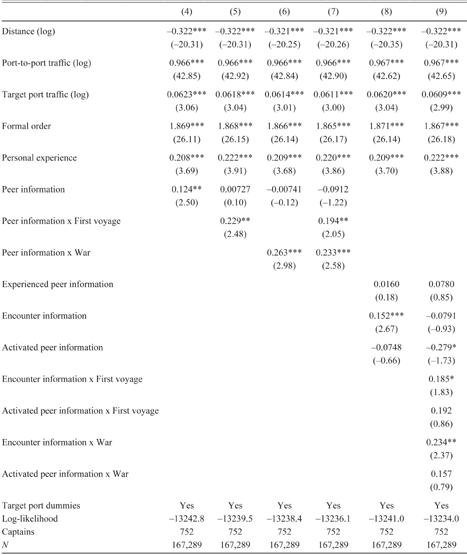
Table 3 presents the results from the regressions for the pre-1776 era when networks were active in the Company. Model 4 gives the baseline estimation and is a replication of Model 2, Table 2. Model 5 includes the interaction term between peer information and first voyage. The interaction is significant, while the main effect of peer information is not. The results indicate that this type of information exchange is largely driven by uncertainty on the part of captains early in their careers. As the logit model is linear in log odds, the interpretation of the interaction is straightforward as a multiplicative factor for the odds of going to a port. However, interpreting it as a marginal increase in the probability is more involved and as an alternative estimation, we split the sample according to the values of first voyage and war to avoid interactions and provide the results in the Online Appendix. For a captain on his first voyage, receiving information about a port from a peer increases the odds of going to that port by 27 percent (e 0.00727+0.229 ~ 1.2665) while for a captain on a later voyage the effect is effectively zero (e 0.00727 ~ 1.0073 and insignificant). Model 6 includes war and produces a similar result. The interaction effect is significant while the main effect of peer information loses significance, indicating that uncertainty is driving the information exchange. During times of war, receiving information about a port from a peer increases the odds of going to that port by 29 percent (e -0.00741+0.263 ~ 1.2912), while during peace time, the effect is zero (e 0.00741 ~ 0.9926 and insignificant). Model 7 includes interactions between peer information and both measures of uncertainty, first voyage and war. The results are consistent with previous models, confirming that spuriousness caused by correlations between the variables is not an issue. Information exchange appears highly driven by conditions of uncertainty.
Conditional Logit Regressions on Effects of Uncertainty

* p < 0.10
** p < 0.05
*** p < 0.01
The figures in parentheses are t-statistics, based on robust standard errors clustered by captain. These are the results of conditional logit estimations where each case is a captain leaving a port and choosing to which port to go next. The control variables cover distance between the current port and each alternative, the recent ship traffic from this port to each alternative, the overall traffic at each alternative port, for each alternative port a dummy indicating whether the focal captain was ordered to go to that port and a dummy indicating whether the same captain had been in the port in the past. The key variable peer information indicates for each alternative port whether the focal captain in the current port encountered another captain who had recently visited that port. We break this later into experienced peer information, if the peer was an experienced captain, encounter information, if the focal captain had not acted on information from that peer in the past, and activated peer information, if the focal captain had acted on information from that peer in the past. We measure uncertainty through first voyage that indicates whether this is the first voyage of the focal captain and war that indicates whether Britain was at war with either France or Holland.
Source: Authors’ calculations based on dataset described in Statistical Model section.
In Model 8, we divide the network variable into 3 categories: encounter information, activated peer information, and experienced peer information. Neither experienced peer interaction or activated interaction (i.e., the reoccurrence of information exchange between captains) are significant. Encounter information—information exchange without a previous history of exchange—is significant, providing further evidence that factors other than reciprocity and network governance were driving information exchange.
If reciprocity and trust encouraged information exchange, we should see repeated exchange in the form of a significant coefficient for activated peer information. It is important to stress that captains often repeatedly use social networks; however, they do not often draw information from the same captain more than once. Thus, this is not evidence of a tendency to avoid repeated use of networks altogether. It is also true that captains who use networks on their first voyage return to the trade for a second voyage at a slightly higher rate than captains who do not, so there is no evidence that bad information is driving captains out of the trade: 53 percent of captains who used networks on their first voyage returned for a second voyage compared to 50 percent of those who did not use networks on their first voyage. Long-term dyadic relationships thus do not appear to be a central mechanism fostering the exchange of information.
Experienced peer information is not significant. Since reputation and status should build over time as captains participated in the trade, we should expect to see more experienced captains hold more sway over others; however, the insignificance of experienced peer information suggests that this is not the case. Instead encounter information is the only significant coefficient. Indeed, the coefficient for encounters is larger than the aggregated measure of the impact of peer information. Model 8 thus provides additional confirmation of the absence of network governance in the information exchange network.
Model 9 adds interactions between first voyage and war with the encounter information, activated peer information, and experienced peer information. Once again, the results provide evidence of the importance of uncertainty. Interactions between encounter information and first voyage and war are significant while the significance of the main effect of encounter information is lost.
An important caveat to our research findings is that we have only limited biographical information on captains, thus it is possible that other small-group networks intersected with the network we observe, and we are therefore capturing only portions of persistent small-groups that did exist but overlap the boundary of our data. However, the limited information we have to test this hypothesis does not bear it out. Captains are not more likely to use information from other captains with the same surname or same ship owner.Footnote 18 More importantly, although it is extremely plausible that external networks of relations would have served as the basis of reciprocal relations, social cohesion, or durable groups of connected captains, we do not observe these patterns in the trade itself. This is to say, if kinship ties acted as a significant constraint channeling information flow, we should see evidence of that in strong and persistent dyadic relations whether or not we are able to observe that the two individuals were related. We cannot rule out the existence of these other networks, but can argue that they did not produce generalized exchange, reciprocity, or stable small-groups in this instance of early modern information exchange.
Conclusion
Our results provide strong evidence that information exchange was not driven by small groups or strong institutions, but instead by conditions of uncertainty. The information was not constrained by small groups, reciprocity, or generalized exchange patterns. Reciprocity and generalized patterns of exchange (A=>B=>C=>A) are lower than expected by chance given the structure of encounters. The connected triads that do take shape in the network are not durable; they quickly disband and disperse, typically within one trading season. Increasing institutional strength also is not associated with increases in information. Instead the opposite is true: information exchange declined with increasing institutional strength. The most robust predictor of information exchange is increased uncertainty.
Our findings begin to delimit the importance of relational and formal governance processes in information exchange in early modern trade. Neither appear to have encouraged informal information exchange; instead increasing institutional strength is associated with decreasing rates. Thus, the network approach, which is open to investigating a wide array of factors that can encourage exchange and cooperation at the dyadic level, provides a better framework for interpreting our results than the more narrow, but also logically-tighter framework of transaction cost analysis, which assumes the necessity of monitoring and sanctioning.
With regards to the history of the English East India Company, we find that in the pre-1776 period of weak institutions English captains were surprisingly cooperative with each other. Company owners of the time recorded fears that captains and employees were actively colluding against their interests. Despite these fears, we find little evidence of such conspiracies. Thus, the agents were better behaved than their employers expected. What is perhaps particularly intriguing is that the cooperative relations between socially distant actors is also in line with historical research showing that prior to the nineteenth century, Company employees and merchants also cooperated more with Asian merchants in what is known as the age of partnership (Furber Reference Furber1969; Kling, Pearson, and Furber Reference Kling, Pearson and Furber1979).
There is a sense in which these results are not out of line with basic market expectations. Increased demand, in the form of uncertainty, led to increases in rates of exchange. It is not surprising that the increasing institutional strength of the Company dampened informal information exchange because the institutions was also attempting to delegitimize the practice of private trade that both generated and created the need for information. The findings then emphasize that the increased formal strength of early modern political institutions (such as the colonial governance of the Company) did not always work to the advantage of market efficiency and expansion. The result is also in line with research that shows that coercive institutions can, under certain circumstances, undermine trust formation processes (Ingram and Lifschitz Reference Ingram and Lifschitz2006; Gellner Reference Gellner1988), but does not undermine arguments about the positive impact of institutions when they are not also delegitimizing types of market activity that had positive spill-over effects—such as the private trade’s effect on information sharing. We do, however, believe that there is another social component to the process of encouraging information exchange in this context, which does not rely on monitoring and sanctioning, but instead provides a platform for group social interactions.
The factory system served as a mixing device bringing otherwise disconnected individuals into close contact with each other while simultaneously maximizing exposure to relevant information about the trade in English private goods (by concentrating the exposure of captains to other English private traders, who were in fact employees of the Company). This infrastructure encouraged a diversified flow of information within the trade system. Thus, the research also bears upon our understanding of the role of companies, commercial organizations, and factories in the development of global capitalism. We cannot properly evaluate the role of the factory system in encouraging information exchange as it does not vary in our context, however, the results are suggestive. Thus, our research suggests that work on the role of governance in encouraging exchange may be supplemented by work that considers the endogenous emergence of commercial cooperation through the creation of interactional spaces that facilitate information exchange between a diverse and shifting group of market actors.