





Introduction
Depression represents the most prevalent mental disorder in adolescent population. Clinically, adolescent depression often presents with features that may differ from classic adult presentations. According to the DSM-5, irritability is a core diagnostic feature of depression in adolescents (American Psychiatric Association, 2013; Malhi et al., Reference Malhi, Byrow, Fritz, Berk and Berk2017), whereas emotional instability and impulsivity – while commonly observed in this population – may be more closely associated with co-occurring conditions such as nonsuicidal self-injury (NSSI) or emotion dysregulation rather than being direct core symptoms of depression itself (Apicella et al., Reference Apicella, Pontillo, Maglio, Di Vincenzo, Della Santa, Andracchio and Vicari2025; He et al., Reference He, Huang, Xu, Yu, Huang, Yang and Yang2025; Kweon, Reference Kweon2026; Liu et al., Reference Liu, Zhang, Li, Yang, Du and Dong2025), which are frequently triggered by academic pressure, interpersonal conflicts, and other psychosocial stressors (Kessler et al., 2007). Due to ongoing cognitive development and a deficit in adaptive emotion regulation strategies, affected adolescents may resort to nonsuicidal self-injury (NSSI) as a maladaptive mechanism to alleviate acute psychological distress (Hasking, Whitlock, Voon, & Rose, Reference Hasking, Whitlock, Voon and Rose2017). NSSI is defined as the deliberate, self-inflicted destruction of body tissue without suicidal intent (Mcshane, Reference Mcshane2012), encompassing behaviors such as cutting, biting, burning, and head banging. Recent epidemiological studies indicate that approximately 15%–17% of adolescents worldwide report a lifetime history of NSSI (Liu et al., Reference Liu, Chen, Bo, Chen, Li, Lv, Jia and Liu2018; Swannell et al., Reference Swannell, Martin, Page, Hasking and St John2014), with a comorbidity rate as high as 51% (95% CI: 46%–56%) among those diagnosed with depressive disorders (Zeng et al., Reference Zeng, Chen, Wang, Zhang and Deng2019). The chronic NSSI is associated with significant personal distress and functional impairment, and poses challenges for families and healthcare systems (Murray et al., Reference Murray, Atkinson, Bhalla, Birbeck, Burstein, Chou and Murray2013), underscoring an urgent need for effective interventions as highlighted by healthcare systems and policymakers.
The advancement of the biopsychosocial model in medicine has established psychological therapies – including cognitive behavioral therapy (CBT), dialectical behavior therapy (DBT), and transference-focused therapy – as first-line interventions for NSSI (Lawton & Moghraby, Reference Lawton and Moghraby2016). However, their applicability in adolescent populations is often limited. These interventions can exhibit high specificity to certain clinical groups and face significant implementation challenges (Kernberg & Yeomans, Reference Kernberg and Yeomans2008; Linehan & Wilks, Reference Linehan and Wilks2015; Taylor et al., Reference Taylor, Oldershaw, Richards, Davidson, Schmidt and Simic2011; Walton et al., Reference Walton, Bendit, Baker, Carter and Lewin2020), which may reduce their accessibility and feasibility for adolescents in crisis.
Mindfulness-based cognitive therapy (MBCT), which was originally developed for the prevention of depressive relapse (Hofmann & Gómez, Reference Hofmann and Gómez2017), integrates core principles of CBT with structured mindfulness and meditation practices. This therapeutic approach has gained significant endorsement as a recommended intervention from major clinical guidelines, including those issued by the UK National Institute for Health and Care Excellence (NICE) (Luxton & Kyriakopoulos, Reference Luxton and Kyriakopoulos2022), the Canadian Network for Mood and Anxiety Treatments (CANM AT) (Lam et al., Reference Lam, Kennedy, Adams, Bahji, Beaulieu, Bhat, Blier, Blumberger, Brietzke, Chakrabarty, Do, Frey, Giacobbe, Gratzer, Grigoriadis, Habert, Husain, Ismail, McGirr and Milev2024), and Chinese guidelines for the treatment of depressive disorder (Lingjiang, Reference Lingjiang2016). The rising profile of mindfulness has consequently spurred its wider application in both school and clinical settings for adolescents. A growing body of research demonstrating its benefits in enhancing key domains such as executive function, attentional control, emotional regulation, and impulse management (Dumontheil, Lyons, Russell, & Zelazo, Reference Dumontheil, Lyons, Russell and Zelazo2023; Porter et al., Reference Porter, Oyanadel, Sáez-Delgado, Andaur and Peñate2022). Notably, higher frequency of mindfulness practice has been positively associated with greater well-being in adolescents (Scafuto et al., Reference Scafuto, Ghiroldi, Montecucco, De Vincenzo, Quinto, Presaghi and Iani2024; Tudor et al., Reference Tudor, Maloney, Raja, Baer, Blakemore, Byford, Crane, Dalgleish, de Wilde, Ford, Greenberg, Hinze, Lord, Radley, Opaleye, Taylor, Ukoumunne, Viner and Montero-Marin2022). Furthermore, a cost–benefit analysis indicates that school-based mindfulness programs represent a promising public health investment, with modeling suggesting that an annual investment of £20,000 could potentially achieve 83% rate of mental health recovery among students (Kuyken et al., Reference Kuyken, Ball, Crane, Ganguli, Jones, Montero-Marin, Nuthall, Raja, Taylor, Tudor, Viner, Allwood, Aukland, Dunning, Casey, Dalrymple, de Wilde, Farley, Harper and Williams2022).
Cross-sectional studies indicated that adolescents with depression and NSSI tend to exhibit poorer emotion regulation, lower mindfulness, and greater impulsivity (Thomassin, Quint, Sezlik, & Shaffer, Reference Thomassin, Quint, Sezlik and Shaffer2017). MBCT targets these deficits by fostering present-moment awareness, acceptance, and a nonjudgmental attitude, which can help disrupt cycles of rumination and improve coping skills. With sustained practice, MBCT may also reduce reliance on medication, directly mitigate NSSI behaviors, and support functional recovery. To the best of our knowledge, no randomized controlled trial (RCT) has yet examined the efficacy of MBCT specifically for adolescents with depression undergoing NSSI. Therefore, this study aims to compare MBCT plus treatment-as-usual (TAU) with TAU alone, testing the hypothesis that MBCT leads to a reduction in NSSI behaviors. Secondary outcomes will include anxiety and depression symptoms, risk behaviors, emotion regulation, life satisfaction, resilience, rumination, coping styles, and mindfulness.
Materials and methods
Study design and participants
Randomization and masking
This RCT was conducted among hospitalized adolescents to compare two intervention groups: MBCT combined with treatment-as-usual (MBCT + TAU), and treatment-as-usual alone (TAU-A). Participants were recruited from the Child Psychiatry Department of Peking University Sixth Hospital between March 2023 and March 2024. Recruitment occurred through referrals made by psychiatrists, who were not otherwise involved in the study, while the potential participants were already receiving TAU. Notably, the ongoing TAU protocol explicitly excluded any form of psychotherapy or counseling at the time of recruitment.
All potential participants completed a three-stage screening process to determine eligibility. First, preliminary screening was conducted via telephone or face-to-face interview by a trained nursing graduate student (X.J.J.), using a structured questionnaire to assess illness stability, suicide risk, and willingness to participate voluntarily. Subsequently, the diagnoses of depressive disorder and NSSI were independently verified by attending psychiatrists in accordance with DSM-5 diagnostic criteria. Finally, the same nursing graduate student applied the full set of inclusion and exclusion criteria for the final eligibility determination and obtained informed consent from all included participants.
Eligibility criteria
Inclusion criteria. Participants were required to meet all of the following criteria: (a) age 13–18 years; (b) meet DSM-5 diagnostic criteria for a depressive disorder and for NSSI, and have been on a stable selective serotonin reuptake inhibitor (SSRI) regimen for at least 4 weeks; (c) have not received any form of psychotherapy in the 3 months prior to enrollment; (d) possess normal cognitive function and fluency in Mandarin Chinese; clinically judged by the attending psychiatrist to have sufficient cognitive and linguistic ability to understand and participate in the group intervention and complete self-report assessments; and (e) provide written informed consent from a legal guardian and express willingness to comply with the trial protocol.
Exclusion criteria. Individuals were excluded if they met any of the following conditions: (a) presented with current psychotic features or recent suicidal behavior within the past week, as indicated by a score of ≥3 on item 2 (suicidal ideation) of the 24-item Hamilton Depression Rating Scale (HAMD−24) (Hamilton, Reference Hamilton1959); (b) had a comorbid diagnosis of another major psychiatric disorder (e.g. bipolar disorder, schizophrenia), active substance dependence, a significant neurological condition, or a severe, unstable systemic illness.
Withdrawal criteria. Participants could be withdrawn from the trial at the investigator’s discretion for any of the following reasons: (a) nonadherence to the trial protocol or intervention sessions; (b) experience of a severe adverse event deemed related to the study; (c) significant clinical deterioration requiring immediate alternative intervention; (d) voluntary withdrawal of consent by the participant or their guardian; or (e) participation duration of less than 2 weeks, rendering outcome assessment nonmeasurable.
This randomized, single-blind study employed a computer-generated randomization sequence produced by an independent statistician, who was not involved in participant recruitment or assessment. An unstratified block randomization method with variable block sizes of 4–6 was used to ensure balanced group allocation over time. To maintain allocation concealment, the generated sequence was securely placed inside sequentially numbered, opaque, sealed envelopes (SNOSEs), each containing an assignment card.
After obtaining informed consent, trained interventionists, who were responsible for delivering the therapy, sequentially opened these envelopes in the order of participant enrollment to reveal the group assignment. Each allocation was immediately documented. Participants were informed of their assigned group (either MBCT + TAU or TAU-A) immediately following randomization. They were also told that both intervention approaches were designed to help reduce self-harm behaviors and alleviate emotional distress. Participants who accepted their assignment were instructed to await further contact and scheduling details from the research team.
The complete participant flow, from screening to analysis, is detailed in Figure 1. All randomization and allocation procedures were designed and reported in strict accordance with the Consolidated Standards of Reporting Trial (CONSORT) guidelines for clinical trials.
Participants flow chart.

Figure 1. Long description
The flowchart is organized into four main vertical stages, with side labels on the left.
1. Enrollment and Randomization tier.
- Side label: randomization interview.
- Top box: Enrollment.
- Second box: Satisfy the diagnostic criteria for depression and N S S I according to D S M 5, as diagnosed by attending physician or above.
- Third box: Enrolled and randomly assigned, and signed informed consent on a Monthly. Establish a suicide prevention agreement.
2. Baseline Assessment tier.
- Side label: Baseline assessment.
- The flow splits into two groups.
- Left: M B C T plus T A U A group n equals 48.
- Right: T A U A group n equals 46.
- A dashed box to the right indicates: basic demographics data and primary or secondary outcome measures.
3. Post-intervention Evaluation tier.
- Side label: post-intervention evaluation.
- Left path: withdraw consent n equals 0 leads to Intervention group completed the evaluation after intervention n equals 48.
- Right path: withdraw consent n equals 3 leads to Control group completed the evaluation after intervention n equals 43.
- A dashed box to the right indicates: primary or secondary outcome measures.
4. Follow-up Visits Evaluation tier.
- Side label: Follow-up visits evaluation.
- Left path: out of contact n equals 26 leads to Follow-up visits at 1 month n equals 22.
- Right path: out of contact n equals 26 leads to Follow-up visits at 1 month n equals 17.
- A dashed box to the right indicates: primary outcome measures.
5. Final Analysis.
- Both paths converge at the bottom box: Two-person collection statistical analysis primary outcome I T T plus P P, secondary outcome P P.
To preserve the integrity of the trial, blinding procedures were rigorously implemented at multiple levels. Research personnel involved in participant management remained unaware of group allocations. Outcome assessments were conducted by independent evaluators who were blinded to treatment assignments. Furthermore, the principal data analysts were kept blind to participant group identities until the primary outcome analyses were finalized.
Interventions
Intervention: MBCT
The MBCT intervention in this study was adapted from the foundational manual developed by Segal et al. The standard protocol, typically comprising an individual preintervention orientation session, eight weekly group sessions, one day of silent practice, and daily audio-guided exercises and homework assignments, was implemented following a manual-based approach as supported by prior research (Hofmann, Grossman, & Hinton, Reference Hofmann, Grossman and Hinton2011; Williams & Kuyken, Reference Williams and Kuyken2012).
Adaptations to the MBCT-A protocol
Our MBCT-A manual incorporated several modifications designed to enhance its suitability for clinically hospitalized adolescents and align with inpatient treatment schedules while preserving clinical feasibility and developmental appropriateness (a summary is provided in Table 1). The key adaptations were as follows: (1) Duration and frequency: The total intervention period was condensed from 8 weeks to 4 weeks. Session frequency was increased to twice per week, with each session lasting 60 min (compared to the original 90-min weekly sessions). This was supplemented by intensive daily audio-guided practice. (2) Additional therapeutic elements: New components were introduced to address adolescent-specific needs. These included loving-kindness meditation to foster self-compassion (Kabat-Zinn, F., & Body-Scan, Reference Kabat-Zinn, F. and Body-Scan1990), psychoeducation using engaging frameworks such as the ‘Brain Elf’ theory, the triune brain theory, the triune brain model, and the three-stress-system theory, and practical coping exercises (e.g. ‘Help Button’ and ‘Pause Key’) to promote acceptance and emotional regulation (Crane., Reference Crane2010; Gross, Reference Gross1998). (3) Delivery format: The intervention was delivered in a hybrid format: In-person sessions were conducted during hospitalization, followed by WeChat-based audio sessions during the follow-up period.
Adapted MBCT implementation protocol (abridged version)

Table 1. Long description
The table consists of two columns: Session and Core content.
* Session 1: Psychoeducation. Introduction to mindfulness including origins, purpose, practical exercises, and exploration of initial motivations.
* Session 2: Mindfulness practice techniques. Understanding emotion-thought-body sensation interactions through scenario simulation.
* Session 3: Benefits of mindfulness practice. Identifying difficult emotions and cultivating skillful responses.
* Session 4: Stress-response cycle model. Recognizing habitual stress reactions using coping mapping, emphasizing response over stressors.
* Session 5: Depletion funnel model and triune brain theory. Developing nonreactive coexistence with challenging situations.
* Session 6: Three-stress-system theory. Evidence-based evaluation of thought-reality relationships with open awareness.
* Session 7: Three-stress-system theory. Evidence-based evaluation of thought-reality relationships with open awareness.
* Session 8: Program review. Consolidating learning outcomes and initiating mindful living practices.
Throughout these adaptations, all core MBCT components – including body scan, 3-min breathing space, mindful walking, yoga, stretching, and session-based health education – were retained in accordance with the established framework (Hofmann et al., Reference Hofmann, Grossman and Hinton2011; Williams & Kuyken, Reference Williams and Kuyken2012). All MBCT-A sessions were delivered by two MBCT-certified nurses, each with over 5 years of personal mindfulness practice experience, following a standardized manual. Weekly supervision was provided by a standing committee member of the Mindfulness Professional Committee of the Chinese Association for Life Care, who holds formal certification as a mindfulness-based teacher from both the Oxford Mindfulness Centre (for MBCT) and the Brown University Mindfulness Center (for MBSR). The supervisor reviewed session content and discussed adherence to the manual with the therapists on a weekly basis. Although no structured fidelity checklist was used, these procedures ensured that the intervention was delivered consistently with the manual. No major protocol deviations were identified.
Control: TAU (treatment as usual for adolescents)
The health education component of the intervention encompassed four key points: (1) the clinical manifestations and associated risk factors of adolescent depression (Nock, Reference Nock2009; Qi et al., Reference Qi, Jiang, Jing, Xingjie and Huaqing2022); (2) the functional classification and behavioral typology of NSSI (Marshall, Tilton-Weaver, & Stattin, Reference Marshall, Tilton-Weaver and Stattin2013; Richmond, Hasking, & Meaney, Reference Richmond, Hasking and Meaney2017; Störkel et al., Reference Störkel, Karabatsiakis, Hepp, Kolassa, Schmahl and Niedtfeld2021); (3) the established association between depressive disorders and NSSI behaviors (Fridh, Lindström, & Rosvall, Reference Fridh, Lindström and Rosvall2019); and (4) evidence-based techniques for enhancing psychological resilience and adaptive emotion regulation (Fridh et al., Reference Fridh, Lindström and Rosvall2019; Störkel et al., Reference Störkel, Karabatsiakis, Hepp, Kolassa, Schmahl and Niedtfeld2021). TAU consisted of ongoing pharmacotherapy with SSRIs, prescribed and monitored by attending psychiatrists, along with basic psychoeducation about depression and NSSI. No structured psychological interventions were provided. Medication adherence was clinically supervised but not systematically measured, which may represent a potential confounder. The psychoeducation component included general information on resilience and emotion regulation (e.g. recognizing stressors, seeking social support), but did not involve structured skill-building or mindfulness practices. Thus, the overlap with MBCT-A was minimal.
Measures
Outcome measures were collected at three time points: baseline (T1, post randomization), post intervention at 4 weeks (T2), and at the 1-month follow-up (T3). All assessments were administered by a trained nursing graduate student who was blinded to treatment group allocation. Demographic information (e.g. age, gender, school type) and baseline clinical characteristics were recorded for all participants using standardized questionnaires at T1.
The primary outcome was the reduction in the severity of NSSI, measured by the change in total Adolescent Self-Harm Scale (ASHS) scores from baseline to Week 4. Secondary outcomes encompassed the following domains: psychological symptoms (anxiety and depression); behavioral problems (risk behaviors); emotion regulation capacity; life satisfaction; psychological resilience; rumination; coping styles; and mindfulness levels. Throughout the intervention period, all serious adverse were systematically monitored.
The ASHS (Zhiqin, Reference Zhiqin2018) was employed to assess the severity of NSSI. This scale consists of 18 items organized into two parallel subscales – NSSI frequency and bodily damage severity. The total score is obtained by multiplying the frequency score by the corresponding damage rating, with higher scores representing greater NSSI severity. Mindfulness was evaluated using the validated Chinese version of the 39-item Five Facet Mindfulness Questionnaire (FFMQ) (Dunstan, Scott, & Todd, Reference Dunstan, Scott and Todd2017). Total scores on the FFMQ range from 39 to 195, with higher scores indicating higher levels of mindfulness. Psychological symptoms were assessed using the Self-Rating Anxiety Scale (SAS) (Duan Quanquan, Reference Duan Quanquan2012) and Self-Rating Depression Scale (SDS) (Jie, Reference Jie2008). Behavioral problems – including aggression, academic misconduct, theft, and sexual maladjustment – were measured with the Adolescent Risk Behavior Scale (SRBT) (Yu, Reference Yu2008), where higher scores reflect more severe problems. Emotion regulation capacity was evaluated via the Difficulties in Emotion Regulation Scale (DERS) (Zhang Xing Gui & Xue, Reference Zhang Xing Gui and Xue2004), which examines domains such as awareness, identification, acceptance, and impulse control: Higher scores indicate greater difficulties. Life satisfaction was assessed using the Adolescent Life Satisfaction Scale (ASLSS) (Hu Yue Qin, Reference Hu Yue Qin2008), covering academic, interpersonal, and family domains, with higher scores representing better satisfaction. Psychological resilience and rumination were measured, respectively, by the Resiliency Scale for Chinese Adolescents (RSCA) (Han Xiu, Reference Han Xiu2009) (higher scores indicate greater resilience) and Ruminative Response Scale (RRS) (Feng, Reference Feng1996) (higher scores indicate more severe rumination). Finally, coping strategies were examined with the Coping Style Questionnaire (CSQ) (Zi, Reference Zi2022), where a lower total score corresponds to more effective problem-solving abilities.
Sample size
Given the current lack of studies examining the efficacy of MBCT for adolescents with depressive disorders and NSSI, we based our sample size estimation on a prior study involving students with NSSI behaviors (Swannell et al., Reference Swannell, Martin, Page, Hasking and St John2014). That study reported post-intervention NSSI scores of 13.73 ± 18.61 (mean ± SD) in the control group, compared to 0 (0,1) in the intervention group (Luxton & Kyriakopoulos). Using the RCT sample size formula n = 2(Zα + Zβ)2 × σ2/δ2 with Zα = 1.96 (two-tailed α = 0.05), Zβ = 1.28 (90% power), σ =18.61 (control group SD), and δ =13.73 (mean difference), we obtained a required sample size of 39 participants per group. Accounting for 1:1 randomization and an anticipated attrition rate of 20%, the final required sample size was determined to be 47 participants per group, resulting in a total sample size of 94 participants.
Randomization – sequence generation, allocation concealment, and implementation
This randomized, single-blind trial employed a computer-generated random sequence produced by an independent statistician, using an unstratified block randomization method with block sizes ranging from 4 to 6. Trial personnel were blinded to both the sequence and block sizes. Allocation concealment was achieved using SNOSEs containing assignment cards. After obtaining informed consent, trained interventionists opened the envelopes in sequential order to reveal group assignments, simultaneously documenting the participant allocations. Participants were informed of their group assignment immediately following randomization and were advised that either intervention could potentially help reduce self-harm behaviors and emotional distress. Participants who accepted their assignment were instructed to await further contract from the researcher team. The participant flow throughout the trial is detailed in Figure 1. All randomization and allocation procedures were conducted in strict accordance with the CONSORT guidelines for clinical trials.
Blinding
Throughout the trial, research personnel remained blinded to group allocation. Independent assessors were unaware of treatment assignments, and data analysts maintained blinding to participant identities until final outcome determination.
Ethics approval
This study was approved by the Institutional Review Board of Peking University Sixth Hospital (approval number: [2023]伦审第[31]号) prior to participant enrollment. The trial was conducted in accordance with the ethical standards of the responsible committee on human experimentation and with the Helsinki Declaration of 1975, as revised in 2000. Written informed consent was obtained from a legal guardian of each participant, and written assent was obtained from the adolescents themselves.
Statistical methods
All analyses were performed using IBM SPSS Statistics 27.0, with verification by dual-data entry. Normally distributed continuous variables are presented as mean ± standard deviation (SD), non-normal distributed continuous variables as median (interquartile range, IQR), and categorical variables as frequency (percentage). Between-group comparisons used independent-samples t-tests for normally distributed continuous data, Mann–Whitney U tests for non-normal continuous data, and χ2 or Fisher’s exact tests for categorical variables. Primary outcomes were analyzed using both intention-to-treat (ITT; participants who completed at least one session) and per-protocol (PP; participants who completed at least five or eight sessions) approaches. Secondary outcomes were analyzed using the PP approach only. For ITT analyses, missing data were handled using last observation carried forward (LOCF). PP analyses included only participants who completed at least five of eight sessions. Secondary outcomes were analyzed using PP to better reflect the potential efficacy of the full intervention. Changes in NSSI across T1 (baseline), T2 (post intervention), and T3 (1-month follow-up) were examined using repeated-measures analysis of variance (ANOVA), with treatment group (MBCT + TAU versus TAU) as the between-subject factor and time (baseline, post intervention, 1-month follow-up) as the within-subject factor. Post-hoc comparisons were performed with Bonferroni adjustment. The significance threshold was set at two-tailed p < 0.05. The CONSORT 2025 checklist is provided in Supplementary Appendix 5.
Participants
A total of 94 participants were enrolled, of whom 73 were female and 21 were male, with a median age of 14 years (IQR: 13–15). Three participants (6.38%) from the control group withdrew due to early hospital discharge and relocation outside Beijing before completing 2 weeks of study participation, while no attrition occurred in the intervention group (Figure 1). No participants were withdrawn due to nonadherence to the intervention protocol or clinical deterioration. All withdrawals (n = 3) occurred in the control group due to early hospital discharge and relocation. As complete baseline data had been collected from these three participants prior to withdrawal, they were retained in the primary ITT analysis. No serious adverse events were reported.
Table 1 presents detailed demographic and baseline clinical characteristics (see Supplementary Appendix 1 for full details). No significant between-group differences were observed at baseline between the MBCT+TAU and TAU groups (all p > 0.05).
Outcomes
Primary outcomes
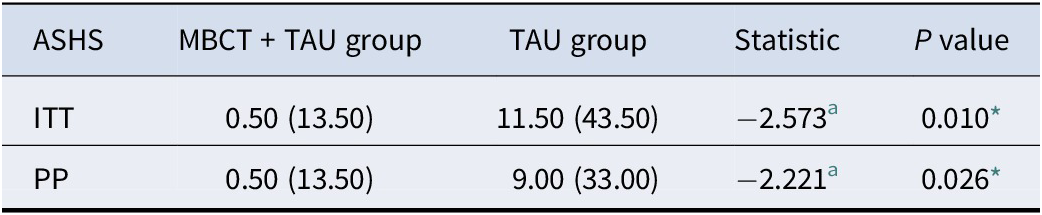
For the primary outcome at baseline and 4 weeks, ITT analysis (n = 94 participants with ≥1 session) showed significantly lower ASHS scores in the MBCT + TAU group compared to the TAU at 4 weeks (median: 0.50 versus 11.50 [43.50]; P = 0.010) (Luxton & Kyriakopoulos). The ITT analysis included all 94 randomized participants, with LOCF applied to the three participants who withdrew from the control group. Per-protocol (PP) analysis corroborated these findings, with the MBCT + TAU group exhibiting markedly lower median ASHS scores (0.50 versus 9.00; P = 0.026) (Table 2). Both ITT and PP analyses consistently demonstrated statistically significant between-group differences in ASHS reduction (ITT: P = 0.010; PP: P = 0.026), supporting the clinical efficacy of MBCT for reducing NSSI behaviors in this population.
Primary outcomes: ASHS at 4 weeks (intergroup differences)

Table 2. Long description
The table consists of five columns: A S H S, M B C T plus T A U group, T A U group, Statistic, and P value.
* The first data row for I T T (intention-to-treat) shows: M B C T plus T A U group at 0.50 (13.50), T A U group at 11.50 (43.50), Statistic (Mann-Whitney U test) at minus 2.573, and a P value of 0.010.
* The second data row for P P (per-protocol) shows: M B C T plus T A U group at 0.50 (13.50), T A U group at 9.00 (33.00), Statistic at minus 2.221, and a P value of 0.026.
Notes indicate that A S H S stands for Adolescents Self-Harm Scale and asterisks denote P less than 0.05.
Note: ASHS, Adolescents Self-Harm Scale, ITT, intention-to-treat, PP: per-protocol.
a Mann–Whitney U test.
* P<0.05.
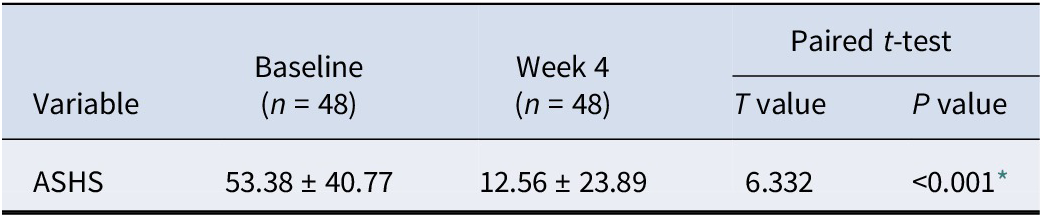
In an additional single-group pre-post analysis (n = 48), ASHS scores showed a significant reduction in NSSI severity from baseline (53.38 ± 40.77) to post intervention (12.56 ± 23.89) (paired t-test: t = 6.332, P < 0.001). This finding further confirms the effectiveness of MBCT in reducing both the frequency and severity of self-harm behaviors (Table 3).
Primary outcomes: ASHS at 4 weeks (MBCT+TAU group)

Table 3. Long description
The table consists of five columns and two main rows of data including the header.
Column 1: Variable.
Column 2: Baseline (n = 48).
Column 3: Week 4 (n = 48).
Column 4: paired t-test T value.
Column 5: paired t-test P value.
Data Row 1:
Variable: A S H S.
Baseline: 53.38 plus or minus 40.77.
Week 4: 12.56 plus or minus 23.89.
T value: 6.332.
P value: less than 0.001.
A note below the table specifies that A S H S stands for Adolescents Self Harm Scale and that the asterisk indicates a P value less than 0.001.
Note: ASHS, Adolescents Self Harm Scale.
* P<0.001.
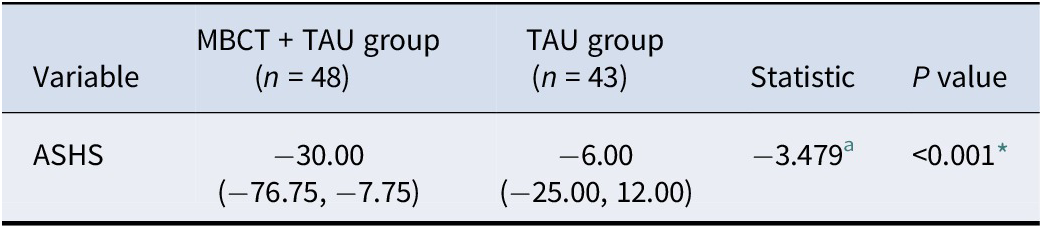
A per-protocol analysis of treatment effects (n = 91; MBCT + TAU = 48, TAU = 43) was conducted. A comparison of pre-post changes at 4 weeks showed a significantly greater reduction in NSSI severity in the MBCT + TAU group (median change = −30.00, IQR = −76.75 to −7.75) compared with the TAU group (median change = −6.00, IQR = −25.00 to 12.00), with the upper quartile of control group indicating symptom worsening in some participants. The between-group difference was highly significant (Mann–Whitney U test: z = −3.479, P < 0.001), demonstrating the superior efficacy of MBCT in reducing NSSI severity and supporting its clinical utility as an evidence-based intervention (Table 4).
Between-group differences in changes from baseline to 4 weeks of intervention

Table 4. Long description
The table consists of five columns: Variable, M B C T plus T A U group (n equals 48), T A U group (n equals 43), Statistic, and P value.
* The row for the variable A S H S (Adolescents Self Harm Scale) shows:
* M B C T plus T A U group: -30.00 (with a range of -76.75 to -7.75).
* T A U group: -6.00 (with a range of -25.00 to 12.00).
* Statistic: -3.479 (indicated by a superscript b, referring to the Mann-Whitney U test).
* P value: less than 0.001 (marked with an asterisk).
Note: ASHS, Adolescents Self Harm Scale.
a Significant difference between the MBCT+TAU group and the TAU group at 4 weeks (P < 0.05, Mann-Whitney U test).
* P<0.001.
A mixed-design repeated-measures ANOVA was performed with time as the within-subjects factor, group as between-subjects factor, and ASHS scores as dependent variable (n = 39). The analysis revealed: (1) a significant main effect of time (P < 0.001), and (2) significant group × time interaction (P < 0.001). Post-hoc tests indicated that the MBCT + TAU group had significantly lower ASHS scores than the TAU group at 4 weeks (50.12 ± 63.92 versus 12.23 ± 24.07; P = 0.036), but this difference was no longer significant at 1-month follow-up (P = 0.350) (Table 5 and Figure 2).These findings suggest robust short-term efficacy of MBCT in reducing NSSI, with diminished effects at follow-up possible due to the reduced intensity of the intervention during the WeChat-based audio follow-up phase compared to in-person delivery.
Primary outcomes: ASHS at 1-month follow-up visit (intergroup differences)

Table 5. Long description
The table consists of six columns: Variable, Time, T A U group (n equals 17), M B C T plus T A U group (n equals 22), T value, and P value.
Under the variable A S H S:
* At time T 0: T A U group is 43.88 plus or minus 34.17; M B C T plus T A U group is 66.23 plus or minus 44.19; T value is minus 1.460; P value is 0.144.
* At time T 1: T A U group is 50.12 plus or minus 63.92; M B C T plus T A U group is 12.23 plus or minus 24.07; T value is minus 2.100; P value is 0.036 with a single asterisk.
* At time T 2: T A U group is 24.88 plus or minus 49.02; M B C T plus T A U group is 13.36 plus or minus 28.47; T value is minus 0.935; P value is 0.350.
Statistical summary for A S H S:
* F value: T A U group is 2.939; M B C T plus T A U group is 24.130.
* P value: T A U group is 0.067; M B C T plus T A U group is less than 0.001 with double asterisks.
* Time interaction: F equals 0.796; P value is 0.378.
* Group interaction: F equals 13.871; P value is less than 0.001 with double asterisks.
* Group times time interaction: F equals 9.454; P value is less than 0.001 with double asterisks.
* p < 0.05.
** p < 0.01.
Line graph showing the mean changes of ASHS at three time points in two groups.

Figure 2. Long description
The y-axis represents mean changes in A S H S ranging from negative 20 to 90. The x-axis marks three time points: T 0, T 1, and T 2. A legend on the right identifies the Control group with blue diamonds and the Intervention group with red squares.
Data Trends:
* The Intervention group starts at approximately 67 at T 0, drops sharply to about 12 at T 1, and remains stable at 13 at T 2. A bracket with two asterisks indicates a significant difference between T 0 and T 2.
* The Control group starts at approximately 44 at T 0, rises slightly to 50 at T 1, and decreases to 25 at T 2.
* Error bars are present at each data point.
* Statistical markers include a single asterisk above the Control group at T 1 and a pound symbol above the Control group at T 2.
Secondary outcomes
For the secondary outcome at baseline and 4 weeks, per-protocol analysis (n = 91; MBCT + TAU = 48, TAU = 43) demonstrated superior outcomes in the MBCT+TAU group at 4 weeks across mindfulness domains – including awareness (31.00 vs 21.00), acting with awareness (14.00 vs 26.00), and emotional awareness (22.00 vs 14.00; all P < 0.001) – as well as in clinical measures such as depressive symptoms (42.92 ± 10.66 vs 49.91 ± 11.42, P = 0.003), behavioral problems (17.00 vs 27.00), and rumination (9.00 vs 13.00; both P < 0.001) (see Supplementary Appendix 2 for details). These results indicate that MBCT significantly enhances psychological regulation and promotes symptom improvement.
Within the intervention group, a pre-post analysis demonstrated that MBCT led to significant improvements across multiple domains. Mindfulness capacities increased, including in awareness (31.33 ± 4.20 vs 15.79 ± 4.69), describing (23.50 ± 7.26 vs 19.92 ± 8.07), and acting with awareness (15.81 ± 6.22 vs 27.73 ± 6.98). Concurrently, clinical symptoms were reduced, such as depression (42.92 ± 10.66 vs 52.10 ± 12.78), anxiety (41.98 ± 12.87 vs 51.67 ± 12.00), alongside a decrease in risk behaviors (160.85 ± 48.10 vs 193.73 ± 53.82). Psychosocial functioning also improved, reflected in enhanced emotion regulation (109.98 ± 25.46 vs 123.56 ± 26.22), life satisfaction (147.02 ± 38.76 vs 120.27 ± 41.69), better emotional control (16.31 ± 6.11 vs 12.54 ± 6.08), help-seeking (4.38 ± 2.83 vs 3.54 ± 2.16) (all P < 0.05, see Supplementary Appendix 3 for details). These findings demonstrate the comprehensive efficacy of MBCT in enhancing psychological regulation, alleviating affective symptoms, and promoting quality of life.
Between-group comparative analysis of change scores (Δ) showed that the MBCT + TAU group achieved significantly greater improvement than the TAU group in mindfulness awareness (Δ = –16.50 vs −2.00), behavioral control (Δ = –14.00 vs 4.00), and NSSI reduction (Δ = –30.00 vs −6.00) (all P < 0.001). Additional significant advantages were observed in emotion regulation (P = 0.009) and rumination (P = 0.005). Although changes in depressive symptoms and self-satisfaction did not reach statistical significance (P > 0.05), the MBCT + TAU group exhibited stronger improvement trends in these domains (see Supplementary Appendix 4 for details). Together, these results indicate that MBCT is effective in enhancing psychological regulation and behavioral management.
Discussion
To the best of our knowledge, this study is the first RCT to examine MBCT in adolescents with depressive disorders and NSSI. Our findings demonstrate that MBCT – a group psychotherapy recommended as a first-line treatment for depression (Lam et al., Reference Lam, Kennedy, Adams, Bahji, Beaulieu, Bhat, Blier, Blumberger, Brietzke, Chakrabarty, Do, Frey, Giacobbe, Gratzer, Grigoriadis, Habert, Husain, Ismail, McGirr and Milev2024; Lingjiang, Reference Lingjiang2016; Luxton & Kyriakopoulos, Reference Luxton and Kyriakopoulos2022) – significantly reduces self-harm behaviors.
The sample consisted of 94 participants (73 female, 21 male; mean age: 14 years), which aligns with established developmental trajectories of NSSI (Brown & Plener, Reference Brown and Plener2017; Cipriano & Cotrufo, Reference Cipriano and Cotrufo2017; Morgan et al., Reference Morgan, Webb, Carr, Kontopantelis, Green, Chew-Graham, Kapur and Ashcroft2017; Perry-Parrish et al., Reference Perry-Parrish, Copeland-Linder, Webb, Shields and Sibinga2016; Roberts et al., Reference Roberts, Joinson, Gunnell, Fraser and Mars2020).
The primary outcomes revealed that the MBCT + TAU group produced significantly lower ASHS scores than the TAU group at 4 weeks (ITT: 0.50 [13.50] vs 11.50 [43.50], P = 0.010; PP: 0.50 [13.50] vs 9.00 [33.00], P = 0.026), with greater pre-post reductions (median Δ = −30.00 [IQR = −76.75, −7.75] vs −6.00 [−25.00, 12.00]). Within-group analysis confirmed a decreased in NSSI severity from 53.38 ± 40.77 to 12.56 ± 23.89 (t = 6.332, P < 0.001). Repeated-measures ANOVA showed significant main effects of time (P < 0.001) and group × time interaction (P < 0.001), with superior efficacy for MBCT + TAU at 4 weeks (50.12 ± 63.92 vs 12.23 ± 24.07, P = 0.036). The diminished effect at 1-month follow-up may reflect the transition from hospital to community, where adolescents face renewed stressors and reduced therapeutic support. The follow-up phase relied on remote audio guidance via WeChat, which may not provide sufficient reinforcement compared to in-person sessions. Additionally, environmental factors such as academic pressure, family dynamics, and peer relationships – which were minimized during hospitalization – may have re-emerged post discharge, potentially contributing to the attenuation of treatment effects. Future studies should consider booster sessions, extended support post discharge, or hybrid models that maintain therapeutic contact during the community transition period.
These results support the clinical utility of MBCT for reducing NSSI, consistent with prior mindfulness research (Dumontheil et al., Reference Dumontheil, Lyons, Russell and Zelazo2023; Porter et al., Reference Porter, Oyanadel, Sáez-Delgado, Andaur and Peñate2022). Additionally, three exploratory findings emerged from the present study.
First, following the 4-week intervention, the MBCT + TAU group exhibited significant reductions in depressive (42.92 ± 10.66 vs 52.10 ± 12.78) and anxiety symptoms (41.98 ± 12.87 vs 51.67 ± 12.00), together with improvements in emotion regulation (109.98 ± 25.46 vs 123.56 ± 26.22), emotional control (16.31 ± 6.11 vs 12.54 ± 6.08), and help-seeking behaviors (4.38 ± 2.83 vs 3.54 ± 2.16). These therapeutic benefits may be mediated through MBCT’s core mechanisms: (1) cultivation of the nine foundational mindfulness attitudes, (2) enhancing cognitive reappraisal of negative affect through psychoeducation, and (3) fostering adaptive regulatory capacities when facing stressors (Erisman & Roemer, Reference Erisman and Roemer2010; Shapiro, Carlson, Astin, & Freedman, Reference Shapiro, Carlson, Astin and Freedman2006; Way, Creswell, Eisenberger, & Lieberman, Reference Way, Creswell, Eisenberger and Lieberman2010; Zeidan, Gordon, Merchant, & Goolkasian, Reference Zeidan, Gordon, Merchant and Goolkasian2010). In particular, the intervention seems to promote a shift from emotional responding to more intentional responding, facilitated by increased meta-awareness and stress tolerance, thereby reducing maladaptive emotional dominance.
Second, a short-term MBCT intervention can also enhance the mindfulness levels and awareness capacity in adolescents with depression and NSSI. After the 4-week intervention, the MBCT + TAU group exhibited significantly higher scores in mindful awareness (31.33 ± 4.20 versus 15.79 ± 4.69) and mindful describing (23.50 ± 7.26 versus 19.92 ± 8.07) compared to the TAU group. This improvement may be attributed to mindfulness practice increasing cortical thickness in specific brain regions, particularly the right anterior insula and prefrontal cortex (Grant et al., Reference Grant, Courtemanche, Duerden, Duncan and Rainville2010; Hölzel et al., Reference Hölzel, Ott, Gard, Hempel, Weygandt, Morgen and Vaitl2008; Hölzel et al., Reference Hölzel, Carmody, Vangel, Congleton, Yerramsetti, Gard and Lazar2011; Lazar et al., Reference Lazar, Kerr, Wasserman, Gray, Greve, Treadway, McGarvey, Quinn, Dusek, Benson, Rauch, Moore and Fischl2005), which further supports the integration of perceptual information, strengthens attentional control and awareness, and thereby enhances self-connection and observational skills in participants.
Third, the MBCT intervention enhanced reflective thinking [median: 9.00 (P 25 = 6.00, P 75 = 12.00) in the MBCT + TAU group versus 13.00 (P 25 = 11.00, P75 = 16.00) in the TAU group] and reduced externalizing behavioral problems (median: 17.00 [P 25 = 15.00, P 75 = 23.75] versus 27.00 [P 25 = 19.00, P 75 = 36.00]). This effect may be attributable to MBCT’s capacity to modulate cognition process and disrupt automatic maladaptive processes, thereby promoting rational coping strategies over habitual dysfunctional behaviors (Erisman & Roemer, Reference Erisman and Roemer2010; Hamilton, Reference Hamilton1959) and further reducing impulsive actions and rumination.
The predominance of female participants (77.7%) is consistent with epidemiological data showing higher rates of depression and NSSI among adolescent girls. However, this limits the generalizability of findings to male adolescents.
Strengths
Our study has several notable strengths. To the best of our knowledge, this is the first RCT investigating MBCT for NSSI among hospitalized adolescents with depressive disorders in China. The high diagnostic consistency across participants improves the generalizability and clinical applicability of our findings. Furthermore, we adapted the standard MBCT protocol specifically for this hospitalized population with depression and NSSI. All interventions were delivered by trained, experienced instructors following a standardized manual, demonstrating both the feasibility and clinical utility of this approach, which may serve as a useful for future research and clinical practice.
Limitations
Several limitations should also be noted. First, we did not compare the efficacy of MBCT with other guideline-recommended psychotherapies, such as CBT (Luxton & Kyriakopoulos, Reference Luxton and Kyriakopoulos2022). A direct comparison could help expand the range of evidence-based treatment options for this population. Second, due to the inpatient setting, we did not collect qualitative data on participants’ perceptions of the intervention’s acceptability, usefulness, or potential shortcomings. Additionally, although this trial demonstrated clinical efficacy, we did not include formal feasibility or acceptability measures. Such data would have provided valuable insights into intervention engagement, perceived helpfulness, and barriers to participation. Future studies should incorporate mixed-methods designs to address these gaps. The absence of withdrawal due to nonadherence may suggest acceptable engagement with the MBCT-A protocol, though this should be interpreted cautiously without formal acceptability measures. Third, as an open-label trial, neither participants nor therapists were blinded to the intervention condition, which may have introduced expectancy effects (e.g. placebo responses) and could partially account for the observed improvements. To minimize resultant assessment bias, outcome evaluators were rigorously blinded to group assignment and were not involved in treatment delivery, thereby enhancing the objectivity of outcome measurement. Finally, the intervention duration was relatively short, constrained by typical hospitalization lengths, which limited our ability to examine long-term effects. In addition, we did not employ neuroimaging methods to assess changes in specific brain regions; such data have provided further mechanistic insights and helped guide the development of combined intervention strategies for optimizing clinical outcomes.
Conclusion
MBCT has demonstrated efficacy and feasibility in reducing NSSI among adolescents with depressive disorders, supporting its integration into clinical adoption. Notably, MBCT is operationally straightforward, cost-effective, and highly scalable, making it particularly suitable for implementation in resource-limited clinical and educational settings. These advantages establish MBCT as a viable treatment option for youth with comorbid depression and NSSI with potential for future extension to outpatient or mild depression adolescent populations.
Supplementary material
The supplementary material for this article can be found at http://doi.org/10.1017/S0033291726104735.
Acknowledgements
This study was supported by the STI2030-Major Projects (2021ZD0200702); National Natural Science Foundation of China (81825009, 82330042, 82441004, and 82441005); National Key R&D Program of China (2023YFE0119400); Capital’s Funds for Health Improvement and Research (2024–1-4111); Beijing Municipal Health Commission Research Ward Programme (3rd batch); and Beijing Nova Program (20230484425).
Author contribution
LXH and YWH contributed to study design and conception. XJJ and LLX conducted the analysis to determine alkaloid concentrations. XJJ, LXH, and LLX coordinated the psychology team. XJJ, LLX, and GJ recruited the patients. XJJ, LLX, GJ, and LXH coordinated data acquisition. XJJ, LLX, and GJ coordinated the trial. GJ and YWH analyzed data and interpreted the results. XJJ, LLX, GJ, LXH, and YWH were responsible for the first draft of the manuscript. All the authors have read, critically revised, and approved the manuscript.
Funding statement
This research received no specific grant from any funding agency, commercial or not-for-profit sectors.
Competing interests
None of the authors declare any conflict of interest with regard to this manuscript.




 Open access

