I. INTRODUCTION
It is well known that the exchange bias (EB) behavior was first discovered by C.P. Bean and W.H. Meiklejohn in a Co/CoO system.Reference Meiklejohn and Bean1 Subsequently, many scientists spent their efforts exploring the origin of this interesting phenomenon.Reference Nogués and Schuller2–Reference Ambrose and Chien8 A general consensus is that the EB is the result of an interfacial coupling between ferromagnetic and antiferromagnetic (FM/AFM) spins around the interface in the system. Large amounts of investigations indicated that the roughness, thickness, and microstructure of interface in the FM/AFM systems can dramatically influence the EB behavior.Reference Choukh3–Reference Jungblut, Coehoorn, Johnson, aan de Stegge and Reinders5 Thus, much attention has been paid to these aspects since the EB stability in the FM/AFM systems became the key for the materials to develop in applications.Reference Lai, Anthony, Iwamura and White6, Reference Pan, You, Zhao, Lu, Hu, Zhai and Zhou9–Reference Gao, Shi, Zhou, Chantrell, Asselin, Bai, Du and Zhang12 Basically, the application of a magnetic field can change the size of magnetic domains in these FM/AFM systems, and Lai and coworkers indicated that the size of magnetic domains as well as the micrograins of AFM phase can limit EB field to a certain extent.Reference Lai, Anthony, Iwamura and White6 There are many investigations about the influence of magnetic training on the EB behavior,Reference Nogués and Schuller2, Reference Pan, You, Zhao, Lu, Hu, Zhai and Zhou9, Reference Gao, Shi, Zhou, Chantrell, Asselin, Bai, Du and Zhang12–Reference Brems, Volodin, Van Haesendonck and Temst14 by means of the reduplicate measurement of hysteresis loop for the same sample. It has been found that the EB field decreases with increasing loop measurement cycle number n as an empirical linear function of 1/n.Reference Nogués and Schuller2, Reference Xi, Franzen and White13 The training effect became more considerable if the thickness of AFM layer is thinner.Reference Pan, You, Zhao, Lu, Hu, Zhai and Zhou9, Reference Gao, Shi, Zhou, Chantrell, Asselin, Bai, Du and Zhang12 Further research verified the influence of the training field and its direction on the local domains configuration in Co/CoO bilayers.Reference Brems, Volodin, Van Haesendonck and Temst14 In brief, magnetic training operation is thought to be one of the best avenues to effectively tune the EB in magnetic multilayer systems by tailoring local domains configuration around the interface.
However, the loop shift away from zero point is not a unique phenomenon in the FM/AFM multilayers or coated particles. Kohmoto and coworkers mentioned that Co-based amorphous ribbons can sometimes exhibit displaced hysteresis curves along the positive or negative field direction.Reference Kohmoto, Yamaguchi, Ohya and Fujishima15 Even though the loop shift characteristics of amorphous ribbons are quite similar to those of FM/AFM systems, the magnitude and origin of EB behavior are completely different from those of FM/AFM systems. Recently, there are a few reports about observation of the asymmetric loop of Co-/Fe-based amorphous materials.Reference Yamauchi and Yoshizawa16–Reference Li, Chen, Vazquez and Hernando18 Our recent effort was also targeted on the influence of annealing process and the direction of applied field during annealing on the loop shift of the Co-based ribbons.Reference He, Zhou, Zhao and Wang19, Reference Zhou, He, Li, Li and Zhao20 Until now, only few reports focused on the influence of the magnetic training effect on the asymmetrical loops of amorphous ribbons. Actually, based on our new investigation, the reduplicate measurement of hysteresis loop has no obvious effect on the loop shift in soft magnetic ribbons. However, the asymmetric behavior of the hysteresis loop can be modulated by the AC magnetic field training before the measurement of DC loop. A fading of EB behavior has been obtained by this novel magnetic training method.Reference Chen and Pan21 But, the intrinsic mechanism is still unclear as the microstructure and local domains configuration of the ribbons were rarely discussed. Further characterization of this interesting effect is quite necessary to be probed.
In this article, we explore the dependence of asymmetrical loops on the AC magnetic training effect for Co-based amorphous ribbons and then try to find a way to modulate the abnormal magnetic features in amorphous ribbons. As a pursuit of our previous investigations,Reference He, Zhou, Zhao and Wang19, Reference Zhou, He, Li, Li and Zhao20 the Co-based amorphous alloy Co58Fe5Ni10Si11B16 was representatively chosen to study the influence of the AC magnetic training on the hysteresis loop shift. The hysteresis loops were measured at room temperature to explore the evolution of EB at different training fields. Magnetic domains scan was also used to evidence the change of the surface domains configuration of ribbons after magnetic training.
II. EXPERIMENTAL PROCEDURE
Amorphous Co58Fe5Ni10Si11B16 alloy ribbons were prepared by the single roller quenching method. The width and thickness of these ribbons were about 10 mm and 35 μm, respectively. These ribbons were wound to form toroid-core samples with 31 mm o.d. and 20 mm i.d. The samples were annealed at 653 K for 2 h. The longitudinal magnetic field (LF) of 800 A/m was applied along the direction of the ribbon axis. B–H hysteresis loops were measured by using a ballistic galvanometer. The coercive field H c, EB field H eb, and shift ratio β were then determined from the magnetic hysteresis loops. AC longitudinal magnetic training (ALMT) was performed on the ribbons with the shifted loop, and then the hysteresis loop was measured again to ascertain the training effect. The applied AC field was in the range of 0.1–11 kA/m, with a frequency of 50 Hz. The surface morphology and magnetic domains were scanned by Veeco Nanoscope IIIa scanning probe microscope (SPM; Veeco, Shanghai, People's Republic of China). A magnetic tip coated with CoCr layer was chosen for the scans. The size of the scanned domain patterns was ranging from 6 to 30 μm.
III. RESULTS AND DISCUSSION
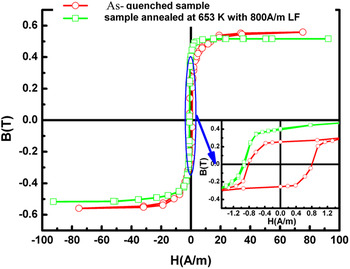
As our previous report summarized,Reference He, Zhou, Zhao and Wang19, Reference Zhou, He, Li, Li and Zhao20 the considerable EB behavior was obtained in the Co58Fe5Ni10Si11B16 amorphous ribbons when they were annealed at 653–733 K in proper LF. A simple comparison between the as-cast and annealed ribbons is given in Fig. 1. Different from the as-cast ribbon, which has a loop with perfect symmetry and hysteresis, the ribbon annealed in LF shows a dramatic loop shift along the field axis, totally away from zero point hysteresis. The shift ratio β, which is EB field divided by coercive field, can reach up to 90. A phenomenological explanation has been given to discuss the EB behavior in Co-based amorphous ribbons.Reference Zhou, He, Li, Li and Zhao20 But, more investigation should be performed to determine the configuration of the local magnetic moments induced by the ALMT and the mechanism of recovery.
Hysteresis loops of Co58Fe5Ni10Si11B16 as-cast and annealed ribbons at 653 K in 800 A/m longitudinal magnetic field. The inset is the local enlargement of the central part of loops.

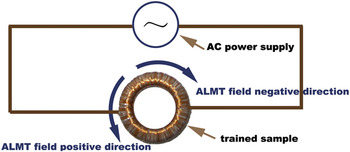
Enlightened by the active discussion about the magnetic training effect on the hysteresis by cycle loops measurementsReference Nogués and Schuller2 and thermal stability by irradiation with ultrafast laser beamReference Seu and Reilly22 in the FM/AFM multilayer systems, we designed a simple magnetic training method, proper for the toroidal soft magnetic ribbons. Co-based ribbons annealed at 653 K in an 800 A/m LF were chosen to perform a series of ALMT with increasing AC field. As shown in Fig. 2, the copper wire was compactly wound on the annealed sample and the two terminals of wire were connected to the AC power supply. AC magnetic field was induced along the longitudinal axis of ribbons once the AC current flows through the winding. Its magnitude can be easily controlled by the number of winding turns or current flux. The ALMT fields are in the range 0.1–11 kA/m, and their direction is schemed in Fig. 2.
Schematic diagram of the setup used to train the samples by AC longitudinal magnetic training (ALMT).

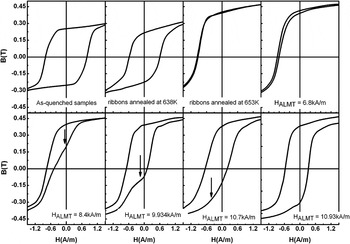
The influence of ALMT on the hysteresis loops of samples with EB behavior is shown in Fig. 3. As a comparison, the loops of as-cast and LF annealed samples are also presented in Fig. 3 to demonstrate the strong influence of LF annealing, which gives rise to the big loop shift, and the vanishing of hysteresis. As the ALMT was applied to the ribbons with EB behavior, the gradual recovery of the hysteresis loops is evident, as shown in Fig. 3. With increasing the ALMT field, the loops shift along H axis from the negative to the positive direction and finally comes back to the symmetrical characteristics. In addition, the step transition of magnetization can also be observed in Fig. 3, the position marked by the black arrows, indicating the coexistence of different magnetic phases and the interaction among the magnetic moments.
Hysteresis loops of as-quenched, annealed, and magnetically trained ribbons in different ALMT fields.

As we reported in our previous paper,Reference Zhou, He, Li, Li and Zhao20 both the x-ray diffraction (XRD) scans and high-resolution transmission electron microscope images indicated the presence of f.c.c. Co and cubic CoSi phases with the grain size of about 5–10 nm precipitated in the Co58Fe5Ni10Si11B16 amorphous matrix after annealing. The magnetic moments of these small crystalline grains are acting as pinning centers, inducing strong interactions between the two magnetic phases (precipitated phases and amorphous matrix) and the EB behavior. The optimum annealing temperature of soft magnetic Co58Fe5Ni10Si11B16 ribbons, after which they exhibit the EB behavior, is about 653–733 K. It should be mentioned that this temperature range is just below the primary crystallization temperature (820 K) of Co58Fe5Ni10Si11B16 ribbons.Reference Zhou23 Moreover, a very small amount of magnetic crystalline phases are enough for the appearance of EB behavior of the ribbons.Reference Zhou23 Once the ribbons are annealed at temperatures around primary crystallization temperature, more crystalline phases precipitate into the matrix, leading to the destruction of the EB behavior due to the absence of unidirectional anisotropy.Reference Zhou, He, Li, Li and Zhao20
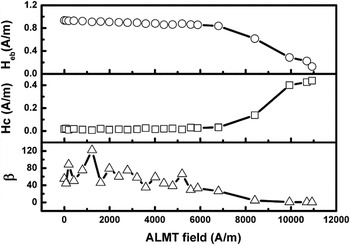
The dependence of H eb, H c, and β on the ALMT field is shown in Fig. 4. H eb and H c are almost stable when the used ALMT field is not strong enough. The shift ratio, β, maintains the fluctuation around the value of about 80, before dropping down at higher ALMT fields. When the ALMT field exceeds the critical field, which is in the range of 6.8–8 kA/m for our samples, the magnetic training effect begins to be effective. H eb field remarkably weakens, this decrease being associated with the regeneration of magnetic hysteresis and the increase of H c. As ALMT field reaches up to about 10 kA/m, the shift ratio β almost diminishes to zero. The explanation put forward is that the local vertical stray field, which was induced by magnetically harder crystalline phases, plays a main role in restricting the motion of main domains during magnetization, which induces the EB behavior.Reference Zhou, He, Li, Li and Zhao20 Undoubtedly, the application of ALMT to the ribbons can obviously soften the magnetic properties of hard crystalline phases, restraining the occurrence of EB in ribbons.
The dependence of H eb, H c, and β on the ALMT field.

It should be reiterated that the change of H c with strengthening ALMT is opposite to that of H eb. The amorphous soft magnetic ribbons, which actually are multidomain materials, usually exhibit irreversibility during the reversed magnetization. The mechanism of the hysteresis can be demonstrated by the irreversible displacement of domain walls, the growth of reversed magnetization, and the rotation of domains. As a rule, the reversed magnetization of soft magnetic materials mainly depends on the displacement of domain walls. In our samples, the remaining stress fluctuation and the existence of local crystalline phases can dramatically affect the displacement of domain walls, leading to the change of coercive field.Reference Wan and Ma24
Thus, the near-zero coercive field for the annealed ribbons without ALMT is basically originating from the extensive release of remaining stresses in the as-cast ribbons even though annealing can also bring the magnetocrystalline anisotropy into the ribbons. The increase of H c with increasing ALMT is probably related to the large resistance of domain walls displacement, considering the increase of domain energy due to the movement of domain wall in the local position of the crystalline phases. (For 180° domains, the density γw of domain wall energy can be expressed by the formula: γw = (2A 1K u)0.5 ∫cos θ dθ, in which K u is the constant of magnetocrystalline anisotropy and A 1 is a coefficient related to exchange integral.)
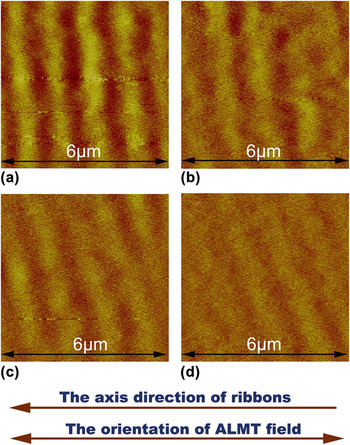
Figure 5 exhibits four microscale SPM domain images for the samples trained by different ALMT fields. The clear 180° domain patterns with strong contrast are evident for ribbons trained by 0.1 kA/m ALMT field, implying the distinct Z-oriented magnetic signal, as seen in Fig. 5(a). The vertical signals, which reflect the local stray field around the crystalline phases, are mainly responsible for the EB behavior in the amorphous ribbons. However, as the ALMT field increases, the Z-oriented magnetic signals become weaker and the stripe patterns gradually turn to be indistinct, as shown in Figs. 5(c) and 5(d). This also illustrates that the ALMT causes the frequent movement of domain walls to traverse the local crystalline phases and drive the magnetic moments of harder crystalline phases down to the plane direction, resulting in the increase of H c as well as the drop of β, as reflected in Fig. 4. The SPM images distinctly characterize the features of the change of local domains configuration in the presence of ALMT, showing that ALMT is one of the best modes to effectively modulate the loop shift behavior in the ribbons, and even recover the symmetrical magnetization features in LF annealed amorphous ribbons.
Surface magnetic domain images for the samples with asymmetrical loops after they are trained in ALMT fields of (a) 0.1 kA/m, (b) 9.9 kA/m, (c) 10.7 kA/m, and (d) 11 kA/m, respectively. The scan size is about 6 μm × 6 μm.

IV. CONCLUSIONS
The asymmetrical hysteresis loops for the Co-based amorphous ribbons with moderate longitudinal thermomagnetic treatment have been observed. The gradual change of loop from asymmetrical to symmetrical was clearly probed by applying an ALMT field to EB ribbons. The switching ALMT field, at which the H eb begins to decrease, is in the range of 6.8–8 kA/m. A SPM scan illustrates that the sequential ALMT operation can orderly rearrange the local magnetic domains by weakening vertical magnetic signals. The dependence of H eb on the ALMT field also verifies that this magnetic training method is one of the best avenues to effectively modulate the EB behavior in Co-based amorphous ribbons for potential application.
ACKNOWLEDGMENTS
The authors are indebted to Associate Professor Yu Wang from Central Iron & Steel Research Institute, China, for her help with the magnetic measurements and sincere discussions. This work was supported by the National Natural Science Foundation of China under Grant No. 50971044.