Introduction
Coenogonium (Ostropales, Coenogoniaceae) is a large genus of crustose or filamentous lichenized fungi, currently including c. 90 species (Rivas Plata et al. Reference Rivas Plata, Lücking, Aptroot, Sipman, Chaves, Umaña and Lizano2006; Lücking et al. Reference Lücking, Hodkinson and Leavitt2017). It is distributed almost worldwide with its centre of diversity in the tropics (Kantvilas et al. Reference Kantvilas, Rivas Plata and Lücking2018). In Europe, three species are so far known: C. luteum (Dicks.) Kalb & Lücking, C. pineti (Ach.) Lücking & Lumbsch and C. tavaresianum (Vězda) Lücking et al. In addition, five tropical species have been reported from Macaronesia: Coenogonium frederici (Kalb) Kalb & Lücking (Aptroot & Rodrigues Reference Aptroot and Rodrigues2005; as Dimerella frederici), Coenogonium implexum Nyl. (Rodrigues & Aptroot Reference Rodrigues, Aptroot, Borges, Cunha, Gabriel, Martins, Silva and Vieira2005), C. interplexum (Tavares Reference Tavares1952), C. luteolum (Kalb) Kalb & Lücking (Kalb & Hafellner Reference Kalb and Hafellner1992; as D. luteola) and C. subluteum (Rehm) Kalb & Lücking (Follmann Reference Follmann1990; as D. epiphylla).
During our fieldwork in British ancient forests, we collected isidiate thalli of ‘Porina rosei’ with apothecia or pycnidia of ‘Coenogonium luteum’. These strange specimens were sequenced and we revealed an undescribed Coenogonium species. Subsequently, this taxon was mentioned in the Revisions of British and Irish Lichens (Vol. 3) under the provisional name C. confusum Malíček & Sanderson ined. (Cannon et al. Reference Cannon, Malíček, Sanderson, Benfield, Coppins and Simkin2021). Finally, we decided to describe it here formally as C. nimisii.
Material and Methods
Sampling, morphology and chemistry
Collected specimens are deposited in PRA and the personal herbaria of J. Malíček and N. Sanderson. Microscopic descriptions are based on hand-cut sections mounted in water or 10% KOH for observations of the isidia surface. Lichen secondary metabolites were identified using thin-layer chromatography (TLC) in solvents A, Bʹ and C (Orange et al. Reference Orange, James and White2010). The images were captured using 1) an Olympus SZX 12 stereomicroscope with an Olympus DP 70 (resolution 12.5 Mpx) cooled colour digital camera with the software QuickPHOTO MICRO 3.0 (Promicra), using an extended depth of field module Deep Focus, and 2) an Olympus BX 43 microscope with a Promicra 3–5CP (resolution 5 Mpx) colour digital camera with the same software.
DNA extraction, PCR amplification and sequencing
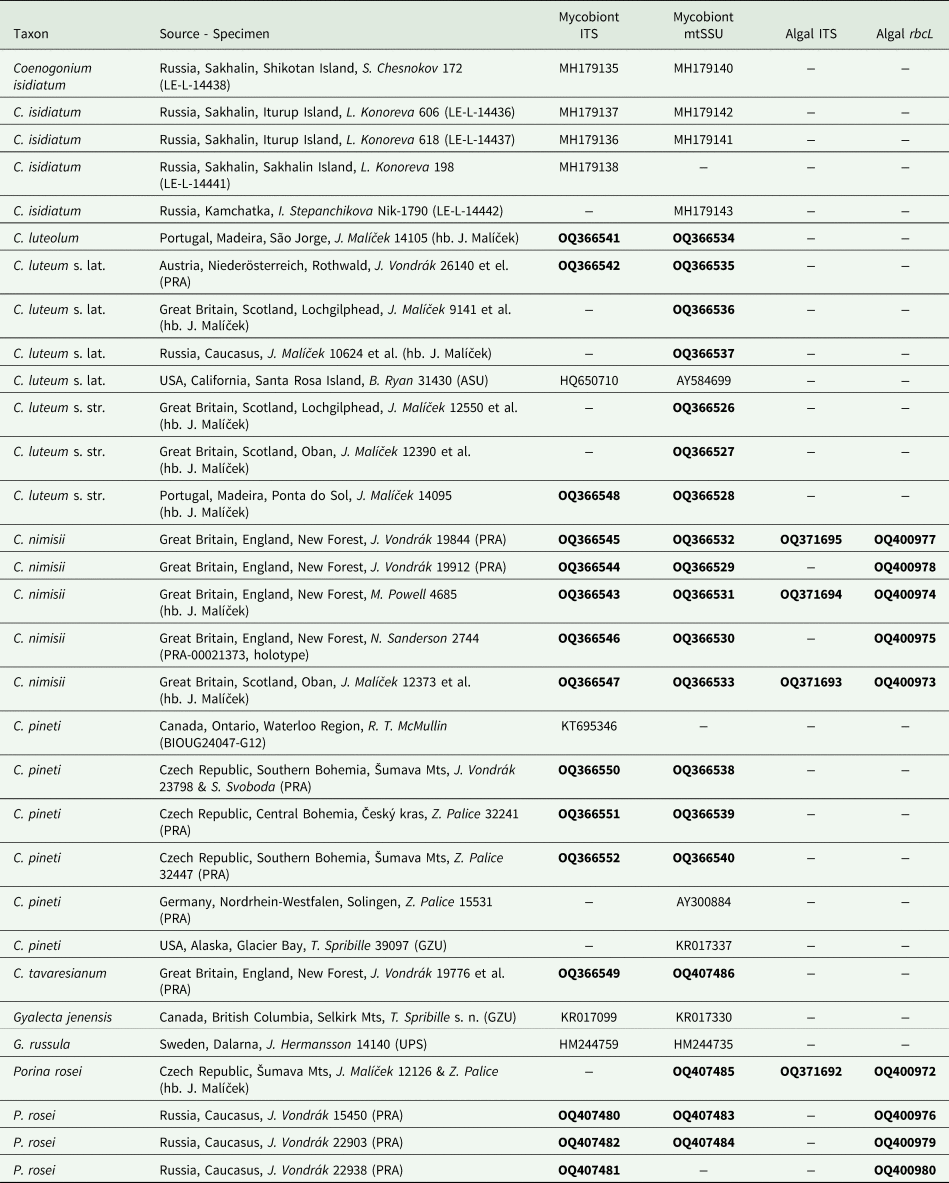
The Invisorb Spin Plant Mini Kit (Invitek) and Chelex protocol (Ferencová et al. Reference Ferencová, Rico and Hawksworth2017) were used for DNA extractions. The fungal ITS rDNA (henceforth ITS) and mitochondrial SSU (mtSSU) were amplified with the following primers: ITS1F (Gardes & Bruns Reference Gardes and Bruns1993) and ITS4 (White et al. Reference White, Bruns, Lee, Taylor, Innis, Gelfand, Sninsky and White1990), mrSSU1, mrSSU2R and mrSSU3R (Zoller et al. Reference Zoller, Scheidegger and Sperisen1999). The mycobiont from three samples of Porina rosei was amplified with ITS-A (Blattner Reference Blattner1999; Škaloud & Rindi Reference Škaloud and Rindi2013) and ITS4. PCR reactions of ITS and mtSSU were prepared for a 20 μl final volume, containing 14 μl double-distilled water, 4 μl MyTaq polymerase reaction buffer, 0.2 μl MyTaq DNA polymerase, 0.4 μl of each of the 25 mM primers, and 1 μl of the sample. Amplifications of both loci consisted of an initial 1 min denaturation at 95 °C, followed by 35 cycles of 30 s at 95 °C, 30 s at 56 °C, 30 s at 72 °C, and a final extension of 7 min at 72 °C. For the combination ITS-A and ITS4, a cycle was programmed with an initial 1 min denaturation at 94 °C, followed by 30 cycles of 25 s at 94 °C, 30 s at 54 °C, 45 s at 72 °C, and a final extension of 10 min at 72 °C. The PCR products were visualized on a 0.8% agarose gel and cleaned with ExoSAP-IT™ PCR Product Cleanup Reagent (ThermoFisher Scientific), according to the manufacturer's protocols. The algal ITS and rbcL sequences were amplified as described by Černajová et al. (Reference Černajová, Schiefelbein and Škaloud2022). In total, 19 new ITS, 19 mtSSU and 9 rbcL sequences were generated (Table 1). Sequences of the Porina rosei mycobiont, photobiont and Coccomyxa ITS were not included in the phylogenetic analysis.
GenBank Accession numbers and voucher information for sequenced specimens of Coenogonium. Sequences in bold are newly produced.

Sequence alignment and phylogenetic analysis
The newly produced sequences were edited in BioEdit v. 7.2.5 (Hall Reference Hall1999). The final analyses of the mycobiont included the 28 newly generated sequences and nrITS and mtSSU sequences of the genus Coenogonium available in the GenBank database. Gyalecta jenensis and G. russula were selected as outgroups because they form a sister clade to Coenogonium (see Miadlikowska et al. Reference Miadlikowska, Kauff, Högnabba, Oliver, Molnár, Fraker, Gaya, Hafellner, Hofstetter and Gueidan2014) and both ITS and mtSSU sequences were available in GenBank. The ITS and mtSSU regions were aligned separately using MAFFT v. 7 (Katoh & Standley Reference Katoh and Standley2013) with the L-INS-i method (Katoh et al. Reference Katoh, Kuma, Toh and Miyata2005). The ITS alignment contained 531 positions and 20 sequences; the mtSSU alignment had 719 positions and 25 sequences. Both regions were analyzed as single-locus datasets (see Supplementary Material Figures S1 & S2, available online). For the final tree, we created a concatenated dataset of 27 sequences, containing 462 ITS positions and 719 mtSSU positions. Ambiguous positions (i.e. > 50% of missing data) were excluded from the final analysis. Support values on nodes were checked against single-gene trees and no conflict among well-supported branches (maximum likelihood bootstrap percentages > 0.7) was detected.
The photobiont analysis was based on seven newly generated rbcL sequences and 88 sequences retrieved from GenBank (16 reported as Coenogonium photobionts, 10 as Porina photobionts and 62 other reference sequences, both lichen photobionts and free-living algae). The rbcL alignment contained 87 unique sequences and 752 positions.
Phylogenetic trees were inferred with Bayesian inference (BI) using MrBayes v. 3.2.7a (Ronquist & Huelsenbeck Reference Ronquist and Huelsenbeck2003; Ronquist et al. Reference Ronquist, Teslenko, van der Mark, Ayres, Darling, Höhna, Larget, Liu, Suchard and Huelsenbeck2012), maximum likelihood (ML) analysis using GARLI v. 2.0 (Zwickl Reference Zwickl2006), and maximum parsimony (MP) analysis using PAUP v. 4.0b10 (Swofford Reference Swofford2003). BI and ML analyses were carried out on a partitioned dataset to differentiate among ITS1, 5.8S and ITS2 rDNA, and mtSSU regions for mycobionts. For the photobiont rbcL tree, the dataset was partitioned according to particular codon positions. Substitution models TN93 + G (ITS1), JC + G (5.8S), K2 + I (ITS2), T92 + G (mtSSU), and JC + G + I, T92 + G and K2 + G + I (rbcL) were selected using the Bayesian information criterion (BIC) as implemented in jModelTest2 (Guindon & Gascuel Reference Guindon and Gascuel2003; Darriba et al. Reference Darriba, Taboada, Doallo and Posada2012). Two parallel MCMC runs, with four chains, were carried out for 10 million generations. Trees and parameters were sampled every 100 generations. Finally, the burn-in values were determined using the ‘sump’ command. The ML analysis was carried out using default settings, five search replicates, and the automatic termination set at 5 million generations. The MP analysis was performed using heuristic searches with 1000 random sequence addition replicates and random addition of sequences (the number was limited to 104 per replicate). ML and MP bootstrap support values were obtained from 100 and 1000 bootstrap replicates, respectively. Only one search replicate was applied for ML bootstrapping. The alignment used in this study is publicly available on Zenodo as doi: 10.5281/zenodo.7627869.
Taxonomy
Coenogonium nimisii Malíček & Sanderson sp. nov.
MycoBank No.: MB 847489
Similar to Coenogonium fruticulosum L. Ludw., so far known from New Zealand, but different in several anatomical characters, such as the higher hymenium (80–110 μm), and larger photobiont cells (10–18 μm) and ascospores (9–11 μm). The isidia of C. nimisii are 25–70 μm thick, glossy in fresh material, with one or rarely more layers of thin periclinal hyphae. Apothecia and pycnidia rarely present, ±identical with C. luteum.
Type: Great Britain, England, V.C. 11, by Penderley Lodge, Stubbs Wood, New Forest, veteran Quercus robur in pasture woodland, 2020, N. Sanderson 2744 (PRA 21373—holotype). GenBank Accession nos: OQ366546 and OQ366530.
(Fig. 1)
Habitus of Coenogonium nimisii. A, holotype (PRA). B, apothecium (Sanderson 436). C, isidia (Sanderson 436). D, isidia in water (Malíček 12373). E, isidia in KOH (Malíček 12373). F, apothecial section in water (holotype, PRA). G, exciple in water (holotype, PRA). H, paraphyses in water (Sanderson 436). Scales: A–C = 0.5 mm; D & G = 20 μm; E & H = 10 μm; F = 100 μm. In colour online.

Thallus crustose, thin, up to 40 μm thick, pale (green-)grey to whitish, without prothallus, often with yellow/ochre tinge, with abundant isidia, forming dense mounds away from the apothecia, more discrete near apothecia. Isidia coralloid, moniliform (i.e. with frequent constrictions), green and glossy in fresh material, pale grey-green, grading to ochre-orange where well lit, up to 0.5 mm high, 25–70 μm diam., filled with very abundant photobiont cells with 3–5 cells per isidium width in optical view, cortex poorly defined and composed of one or rarely more layers of colourless periclinal hyphae which are more visible in fresh material or KOH. Photobiont trentepohlioid, ±globose cells (7–)10–18 μm diam.
Apothecia rare, (0.5–)1–1.5 mm diam., sessile on the thallus (rarely formed on isidia), distinctly constricted at the base. Disc yellow-orange to dark orange, with creamy to yellow, sometimes flexuose margins. Exciple colourless, outermost part yellow-brown in dark-pigmented apothecia, composed of branching, conglutinated, 5–8 μm thick hyphae. Hypothecium colourless. Hymenium 80–110 μm tall, colourless, I+ brownish orange to locally pale blue, K/I+ blue; epihymenium pale yellow-brown in dark-pigmented apothecia; paraphyses 1.5–2.0 μm thick, upper cells sometimes moniliform, the apical cell up to 4.5 μm diam. Asci narrowly cylindrical, c. 30 × 4 μm, without an amyloid ring around the pore, 8-spored, uniseriate. Ascospores colourless, fusiform-ellipsoid, 1-septate, straight or rarely one cell slightly curved, (7–)9–11(–14) × 2.5–3(–3.5) μm (Supplementary Material Figure S3, available online).
Pycnidia rare, ±globose, 0.3–0.5 mm diam., sessile to shallowly immersed in the thallus and substratum, beige, pycnidia wall colourless in section, 15–30 μm thick, composed of branched hyphae of mostly parallel orientation. Conidia aseptate, colourless, ellipsoid, 3.5–5 × 2 μm.
Chemistry
No lichen compounds detected by TLC. Spot reactions: C−, K−, KC−, Pd−, UV− or UV+ whitish grey or ochre (parts with the orange/ochre pigment).
Phylogeny
The new species forms a well-supported clade in the phylogenetic tree (Fig. 2). The sequences of C. nimisii are very uniform with only one change in the mtSSU region. However, unexpectedly large variability was observed in the Scottish specimen (Malíček 12373), which differs in 31 ITS positions and four mtSSU positions. The new species is very closely related to the North American specimen of C. luteum (Ryan 31430), which could theoretically represent a non-isidiate form of C. nimisii. Nevertheless, the original collection has been examined only as a picture.
Phylogenetic hypothesis of Coenogonium resulting from the Bayesian analysis of combined ITS rDNA and mtSSU sequences. Values at nodes indicate the statistical supports of Bayesian posterior probability (left), maximum-likelihood bootstrap (middle) and maximum parsimony bootstrap (right). Fully supported branches (1.0/100/100) are marked with an asterisk. Scale bar shows the estimated number of substitutions per site. In colour online.

Etymology
The specific epithet honours Pier Luigi Nimis, the famous Italian lichenologist, who celebrates his 70th birthday this year.
Habitat and distribution
On a wide range of tree species with base-rich bark, especially on Quercus robur, frequently overgrowing epiphytic mosses and liverworts; rarely also on mossy rocks. Agonimia octospora Coppins & P. James, Lepraria finkii (B. de Lesd.) R.C. Harris and Thelotrema lepadinum (Ach.) Ach. are examples of associated species. Coenogonium nimisii is a typical species of ancient oceanic woodlands, so far known only from Great Britain and Ireland. It is widespread but local, known from SW England, Wales, SW Scottish Highlands and Ireland.
Notes
In Great Britain and Ireland C. nimisii is very rarely fertile and has been long mistaken for the very similar looking but much rarer Porina rosei (Fig. 3A). True P. rosei is also often sterile and isidia are very variable in colour, size and shape in both species. However, the two species differ mainly in microscopic characters of their isidia. The poorly defined cortex in C. nimisii is formed by periclinal hyphae, in contrast to a thick layer of irregular rounded cells in P. rosei, as demonstrated by Sérusiaux (Reference Sérusiaux1991) and Orange et al. (Reference Orange, Palice and Klepsland2020). In poorly developed isidia, we recommend observing this character carefully in KOH. Additionally, isidia in P. rosei are more slender (20–50 μm thick), dull in fresh material, thin isidia contain only one or two layers of photobiont cells (Fig. 3B), they are squarrose when richly branched and contain an unknown pigment which is K+ pale brown directly after application and pale purple after several hours (Fig. 3B & C).
Habitus of Porina rosei. A, isidiate thallus with perithecia (PRA-JV22903). B & C, purple pigment in isidia c. 20 hours after KOH application (PRA-ZP29299). D, trentepohlioid photobiont (large cells) and a colony of Coccomyxa (small cells) from isidia in KOH (PRA-JV22903). Scales: A = 0.5 mm; B & C = 50 μm; D = 20 μm. In colour online.

Coenogonium nimisii and Porina rosei also differ in their trentepohlioid photobionts despite their morphological similarity. Porina rosei photobionts in our phylogenetic hypothesis, based on the rbcL gene (Supplementary Material Figure S4, available online) were recovered in clade 1 sensu Nelsen et al. (Reference Nelsen, Plata, Andrew, Lücking and Lumbsch2011), together with all previously published Porina photobionts regardless of their geographical origin (including the tropics). The photobionts of Porina rosei originating from the Caucasus and Czech Republic were identical or closely related to those of Porina leptalea (Durieu & Mont.) A.L. Sm. from France in rbcL sequences (Borgato et al. Reference Borgato, Ertz, Van Rossum and Verbeken2022). Phycopeltis, which has been repeatedly mentioned as the photobiont of Porina spp. (Grube et al. Reference Grube, Muggia, Baloch, Hametner, Stocker-Wörgötter, Grube, Seckbach and Muggia2017; McCarthy & Kantvilas Reference McCarthy and Kantvilas2017), could be placed within clade 1 (Zhu et al. Reference Zhu, Zhao, Xia, Hu and Liu2015). However, the genera Trentepohlia, Printzina and Phycopeltis are polyphyletic (Škaloud et al. Reference Škaloud, Rindi, Boedeker and Leliaert2018); their taxonomic revision is beyond the scope of this study and we therefore maintain the clade nomenclature introduced by Nelsen et. al. (Reference Nelsen, Plata, Andrew, Lücking and Lumbsch2011). Coenogonium nimisii photobionts were recovered in clade 2 together with the majority of previously published Coenogonium photobionts (Supplementary Material Figure S4). According to the BLAST search, the algal ITS sequences retrieved from both lichen species are congruent with rbcL sequences in terms of the closest relatives. From one sample of both lichen species, we obtained a sequence of Coccomyxa sp. and also observed its colonies (Fig. 3D) several times. The observations indicate the colonies are probably free-living but in a close association with the lichens.
Apothecia of C. luteum s. lat. are almost identical to those of C. nimisii. We observed only a slightly lower hymenium (up to 90 μm) in C. luteum s. lat. A comparison of the 10 isidiate taxa of the genus known so far was recently made (Davydov et al. Reference Davydov, Yakovchenko, Konoreva, Chesnokov, Ezhkin, Galanina and Paukov2021). Until now, only C. isidiatum (G. Thor & Vězda) Lücking et al. has been reported from the temperate to boreal zone of the Northern Hemisphere. It differs in the bluish grey, locally shiny thallus with concolorous isidia and bigger ascospores of 9–14 × 3–4 μm (Thor & Vězda Reference Thor and Vězda1984; Davydov et al. Reference Davydov, Yakovchenko, Konoreva, Chesnokov, Ezhkin, Galanina and Paukov2021). Coenogonium nimisii is very similar to the New Zealand species C. fruticulosum L. Ludw., which differs in several minor anatomical characters (see the diagnosis) and having no observed pycnidia and a wider ecology, including also rotting tussock bases in subalpine grasslands and bryophytes or detritus in montane shrublands (Ludwig Reference Ludwig2014).
Enterographa brezhonega Sparrius & Aptroot is occasionally parasitic on C. nimisii and rarely on C. luteum, and could easily be mistaken as myxomycete fruiting bodies or blobs of Lepraria; however, if examined closely the convoluted white lirellae are highly distinctive.
Additional specimens examined
Great Britain: England: V.C. 5, South Somerset, Ley Combe, Hawkcombe, SS885.456, Quercus high forest derived from coppice on steep slope, on base-rich streak on downhill side of Quercus stub, 2001, N. Sanderson 436 (hb. Sanderson; fertile!); V.C. 11, South Hampshire, Southampton, New Forest National Park, c. 4 km west of Lyndhurst, 50.86893°N, 1.63327°W, 60 m, on mossy bark of Fagus sylvatica, 2018, N. Sanderson, A. Acton, M. Powell & J. Vondrák 19844 (PRA); ibid., c. 3 km east of Lyndhurst, 50.86941°N, 1.52586°W, 40 m, on bark of Quercus, 2018, N. Sanderson, A. Acton, M. Powell & J. Vondrák 19912 (PRA); Matley Wood, on flushed side of old Quercus trunk, 2018, M. Powell 4685 (hb. Powell, hb. Malíček). Scotland: V.C. 98, Argyll Main, Grampian Mts, Oban, Invercreran, Glen Creran, old-growth oak-dominated forest with wet places, ESE-facing slope, 56°35ʹ48ʺN, 5°11ʹ23ʺW, 40–60 m, on bark of Quercus robur, 2018, J. Malíček 12373, A. Acton, Z. Palice, M. Powell & J. Vondrák (hb. Malíček); Ardfern, Eilean Mhic Chrion, old-growth hazel-dominated wood on a ridge and slopes below, 56°10ʹ25ʺN, 5°32ʹ23ʺW, alt. 50–60 m, on mossy Fraxinus, infected by Enterographa brezhonega, 2018, A. Acton, B. Coppins, J. Malíček, Z. Palice 25138, M. Powell & J. Vondrák (PRA).—Ireland: V.C. H2, North Kerry, Killarney, Meeting of the Waters, on Quercus, infected by Enterographa brezhonega, 1996, B. Coppins 25862 (E).
Specimens of Porina rosei examined
Czech Republic: South Bohemian Region: Šumava, Lenora, Zátoňská hora Nature Reserve, old-growth scree forest on S-facing slope of Mt Zátoňská hora, 48°56ʹ27ʺN, 13°49ʹ52ʺE, 900 m, on overhanging siliceous rock, 2018, J. Malíček 12126 & Z. Palice (hb. Malíček); Šumava, Prachatice, the valley of Blanice, rock outcrop with a fragment of relic pine forest above the right bank of the rivulet, 48°57ʹ47.2ʺN, 13°55ʹ21.8ʺE, 760 m, on shaded overhanging granite rock, 2020, Z. Palice 29299 (PRA).—France: Vercors, Gorges de la Vernaison, en amont de Echevis, amont du lieu-dit Grangeage, 400–450 m, tailis avec buis en bord de rivière, 1986, E. Sérusiaux (PRA-V-03285, isotype).—Great Britain: England. V.C. 11, South Hampshire, New Forest, Busketts Wood, Great Stubby Hat, 50.896588°N, 001.564699°W, 35 m, fertile on bark of senescent Fagus sylvatica in old-growth Fagus-Ilex pasture woodland, 2017, N. Sanderson (hb. Sanderson); ibid., Coomy Hat, 50.897609°N, 001.558788°W, 30 m, on bark of ancient Fagus sylvatica in old-growth Fagus-Ilex pasture woodland, 2020, N. Sanderson (hb. Sanderson).—Russia: Adygea: Maykop, Guzeripl, protected area Kavkazskiy zapovednik, 43.98889°N, 40.12507°E, 700 m, on bark of Carpinus orientalis, 2016, J. Vondrák 15450 (PRA). Krasnodar Region: Adler, Khosta, protected area Tiso-samshitovaya roshcha, 43.53116°N, 39.87683°E, 120 m, on twig of Buxus sempervirens, 2019, J. Vondrák 22903 (PRA); ibid., on bark of Quercus, 2019, Z. Palice 33401, J. Vondrák 22938 (PRA).
Coenogonium luteum (Dicks.) Kalb & Lücking
(Fig. 4)
Variability of Coenogonium luteum s. lat. (A–C) and C. luteolum (D). A, specimen JM 12550. B, JM 10624. C, JM 9141. D, JM 14105. Scales = 1 mm. In colour online.

For a comparison of phylogenetic relationships, we included seven specimens of C. luteum in the analysis. However, we found this to be a polyphyletic species, represented by at least three lineages in this study (Fig. 2). The lectotype (E00455320, coll. J. Dickson 1785) of C. luteum comes from the United Kingdom. Sequences cover two distinct clades from Britain, but the specimens differ in the ascospore length: 7.0–9.0(–10.5) versus 9.5–12 μm. We consider the clade represented by three collections (marked s. str.), which contain shorter ascospores, to be identical with the type specimen with ascospores of (6.7–)8–9(–11) μm. The clade represented by the specimen JM10624 corresponds to C. luteolum, which is characterized by yellowish apothecia. Kalb & Hafellner (Reference Kalb and Hafellner1992) also described differences in the length of ascospores (7–9 μm in C. luteolum vs 8–12 μm in C. luteum); however, these differences were not observed by us and we regard them as part of intraspecific variability. The remaining two lineages (marked s. lat.) probably represent undescribed or similar tropical species (see Rivas Plata et al. Reference Rivas Plata, Lücking, Aptroot, Sipman, Chaves, Umaña and Lizano2006). The identity of the North American C. luteum (Ryan 31430), which is strikingly close genetically to C. nimisii, is debatable and the possibility that it could be C. nimisii cannot be ruled out. The sequenced C. nimisii samples come from a geographically limited area (i.e. Great Britain), which may account for the low genetic variability.
Conclusions
In contrast to the high number of described species in the genus Coenogonium, the representation of molecular data in the GenBank database is very poor (< 10 species). In this study, we produced 16 mitochondrial SSU and 12 nuclear ITS sequences from five morphologically delimited taxa of Coenogonium. Additionally, we produced three mycobiont sequences of mtSSU and three ITS for Porina rosei, as well as four ITS and nine rbcL sequences of algal partners isolated from both species. The sequences of C. tavaresianum, C. luteolum and Porina rosei are published here for the first time. Coenogonium tavaresianum is genetically close to C. pineti. Porina rosei is published here as new for the Czech Republic.
The newly described species C. nimisii forms a well-defined and supported branch within the phylogenetic tree (Fig. 2), but this is in contrast to two other well-known, widely distributed and traditionally defined taxa, C. luteum and C. pineti. The first mentioned taxon represents at least three distinct species according to molecular data. Similarly, C. pineti is genetically variable and consists of at least two distinct but apparently cryptic species. The species complexes of the traditionally circumscribed taxa C. luteum and C. pineti are deliberately not addressed in detail within this paper as they merit a more comprehensive study.
Acknowledgements
We thank Mark Powell for providing his specimen of Coenogonium nimisii. Zuzana Sejfová contributed four images and Stanislav Svoboda produced several sequences. Two anonymous reviewers helped to improve the manuscript. JM, ZP and JV have been supported by the long-term research development project RVO 67985939 and by the Technology Agency of the Czech Republic (grant TH03030469).
Author ORCIDs
Jiří Malíček, 0000-0002-3119-8967; Brian Coppins, 0000-0001-9464-0495; Zdeněk Palice, 0000-0003-4984-8654; Lucie Vančurová, 0000-0002-1370-1020; Jan Vondrák, 0000-0001-7568-6711; Neil Sanderson, 0000-0002-3719-3104.
Competing Interests
The authors declare none.
Supplementary Material
The Supplementary Material for this article can be found at https://doi.org/10.1017/S0024282923000257.