Introduction
Recent research has been engaged in investigating psychological factors of delusion development in schizophrenia (Freeman, Reference Freeman2007; Kahn & Keefe, Reference Kahn and Keefe2013; Freeman & Garety, Reference Freeman and Garety2014). Metacognitive abilities have been shown to play an important role in this context (Garety et al. Reference Garety, Freeman, Jolley, Dunn, Bebbington, Fowler, Kuipers and Dudley2005). Metacognition describes the ability to monitor and control one's cognitive processes and was introduced by Flavell (Reference Flavell1979) as ‘thinking about thinking’. In patients with schizophrenia, metacognitive abilities have often been found to be biased (Levine et al. Reference Levine, Jonas and Serper2004; Broome et al. Reference Broome, Johns, Valli, Woolley, Tabraham, Brett, Valmaggia, Peters, Garety and McGuire2007; Fine et al. Reference Fine, Gardner, Craigie and Gold2007; So et al. Reference So, Freeman, Dunn, Kapur, Kuipers, Bebbington, Fowler and Garety2012; Eifler et al. Reference Eifler, Rausch, Schirmbeck, Veckenstedt, Englisch, Meyer-Lindenberg, Kirsch and Zink2014b ; Rausch et al. Reference Rausch, Mier, Eifler, Esslinger, Schilling, Schirmbeck, Englisch, Meyer-Lindenberg, Kirsch and Zink2014), demonstrating deviations in the selection, appraisal and processing of information (Moritz et al. Reference Moritz, Vitzthum, Randjbar, Veckenstedt and Woodward2010). Freeman & Garety (Reference Freeman and Garety2014) identified biases in reasoning as one of the main putative causal determinants of paranoid beliefs.
For example, biases in memory monitoring have been associated with the acceptation of false memories with high conviction at a low threshold (Moritz et al. Reference Moritz, Woodward, Jelinek and Klinge2008). Several prior studies have found these so-called metamemory biases in patients with schizophrenia (Moritz & Woodward, Reference Moritz and Woodward2006b ; Moritz et al. Reference Moritz, Woodward, Jelinek and Klinge2008; Eifler et al. Reference Eifler, Rausch, Schirmbeck, Veckenstedt, Mier, Esslinger, Englisch, Meyer-Lindenberg, Kirsch and Zink2014a ). One way to assess metamemory is to ask for retrospective confidence-level ratings, for example in verbal recognition tasks. In such tasks, metamemory includes monitoring one's recognition performance and deciding how certain one is that the respective answers were correct (Moritz et al. Reference Moritz, Woodward and Rodriguez-Raecke2006c ; Eifler et al. Reference Eifler, Rausch, Schirmbeck, Veckenstedt, Mier, Esslinger, Englisch, Meyer-Lindenberg, Kirsch and Zink2014a ). It has been found in several studies that patients with schizophrenia indicate higher levels of confidence for recognition errors and often lower ones for correct answers compared to healthy and psychiatric controls. This reduced capability to differentiate between correct and false answers in terms of confidence, was named ‘decreased confidence gap’ (Moritz et al. Reference Moritz, Woodward and Rodriguez-Raecke2006c ). A second related index of metamemory functioning was termed ‘knowledge corruption index’ (KCI; Moritz et al. Reference Moritz, Woodward, Cuttler, Whitman and Watson2004) and expresses the proportion of very high confident recognitions which are errors. Patients with schizophrenia have been found to have a higher KCI compared to controls (Moritz et al. Reference Moritz, Woodward, Cuttler, Whitman and Watson2004, Reference Moritz, Woodward and Rodriguez-Raecke2006c ), i.e. they make more errors, but evaluate their answers with a very high confidence of being correct. In addition to findings in verbal memory tasks, knowledge corruption has also been found in source-monitoring tasks (Gaweda et al. Reference Gaweda, Moritz and Kokoszka2012, Reference Gaweda, Woodward, Moritz and Kokoszka2013). Previous research has shown that overconfidence can depend on subjective feelings about competence and item difficulty (Moritz et al. Reference Moritz, Göritz, Schafschetzy, Van Quaquebeke, Peters and Andreou2015). Moreover, metamemory performance does not seem to be independent of individual differences in neurocognition. Especially, competences in the domains of working memory and executive functioning have been discussed to be involved (Souchay et al. Reference Souchay, Isingrini, Clarys, Taconnat and Eustache2004; Mäntylä et al. Reference Mäntylä, Rönnlund and Kliegel2010; Eifler et al. Reference Eifler, Rausch, Schirmbeck, Veckenstedt, Mier, Esslinger, Englisch, Meyer-Lindenberg, Kirsch and Zink2014a ). Patients with the lowest memory performance seem to be most impaired in metamemory abilities (Gilleen et al. Reference Gilleen, Greenwood and David2014).
Schizophrenia spectrum disorders are usually preceded by a prodromal phase, in which pre-psychotic symptoms develop (Häfner et al. Reference Häfner, Maurer, Löffler, an der Heiden, Hambrecht and Schultze-Lutter2003; Fusar-Poli et al. Reference Fusar-Poli, Borgwardt, Bechdolf, Addington, Riecher-Rossler, Schultze-Lutter, Keshavan, Wood, Ruhrmann, Seidman, Valmaggia, Cannon, Velthorst, de, Cornblatt, Bonoldi, Birchwood, McGlashan, Carpenter, McGorry, Klosterkotter, McGuire and Yung2013). This ‘at-risk mental state’ for psychosis (ARMS) is characterized by attenuated psychotic symptoms (APS), brief limited intermittent psychotic symptoms (BLIPS) and/or cognitive basic symptoms. On average, about 22% of the patients meeting ARMS criteria experience a transition to psychosis after 1 year (McGorry et al. Reference McGorry, Nelson, Amminger, Bechdolf, Francey, Berger, Riecher-Rossler, Klosterkotter, Ruhrmann, Schultze-Lutter, Nordentoft, Hickie, McGuire, Berk, Chen, Keshavan and Yung2009; Ruhrmann et al. Reference Ruhrmann, Schultze-Lutter, Salokangas, Heinimaa, Linszen, Dingemans, Birchwood, Patterson, Juckel, Heinz, Morrison, Lewis, von Reventlow and Klosterkötter2010; Fusar-Poli et al. Reference Fusar-Poli, Bonoldi, Yung, Borgwardt, Kempton, Valmaggia, Barale, Caverzasi and McGuire2012). A valid and reliable tool for the detection of ARMS is the Early Recognition Inventory (ERIraos; Häfner et al. Reference Häfner, Bechdolf, Klosterkoetter and Maurer2012; Rausch et al. Reference Rausch, Eifler, Esser, Esslinger, Schirmbeck, Meyer-Lindenberg and Zink2013). However, pathogenic research in schizophrenia is usually confounded by the chronic course of the illness and long-term antipsychotic treatment of the patients, which has been demonstrated to influence confidence of judgements (Lou et al. Reference Lou, Skewes, Thomsen, Overgaard, Lau, Mouridsen and Roepstorff2011; Andreou et al. Reference Andreou, Moritz, Veith, Veckenstedt and Naber2013).
Studies comparing antipsychotic-naive patients with a first episode of schizophrenia (FEP) and ARMS patients are therefore very valuable to gain more insight into early cognitive markers of psychosis symptoms while controlling for confounding influences. Currently, few prior studies have reported on the relationship of metamemory biases with early delusions in patients with a FEP or delusional thinking in healthy controls (HCs). FEP patients were found to have a lower confidence gap (CG) and a higher KCI compared to HCs, similar to patients with chronic schizophrenia, in a source memory task (Moritz et al. Reference Moritz, Woodward and Chen2006b ). In a study with healthy participants, a tendency to rate incorrect memories with higher confidence in those subjects with high delusion ideation scores was found compared to other healthy participants (Laws & Bhatt, Reference Laws and Bhatt2005). Another study with HCs with high levels of paranoia found similar results in a visual perception task (Moritz et al. Reference Moritz, Goritz, Van, Andreou, Jungclaussen and Peters2014a ). Several recent studies also investigated metacognitive functioning in the ARMS and found, for example, jumping to conclusion to be associated with the severity of abnormal beliefs (Broome et al. Reference Broome, Johns, Valli, Woolley, Tabraham, Brett, Valmaggia, Peters, Garety and McGuire2007), reduced functional activation in the ventral striatum of ARMS patients during a JTC-fMRI (functional magnetic resonance imaging) task (Rausch et al. Reference Rausch, Mier, Eifler, Fenske, Schilling, Schirmbeck, Meyer-Lindenberg, Kirsch and Zink2015), or associations between impairments in self-monitoring and delusion ideation (Versmissen et al. Reference Versmissen, Myin-Germeys, Janssen, Franck, Georgieff, Campo, Mengelers, van and Krabbendam2007). Uchida et al. (Reference Uchida, Matsumoto, Ito, Ohmuro, Miyakoshi, Ueno and Matsuoka2014) evaluated cognitive insight in ARMS patients using a questionnaire and found overconfidence to be related to attenuated delusional symptoms. However, no study has yet investigated metamemory performance in the ARMS. Whether metamemory biases are already present in risk constellations of psychosis and whether they are associated with the reported psychosis-related symptomatology at this early stage is thus unclear. Furthermore, in how far associations between executive functioning, working memory and metamemory abilities can be found already in the early course of psychosis, similar to findings in chronic schizophrenia, has not been considered.
The aim of the present study was to investigate memory monitoring performance in the ARMS in order to fill the gap of previous investigations and to gain more insight into early cognitive markers of psychosis symptoms. In addition to ARMS patients, we recruited antipsychotic-naive FEP patients and compared these two groups to HCs, using a variation of the Deese–Roediger–McDermott (DRM) paradigm (Deese, Reference Deese1959; Roediger & McDermott, Reference Roediger and McDermott1995) to assess memory recognition and confidence. We hypothesized that (1) patients with a FEP will have a higher KCI and a lower CG than the two other groups and ARMS patients will have a higher KCI and a lower CG than HCs, (2) these biases will be associated with delusional thinking and (3) the biases will be associated with working memory abilities and executive functioning in the patient groups.
Method
Participants
The present study was approved by the local ethical board of the Medical Faculty Mannheim of the Ruprecht-Karls-University Heidelberg (Germany; accession number: 2009-296N-MA). All participants were carefully informed about aims and procedures of the study and provided written consent. Thirty-four ARMS patients were recruited via the Early Recognition Outpatient unit (FAPS; Früherkennungsambulanz für Psychosen) of the Central Institute of Mental Health in Mannheim, Germany. They fulfilled the attribution for an ARMS according to a diagnostic interview with the Early Recognition Inventory based on IRAOS (ERIraos; Häfner et al. Reference Häfner, Bechdolf, Klosterkoetter and Maurer2012; Rausch et al. Reference Rausch, Eifler, Esser, Esslinger, Schirmbeck, Meyer-Lindenberg and Zink2013) by a transgression of the cut-off (sum score ⩾ 30), and/or by the presence of at least two cognitive basic symptoms and/or at least one APS and/or at least one BLIPS. The ERIraos demands the clinical interviewer to assess the following information about each of 50 symptoms: (a) presence during the past 4 weeks, (b) presence during the last 12 months, (c) deterioration within the last 12 months, (d) current emotional strain. For further information, we refer to a prior article describing the detailed diagnostic procedures using ERIraos (Rausch et al. Reference Rausch, Eifler, Esser, Esslinger, Schirmbeck, Meyer-Lindenberg and Zink2013). Further predefined inclusion criteria were as follows: age between 18 and 40 years, ability to provide informed consent and sufficient German-language skills. We excluded patients who had received antipsychotic medication for >4 weeks in total and at least in the last 4 weeks prior to testing, who suffered from substance dependence excluding nicotine or had other disorders of the central nervous system requiring treatment. Ten ARMS patients reported only cognitive basic symptoms, 12 patients at least one APS, and 12 patients at least one BLIPS. Nine ARMS patients were treated with antidepressive agents (citalopram n = 2, trimipramine n = 1, sertraline n = 2, mirtazapine n = 2, paroxetine n = 1, duloxetine n = 1) or received low doses of lorazepam or diazepam (n = 3; mean diazepam equivalent according to Ashton, Reference Ashton2002: 18.33 ± 2.89).
Twenty-one FEP patients were recruited via the FAPS or during their inpatient treatment at the Central Institute of Mental Health. They fulfilled the following predefined inclusion criteria: FEP according to DSM-IV criteria (Saß et al. Reference Saß, Wittchen and Zaudig2000), aged between 18 and 40 years, ability to provide informed consent, sufficient German-language skills, no antipsychotic medication for >4 weeks in total and at least in the last 4 weeks prior to testing, no substance dependence excluding nicotine, no other disorders of the central nervous system requiring treatment. Nineteen patients were diagnosed with paranoid schizophrenia and two patients with a brief psychotic disorder. Two patients were treated with antidepressants (venlafaxine and mirtazapine, trimipramine) and 12 patients received benzodiazepines [lorazepam or diazepam; mean diazepam equivalent (Ashton, Reference Ashton2002): 31.25 ± 19.20].
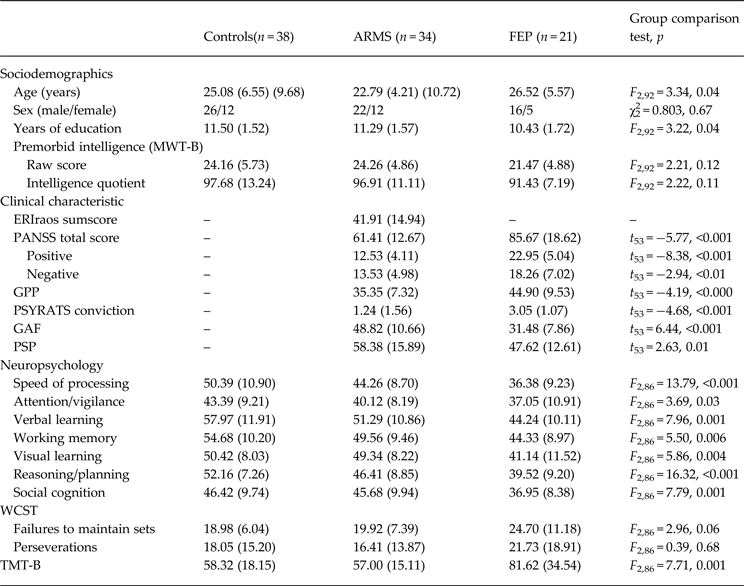
Thirty-eight HCs were matched to the ARMS group at group level regarding gender, age, levels of education and premorbid verbal intelligence. They were further matched to FEP patients, with the exception of the duration of education (Table 1). All groups were predominantly male. HCs were carefully characterized regarding family history of schizophrenia and bipolar disorder in first-degree relatives, previous or current psychiatric disorders using the Mini-International Neuropsychiatric Interview (M.I.N.I.; Sheehan et al. Reference Sheehan, Lecrubier, Sheehan, Amorim, Janavs, Weiller, Hergueta, Baker and Dunbar1998), former or present psychopharmacological treatment and abuse of illegal substances within 4 weeks prior to the investigation and excluded when they fulfilled any of these criteria.
Sociodemographic data and clinical characteristics

ARMS, At-risk mental state; ERIraos, Early Recognition Inventory based on Interview for the Retrospective Assessment of the Onset of Schizophrenia and Other Psychoses (IRAOS); FEP, first episode of psychosis; GAF, Global Assessment of Functioning scale; GPP, General Psychopathology; MWT-B, Multiple Choice Word Test, version B; PANSS, Positive and Negative Syndrome Scale; PSP, Personal and Social Performance Scale; PSYRATS, Psychotic Symptom Rating Scale; TMT-B, Trail Making Test, version B; WCST, Wisconsin Card Sorting Test.
Data are presented as mean (standard deviation). Results of neuropsychological domains are presented as standardized t values. Results of the WCST and TMT-B indicate raw scores.
Psychometric rating scales and neuropsychological characterization
Current ARMS symptoms and general psychopathology were assessed by trained and certified raters (F.R., S.E.) using ERIraos, the Positive and Negative Syndrome Scale (PANSS) and the delusion part of the Psychotic Symptoms Rating Scale (PSYRATS). Negative and depressive symptoms were evaluated with the Scale for the Assessment of Negative Symptoms (SANS) and the Calgary Depression Scale for Schizophrenia (CDSS). Illness severity was rated using the Clinical Global Impression Scale (CGI) and social and global functioning using the Global Assessment of Functioning (GAF) scale and the Personal and Social Performance Scale (PSP).
The Measurement and Treatment Research to Improve Cognition in Schizophrenia (MATRICS) consensus cognitive battery (MCCB) for schizophrenia (Nuechterlein et al. Reference Nuechterlein, Green, Kern, Baade, Barch, Cohen, Essock, Fenton, Frese, Gold, Goldberg, Heaton, Keefe, Kraemer, Mesholam-Gately, Seidman, Stover, Weinberger, Young, Zalcman and Marder2008) was used to assess neurocognitive functioning. It contains tests of processing speed (Trail Making Test, version A, symbol coding, verbal fluency), vigilance (Continuous Performance Test – identical pairs), verbal (Hopkins’ Verbal Learning Test – revised) and visual learning (Brief Visuospatial Memory Test – revised), verbal and visuospatial working memory (Wechsler Memory Scale: Letter Number Sequencing, Spatial Span task), planning (mazes task) and social cognition (Meyer-Salovey-Caruso Emotional Intelligence Test). Additionally, we evaluated executive functions as set shifting and maintenance with the Wisconsin Card Sorting Test (WCST; Heaton, Reference Heaton1981) and set maintenance and alternate attention with the Trail Making Test, version B (TMT-B; Reitan & Wolfson, Reference Reitan and Wolfson1993). Premorbid verbal intelligence was estimated by means of the Multiple Choice Word Test, version B (MWT-B; Lehrl, Reference Lehrl2005).
Metamemory task
A computerized version of the DRM paradigm (Deese, Reference Deese1959; Roediger & McDermott, Reference Roediger and McDermott1995), presented with Presentation version 14.4 (Neurobehavioral Systems Inc., USA) was used to assess metamemory performance. Descriptions of validation and standardization processes of the stimuli can be found in prior publications (Moritz et al. Reference Moritz, Gläscher, Sommer, Buechel and Braus2006a ; Eifler et al. Reference Eifler, Rausch, Schirmbeck, Veckenstedt, Mier, Esslinger, Englisch, Meyer-Lindenberg, Kirsch and Zink2014a ).
In this study, we used six word lists which were associated with the following themes: holiday, street, betrayal, love, to look, garbage. Twelve words per list were presented sequentially 1 s each with intermediate intervals of 2 s in the encoding phase. They were presented in descending semantic association with the theme word. Ten-second intervals intervened between presentations of subsequent word lists. The lists were presented in the above-stated order (starting with the association list of holiday). Participants were instructed to first encode the upcoming words and then to recognize words in a following recognition phase. After the presentation of three word lists, a new instruction was shown telling participants to indicate if they had seen the upcoming words before and how certain they were about their decision. The recognition list contained six words that had actually been presented, two new words not related to the theme word and the four words that were not presented during encoding (lure words, including the theme word as critical lure). Confidence was rated on a six-point Likert scale. Participants had to indicate if they had seen the word and were (1) 100% certain, (2) rather certain or (3) uncertain, or if they had not seen the word before and were (4) uncertain, (5) rather certain or (6) 100% certain. In order to ease analyses, the confidence ratings were later recoded, so that scores from 1 to 3 indicated increasing confidence for two categories: ‘studied words’ and ‘not studied’. Words remained on the screen until a decision was made. The whole task was divided into two blocks, each containing three lists.
Variables of interest were the amount of hits (correctly recognized studied words), correct lure rejections (correct rejections of new words which were semantically related), misses (not recognized but studied words) and false-positive lures (new words, semantically related and incorrectly judged as studied). Consistent with work from Moritz & Woodward (Reference Moritz and Woodward2006b ), we computed two metamemory parameters. First, the CG was calculated by subtracting the mean confidence in incorrect answers from the mean confidence in correct answers (mean confidences(incorrect) – mean confidences(correct)). This index includes all confidence ratings in any type of answer and describes participants’ abilities to discriminate false and true memories in terms of confidence. Second, the KCI was calculated by generating the percentage of very-high-confident answers (answers with 100% certainty) which were errors of all high-confident answers
 $$\eqalign{ & \displaystyle{{\sum {\left( { \hbox{high - confident}\,\,{\rm errors}} \right)}} \over {\sum {\left( {\hbox{high - confident}\,\,\hbox{correct + high - confident}\,\,{\rm errors}} \right)}}} \cr & \quad \times 100.}$$
The KCI specifically relates to subjectively highly confident, but false knowledge.
Statistics
Data was analysed using SPSS version 18.0 (SPSS Inc., USA). We tested for non-normal distributions of parameters using histograms and the Kolmogorov–Smirnov test. The primary endpoint of our study was the hypothesis-driven cross-sectional comparison of HCs, ARMS and FEP patients regarding metamemory functioning using ANCOVAs (significance level of p < 0.05). Outliers were defined as exceeding the mean by >2 standard deviations. One FEP patient fulfilled this criterion in the metamemory data and was listwise excluded from the analyses. One ARMS patient fulfilled the criterion for the domain visual learning and one ARMS patient for the TMT-B. These cases were casewise excluded from neuropsychological analyses. Neuropsychological functioning was analysed using multivariate analyses of covariance. In cases of missing data (1 × TMT-B, 1 × visual learning, 2 × attention/vigilance, 2 × social cognition) scores were interpolated from group means. Correlations of metamemory functioning with psychopathological variables and neuropsychological measures were analysed using Pearson's product-moment correlation coefficient if data was normally distributed and Spearman's rank correlations if prerequisites were not fulfilled and the data could not be improved by standard transformation methods. Partial correlations were implemented in analyses of the ‘all patients’ group.
Results
Sociodemographic, clinical and neuropsychological data
In the three group comparison the variables age and years of education revealed significant differences. Post-hoc multiple comparisons showed that these significant differences were due to age differences between ARMS and FEP patients (p = 0.015) and education differences between HCs and FEP patients (p = 0.015). Therefore, these variables were included as covariates in subsequent group comparisons. FEP patients showed significantly higher scores regarding psychotic symptoms and general psychosocial impairment compared to ARMS patients. Neurocognitive functions differed between groups with highest levels of impairment in the FEP group (Table 1).
Metamemory task
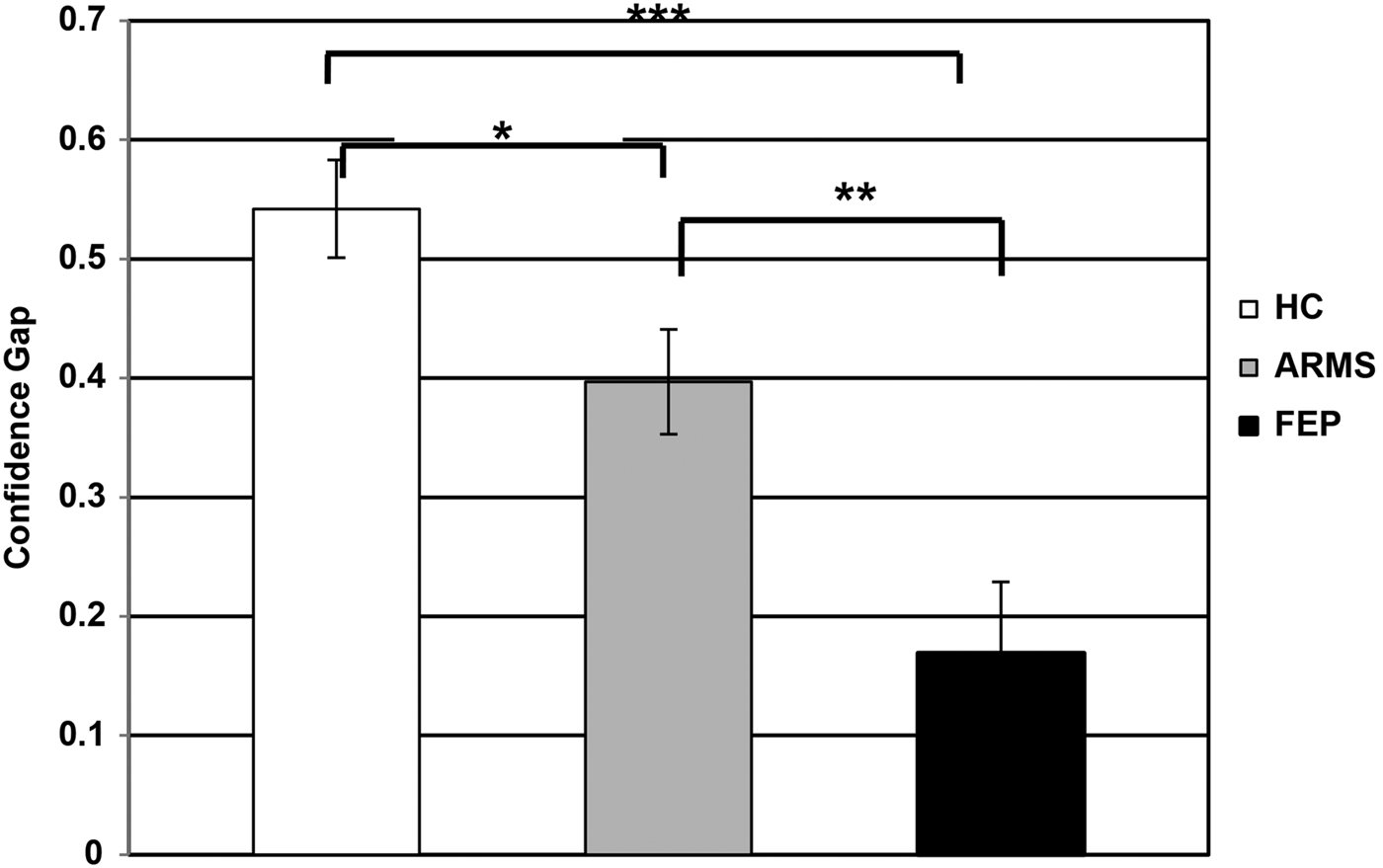
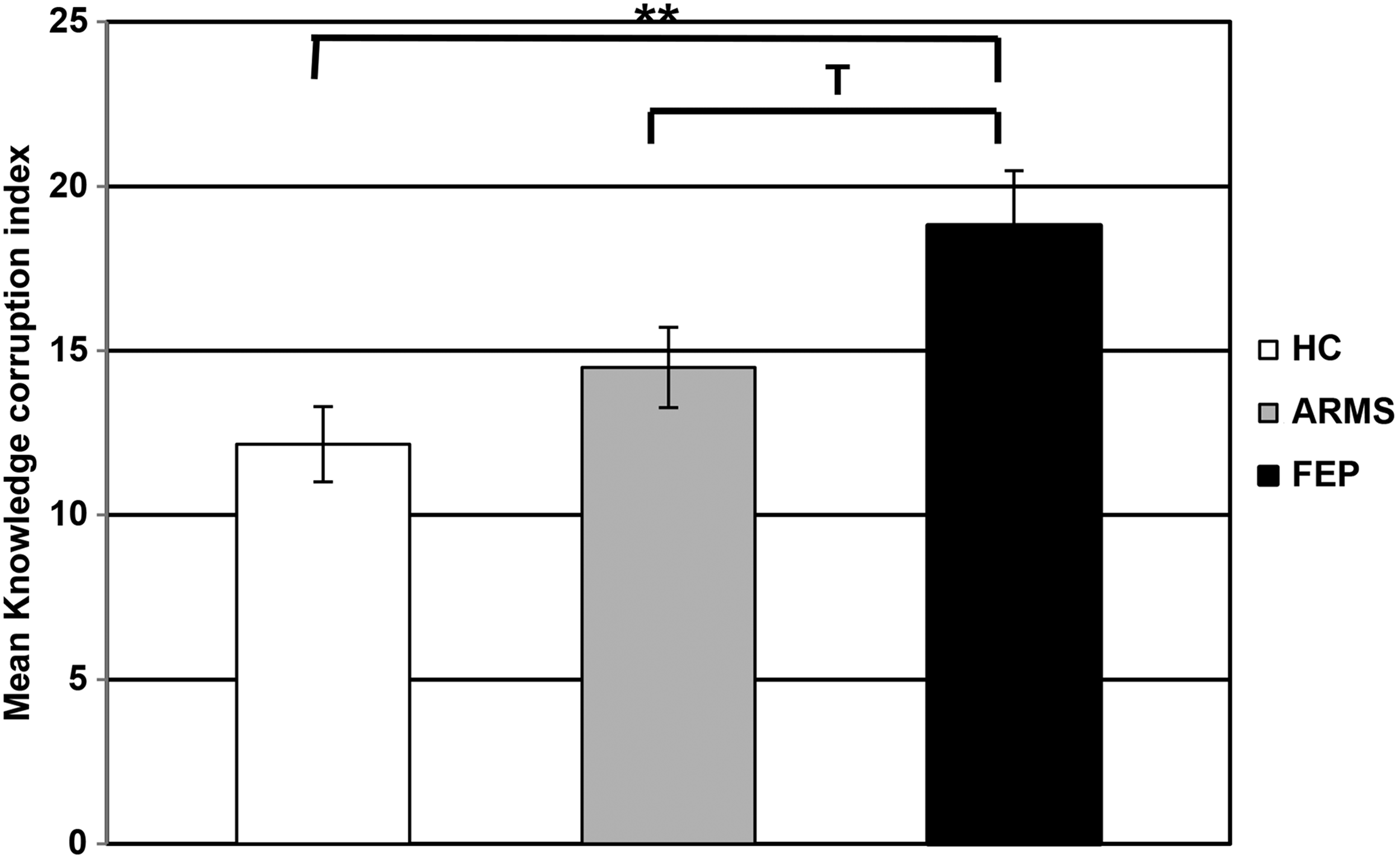
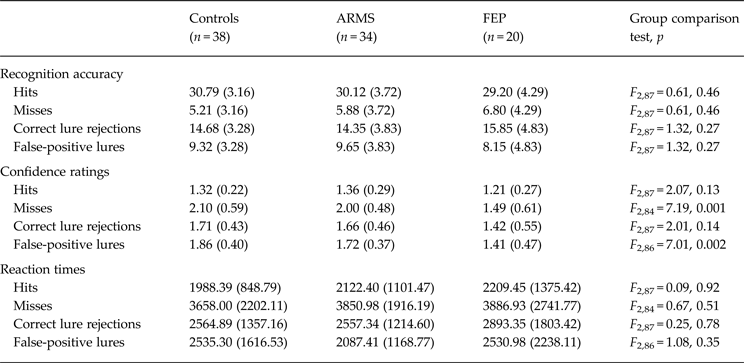
There were no group differences in the accuracy of recognitions (F 4,174 = 0.826, p = 0.510, η p 2 = 0.019). Univariate analyses of covariance regarding confidence-level ratings showed significant differences for misses and false positives (Table 2). These differences were ascribable to differences between controls and FEP patients [p = 0.001, 95% confidence interval (CI) −1.01 to −0.20; p = 0.001, 95% CI −0.73 to −0.15, respectively] and between ARMS and FEP patients (p = 0.007, 95% CI −0.95 to −0.12; p = 0.068, 95% CI −0.58 to −0.02, respectively). The CG differed significantly between groups (F 2,87 = 13.51, p < 0.001, η p 2 = 0.237). Planned contrasts revealed significant differences between HCs and the ARMS group (p = 0.018, 95% CI 0.025–0.266), controls and the FEP group (p < 0.001, 95% CI 0.231–0.518), as well as ARMS and FEP patients (p = 0.003, 95% CI 0.081–0.377). The KCI also differed significantly between groups (F 2,87 = 4.47, p = 0.014, η p 2 = 0.093). Using planned contrasts, a significant group difference was only found between HCs and FEP patients (p = 0.004, 95% CI −9.714 to −1.952) and a trend was found between ARMS and FEP patients (p = 0.062, 95% CI −7.775 to 0.197) (Figs 1 and 2). Reaction-time data was transformed using log transformation. There were no group differences (F 8,162 = 0.705, p = 0.687, η p 2 = 0.034).
Group comparisons of the confidence gap (CG). The bars represent the estimated marginal means and standard errors of the CG (mean confidences(incorrect) – mean confidences(correct), corrected for the covariates years of education and age). At-risk mental state (ARMS) patients differed significantly from healthy controls (HCs) as well as first episode of psychosis (FEP) patients in their CG. FEP patients showed highly significant different results compared to the control group. Significant results are indicated by *p < 0.05, **p < 0.01, ***p < 0.001.

Group comparisons of knowledge corruption index (KCI). The bars represent the marginal means and standard errors of the KCI [Σ(high-confident errors)/Σ(high-confident correct + high-confident errors) × 100], corrected for the covariates years of education and age. First episode of psychosis (FEP) patients differed significantly from the healthy control (HC) group. Results of at-risk mental state (ARMS) patients were found to be in between the other two groups. Significant results are indicated by **p < 0.01. T, trend.

Recognition accuracy, confidence ratings, and reaction times in the metamemory task

ARMS, At-risk mental state; FEP, first episode of psychosis.
Data are presented as mean (standard deviation). Reaction times are displayed in milliseconds. Group comparisons are done after log transformation.
Subsequently, we evaluated possible confounding effects of depressive symptoms by comparing those patients with (CDSS sumscore ⩾6, n = 23) and without (CDSS sumscore <6, n = 31) clinically significant depressive symptoms. There were no group differences for the CG (F 1,50 = 0.05, p = 0.83, η p 2 = 0.001, 95% CI −0.133 to 0.165) or the KCI (F 1,50 = 0.43, p = 0.52, η p 2 = 0.009, 95% CI −2.873 to 5.657). To test the influence of benzodiazepines, diazepam equivalents were correlated with metamemory performance. They did not correlate in the ARMS group (CG: r = 0.03, p = 0.88; KCI: r = 0.13, p = 0.48) but showed a trend in the FEP group (CG: r = −0.47, p = 0.05; KCI: r = −0.30, p = 0.23). Thus this variable was included as covariate in a second group comparison of the CG and the KCI and results still reached significance (CG: p = 0.001, KCI: p = 0.009).
Correlational analyses
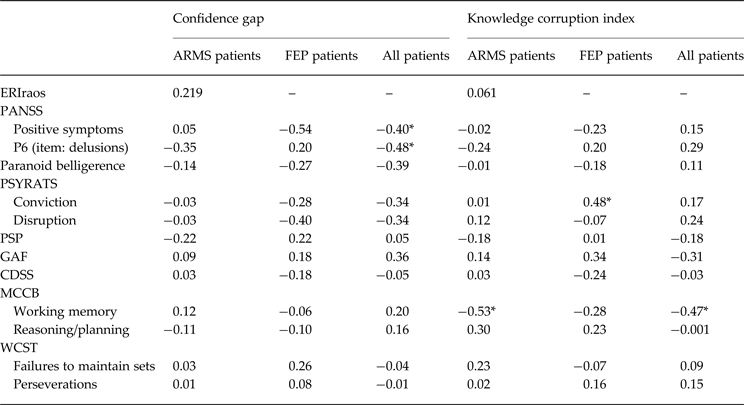
An analysis of all patients combined in one group indicated that the CG correlated with delusional measures significantly even after Bonferroni corrections (see Table 3). Correlations between scales of social and global functioning or depression and metamemory indices did not remain significant after Bonferroni correction. In the separate groups, analyses revealed similar correlations. A number of delusional measures reached medium effect sizes. However, these did not withstand the strict correction for multiple testing. Furthermore, a significant correlation between the KCI and the neuropsychological domain of working memory was revealed in the entire group and the ARMS group (Table 3).
Correlations between Metamemory indices, psychopathology and neuropsychology

ARMS, At-risk mental state; CDSS, Calgary Depression Scale for Schizophrenia; ERIraos, Early Recognition Inventory based on Interview for the Retrospective Assessment of the Onset of Schizophrenia and Other Psychoses (IRAOS); FEP, first episode of psychosis; GAF, Global Assessment of Functioning scale; MCCB, MATRICS Consensus Cognitive Battery; PANSS, Positive and Negative Syndrome Scale; PSP, Personal and Social Performance Scale; PSYRATS, Psychotic Symptom Rating Scale; WCST, Wisconsin Card Sorting Test.
Asterisks indicate significant results after Bonferroni correction for multiple comparisons. Correlations were performed using Pearson's correlation coefficient or Spearman Rank correlation. In the ‘all patients’ group partial correlations were used.
Discussion
The present results fit nicely into prior research of patients with chronic schizophrenia (e.g. Moritz et al. Reference Moritz, Woodward, Jelinek and Klinge2008; Eifler et al. Reference Eifler, Rausch, Schirmbeck, Veckenstedt, Mier, Esslinger, Englisch, Meyer-Lindenberg, Kirsch and Zink2014a ), FEP patients (Moritz et al. Reference Moritz, Woodward and Chen2006b ) and HCs with delusional ideation (Laws & Bhatt, Reference Laws and Bhatt2005; Moritz et al. Reference Moritz, Goritz, Van, Andreou, Jungclaussen and Peters2014a ). FEP patients, who already suffered from manifest psychotic symptoms, showed the lowest CG and a significantly larger KCI compared to the control group. This replicates earlier findings in FEP patients, demonstrating a performance similar to chronic patients (Moritz et al. Reference Moritz, Woodward, Whitman and Cuttler2005, Reference Moritz, Ramdani, Klass, Andreou, Jungclaussen, Eifler, Englisch, Schirmbeck and Zink2014b ; Peters et al. Reference Peters, Hauschildt, Moritz and Jelinek2013). As all patients were antipsychotic-naive, an antidopaminergic influence on metamemory performance can be excluded. It should be noted that all groups displayed similar recognition accuracy and reaction times. This indicates that the impairment in memory monitoring abilities occurs irrespective of actual memory performance. With respect to prior literature, the finding that FEP patients had preserved recognition accuracy is unexpected. Many other studies of metamemory (Moritz et al. Reference Moritz, Woodward, Cuttler, Whitman and Watson2004, Reference Moritz, Woodward and Rodriguez-Raecke2006c , Reference Moritz, Ramdani, Klass, Andreou, Jungclaussen, Eifler, Englisch, Schirmbeck and Zink2014b ; Peters et al. Reference Peters, Hauschildt, Moritz and Jelinek2013; Eifler et al. Reference Eifler, Rausch, Schirmbeck, Veckenstedt, Mier, Esslinger, Englisch, Meyer-Lindenberg, Kirsch and Zink2014a ), but not all (cf. Kircher et al. Reference Kircher, Koch, Stottmeister and Durst2007), found increased error rates in patients with schizophrenia, especially for false-negative errors. We can exclude confounding effects of negative symptoms, medication and reaction times in our sample. More work is necessary to explain this difference.
Regarding our main hypothesis, the present results add interesting supporting evidence for early aberrations in retrospective memory confidence in risk constellations for psychosis. ARMS patients presented intermediate metamemory abilities between both comparison groups resembling a three-staged, stepwise picture. However, there were differences between the two measures of metamemory performance. ARMS patients differed significantly from the other groups regarding CG. These results implicate that deviations in the CG already occur in help-seeking individuals who experience ARMS symptoms, but are less distinct than after the exacerbation of a first psychosis. The interpretation seems plausible that the bias aggravates during the progression of a psychotic illness. The results regarding knowledge corruption pointed towards a lower index in the ARMS group compared to FEP patients but no significant difference could be seen in comparison to the control group. It is possible that ARMS patients already have constraints in their monitoring abilities, as indicated by the reduced CG, but that they implement a more conservative decision-making strategy than patients with psychosis and do not (yet) liberally make their decisions with very high confidence. The liberal acceptance account of psychosis illustrates this data-gathering bias (Moritz et al. Reference Moritz, Woodward, Jelinek and Klinge2008), which holds that patients with psychosis reach fast and highly confident decisions on the basis of little evidence without searching for further proof.
The present results contribute to a cognitive theory of upcoming psychotic syndromes as decreased memory monitoring abilities may represent a cognitive marker of psychosis. But do they represent a cognitive marker for specific symptoms of psychosis? As introduced, metacognitive biases have been discussed as being relevant risk factors, particularly for the emergence of delusions (Moritz & Woodward, Reference Moritz and Woodward2006a ). Our results hint towards this direction: a stronger metamemory bias was associated with more severe positive and delusional symptoms as measured by PANSS and PSYRATS. Metamemory was neither associated with depressive symptoms, nor influenced by benzodiazepines, nor biased by antidopaminergic agents. These primary analyses of confidence in memory in ARMS patients give the first hints strengthening the interpretation that metamemory biases are associated with the severity of positive symptoms, especially delusions, during the development of psychosis. Some prior studies have not reported any association between metamemory biases and the magnitude of symptoms in schizophrenia (Moritz et al. Reference Moritz, Woodward and Ruff2003; Moritz & Woodward, Reference Moritz and Woodward2004; Eifler et al. Reference Eifler, Rausch, Schirmbeck, Veckenstedt, Mier, Esslinger, Englisch, Meyer-Lindenberg, Kirsch and Zink2014a ). Replications of the present findings are needed to support the hypothesis. It is recommended that special attention is paid to differences in sample characteristics, which might at least partly explain diverging findings between studies, e.g. antipsychotic medication and severity of illness expressed in PANSS scores.
Different mechanisms might explain the link between metamemory and positive symptoms. As reported earlier, associations between dopaminergic stimulation and higher confidence ratings were found in two double-blind studies (Lou et al. Reference Lou, Skewes, Thomsen, Overgaard, Lau, Mouridsen and Roepstorff2011; Andreou et al. Reference Andreou, Moritz, Veith, Veckenstedt and Naber2013). It was hypothesized that high-confident acceptance operates as a rewarding experience, which might lead to over-interpretations of one's judgements as correct and form the basis for delusions or hallucinations. Moritz et al. (Reference Moritz, Woodward, Cuttler, Whitman and Watson2004) suggested in a similar line a high liability to accept, even implausible, hypotheses on the basis of little information as mechanism of high plausibility ratings for decisions. Neurofunctional activation during metamemory tasks in healthy people appeared in medial prefrontal, medial parietal and lateral parietal areas (Chua et al. Reference Chua, Schacter and Sperling2009), possibly forming a network representing internally directed cognition (Gusnard et al. Reference Gusnard, Raichle and Raichle2001; Chua et al. Reference Chua, Schacter and Sperling2009). It would be interesting to thoroughly explore if the same network was activated in patients with an ARMS, with a FEP and patients with chronic schizophrenia to gain knowledge about the neural mechanisms of metamemory in the course of illness. Therefore, multimodal and longitudinal studies are needed. Whether memory monitoring can predict the development of positive symptoms cannot be answered without longitudinal data including assessments of transitions into psychosis.
Previous literature discussed the importance of associations between neuropsychological and metacognitive performance to improve the prediction of psychosocial functioning in ARMS patients (Scheyer et al. Reference Scheyer, Reznik, Apter, Seidman and Koren2014). The exploration of cognitive mechanisms of metamemory in our study revealed that increasing working memory abilities were associated with a decreasing KCI in the entire patient group and in the ARMS group. This result is in line with a prior study by our group which investigated metamemory in chronic schizophrenia (Eifler et al. Reference Eifler, Rausch, Schirmbeck, Veckenstedt, Mier, Esslinger, Englisch, Meyer-Lindenberg, Kirsch and Zink2014a ) and found that tests of working memory as well as executive functioning (set-shifting and maintenance abilities as measured by the WCST) were related to KCI. Another work group found the same domains to be correlated with cognitive insight as measured with a self-rating questionnaire and suggested that cognitive insight mainly depends on these two cognitive domains (Orfei et al. Reference Orfei, Spoletini, Banfi, Caltagirone and Spalletta2010). Impairment of working memory ability in psychosis thus seems to correlate with decreased processing abilities in metamemory tasks. However, the KCI was the only metamemory measure associated with neurocognitive abilities. The present findings can be interpreted in the way that working memory partially overlaps with metamemory functioning, yet, it does not explain all aspects of metamemory. Importantly, these results cannot be interpreted causally. A correspondingly higher correlation in the FEP group was not found as expected, which was probably due to small group size. Differences in the assessment of neurocognitive abilities might also explain diverging results. For example, Mäntylä et al. (Reference Mäntylä, Rönnlund and Kliegel2010) found executive functions to be related to metamemory even in healthy people and regarded the ability of set shifting as particularly important. Sometimes it has been suggested, that the here implemented measures might not be sensitive enough to reveal group differences in executive functioning (Goldstein et al. Reference Goldstein, Beers and Shemansky1996). Therefore different tests assessing executive functioning and working memory should be used and compared to gain more insight into neurocognitive mechanisms of metamemory in the early course of psychosis. This knowledge is needed to improve treatment programmes, such as metacognitive training (Moritz et al. Reference Moritz, Kerstan, Veckenstedt, Randjbar, Vitzthum, Schmidt, Heise and Woodward2011) because most likely co-functioning of different metacognitive and neurocognitive abilities contribute to delusion development (Juarez-Ramos et al. Reference Juarez-Ramos, Rubio, Delpero, Mioni, Stablum and Gomez-Milan2014; Scheyer et al. Reference Scheyer, Reznik, Apter, Seidman and Koren2014).
Different limitations have to be considered: groups were not entirely matched, but significantly differing variables were included as covariates. The relatively small sample size might have led to Type II errors. Raters were not blind regarding grouping. Though our aim was to cross-sectionally investigate memory monitoring abilities in a risk constellation and not specifically in the pre-psychotic stage, it is important to note that this study design precludes extrapolations on transitions to psychosis. Some patients were treated with small doses of benzodiazepines. An influence of this medication cannot completely be ruled out but the analyses did not reveal any confounding effect. Finally, there is emerging evidence (Moritz et al. Reference Moritz, Göritz, Schafschetzy, Van Quaquebeke, Peters and Andreou2015) that overconfidence is errors is not ubiquitous in schizophrenia but depends on subjective ease of the task.
Conclusions
To our knowledge, this is the first study assessing confidence level ratings in a DRM task to measure metamemory abilities in FEP patients, ARMS patients and HCs. Our results suggest decreased memory monitoring abilities in early stages of psychosis development. This bias seems to play an important role in the pathogenesis of psychosis and might contribute to the cognitive theory of delusions (Freeman, Reference Freeman2007). Further research is necessary to focus on differences between ARMS patients with and without a transition to psychosis. Knowledge about metacognitive functioning might improve the prediction of transition to psychosis when added to psychopathological diagnostic tools.
Acknowledgements
We are grateful to all participants and to the staff of the inpatient clinic who helped support our study appointments. M.Z., A.M.-L., and P.K. were funded by the Deutsche Forschungsgesellschaft (DFG, http://www.dfg.de, projects ZI1253/3-1, ZI1253/3-2, KI 576/14-2, ME 1591/6-2). S.E. was supported by a grant of Heidelberg University (Landesgraduiertenförderungsgesetz), D.M. by the Olympia-Morata Program, and F.S. by the Evangelisches Studienwerk and by the Deutscher Akademischer Austauschbund (DAAD). The funders had no role in study design, data collection and analysis, decision to publish or preparation of the manuscript.
Declaration of Interest
S.En. has received travel expenses and consultant fees from AstraZeneca, Bristol–Myers Squibb GmbH & CoKGaA, Eli-Lilly, Janssen Cilag, Otsuka Pharma, Pfizer Pharma and Servier. A.M. has received consultant fees and travel expenses from AstraZeneca, Hoffmann-La Roche, Lundbeck Foundation, and speaker's fees from Pfizer Pharma, Lilly Deutschland, Glaxo SmithKline, Janssen Cilag, Bristol–Myers Squibb, Lundbeck, Servier and AstraZeneca. M.Z. has received unrestricted scientific grants from the European Research Advisory Board (ERAB), German Research Foundation (DFG), Pfizer Pharma GmbH, Servier and Bristol–Myers Squibb Pharmaceuticals; further speaker and travel grants were provided by Astra Zeneca, Lilly, Pfizer Pharma GmbH, Bristol-Myers Squibb Pharmaceuticals, Otsuka, Servier, Lundbeck, Janssen Cilag, Roche and Trommsdorff. All other authors have no conflicts of interest.