Introduction
In response to global measures to combat climate change, industry is increasingly being expected to behave pro-environmentally. There is a consensus among scholars and practitioners that human behaviour has had a significant bearing on environmental degradation, causing numerous natural calamities, such as global warming, urban air pollution, drought, flood, tsunami and loss of biodiversity (Ernst & Wenzel, Reference Ernst and Wenzel2014; Gardner & Stern, Reference Gardner and Stern1996; Steg & Vlek, Reference Steg and Vlek2009). As research indicates, many business operations can have adverse effects on the environment. Yet the good news is that a number of studies have found that these adverse impacts can largely be minimised by changing managerial decisions towards environmental sustainability (Chen, Ngniatedema, & Li, Reference Chen, Ngniatedema and Li2018; Molina-Azorín et al., 2016; Shaukat, Qiu, & Trojanowski, Reference Shaukat, Qiu and Trojanowski2016). In an era of freely available media coverage, stakeholders are able to continuously monitor organisations’ environmental performance. This necessitates managers to behave pro-environmentally to ensure their organisation’s survival and growth. Therefore, more research needs to be carried out to examine the possible antecedents of people’s pro-environmental behavioural intentions. A critical first step for organisations seeking to act pro-environmentally is to hire the right kind of manager who will uphold the organisation’s commitment to the environment by adopting green business operations.Footnote 1 Research investigating such adverse impacts of human behaviour on Earth’s ecological systems has gained momentum, mostly in the context of economically advanced nations of the United States and European Union since the 1970s (Dunlap & Mertig, Reference Dunlap and Mertig2014; Golub, Reference Golub2013). Despite this growing research field, there is a paucity of such initiatives in the context of developing countries, which comprise more than 80% of the world’s total population. Moreover, these countries are reportedly the most vulnerable to global climate change.
Extant research investigating the antecedents of pro-environmental behaviour indicates that personal values do influence many of human behaviours in a given situation. As noted by Schwartz (Reference Schwartz1992), values are goals that guide our lives and influence behaviour. A number of studies demonstrate that personal values do influence attitudes, which in turn influence people’s behaviour (Homer & Kahle, Reference Homer and Kahle1988). Value-Attitude-Behaviour theory (VAB) by Homer and Kahle (Reference Homer and Kahle1988) and Value-Belief-Norm theory (VBN) by Stern (Reference Stern2000) postulate that general value orientations affect people’s attitudes regarding specific objects and situations, and that attitudes, in turn, influence people’s behavioural intentions, and finally the actual behaviour. However, some scholars (e.g., Andorfer, & Liebe, Reference Andorfer and Liebe2012; Carrington, Neville, & Whitwell, Reference Carrington, Neville and Whitwell2010; Hassan, Shiu, & Shaw, Reference Hassan, Shiu and Shaw2016; Sutton, Reference Sutton1998) argue that there may not be any correlation between the intention-behaviour link due to the presence of some confounding situational factors such as implementation intention, actual behaviour control, and time lapse; therefore, intention as a distal behaviour may tend to yield a weak or no association with the corresponding behaviour.
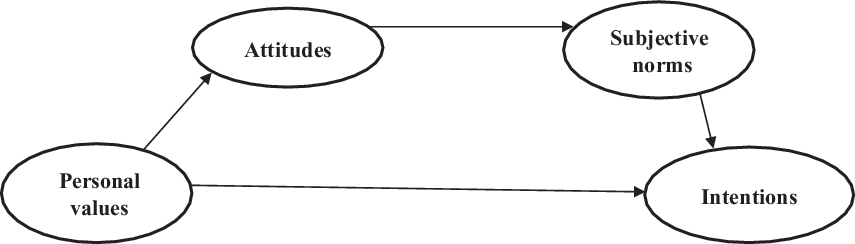
In line with the theoretical underpinning of VAB and VBN, our study aims to examine the roles of personal values, beliefs, attitude, and subjective norms on individuals’ environmental behavioural intention — the closest proxy of actual pro-environmental behaviour (Ajzen, Reference Ajzen1991). The exploration of future behavioural intention would allow organisations to develop effective recruitment and selection mechanisms through embedding environmental sensitiveness into their mainstream HR practices to find, hire and retain environmentally responsible managers. We also aim to examine whether any mediating relationships exist between the variables of the research model, to better understand the pattern of future managers’ pro-environmental behavioural intention. To achieve these objectives, we propose to examine a parsimonious research model (see Figure 1) with the underpinning of VAB and VBN theoretical frameworks. As such, our findings will assist in understanding the extent to which the personal values, attitudes, and subjective norms of the future managerial candidates can help us in predicting the likelihood of their intention to behave pro-environmentally. By doing so, our findings offer some significant theoretical, methodological and practical implications for researchers, practitioners and policy makers towards creating a greener and sustainable world.
Research model to understand the intention of future managers to behave pro-environmentally.

Our article differs from the existing literature in several ways. For example, our research setting is unique in term of its context: India, one of the fastest growing emerging economies, which is also one of the high carbon dioxide (CO2) emitting nationsFootnote 2 in the world. The World Economic Forum (2018) warns that India is the most vulnerable country regarding global climate change, just after Pakistan, the Philippines and Bangladesh. Second, the subjects of the study are Indian MBA students, who will be the future business leaders. Due to the global movement of ethical business leaders, the current study, by engaging Indian MBA students, may have far-reaching policy implications not only for India but also for the world community, as many Indian-born managers work for leading world-class multinationals in the capacity of CEO, such as Google, MasterCard, Microsoft, and PepsiCo. Furthermore, most MBA students will likely be (or are currently) employed in managerial positions, and their collaborative actions may have a significant social impetus on their organisation’s endeavours to be recognised as a green organisation by adopting and implementing sustainable pro-environmental practices.
Lord and Brown (Reference Lord and Brown2001) argued that where the implementation of the regulation is weak (generally in emerging economies like India), the appointment of pro-environmental manager becomes more important because a leader’s personal values towards the intended behaviour — for example, adopting pro-environmental behaviour — can play an exemplary role in influencing their followers’ motivations to behave in line with expectations of the organisation (Jacobs, Petersen, Hörisch, & Battenfeld, Reference Jacobs, Petersen, Hörisch and Battenfeld2018; Whitley, Takahashi, Zwickle, Besley, & Lertpratchya, Reference Whitley, Takahashi, Zwickle, Besley and Lertpratchya2018). It is a critical first step for organisations seeking to act pro-environmentally to hire responsible future ‘green managers’. An organisation’s initiative to hire environmentally responsible managers indicates its genuine commitment towards sustainability outcomes (Hartmann, Apaolaza, & D’Souza, Reference Hartmann, Apaolaza and D’Souza2018; Su, Watchravesringkan, Zhou, & Gil, Reference Su, Watchravesringkan, Zhou and Gil2019). Our findings suggest which personal attributes and environmental obligations employers should look for in job applicants to determine whether their newly hired managers will behave pro-environmentally in the future.
To the best of our knowledge, our paper is the first to use a comprehensive model comprising both the VAB and VBN theoretical frameworks to examine the association and mediating effects of values–attitudes–subjective norms with pro-environmental behavioural intentions in a developing country context. Our study also contributes to the literature by conjoining VAB with VBN and extending the model by incorporating a prediction of individuals’ willingness to engage in pro-environmental behaviours, which enhances the predictive capability of the model in terms of pro-environmental intention. Therefore, one’s willingness to engage in pro-environmental behaviours can be better understood through this extended model of examination of the intention to behave pro-environmentally.
Theoretical framework and research model
Our conceptual model presented in Figure 1 has been developed to understand the pro-environmental behavioural intention of MBA students in India. The model hypothesises that personal values are positively associated with pro-environmental attitudes, attitudes are positively associated with their subjective norms, and subjective norms is positively associated with their pro-environmental behavioural intentions. To understand their pro-environment intention, our proposed research model accommodates VBN (Stern, Reference Stern2000) and VAB (Homer & Kahle, Reference Homer and Kahle1988). Our model integrates the interrelationships between values, belief, attitudes, norms, and behavioural intention by proposing a causal model that examines their complex interrelationships. The model assumes a hierarchical influence of values, attitudes, and behavioural intentions.
Schwartz (Reference Schwartz1992) defines values as goals that guide our lives and influence human behaviour. Schwartz’s (Reference Schwartz1992) value theory describes 10 basic types of human values that are differentiated by their motivational goals: universalism, benevolence, conformity, tradition, security, power, achievement, hedonism, stimulation, and self-direction. These values can be differentiated through their emphasis on different motivational goals. Kulin and Svallfors (Reference Kulin and Svallfors2013) commented that ‘the ten values can be classified into a circular continuum (quasi-circumplex) representing their dynamic relationships, where adjacent values are related, more distant values less related and diametrical values are each other’s opposites and therefore directly negatively linked’ (p. 157). Four higher order value types also differentiated by Schwartz in the circular scale are self-transcendence, self-enhancement, openness, and tradition. One of the most appealing features of Schwartz’s theory is the integration of basic value types into broader value systems of self-transcendence versus self-enhancement, and openness to change versus conservatism (Kulin & Svallfors, Reference Kulin and Svallfors2013).
The value-belief-norm theory of environmentalism (Stern, Reference Stern2000; Stern, Dietz, Abel, Guagnano, & Kalof, Reference Stern, Dietz, Abel, Guagnano and Kalof1999) postulates a causal chain of five variables: values, the new environmental (or ecological) paradigm (NEP), awareness of consequences (AC), ascription of responsibility (AR) to self-beliefs, and personal norms (PN). The theory suggests that individuals’ choice about pro-environmental actions can be driven by personal norms — a sense of obligations from within to act in a certain way. Norms are triggered at a point when an individual believes that violating them would have adverse effects on things they value and they will bear significant responsibility for those consequences by taking actions. The theory provides a framework for investigating normative factors that promote sustainable attitudes and behavioural intention and finally the behaviour. In the norm-activation theory, Schwartz (Reference Schwartz1968, Reference Schwartz1977) has articulated ‘personal norms’ as self-expectations that are primarily based on people’s personal values. Personal norms have effects on people’s behaviour when they are activated depending on the situational context (Harland, Staats, & Wilke, Reference Harland, Staats and Wilke1999). Given this, and considering our study context, we have operationalised personal norms as subjective norms of perceived social pressures and a motivation to comply with those pressures to perform the desired behaviour (Fishbein & Ajzen, Reference Fishbein and Ajzen1975).
Homer and Kahle’s (Reference Homer and Kahle1988) cognitive hierarchy model, operationalised as the VAB model, integrates people’s values, attitudes and behaviour by posting a hierarchical influence of cognition in which the influence theoretically flows from more abstract cognitions (i.e., value) to mid-range cognitions (i.e., attitudes) to specific behaviour, arguably pro-environmental behaviour (Milfont, Duckitt, & Wagner, Reference Milfont, Duckitt and Wagner2010). Homer and Kahle (Reference Homer and Kahle1988) attempted to integrate the interrelationships between values, attitudes and behaviour by proposing a causal model with a hierarchical influence of values and attitudes on the people’s behaviour. This model has been applied and validated in the areas of natural food-shopping behaviour (Homer & Kahle, Reference Homer and Kahle1988), predicting college students’ attitudes as to whether to choose a retail career (Shim, Warrington, & Goldsberry, Reference Shim, Warrington and Goldsberry1999), understanding mall shopping behaviour in China and Thailand (Cai & Shannon, Reference Cai and Shannon2012), predicting green cloth purchase behaviour (Jacobs et al., Reference Jacobs, Petersen, Hörisch and Battenfeld2018), and most recently in capturing the perception and consumption behaviour of sustainable apparel products of both US and Chinese younger generations (Su et al., Reference Su, Watchravesringkan, Zhou and Gil2019).
Previous studies of pro-environmental behaviour (e.g., Hillhouse, Adler, Drinnon, & Turrisi, Reference Hillhouse, Adler, Drinnon and Turrisi1997; Steg & Vlek, Reference Steg and Vlek2009; Unsworth, Dmitrieva, & Adriasola, Reference Unsworth, Dmitrieva and Adriasola2013) have predominantly employed the theory of planned behaviour (Ajzen, Reference Ajzen1991). Stern’s (Reference Stern2000) VBN model is increasingly being employed in current studies for predicting young travellers’ intention to behave pro-environmentally (Kiatkawsin & Han, Reference Kiatkawsin and Han2017), understanding the role of psychological empowerment in climate-protective consumer behaviour (Hartmann, Apaolaza, & D’Souza, Reference Hartmann, Apaolaza and D’Souza2018) and to understand sustainability behaviours among college students (Whitley et al., Reference Whitley, Takahashi, Zwickle, Besley and Lertpratchya2018). In reality, we argue that integration of the constructs of these two models — that is, people’s values, beliefs, attitudes, norms, and their hierarchical influence on attitudes — can help us to better understand people’s intention to behave pro-environmentally. Therefore, we attempted to examine a research model containing the casual sequence of value-belief-attitude-behavioural intention to address this theoretical gap. The hypotheses that emerged from our theoretical pro-environmental model are articulated in the following sections.
Hypotheses development
Personal values, attitudes and behavioural intention
Many of our behaviours are influenced by our personal values (Schwartz, Reference Schwartz1992). Schwartz (Reference Schwartz1992) articulated value as ‘an enduring belief that a specific mode of conduct or end-state of existence is personally or socially preferable to an opposite or converse mode of conduct or end-state of existence’ (Rokeach, Reference Rokeach1973, p. 5). Values are commonly recognised as important life goals or standards that act as guiding principles in people’s life (Rokeach, Reference Rokeach1973). People’s consideration of choosing a particular behaviour is guided by their personal values (Poortinga, Steg, & Vlek, Reference Poortinga, Steg and Vlek2004). As such, values play a pivotal role in shaping people’s attitudes and behavioural intentions. With respect to pro-environmental behaviour, people’s values also may have a significant bearing on reducing the degree of conflict transcending self-interest (Poortinga et al., Reference Poortinga, Steg and Vlek2004). It is well researched that people’s values have a significant influence on their pro-environmental attitudes and behavioural intentions (Dunlap, Grieneeks, & Rokeach, Reference Dunlap, Grieneeks, Rokeach and Conn1983; Karp, Reference Karp1996; Schultz & Zelezny, Reference Schultz and Zelezny1999; Stern, Reference Stern2000; Van der Werff, Steg, & Keizer, Reference Van der Werff, Steg and Keizer2013). In addition to the direct effect of values on behavioural intentions, the value-belief-norm theory (Stern et al., Reference Stern, Dietz, Abel, Guagnano and Kalof1999) argues that personal values have an influence on pro-environmental behavioural intentions, either directly or through attitudes and normative beliefs (Cordano, Welcomer, Scherer, Pradenas, & Parada, Reference Cordano, Welcomer, Scherer, Pradenas and Parada2011; Papagiannakis & Lioukas, Reference Papagiannakis and Lioukas2012). Ajzen (Reference Ajzen, Krebs and Schmidt1993) and Rokeach (Reference Rokeach1973) articulated that attitudes are individual dispositions to act on or in a preferential manner towards a specific object, behaviour, person, institution, or event. According to Ajzen (Reference Ajzen2001, p. 28), ‘there is general agreement that attitude represents a summary evaluation of a psychological object captured in such attribute dimensions as good–bad, harmful–beneficial, pleasant–unpleasant and likable–dislikeable’. On the basis of these accounts, an attitude can be described as an individual’s tendency to evaluate a specific object — such as a behaviour, person, institution, or event — as good or bad. Eagly and Chaiken (Reference Eagly, Chaiken, Gilbert, Fiske and Lindzey1998) defined an attitude as a psychological tendency that is expressed by evaluating a particular entity with some degree of favour or disfavour.
Research investigating the possible antecedents of individual attitudes provides evidence that personal values can influence attitudes, which in turn influence behavioural intentions (Homer & Kahle, Reference Homer and Kahle1988). While the influence of managers’ personal values on environmental attitudes has been examined in previous studies (e.g., Bansal & Roth, Reference Bansal and Roth2000; Cordano et al., Reference Cordano, Welcomer, Scherer, Pradenas and Parada2011), the direction to which the personal values of future managers influence their pro-environmental attitudes is inconclusive, which leads to the following hypothesis.
Hypothesis 1: The personal values of future managers will be positively associated with their pro-environmental attitudes.
Subjective norms
Fishbein and Ajzen (Reference Fishbein and Ajzen1975) advocated that the notion of subjective norms originates from the perceived social pressures and the motivation to comply with those pressures to perform a desired behaviour expected by the society. Ajzen (Reference Ajzen1991) argues that ‘as a general rule, the more favourable the attitude and subjective norm with respect to a behaviour, the stronger should be an individual’s intention to perform the behaviour under consideration’ (p. 188). This concept has been applied to understand and predict people’s behavioural intentions in a large variety of contexts, such as exercise habits (Jackson, Smith, & Conner, Reference Jackson, Smith and Conner2001; Wise et al., Reference Wise, Scott, Blank, Mummery, Murphy and Warburton2001), smoking (Gantt, Reference Gantt2001; Rise, Kovac, Kraft, & Moan, Reference Rise, Kovac, Kraft and Moan2008), drinking and avoiding alcohol, and fast-food consumption (Ajzen & Sheikh, Reference Ajzen and Sheikh2013). Cordano and Frieze (Reference Cordano and Frieze2000) reported that pollution prevention attitudes, a subjective norm of environmental managers, significantly predicted their intention related to reducing source pollution. In line with these theoretical expectations, White and Hyde (Reference White and Hyde2012) found that attitudes and subjective norms of Australian residents significantly predicted their recycling intentions and subsequent behaviour. Based on the above theoretical expectations and empirical findings, we propose the following hypotheses.
Hypothesis 2: The pro-environmental attitudes of future managers will be positively associated with their subjective norms.
Hypothesis 3: Subjective norms of future managers will be positively associated with their pro-environmental behavioural intentions.
In our discussions, we have articulated that the direct link between personal values and pro-environmental intentions may be affected by other intervening factors such as attitudes and subjective norms; therefore, we propose the following hypothesis:
Hypothesis 4: Attitudes and subjective norms of future managers will mediate the link between personal values and pro-environmental behavioural intentions.
Methods
Measures
Personal values
The Schwartz value instrument (European Social Survey; ESS) was adapted from Bilsky, Janik, and Schwartz (Reference Bilsky, Janik and Schwartz2011). To preserve coverage of the content of the 10 different values, the items included in the Schwartz value instrument were adopted. The ESS scale included Verbal portraits of 21 different people, which were gender-matched with the respondent in the survey scale. A person’s goals, aspirations, or wishes are described in each portrait. For example, ‘Thinking up new ideas and being creative is important to her. She likes to do things in her own original way’ describes a person for whom self-direction values are important. Respondents’ own values were inferred from their self-reported similarity to people described implicitly in terms of a particular value. Footnote 3 Regarding each portrait, respondents answered the question: ‘How much like you is this person?’ Six labelled responses (6-point scale) ranged from Not like me at all to Very much like me. Two portraits operationalised each value, with three for universalism because of its very broad content. The score for the importance of each value was the mean response to the items that measured it. Footnote 4
Attitudes towards the pro-environmental behaviour
The measures of pro-environmental attitudes were adapted from Fukukawa, Shafer, and Lee, (Reference Fukukawa, Shafer and Lee2007) and modified to fit the study context. Six items addressed environmental accountability (e.g., ‘Business executives should be held responsible for the effects of their decisions on a broad range of stakeholders (e.g., employees, local communities, the general public)’, and the other four items addressed government enforcement (e.g., ‘The government should adopt standards for corporate social accountability and make companies publish what they are doing to meet the standards so their stakeholders can judge whether the company is socially responsible’). Interval response scales of 1–5 (Likert-type scale; 1 = Strongly disagree to 5 = Strongly agree) were used.
Subjective norms
These were assessed by seven items developed by Ajzen (Reference Ajzen2003) and Kwan and Bryan (Reference Kwan and Bryan2010), and items were slightly modified in wording to fit the study context; for example, ‘Most people who are important to me expect that I should discharge social and environmental responsibility when opportunities arise’. In this study, the Cronbach’s alpha was .86 for subjective norms. Interval response scales of 1–5 (Likert-type scale) were also used.
Pro-environmental intention
This was measured using four items that were adopted from Ajzen (Reference Ajzen2003), with minor modifications to fit the study context; for example, ‘I intend to discharge social and environmental responsibility when such opportunities arise’. All these items were assessed on a 5-point Likert-type scale from 1 = Strongly disagree to 5 = Strongly agree. The Cronbach’s alpha was .59 for the intention to pro-environmental behaviour.
Sample and data collection
Participants were all MBA students who completed a questionnaire comprising a set of questions to assess attitude, subjective norms, behavioural intentions, the Schwartz (Reference Schwartz1994) value instrument, and demographic questions. Their participation was voluntary. The survey instrument was distributed in the classroom of the MBA students studying at both at the Kolkata and Ranchi campuses of Indian Institute of Management (IIM) before commencing their classes. The students were requested to drop the completed survey instrument after their classes in a sealed box kept at the door of the classroom. A total of 550 survey instruments were distributed and 342 completely filled instruments were received (62% response rate). Some participants returned incomplete questionnaires and some did not return the questionnaires. The majority of the respondents (68%) were between 25 and 34 years old, and 30% were between 35 and 44. The majority of the sample (73%) were males. Most (87%) of the sample had completed a bachelor’s degree before enrolling in the MBA program. Of the total candidates, 97% were born and raised within Indian culture. Slightly more than half (56%) had previous work experience, and 44% were fresh graduates without any work experience.
Data analysis
To examine our proposed research model, we employed partial least squares based structural equation modelling (PLS-SEM) using SmartPLS-M3 (Ringle, Wende, & Will, Reference Ringle, Wende and Will2005). PLS is a structural equation modelling technique that relies on ordinary least squares methods (component-based approach) rather than a covariance-based structural equation modelling (CB-SEM) techniques (Chin, Marcolin, & Newsted, Reference Chin, Marcolin and Newsted2003; Hair, Ringle, & Sarstedt, Reference Hair, Ringle and Sarstedt2012; Sosik, Kahai, & Piovoso, Reference Sosik, Kahai and Piovoso2009;). This approach has been extensively used in the field of social science, such as in management (Batjargal et al. Reference Batjargal, Hitt, Tsui, Arregle, Webb and Miller2012; Cording, Christmann, & King, Reference Cording, Christmann and King2008; Groth, Hennig-Thurau, & Walsh, Reference Groth, Hennig-Thurau and Walsh2009) and environmental research (Clark Ehlers, Forrester, Scherr, Loibner, & Janik, Reference Clark Ehlers, Forrester, Scherr, Loibner and Janik2010; Durdyev, Ismail, Ihtiyar, Bakar, & Darko, Reference Durdyev, Ismail, Ihtiyar, Bakar and Darko2018; Wan, Shen, & Yu, Reference Wan, Shen and Yu2014, Yusof, Abidin, Zailani, Govindan, & Iranmanesh, Reference Yusof, Abidin, Zailani, Govindan and Iranmanesh2016; Wei, Zhu, Li, Yao, & Tao, Reference Wei, Zhu, Li, Yao and Tao2019).
A two-step approach to partial least squares (PLS), was employed in this study to examine measurement and structural models (Anderson & Gerbing, Reference Anderson and Gerbing1988; Chin, Reference Chin, Esposito Vinzi, Chin, Henseler and Wang2010). The measurement model was assessed by measuring the convergent and discriminant validity of the scales. To the assessment of the structural model, the path coefficients were estimated with PLS-SEM (Chin, Reference Chin, Esposito Vinzi, Chin, Henseler and Wang2010; Tenenhaus, Vinzi, Chatelin, & Lauro, Reference Tenenhaus, Vinzi, Chatelin and Lauro2005). In line with the recommendations of Hair et al., (Reference Hair, Ringle and Sarstedt2012), bootstrapping resampling (resampling size = 5000) was employed using Smart PLS software (Ringle et al., Reference Ringle, Wende and Will2005). To examine mediating effects of multiple mediators (i.e., attitudes and subjective norms) in the proposed model, the bootstrapped confidence interval technique was employed using an SPSS Process macro (Preacher & Hayes, Reference Preacher and Hayes2008). A number of simulation studies have demonstrated that of the methods used to test mediation effects, Baron and Kenny’s approach (Reference Baron and Kenny1986) is the most conservative, which produces the lowest statistical power and thus tends to result in higher levels of type II error (Hayes, Reference Hayes2009; Preacher & Hayes, Reference Preacher and Hayes2004). To address CMB, following methodologists (e.g., Podsakoff & Organ Reference Podsakoff and Organ1986, Podsakoff, MacKenzie, Lee, & Podsakoff, Reference Podsakoff, MacKenzie, Lee and Podsakoff2003), Harman’s single-factor test indicates that the highest variance is explained by a single factor is 34.05%, thus indicating that the risk of common method bias is unlikely to pose the validity of our findings.
Findings
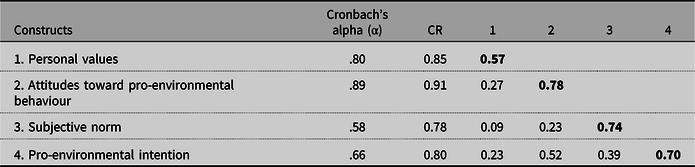
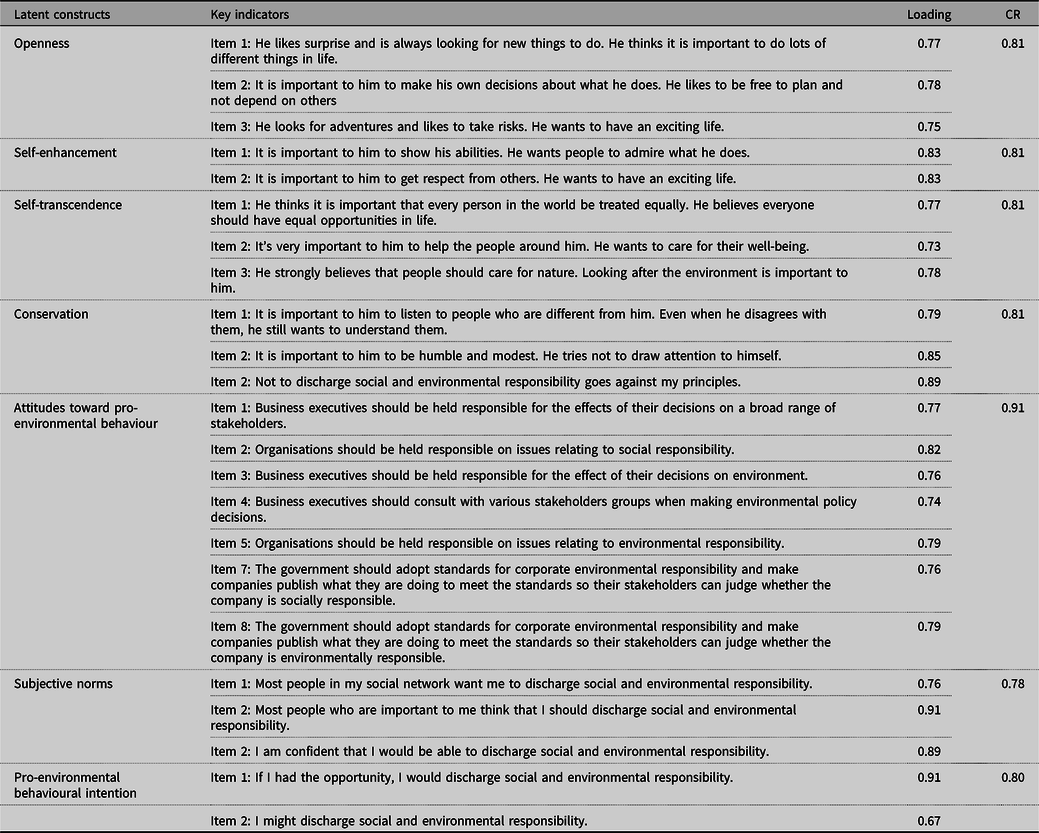
The results of the measurement model, presented in Table 1B, show that all the scale items used to measure the constructs of our model satisfy the requirements of the convergent validity of scales, as specified by Fornell and Larcker (Reference Fornell and Larcker1981). The squared root of average variance extracted (AVE) and composite reliability (CR) for all of the variables are >.50 and >.80 respectively (Table 1A). Consistent with the criteria set out by Fornell and Larcker (Reference Fornell and Larcker1981), Table 1 also exhibits that discriminant validity at the construct level was achieved as the square root of AVE of every construct exceeded the correlation with the rest of the variables.
Composite reliability (CR), squared root of average variance extracted (AVE) a and correlations

Column 1 represents personal values, column 2 represents attitudes toward pro-environmental behaviour, column 3 represents subjective norms, and column 4 represents pro-environmental intention.
a Square root of AVE is on the diagonal, shown in bold type.
Psychometric properties for the first-order construct

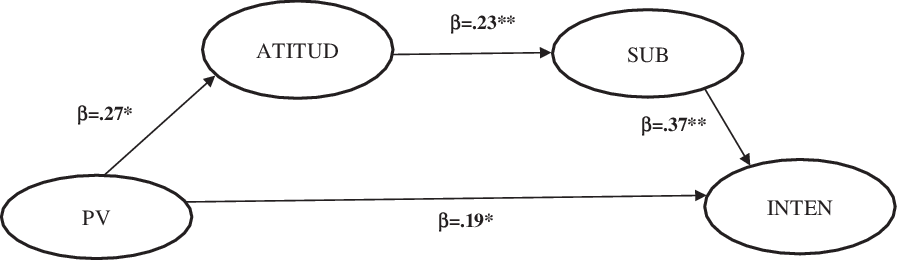
Structural model analysis performed using PLS-SEM, as shown in Figure 2, reveals a significant positive path coefficient for the effects of personal values on the pro-environmental attitudes (β = 0.27, t = 2.67, p < .01) thus supporting our first hypothesis. This implies that future managers’ personal value system has a significant bearing on their pro-environmental attitudes. Similarly, PLS analyses show that future managers’ pro-environmental attitudes are positively associated with their subjective norms (β = 0.23, t = 2.39, p < .01) and subsequently, subjective norms have a significant positive effect on their intention to behave pro-environmentally (β = 0.37, t = 4.04, p < .01); thus, hypotheses 2 and 3 also received support. These results suggest that positive environmental attitudes directly impact subjective norms positively, which in turn influence their intention to behave pro-environmentally.
Results of the structural model. Note: Path significant at *p < .05 and **p < .01. ATITUD, attitudes towards the pro-environmental behaviour, SUB, subjective norms, PV, personal values, INTEN, intention to behave pro-environmentally.

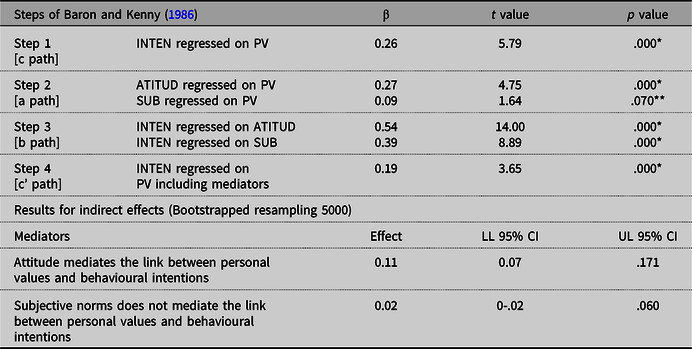
The Process macro developed by Hayes (Reference Hayes2013) used a bootstrapped 95% confidence interval (CI) to examine mediating effects on the proposed links, as shown in Table 2. Results indicate that environmental attitudes mediate the link between personal value and intention because the range (0.069 to 0.171) of the indirect effect for environmental attitudes (effect 0.11) does not include zero, thus reconfirming the mediating effects of environmental attitudes. However, the subjective norms does not mediate the link between personal values and the intention of future managers to behave pro-environmentally because the indirect effect for subjective norms (effect 0.02) ranged between -0.002 to 0.060, which included zero, thus receiving partial support for Hypothesis 4.
Results of mediation analysis (Hypothesis 4)

Note: N = 342. LL, lower limit, UL, upper limit, CI, confidence interval, SE, standard error. Bootstrapped sample size = 5000. Path significant at *p < .01 and **p < .10.
ATITUD, attitudes towards the pro-environmental behaviour, SUB, subjective norms, PV, personal values, INTEN, intention to behave pro-environmentally.
Evaluation of the PLS model
Global fit measures
In line with the guidelines of Chin (Reference Chin, Esposito Vinzi, Chin, Henseler and Wang2010), the value of global goodness of fit (GoF) was estimated for this model to ensure global validation of the PLS path model. GoF for PLS path modelling was estimated by calculating the average R 2 and the geometric mean of the average commonality of all the endogenous variables in a model (Tenenhaus et al., Reference Tenenhaus, Vinzi, Chatelin and Lauro2005). The proposed model provided the GoF value of 0.725, which exceeded the cut-off value of 0.36 for the large-size effect of R 2 (Cohen, Reference Cohen1988). This suggested that the proposed conceptual model has a significant explanatory power in the relationship with baseline value (GoF small = 0.1, GoF medium = 0.25, GoF large = 0.36). Thus, an inference could be drawn that the data fit the theoretical model proposed in this study to a significant extent.
Discussion and conclusion
Our study examined the mechanism of how the personal values, attitudes, and subjective norms of future managers can influence their intention to behave pro-environmentally. We found that managers who are likely to possess the intention to behave pro-environmentally can be predicted by three core attributes: personal values (i.e., how they feel and react ethically towards the environment based on their values); their environmental attitudes (i.e., an evaluation and level of awareness about protecting the environment); and their subjective norms (i.e., the extent to which people comply with the expectations of peers and communities in relation to protecting the environment). Our research tried to understand whether by measuring these three attributes it is possible to ascertain whether a management recruit is likely to behave in a pro-environment way. Our findings — that is, the positive effects of personal values, attitudes and subjective norms of future managers on the intention of behave pro-environmentally — can assist organisations to develop effective recruitment and selection mechanisms to assist businesses to find and hire environmentally responsible managers.
Our study offers a novel contribution to the environmental research by examining whether future managers’ pro-environmental initiatives are not only determined by their values and attitudes, but also by their subjective norms towards pro-environmental behavioural intentions. This finding provides an empirical support to Stern’s (Reference Stern2000) premise and extends the support to the VAB model (Homer & Kahle, Reference Homer and Kahle1988; Stern et al., Reference Stern, Dietz, Abel, Guagnano and Kalof1999). The study extends the existing theoretical frameworks to better predict the intention of future managers’ pro-environmental behaviour by combining VBN and VAB into a complex theoretical model and validates it empirically in the Indian context. Methodologically, the contribution extends beyond validating personal values as a second-order reflective hierarchical model employing the PLS-SEM data analytic technique. It enhances our understanding of component-based structural equation modelling and its application in measuring pro-environmental behavioural intentions.
Consistent with prior research on environmental study by Papagiannakis and Lioukas (Reference Papagiannakis and Lioukas2012) that managers’ values, attitudes, and perceptions have a significant effect on the greening initiatives of organisations, our findings indicate that pro-environmental behavioural intention is significantly impacted by causal factors such as personal values, attitudes, and subjective norms. Therefore, to guide future managers’ pro-environmental behaviour, appropriate intervention strategies could be developed to positively shape these socio-psychological factors. To develop more positive values and attitudes and ethical behaviour toward protecting the environment, the Indian government could initiate to redesign their curriculum on environmental education at school levels. Besides these initiatives, we suggest that the government may transform its large number of traditional public offices into digital offices to promote the philosophy of green organisations and pro-environmental behaviour. Considering India’s current (third largest) environmental pollution status, interventions of policy makers are imminent. Practically, our study has implications for organisational leaders to be ascertained of what personal attributes to be looked into, though not an exhaustive list, among new recruits at the time of hiring future managers who will be responsible for achieving the organisation’s commitment to sustainable environmental outcomes.
The limitations of the study should be taken into account when interpreting the results. First, data were collected for this study from a self-report, cross-sectional survey, using the same instrument at a single-shot, which may raise concerns relating to common method bias (CMB). However, we performed Harman’s single-factor test to address CMB. Second, the dependent variable used in this study was the intention of the pro-environmental behaviour rather than the actual behaviour itself because of the characteristics of subjects (all our respondents are current tertiary management students); therefore, a longitudinal study may offset this limitation in future research by examining the actual pro-environmental behaviour. Longitudinal research design could help scholars to obtain data regarding whether managers are actually behaving pro-environmentally in their management roles. Finally, due to the cross-sectional nature of our data, we were unable to rule out the possible reverse causal effects of subjective norm and attitudes on rest of the constructs in our research model. Future research could endeavour to address this valuable research gap. Despite these inherent limitations, our study offers some novel insights for the organisational leaders as to what personal attributes new recruits should have at least, though not an exhaustive list, at the time of hiring future managers who will be responsible in achieving the organisation’s environmentally sustainable goals.
Asit Bhattacharyya has been an academic for more than 15 years and am currently an Associate Professor of Accounting at Central Queensland University, Sydney. He has previously taught at the University of Newcastle, Monash University (Singapore) and University of New England for over 15 years. His main research interest areas are (1) corporate social and environmental accounting, reporting and accountability; and (2) accounting education and learning. He has received 19 competitive research grants totalling AUD198,507. Asit is the chief investigator of 15 research grants and has led six group projects. He has published 42 peer-reviewed publications, including 21 journal articles, since 2008. He has published 8A ranked journal articles as the sole author or lead author. Some of his work been published in A-ranked journals such as Accounting and Finance, Contemporary Research in Accounting and Economics, and Australasian Journal of Environmental Management and Cleaner Production. He has successfully supervised four higher degree research candidates to completion and is currently guiding three PhD candidates.
Kumar Biswas (PhD, University of Newcastle, Australia) is a lecturer in Management at the Faculty of Business, University of Wollongong, Australia. Dr Biswas has been published in a range of international scholarly journals including International Journal of Human Resource Management, British Accounting Review, Strategic Marketing Journal, Asia-Pacific Journal of Human Resource Management in the area of gender diversity, firm performance, and corporate social responsibility.